Sample Category Title
Currencies: Uncertainty On Global Growth Give Mixed Signals For FX Trading
- Rates: Core bonds steam ahead, but enter overbought conditions
Core bonds rallied ahead yesterday, pushing the European swap rate curve into negative territory for tenors up to 5 years. EMU economic data will probably confirm the recent gloomy picture, adding to ECB Draghi's and Praet's recent case to explore mitigating potential risks from the central bank's negative interest rate policy - Currencies: uncertainty on global growth give mixed signals for FX trading
Swings in the EUR/USD and USD/JPY were modest given sharp moves in interest rate markets. The sharp decline in both US and EMU yields provides some kind of a balance for EUR/USD. Today, the EMU confidence data and German CPI might affect intraday EUR/USD trading. Will soft data push EUR/USD for a test of the 1.1187/1.12 range bottom?
The Sunrise Headlines
- US equity markets lost ground yesterday with losses up to -0.67% (Nasdaq). Asian markets are largely tracking losses on Wall Street with Japanese indices underperforming.
- UK PM May announced that she is willing to step down as Prime Minister if her deal survives a third vote this week and eventually gets ratified. Meanwhile, not one alternative option to May's deal found majority in the UK Parliament.
- ECB chief economist Peter Praet said the Bank will need to have a solid monetary policy case to mitigate the side effects of negative interest rates (‘tiering') on banks, brought up by president Draghi earlier.
- Kansas City Fed chief Esther George said it is appropriate to put monetary policy on hold amid ‘'notable” downside risks. She sees the biggest risk coming from slower growth globally, particularly in China, the euro zone and the UK
- Turkey took unconventional measures to prevent foreign investors of betting against the Turkish lira, days before local elections will test President Erdogan's support. The cost of borrowing liras overnight soared past 1000%.
- US-Sino trade negotiations continue today in Beijing. US officials said talks have moved forward in all areas, incl. forced technology transfers as China has made unprecedented proposals to the US.
- Today's US eco calendar contains this week's jobless claims and pending home sales (Feb). The EC prints economic confidence gauges (Mar) and Germany releases CPI data. ECB's de Guindos and an avalanche of Fed governors speak
Currencies: Uncertainty On Global Growth Give Mixed Signals For FX Trading
Uncerainty on growth indecisive for EUR/USD?
Interest rate markets signalled ever growing market concerns on global growth yesterday. Both US and European yields nosedived. Early in the session, ECB's Draghi confirmed the soft U-turn in policy at the March meeting but also indicated that the ECB is studying measures to mitigate the side-effects negative interest rates, if necessary. The euro temporarily regained a few ticks, but EUR/USD soon returned the mid 1.1250 area. For now, the relative valuation between the euro and the dollar is not the focus for trading as growth (& rate) expectations for both regions are being scaled back. EUR/USD closed at 1.1244 (from 1.1266). The loss in USD/JPY was modest given the decline in core yields and fragile risk sentiment. The pair finished at 110.51 (from 110.64).
This morning, Asian equity indices are mostly drifting lower, with Japan underperforming. Australia and India are outperforming. Yields of most developed markets remain under pressure as doubts on global growth persist. USD/JPY is drifting back south to the low 110 area. EUR/USD regained some ground (currently in the 1.1255 area).
US data (final US Q4 GDP, jobless claims and pending home sales) are probably of second tier importance today. In the EMU the confidence indicators from the EC and German (regional) CPI will be published. In the current context, growth-related indicators (including confidence) are probably more important for global markets/FX trading rather than inflation. That said, the consensus for the German HICP (0.6% M/M and 1.6% Y/Y) is quite high and an undershoot probably won't pass unnoticed with potentially (temporary?) implications for the EUR/USD. At the same time, the growth story will remain the focus for global trading. EUR/USD is drifting further south in the 1.2/1.15 MT trading range. Euro sentiment is fragile, but US data are also turning mixed. For now, we maintain the view that there is no compelling reason for EUR/USD break below the 1.1187/1.12 support in a sustainable way even as we understand downside risks have increased. In this respect, we continue to monitor EUR/JPY which is nearing the key 123.40/80 support area.
Overnight, sterling reversed yesterday's intraday gain against the euro as the UK parliament failed to agree on alternative options to solve the Brexit stalemate. The impasse persists. UK PM May still has the option to bring hear deal back to parliament but it is unsure (unlikely) she will get a majority. So for now, more erratic wait-and-see trading might be on the cards for the major sterling cross rates.
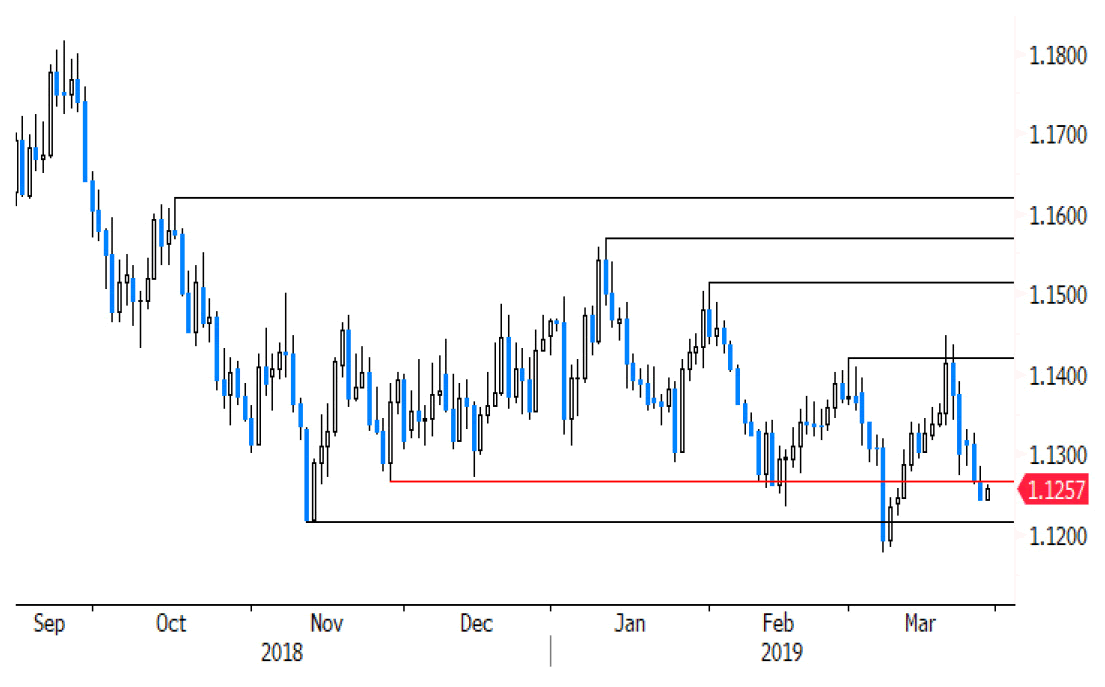
EUR/USD: drifting lower in the 1.12/1.15 range. However, global uncertainty on growth makes a real trend-move not evident
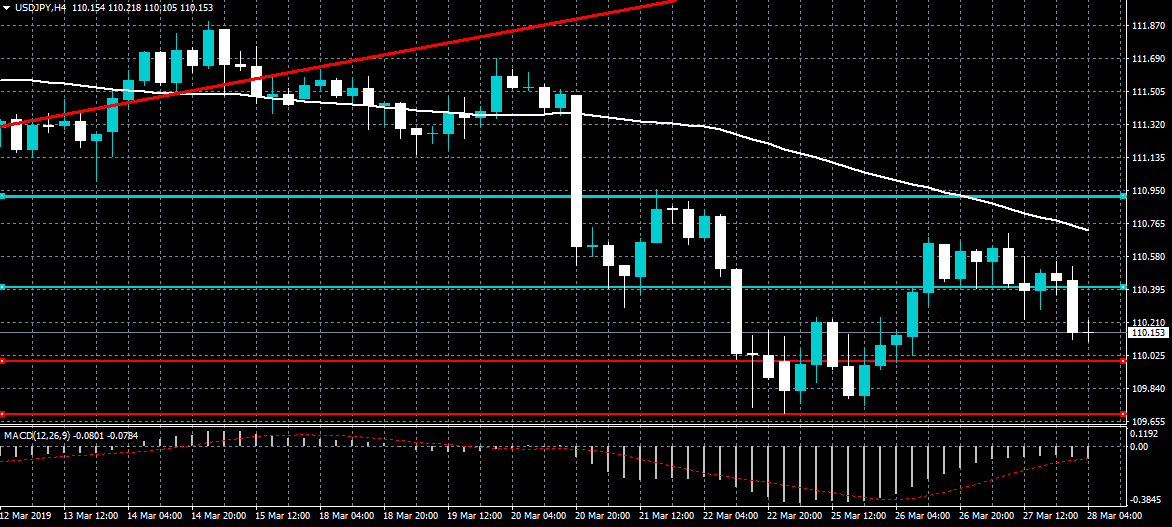
USDJPY Still Bearish Below 110.40
The US dollar is struggling to find direction against the Japanese yen currency on Thursday, as the risk-sensitive pair trades towards the middle of its weekly. The USDJPY pair still retains a weekly bearish bias while trading below 110.40 level, following last weeks strong decline from 111.68 level. Sellers need to convincingly move price under the 110.00 level in order to accelerate selling pressure.
The USDJPY pair is bearish while trading below the 110.40 level, key support is found at the 109.80 and 109.10 levels.
If the USDJPY pair trades above the 110.40 level, buyers may test towards the 110.90 and 111.20 resistance levels.
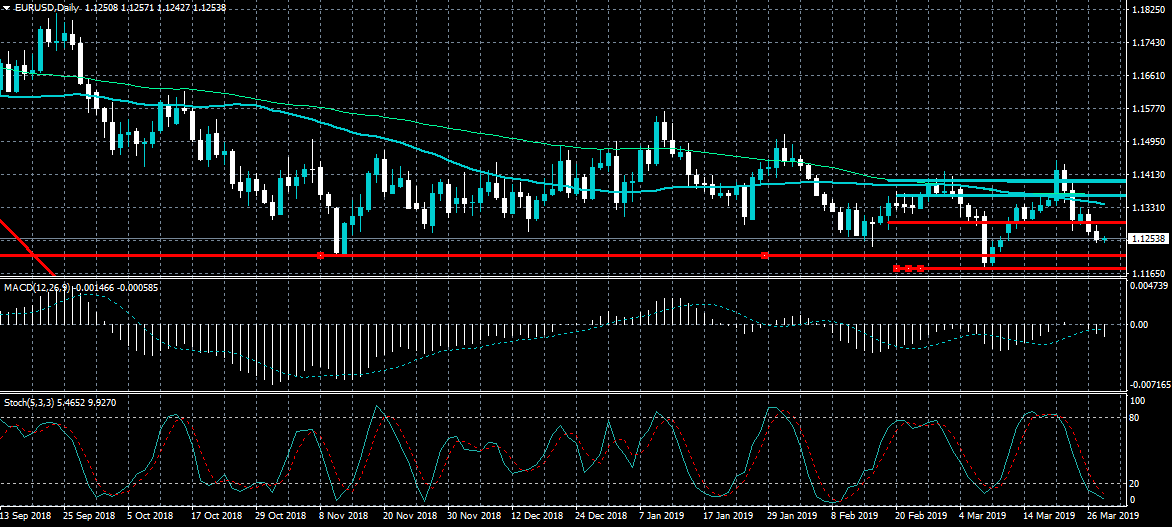
EURUSD 1.1200 In Focus
The euro has fallen to a fresh weekly trading low against the US dollar after buyers failed to move price above the key 1.1290 resistance level. The 1.1200 support level is now coming into focus for the EURUSD pair, with the 1.1170 level critical weekly support below. The daily time frame is showing a bearish head and shoulders pattern with a downside projection of over three-hundred points.
The EURUSD pair bearish while trading below the 1.1290 level, key technical support is found at the 1.1216 and 1.1215 levels.
If the EURUSD pair trades above the 1.1290 level, buyers may test back towards the 1.1315 and 1.1330 resistance levels.
BTCUSD Back To $4,000
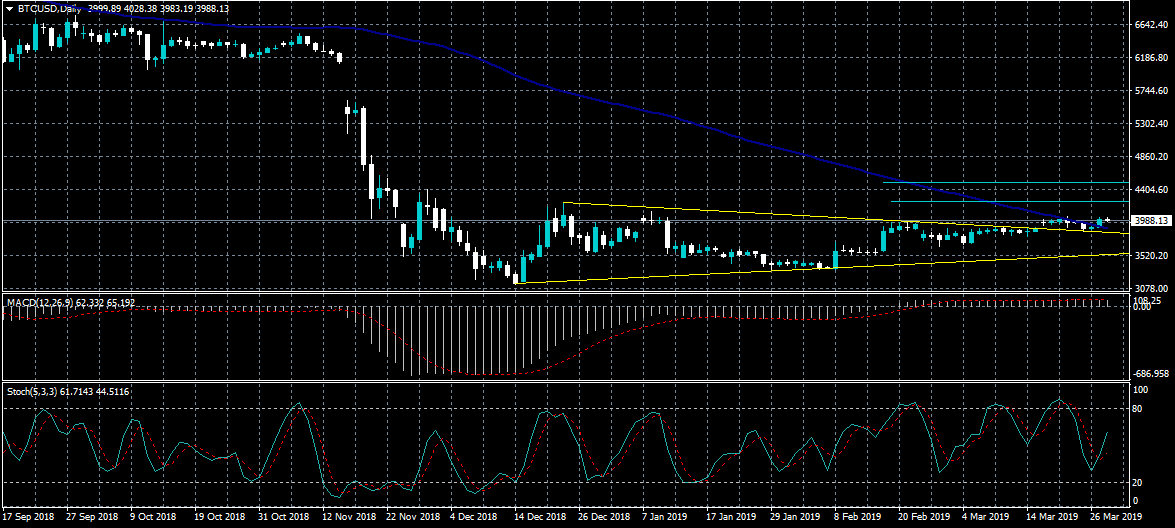
Bitcoin is trading back towards the $4,000 level on Thursday after the number one cryptocurrency found strong technical support from the $3,850 level earlier this week. The daily time frame shows that BTCUSD pair continues to trade above the triangle pattern, with a $400.00 upside target. Bitcoin also closed the session about its 100-day moving average for the first time since July 2018.
The BTCUSD pair is bullish while trading above the $3,850 level, key technical resistance remains at the $4,225 and $4,400 levels.
If the BTCUSD pair trades under the $3,850 level, sellers may test towards the $3,700 and $3,630 support levels.
No Brexit Breakthrough As May Vows To Resign
There was confusion in the United Kingdom as MPs failed to pass any alternative Brexit solutions in Parliament. This came after the Prime Minister announced that she will step down if her Brexit proposal is passed. This measure itself has somewhat backfired as Northern Ireland’s Democratic Unionist Party (DUP) announced that it won’t support her proposal. All this introduces uncertainty for the country because no one really knows what will happen next.
After declining sharply yesterday, the price of crude oil stabilized in the Asian session. The price had dropped after the EIA released inventories data that missed expectations. Data showed that over the past week, crude oil inventories rose by 2.8 million barrels. This was much higher than the expected drawdown of more than 1.1 million barrels. Earlier on, the numbers from the American Petroleum Institute (API), showed that inventories rose by 1.9 million barrels.
Focus will remain in the euro after yesterday’s statement by Mario Draghi. At a conference in Frankfurt, he said that the bank was ready to extend its planned period of raising interest rates. In line with this, traders will focus on key data from the region, such as Spanish CPI, private sector loan growth in the EU, Germany CPI, and sentiment data from the region.
Traders will also focus on the final reading of the US fourth quarter GDP numbers. The numbers are expected to show that the economy expanded by 2.4%, which will be lower than the previously reported 2.6%. The GDP price index is expected to have risen by 1.8%, which is lower than the previous 2.0%, while the core PCE price is expected to remain unchanged at 1.70%.
EUR/USD
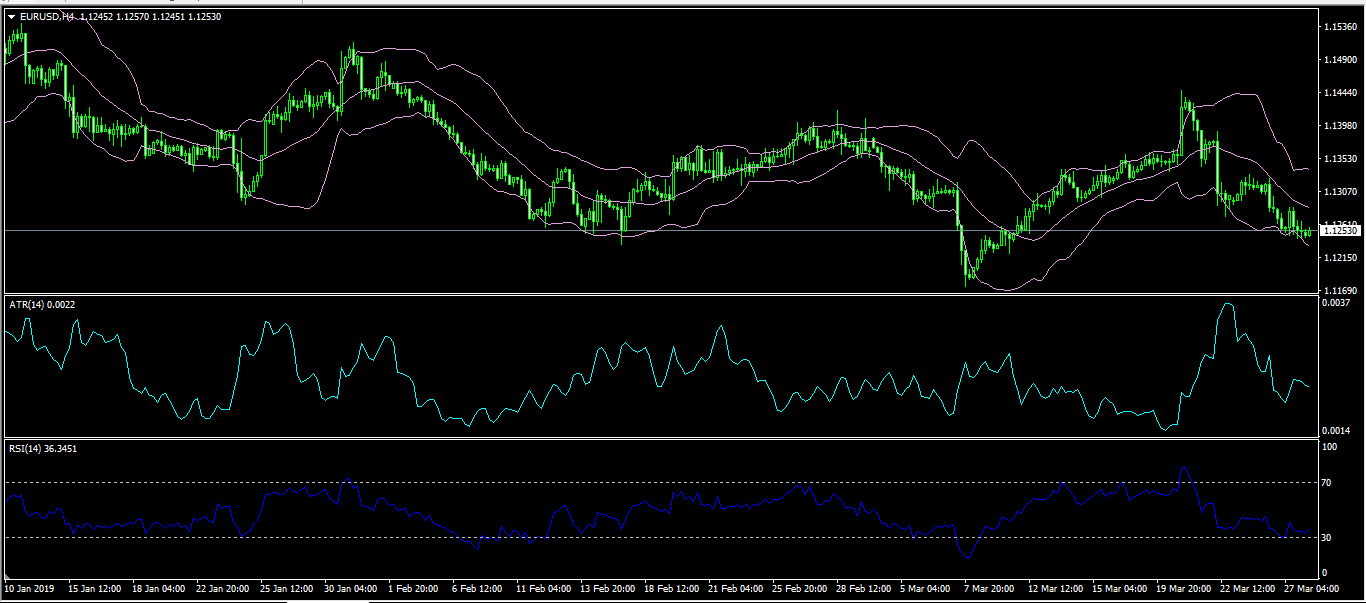
The EUR/USD pair continued to decline, reaching a low of 1.1240 today. This is the lowest it has been this week and is sharply lower than the week’s high of 1.1447. On the four-hour chart, this price is along the lower line of the Bollinger Bands while the ATR has dropped sharply from the day’s high. The RSI has moved almost close to the oversold level. There is a likelihood that the downward momentum will continue as the pair tries to test the important support of the 1.1210 level.
GBP/USD
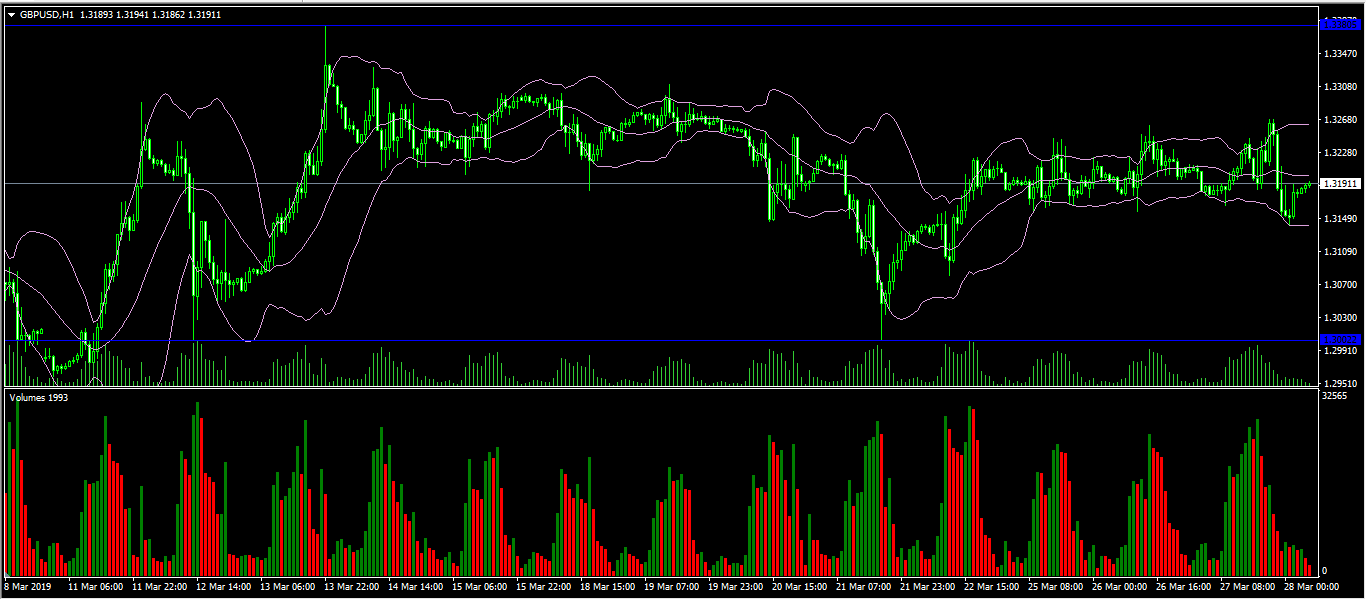
The GBP/USD pair continued trading within a narrow range as traders waited for a way forward on Brexit. The volumes have dropped as evidenced by the volumes indicators below. This is because no one really knows what will happen and how it will affect the country. The pair is now trading at 1.3193, which is slightly lower than yesterday’s high of 1.3270. It is also along the middle line of the Bollinger Bands.
XBR/USD
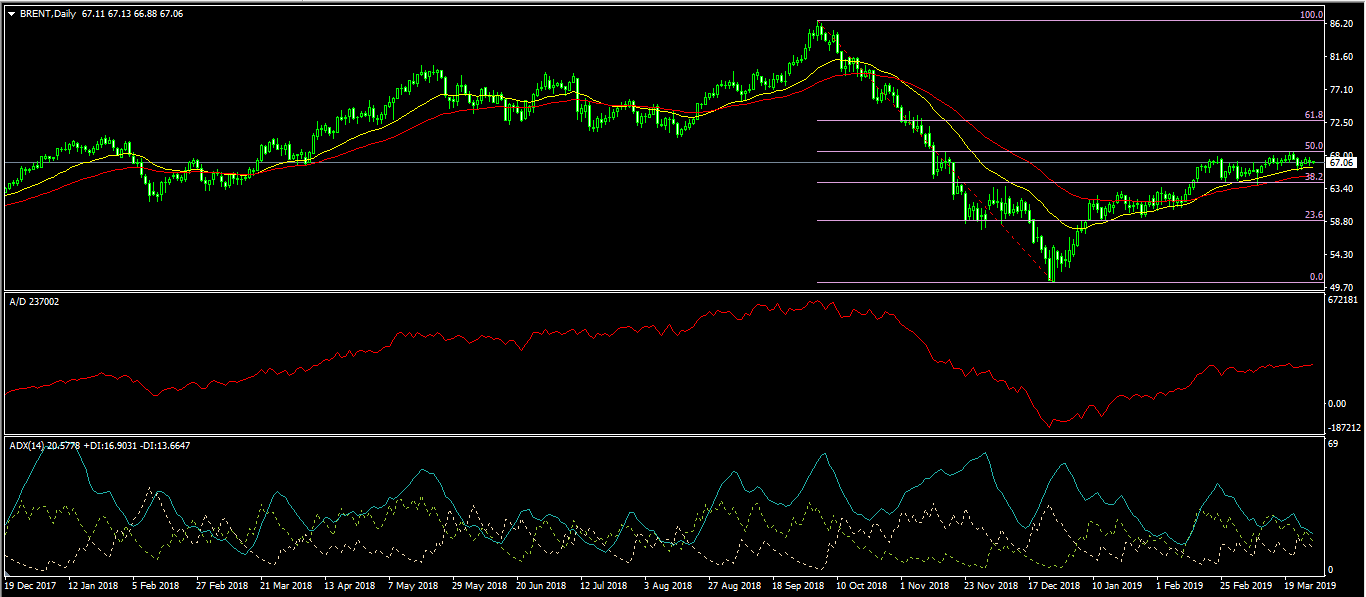
After dropping yesterday, the XBR/USD pair stabilized at the current price of 67. On the daily chart, the pair has been on an upward trajectory this year. It has risen from a low of 50 and reached a high of 68.50. This price is slightly above the 21-day and 50-day moving averages. The Accumulation and Distribution indicator has continued to move up while ADX has moved slightly lower. It is also close to the 50% Fibonacci Retracement level. There is a likelihood that the pair could continue the upward trend.
Elliott Wave View: Nasdaq (NQ_F) Showing Signs Of Rolling Over
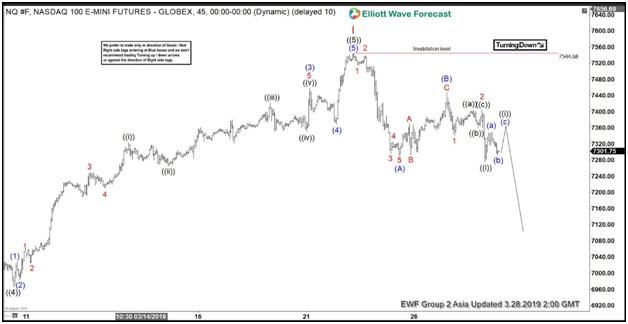
Nasdaq (NQ_F) is showing a preliminary sign that the cycle from December 26, 2018 low has ended. After forming the high at 7544.68 on March 22, 2019, the Index has started to turn lower. The first leg of the decline looks impulsive and ended wave (A) at 7290. Then after a bounce in wave (B) to 7447.50, the Index has turned lower and broken below wave (A) again, suggesting further extension lower is likely. If the Index really ended cycle from Dec 26, 2018 low, this means at minimum it should do a larger pullback in 3, 7, or 11 swing to correct that cycle.
The entire rally from Dec 26, 2018 low ended at 7544.68. Down from there, the first leg of the decline ended wave (A) at 7290. Internal of wave (A) is unfolding as an Impulse Elliott Wave structure. Wave 1 of (A) ended at 7514.5 and wave 2 of (A) ended at 7538.50. Wave 3 of (A) shows an extension and ended at 7294.75, wave 4 of (A) ended at 7325.50, and wave 5 of (A) ended at 7290. Index then bounced within wave (B) as a zigzag Elliott Wave structure. Wave A of (B) ended at 7371.50, wave B of (B) ended at 7293.50, and wave C of (B) ended at 7447.50. Wave (C) lower looks to have started as the Index already broke below wave (A) at 7290.
We are counting the wave (C) as an impulse with a nest. As far as the bounce stays below 7544.68, expect the Index to extend lower.
1 Hour Nasdaq (NQ_F) Elliott Wave Chart
Equities Trade Generally Lower In Asia
General Trend:
- Chinese financial, property and energy shares are among the early decliners
- Telecom services index out performs in China; ZTE rises over 10% post earnings
- China bank earnings in focus: China Construction Bank declines post earnings
- ICBC is expected to report results later today, Bank of China and Agbank seen on Friday
- China property developer Vanke rises over 2%, announced stock offering to repay foreign debt
- Financial, Energy and Resources companies rise in Australia
- Marine/Transportation and Securities Brokers under perform in Japan
- Japanese automakers trade broadly lower
- Japan’s Gunma Bank declines over 7% after profit warning
- Yen gains amid lower bond yields and equity declines
- Kiwi (NZD) rebounds from the initial losses seen after weaker business confidence data
- Indonesia plays down contagion concerns related to Turkey
- US/China due to hold trade talks in China on March 28-29th (Thursday-Friday)
- Upcoming end of Japan’s fiscal year in focus (March 31st)
Headlines/Economic Data
Australia/New Zealand
- ASX 200 opened slightly lower
- (NZ) New Zealand 8-month Budget Surplus NZ$2.26B, NZ$347M wider than forecasted
- (NZ) New Zealand Fin Min Robertson: economy is well placed to weather a global downturn
- (NZ) New Zealand Mar ANZ Activity Outlook: 6.3 v 10.5 prior (lowest level since August); Business Confidence: -38.0 v -30.9 prior; Inflation expectations 2.05% v 2.06% prior
- (AU) Australia Feb Job Vacancies: 1.4% v 1.6% prior
- (NZ) New Zealand sells NZ$200M v NZ$200M indicated in April 2025 bonds, avg yield 1.4456% v 1.9118% prior, bid to cover 2.4x v 4.4x prior
Japan
- Nikkei 225 opened -0.9%
- (JP) Japan Investors Weekly Net Buying of Foreign Bonds: ¥1.8T v -¥595.3B prior; Foreign Buying of Japan Stocks: -¥1.1T v -¥1.59T prior
- (JP) Japan Chief Cabinet Sec Suga: Nissan/Renault merger needs to satisfy all parties
- 8697.JP Confirms basic agreement to merge with TOCOM, no terms disclosed, expected to close in Sept
- (JP) Japan MoF sells ¥2.1T v ¥2.1T indicated in 0.10% (0.10% prior) 2-yr JGBs, avg yield: -0.175% v -0.167% prior, bid to cover 5.28x v 6.08x prior
- (JP) Japan Fin Min Aso: Fiscal year budget aimed at smoothing demand around the upcoming sales tax increase (after the close yesterday)
Korea
- Kospi opened -0.7%
- (KR) US Sec State Pompeo: Time we see real action by North Korea on nuclear talks
- (KR) US Commander in S. Korea, Army Gen. Robert Abrams, North Korea's nuclear and missile activities have been "inconsistent" with its pledge to denuclearize, the commander of US forces in South Korea - Yonhap
- 000660.KR To invest KRW1.2T for new chip manufacturing complex, targeting to start construction from 2022
China/Hong Kong
- Hang Seng opened -0.2%; Shanghai Composite opened -0.4%
- (CN) Trump Administration Official: China tariffs will be key sticking point and will be resolved as part of the deal; no specific time frame set for trade deal, talks could conclude anytime from April to June
- (CN) China Premier Li: Have not adopted loose monetary policy to stimulate growth, policies are paying off, Economic indicators steady in first 2 months of the year, market expectations are improving; Cannot rule out some fluctuation in quarterly economic growth this year, enough policy tools to deal with any slowdowns
- (CN) China Feb Swift Global Payments CNY: 1.9% v 2.2% prior
- (CN) Pork stocks in Shandong said to decline amid impact of African swine fever outbreak - HK Press
- 2202.HK Announces placement of 263M H shares at HK$29.68/shr for HK$7.8B
- 2628.HK Reports FY18 (CNY) Net 11.4B v 32.3B y/y, Total Rev 627.4B v 643.4B y/y
- (CN) China PBoC Open Market Operation (OMO): Skips for 7th consecutive session; Net drains CNY0B v CNY0B prior
- (CN) China PBoC sets yuan reference rate: 6.7263 v 6.7141 prior (weakest setting since Feb 20th)
- (US) US President Trump: We're going to make 'very good' deal with China - US media interview
- (CN) China General Administration of Customs: To cut import VAT tax by CNY225B ($33.5B) in 2019, effective April 1 - Xinhua
North America
- (US) Fed's George (hawk, voter): Support Fed outlook to be patient on policy in a good place for it, current outlook for inflation looks benign; sees 2019 GDP ~2.0%
- (US) DOE CRUDE: +2.8M V -0.5ME; GASOLINE: -2.9M V -2.5ME; DISTILLATE: -2.1M V -1ME
Europe
- (UK) Parliament approves legislation to delay date of Brexit (as expected); Vote count was 441 to 105
- (UK) UK Parliament indicative votes: no majority reached on any indicative votes (as expected); MP Letwin proposes parliament should vote again on Monday to reconsider these matters
- (UK) PM May told Tory MPs that she'll hand over leadership once Brexit is delivered; does not offer a specific timetable for stepping down
- (UK) Democratic Unionist Party (DUP) leader Foster says she regrets DUP cannot support PM May's Brexit deal while it poses a threat to the integrity of the UK – press
- (UK) Tory Lawmaker Rees-Moog: If PM May brings Brexit deal to vote, will support DUP
Levels as of 1:20 ET
- Nikkei 225, -1.6%, ASX 200 +0.7%, Hang Seng -0.1%; Shanghai Composite -0.3%; Kospi -0.7%
- Equity Futures: S&P500 -0.3%; Nasdaq100 -0.3%, Dax -0.3%; FTSE100 +0.3%
- EUR 1.1259-1.1243 ; JPY 110.53-110.11 ; AUD 0.7100-0.7073 ;NZD 0.6823-0.6780
- Gold -0.1% at $1,316/oz; Crude Oil -0.3% at $59.23/brl; Copper flat at $2.862/lb
Potential ECB Tiering System Opens For A Rate Cut
Market movers today
Today, we have a hectic day ahead of us. Markets will continue to digest the potential ECB tiering system as well as the aftermath of yesterday's Brexit votes. On the data from, we get preliminary German inflation data for March. We see scope for a small rise to 1.8% y/y (from 1.7%) on the back of the recent increasing oil prices.
In the US, we get February housing market numbers and 2018 Q4 private consumption print. Recently, the housing market has started to show a bit weakness especially home sales numbers, which we expect is driven by higher mortgage rates. However, housing market data are quite volatile. The day also brings a number of Fed speeches, but these are going to fade into the background for some time, as the Fed has clearly signalled it is on hold for the rest of the year, see FOMC review: Fed done hiking rates .
Overnight, Japanese industrial production and retail sales are released.
This morning we published our Nordic Outlook for March 2019 (see page 2).
Selected market news
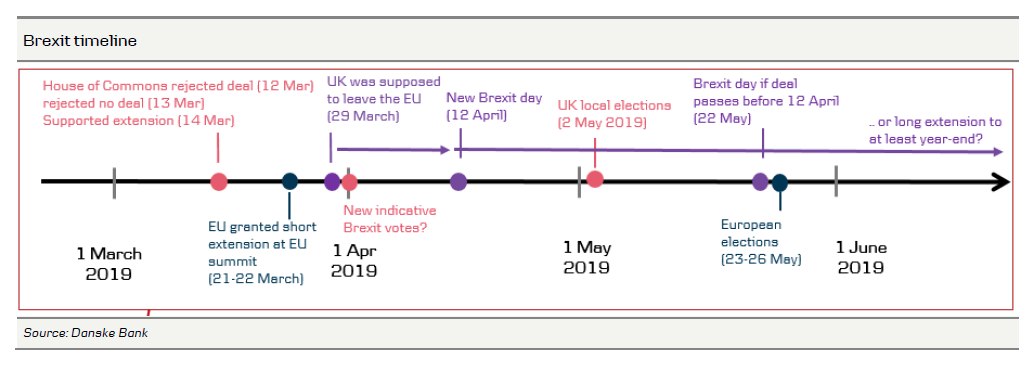
In yesterday's indicative votes, the House of Commons rejected all eight Brexit options. Readers of yesterday's Danske Daily will know this was not a big surprise given the House of Commons had rejected most of the options in one way or another in previous votes. Next step is likely more indicative votes on Monday 1 April, where members of parliament may vote again but on fewer options. Within the Conservative Party more Brexiteers are now backing May's deal after she promised to resign soon after Brexit has been delivered, but unfortunately for May, the supporting party DUP from Northern Ireland remains against. May's deal will likely be dead on arrival if brought forward for a vote tomorrow. With just about two weeks to go, uncertainty is high. In our view, there seems to be four possible ways forward now: May's deal, no deal, second EU referendum or May's deal including a permanent customs union. Risk of snap election might have gone up, though.
Yesterday's ECB watchers conference shook markets . The comments from Mario Draghi, Peter Praet and Luis de Guindos on attention to banks' profitability fuelled with a Reuters ECB-sourced story sent yields lower. Their comments predominantly focused on the weak banking sector profitability and what ECB could do to mitigate this. However, it was not until the Reuters story around 14:00 CET that the significant market move took place. This morning, Praet said that ECB staff are looking into the possibility of a tiering system should a monetary policy reason warrant that. That also means that all options to mitigate the side effects from the negative deposit rate are on the table. However, we expect next step from ECB is announcing the TLTRO3 modalities, which could be made very favourable, should they find the need before a tiering system were to be announced.
Brexit Monitor: No No No No No No No No
No support for any version of Brexit
While a lot seems to happen every day, we still do not know what is going to happen with less than two and a half weeks until the new Brexit day on 12 April. None of the Brexit options has won support from a majority in the House of Commons. The main headache is that there is no majority for anything in the House of Commons and Brexit is an example of a Condorcet Paradox, as preferences are cyclic (X beats Y, Y beats Z but Z beats X). The problem with the indicative votes is that the House of Commons had voted many of the proposals down already in one way or another, so it was difficult to see why the results should be different. The situation is bizarre but the population is just as divided as the politicians, see Sky Data (twitter).
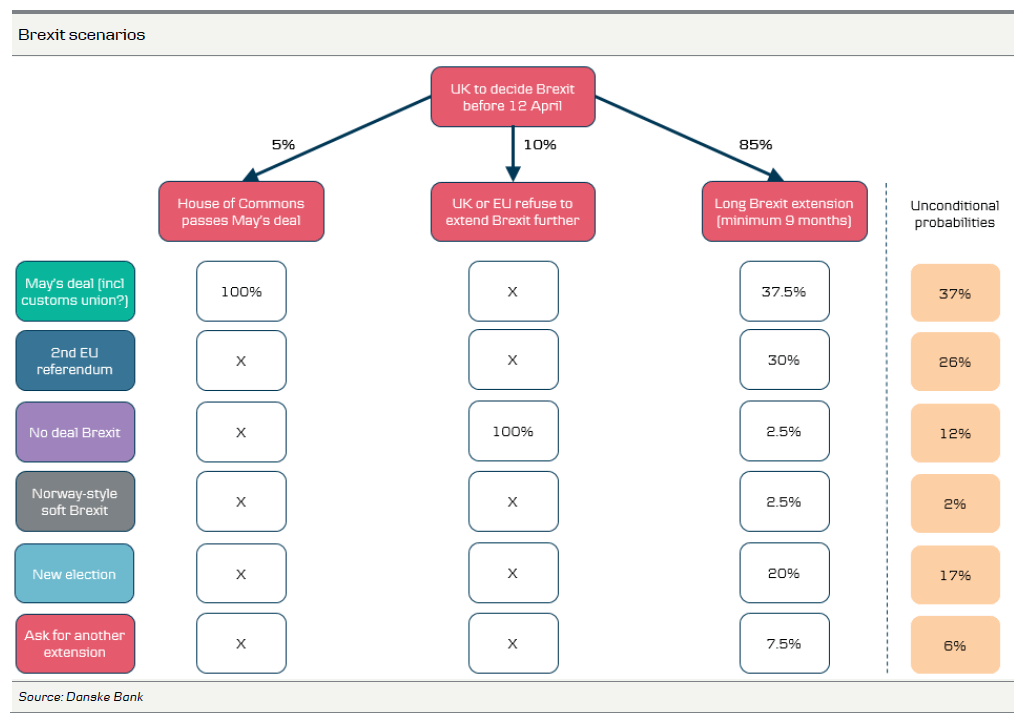
Still, we have learned something and perhaps it was not a total waste of time. In our view, there seem to be four possible ways forward now: May’s deal, no deal, a second referendum or May’s deal including a permanent customs union. See our game tree on the next page. Next step is likely a new round of indicative votes but on fewer options on Monday 1 April.
A large majority voted against no deal and at least a small majority in the Commons will likely support a long extension if necessary (the problem here is whether the EU27 leaders will accept a long extension if the UK has no idea what for? We think yes but uncertainty remains, as the decision has to be taken unanimously). The very soft Brexit options (joining the EEA or Norway plus customs union) were voted down, so they are out of the question (in line with our long-held view – why not stay instead then?). The two options with most votes in favour (but without a majority) were a second referendum and a permanent customs union (268 and 264 votes in favour, respectively, versus 242 for May’s deal last time). Neither SNP nor LibDems voted in favour of a customs union, which they might do at a later stage. Also a few Labour voted against or abstained. The problem is, however, that it may trigger a general election, as it would make it impossible for the UK to strike its own trade deals.
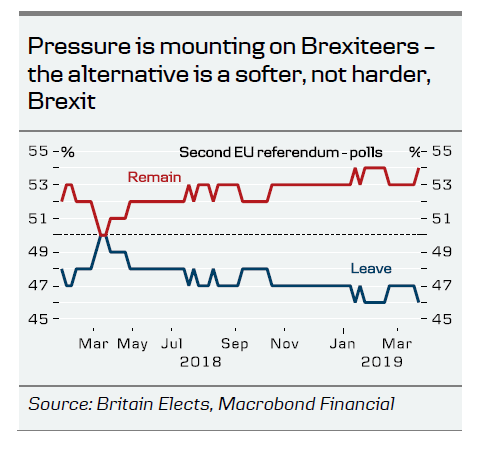
Over the past couple of weeks, it has become increasingly clear that the Brexiteers are afraid of losing Brexit altogether and are looking for a reason to support May’s deal. This is in line with our long-held view that if the pressure is big enough, many Brexiteers would surrender, as they start realising Brexit is unlikely to get cleaner/harder but only softer. The price was May’s promise to resign soon, which came earlier than we had thought. The problem is that DUP soon afterwards stated that it still cannot support the deal, so it is likely dead on arrival, if it is brought forward for another vote soon. Even if, May would still need support from some Labour MPs, as there are still die-hard Brexiteers and remainers inside the Conservative Party who are going to vote against her deal no matter what. If May’s deal passes without DUP’s support, DUP may pull its support for the government, which could trigger a snap election.
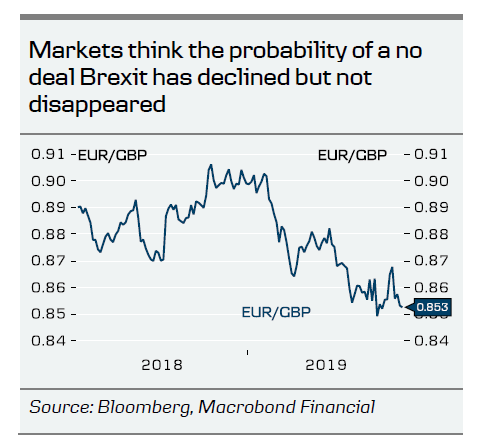
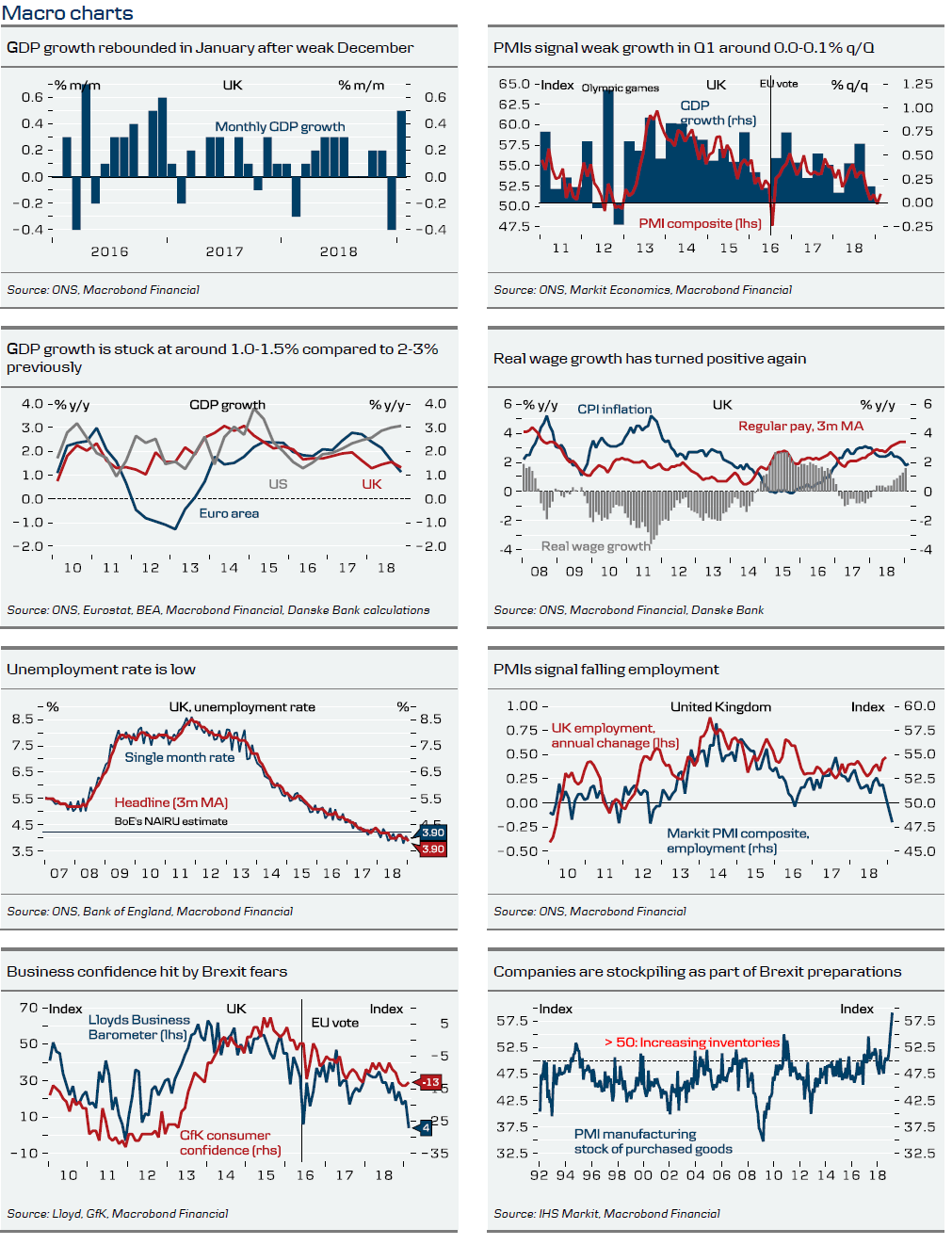
In the current situation, we believe EUR/GBP is stuck in the 0.85-0.87 range. If we get more clarification that we are heading for May’s deal or her deal including a customs union, we expect a move lower to around 0.83. In case of a no-deal Brexit by accident, we still expect EUR/GBP to move towards 1.00. A snap election would also send EUR/GBP higher, at least back to the old 0.87-0.90 range.
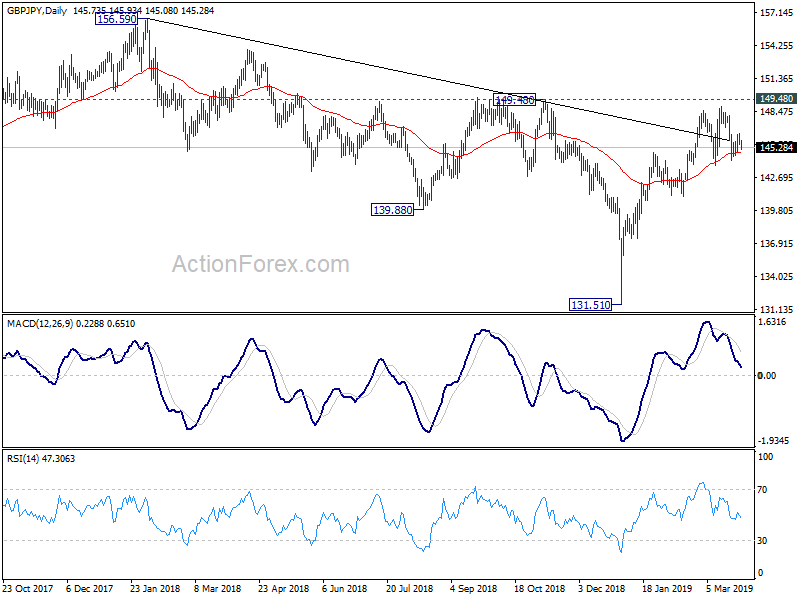
GBP/JPY Daily Outlook
Daily Pivots: (S1) 145.37; (P) 145.94; (R1) 146.35; More...
Intraday bias in GBP/JPY remains neutral at this point. On the downside, decisive break of 143.72 support will indicate near term reversal, after rejection by 149.48 key resistance. In that case, intraday bias will be turned to the downside for 141.00 support first. On the upside, decisive break of 149.48 key resistance will carry larger bullish implication and target 156.58 resistance next.
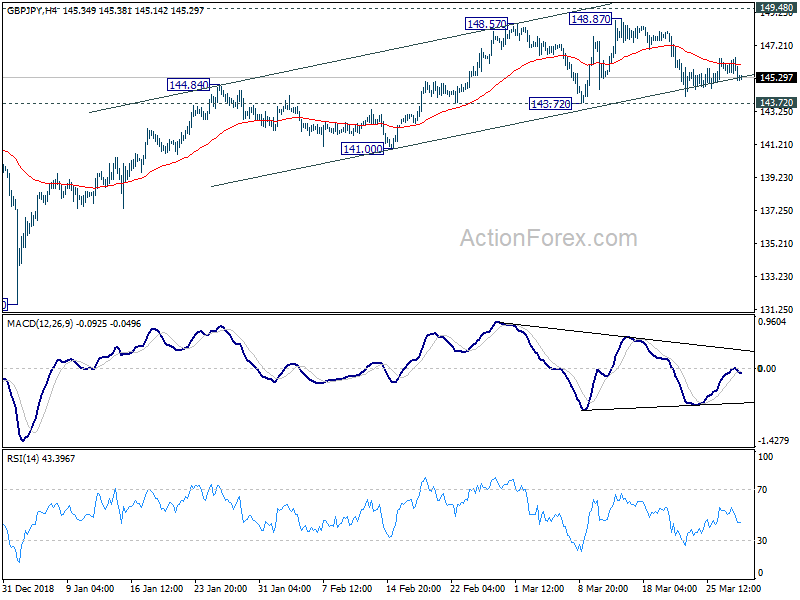
In the bigger picture, focus is now staying on 149.98 key resistance. Decisive break there should confirm that that medium term fall from 156.59 (2018 high) has completed at 131.51 already. Rise from 131.51 is then seen as the third leg of the corrective pattern from 122.36 (2016 low). GBP/JPY should then target 156.59 and above. However, rejection by 149.98 will retain medium term bearishness and could extend the fall from 156.59 through 131.51 to 122.36.