

Sample Category Title
Unprecedented progress made on forced technology transfer as new round of US-China trade talks start
US Trade Representative Robert Lighthizer and Treasury Secretary Steven Mnuchin arrive in Beijing today for a new round of trade negotiations Ahead of that Reuters reported that there were unprecedented progress on a core issue in technology transfers.
Citing unnamed officials, it's said that China's proposals went further than in the past, which created hope for an eventual trade deal. The discussions on forced technology transfer covered areas that were not touched before, in terms of both scope and specifics.
Meanwhile, the texts of agreements moved forward in all areas even though they're not where the US want to be. The areas are believed to include forced technology transfer and cyber theft, intellectual property rights, services, currency, agriculture and non-tariff barriers to trade.
Another official noted that some of the tariffs imposed since last year will stay even after a deal is made. And this will be an important issue to resolve, as an important part of the final deal. But for now, there is no clear timeline for completing the deal yet. And negotiations could drag on till June.
Fed George: More time and evidence needed to separate signal from noise
Kansas City Fed President Esther George said in a speech that weakness in Q1 growth could reflect "transitory factors" such as the government shutdown, financial volatility, an unusually harsh winter, and heightened policy uncertainty. But over the medium term, the "generally positive outlook" of the US economy has "several prominent downside risks".
The biggest risks come from slower growth abroad, "particularly in China, the euro area, and the United Kingdom." Together with waning fiscal and monetary stimulus, they "represent a stronger headwind" then George's baseline forecast. Right now, she noted that "data are noisy" and more time and evidence are needed to "separate the signal from the noise".
All Brexit alternatives voted down while May gains support for her deal
The UK Parliaments once again expressed what they don't want about Brexit, without saying what they want. With April 12 cliff-edge looming, there is still no sign of a breakthrough.
All eight Brexit alternatives were defeated in the UK House of Commons on Wednesday. That means no majority emerged support any options including no deal, a referendum, a customs union and a Norway-style deal. The closet results was for a "permanent and comprehensive UK-wide customs union with the EU", which was voted down by 264 to 272. The call for confirmatory referendum was voted down by 268 to 295.
Meanwhile, Prime Minister Theresa May offered to resign if her Brexit deal gets approved by the parliament in a third meaningful vote. She told the Conservative 1922 Committee that "I know there is a desire for a new approach – and new leadership – in the second phase of the Brexit negotiations, and I won't stand in the way of that." She added "I am prepared to leave this job earlier than I intended in order to do what is right for our country and our party."
With May's offer, more hard-line Brexiteers turned to support her deal. A key consideration is that the change in leadership for the most important of next phase in negotiations. Trade negotiations and futures relationship will be on the line, which Brexiteers would be eager to get a firmer control on. However, it remains uncertain how May could get enough votes as Northern Ireland's DUP repeated its objection to the deal.
Gold Price Uptrend Facing Many Hurdles
Key Highlights
- Gold price started a solid upward move from the $1,282 support against the US Dollar.
- There is a significant ascending channel formed with support at $1,308 on the 4-hours chart of XAU/USD.
- The US Trade Balance in Jan 2019 posted a deficit of $-51.1B, better than the $-57.0B forecast.
- The US Gross Domestic Product in Q4 2018 is likely to grow 2.4%, down from the last 2.6%.
Gold Price Technical Analysis
After trading towards the $1,282 level, gold price started a strong upward move against the US Dollar. The price traded above the $1,295 and $1,300 resistance levels to move into an uptrend.
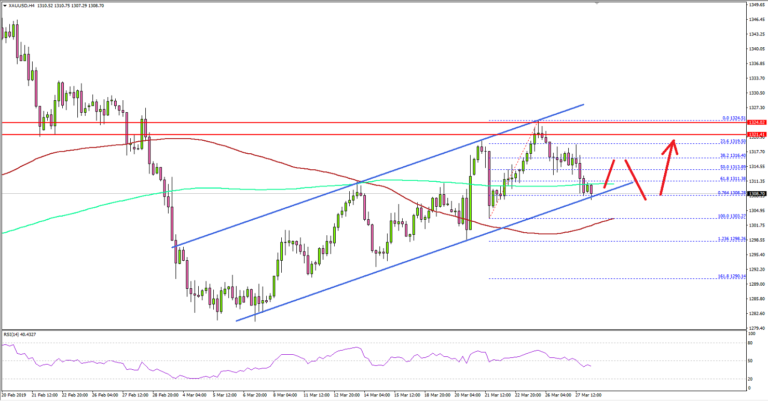
The 4-hour chart of XAU/USD indicates that the price settled above the $1,300 pivot level, plus the 100 simple moving average (red, 4-hours) and the 200 simple moving average (green, 4-hours).
There were multiple swing highs and lows, but the price followed a bullish path and traded above the $1,320 resistance. However, the price faced a strong hurdle near the $1,325 level, which was a support earlier.
A high was formed near $1,324 and later the price corrected below the 50% Fib retracement level of the last wave from the $1,303 low $1,324 high.
However, there are many supports on the downside near the $1,305 level and the 200 simple moving average (green, 4-hours). Besides, there is a significant ascending channel formed with support at $1,308 on the 4-hours chart of XAU/USD.
If there is a break and close below the channel support, the price could extend losses towards the $1,303 swing low and the 100 simple moving average (red, 4-hours). On the flip side, a convincing break above the $1,325 resistance will most likely set the pace for more gains towards the $1,330 and $1,334 levels.
Fundamentally, the US Trade Balance report for Jan 2019 was released by the Bureau of Economic Analysis and the U.S. Census Bureau. The market was looking for a trade deficit of around $-57.0B.
Though, the result was better than the forecast as there was a trade deficit of $-51.1B, improved from the last revised reading of $-59.9B. The report added that:
The January decrease in the goods and services deficit reflected a decrease in the goods deficit of $8.2 billion to $73.3 billion and an increase in the services surplus of $0.5 billion to $22.1 billion.
Overall, gold price remains supported for more gains as long as it stays above $1,303. Looking at major pairs, EUR/USD declined heavily recently below 1.1300 and GBP/USD seems to be consolidating below the 1.3280 resistance.
Economic Releases to Watch Today
- Euro Zone Business Climate Index March 2019 – Forecast 0.66, versus 0.69 previous.
- US Initial Jobless Claims – Forecast 225K, versus 221K previous.
- US Gross Domestic Product Q4 2018 – Forecast 2.4% versus previous 2.6%.
- German CPI for March 2019 (Prelim) (YoY) – Forecast +1.6%, versus +1.5% previous.
- German CPI for March 2019 (Prelim) (MoM) – Forecast +0.6%, versus +0.4% previous.
The Turkish Delight That Bites
The Turkish delight that bites
Yesterday's Turkish travails are hinting at the pressure emerging markets may face later in the year as the global economy slows. The cost of borrowing Turkish Lira (TRY) for offshore parties rose to over 1000% as the Turkish central bank squeezed TRY sellers to defend the currency ahead of municipal elections this weekend. Aside from wild gyrations in the currency, the overflow also spilled into other emerging markets such as South Africa, Brazil and Mexico. The Mexican central bank rate decision will be closely watched tomorrow night.
If a global slowdown proceeds as the bond market is hinting, emerging markets could be caught in an age-old conundrum. The rotation into defensive developed-market government bonds leads to the selling of their currencies. Logically you would hike rates to support the currency, but if your economy is slowing down, that's the last thing anyone wants to do. The best hope, of course, is that the slowdown is shallow, but this box canyon of monetary policy is a story we will see much more of as 2019 progresses.
The rotation into developed-market bonds continued unabated overnight with strong demand in US Treasury auction and the German Bundesbank selling bunds at negative interest rates. Little old New Zealand at the bottom of the world played its part on the global stage as well, with the Reserve Bank of New Zealand (RBNZ) announcing its next move in interest rates would likely be down. Like many other central banks before it this year, the standard mantra was rolled out: the economy is doing well, but we're nervous about our trade partners globally.
Trade talks between the US and China resume in Beijing today and are taking on ever more importance. An agreement between both parties is the key macro-economic event for H1 2019 and will dictate whether we have a slow and low global pullback or if the day of reckoning arrives much sooner and more aggressively. Any news emerging over the weekend will make for a frisky Wellington session on Monday morning.
Wall Street finally bowed to the bond market overnight with the S&P down 0.45%, the Dow Jones down 0.13% and the Nasdaq down 0.63%. Lyft's IPO is likely to provide only a temporary respite. The US dollar continues to perform well, especially against emerging market currencies bolstered by bond inflows.
A quiet data day in Asia leads to the US GDP and German CPI this evening, with the slowdown sharks sniffing for blood in the water.
The day wouldn't be complete without something on this week's Brexit soap opera. In overnight news Prime Minister May offered to resign in the summer, but only if Parliament votes for her deal this week. The problem is the Speaker of the House has said a new vote is not possible unless the substance of the agreement changes significantly. It hasn't by the way. After its tantrums earlier in the week, Parliament finally got to vote on its eight alternative Brexit proposals (by the way, no-one asked the Europeans) however it failed to achieve a majority on any of them. The Brexit status quo remains unchanged, while the UK Parliament's excavation of the foundations of democratic leadership continues unabated.
FX
The US dollar continues to hold its own against the other major currencies as sovereign debt inflows created the equivalent of a nil-all draw on ranges and volatility. The RBNZ's dovish about-face saw the New Zealand dollar (NZD) collapse by 1.6% to 0.6800 in overnight trading. The Australian dollar was dragged lower, falling by 0.7% to 0.7080 as the currency wolves look for the Reserve Bank of Australia to move to the dove-side next week.
Emerging markets were another story, feeling the heat of the rotation into developed-market sovereign debt. That theme could play out today in Asia as well, with regional currencies possibly on the back foot. Any excessive volatility is likely to be met with central bank “smoothing” action, however.
Equities
In the bigger picture, the fall on Wall Street was modest, especially given stocks have enjoyed a positive week so far. Asia-Pacific bourses will likely start the day under pressure, but as the trade talks get underway in Beijing, Asia is probably going to be more circumspect.
Regional markets will be particularly vulnerable to headlines and rumours emerging from the talks: good or bad.
Oil
Oil fell overnight as US official inventories rose unexpectedly. Brent crude fell a modest 0.2% to USD 67.85 a barrel with WTI suffering more, dropping 0.9% to USD59.50. The move lower has a corrective look about it rather than a sea change in investor attitudes. Like equities, trading in Asia will be slow as the trade talks get underway.
Gold
Gold fell 0.4% to USD1310.00 an ounce as the dollar remained strong and haven flows moved into government bonds instead of precious metals. Gold's time may well come if global recession worries increase, but for now, investors' eyes are elsewhere.
Eco Data 3/28/19
[php_everywhere instance="1"]
British Pound Snoozes through Brexit Fireworks
GBP/USD continues to drift this week. In Wednesday’s North American trade, the pair is trading at 1.3207, up 0.01% on the day. On the release front, British CBI Realized Sales shocked with a reading of -18, compared to the forecast of 5 points. There are no major U.S. indicators out of the United States. On Thursday, the U.S. releases Final GDP and unemployment claims.
The Brexit saga continues at a fever pitch, with new developments on almost daily basis. Remarkably, the pound continues to show little movement this week. On Monday, lawmakers voted to take control of the Brexit process away from the government. Parliament is holding votes on various non-binding alternatives. These could range from a hard Brexit to holding a second referendum. The EU extended the March 29 Brexit deadline last week. If May’s withdrawal deal fails to pass for a third time, the U.K. would leave the EU on April 12 without an agreement. If the deal is approved, the deadline would be extended until May 22. Today’s parliamentary proceedings are detailed at the link below:
After a sharply dovish Fed meeting last week, risk apprehension has risen considerably. This could mean headwinds for the Canadian dollar, a minor currency. The Fed said that it had no plans to raise rates before 2019, and also lowered its growth forecast for 2019 to 2.1%, down from 2.3% in December. On Friday, the spread between 3-month and 10-year Treasury notes turned negative, signifying an inverted yield curve. All eyes will be on U.S. Final GDP, which will be released on Thursday and should be treated as a market-mover.
Gold losing upside momentum, corrective recovery ending soon
Gold's recovery from 1280.85 lost momentum after hitting 1324.49 and retreats notably today. The structure of the recovery suggests that it's merely a corrective move. And it could be ending soon.
Hence, even in case of another rise through 1324.49, upside should be limited below 1346.71 high to bring another decline. On the downside break of 1303.25 minor support will bring deeper fall to retest 1280.85 support.
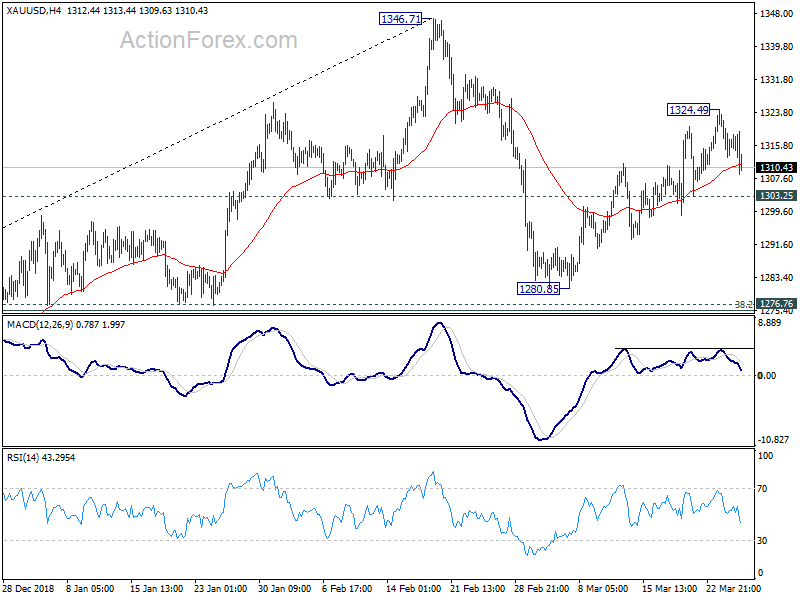
In the bigger picture, it's getting more likely that 1346.71 is a medium term bottom on bearish divergence in daily MACD. Channel support will likely be taken out on next decline, which will put 1276.76 cluster support (38.1% retracement of 1160.17 to 1346.17 at 1275.45) back into focus.
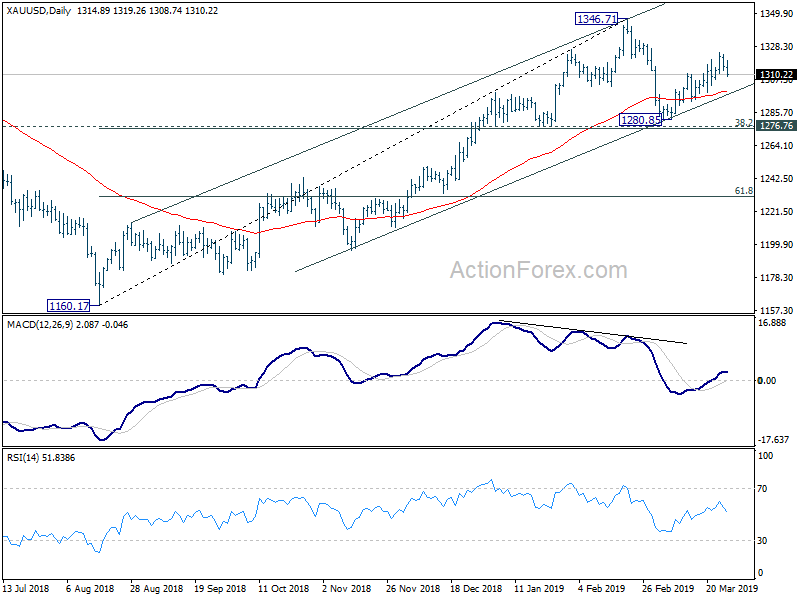
Decisive break of 1275.45/1276.76 should confirm completion of whole rise from 1160.17. In that case, gold should have started another falling leg inside the long term range pattern. Deeper fall should then be seen back towards 61.8% retracement at 1234.42 and below.
But still, as mentioned above, break of 1303.25 support is needed to indicate near term reversal first.
UK Bercow firms up on no repeat votes ruling, eight Brexit amendments chosen
The prospect of another meaningful vote for UK Prime Minister Theresa May's Brexit deal is in doubt. House of Commons speaker John Bercow firmed up his "no repeat votes" ruling today. In short, he restated his ruling that a new vote will only be allowed if there is substantial changes. Additional, he pledged to block any attempt by the government to use a procedural rule change to get round such decision.
The prospect of another meaningful vote for UK Prime Minister Theresa May's Brexit deal is in doubt. House of Commons speaker John Bercow firmed up his "no repeat votes" ruling today. In short, he restated his ruling that a new vote will only be allowed if there is substantial changes. Additional, he pledged to block any attempt by the government to use a procedural rule change to get round such decision.
Meanwhile, eight amendments are chosen by Bercow to be put to indicative votes today. They include
- Conservative John Baron's No deal
- Conservative Nick Boles's Common Market 2.0
- Conservative George Eustice's Efta and EEA
- Conservative Ken Clarke's - Customs union
- Labour's - Customs union and alignment with single market
- SNP Joanna Cherry's - Revocation to avoid no deal
- Dame Margaret Beckett's - Confirmatory public vote
- Marcus Fysh's - Contingent preferential arrangements
Here is Bercow's statement on no repeat rules:
"In the course of answering questions following her statement [on Monday], the prime minister accepted this constraint, saying that "I am very clear about the strictures that Mr Speaker gave when he made his statement last week and, were we to bring forward a further motion to this house, we would of course ensure that it met the requirements he made."
I understand that the government may be thinking of bringing meaningful vote three before the house either tomorrow or even on Friday, if the house opts to sit that day.
Therefore, in order that there should be no misunderstanding, I wish to make clear that I do expect the government to meet the test of change. They should not seek to circumvent my ruling by means of tabling either a notwithstanding motion or a tabling motion. The table office has been instructed that no such motions will be accepted.
I very much look forward, colleagues, to today's debate and votes which give the house the chance to start the process of positively indicating what it wants."
Japanese Yen Dips, Consumer Data Ahead
USD/JPY has edged higher on Wednesday. In the North American session, the pair is trading at 110.32, down 0.28% on the day. On the release front, there are no Japanese indicators. In the U.S., the trade deficit narrowed to $51.1 billion, better than expected. On Thursday, the U.S. releases Final GDP and unemployment claims. Japan will publish Tokyo Core CPI and retail sales.
The nasty trade war between the U.S. and China has hit Japan hard, as both countries are major trading partners with Japan. The weaker global climate has resulted in weaker demand for Japanese exports, and there are growing concerns that the fragile economy could be heading for a recession. Earlier in the week, the BoJ released the summary of opinions from the March policy meeting. Policymakers debated whether to ramp up stimulus in order to boost growth. Inflation levels remain sluggish, and the scheduled tax hike in October, which is certain weigh on growth, poses another headache for policymakers.
Japan’s economy remains fragile, with exports down due to the global trade war. BoJ policymakers remain nervous, and the summary of opinions from the March policy meeting indicated that members debated whether to ramp up stimulus in order to boost the economy. There are concerns that the economy could be heading towards a recession, given the weak global climate and the tax hike scheduled for October.