Sample Category Title
Canada’s Trade Deficit Narrows in January, Driven by Increases in Crude Oil Prices
Canada posted a $4.25 billion trade deficit in January, down from an upwardly revised $4.82 billion deficit in December (previously reported as $4.59 billion). This was higher than consensus estimates for a $3.55 billion deficit. Exports advanced 2.9% to $47.6 billion, lifted mainly by increases in the value of energy product exports (up 14%). Meanwhile, imports were up 1.5%, driven largely by imports of aircraft (+52.6%).
Excluding energy products, exports were up 1.2%. Still, exports of metal and non-metallic mineral products were also strong (+11.9%), driven by higher exports of refined gold to the U.K. and gold transfers to Hong Kong (according to Statistics Canada). Providing some offset was a large decline in farm, fishing, and intermediate food products (-8.1%) due to lower exports of soybeans to China.
After accounting for price changes, the picture was somewhat less impressive. Export volumes were up 0.9%, but were outweighed by a 1.5% increase in import volumes.
Canada's merchandise trade surplus with the U.S. narrowed to $1.6 billion. Its merchandise trade deficit with the rest of the world narrowed to $5.8 billion.
Key Implications
This wasn't a great start to 2019, but it could have been worse. The negative revisions to December's report and the modest export uptick (relative to imports) were disappointing, and will marginally negatively impact our GDP tracking. Nevertheless, it is important to note that a large driver of the increases in import volumes is transitory and likely to reverse.
The rebound in exports (the first since July), and specifically in energy prices, which weighed heavily on trade in the last few months, is encouraging. Looking ahead, exports should get some support from a weak loonie and ongoing demand growth south of the border, but a weakening global growth picture suggests that growth will remain contained to the low single-digits.
US 500 Index Retains Positive Bias; SMAs are Ready for ‘Golden Cross’
The US 500 stock index eased below the five-month high of 2863 but retains bullish action as it holds above the 50- and 200-day simple moving averages (SMAs) which are ready to post a ‘golden cross’. Looking at momentum oscillators in the daily chart though, they suggest upside movements may be on the cards. The RSI is above its neutral 50 line, while the stochastic reversed higher before touching the oversold zone.
In case of further gains, the next resistance would likely be faced around the 2863 barrier, taken from the inside swing bottom on September 7 and from the latest highs. A jump above this region would increase positive sentiment until the all-time high of 2940, returning the medium-term outlook back to bullish.
On the other side, if the price loses momentum and retreats below the moving averages it could find support at the 23.6% Fibonacci retracement level of the upleg from 2332 to 2863, near 2735. Dropping below this area could take prices towards the immediate support of 2723 and then could open the door for the 2675 barrier.
In the medium-term, the index is trying to switch the neutral mode to a more bullish one and this would happen if prices surpass the all-time high set in September 2018.
Canada’s Trade Deficit Narrowed in January as Oil Prices Rebounded
- Canada’s trade deficit narrowed to $4.2 billion in January from a record $4.8 billion shortfall in December.
- Lower crude oil prices were behind Canada’s wider trade deficit toward the end of last year. A decent rebound in global and Western Canadian oil prices in January helped boost nominal exports.
- Crude oil export volumes were close to flat in January despite the Alberta government’s mandatory oil production curtailments taking effect in the month. That is consistent with a drawdown in elevated crude inventories.
- Non-energy exports also posted a solid gain in January after slowing toward the end of last year.
- A jump in aircraft imports limited the improvement in the trade deficit. Imports of machinery and equipment were also higher—a positive sign for business investment.
Today’s trade report provides a bit of encouragement. It’s a good reminder that the energy sector’s near-term difficulties, which weighed on growth toward the end of last year, should be largely transitory. Prices have rebounded this year and output should follow as mandatory curtailments are reduced. We also saw some green shoots in non-energy exports, which disappointed toward the end of last year. But let’s not get ahead of ourselves. Canadian exporters are swimming against the tide of a softening global industrial sector, slower global trade growth, and a US manufacturing sector whose growth appears to have peaked last year.
Canadian Dollar Edges Lower, Trade Deficit Widens
The Canadian dollar has edged higher in Wednesday trade. Currently, the pair is trading at 1.3415, up 0.25%. On the release front, Canada posted a larger trade deficit than expected. The deficit increased to C$4.2 billion, higher than the forecast of C$3.5 billion. There are no major U.S. events on the calendar. On Thursday, the U.S. releases Final GDP and unemployment claims.
Canadian bonds showed an inverted yield curve on Monday, after U.S. Treasuries showed the same pattern on Friday. This has spooked investors, as the inverted yield curve is a sign of a recession. The Bank of Canada is already in a dovish stance and could follow the Fed and freeze rates for the rest of the year. If the economic slowdown continues, policymakers may have to consider a rate cut in order to stimulate the economy.
After a sharply dovish Fed meeting last week, risk apprehension has risen considerably. This could mean headwinds for the Canadian dollar, a minor currency. The Fed said that it had no plans to raise rates before 2019, and also lowered its growth forecast for 2019 to 2.1%, down from 2.3% in December. On Friday, the spread between 3-month and 10-year Treasury notes turned negative, signifying an inverted yield curve. All eyes will be on U.S. Final GDP, which will be released on Thursday. If GDP misses the forecast of 2.4%, investors could get jittery and dump Canadian dollars in favor of safe-haven assets.
Into US session: Sterling higher as consolidation continues, global yields pressured again
Entering into US session, New Zealand and Australian Dollar remain the weakest ones undoubtedly. NZD is sold off sharply after RBNZ indicated that next move is a cut. AUD follows as RBNZ's dovish shift somewhat solidifies that case for RBA cuts too.
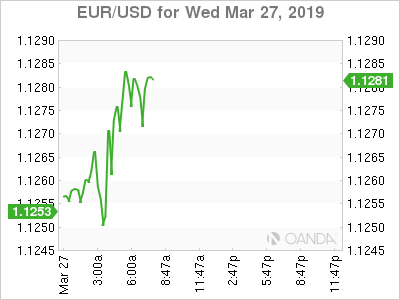
On the other hand, Sterling is the strongest one today. But again, the Pound is stuck in recently established range against Dollar, Euro and Yen. There is no sign of breakout and current rise is nothing more than part of consolidations. The indicative votes on Brexit alternatives will be carried out in the House of Commons today. And debate is due to start by 1500GMT. We'll see what alternative Brexit path could gain majority in the Parliament.
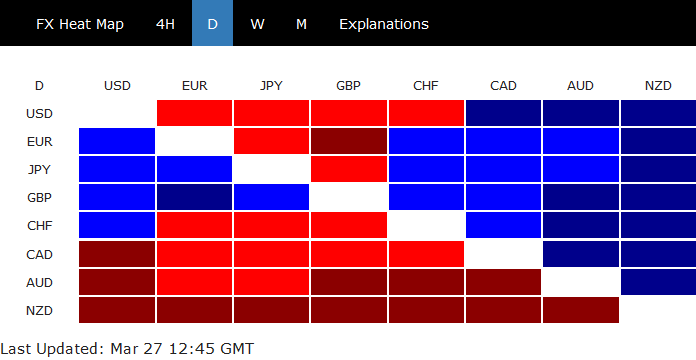
On development to note is that global treasury yields are back under pressure. Japan 10-year JGB yield closed down -0.0018 at -0.067. German 10-year yield is down -0.0192 at -0.033. US 10-year yield hits as low as 2.379 and is now struggling to climb back above even 2.4 handle. The development might give Yen a little helping hand.
In Europe:
- FTSE is down -0.06%.
- DAX is up 0.35%.
- CAC is up 0.42%. German 10-year yield is down -0.0192 at -0.033.
Earlier in Asia:
- Nikkei dropped -0.23%.
- Hong Kong HSI rose 0.56%.
- China Shanghai SSE rose 0.85%, back above 3000 handle.
- Singapore Strait Times dropped -0.06%.
- Japan 10-year JGB yield dropped -0.0018 at -0.067.
EU Tusk: Cannot betray increasing majority of British people who want to stay in EU
European Commission President Jean-Claude Juncker and European Council President Donald Tusk talked Brexit to the European Parliament day.
Tusk said the voices of British people whole wanted to stay in the EU shouldn't be ignored. And he urged the Parliament to be open to a longer Article 50 extension. He said, "I said that we should be open to a long extension if the UK wishes to rethink its Brexit strategy, which would of course mean the UK's participation in the European parliament elections. And then there were voices saying that this would be harmful or inconvenient to some of you.... Let me be clear: such thinking is unacceptable. You cannot betray the 6 million people who signed the petition to revoke article 50, the 1 million people who marched for a people's vote, or the increasing majority of people who want to remain in the European Union."
Juncker said it's unclear how Brexit would unfold. And, "I told some of you that if you compare Great Britain to a sphinx then the sphinx would seem to me an open book. We will see in the course of this week how this book will speak,"
Also, chief Brexit negotiator told lawmakers: "In all scenarios, the Good Friday agreement will continue to apply. The United Kingdom will remain a core guarantor of that agreement and is expected to uphold it in spirit and in letter:" And, "the Commission is ready to make additional resources available to Ireland, technical and financial to address any additional challenges."
ECB de Guindos: Eurozone slowdown raises financial stability risks
Vice President Luis de Guindos warned that weak Eurozone growth is raising financial stability risks due to weakening bank profits and rising concern over sovereign debt sustainability.
De Guindos said in a conference in Frankfurt that "in an environment where cyclical factors may exert further downward pressure on bank profitability, banks would need to step up their efforts to overcome structural challenges".
Also, "such measures may include cost reductions – including lower staffing costs and streamlining of branch networks, enhanced digitalization – implying initial, one-off large-scale investments, revenue diversification and the reduction of the stock of non-performing loans in the six countries where levels are still high."
UK retail sales volume dropped most in 17 months as Brexit uncertainty escalates
UK CBI Reported Sales dropped sharply to -18 in March, down from 0 and missed expectation of 5. That is, 28% of respondents reported that sales volumes were up on a year ago in March, while 46% said they were down, giving a balance of -18%. It's the fastest contraction in 17 months, marked four-month run in which sales have not grown.
Anna Leach, CBI head of economic intelligence, said: "Even accounting for Easter timing, the High Street's poor run continues. While real wage growth is picking up, consumer confidence has been hit by escalating uncertainty over Brexit and concern over the economy's future. The pain currently being felt on the High Street is yet another reason why it is so vitally important politicians agree a deal in Parliament that is acceptable to the EU and protects our economy. No-deal must be averted at all costs."
DAX Under Pressure After Draghi’s Sour Speech
The DAX index has posted losses on Wednesday, after starting the week with two winning sessions. Currently, the DAX is trading at 11,389, down 0.26%. In economic news, there are no major eurozone or German numbers. ECB Mario Draghi spoke at an ECB event in Frankfurt. On Thursday, Germany releases CPI.
ECB President Mario Draghi sounded pessimistic when talking about the eurozone economy on Wednesday. Draghi acknowledged that the economic slowdown which started in the second half of 2018 had extended into 2019. Draghi blamed uncertainty in the global economy, adding that “risks to the outlook remained tilted to the downside”. With weak conditions in the eurozone and Germany, the ECB is expected to remain dovish in stance.
German confidence indicators were soft in March, raising concerns about the health of the biggest economy in the eurozone. The week started with consumer climate, which dropped to 10.4 points, after two successive readings of 10.8 points. With the eurozone mired in an economic slowdown and German numbers pointing to weaker growth, it's not surprising that the German consumer has become less optimistic. On Tuesday, German business confidence improved slightly in March, with a reading of 99.6 points. The markets have been accustomed to releases above the 100-level, and the February reading of 98.5 was the weakest since November 2014. The survey noted that any improvement was confined to domestic sectors, such as construction and retail services. The ongoing global trade war has dampened demand for German exports, especially vehicles and auto parts. This has weighed on automaker shares on the DAX.
Risk Aversion Drives Bonds And Safe-Havens Higher
Steady news from across the globe painted a downbeat outlook for global growth. In New Zealand, the RBNZ downgraded their forward guidance from neutral to dovish. ECB’s Draghi noted that risks to the euro zone’s economic outlook remain tilted to the downside. Most investors are targeting China to rebound, but a Bloomberg surveys now show that expectations are for the PBOC to ease less aggressively this year, with the earliest cut next quarter and two more in the second half. Currencies struggled for direction, with the exception of the kiwi, which sold off immediately following the bank’s dovish statement.
- EUR – Draghi keeps dovish hand
- Brexit – MPs to vote on Brexit options
- NZD – RBNZ joins the dove camp
- Oil – Inventory data eyed
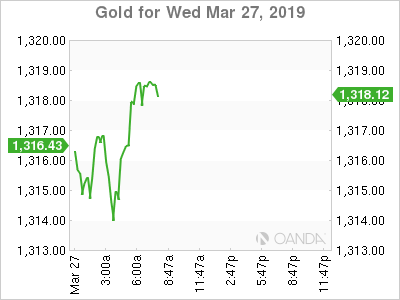
- Gold – rises on safe-haven flows
EUR
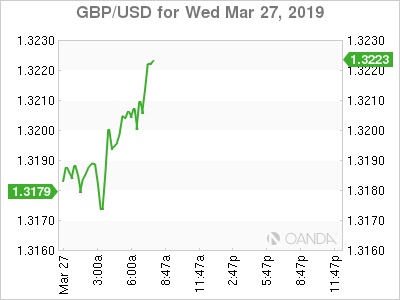
The euro was little changed following mixed confidence data and dovish reiterations from ECB Chief Draghi and Chief Economist Praet. Confidence data slightly improved in France and declined in Italy, not necessarily pointing to a strong rebound for the Eurozone. Draghi reiterated risks to the euro zone’s economic outlook remain tilted to the downside and a pickup in inflation is delayed, warranting their current accommodative stance that includes negative rates. Praet noted that the natural interest rate to be structurally low for a while.
The German bund fell another 4 basis points, deeper into negative territory at -0.061%. Germany’s bund auction had a negative yield for the first since 2016.
Brexit
Today Parliament has control of the Brexit process and they will try to outline how they want to move forward. Motions will be voted on that will focus on the Brexit process and what relationship the UK wants to have with the EU. We still can’t rule out most potential outcomes, but the general consensus remains, we will not see a no-deal Brexit. May’s deal is gaining some momentum, and that may end up being the best option for Conservative hardliners. It appears that she could win over more votes if she promises to step down for a successful meaningful third vote.
NZD
The RBNZ dovish statement should not have come as a surprise. GDP matched its slowest growth since 2015 and inflation was just below their midpoint target. The second sentence of the interest rate statement summed up everything perfectly, “weaker global economic outlook and reduced momentum in domestic spending, the more likely direction of our next OCR move is down.”
The kiwi fell the most in seven weeks following the decision, down 1.6% to the greenback. The RBNZ fell in line with their peers adopting a very dovish stance.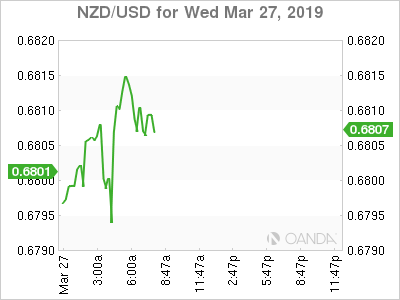
Oil
West Texas Intermediate crude continues to respect the $60 a barrel level ahead of the EIA’s weekly crude inventory data. Last week’s EIA release saw a surprising near 10-million-barrel draw, current expectations are for this week’s reading is for a near 1 million drop in crude supplies. Late yesterday, the American Petroleum Institute report showed stockpiles climbed 1.93 million barrels.
Oil prices were earlier supported by Russian energy minister Novak’s comments that Russia is poised to reach their production cut pledge of 228,000 barrels per day. OPEC and friends are also considering having a meeting of Joint Ministerial Monitoring Committee in Jeddah, Saudi Arabia on May 19th. While the production cuts have worked to stabilize prices, we could see Russia become less supportive to keep the cuts for an extended time.
One developing story for US shale oil is the growing risks of contamination as the complex infrastructure has oil travel from Texas to North Dakota and eventually all the way to Asia. Two refiners for South Korea have rejected some cargoes over contamination. Further quality issues could see further costs to updating pipelines and that could cause major disruptions.
Oil is likely to be unable to break out much higher unless US production has some headwinds. Current expectations are for US crude exports to rise to a record 5 million barrels by late 2020, a near 70% jump from current levels.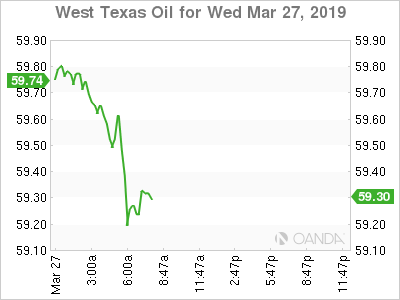
Gold
Gold prices are slightly higher, but still showing no signs of breaking out. Falling Treasury yields, and a gloomier outlook have provided a bid for the precious metal, but gains are capped on optimism for the US and China to reach a trade deal in the next couple of months and high expectations the UK will not have to deal with a hard exit.