

Sample Category Title
Sunset Market Commentary
Markets
Global core bonds are gaining ground today in a high-volume and choppy trading day. Risks sentiment was mixed overnight and continued to be fragile across Europe. Core bonds opened with an upward bias. Draghi said that an accommodative policy stance is still necessary but added that the ECB is ready to soften the impact of negative interest rates if eroding bank profitability would prevent stimulus reaching the economy. This might mean introducing a tiered deposit rate system which could all else equal also increase the bar for an eventual rate hike. The German Treasury sold a well-bid 10-yr bond against -0.05% (vs 0.12% at the prior auction), a negative rate yield for the first time since 2016, giving Bunds some extra tailwind. Core bonds lost some steam afterwards but spurred higher again ahead of the WS opening. The German yield curve is edging lower with changes up to -7 bps (5-yr). US Treasuries behaved similar to German Bunds and set a first peak before noon before temporarily paring gains after Dallas Fed chief Kaplan said it is too early for the Fed to consider possible rate cuts. The move didn’t persist as US Treasuries edged higher again. The US yield curve bull flattens with changes varying between -4.2 bps (30-yr) and -7.2 bps (2-yr). Peripheral credit spreads are widening with Italy (+7 bps) and Greece (+4 bps) underperforming.
Trading on global markets was some kind of erratic today. Interest rates initially jumped up and down as investors tried to cope with comments of several ECB policy makers, including president Draghi. He confirmed the ECB’s soft U-turn at the March meeting as risks to growth have clearly tilted to the downside. At the same time, he indicated the ECB might consider measures to mitigate the side-effects of negative interest rates, if necessary. The euro temporary gained some ground, but the rebound soon ran into resistance. USD strength prevailed as US traders joined the action. Maybe markets interpreted the ECB considering measures to reduce the side-effects of negative interest rates as an indication that (EU) rates might stay low for longer. Whatever, the euro at least didn’t profit from the ECB comments. EUR/USD is changing hands in the 1.1260 area. USD/JPY initially declined as core yields declined further, but reversed the losses later (currently 110.50 area).
Sterling traders again kept a close eye at the developing Brexit story. The sequence and the outcome of all kinds of potential Brexit events is still highly unlikely. However, at least for now there is no (additional) negative impact on sterling. EUR/GBP declined to the low 0.85 area. Cable is trading north of 1.32. The UK Parliament will vote on several indicative amendments this evening on how to proceed with Brexit. At the same time, PM May is said to still consider a third vote on her deal later this week as some Brexiteers recently indicated they might favour the May proposal rather than face the risk of a soft Brexit or no Brexit at all. In any case visibility for GBP-traders remains close to non-existent.
News Headlines
The ECB is ready to mitigate the side effects of negative rates if they start harming the transmission of monetary policy, ECB president Draghi said. He didn’t elaborate on details but the ECB could be inspired by the BoJ’s or SnB’s tiered system where only deposits surpassing a certain threshold are charged with a negative rate.
The US trade deficit shrank from -$59.9b to -$51.1b (vs. -$57.0b expected) in January. That’s the most in 10 months and likely the result of China’s promise to buy more US soybeans put into practice. Lower oil prices and increased domestic production lowered the import bill in January in another boost to January’s surprising deficit narrowing.
Greece submitted a revised home foreclosure protection bill under which the state would pay monthly installments of the eligible households who are unable to do so. The idea is to expedite the clean-up of bank balance sheet who are grappling with $90bn euros of bad loans but it has yet to receive green lights from Greece’s official lenders.
Lira Crisis Weighs on Rest of EM Currencies
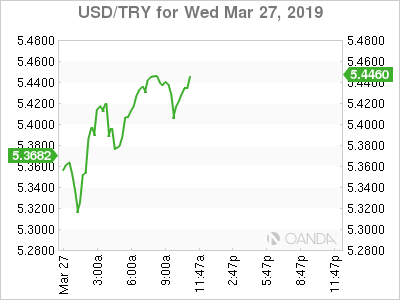
Turkey is back in the headlines as the local elections that will take place at the end of the month, will be a referendum on President Erdogan. Just last summer, Erdogan won a fresh mandate with Parliamentary and Presidential wins. The economy has not improved and Turkey is back in crisis mode.
About a month ago, Turkish stocks entered bull market territory, inflation was slowly coming down from the recent 15-year highs and optimism was improving for emerging markets after the Fed signaled they will be keeping rates on hold throughout the rest of the year.
Overnight, foreign investors were unable to hedge their risks to the lira as swap rates jumped past 1,000 percent. Local banks are being pressured to not provide liquidity to foreign investors and we are seeing them scramble for hedges by selling other emerging market currencies. These actions by Erdogan will potentially scare investors from wanting to invest in Turkey in the future. The Turkish lira is down 1.4% to the dollar and trading around the 5.4182 region.
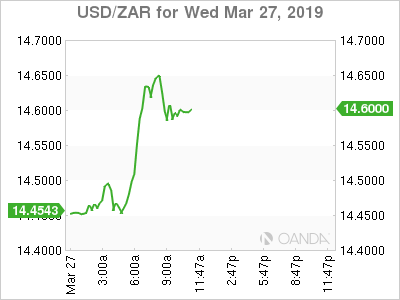
Other emerging market currencies are under pressure. The South African rand is lower by 1.1% at 14.5805.
US: Trade Deficit Steps Back from the Abyss, May Lift Q1 GDP
After swelling to its largest gap in 10 years last month, the trade deficit narrowed in January. The unexpected move will lift tracking estimates for Q1 GDP, but the imports collapse is worrisome for domestic demand.
Big Narrowing in the Trade Deficit
The trade gap narrowed by a substantial $8.8 billion in January. To keep that in perspective, it's useful to consider that in the prior month the trade deficit was as large as it has been at any point since the height of the financial crisis in 2008. Indeed, even after the improvement here in January, the deficit remains larger than it was at any point between 2009 and 2016.
Still, what happened in January is that most of the details moved favorably for reducing the trade deficit. Exports increased. Imports decreased. The trade deficit narrowed.
Again with the Beans?
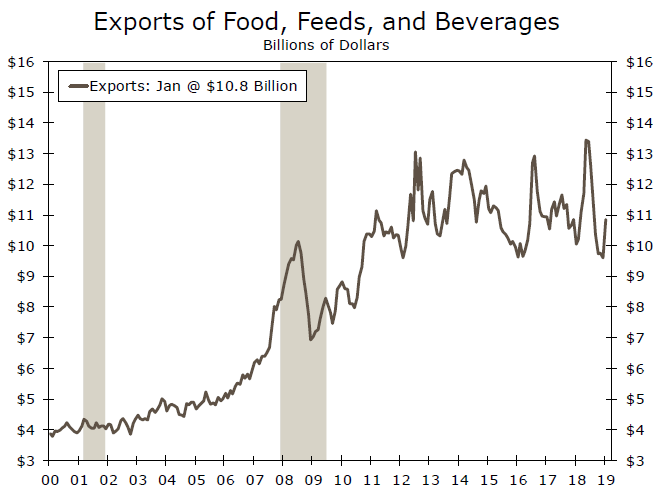
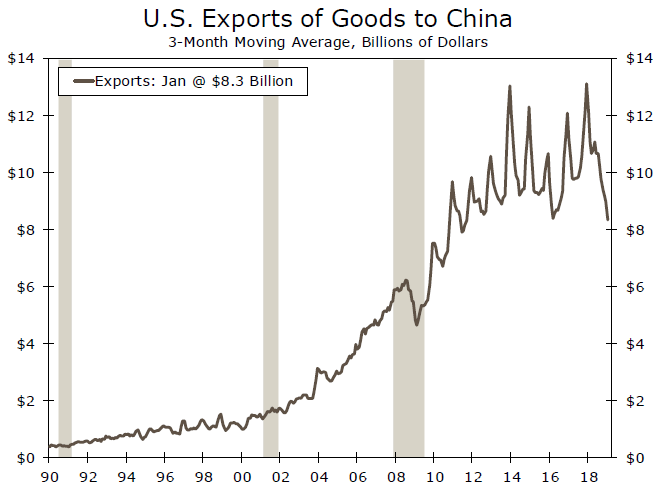
Exports increased $1.9 billion, retracing a little less than half of the $4 billion drop in December. Most of the gain came on the goods side. The biggest major category increase was food and beverage exports, which shot up 13.1% in January. Within that category, the big mover was once again soybeans. The $910 million increase was roughly eight times larger than the second biggest mover (nuts were up $118 million) and brings the category to $1.2 billion in the month—a roughly four-fold increase from December levels. Tempting though it may be to conclude that this is a China effect, we cannot be sure. In fact, U.S. exports to China fell slightly in January; the big narrowing in the trade deficit with China was entirely a function of shrinking imports from that country.
What is Behind the Drop-Off in Imports?
The decline on the imports side was more than three times larger than the increase on the export side. Interestingly, of the $6.8 billion decline in imports in January, $5.7 billion was attributable to smaller goods imports from one country: China.
There are any number of explanations for that, but the two best arguments in our view are either that the tariffs are biting imports from China or there is simply diminished demand for the stuff we import from there. If it's just the tariffs, then we could reasonably expect to see some supply chain disruption in coming months as U.S. businesses find alternative sources for goods they used to get from China. We will watch supplier deliveries and inventories to get a better sense of that, but at the moment supply chains seem tight but not yet completely strained to the point where there are widespread production delays.
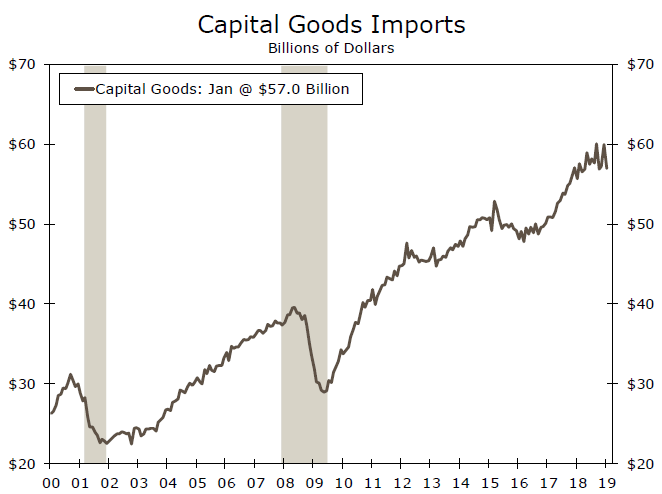
The alternative argument (just a softening in demand) can find a foothold in the data. Overall imports (not just from China) declined in every major category, but the two biggest were industrial supplies, which fell 5.0%, and capital goods, which slipped 4.9%. These are the big categories too; together, the drop in industrial and capital goods accounted for $5.3 billion of the overall $6.5 billion decline in goods imports overall.
USD/JPY Mid-Day Outlook
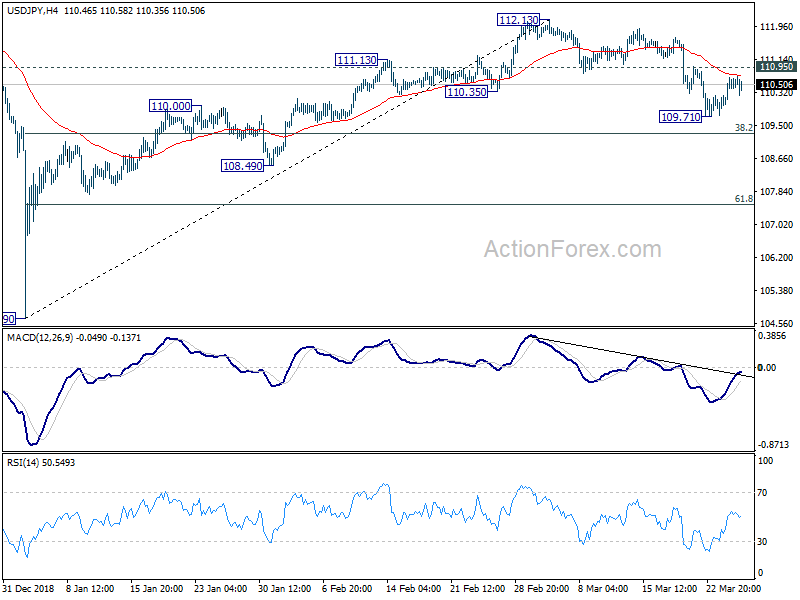
Daily Pivots: (S1) 110.14; (P) 110.42; (R1) 110.90; More...
No change in USD/JPY's outlook and intraday bias stays neutral. On the upside, break of 110.95 minor resistance will argue that the pull back from 112.13 has completed at 109.17. In this case, intraday bias will be turned back to the upside for retesting 112.13. On the downside, below 109.71 will resume the fall from 112.13 to 38.2% retracement of 104.69 to 112.13 at 109.28. Break of 109.28 will target 61.8% retracement at 107.53 next.
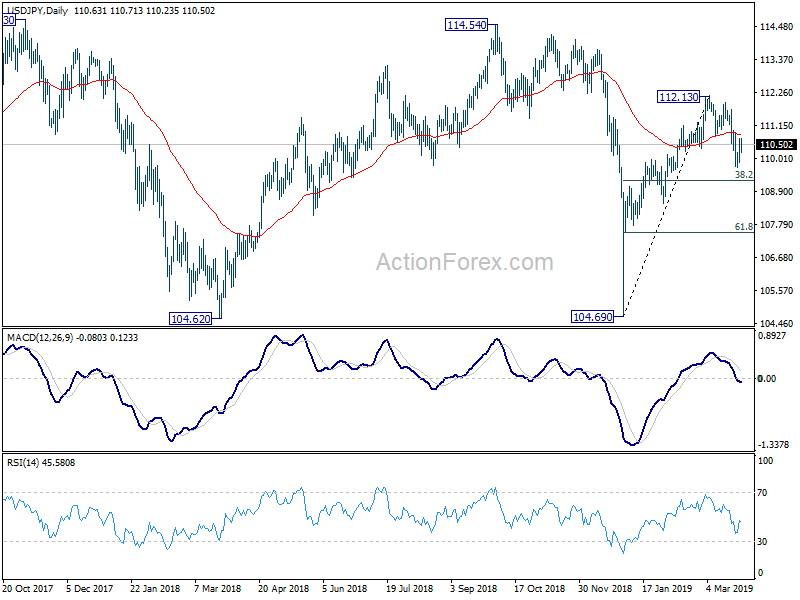
In the bigger picture, while the rebound from 104.69 was strong, USD/JPY failed to sustain above 55 week EMA (now at 110.91), and was kept well below 114.54 resistance. Medium term outlook is turned mixed and we'll wait for the structure of the fall from 112.13 to unveil to make an assessment later. For now, more range trading is expected between 104.69 and 112.13 first.
USD/CHF Mid-Day Outlook
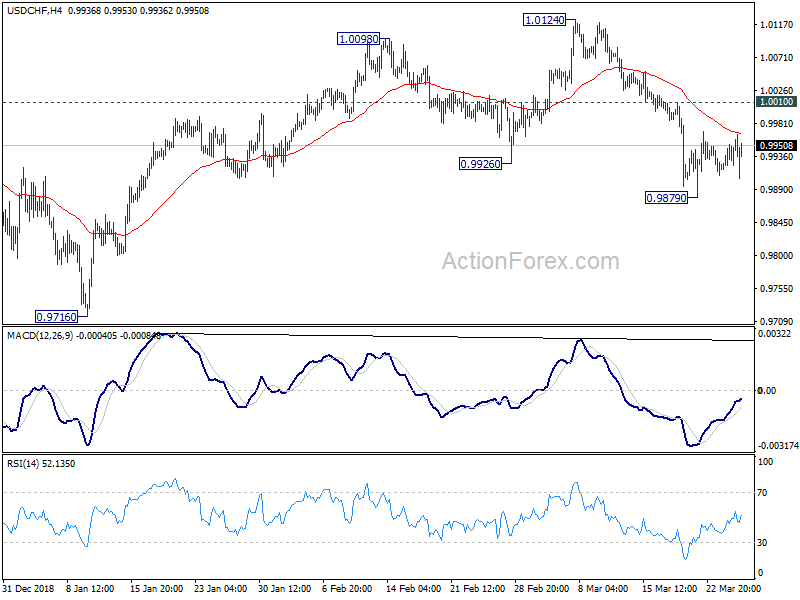
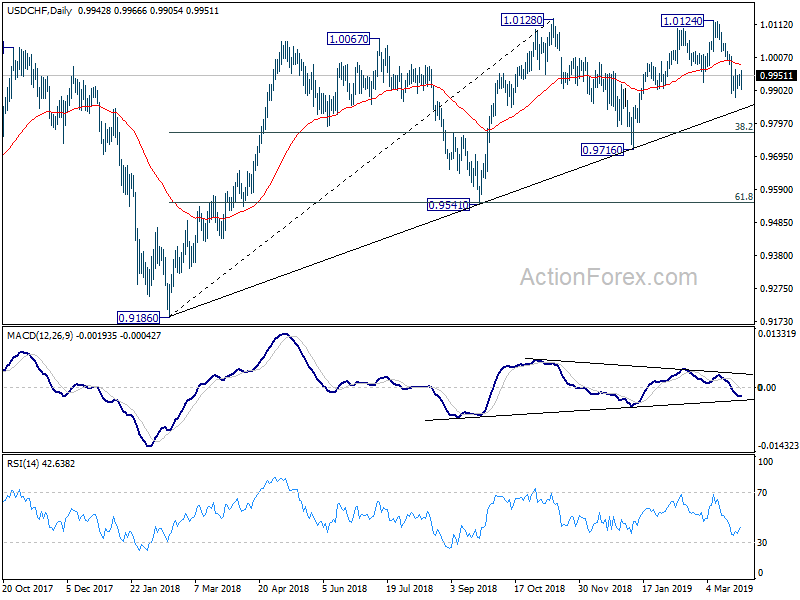
Daily Pivots: (S1) 0.9925; (P) 0.9939; (R1) 0.9960; More.....
USD/CHF is staying in consolidation above 0.9879 temporary low. Intraday bias remains neutral first. As long as 1.0010 minor resistance holds, further decline is mildly in favor. On the downside, below 0.9879 will resume the fall from 1.0124 to 0.9716 key support. Nevertheless, break of 1.0010 will turn bias back to the upside for 1.0124/28 resistance zone.
In the bigger picture, focus is back on medium term trend line (now at 0.9846). Decisive break there will argue that whole rise from 0.9186 has completed. Further break of 0.9716 will confirm reversal and target next support level at 0.9541. Nevertheless, there is still a chance that price action from 1.0128 are forming a consolidative pattern with fall from 1.0124 as third leg. If this is the case, stronger support should be seen between 0.9716 and the trend line to contain downside.
EUR/USD Mid-Day Outlook
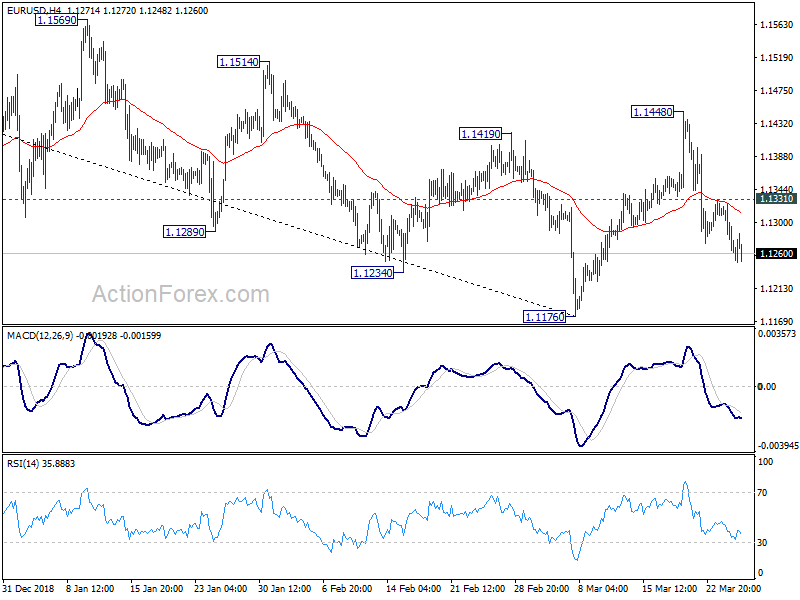
Daily Pivots: (S1) 1.1243; (P) 1.1284; (R1) 1.1308; More.....
Intraday bias in EUR/USD remains on the downside at this point. Fall from 1.1448 is target 1.1176 low. Decisive break there will resume whole decline from 1.2555. On the upside, however, break of 1.1331 minor resistance will turn bias back to the upside for 1.1448 instead.
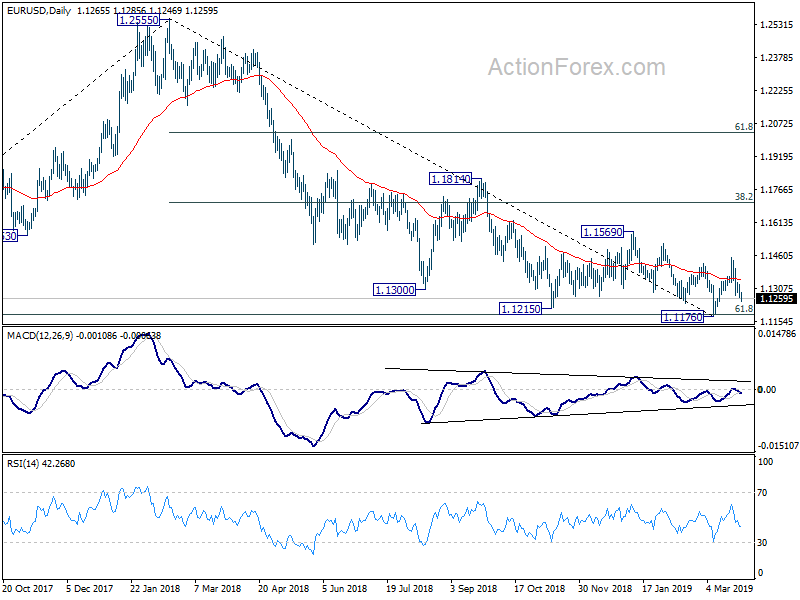
In the bigger picture, medium term outlooks is a bit mixed for now as there are conflicting signals. We'll turn neutral first. On the downside, decisive break of 61.8% retracement of 1.0339 (2016 low) to 1.2555 (2018 high) at 1.1186 will resume the whole down trend from 1.2555. Next target will be 1.0339 low. Nevertheless, break of 1.1569 resistance should confirm medium term bottoming. Stronger rebound should be seen back to 38.2% retracement of 1.2555 to 1.1176 at 1.1703. In that case, the structure of the rise from 1.1176 and reaction to 1.1703 fibonacci level will be watched for making an assessment on whether medium term trend has reversed, or rebound form 1.1176 is merely a correction.
EUR/JPY Looks To Resume Downside Pressure
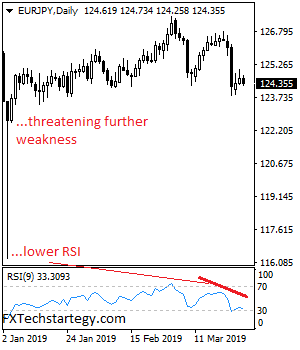
EURJPY looks to resume downside pressure despite its present price hesitation threats. Support comes in at the 124.00 level where a break if seen will aim at the 123.50 level. A cut through here will turn focus to the 123.00 level and possibly lower towards the 123.50 level. Its daily RSI is bearish and pointing lower suggesting further weakness. On the upside, resistance resides at the 125.00 level. Further out, we envisage a possible move towards the 125.50 level. Further out, resistance resides at the 126.00 level with a turn above here aiming at the 126.50 level. On the whole, EURJPY faces further price weakness nearer term.
GBP/USD Outlook: Cable Changes Near-Term Direction But Remains Within Range ahead of UK Parliament Vote
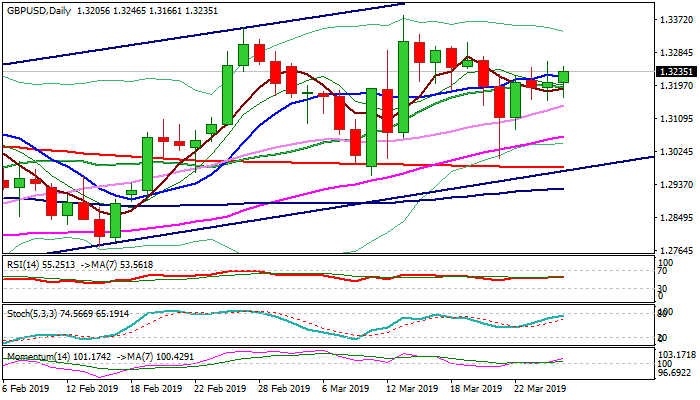
Cable stands at the front foot at the beginning of US session on Wednesday and rises above 10SMA (1.3220) in attempts to eventually register clear break, after upticks in past four days repeatedly failed to close above the moving average and generate positive signal. However, the pair's price remains within the range of past two days and fresh direction signal can be expected on close above congestion top (1.3261), as rising bullish momentum on daily chart supports the action along with MA's in bullish setup. Brexit story remains pair's key driver, putting the technical signals at the second position. All eyes are turned today towards UK parliament's indicative and non-binding vote on many subjects which range from UK's post-exit relation with the EU to scenarios of no-deal divorce or even no Brexit. UK PM Theresa May stands on shaky ground and repeated failure of her plan could mean that her post as prime minister might end here. Strong uncertainty around the biggest political and economic move since WW2 in the UK keeps British pound in highly volatile mode, which was boosted by comments from top EU officials, who remind the UK about millions of people who signed petition to revoke Article 50 and those who want to stay in the EU, but also urged European parliament to remain open for longer Brexit extension. The outcome from today's parliament's vote could give more clues about possible solutions, but the final one seems to be still far.
Res: 1.3261; 1.3292; 1.3310; 1.3330
Sup: 1.3220; 1.3190; 1.3199; 1.3144
GBP/USD Mid-Day Outlook
Daily Pivots: (S1) 1.3155; (P) 1.3209; (R1) 1.3259; More....
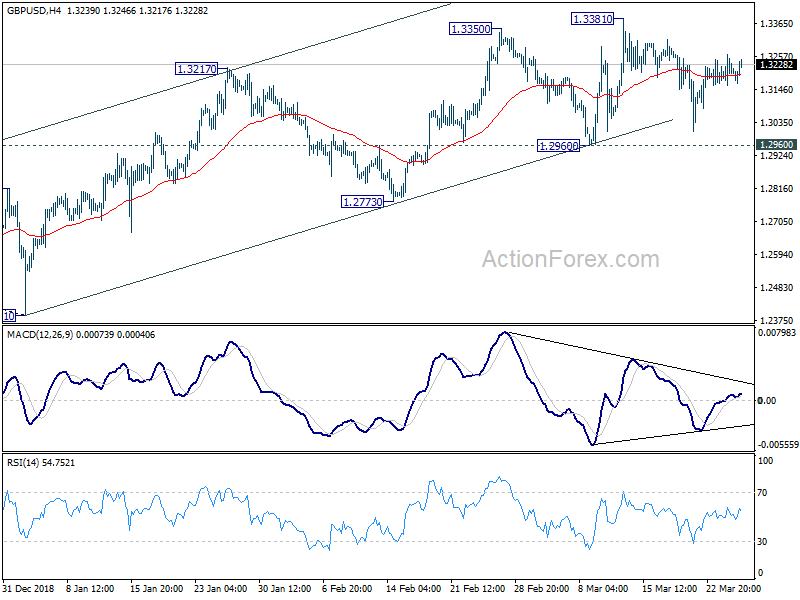
GBP/USD strengthens mildly but remains bounded in range of 1.2960.3381. Intraday bias remains neutral and more sideway trading could be seen. As long as 1.2960 support holds, further rally remains in favor. On the upside, firm break of 1.3381 will resume the rebound from 1.2391 to 61.8% retracement of 1.4376 to 1.2391 at 1.3618 next. However, on the downside, decisive break of 1.2960 will indicate that rebound from 1.2391 has completed earlier than expected. Deeper fall would then be seen to 1.2773 support for confirmation.
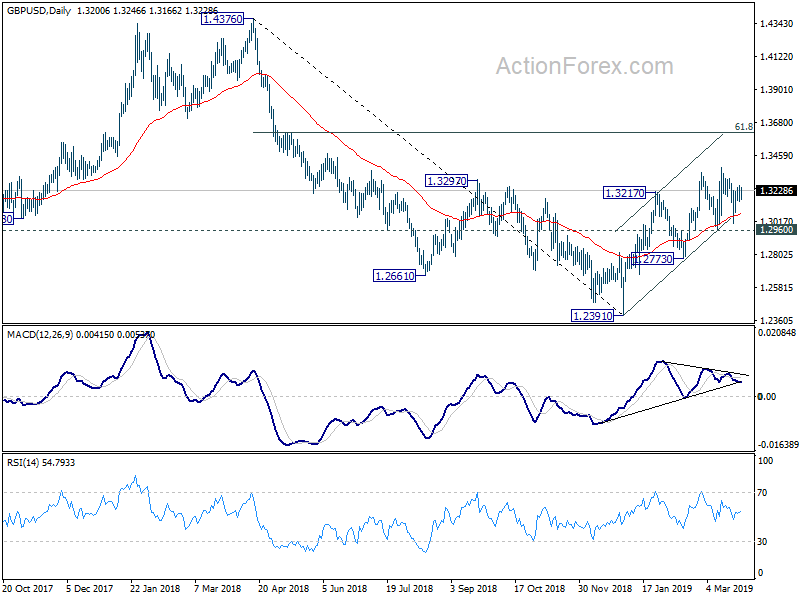
In the bigger picture, medium term decline from 1.4376 (2018 high) should have completed at 1.2391. Rise from 1.2391 is now seen as the third leg of the corrective pattern from 1.1946 (2016 low). Further rise could be seen through 1.4376 in medium term. On the downside, though, break of 1.2773 support will dampen this view. Focus will be turned back to 1.2391 low and break will resume the fall from 1.4376 to 1.1946.
Sterling Higher ahead of Brexit Indicative Votes, Yen Higher as Treasury Yields Extend Slump
Indicative votes on Brexit alternatives in the UK House of Commons will catch most attention ahead. Debate is due to start by 1500GMT. We'll see what alternative Brexit path could gain majority in the Parliament. House of Commons Speaker John Bercow will select which of the proposals will be put to a vote. The options now include "respect the referendum result", "customs union", "confirmatory public vote", "revocation to avoid no deal" and "no deal".
Ahead of that, Sterling is trading as the strongest one for today so far. But it should be emphasized that Pound is stuck in recently established range against Dollar, Euro and Yen. There is no sign of breakout and current rise is nothing more than part of consolidations. Yen is following as the second strongest with help from weakness in global treasury yields. In particular, US 10-year yield is extending recent decline to as low as 2.379 so far, losing 2.4% handle. Yield curve inversion is just getting worse and worse.
Meanwhile, New Zealand and Australian Dollar remain the weakest ones undoubtedly. NZD is sold off sharply after RBNZ indicated that next move is a cut. AUD follows as RBNZ's dovish shift somewhat solidifies that case for RBA cuts too.
In other markets, US stocks open mildly higher with DOW, S&P 500 and NASDAQ trading up around 0.2%. In Europe, FTSE is up 0.17%. DAX is up 0.62%. CAC is up 0.58%. German 10-year yield is down -0.0546 at -0.068. Earlier in Asia: Nikkei dropped -0.23%. Hong Kong HSI rose 0.56%. China Shanghai SSE rose 0.85%, back above 3000 handle. Singapore Strait Times dropped -0.06%. Japan 10-year JGB yield dropped -0.0018 at -0.067.
EU Tusk: Cannot betray increasing majority of British people who want to stay in EU
European Commission President Jean-Claude Juncker and European Council President Donald Tusk talked Brexit to the European Parliament day.
Tusk said the voices of British people whole wanted to stay in the EU shouldn't be ignored. And he urged the Parliament to be open to a longer Article 50 extension. He said, "I said that we should be open to a long extension if the UK wishes to rethink its Brexit strategy, which would of course mean the UK's participation in the European parliament elections. And then there were voices saying that this would be harmful or inconvenient to some of you.... Let me be clear: such thinking is unacceptable. You cannot betray the 6 million people who signed the petition to revoke article 50, the 1 million people who marched for a people's vote, or the increasing majority of people who want to remain in the European Union."
Juncker said it's unclear how Brexit would unfold. And, "I told some of you that if you compare Great Britain to a sphinx then the sphinx would seem to me an open book. We will see in the course of this week how this book will speak,"
Also, chief Brexit negotiator told lawmakers: "In all scenarios, the Good Friday agreement will continue to apply. The United Kingdom will remain a core guarantor of that agreement and is expected to uphold it in spirit and in letter:" And, "the Commission is ready to make additional resources available to Ireland, technical and financial to address any additional challenges."
UK retail sales volume dropped most in 17 months as Brexit uncertainty escalates
UK CBI Reported Sales dropped sharply to -18 in March, down from 0 and missed expectation of 5. That is, 28% of respondents reported that sales volumes were up on a year ago in March, while 46% said they were down, giving a balance of -18%. It's the fastest contraction in 17 months, marked four-month run in which sales have not grown.
Anna Leach, CBI head of economic intelligence, said: "Even accounting for Easter timing, the High Street's poor run continues. While real wage growth is picking up, consumer confidence has been hit by escalating uncertainty over Brexit and concern over the economy's future. The pain currently being felt on the High Street is yet another reason why it is so vitally important politicians agree a deal in Parliament that is acceptable to the EU and protects our economy. No-deal must be averted at all costs."
ECB Draghi: Intra- and extra- Eurozone trade growth recoupled downward for the first time since GFC
ECB President Mario Draghi said in a speech that it's "not yet certain" whether Eurozone is experience a "more lasting deterioration in the growth outlook" right now. The loss of momentum has been "predominantly driven by pervasive uncertainty in the global economy". Domestic economy has "remained relatively resilient" and expansion drivers "remain in place". But risks remained "tilted to the downside".
Draghi pointed to continuing weakness in wold trade which has "significantly affected the manufacturing sector" and Eurozone is now "seeing a more persistent deterioration of external demand". Intra-euro area trade also slowed steeply last year. And, "recoupling of intra- and extra-euro area trade growth in a downward direction has not occurred since the start of the global financial crisis". For now, "current data suggest that external demand has not yet spilled over significantly into domestic demand". But " risks have risen in the last months and uncertainty remains high".
Draghi also reiterated that "substantial accommodation is still needed". At last meeting, ECB decided to extend the date-based leg of the rate guidance "at least through the end of 2019". That ECB will continue too the "very sizeable stocks of assets" bought under the asset purchase program for even longer. Also, Draghi added that "we would ensure that monetary policy continues to accompany the economy by adjusting our rate forward guidance to reflect the new inflation outlook." It suggests ECB is ready to extend delay a rate hike further when necessary.
ECB de Guindos: Eurozone slowdown raises financial stability risks
Vice President Luis de Guindos warned that weak Eurozone growth is raising financial stability risks due to weakening bank profits and rising concern over sovereign debt sustainability.
De Guindos said in a conference in Frankfurt that "in an environment where cyclical factors may exert further downward pressure on bank profitability, banks would need to step up their efforts to overcome structural challenges".
Also, "such measures may include cost reductions – including lower staffing costs and streamlining of branch networks, enhanced digitalization – implying initial, one-off large-scale investments, revenue diversification and the reduction of the stock of non-performing loans in the six countries where levels are still high."
NZD dives as RBNZ turns dovish, next move is rate cut
New Zealand Dollar dives sharply after RBNZ kept OCR unchanged at 1.75% and shifted to a clear dovish stance. It now expected that "the more likely direction of our next OCR move is down".
In the statement, it also noted that balance of risks to the outlook has "shifted to the downside". At the same time, risk of a "more pronounced global downturn has increased", and 'low business sentiment continues to weigh on domestic spending." Though, on the upside, "inflation could rise faster if firms pass on cost increases to prices to a greater extent."
Markets are raising bets of an RBNZ rate cut this year. A cut it full priced in for November and there speculations that it might happen as soon as in May.
More in
- RBNZ Review – Next Move would be Rate Cut as Risks...
- First impressions of the RBNZ's March OCR Review
China industrial profits dropped -14%. Autos, oil processing, steel and chemicals dragged
China's industrial profits in January-February period slumped -14.0% yoy to CNY 708B. It's the biggest contraction since 2011. National Bureau of Statistics (NBS) said the contract was mainly due to distortions caused by the timing of Lunar New Year.
Meanwhile, there were notable declines in profits in auto, oil processing, steel and chemical industries. Ex-factory prices of Auto, oil processing, steel and chemicals dropped -0.4%, -1.3%, -2.5% and -2.3% respectively. Profits dropped CNY 37B, CNY 32B, CNY, 29B and CNY 19B respectively. Combined the contributed to -14.2% contraction in profits. Excluding them, industrial profits rose 0.2%.
While the set of data is largely ignored by the stock markets, it's putting some more weight to the upcoming round of trade talks. US Trade Representative Robert Lighthizer and Treasury Secretary Steven Mnuchin will visit Beijing on March 28-29. Even though an eventual trade might might not help reverse the slowdown in China, at least, the drag on exports will likely be eased.
GBP/USD Mid-Day Outlook
Daily Pivots: (S1) 1.3155; (P) 1.3209; (R1) 1.3259; More....
GBP/USD strengthens mildly but remains bounded in range of 1.2960.3381. Intraday bias remains neutral and more sideway trading could be seen. As long as 1.2960 support holds, further rally remains in favor. On the upside, firm break of 1.3381 will resume the rebound from 1.2391 to 61.8% retracement of 1.4376 to 1.2391 at 1.3618 next. However, on the downside, decisive break of 1.2960 will indicate that rebound from 1.2391 has completed earlier than expected. Deeper fall would then be seen to 1.2773 support for confirmation.
In the bigger picture, medium term decline from 1.4376 (2018 high) should have completed at 1.2391. Rise from 1.2391 is now seen as the third leg of the corrective pattern from 1.1946 (2016 low). Further rise could be seen through 1.4376 in medium term. On the downside, though, break of 1.2773 support will dampen this view. Focus will be turned back to 1.2391 low and break will resume the fall from 1.4376 to 1.1946.
Economic Indicators Update
| GMT | Ccy | Events | Actual | Forecast | Previous | Revised |
|---|---|---|---|---|---|---|
| 01:00 | NZD | RBNZ Official Cash Rate | 1.75% | 1.75% | 1.75% | |
| 11:00 | GBP | CBI Reported Sales Mar | -18 | 5 | 0 | |
| 12:30 | CAD | International Merchandise Trade (CAD) Jan | -4.2B | -2.3B | -4.6B | -4.8B |
| 12:30 | USD | Trade Balance (USD) Jan | -51.1B | -57.5B | -59.8B | -59.9B |
| 14:00 | USD | Current Account Balance (USD) Q4 | -130B | -125B | ||
| 14:30 | USD | Crude Oil Inventories | -9.6M |