Sample Category Title
AUD/USD The Downside Prevails
Pivot (invalidation): 0.7130
Our preference Short positions below 0.7130 with targets at 0.7095 & 0.7080 in extension.
Alternative scenario Above 0.7130 look for further upside with 0.7145 & 0.7155 as targets.
Comment The immediate trend remains down and the momentum is strong.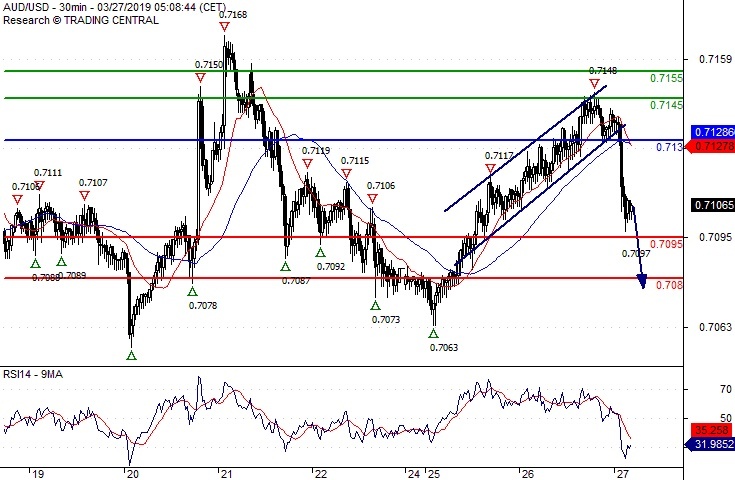
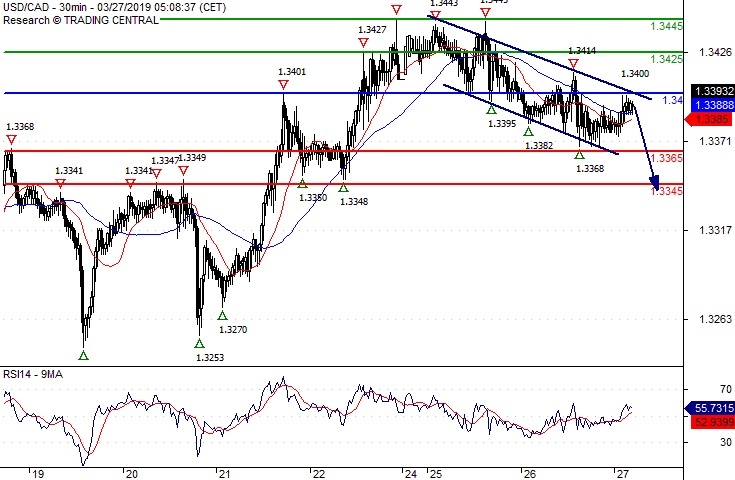
USD/CAD Key Resistance At 1.3400
Pivot (invalidation): 1.3400
Our preference Short positions below 1.3400 with targets at 1.3365 & 1.3345 in extension.
Alternative scenario Above 1.3400 look for further upside with 1.3425 & 1.3445 as targets.
Comment The upward potential is likely to be limited by the resistance at 1.3400.
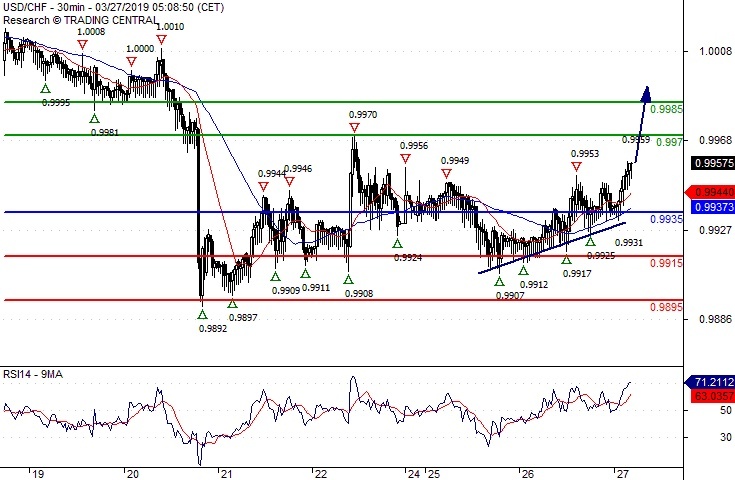
USD/CHF Towards 0.9985
Pivot (invalidation): 0.9935
Our preference Long positions above 0.9935 with targets at 0.9970 & 0.9985 in extension.
Alternative scenario Below 0.9935 look for further downside with 0.9915 & 0.9895 as targets.
Comment The RSI calls for a new upleg.
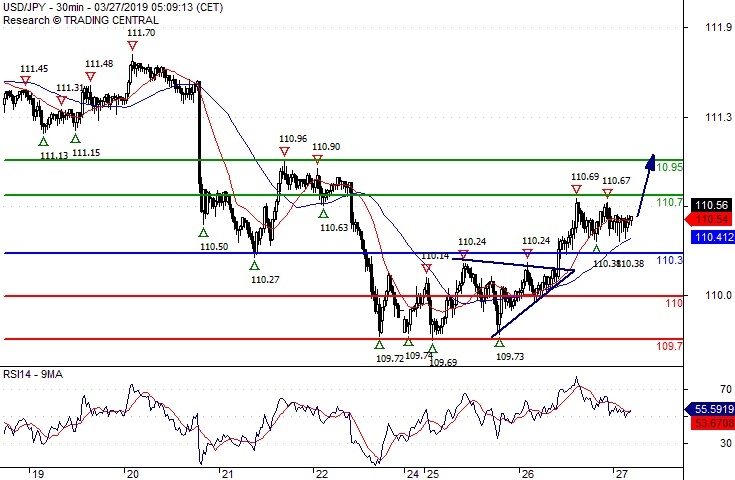
USD/JPY 110.95 Expected
Pivot (invalidation): 110.30
Our preference Long positions above 110.30 with targets at 110.70 & 110.95 in extension.
Alternative scenario Below 110.30 look for further downside with 110.00 & 109.70 as targets.
Comment The RSI lacks downward momentum.
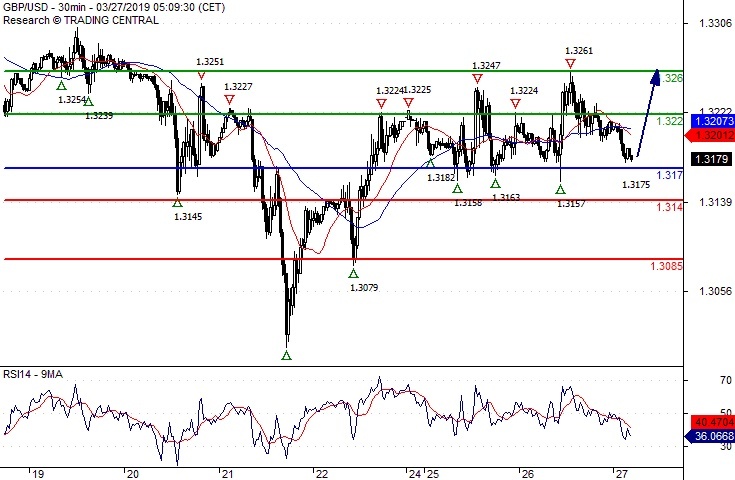
GBP/USD Caution
Pivot (invalidation): 1.3170
Our preference Long positions above 1.3170 with targets at 1.3220 & 1.3260 in extension.
Alternative scenario Below 1.3170 look for further downside with 1.3140 & 1.3085 as targets.
Comment Intraday technical indicators are mixed and call for caution. See if the repeatedly-tested key support at 1.3170 can hold.
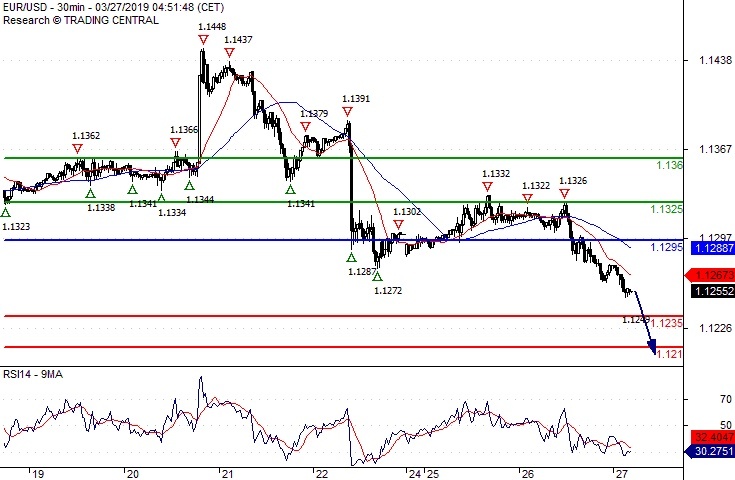
EUR/USD Aim @ 1.1210
Pivot (invalidation): 1.1295
Our preference Short positions below 1.1295 with targets at 1.1235 & 1.1210 in extension.
Alternative scenario Above 1.1295 look for further upside with 1.1325 & 1.1360 as targets.
Comment The RSI has broken down its 30 level.
ECB Draghi: Intra- and extra- Eurozone trade growth recoupled downward for the first time since GFC
ECB President Mario Draghi said in a speech that it's "not yet certain" whether Eurozone is experience a "more lasting deterioration in the growth outlook" right now. The loss of momentum has been "predominantly driven by pervasive uncertainty in the global economy". Domestic economy has "remained relatively resilient" and expansion drivers "remain in place". But risks remained "tilted to the downside".
Draghi pointed to continuing weakness in wold trade which has "significantly affected the manufacturing sector" and Eurozone is now "seeing a more persistent deterioration of external demand". Intra-euro area trade also slowed steeply last year. And, "recoupling of intra- and extra-euro area trade growth in a downward direction has not occurred since the start of the global financial crisis". For now, "current data suggest that external demand has not yet spilled over significantly into domestic demand". But " risks have risen in the last months and uncertainty remains high".
Draghi also reiterated that "substantial accommodation is still needed". At last meeting, ECB decided to extend the date-based leg of the rate guidance "at least through the end of 2019". That ECB will continue too the "very sizeable stocks of assets" bought under the asset purchase program for even longer. Also, Draghi added that "we would ensure that monetary policy continues to accompany the economy by adjusting our rate forward guidance to reflect the new inflation outlook." It suggests ECB is ready to extend delay a rate hike further when necessary.
Currencies: Dollar Outperformance Despite Soft Data
- Rates: Will the bond rally resume after yesterday's easing?
The rally in global core bonds took a breather yesterday. Yields rose a few basis points. US Treasuries underperformed despite disappointing US housing data and weaker consumer confidence. Risk sentiment remains key for trading today with an avalanche of ECB members, incl. president Draghi, taking the stage and consumer confidence in France and Italy. - Currencies: Dollar outperformance despite soft data
Yesterday USD-trading faced conflicting signals. The dollar profited from higher interest rate differentials even as US data were mostly weaker than expected. The euro didn't profit from a risk-on context. Today, the eco calendar is thin. Will ECB governors bring a more balanced view on the economy. If so, it might give the euro some downside protection
The Sunrise Headlines
- Main US equity indices closed 0.5% to 0.7% higher yesterday. Asian risk sentiment is more mixed this morning with Japan and Korea underperforming and China outperforming.
- The 'appreciable risk' that Brexit might not happen at all pushed Boris Johnson in the direction of supporting PM May's 'pseudo-Brexit'. Brexit hardliner Rees-Mogg made a similar shift earlier. They want the PM's resignation in return.
- New Zealand's central bank (RBNZ) left its policy rate unchanged at 1.75%, but governor Orr said that the more likely direction of their next move is down. NZD/USD fell from 0.77 to 0.76 with markets discounting an Aug19 rate cut.
- Chinese industrial profits slumped by the most since 2011 in Jan & Feb (-14% Y/Y) with the auto industry, ferrous metal producers and the chemical industry underperforming. Lunar New Year played a minor negative role.
- Stephen Moore, who is likely to be nominated by US President Trump for a vacant seat on the Fed board called in favour of immediately reversing course by slashing rates by half a percentage point.
- The Turkish central bank conducted 'back-door' operations to prop up the falling currency. The currency entered sell-off mode ahead of local elections. EUR/TRY currently trades just north of 6, compared with 6.6 on Monday.
- Today's eco calendar contains second tier data. Several ECB heavyweights speak at the central bank's conference. Germany and the US tap the bond market. The UK parliament holds indicative votes on Brexit scenario's
Currencies: Dollar Outperformance Despite Soft Data
USD outperforms even as risk sentiment improves
Global market stress eased yesterday. Equities and yields rebounded after last week's correction. EMU data (German/French confidence) were mixed. US data (including consumer confidence) were mostly weaker than expected. Contrary to last week it didn't spark any further risk-off positioning. Yields rose early in the session but softened later. At the end of the day, the US-German spread had still widened, supporting the dollar. The euro didn't profit from relative better data or a better risk sentiment. Growing Brexit uncertainty might have been a minor negative for the euro. EUR/USD closed at 1.1266 (from 1.1312). USD/JPY closed at 110.64, near the session top. Dollar strength prevailed.
This morning, Asian equity indices are trading mixed. Uncertainty on the health of the global economy persists and the potential outcome of the US-China trade talks remains vague. USD/JPY (110.60 area) maintains yesterday's gain. EUR/USD (1.1260 area) remains in the defensive. The kiwi dollar nosedived as the RBNZ in its policy statement indicated that the next move in the policy rate is more likely to be a cut. NZD/USD tumbled from the 0.69+ area to the 0.68 pivot.
Today, the eco calendar is thin with only confidence data from EMU member states. In the US, the trade balance often provides conflicting data for FX trading. Plenty of ECB governors will speak, including president Draghi and chief economist Peter Praet. The ECB already ‘finetuned' its guidance at the March meeting, but markets will be keen to hear the speakers' view on growth and on inflation(expectations). A balanced message from the conference in Frankfurt might in theory be slightly supportive for the euro. Admittedly, at least yesterday, the dollar outperformed in a context that wasn't per se USD supportive. Brexit also remains a wild-card for euro trading. EUR/USD is drifting further south in the 1.2/1.15 MT trading range. Euro sentiment remains fragile, but US data are also turning more mixed. For now, we maintain the view that there is no compelling reason for EUR/USD break below the 1.1187/1.12 support in a sustainable way even as we understand downside risks have increased.
Sterling gained modest ground yesterday as pro-Brexcit conservative party members showed preparedness to support May's Deal. However, uncertainty on Brexit remains high with today's indicative votes in Parliament. Question is whether Brexiteers having a bigger weight on the UK negotiation process will be a positive for sterling over time. For now, we avoid sterling long exposure as long as the binary risk remains as high as it is now
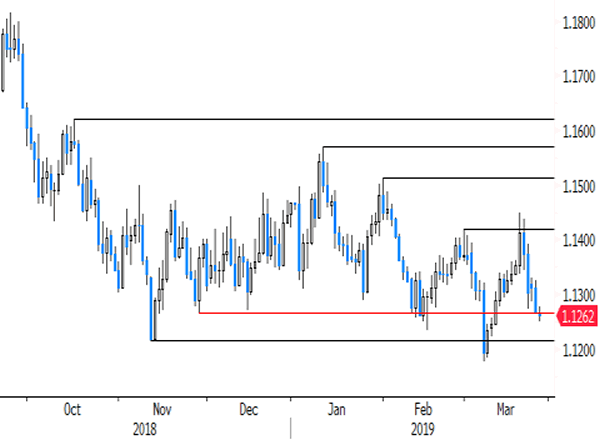
EUR/USD: dollar outperforms euro even as sentiment on risk improves and as US data disappoint
What Are the Methods to Predict Forex Changes
To know how to properly analyze the market is equal to making money on it. The whole essence of work in the financial markets is the ability to predict the price movement. Therefore, leading analysts of the world come up with all the new ways and patterns by which the price moves. But still, at the moment there are two types of analysis:
- Fundamental analysis
- Technical analysis
There are several other methods: candlestick, wave and fractal analysis. But all of them can be attributed to the technical method, as charts are used there, and the forecast is built on the price history.
Technical analysis
Technical analysis is an analysis of the history of the behavior of a currency on a chart for a certain period of time. It is the most popular method of forecasting and the easiest to master. Advisors and robots that trade automatically are built on the basis of technical analysis.
For example, if our strategy is designed for trading on a 5-minute timeframe, then the decision is made based on the price movement over the last 24 hours. While good traders take into account the general trend with higher timeframes.
Fundamental analysis
It is a more complex method compared with the technical one. As for making a decision, one should take into account a multitude of macroeconomic factors, the political situation, world events and possible changes.
It is difficult to process so much information, so only the most significant are taken as a basis, which already adds errors to the forecast. Moreover, it is impossible to prove that fundamental analysis works in practice.
However, using knowledge of trading on news is very helpful in trading or reducing risks when using technical analysis.
Alternative Analysis Methods
As already mentioned, there are several methods that are attributed to the individual, although in essence they are technical tools.
Candlestick analysis is a non-indicator analysis method for which a candlestick chart is used. It came from Japan and was originally calculated to work on the daily chart. The essence of the analysis is to find the figures of candles and on their basis to predict the future of the price movement.
Fractal analysis - trading is based on an indicator created by Bill Williams. It is rarely used as a separate trading strategy and is used more as an additional signal to break through the resistance or support line.
Wave analysis - created on the basis of the psychology of traders, is a separate strategy. Although it can be used in combination with others. According to the theory of the creator, Eliot, any price movement can be divided into 5 waves according to the trend and 3 waves against the trend. Beginners are hard to understand it, but professional traders active;y use this type of analysis.
Technical vs Fundamental analysis. What to choose?
This dilemma touches everyone who has decided to take forex seriously. But everyone comes to the same conclusion: they should be combined. It is impossible to deny that macroeconomic indicators strongly influence the market at the time of their release. So, you need to know about it in advance and be ready to it.
It is also not to say that the methods of technical analysis do not work, because every year there are more and more successful traders. And they mainly use technical analysis. Especially for beginners, this will be the best option. And when you gain experience, you can try to combine both ways and thus increase your income.
Conclusion
In fact, it is not so important which method you will choose. All of them are working and can bring stable profits. But combining several options can give a faster and more positive effect from trading. Moreover, JustForex broker prepares analysis based on fundamental and technical analysis on a daily basis. It will be very useful both for beginners and experienced traders and can be well tested on free Demo account.
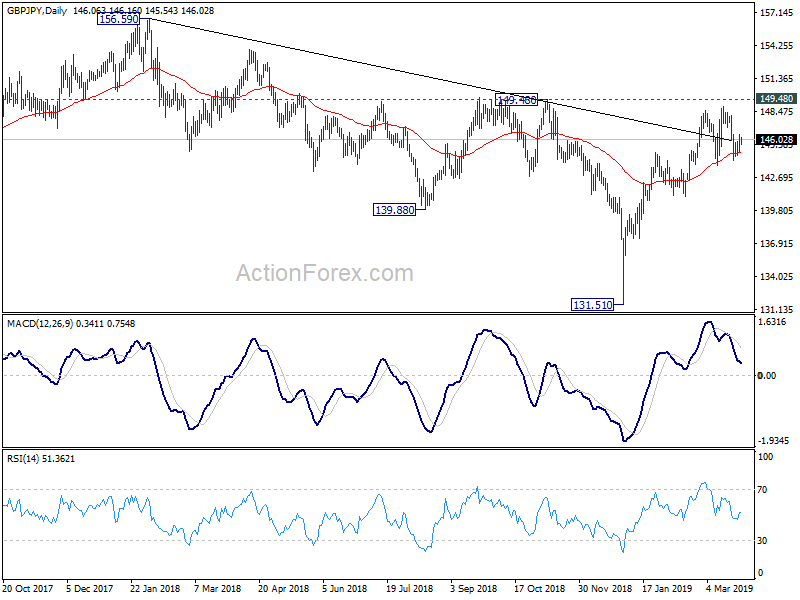
GBP/JPY Daily Outlook
Daily Pivots: (S1) 145.23; (P) 145.84; (R1) 146.70; More...
GBP/JPY is staying in consolidation below 148.87 and intraday bias remains neutral. On the downside, decisive break of 143.72 support will indicate near term reversal, after rejection by 149.48 key resistance. In that case, intraday bias will be turned to the downside for 141.00 support first. On the upside, decisive break of 149.48 key resistance will carry larger bullish implication and target 156.58 resistance next.
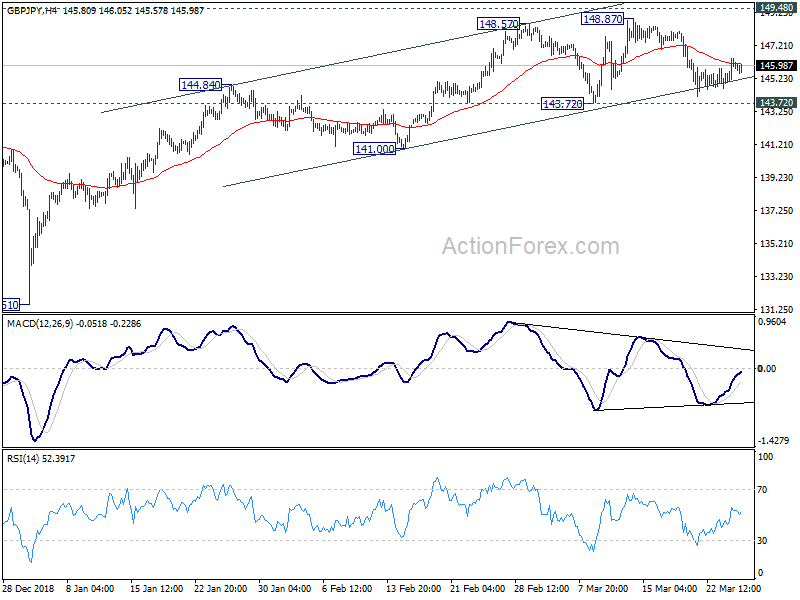
In the bigger picture, focus is now staying on 149.98 key resistance. Decisive break there should confirm that that medium term fall from 156.59 (2018 high) has completed at 131.51 already. Rise from 131.51 is then seen as the third leg of the corrective pattern from 122.36 (2016 low). GBP/JPY should then target 156.59 and above. However, rejection by 149.98 will retain medium term bearishness and could extend the fall from 156.59 through 131.51 to 122.36.