

Sample Category Title
Fed Rosengren: Balance runoff didn’t cause Q4 market turbulence
Boston Fed President Eric Rosengren defended against claims that Fed's balance sheet run-off caused financial markets turbulence during last Q4. He said, "concerns about the international economy, potential trade disputes, and a U.S. government shutdown are much more plausible explanations". Rosengren pointed out that the balance reduction is "still quite gradual". Meanwhile, equity markets experienced a "substantial recovery" in the first two months this year, even though the runoff was "slightly faster" than in Q4.
Also, as Fed purchased long-term securities, it encouraged investors to "big up" the price and lower rates on other higher-duration securities. Thus, there was spillover to a wide array of other asset prices. With "quantitative tightening", Treasury yields and term premia would move higher. But back in December, treasury rate indeed feel and term premium remained quit low. That shouldn't be the reaction to the balance sheet runoff.
Looking forward, Rosengren said it's "unrealistic to expect the Federal Reserve's balance sheet to return to the size it was before the financial crisis". Meanwhile, in a hypothetical next recession, central banks will have little room to reduce short-term rates. Thus, there will be increased need to utilize the balance sheet as stimulative tool of monetary policy.
Market Morning Briefing: Aussie Has Resistance At 0.7150
STOCKS
Concerns of the global economic slowdown and fresh fears of a recession are weighing more on the equities. Though an intermediate bounce cannot be ruled out, the global indices continue to remain negative and can fall further in the near term.
Dow (25516.83 +14.51, +0.06%) oscillated around 25500 yesterday and has closed on a mixed note. The outlook remains bearish for a fall to 25200-25180 while it trades below 25650.
DAX (11346.65, -17.52, -0.15%) might seen an intermediate bounce to 11400-11500 while it sustains above 11300. But the short-term outlook remains negative for the index to test 11200.
Nikkei (21342.48, +365.37, +1.74%) has been making some wild swings with a wide gap-down open yesterday followed by a sharp gap-up open today. Though a test of 21500 is possible while it trades above 21235, we will have to wait and see for a few sessions to get a clear idea on the next leg of move.
Shanghai (3045.41, +2.38, +0.08%) has bounced after testing the 21-day moving average support at 3033 today. While above 3033, a bounce to test 3100 is possible in the near term. But a break below 3033 can drag it to 3000 and 2950 in the coming days.
Sensex (37808.91, -355.70, -0.93%) and Nifty 50 (11354.25, -102.65, -0.90%) opened with a wide gap-down and fell sharply as expected. The short-term bearish outlook is intact. Nifty can fall to 11230 in the coming days while it trades below 11400. Sensex has resistance at 38000. It can test 37230 and 37000 on a break below 37680.
COMMODITIES
Gold and Silver have risen and remains bullish in the near term. Copper has bounced but can fall further before reversing decisively higher. Oil continues to consolidate with a bullish bias.
Gold (1321) has risen towards 1320 as expected and keeps the near-term bullish outlook intact for a test of 1330.
The support at 15.35 has held very well for Silver (15.55) and it has bounced sharply from there yesterday. The next resistance is at 15.65, a break above which will pave way for a rise to 16.
Copper (2.85) has bounced yesterday. The support at 2.84 is holding as of now. But the immediate resistance at 2.86 has to be breached for it to move further higher towards 2.88 and 2.89. A pull-back from current levels will keep copper vulnerable to test 2.82-2.81 in the coming days.
WTI (59.25) has bounced around 58 thereby keeping the 58-60 sideways range intact. As long as WTI sustains above 58, a strong break above 60 and a rally to 61.5-62 cannot be ruled out in the coming days.
Brent (67.4) is holding above 66 and is likely to revisit 68.30-68.50 levels in the coming sessions. The bias remains positive for it to breach 68.5 decisively and move up to 70.
FOREX
Currencies are mixed. Overall Dollar looks bullish for the near term. EM currencies could either trade sideways or consolidate a bit.
Dollar-Index (96.52) has interim near term resistance at 96.75 which if holds could push it down to 96.0-95.75 in the near term; else a rise towards 97.50/75 may continue for the coming sessions.
Euro (1.1315) could see some interim corrective bounces but overall while below 1.1450, Euro looks bearish towards 1.12-1.11 in the medium term.
Euro-Yen (124.58) has bounced from 123.60, but could fall back again towards 123.60 or lower in the near term unless it breaks above 125.20 immediately. On the upside there is scope for a rise towards 126.80.
Dollar Yen (110.06) has bounced a bit from levels above 109.50. A break above 110.50 could pull it higher towards 112.50 else we could see another fall back towards 109.
Aussie (0.7120) has resistance at 0.7150 and while that holds, Aussie looks bearish and could fall targeting 0.70.
Pound (1.3193) is almost stable just now, trading within the middle of the 1.31-1.34 region. An initial dip to 1.31 is possible followed by a rise back towards 1.34.
USDCNY (6.7057) has come down from near term resistance at 6.73/74 levels and could dip towards 6.68.
Dollar-Rupee (68.94) is holding below 69.20/25 and could trade within 68.60/80-69.25 just now. Only on a break above 69.25, we would consider a test of 69.50.
INTEREST RATES
The US yields look bearish for the near term and having broken immediate support levels, the yield could head lower in the coming sessions. The 2YR (2.27%), 5YR (2.21%), 10YR (2.43%) and the 30Yr (2.88%) are trading lower and look bearish.
The US-JGB 10Yr (2.51%) is down 2bps and could fall further towards 2.45%.
The German-US 10Yr (-2.45%) is trading just below resistance and while that holds, it could come off sharply back towards -2.52% indicating Euro weakness to continue.
The 10YR GOI (7.4711%) may rise while above 7.45%. Break below 7.45% opens downside chances of 7.35/30%.
Which Economies Can Catch A Cold When The Eurozone Sneezes?
Measuring the Effect on Value Added
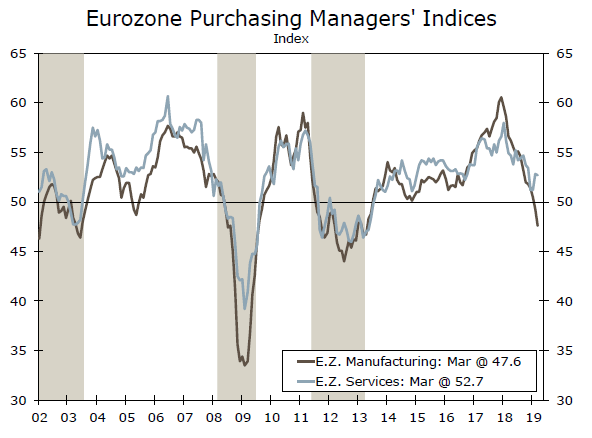
Recent economic data shows that the pace of economic activity in the Eurozone has been lackluster. Not only did the year-over-year rate of real GDP growth in the euro area fall to just 1.1% in Q4-2018, the slowest rate of economic growth in more than four years, but the outlook for the current quarter is not any better. As shown in the top chart, the manufacturing PMI in the Eurozone fell to its lowest level in nearly six years in March. The manufacturing PMI in Germany, the largest individual economy in the euro area, tumbled to only 44.7 in March. Could this slowdown in the Eurozone lead to significant economic weakness in other economies?
Let’s start with the United States. The 19 individual economies that comprise the euro area bought more than $230 billion worth of American goods in 2018, and we estimate that service exports totaled about $180 billion or so last year. So American exports of goods and services to the Eurozone totaled more than $400 billion in 2018. In addition, U.S. parent companies received about $475 billion worth of net income from their subsidiaries operating in the Eurozone in 2016 (latest available data).
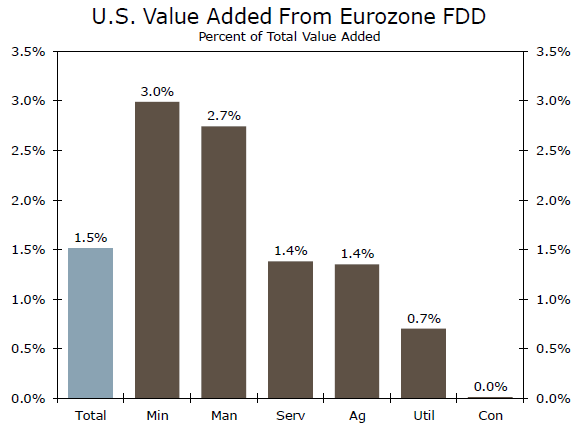
These absolute numbers are large, but they must be put into the context of the overall U.S. economy. As shown in the middle chart, final domestic demand (FDD)—final spending by consumers, businesses and government in the Eurozone on American exports of goods and services—accounted for only 1.5% of the value added that was created in the U.S. economy in 2015 (latest available data). To the extent that American parent companies use the net income they earned from their Eurozone subs to pay dividends to American shareholders, then the proportion of total U.S. value added that is accounted for by final spending in the Eurozone would be pushed up a bit more. But the bottom line is that there would need to be a significant deceleration, if not outright contraction, in the Eurozone economy to have a meaningfully depressing effect on U.S. economic growth.
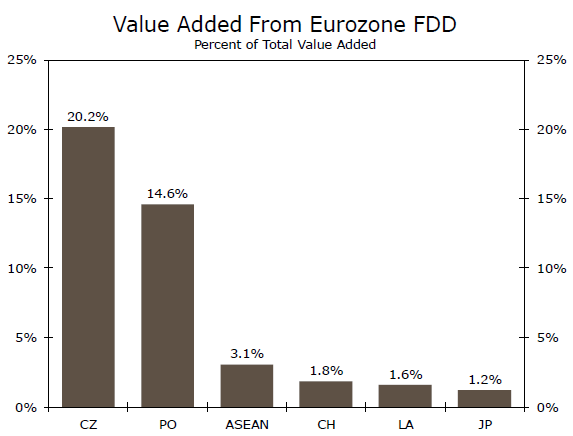
Are there any other countries or regions that have high degrees of exposure to the Eurozone? Given geographical proximity, it would be reasonable to expect that countries in eastern and central Europe may be highly dependent on final spending in the Eurozone. We do not have data for all economies in central and eastern Europe, but data from the Czech Republic and Poland are instructive. As shown in the bottom chart, FDD in the Eurozone accounts for 20% of value added in the Czech Republic and about 15% in Poland. But the euro area is much less important to China (less than 2% of value added) and Japan (only 1%). In sum, deceleration in the Eurozone can lead to slower economic growth in large economies such as the United States, China and Japan, at the margin. But it would take a meaningful economic contraction in the euro area to lead to significantly slower growth in those large economies.
Asia Breathes A Sigh Of Relief
Asia breathes a sigh of relief
After a sea of red on regional stock markets yesterday, Asia appears to be letting out a collective sigh of relief this morning as European and North American stocks stabilised in the overnight session. The Dow Jones, S&P and Nasdaq all closed flat with the US dollar enjoying a sideways day against major and emerging market currencies.
Bond yields continued to move lower with negative yields on the 10-year German bund and Japan JGB. The US yield curve from the 3-month to the 10-year collectively moved slightly lower, but the smell of panic we experienced on Friday seems to have dissipated. The bond markets are still strongly suggesting the world economy will slow in 2019, but anyone writing off the US dollar as a result might want to look at relative yields between the US, Japan and Europe first.
Asian markets could regain some of yesterday’s losses today after a calm Wall Street session. Indeed, the Japan Nikkei has enjoyed a bright early session, rising 0.80% in the first hours of trading. Confidence remains fragile though with markets susceptible to headline trading on a quiet data day, US Consumer Confidence this evening being the highlight.
Thailand’s fiendishly complicated voting system and a delayed announcement have delivered no clear winner with both major parties claiming the right to form a government. Until the election quagmire is resolved, gains on the Thai baht and Thailand stock market could be limited in the days ahead.
Speaking of quagmires, the quicksand keeps sucking UK Prime Minister Theresa May further in with the UK Parliament defeating her government yet again in a Brexit vote and seizing control of the process. Parliament will now vote on a series of alternative Brexit ideas with a view to gaining a majority consensus. Good luck with that chaps.
Somewhat lost in Parliament’s delusion, the European Union (EU) only granted a short Brexit extension to allow PM May the chance to pass her version of the Brexit deal, not anyone else’s. As such, it remains to be seen whether: a) Mrs May keeps her job; b) the EU will even consider alternative proposals; or c) the EU finally washes their hands of the entire process and cuts the UK loose with little more than a cheery bonne chance. A hard Brexit is not off the table but given the events of this morning, I suspect a multi-year extension is the most likely outcome, if only because the EU leaders are probably not sure who is actually in charge of Her Majesty’s Government at the moment.
FX
We are expecting a quiet day today in the regional forex markets with local currencies happy to trade in sideways ranges following a consolidative overnight session. Asia will likely prefer to wait for more clarity from the Northern Hemisphere before deciding its next move.
For those wondering why sterling (GBP) has not moved post the ructions in the UK Parliament today, I can only surmise that the markets (which are strongly anti-Brexit) feel the plan to torpedo Brexit is coming together nicely, and no further action is required for now.
Equities
In Japan, the Nikkei has had a bright start to trading with Hong Kong, China and Taiwan all opening in the green. We’ve seen a pause for breath in the market today after yesterday’s sell-offs, and Asia will likely use the session to unwind some of those panic-induced losses.
Oil
Oil is enjoying a small relief rally with both Brent and WTI rising by 0.35% to USD67.50 and USD59.00 a barrel respectively. The price action has a definite no-news-is-good-news feel about it today as we await clarity on US-China trade talk progress and direction from the bond market.
Gold
Gold was the big winner overnight rising 0.70% to USD1,322.00 per ounce, as delayed safe-haven buying finally lifted the yellow metal. Gold remains unchanged in early Asia but seems poised to benefit more strongly from risk aversion flows going forward, as bond yields fall to negative in some developed markets. Since bottoming at USD1,280.00 an ounce in early March, the technical picture now has a very constructive, positive look.
GBP/USD Approaching Crucial Resistance Near 1.3300
Key Highlights
- The British Pound recovered nicely after trading towards the 1.3000 support against the US Dollar.
- A major bullish trend line is in place with support at 1.3120 on the 4-hours chart of GBP/USD.
- The Chicago Fed National Activity Index (CFNAI) declined from -0.25 to -0.29 in Feb 2019.
- The US Consumer Confidence in March 2019 could increase from 131.4 to 132.0.
GBPUSD Technical Analysis
The British Pound started a solid upward move after buyers defended the 1.3000 support against the US Dollar. The GBP/USD pair traded above the 1.3140 resistance to move into a positive zone.
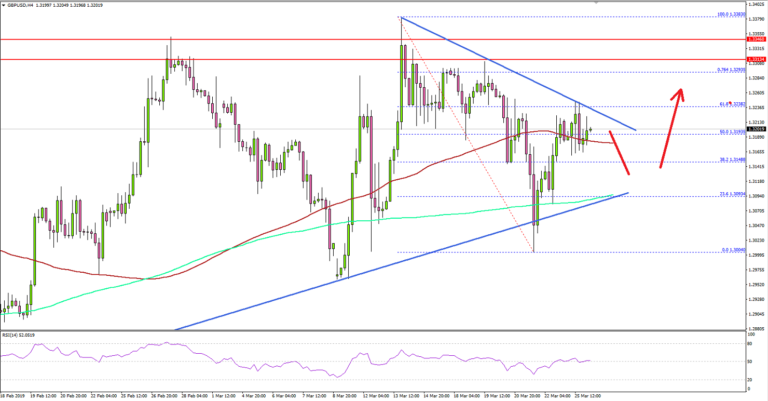
Looking at the 4-hours chart, the pair surpassed the key 1.3150 resistance level and settled above the 200 simple moving average (4-hours, green) and 100 simple moving average (4-hours, red).
There was a break above the 50% Fib retracement level of the last drop from the 1.3383 high to 1.3004 low. The pair even broke the 1.3200 and 1.3210 resistance levels.
The next key resistance is near the 1.3290 level and the 76.4% Fib retracement level of the last drop from the 1.3383 high to 1.3004 low. However, the main resistance is near the 1.3300-1.3320 zone, which acted as a hurdle for buyers on many occasions earlier.
On the downside, an initial support is near the 1.3150 level. There is also a major bullish trend line in place with support at 1.3120, positioned along with the 200 simple moving average (4-hours, green).
Fundamentally, the Chicago Fed National Activity Index (CFNAI) for Feb 2019 was released by the Federal Reserve Bank of Chicago. The market was looking for a rise from the last reading of -0.43 to -0.30.
However, the actual result was mixed as the CFNAI came in at -0.29, down from the last revised reading of -0.43. The report added:
Two of the four broad categories of indicators that make up the index decreased from January, and three of the four categories made negative contributions to the index in February.
Overall, dips remain supported in GBP/USD towards 1.3150 and 1.3120 and the pair seems to be approaching a significant hurdle near 1.3300.
Economic Releases to Watch Today
- US Housing Starts Feb 2019 (MoM) – Forecast 1.215M, versus 1.230M previous.
- US Building Permits Feb 2019 (MoM) – Forecast 1.300M, versus 1.317M previous.
- US Consumer Confidence March 2019 – Forecast 132.0, versus 131.4 previous.
Daily Markets Broadcast
Wall Street overcomes early selling to close higher
US indices experienced early pressure yesterday but recovered lost ground to finally close higher on the day. Apple kept the Nas100 index capped while gold hit a near-one month high.
US30USD Daily Chart
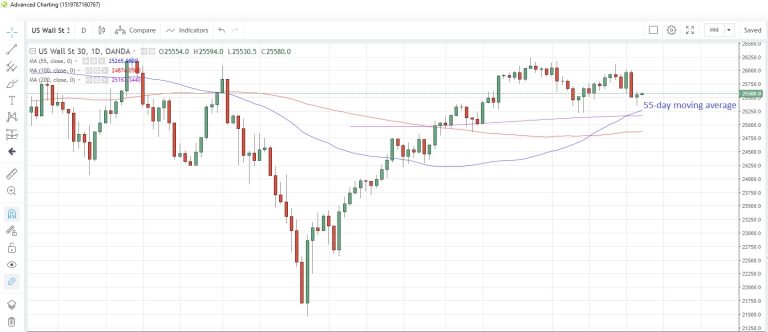
The US30 index slid to a two-week low before rebounding to close higher yesterday
The index held above the 55-day moving average at 25,266, which has underscored prices since January 23
US housing starts are seen dropping 28.3% m/m in February and building permits are expected to decline 0.6%. In contrast, the house price index is forecast to rise 0.3% in January.
DE30EUR Daily Chart
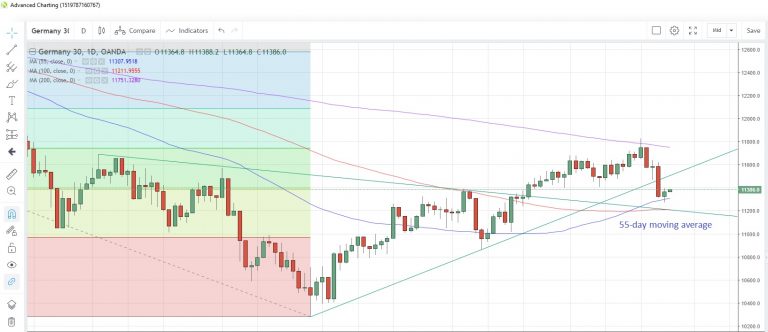
The Germany30 index rebounded from the lowest level since February 19 to post a positive close yesterday as German IFO surveys beat estimates
The index tested below the 55-day moving average at 11,298 before rebounding. The moving average still supports prices on a closing basis since February 8
After the better-than-expected German March IFO surveys yesterday (expectations index 95.6 vs 94.0 forecast), today we see the Gfk consumer confidence survey for April. That’s expected to hold steady at 10.8, according to the latest survey of economists.
XAU/USD Daily Chart
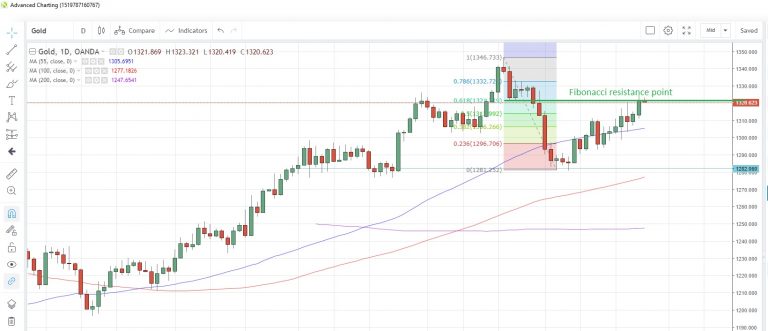
Gold pushed to the highest level this month last night versus the US dollar amid global growth concerns and a weaker US dollar on the back of lower US yields
The index breached the 61.8% Fibonacci retracement level of the February-March drop at 1,321.79 for the first time since February 28. The pair is still hovering near that resistance point
The US 10-year Treasury yield fell to 2.418% yesterday, the lowest since December 2017, after Friday’s PMI readings raised concerns of a deeper global slowdown. The yield curve inverted a touch more, which many believe to be the fore-runner of a US recession.
GBPUSD Looks To Follow Through Higher On Correction
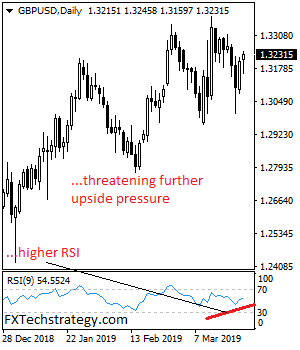
GBPUSD looks to follow through higher on correction. Support stands at 1.3150 level. Further down, support comes in at the 1.3100 level where a break will turn focus to the 1.3050 level. Further down, support lies at the 1.3000 level. Below here will set the stage for more weakness towards the 1.2950 level. On the upside, resistance stands at the 1.3250 with a turn above here allowing for additional strength to build up towards the 1.3300 level. Further out, resistance stands at the 1.3350 level followed by the 1.3400 level. On the whole, GBPUSD faces further upside pressure on more recovery threats.
Eco Data 3/26/19
[php_everywhere instance="1"]
Gold Climbs to 4-Week High as Risk Apprehension Jumps
Gold has posted strong gains to kick off the week. In Monday’s North American session, the spot price for one ounce of gold is $1322.50, up 0.69% on the day. The metal is currently at its highest level since the end of February. On Tuesday, the U.S. publishes building permits and CB consumer confidence.
Nervous investors is usually good news for gold, which is a safe-haven asset. Investors have been in a sour mood since the Federal Reserve policy meeting on Wednesday. The Fed has been dovish since the start of the year, but the Fed was much more dovish than expected last week. The Fed’s dot plot indicated that rate levels will remain on hold for the rest of 2019, and the Fed also lowered its growth forecast for 2019 to 2.1%, down from 2.3% in December. There was more bad news on Friday, as the spread between 3-month and 10-year Treasury notes turned negative for the first time since 2007. This is known as an inverted yield curve, which is considered a recession indicator. Stock markets dropped sharply late last week and the downward trend has continued on Monday. This has been good news for gold, which has climbed close to 1.0% since Thursday. If risk apprehension remains strong, traders can expect gold to continue to climb.
British Pound Steady, But More Brexit Drama Looms
GBP/USD is almost unchanged in the Monday session. In North American trade, the pair is trading at 1.3228, up 0.14% on the day. It’s a quiet session for fundamentals, with no data events. In the U.S., the sole events are speeches from two FOMC members, Charles Evans and Eric Rosengren. On Tuesday, the U.S. releases building permits and CB consumer confidence.
Amid the chaos surrounding Brexit, about the only certainty in store this week is that the drama will continue, as parliament is scheduled to hold a series of votes. On Monday, lawmakers vote on whether to adopt alternatives to Prime Minister May’s withdrawal agreement. If this motion passes, parliament would vote on an array of alternatives on Wednesday, which could include a second referendum or some version of May’s withdrawal deal. However, even if any alternatives are supported by parliament, they would not be binding on the government. May has seen her authority seriously eroded, and she would like nothing more than to see parliament pass her deal or a similar variation. The pound showed strong movement late in the week, and the volatility is likely to continue this week.
A sharply dovish Federal Reserve has unnerved investors, and stock markets dropped sharply late last week. At last week’s policy meeting, the Federal Reserve indicated it had no plans to raise interest rates in 2019 and also lowered its growth forecast for 2019 to 2.1%, down from 2.3% in December. There was more bad news on Friday, as the spread between 3-month and 10-year Treasury notes turned negative for the first time since 2007. This is known as an inverted yield curve, which is considered a recession indicator. All eyes will be on U.S. Final GDP, which will be released on Thursday. If GDP is weaker than expected, traders can expect volatility in the currency markets.