

Sample Category Title
Former Fed chair Yellen: Yield curve inversion signals Fed cut, not recession
Former Fed Chair Janet Yellen said in a conference in Hong Kong that yield curve inversion doesn't indicate recession in the US economy ahead. Rather, the development suggests that Fed might need to cut interest rate.
Simply, put she said "my own answer is no, I don't see it as a signal of recession". She explained, "in contrast to times past, there's a tendency now for the yield curve to be very flat". Thus, it's now easier for it to invert.
On the other hand, Yellen said "it might signal that the Fed would at some point need to cut rates, but it certainly doesn't signal that this is a set of developments that would necessarily cause a recession."
WTI Oil Outlook: Rising Concerns about Global Economic Slowdown Keep Oil Price Under Pressure
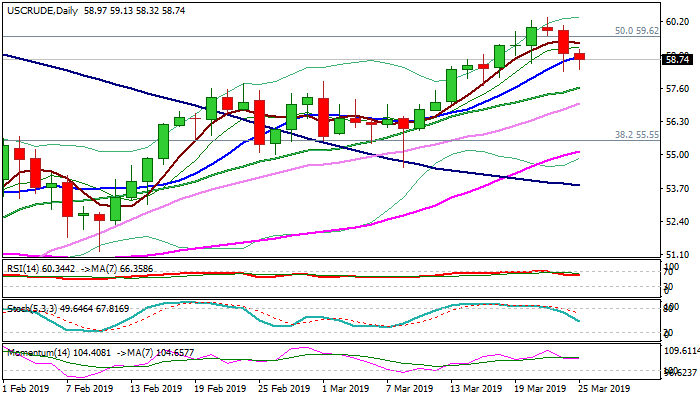
WTI oil remains in red on Monday, following bearish close last Friday that completed Doji reversal pattern on daily chart. Rising concerns of broadening global slowdown that were sparked by news from Germany on Friday that showed extending contraction of the economy, keep oil prices at the back foot on fears that slowdown will lower oil demand. Fresh easing was also signaled by overbought daily studies and is so far seen as price adjustment before larger bulls continue. Dips cracked 10SMA support ($58.84) and close below would signal extension of corrective phase that would expose next pivotal support at $57.62 (20SMA). Sustained break here would sideline bulls and signal deeper pullback.
Res: 59.13; 59.36; 59.62; 60.05
Sup: 58.27; 57.62; 57.00; 56.75
Into US session: German Ifo helps stabilize sentiments, 10-year bund yield turned positive briefly
Entering into US session, the forex markets remain generally in tight range as risk sentiments are stabilized by slightly better than expected German Ifo. Most notably, German 10-year bund yield recovered some ground and turned positive to 0.006 briefly. However, it should be noted that the implications of Ifo data were not much different from last week's PMIs. That is, manufacturing remains a weak spot in the German economy, with the component declined for the six month in a row. The improvements in headline Business Climate was due to improvements in services, trade and construction.
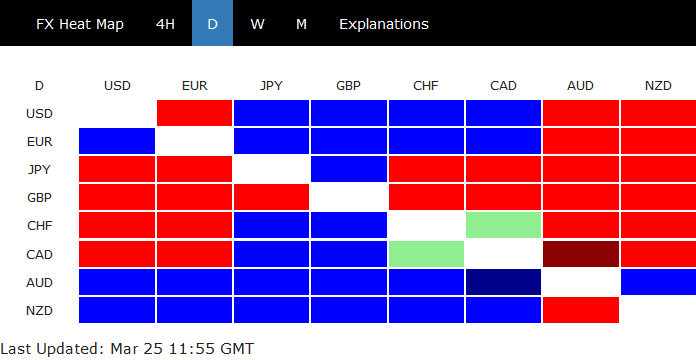
Australian and New Zealand Dollar are the strongest ones for today so far. Sterling is the weakest, await resumption of Brexit debate in the Commons. Yen is the second weakest as risk aversion receded mildly.
In Europe, currently:
- FTSE is down -0.48%.
- DAX is down -0.19%.
- CAC is down -0.21%.
- German 10-year yield is up 0.0082 at -0.003.
Earlier in Asia:
- Nikkei dropped -3.01%.
- Hong Kong HSI dropped -2.03%.
- China Shanghai SSE dropped -1.97%.
- Singapore Strait Times dropped -0.91%.
- Japan 10-year JGB yield dropped -0.119 to -0.085.
AUD/USD Outlook: The Downside Will Remain Vulnerable While 30SMA Caps Recovery
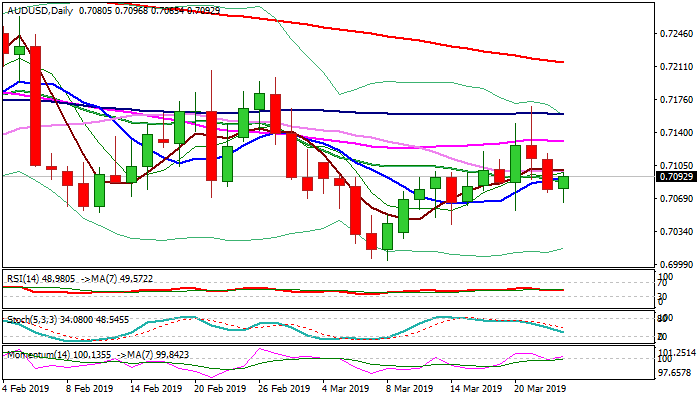
The Aussie dollar bounces from Asian low at 0.7065 and pressures 0.71 barrier (30SMA), propped by renewed risk mode on Monday. Rising bullish momentum helps recovery, but daily techs are still bearishly aligned, following last week's strong upside rejection and subsequent weakness. Lift above 30SMA would ease immediate negative pressure, however, recovery needs break above 55SMA (0.7130) to neutralize bears for renewed attack at pivotal barriers at 0.7159/67 (100SMA / daily cloud top). Limited recovery under 0.71 handle would keep the downside vulnerable for fresh attempts at cracked pivotal Fibo support at 0.7065 (Fibo 61.8% of 0.7003/0.7168) that would unmask daily cloud base (0.7031) and key support at 0.7003 (8 Mar low).
Res: 0.7100, 0.7130, 0.7159, 0.7167
Sup: 0.7085, 0.7065, 0.7056, 0.7031
USD/JPY Outlook: Bears Take A Breather Above Thickening Daily Cloud
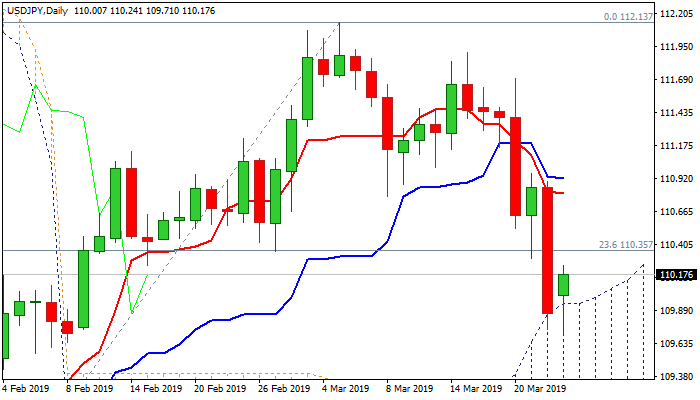
The pair ticks higher on Monday following last Friday's 0.9% fall that contained by the top of daily cloud.
Thickening cloud continues to underpin the action today, but recovery attempts were so far capped by broken 55SMA (110.24) now reverted to resistance, as Friday's close below it was negative signal.
Bearish setup of daily techs suggests that the downside remains vulnerable and corrective upticks could be seen as positioning.
However, bears may show stronger hesitation at cloud top (109.95), but bearish bias is expected to remain in play while extended upticks are capped under daily Tenkan-sen (110.80).
Eventual clear break of daily cloud top would open way towards next key supports at 109.25/15 (Fibo 38.2% of 104.59/112.13 / daily cloud base) violation of which will signal reversal.
Only return and close above 110.90/95 zone (Thu/Fri highs, reinforced by daily Kijun-sen) would sideline bears.
Res: 110.24, 110.58, 110.80, 110.95
Sup: 109.95, 109.71, 109.25, 109.15
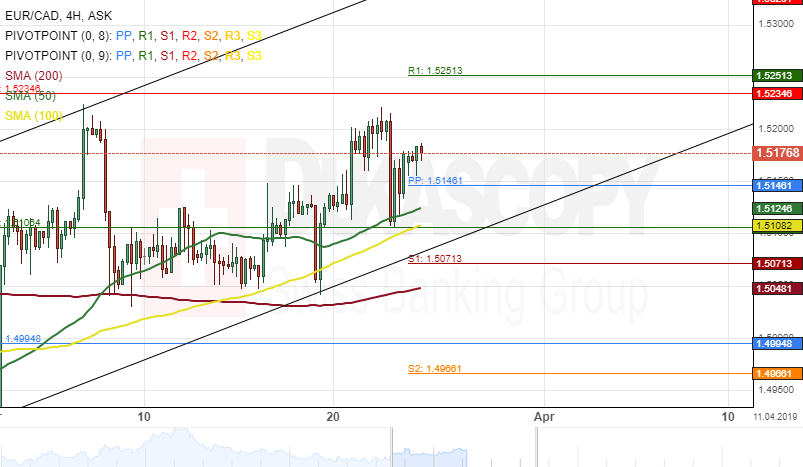
EUR/CAD 4H Chart: Long-Term Targets At 1.5326
The common European currency has appreciated about 1.19% in value against the Canadian Dollar since last week's trading sessions. The 50-hour simple moving average provided support for the pair during Friday's trading session.
Everything being equal, it is likely that the exchange rate will target a resistance cluster formed by the combination of the weekly and the monthly pivot points at 1.5251 during the following trading sessions.
On the other hand, the currency exchange rate could reverse from the current price level at 1.5171 and aim for the lower band of an ascending channel pattern at 1.5071 in the shorter term.
EUR/AUD 4H Chart: Stranded Between SMAs
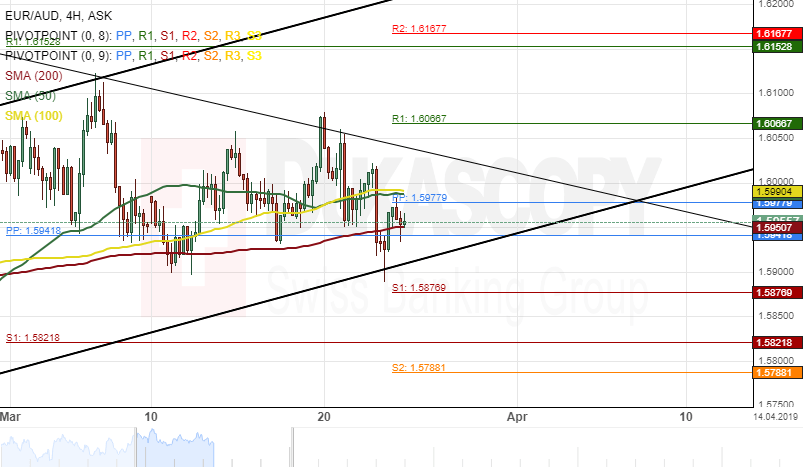
The Eurozone single currency depreciated about 1.13% in value against the Australian Dollar during last week's trading session. The currency pair tested the lower boundary of an ascending channel pattern at 1.5895 during Friday's session.
The exchange rate was stranded between moving averages during the morning hours of Monday's trading session. The 50– and 100-hour SMAs was providing resistance for the pair, while the 200-hour simple moving average was providing support.
Given that the currency exchange rate has bounced off its bottom border of the channel pattern, bullish traders could push the pair towards 1.6078 in the short-term.
Fed Harker: Risks tilt very slightly to the downside, at most one hike this year
Philadelphia Fed President Patrick Harker said in a speech in London that "potential risks tilt very slightly to the downside" in the US. Though he emphasized the work "slight" as he saw "outlook as positive" and economy "continues to grow" and is on pace to the the longest economic expansion in history.
Harker added there was "continued strength" in the labor market. He'd "cautious against" getting caught up in a single data point in February's dismal job data. Meanwhile, inflation is running around 2% target and "does not appear to be on a strong upward trajectory". Rather inflation is "edging slightly downward".
Combining all, Harker stays in "wait-and-see mode". He expects "at most, on rate hike this year, and one in 2020". But his stance will be "guided by data".
The US Curve Inverts, Uncertainty Rises
The continued effects of US yields can be felt across the entire asset class today. Following Friday, we are seeing risk sell-off in FX, equity indices and bond yields. The FX risk basket of TRY, BRL and ZAR have been hammered with the JPY as the primary destination for safe-haven flows. The yield on the 3 Month Treasury Bill rose above the yield for 10-year Treasuries for the first time since 2007, generating forewarnings that the US is headed for recession in early 2020. The move was generated by FOMC dots indicating solid expectations for a pause in 2019 and raising the probability that the next move will be an interest rate cut.
Historically, yield-curve inversions precede significant economic slowdowns by about a year. While some high-status pundits have suggested that it's different this time, the actions have already triggered a self-fulling prophecy. The San Francisco Fed's Michael Bauer and Thomas Mertens wrote last year that the "the traditional 10 yr-3-month spread is the most reliable predictor (of recession)". Note: The US 10-year, 3-month curve inverted ahead of the 1990-91, 2001 and 2007-09 recessions.
On the policy side, we believe that the Fed will pause its currency hiking cycle indefinitely. Core PCE (Personal Consumption Expenditure) inflation has been running below 2% y/y so there is little need for the FOMC to be aggressive. In addition, the growth slowdown indicates that any overshoot would hit meaningful headwinds. The theory of no further hikes this cycle is also supported by the fact that unconventional policy in balance sheet reduction has also turned dovish. Yet the Fed's concern is less about growth outlook, which has remained solid but at risk to financial conditions. Instead, it seems to have become hypersensitive to risk in the financial markets. This outlook should be USD negative, however, as there is increasing worry that Europe and the ECB are not behind the curve. We don't expect the ECB to cut rates any time soon but the outlook for tighter Euro-area monetary policy is now fading. Our US-EU convergence theory that would have given the Euro a boost need to be side-lined.
The ups and downs of the US job market
The US economy is decelerating as the boost stimulated by tax cuts begins to dwindle and the trade war with China begins to bite. Other factors such as political discourse, partial government shutdown and poor Fed communications are hard to measure, but they clearly cast a combined shadow on the economic outlook. In theory, investors now expect that short-term rates will fall as the Fed's next move will be to cut interest rates. The rational for the Fed to cut is that the economy is slowing sharply, and recession warning lights are blinking.
Those who argue that the US will avoid a sharp economic fall point to the strong labor market and positive consumption data. With over 70% of GDP derived from this critical sector, jobs underpin American consumption. An extraordinarily strong hiring cycle has attracted new workers into the labor force, which has increased incomes and expanded the consumption base. If you also factor in the positive trend in wage growth, you have a compelling story for a soft economic slowdown that will avoid recession. However, the problem with having an ultra-strong labor market that has seen monthly job gains of over 200K is that it would not take much for companies to begin slashing payrolls due to perceived negative signals. The US employee psyche has been scarred by the extended hardship of the financial crisis, and if media and data light up to HR cuts, US consumer would quickly move into a defensive position — lower spending. It is critical to mention that left-leaning US media would then be happy to headline this as President Trump's economic failure, even if it meant their own downfall.
EUR/USD – Euro Stops Slide As German Business Confidence Improves
EUR/USD has posted slight gains on Monday, after sharp losses late week. Currently, the pair is trading at 1.1323, up 0.019% on the day. On the release front, German Ifo Business Climate rebounded in March, rising to 99.6 points. This marked a 3-month high. There are no U.S. releases to kick off the week. On Tuesday, Germany releases consumer confidence and the U.S. publishes building permits and CB consumer confidence.
German business confidence rebounded in March by more than expected, boosting the euro on Monday. The markets have been accustomed to releases above the 100-level, and the February reading of 98.5 was the weakest since November 2014. The survey noted that any improvement was confined to domestic sectors, such as construction and retail services. The manufacturing sector remains weak, battered down by the ongoing global trade war, which has dampened the appetite for German exports, such as vehicles and auto parts. Germany’s economy slowed down in the fourth quarter, and this bodes poorly for the rest of the eurozone.
There is continuing uncertainty over the U.S-China trade talks. There have been growing expectations that the sides will reach an agreement, with a summit between President Trump and Chinese President Xi to follow. However, President Trump announced a tougher negotiating position last week, saying that the U.S. would maintain tariffs on China until it was clear that China was complying with a deal. Chinese officials are likely to insist that tariffs be removed as soon as a deal is signed, so a deadlock could be in the offing. Trump’s hard-line stance could hamper negotiations, and nervous investors could respond by flocking to safe-haven gold. The trade talks have taken a break, but are expected to resume later this week.