Sample Category Title
Investors Are Concerned About Rising Recession Risks
On Friday, the US dollar strengthened slightly against a basket of major currencies. The dollar index (#DX) closed the trading session in the positive zone (+0.17%). The euro collapsed after the publication of weak economic data. Thus, German manufacturing PMI fell to 44.7, while experts expected 48.0. Markit composite PMI also updated the lows and counted to 51.3 instead of 52.0.
Demand for safe assets has increased significantly. The yield spread between 3-month and 10-year US bonds has been first inverted since 2007. Financial market participants are increasingly concerned about rising recession risks in the global economy. Meanwhile, the US currency was additionally supported by an optimistic report on existing home sales for February. The indicator rose to 5.51M instead of the forecasted value of 5.10M.
Investors are still focused on Brexit. It should be recalled that the EU agreed to delay Brexit until May 22, if British parliamentarians approve the agreement. If legislators do not accept the Brexit until March 29, the extension will be valid until April 12. However, it became known that the British parliamentarians wanted to hold a vote on taking Brexit in their hands, and Theresa May's ministers intended to force her to resign. Meanwhile, anti-Brexit petition has gained almost 5 million signatures.
The "black gold" prices are falling. At the moment, futures for the WTI crude oil are testing the mark of $58.85 per barrel.
Market Indicators
- On Friday, aggressive sales were observed in the US stock market: #SPY (-1.92%), #DIA (-1.78%), #QQQ (-2.20%).
- The 10-year US government bonds yield fell significantly. At the moment, the indicator is at the level of 2.45-2.46%.
The news feed on 25.03.2019:
- German IFO business climate index at 11:00 (GMT+2:00).
Markets Don’t Believe Fed Any More
On Friday, stock markets experienced one of the biggest declines since the beginning of the year, losing almost 2% on the S&P 500. Investors were frightened by the debt markets signals. The yield on 10-year US government bonds turned out to be lower than the 3-month yield for the first time since 2007. The norm is a higher yield for bonds with a longer maturity.
The opposite situation is regarded as a signal of the coming recession when interest rates are traditionally lower. In our opinion, the markets are somewhat confused about what is the cause and what is the consequence. The yield declined due to a softer Fed tone. Markets now estimate the chances of lowering rates at 68% in the coming year compared to 22.5% a month earlier. But this sharply contradicts the forecasts of the Fed itself, which does not expect rate changes in the coming year.
In other words, the Fed is not tightening policy now to avoid a sharp reduction of rates in the future and not to pull the economy out of recession. In 2016, a similar pause on the way of tightening was enough to put the United States back on the path of growth and even demonstrate impressive acceleration. The same applies to the ECB, Bank of Japan and the Central Bank of China. Apparently, they are now trying to repeat the trick that worked three years ago.
The cautious tone of the largest regulators undoubtedly provokes market anxiety and initially puts pressure on stock prices. However, the fact that central banks are taking proactive actions to calm the markets ultimately can bring growth back to the markets.
As usual in the economy, it is impossible to avoid “if” and “but”. It may well be that the increase in the number of problems may require a more structural solution than just a pause in raising of interest rates. Such fears still look premature, but still it is better to keep them under control. In the short term, in our opinion, the chances are higher that markets will accept the Fed's softness and lower long-term rates as a source for growth, but not cause for concerns. Potentially, lower interest rates can fuel demand for risky assets as soon as the initial shock passes through financial markets.
EUR/USD Outlook: Upbeat Ifo Data Boost Recovery Before Bears Regain Control
The Euro moves higher in European trading on Monday, boosted by better than expected German Ifo data (business climate rose to 99.6 in Mar vs 98.7 f/c / Feb) that partially offsets shock from last Friday’s downbeat PMI numbers.
Traders also booked profits from Thu/Fri 1.1% fall which emerged from last week’s bull-trap pattern, formed above daily cloud.
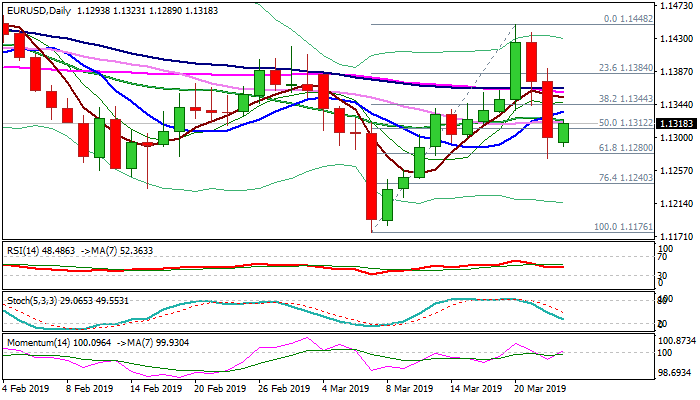
Fresh risk mode works against Euro with Friday’s close below 30SMA (1.1321) being negative signal.
Fresh bears also cracked key Fibo support at 1.1280 (61.8% of 1.1176/1.1448) on Friday, but close below is needed to confirm bearish stance for further weakness and test of 1.1240 (Fibo 76.4%).
Current recovery is seen as positioning for fresh downside with initial barriers at 1.1321/23 (converged 20/30SMA’s); 1.1334 (10SMA) and 1.1344 (broken Fibo 38.2%) which needs to cap upticks and keep bears in play.
Res: 1.1321; 1.1334; 1.1344; 1.1364
Sup: 1.1289; 1.1280; 1.1240; 1.1200
GBP/USD Outlook: Softer Tone And High Volatility At The Beginning Of Key Week For Brexit
Sterling holds soft tone in early Monday's trading, at the beginning of key week for Brexit.
Britain's parliament is going to vote on government's next steps after PM May's plan has been repeatedly rejected.
May managed to get short extension of Brexit from the EU last week, but situation remains dramatical as the bloc grants delay until 22 May only if the Britain offers workable and approved plan.
Otherwise, the due date is on 12 Apr until when UK government needs to either offer new plan or exit the EU without deal.
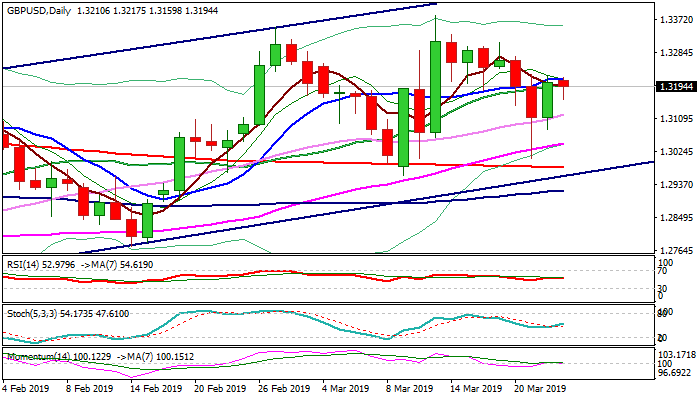
British pound in choppy and volatile mode, as last week's fall was followed by strong downside rejection above key 200SMA, but ended week in red and below thickening weekly cloud which heavily weighs.
Daily studies are mixed as weakening momentum conflicts rising stochastic while MA's remain in mixed configuration.
Bullish signal could be expected on sustained break above 1.3225 highs (reinforced by 10SMA) and 1.3237 (Fibo 61.8% of 1.3381/1.3004 that would shift near-term focus higher.
Conversely, dip below rising 30SMA (1.3120) would weaken near-term structure and risk retest of 200SMA (1.2982).
Res: 1.3225, 1.3237, 1.3272, 1.3292
Sup: 1.3159, 1.3120, 1.3080, 1.3045
German Ifo rose to 99.6, resilient economy except manufacturing
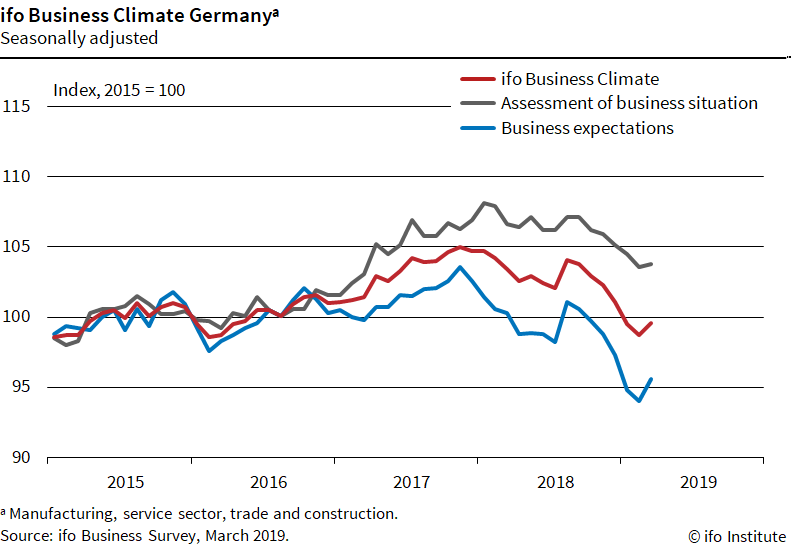
Germany Ifo Business Climate improved to 99.6 in March, up from 98.7 and beat expectation of 98.5. That's also the first increase following six declines in a row. Current Assessment rose 0.2 to 103.8, beat expectation of 102.9. Expectations gauge also rose to 95.6, versus consensus of 94.0.
Looking at the details, manufacturing dropped from 9.1 to 6.6, seventh decline in a row. But services rose from 21.3 to 26.0. Trade rose from 4.9 to 8.2. Construction rose from 18.0 to 20.3.
Ifo President Clemens Fuest noted "sentiment among German business leaders has improved somewhat". And "companies are somewhat more satisfied with their current business situation, and they are decidedly more optimistic regarding business in the coming six months." He added "the German economy is showing resilience."
Ifo economist Klaus Wohlrabe said, "Brexit uncertainty is particularly hitting the industrial sector. The other sectors don’t appear to be affected" .
Forex Technical Analysis: EUR/USD, USD/JPY, GBP/USD
EUR/USD
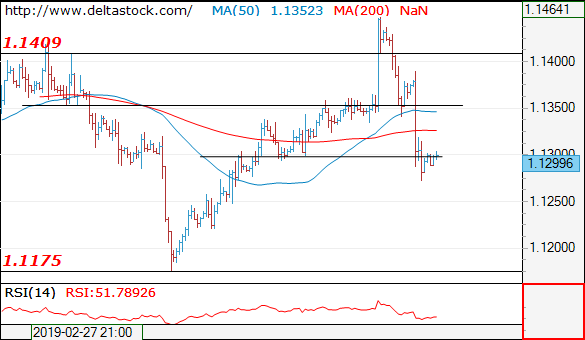
Current level - 1.1299
The violation of 1.1350 support led to a sell-off through 1.1300 and the outlook is bearish below 1.1320, for a test of 1.1175 low.
| Resistance | Support | ||
| intraday | intraweek | intraday | intraweek |
| 1.1320 | 1.1570 | 1.1270 | 1.1175 |
| 1.1410 | 1.1830 | 1.1175 | 1.0860 |
USD/JPY
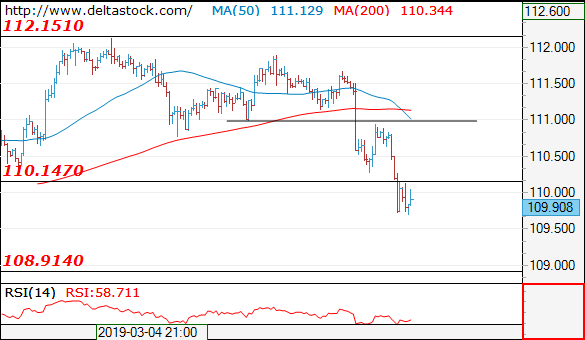
Current level - 109.90
The rebound to 111.00 resistance was followed by a break through 110.20 support and the bias is bearish, for a slide towards 108.90.
| Resistance | Support | ||
| intraday | intraweek | intraday | intraweek |
| 110.20 | 113.00 | 109.70 | 108.90 |
| 111.00 | 114.50 | 108.90 | 107.40 |
GBP/USD
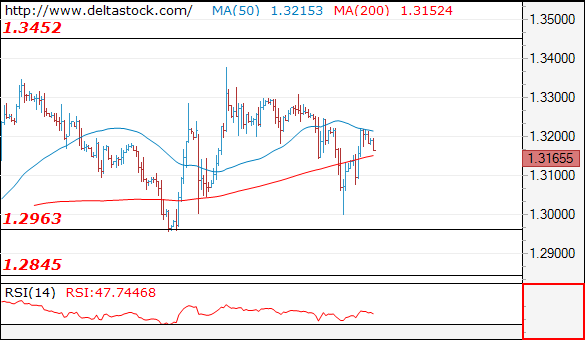
Current level - 1.3165
My outlook is positive, for a test and break through 1.3300 area, towards 1.3450.
| Resistance | Support | ||
| intraday | intraweek | intraday | intraweek |
| 1.3300 | 1.3450 | 1.3150 | 1.2800 |
| 1.3300 | 1.3450 | 1.2960 | 1.2610 |
Currencies: EMU Data And Global Risk-Off Are Weighing On The Euro
Rates: Global 10-yr yields fall below key levels
Disastrous EMU PMI's pushed the German 10-yr yield into negative territory for the first time since October 2016, while the US 10-yr yield broke through key support of 2.50%. Today's German IFO Business sentiment will likely confirm Friday's PMI's. Risk off remains today's sentiment, setting core bonds up for more gains.
Currencies: Poor EMU data and global risk-off are weighing on the euro
Fears on global growth dominated global (FX) trading on Friday. Poor EMU PMI's pushed the euro off a cliff. However, US yield curve moves also suggests investor uncertainty on US growth. The euro remains vulnerable to negative news (e.g from today's Ifo), but we don't expect a break of the 1.12 area. Keep a close eye at the 124.30/123.40 EUR/JPY support area
The Sunrise Headlines
- US stocks slid on global growth concerns Friday undoing all post Fed gains. The Nasdaq underperformed (-2.50%). The equity selloff rolls into Asian markets, with Japan significantly lagging its peers (3%).
- Special counsel Robert Mueller found no evidence of president Trump colluding with Russia to win the 2016 election. Regarding the investigation on obstruction of justice, Attorney General Barr concluded that the evidence “is not sufficient”.
- Spain's Socialist party increased their lead in the run-up to the April 28 elections, according to a freshly concluded poll. Sanchez' party would still fall short of a majority however, as would a coalition of the three right-wing parties.
- China's industry minister Miao said the direct government intervention in the industrial sector will gradually be reduced. His comments came days ahead of a new round of high-level trade talks starting in Beijing on Thursday.
- Chicago Fed Evans understands markets are nervous about the US10y and US3m curve inversion but added the US eco outlook is solid. Evans considers current interest rates neutral and expects no hike until the second half of 2020.
- Italy's Five Star Movement remains the top-voted party in Basilicata's local elections but its support slid considerably compared with last year. League surged but the vote won't affect the stability of the government, PM Conte said.
- Economic data is scant at the start of this week. We watch for Germany's IFO confidence. Fed's Harker is scheduled to speak, marking the start of this week's avalanche. UK parliament votes to take control of the agenda for one day.
Currencies: EMU Data And Global Risk-Off Are Weighing On The Euro
Growth fears weighing more on euro than on USD
Last week both the dollar and the euro faced headwinds as investors pondered mounting signs of a global growth slowdown. On Wednesday, the Fed cemented its await and see bias, taking time to assess incoming eco data and sending the dollar substantially lower. However, on Friday the euro also fell off a cliff. Awful EMU PMI's confirmed the scenario of a regional and global slowdown. The euro was hammered but the EMU PMI's also triggered a global risk-off repositioning. EUR/USD dropped and (more than) reversed the post-Fed rally. EUR/USD closed at 1.1302 (from 1.1374). The yen attracted safe haven flows. USD/JPY declined to close at 109.92. EUR/JPY finished at 124.24, testing a key support area.
This morning, Asian markets are also hit hard as fears on a growth persist. The Mueller report removing some uncertainty on the political fate of US President Trump and hope a further progress on the China US trade talks currently can't alleviate fears on growth. Chicago Fed Evans wasn't that negative on the US economy. Still, US yields stay close to last week's low levels. The major currency cross rates consolidate Friday's repositioning. The yen stays strong. USD/JPY hovers in in the 110 area. EUR/USD struggles not to fall back below the 1.13 handle.
Today, FX markets will focus on pointers for growth. In the US, the Chicago Fed activity index and Dallas Fed manufacturing activity will be published. However, the German IFO business climate will take centre stage. Will the negative PMI's from Friday be confirmed? The reaction to IFO will probably be more muted than after Friday's PMI's. Markets are uncertain on global growth, but the euro is probably more vulnerable to more bad news compared to the dollar. We also keep a close eye at the EUR/JPY technical chart. The pair dropped below the 124.38 neckline and a sustained drop below 123.40 might have (profound) consequences for other euro cross rates. On Friday, the euro upside potential was blocked. EUR/USD remains in the 1.12/1.15 trading range. We still assume no outright break of this range but a downside test is becoming more likely, if EMU data disappoint or global risk sentiment deteriorates further.
The EUR/GBP declined in lockstep with the post PMI overall decline of the euro Friday. This weekend, headlines indicated that the political process of managing Brexit might be heading to an outright chaos. The political survival of PM May is also again at stake. Sterling is losing modest ground (EUR/GBP 0.8580 area). Last week's EUR/GBP decline was euro weakness. We don't see a reason for sterling outperformance if Brexit uncertainty persists.
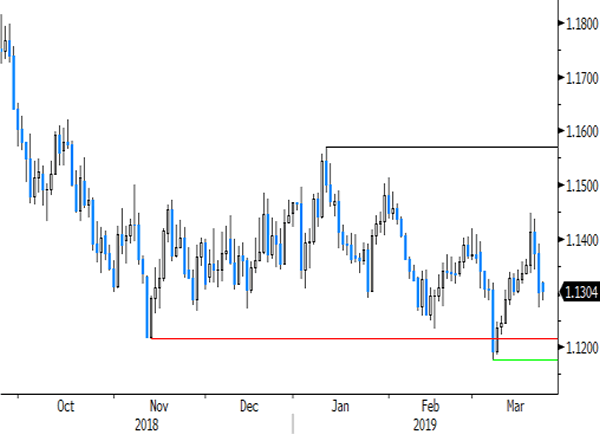
EUR/USD: holding in the 1.12/1.16 range. As risk aversion and worries on global growth persist, EUR/USD risks have tilted to the downside
Fed Evans: May need to loosen monetary policy if activity softens more than expected
More from Chicago Fed President Charles Events. He warned that "at the moment, the risks from the downside scenarios loom larger than those from the upside ones". And, "if activity softens more than expected or if inflation and inflation expectations run too low, then policy may have to be left on hold -- or perhaps even loosened -- to provide the appropriate accommodation to obtain our objectives."
On the other hand, "if growth runs close to its potential and inflation builds momentum, then some further rate increases may be appropriate over time to ensure that the economy settles in on its long-run sustainable growth path and that inflation runs symmetrically about our 2 percent target". He added "in this scenario, the path for rates will depend crucially on any signals of an acceleration in core inflation."
Though, he emphasized that US economy is still in good shape. He pointed to Fed's forecasts of 1.75-2.0% GDP growth in 2019. Evans said "the lower end of this range is actually in line with my view of the economy's long-run growth potential. So we're not looking at a bad number." Though, ":the economy won't feel like it is doing very well compared with last year's very strong performance."
Asia Joins Friday’s Sell-Off, US Treasury Yield Curve Inverts As Global Growth Worries Spike
The selloff in US and European stock markets from Friday has spread across Asia at the start of the new trading week, as concerns over the health of the global economy heat up at a rapid pace.
Perhaps what is even more worrying for investor sentiment is that the US treasury yield curve has inverted for the first time since 2007. This development will psychologically encourage further anxiety and rocket fears that the global economy is heading for another downturn, if recent economic releases across the globe have not already provided indications that the downturn has arrived.
The heavy declines in global markets and inversion of the US Treasury Yield curve follow the fallout from a spectacular dovish-twist from the Federal Reserve after the conclusion of the latest monetary policy meeting last Wednesday, where suspicions are now making waves that the strongest performing developed market might need to cut interest rates as early as 2020. This downbeat view overall represents a spectacular U-turn in market expectations and joins the coordinated chorus of multiple different respected institutions, senior officials and global central bankers that have repeatedly pointed out that the world growth outlook is deteriorating.
Keep an eye on Yen moves
The Japanese Yen has managed to jump against the US Dollar since global markets commenced their tailspin, but Yen demand has not yet reached fever pitch when you consider that the Japanese Nikkei 225 is down over 3% at time of writing.
I would closely monitor how investors digest the inversion of the US Treasury Yield Curve as trading for the new week gets underway, because market panic has repeatedly acted as a magnet for Yen buying in the past and further negative market movement will make the prospect of adding further Yen flows into an investor portfolio an interesting conversation.
King Dollar Remains on the Throne
Perhaps the only reason why Gold prices have not surged on market uncertainty is due to the steady valuation of the US Dollar. Previous economic downturns have encouraged consistent demand for the Greenback, and there is a balanced view that the Dollar will be able to reign supreme on its throne if further economic releases this week strengthen the view that world economic momentum is decelerating at a faster pace than anticipated.
The US Dollar is justifying its current valuation given that the US economy remains in a far superior position relative to its peers in the developed world. The Fed's revised forecasts for 2.1 percent growth this year, and 1.9 percent for 2020, are a celebration when compared to what the EU will be able to offer the world economy.
The recent string of dire economic announcements that have come out of the Eurozone paint a picture of concern that mean the EU economy will be fortunate if it even manages to achieve growth of 1% this year.
When you combine the dynamics between economic growth projections worldwide and the fact that the Euro makes up a large proportion of the Dollar Index, the Greenback should enter the second quarter of 2019 well-supported.
Brexit Saga Enters Make-Or-Break Stage
The DXY Index may also find a helping hand by expected volatility in the Pound this week, as UK lawmakers are poised to potentially vote on Theresa May's Brexit deal for a third time. It's hard to comprehend how exactly the UK Parliament will approve a deal that they've soundly rejected twice before. Speculation that some might be willing to support the deal if UK Prime Minister Theresa May agrees to step down adds in yet another cocktail of unpredictable risks for what could lie ahead for the British Pound.
Brussels has only granted the United Kingdom a short extension on the request to delay the March 29 departure date from the European Union and it should be monitored whether the short extension on offer will be enough to sway voters in Westminster.
In the unexpected event that May's Brexit deal gets the green light, this should send the GBPUSD back above the 1.33 handle as market confidence increases that the UK will be able to leave the European Union with a deal in hand.
Will An Elliott Wave Ending Diagonal Look For A Top Soon On GBPUSD?
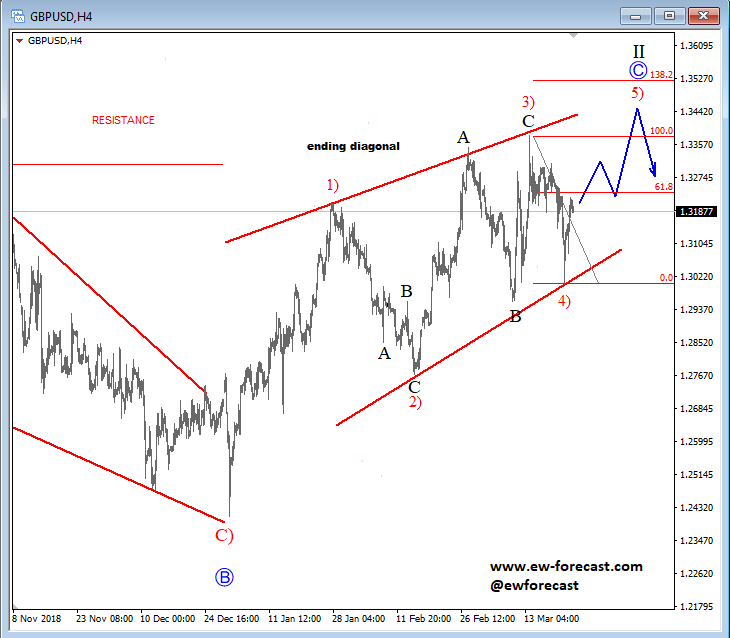
GBPUSD can be trading in an EW ending diagonal within higher degree wave C, with recent turn down representing corrective sub-wave 4), that looks to have found support at the lower EW trend line. Current rally that we see is part of wave 5) which must be structured by three sub-waves in order to complet an EW ending diagonal. A possible top and reversal zone for the pair can be found around the 1.344/1.353 area.
GBPUSD, 4h