Sample Category Title
Asymmetric Trade Deal Sinks Fed Rally
Asymmetric trade deal sinks Fed rally
The Federal Reserve continued to release more doves overnight with the FOMC erasing more dots from its plot and removing any hikes in 2019, moving to just one in 2020. Chairman Powell cited a weakening global economy, US-China trade and nervousness about the domestic economy for sitting on their hands. Somewhat confusingly, he then said that the US economy remains strong with wage growth and inflation where they should be. What is clear is that the Federal Reserve is now in a wait-and-see mode and will play what ends up in front of it.
Bond yields fell across the US curve with the two-year 10-year spread now almost flat. Bond markets have been telling the world for some time that they are much more circumspect about the global economic outlook than the “irrational exuberance” the equity markets continue to show. A US yield curve approaching a negative inversion should speak volumes about how long-term money sees the world in 2019. The falling yields holed the US dollar below the waterline as short-term money piled into emerging market currencies and gold.
Even as the Fed and bond markets were yelling nervous patience, the hot money in equities took a circumspect Fed as a reason to buy, with US stocks rallying. Why the street continues to buy stocks when central banks globally are screaming recession escapes these wizened old eyes. My fall-back position in these circumstances is the old saying, “markets can remain irrational longer than you can stay solvent.”
President Trump was having none of that though, nipping the post-Fed rally in the bud by saying the US wants an asymmetric trade deal. The US wants to keep tariffs in place with China after a signed agreement to ensure they comply with the terms. Many would say this is a fair point, but for China, it clearly is not, and likely explains the drawn-out nature of the negotiations. US equities quickly gave back all their gains with the manufacturing- and bank-heavy Dow Jones Index falling 0.55% and the S&P falling 0.29%, with only the tech-heavy NASDAQ remaining in the green by a paltry 0.07%.
Brexit also got murkier overnight, if that was even possible, as the EU told the UK that a short extension is not possible unless the British Parliament passes a deal – any sort of deal will do. The EU has clearly lost patience with Britain. And with Theresa May unable to control the UK Speaker, her cabinet, her party or Parliament, the EU appear to be taking matters into their own hands, addressing Parliament directly with a stark choice. Sign off on the deal tout suite or risk being kicked out on 29 March. Or, take a multi-year extension, hopefully with a new referendum and or government. The harsh lesson in the one-sided nature of votes when engaged in bilateral negotiations will probably not go unnoticed as the pound (GBP) fell 0.47% to 1.3200 even as the dollar fell across the board.
Asia will be in for an interesting session as it needs to decide whether to follow a dovish Federal Reserve or sweat over potential trade deal delays. Today’s data calendar highlights are Australian Unemployment at 0830 Singapore time and the Bank of Indonesia rate decision at 1530. The former is a volatile number, but with elections looming in the lucky country, a poor print could see traders take flight and talk of Reserve Bank of Australia (RBA) rate cuts increase again. Taking the smart option, Indonesia is expected to hold steady, waiting to see how things play out amongst the big boys first.
FX
The US dollar was pummelled after the FOMC with the dollar index falling 0.53%. Only the GBP slid against the greenback amongst the majors. Emerging markets currencies performed well with the Brazilian real rising 0.8% and the Mexican peso rising 1% versus the dollar. This likely means Asia will ignore the jittery bond market and trade talks, with regional currencies possibly posting decent gains this morning.
The Australian dollar (AUD) will as always be a bit of a turkey shoot over employment data but may struggle to hold onto a 0.71 handle if the print is bad.
GBP has carved out some small gains in early session trading, regaining 1.3200. The rally is modest though, and it’s possible the currency markets have yet to reprice the now much higher chance of a hard Brexit, preferring to focus on the likelihood of a long extension instead and assuming this will be bullish.
Equities
The author is torn this morning on regional equities. Will they follow the initial Fed-induced rally overnight or concentrate on the ominous trade talk remarks by President Trump? One suspects a combination of both, with a possible small rally on regional bourses as bond rates fall, tempered by trade talk tensions.
Gold
Gold loves uncertainty, and we saw plenty of that overnight. Falling bond yields and trade-talk wobbles are the nectar of the gods to the yellow metal, which staged a sparkling rally in New York, rising USD12 from its 1,300.00 an ounce lows to 1,312.00. Asia has seized the mantle in early trade rising another USD4 to 1,316.00 an ounce, eyeing technical resistance at 1,320.00. Bids should remain keenly sought, with increased hard Brexit.
Eco Data 3/21/19
[php_everywhere instance="1"]
Another Dovish FOMC Meeting Sees 2019 Rate Hike Plans Abandoned
- The fed funds target range was held steady at 2.25-2.50% in a unanimous decision
- The updated dot plot shows a majority of FOMC members (11 of 17) don’t see the need for any rate hikes this year; the median call is for just one rate increase in 2020
- GDP growth forecasts revised down slightly this year and next; unemployment expected to be slightly higher
- Policy statement notes slower near-term growth but sustained expansion still expected; “patient” forward guidance unchanged
- Balance sheet normalization details: Fed will begin slowing the pace of tapering in May; balance sheet runoff expected to end in September
We anticipated a cautious tone from the Fed, in keeping with recent comments that suggest officials are comfortable with the current policy stance and see no immediate need to get back to raising rates. But today’s policy statement and projections were still more dovish than we expected—and what investors expected, based on the immediate market reaction. Most notable is the shift in the Fed’s dot plot, which now shows a majority of FOMC members think the current rate setting will remain appropriate through the end of 2019. December’s dot plot had shown a median of two rate hikes were seen as appropriate this year. These new projections suggest the Fed’s base case is to leave policy steady this year—growth and/or inflation will have to surprise to the upside to warrant a return to tightening. We do expect a rebound in Q2 growth but it looks like that might not be enough to pull the Fed from the sidelines in the near-term.
Fed chair Jerome Powell press conference live stream
https://www.youtube.com/watch?v=RNz1osLuTSI
Dollar risks medium term reversal on much more dovish than expected Fed
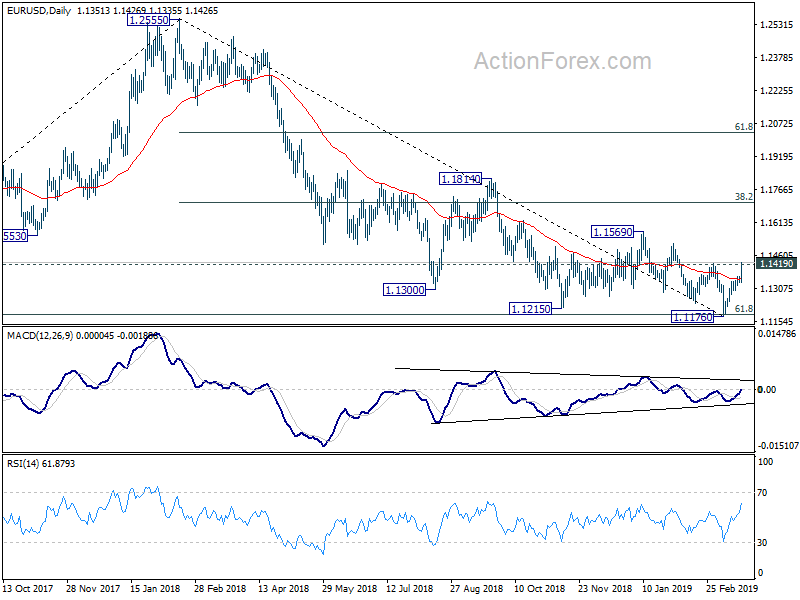
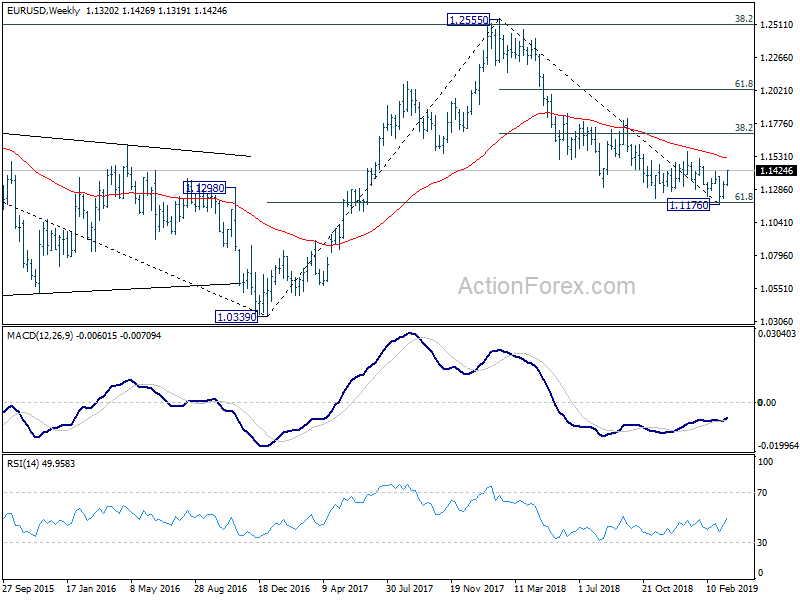
Risks of medium term bearish reversal in Dollar jumps after the much more dovish than expected Fed projections. Break of 1.1419 resistance is taken as the first sign of medium term bottoming at 1.1176. That comes after hitting 61.8% retracement of 1.0339 to 1.2555 at 1.1186, on bullish convergence condition in daily MACD. Sustained trading above 1.1419 will bring further rise to 1.1569 to key resitance to confirm medium term bottoming. Though, it's still too early to confirm trend reversal as we'll have to look at the eventual strength and structure of the rise from 1.1176 to make a judgement.
Fed Goes All in on Dovish Commitment (Dot Plots No More Hikes in 2019)
The Federal Reserve delivered a very clear dovish message. The dovish pivot that has been in place in January was cemented. The decision was considered dovish as the Fed cut the 2019 dot plots forecast from two hikes to none, many expected them to bring it down to one increase. The Fed also sees one hike priced in for 2020, but that might not matter as many will join the camp that the next move will be a cut.
The Fed will end their balance-sheet runoff at the end of September, slightly later than what most economists were expecting.
The immediate dovish reaction saw the dollar tumble, stocks reversed earlier declines, and the 10-year and 2-year yields came down. Gold got its groove back and is now comfortably above the $1,300 an ounce level.
The Fed is over-committing a dovish stance, and this could be a policy mistake that may see them have to flip flop in the summer. The Fed could have maintained their patient approach and kept a rate hike on the table for 2019. If the US sees a trade deal in place in the next two months and if global growth concerns ease, we could see growth and inflation stabilize thus meaning the Fed has painted themselves in a corner.
The next economic downturn will see the Fed have less tools available to support the economy.
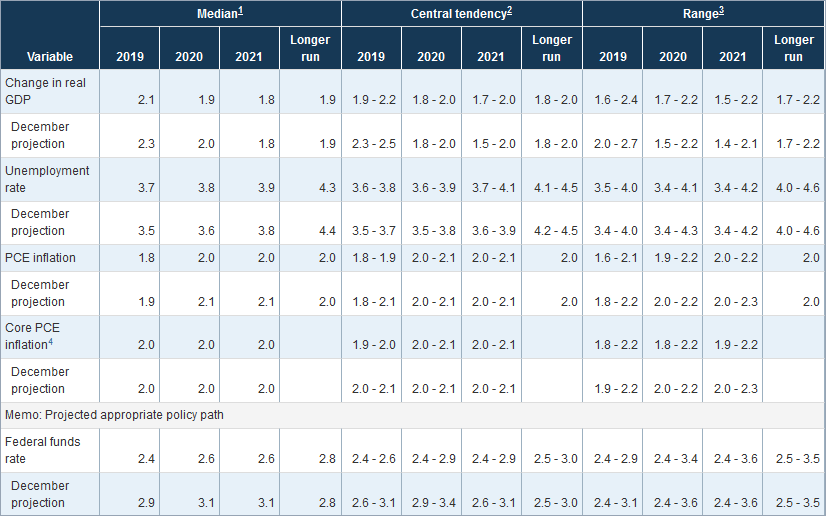
Dovish Fed economic projections: No hike in 2019, lower GDP growth, higher unemployment rate
Fed's new economic projections are rather dovish. In short, there will be no more rate hike in this year. And the current rate hike cycle could end with interest rate below longer run rate. GDP forecasts for 2019 and 2020 are revised down. Unemployment rate for 2019, 2020, and 2021 are all revised up. Dollar dives sharply after the release.
Federal funds rates are projected to be at:
- 2.4% in 2019, revised down from 2.9%.
- 2.6% in 2020, revised down from 3.1%.
- 2.6% in 2021, revised down from 3.1%.
Median longer run rate is unchanged at 2.8%.
That is, there will be no rate hike this year. And probably just one hike in 2020 and it's done. The current cycle could end up with interest rate below the longer run level.
GDP growth is projected to be at:
- 2.1% in 2019, revised down from 2.3%.
- 1.9% in 2020, revised down from 2.0%.
- 1.8% in 20201, unchanged.
Unemployment rate is projected to be at:
- 3.7% in 2019, revised up from 3.5%.
- 3.8% in 2020, revised up from 3.6%.
- 3.9% in 2021, revised up from 3.8%.
Core PCE inflation is projected to be at:
- 2.0% in 2019, unchanged.
- 2.0% in 2020, unchanged.
- 2.0% in 2021, unchanged.
Fed stands pat, talks down weak Feb NFP and fall in headline inflation
Fed left federal funds rate unchanged at 2.25-2.50% as widely expected. It maintained the the Committee will be "patient" regarding future adjustments to interest rates. Nevertheless, Fed talks down the weak NFP growth in February, and maintained that "job gains have been solid, on average, in recent month". Also, unemployment rate "remained low".
Fed also talks down easing in inflation and said it's "largely a result of lower energy prices". Core inflation remains "near 2 percent". Though, growth in household spending and business fixed investments slowed in Q1.
Full statement below:
Federal Reserve Issues FOMC Statement
Information received since the Federal Open Market Committee met in January indicates that the labor market remains strong but that growth of economic activity has slowed from its solid rate in the fourth quarter. Payroll employment was little changed in February, but job gains have been solid, on average, in recent months, and the unemployment rate has remained low. Recent indicators point to slower growth of household spending and business fixed investment in the first quarter. On a 12-month basis, overall inflation has declined, largely as a result of lower energy prices; inflation for items other than food and energy remains near 2 percent. On balance, market-based measures of inflation compensation have remained low in recent months, and survey-based measures of longer-term inflation expectations are little changed.
Consistent with its statutory mandate, the Committee seeks to foster maximum employment and price stability. In support of these goals, the Committee decided to maintain the target range for the federal funds rate at 2-1/4 to 2-1/2 percent. The Committee continues to view sustained expansion of economic activity, strong labor market conditions, and inflation near the Committee's symmetric 2 percent objective as the most likely outcomes. In light of global economic and financial developments and muted inflation pressures, the Committee will be patient as it determines what future adjustments to the target range for the federal funds rate may be appropriate to support these outcomes.
In determining the timing and size of future adjustments to the target range for the federal funds rate, the Committee will assess realized and expected economic conditions relative to its maximum employment objective and its symmetric 2 percent inflation objective. This assessment will take into account a wide range of information, including measures of labor market conditions, indicators of inflation pressures and inflation expectations, and readings on financial and international developments.
Voting for the FOMC monetary policy action were: Jerome H. Powell, Chairman; John C. Williams, Vice Chairman; Michelle W. Bowman; Lael Brainard; James Bullard; Richard H. Clarida; Charles L. Evans; Esther L. George; Randal K. Quarles; and Eric S. Rosengren.
(FED) Federal Reserve Issues FOMC Statement
Information received since the Federal Open Market Committee met in January indicates that the labor market remains strong but that growth of economic activity has slowed from its solid rate in the fourth quarter. Payroll employment was little changed in February, but job gains have been solid, on average, in recent months, and the unemployment rate has remained low. Recent indicators point to slower growth of household spending and business fixed investment in the first quarter. On a 12-month basis, overall inflation has declined, largely as a result of lower energy prices; inflation for items other than food and energy remains near 2 percent. On balance, market-based measures of inflation compensation have remained low in recent months, and survey-based measures of longer-term inflation expectations are little changed.
Consistent with its statutory mandate, the Committee seeks to foster maximum employment and price stability. In support of these goals, the Committee decided to maintain the target range for the federal funds rate at 2-1/4 to 2-1/2 percent. The Committee continues to view sustained expansion of economic activity, strong labor market conditions, and inflation near the Committee's symmetric 2 percent objective as the most likely outcomes. In light of global economic and financial developments and muted inflation pressures, the Committee will be patient as it determines what future adjustments to the target range for the federal funds rate may be appropriate to support these outcomes.
In determining the timing and size of future adjustments to the target range for the federal funds rate, the Committee will assess realized and expected economic conditions relative to its maximum employment objective and its symmetric 2 percent inflation objective. This assessment will take into account a wide range of information, including measures of labor market conditions, indicators of inflation pressures and inflation expectations, and readings on financial and international developments.
Voting for the FOMC monetary policy action were: Jerome H. Powell, Chairman; John C. Williams, Vice Chairman; Michelle W. Bowman; Lael Brainard; James Bullard; Richard H. Clarida; Charles L. Evans; Esther L. George; Randal K. Quarles; and Eric S. Rosengren.
Will Brexit Overshadow this Month’s Meeting?
With only eight days to go until the UK exits the European Union and no deal in place, you would be forgiven for thinking that the Bank of England meeting on Thursday is going to be a non-event, one that investors everywhere are going to broadly ignore, but I’m not sure that’s the right way to look at it.
I’m not suggesting that there may be a surprising rate hike (or cut – other central banks have taken a dovish turn recently) and unlike their US and European counterparts, they don’t release new economic forecasts until May, so no surprises there – although that meeting could be very interesting!
But that doesn’t mean the meeting is a waste of time or should be ignored. The economy is still doing ok, unemployment fell to its lowest level since February 1975 in January, wages are growing at 3.4%, inflation is near-target at 1.9% and a smooth Brexit remains the base case scenario. The bank may not raise rates this week, but one may not be far off.
What can we look forward to?
The flip side of that is that the BoE is unlikely to offer any strong forward guidance this month, especially in such an uncertain global economic environment. That doesn’t mean we won’t see a rate hike this year – 25% priced in this year – but just that May is far more likely to be the time that we are given guidance on it.
The release of the minutes alongside the announcement makes Thursday’s announcement more interesting, with a press conference reserved for the quarters that new projections are released.
Can we expect much movement in GBP?
In terms of what this could mean for the pound, I can’t help but feel that traders are distracted with events in Westminster and Brussels right now and it may take something completely unexpected to draw attention away and significantly impact UK assets.
The fact of the matter is that the BoE this week will play second fiddle to events in Brussels, where the European Council will meet and a possible Brexit extension will be on the agenda. Comments coming from this meeting will likely have a far greater impact on the direction of the pound than whatever the BoE says.
I’m sure Governor Mark Carney and his colleagues won’t be too disappointed at not being in the limelight this week.
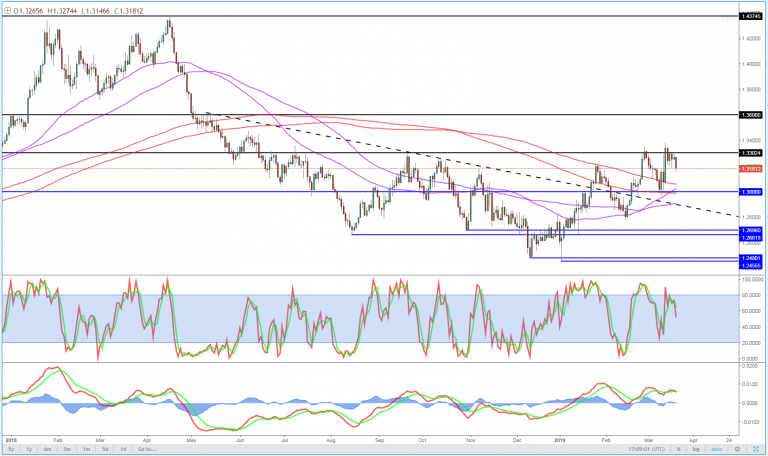
GBPUSD Daily Chart
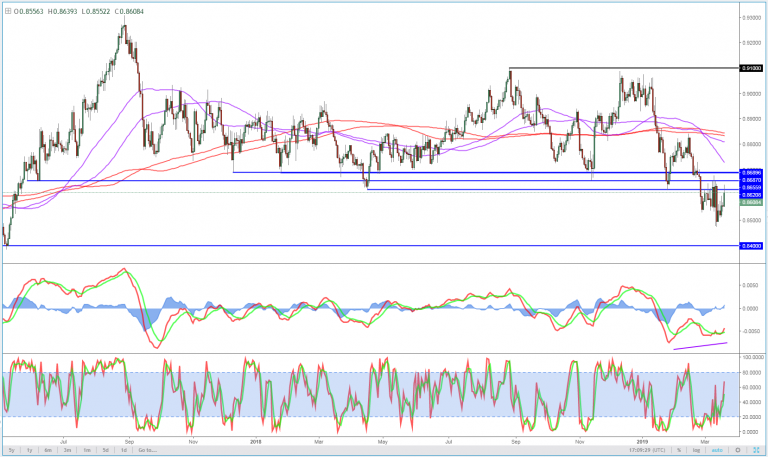
EURGBP Daily Chart
GBPJPY Daily Chart