Sample Category Title
Dovish Fed, Recession Risks, Prolonged Trade War, Brexit Fatigue
Dollar tumbled sharply overnight as FOMC economic projected turned out to be much more dovish than expected. Selling continues today, in particular against the Japanese Yen, which is lifted broadly on after the sharp decline in US treasury yields, in response to FOMC. While stock markets are just mixed, risks are piling quickly. Firstly, Fed's dovishness now pushed the most reliable part of the yield curve on the brink of indicating recession. Secondly, Trump hinted that he's going to extend the ongoing trade war with China even if the latter agrees to a trade deal. The damage to the world economy by the two countries could extend for a long-period of time.
Staying in the currency markets, Canadian Dollar is the second weakest for today even though WTI crude oil surged through 60 handle on sharp decline in oil inventory. New Zealand Dollar is the strongest one following solid rebound in Q4 GDP. Australian Dollar follows as unemployment rate dropped to lowest since 2011. Sterling is mixed for today even though it's the weakest one for the week. EU summit in Brussels will be watched for formal responses to UK's request for Article 50 extension.
Technically, EUR/USD's break of 1.1419 resistance is taken as the first sign of medium term bottoming. Focus will now turn to 1.1569 resistance in near term. Similarly, USD/CHF break of 0.9926 support also suggests medium term topping. Focus will turn to 0.9716 support. USD/JPY will take on 110.35 key support to confirm near term bearish reversal too.
In Asia, Japan is on holiday. Hong Kong HSI is up 0.17%. China SSE is up 0.94% at 3119, back above 3100 handle. Singapore Strait Times is up 0.14%. Overnight, DOW dropped -0.55%. S&P 500 dropped -0.29%. But NASDAQ rose 0.06%. 10-year yield dropped -0.079 to 2.525. 30-year yield dropped -0.053 to 2.975, lost 3% handle.
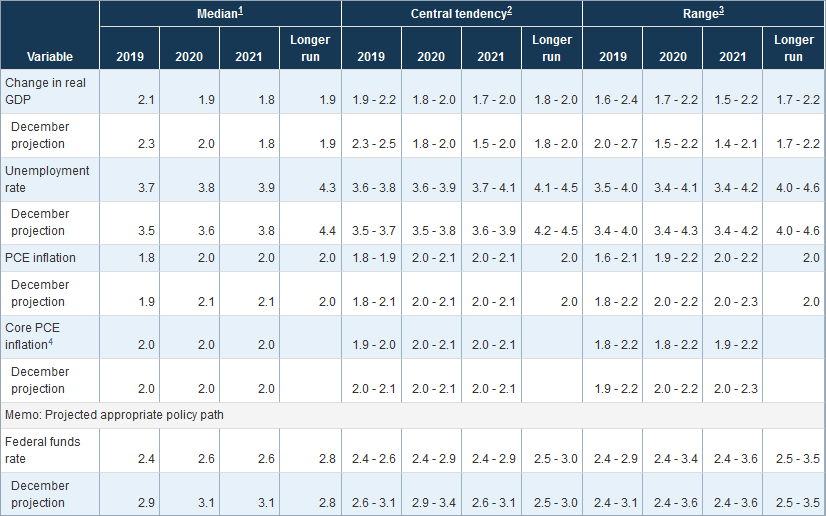
Dovish Fed projections point to no hike in 2019, slower GDP growth and higher unemployment rate
Fed left federal funds rate unchanged at 2.25-2.50% as widely expected. The statement offered no surprise at the committee will remain "patient" regarding future adjustments to interest rates. Fed also decided to terminate the balance sheet reduction plan in September this year.
The shocks came from the all-round, deeply dovish economic projections. In short, there will be no more rate hike in this year. And the current rate hike cycle could end with interest rate below longer run rate. GDP forecasts for 2019 and 2020 are revised down. Unemployment rate for 2019, 2020, and 2021 are all revised up.
Federal funds rates are projected to be at: 2.4% in 2019, revised down from 2.9%; 2.6% in 2020, revised down from 3.1%; 2.6% in 2021, revised down from 3.1%. Median longer run rate is unchanged at 2.8%. That is, there will be no rate hike this year. And probably just one hike in 2020 and it's done. The current cycle could end up with interest rate below the longer run level.
GDP growth is projected to be at: 2.1% in 2019, revised down from 2.3%; 1.9% in 2020, revised down from 2.0%; 1.8% in 20201, unchanged. Unemployment rate is projected to be at; 3.7% in 2019, revised up from 3.5%; 3.8% in 2020, revised up from 3.6%; 3.9% in 2021, revised up from 3.8%. Core PCE inflation is projected to be at: 2.0% in 2019, unchanged; 2.0% in 2020, unchanged; 2.0% in 2021, unchanged.
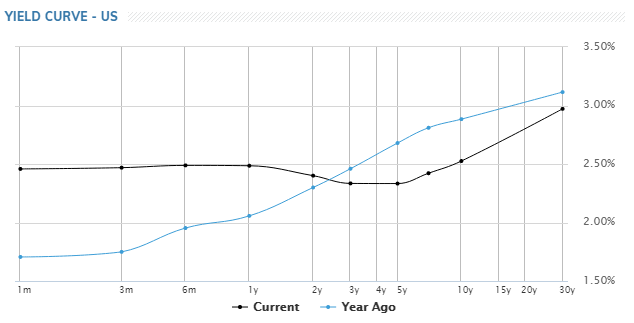
Drastic moves were seen in the bond markets with yield curve now indicate intensified risks of recession ahead. The most reliable recession indicator is now flashing red after yesterday's moves in the bond markets. The spread between 3-month yield and 10-year yield has narrowed sharply and at brink of inverting. The slope of 3-month and 10-year yields is watched by most economist and seen as the best recession indicator.
Suggested readings on FOMC:
- Fed Turns Even More Dovish in March – Downgrading Economic Outlook, Pausing Rate Hike Cycle, Ending Balance Sheet Reduction
- FOMC Thinks It Will Be On Hold Throughout 2019
- Northern Exposure: FOMC in a Good Place
- Fed Keeps Rates Steady as the Dots Fall
- FOMC Recap: Doves On Parade!
- Another Dovish FOMC Meeting Sees 2019 Rate Hike Plans Abandoned
- Fed chair Jerome Powell press conference live stream
- Fed Goes All in on Dovish Commitment (Dot Plots No More Hikes in 2019)
Trump hints at extending trade war and keep tariffs on China for a long period of time
Trump said his administration is talking about leaving tariffs on China for a long period of time. That is, even if a trade agreement is reached, the tariffs won't be limited until China complies with the terms of the deal. His comments come just ahead of USTR Lighthizer's trip to Beijing next week to resume the negotiation.
He said: "We're not talking about removing them, we're talking about leaving them for a substantial period of time, because we have to make sure that if we do the deal with China that China lives by the deal. Trump also criticized that China had a lot of problems living by certain deals."
China has yet to have a formal response to the comments yet. But what Trump said were generally seen as counter productive to the negotiation, as well as the world economy. Without US stopping the punitive tariffs, China will certainly not agree to correcting its unfair trade practice while lifting its own retaliatory tariffs at the same time. The US won't have it all. That is, even if there is an eventual agreement and China will speed up it's reforms, tariffs from both sides will stay there for much longer.
As we emphasized before, there is no trade truce for now, no ceasefire. The tariffs are the "cannons" of trade war and they are bombing both economies everyday right now. They're hurting the world too and will continue to do so for a long period of time as Trump indicated.
EU would grant short Brexit delay only if Commons approve the deal
UK Prime Minister Theresa May formally wrote a letter to European Council President Donald Tusk yesterday, seeking for Article 50 extension until June 30. The date itself is debatable already as EU insisted it couldn't be later than May 23, when EU elections are held. The issue right now is that EU has given quite unified response that UK could be granted an extension only on condition that the Brexit deal is approved by the Commons.
In statement, Tusk offered to give short Article 50 extension. But that would be "conditional on a positive vote on the withdrawal agreement in the House of Commons." If his proposal is approved by all other 27 EU members, and there is a positive vote in the House of Commons next week, the EU can "finalize and formalize the decision on extension in the written procedure". Tusk is ready to call for another EU summit next week if needed.
This position is rather unified in the EU as officials repeated emphasized that there much be a purpose for the extension, be it until May 23 or June 30. But then, the question remains on whether May could secure enough support for her deal. It remains a developing story.
May said at her Downing Street residence that the Brexit delay is "a matter of great personal regret". She added "I passionately hope that (MPs) will find a way to back the deal I have negotiated with the EU, a deal that delivers on the referendum and is the very best deal negotiable, and I will continue to work night and day to secure the support" for the deal. Though, she emphasized she's not preferred t delay Brexit any further than June 30.
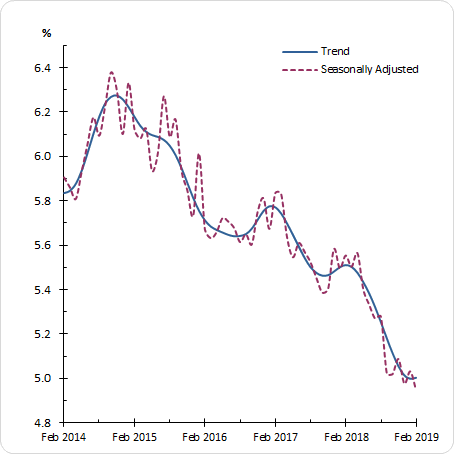
Australia unemployment rate dropped to 4.9% as participation rate dropped -0.2%
In seasonally adjusted term, Australian employment market grew 4.6k in February, well below expectation of 15.2k. Full-time employment dropped -7.3k while part-time jobs grew 11.9k. Unemployment rate dropped to 4.9%, down from 5.0%. That's also the lowest level since June 2011. However, participation rate dropped by -0.2% to 65.6%.
The seasonally adjusted unemployment rate increased in New South Wales (up 0.3 pts to 4.3%) and Victoria (up 0.2 pts to 4.8%). Decreases were observed in Western Australia (down 0.9 pts to 5.9%), Queensland (down 0.6 pts to 5.4%), South Australia (down 0.6 pts to 5.7%) and Tasmania (down 0.5 pts to 6.5%).
ABS Chief Economist Bruce Hockman said: "The trend unemployment rate declined 0.5 percentage points over the year, from 5.5 per cent to 5.0 per cent. The pace of decline slowed in recent months, which was consistent with the slowdown seen in recent Job Vacancies and GDP numbers."
New Zealand GDP grew 0.6% qoq, led by services
New Zealand GDP grew 0.6% qoq in Q4, up from Q3's 0.3% qoq and matched expectations. GDP grew 2.8% over the year ended December 2018. While the 0.6% growth missed RBNZ's forecast of 0.8%, it may not be weak enough to prompt an RBNZ rate cut in this month's meeting yet.
Looking at the details, growth was driven by services industries which rose 0.9%, with 9 of 11 services industries recording increases. Agriculture, forestry, and fishing industry contracted -0.6%. construction rose 1.8%. Household spending rose 1.3%. Investment spending rose 1.4%.
Looking ahead - SNB and BoE unlikely to offer any more surprises
SNB and BoE rate decisions are the main focuses of today. Both are expected to stand pat and are unlikely to offer any surprises. SNB is expected to keep the sight deposit rate at -0.75%. The three-month Libor target range should be held at -1.25% to -0.25% too. The central bank should also maintain that it's necessary to keep interest rate negative and pledge to intervene in the forex markets when needed.
BoE is also expected to keep bank rate unchanged at 0.75%. The asset purchase target should be held at GBP 435B. BoE will also reiterate that the economic outlook will depend significantly on the nature of Brexit, hard or soft, abrupt or smooth. Also, it will be reiterated that the monetary path following Brexit will not be automatic and could be in either direction.
On the data front, UK will release retail sales; Canada will release wholesale sales. US will release jobless claims, Philly Fed survey and leading index.
Suggested readings on BoE and SNB:
- BOE Preview – Staying Cautious Despite Temporary Bounce in Economic Data. Brexit Uncertainty Remains
- SNB: Staying Dovish, Preventing Franc Strength
EUR/USD Daily Outlook
Daily Pivots: (S1) 1.1349; (P) 1.1398; (R1) 1.1462; More.....
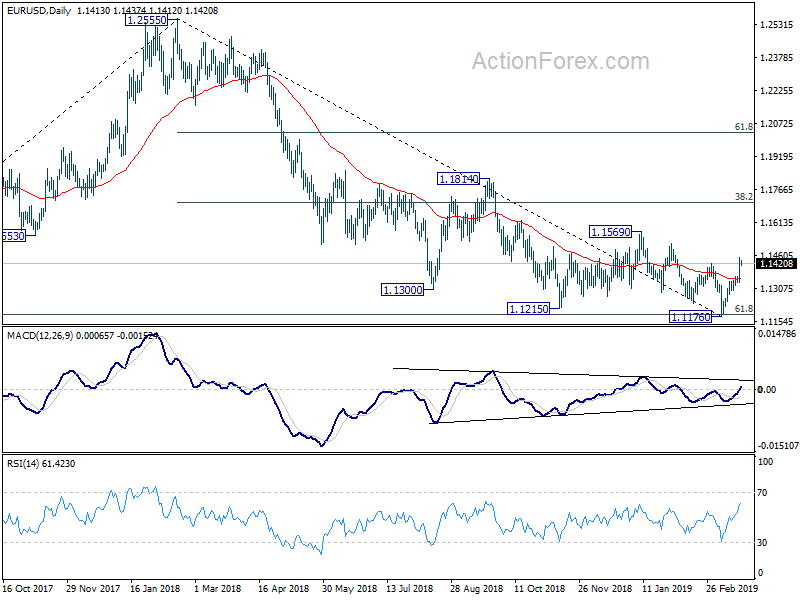
EUR/USD's rebound from 1.1176 accelerated to as high as 1.1448. The break of 1.1419 resistance is taken as the first sign of medium term bottom. Intraday bias is now on the upside for 1.1514/1569 resistance zone first. On the downside, break of 1.1335 minor support is needed to indication completion of the rise from 1.1176. Otherwise, near term outlook will remain cautiously bullish in case of retreat.
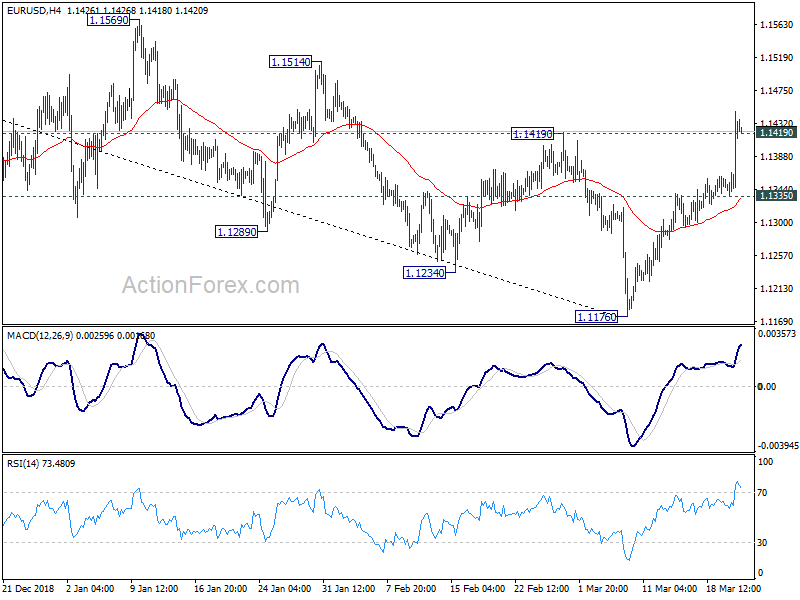
In the bigger picture, current development suggests that a medium term bottom could be formed at 1.1176 already. That came after hitting 61.8% retracement of 1.0339 (2016 low) to 1.2555 (2018 high) at 1.1186, on bullish convergence condition in daily MACD. Further rally could be seen back to 38.2% retracement of 1.2555 to 1.1176 at 1.1703. It's a bit early to confirm medium term bullish reversal. The structure of the rise from 1.1176 and reaction to 1.1703 fibonacci level will be watched for making an assessment later. But in any case, decisive break of 1.1176 is needed to confirm resumption of down trend. Otherwise, outlook is neutral at worst.
Economic Indicators Update
| GMT | Ccy | Events | Actual | Forecast | Previous | Revised |
|---|---|---|---|---|---|---|
| 21:45 | NZD | GDP Q/Q Q4 | 0.60% | 0.60% | 0.30% | |
| 0:30 | AUD | Employment Change Feb | 4.6K | 15.2K | 39.1K | 38.3K |
| 0:30 | AUD | Unemployment Rate Feb | 4.90% | 5.00% | 5.00% | |
| 8:30 | CHF | SNB Sight Deposit Interest Rate | -0.75% | -0.75% | ||
| 8:30 | CHF | SNB 3-Month Libor Upper Target Range | -0.25% | -0.25% | ||
| 8:30 | CHF | SNB 3-Month Libor Lower Target Range | -1.25% | -1.25% | ||
| 9:00 | EUR | ECB Monthly Bulletin | ||||
| 9:30 | GBP | Public Sector Net Borrowing (GBP) Feb | -0.3B | -15.8B | ||
| 9:30 | GBP | Retail Sales Inc Auto Fuel M/M Feb | -0.40% | 1.00% | ||
| 9:30 | GBP | Retail Sales Inc Auto Fuel Y/Y Feb | 3.30% | 4.20% | ||
| 9:30 | GBP | Retail Sales Ex Auto Fuel M/M Feb | -0.40% | 1.20% | ||
| 9:30 | GBP | Retail Sales Ex Auto Fuel Y/Y Feb | 3.50% | 4.10% | ||
| 12:00 | GBP | BoE Rate Decsion | 0.75% | 0.75% | ||
| 12:00 | GBP | BoE Asset Purchase Target Mar | 435B | 435B | ||
| 12:00 | GBP | MPC Official Bank Rate Votes | 0--0--9 | 0--0--9 | ||
| 12:00 | GBP | MPC Asset Purchase Facility Votes | 0--0--9 | 0--0--9 | ||
| 12:30 | CAD | Wholesale Trade Sales M/M Jan | 0.50% | 0.30% | ||
| 12:30 | USD | Philadelphia Fed Business Outlook Mar | 5 | -4.1 | ||
| 12:30 | USD | Initial Jobless Claims (MAR 16) | 226K | 229K | ||
| 14:00 | USD | Leading Index Feb | 0.10% | -0.10% | ||
| 14:30 | USD | Natural Gas Storage | -204B |
Australia’s Unemployment Rate Surprisingly Dropped In February
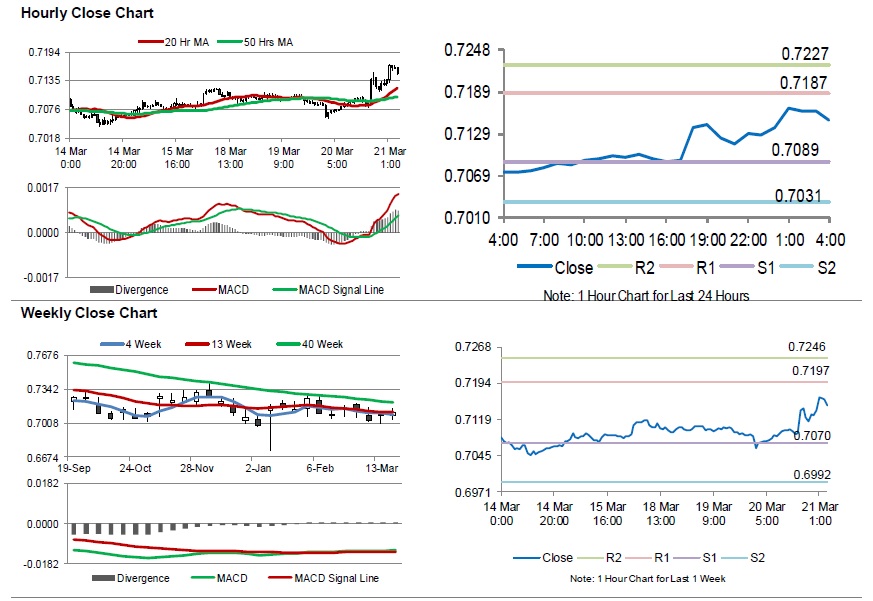
For the 24 hours to 23:00 GMT, the AUD rose 0.56% against the USD and closed at 0.7128.
LME Copper prices declined 0.2% or $13.0/MT to $6487.0/MT. Aluminium prices rose 0.8% or $15.5/MT to $1923.0/MT.
In the Asian session, at GMT0400, the pair is trading at 0.7148, with the AUD trading 0.28% higher against the USD from yesterday's close.
Overnight data indicated that Australia's seasonally adjusted unemployment rate unexpectedly declined to 4.9% in February, compared to a rate of 5.0% in the prior month. Market participants had anticipated unemployment rate to record an unchanged reading.
The pair is expected to find support at 0.7089, and a fall through could take it to the next support level of 0.7031. The pair is expected to find its first resistance at 0.7187, and a rise through could take it to the next resistance level of 0.7227.
Moving forward, traders would keep an eye on Australia's CBA manufacturing and services PMI's for March, set to release overnight.
The currency pair is trading above its 20 Hr and 50 Hr moving averages.
Gold: Yellow Metal Extends Its Gain In The Morning Session
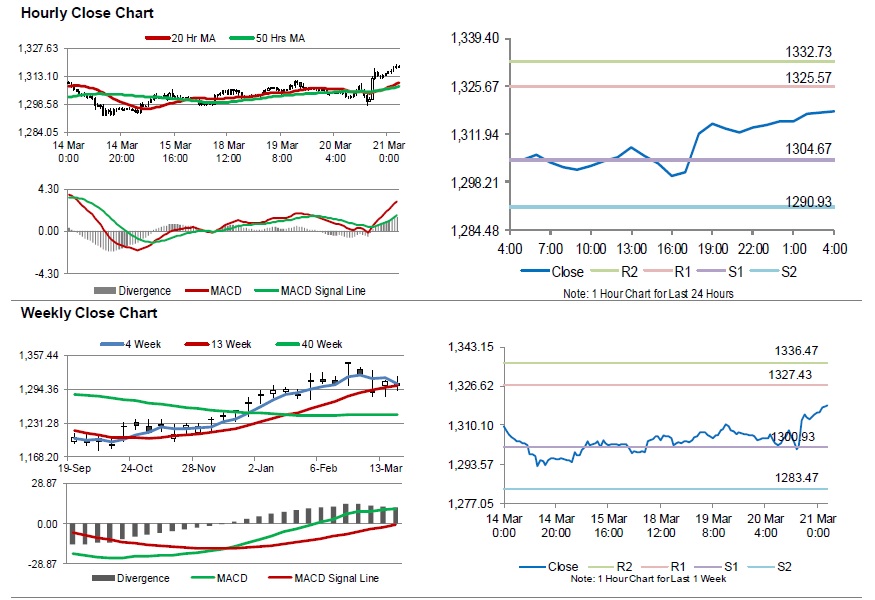
For the 24 hours to 23:00 GMT, Gold rose 0.59% against the USD and closed at USD1313.70 per ounce, amid weakness in the US dollar following Fed’s decision to halt its interest rate hikes until 2020.
In the Asian session, at GMT0400, the pair is trading at 1318.40, with gold trading 0.36% higher against the USD from yesterday’s close.
The pair is expected to find support at 1304.67, and a fall through could take it to the next support level of 1290.93. The pair is expected to find its first resistance at 1325.57, and a rise through could take it to the next resistance level of 1332.73.
The yellow metal is trading above its 20 Hr and 50 Hr moving averages.
Silver: White Metal Trading On A Stronger Footing This Morning
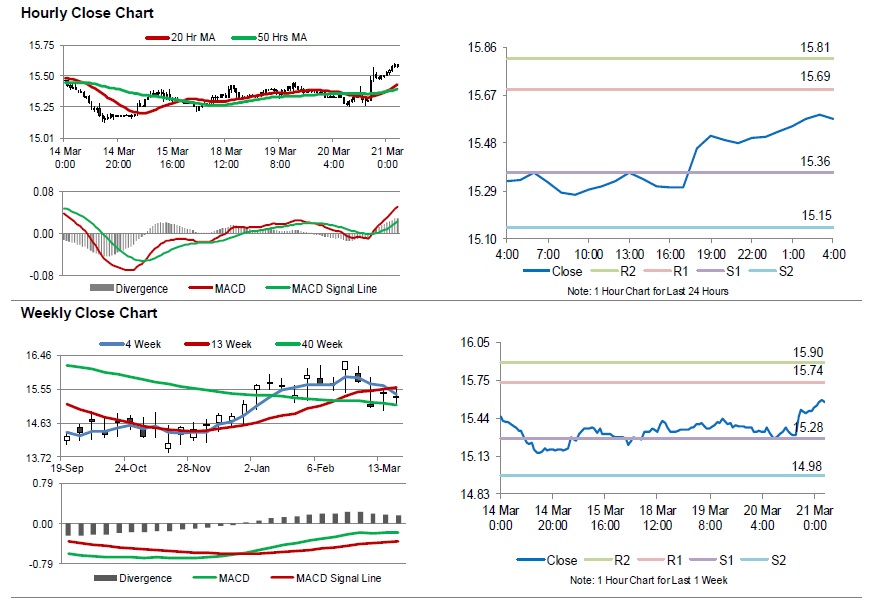
For the 24 hours to 23:00 GMT, Silver rose 0.88% against the USD and closed at USD15.51 per ounce, tracking gains in gold prices.
In the Asian session, at GMT0400, the pair is trading at 15.58, with silver trading 0.45% higher against the USD from yesterday’s close.
The pair is expected to find support at 15.36, and a fall through could take it to the next support level of 15.15. The pair is expected to find its first resistance at 15.69, and a rise through could take it to the next resistance level of 15.81.
The white metal is trading above its 20 Hr and 50 Hr moving averages.
Crude Oil: Oil Trading Higher In The Asian Session
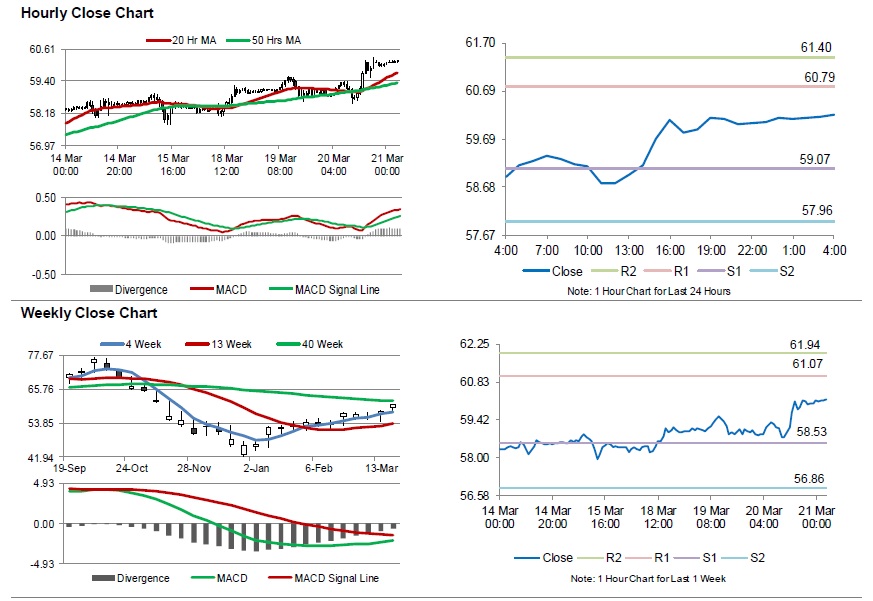
For the 24 hours to 23:00 GMT, Crude Oil rose 1.85% against the USD and closed at USD60.04 per barrel, after the Energy Information Administration (EIA) report indicated that US crude oil stockpiles tumbled 9.6 million barrels to 439.5 million barrels in the week ended 15 March 2019.
In the Asian session, at GMT0400, the pair is trading at 60.19, with oil trading 0.25% higher against the USD from yesterday’s close.
The pair is expected to find support at 59.07, and a fall through could take it to the next support level of 57.96. The pair is expected to find its first resistance at 60.79, and a rise through could take it to the next resistance level of 61.40.
Crude oil is trading above its 20 Hr and 50 Hr moving averages.
Asian Government Bond Yields Generally Lower Post Fed Decision
General Trend:
- Asian equities trade mixed as traders assess Fed statements/forecasts
- IT shares out perform in early trading in China
- Geely reports FY results in line, China Mobile results mixed
- Nikkei 225 closed for holiday, Nikkei Futures decline amid Yen strength
- South Korean chipmakers rise after earnings from Micron
- Tencent expected to report Q4/FY18 earnings after close in Hong Kong
- Australian financials track post Fed declines in US banks
- Iron ore miners trade generally higher in Australia, Vale remains in focus
- Aussie unemployment rate hits ~8-year low, participation rate declined
- New Zealand Dollar (NZD) rises as q/q GDP in line, y/y GDP had slowest growth rate since 2015
- South Korea prelim March chip exports -25% y/y, exports to China -12.6% y/y
- Bank of England (BoE) rate decision expected later today
- Philippines, Taiwan and Indonesia central banks to also meet today
- North America Feb SEMI equipment industry billings due after US close on Thursday
Headlines/Economic Data
Australia/New Zealand
- ASX 200 opened -0.2%
- (AU) AUSTRALIA FEB EMPLOYMENT CHANGE: 4.6K V 15.0KE; UNEMPLOYMENT RATE: 4.9% V 5.0%E (lowest level since June 2011)
- (NZ) NEW ZEALAND Q4 GDP Q/Q: 0.6% V 0.6%E; Y/Y: 2.3% V 2.5%E (matches slowest growth since 2015)
- (AU) Australia Feb RBA Govt FX Transactions (A$): -517M v -546M prior
- (AU) Australia sells A$500M v A$500M indicated in June 2019 notes, avg yield 1.73%, bid to cover 4.42x
- (NZ) New Zealand sells NZ$200M v NZ$200M indicated in 2.75% 2037 bonds; avg yield 2.3779% v 2.6079% prior; bid to cover 2.5x v 2.9x prior
- (NZ) New Zealand to ban military style semi-automatic weapons and assault rifles; gun buyback to be in range of NZ$100M-200M; new law expected to take effect by April 11th
Japan
- Nikkei 225 closed for holiday
- (JP) Japan PM Abe plans to visit the US in April to meet with US President Trump - Japanese Press
- (JP) Japan Cabinet Office (Govt) Mar Monthly Economic Report: Cuts overall economic assessment citing recent weakness in exports and industrial production (1st cut in 3 years) (after the close yesterday)
- (JP) Bank of Japan (BOJ) Gov Kuroda: Central bank said to be on the dovish side; to continue it persistent large scale easing (after the close yesterday)
- (JP) Japan Fin Min Aso: No intention to retract comments on BoJ, no difference with PM Abe on BoJ's 2% price target (after the close yesterday)
Korea
- Kospi opened +0.3%
- (KR) Bank of Korea (BOK) Gov Lee: It's not time to lower rates; monetary policy is in accommodating trend; uncertainties related to US Fed's policies have eased to a large extent - Yonhap
- (KR) North Korea earth tremor thought to be natural not related to testing – Yonhap
- (KR) South Korea Mar 1-20 Exports y/y: -4.9% v -11.7% prior; Imports y/y: -3.4% v -17.3% prior
- (KR) South Korea to cut stock transaction tax by 0.05% in 2019
China/Hong Kong
- Hang Seng opened +0.2%; Shanghai Composite opened +0.1%
- (CN) China PBoC Open Market Operation (OMO): Skips OMO for second consecutive session; Net: CNY0B injection v CNY0B prior
- (CN) China PBoC sets yuan reference rate: 6.6580 v 6.7101 prior (strongest level since mid-July 2018)
- (CN) Banks in China have been told by regulator to disclose stability data every 6 months - Chinese Press
- (HK) Hong Kong Chief Exec Lam: Worried about property prices rising
- (HK) Hong Kong Monetary Authority Chief Exec Chan: HKMA will continue to maintain the stability of HK$ peg; still a gap between HK$ and USD interest rates, which triggers outflows of HKD and drive the currency weak
- (CN) China National Nuclear Corporation plans to build its first floating nuclear power plant within the year - Chinese press
- 941.HK Reports FY18 (CNY) Net 117.8B v 114.3B y/y, EBITDA 275.5B v 270.4B y/y; Rev 736.8B v 741B y/y; Will strive to achieve more than 2.0 billion connections, favourable growth in telecommunications services revenue and, on a comparable basis3 , stable-to-rising growth in profit in 2019
- 175.HK Reports FY18 (CNY) Net 12.6B v 10.6B y/y, Rev 106.6B v 92.8B y/y; Affirms FY19 targets
North America
- (US) FOMC LEAVES TARGET RANGE UNCHANGED BETWEEN 2.25-2.50%; SIGNALS NO HIKES THIS YEAR AND ONE RATE HIKE IN 2020
- (US) FED: Balance Sheet Normalization Plans: to slow reduction of holdings starting in May and conclude run off in Sept
- (US) Fed Chair Powell: US economy is strong and we intend to use our policy to keep it there - FOMC press
- MU Guides Q3 $0.85 +/-$0.10 v $1.38e, Adj Rev $4.8B +/-$0.2B v $5.55Be; DRAM bit shipments to grow sequentially, and grow at much higher rates in Q4; NAND bit shipments modest sequential decline, growth to resume in Q4 - earnings call
- (BR) BRAZIL CENTRAL BANK (BCB) LEAVES SELIC TARGET RATE UNCHANGED AT 6.50%; AS EXPECTED
- (US) White House Economic Adviser Hassett: Sees 2019 GDP at 3.0% - CNN
Europe
- (UK) PM May: UK will not leave EU on time on March 20th as previously expected; not ready to delay Brexit any further than June 30th
- (NL) Netherlands provincial election exit poll: Dutch ruling coalition to lose its Senate majority
- (DE) German Finance Ministry: Feb Tax Rev -1.6% y/y; YTD +0.2% y/y; German growth likely to remain subdued through H1; Brexit disputes dampening expectations
Levels as of 1:20 ET
- Nikkei 225, closed, ASX 200 flat, Hang Seng +0.2%; Shanghai Composite +0.7%; Kospi +0.4%
- Equity Futures: S&P500 +0.1%; Nasdaq100 +0.3%, Dax +0.5%; FTSE100 +0.3%
- EUR 1.1438-1.1412 ; JPY 110.74-110.40 ; AUD 0.7168-0.7113 ;NZD 0.6939-0.6863
- Gold +1.3% at $1,319/oz; Crude Oil flat at $60.25/brl; Copper +0.9% at $2.953/lb
Elliott Wave View: Apple Looking To Turn Lower Soon
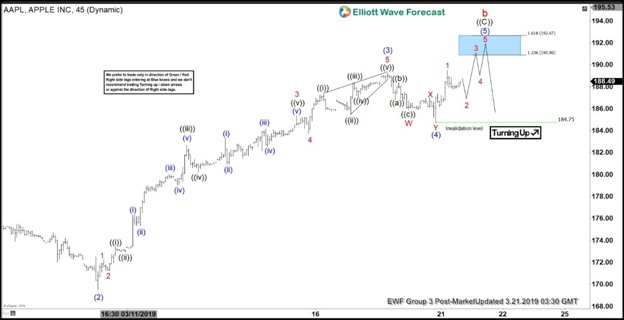
After topping at $233.47 on October 3, 2018, Apple (APPL) dropped to $142.9 for a staggering 39% decline only within 3 months. From $142 low on January 4th, 2019, the stock has rallied and retraced 50% of the drop at $187.9. We think the decline from $233.47 to $142.9 only ended the first leg wave a. The rally from January 4 low thus is within wave b correction with subdivision as a zigzag Elliott Wave structure.
In the short term chart below, we can see the pullback to $169.50 ended wave (2) as part of wave ((C)) of b zigzag. From there, the stock rallied to $189.26 and ended wave (3), then the pullback to $184.75 ended wave (4). Apple is in the process of ending the last leg wave (5) with potential target of $190.9 – $192.67, which is the inverse 1.236 – 1.618 extension of wave (4). This last push higher should also end the wave b correction to the decline from October 3, 2018 last year. As far as pivot at $233.47 high stays intact, it should start to roll over soon or at minimum do larger 3 waves pullback.
1 Hour APPL Elliott Wave Chart
Yield curve suggests risks of recession intensified after Fed’s dovish turn
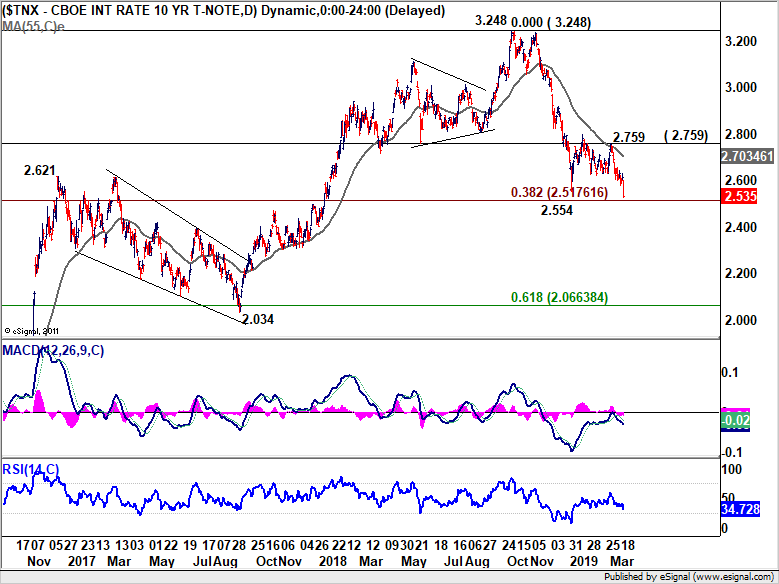
The US markets ended rather terribly overnight despite Fed's steep dovish turn, with re-emerging trade war threat in the background. Drastic moves were seen in the bond markets with yield curve now indicate intensified risks of recession ahead.
The most reliable recession indicator is now flashing red after yesterday's moves in the bond markets. The spread between 3-month yield and 10-year yield has narrowed sharply and at brink of inverting. The slope of 3-month and 10-year yields is watched by most economist and seen as the best recession indicator.
The technical development in 10-year yield (TNX) suggests that it's only starting to get worse. TNX dropped -0.079 to close at 2.535. Indeed, the strong break of 2.554 support indicates resumption of fall from 3.248 high with solid downside momentum. Key fibonacci level of 38.2% retracement of 1.336 (2016 low) to 3.248 (2018 high) at 2.554 looks rather vulnerable. Decisive break will confirm medium term reversal, which could open up the case for deeper fall to 61.8% retracement at 2.066, which is close to 2.034 support and 2% psychological level.
New Zealand GDP grew 0.6% qoq, led by services
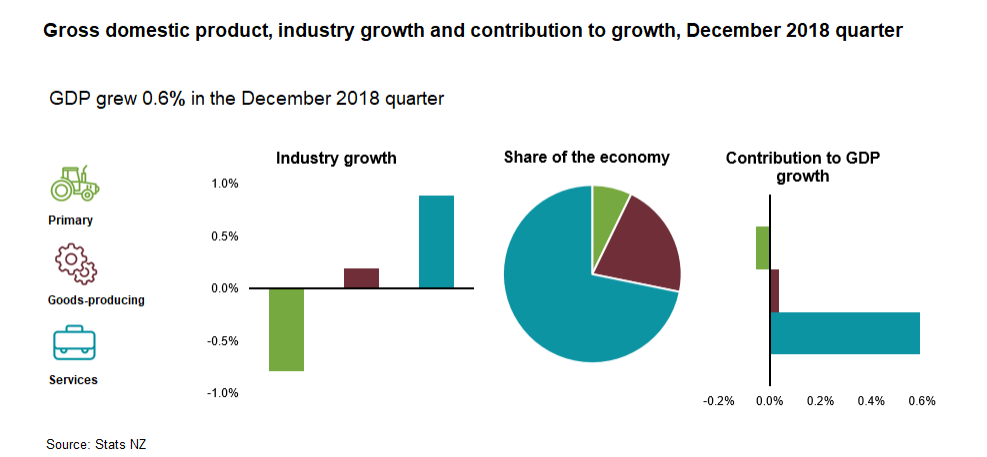
New Zealand GDP grew 0.6% qoq in Q4, up from Q3's 0.3% qoq and matched expectations. GDP grew 2.8% over the year ended December 2018. While the 0.6% growth missed RBNZ's forecast of 0.8%, it may not be weak enough to prompt an RBNZ rate cut in this month's meeting yet.
Looking at the details, growth was driven by services industries which rose 0.9%, with 9 of 11 services industries recording increases. Agriculture, forestry, and fishing industry contracted -0.6%. construction rose 1.8%. Household spending rose 1.3%. Investment spending rose 1.4%.
Australia unemployment rate dropped to 4.9% as participation rate dropped -0.2%
In seasonally adjusted term, Australian employment market grew 4.6k in February, well below expectation of 15.2k. Full-time employment dropped -7.3k while part-time jobs grew 11.9k. Unemployment rate dropped to 4.9%, down from 5.0%. That's also the lowest level since June 2011. However, participation rate dropped by -0.2% to 65.6%.
The seasonally adjusted unemployment rate increased in New South Wales (up 0.3 pts to 4.3%) and Victoria (up 0.2 pts to 4.8%). Decreases were observed in Western Australia (down 0.9 pts to 5.9%), Queensland (down 0.6 pts to 5.4%), South Australia (down 0.6 pts to 5.7%) and Tasmania (down 0.5 pts to 6.5%).
ABS Chief Economist Bruce Hockman said: "The trend unemployment rate declined 0.5 percentage points over the year, from 5.5 per cent to 5.0 per cent. The pace of decline slowed in recent months, which was consistent with the slowdown seen in recent Job Vacancies and GDP numbers."