Sample Category Title
British Slips Below 1.32 as Brexit Confusion Continues
GBP/USD has posted considerable losses in the Wednesday session. In North American trade, the pair is trading at 1.3200, down 0.50% on the day. On the fundamental front, British CPI edged up to 1.9%, compared to 1.8% a month earlier. In the U.S., the Federal Reserve will issue a rate statement at the conclusion of a 2-day policy meeting.
The Brexit saga continues, full of twists and turns. Prime Minister May has said she wants a 3-month extension on Brexit, which would mean Britain departs the E.U. at the end of June. The exasperated Europeans have not said if they will agree, but a senior official said that the E.U. would prefer a much longer delay. On Tuesday, the government cancelled a parliamentary vote on the withdrawal agreement after House Speaker John Bercow ruled that parliament would not vote on the deal unless it was substantially different than the text that had already been voted on twice. This ruling is another blow to Prime Minister May, whose authority has been badly shaken by the recent votes in parliament.
British employment numbers were a mix on Tuesday. Wage growth continues to impress, posting a gain of 3.4% for a third successive month. The unemployment rate dipped to 3.9%, its lowest level since 1975. However, unemployment claims jumped to 27 thousand, marking a 10-month high. All in all, the employment picture remains solid, despite the turmoil of Brexit and the political and economic uncertainties that lie ahead.
The Federal Reserve is virtually certain to hold the benchmark rate at the Wednesday meeting, but traders should nonetheless treat the meeting as a market-mover. Policymakers have been sending out dovish messages, and if the Fed reaffirms that it will remain cautious and patient, the dollar could lose ground. The Fed’s balance sheet will also be under scrutiny, with the policymakers expected to announce when they will stop reducing the $4 billion balance sheet. The central bank has been reducing assets by $50 billion a month, but there has been criticism that this tightening is choking economic growth. The Fed will also publish its new dot plot, a quarterly release which is used to convey its interest rate outlook.
Trump: Tariffs on China could stay for a long time even if a deal is reached
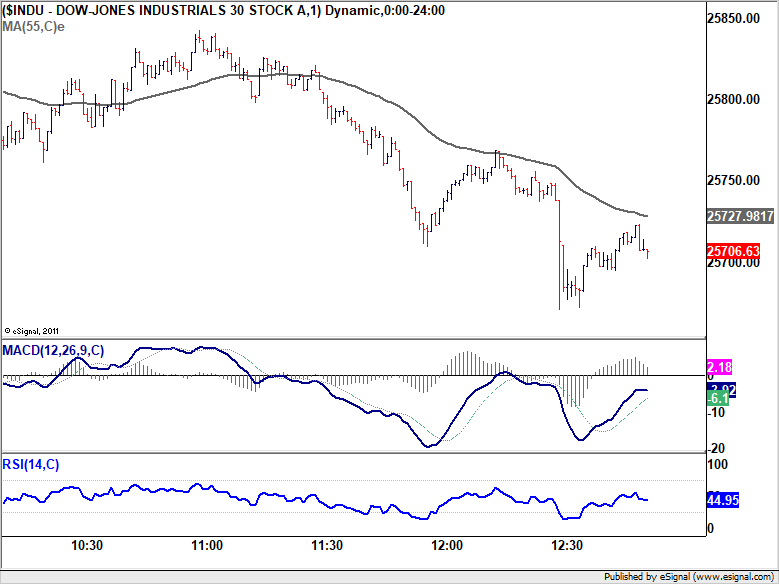
DOW dives instant after Trump said his administration is talking about leaving tariffs on China for a long period of time. That is, even if a trade agreement is reached, the tariffs won't be limited until China complies with the terms of the deal. Though, he also said a deal is coming as tariff threat makes China eager to reach a deal.
He said: "We're not talking about removing [tariffs], we're talking about leaving them for a substantial period of time because we have to make sure that if we do the deal with China that China lives by the deal."
His comments come just ahead of USTR Lighthizer's trip to Beijing next week to resume the negotiation.
EU to UK: Article 50 extension only if Brexit deal is approved
Responses from EU regarding UK's request for Article 50 extensions are generally hardline. European Council President Donald Tusk said EU will only approval short Article 50 extension if UK Parliament passes the Brexit deal. And, if the vote is passed in the Commons next week, the extension can then be finalized using a written procedure. Tusk is also ready to call a summit next week if needed.
Full statement of Tusk.
"In the light of the consultations that I have conducted over the past days, I believe that a short extension would be possible.
But it would be conditional on a positive vote on the withdrawal agreement in the House of Commons.
The question remains open as to the duration of such an extension.
At this time, I do not foresee an extraordinary European council.
If the leaders approve my recommendations and there is a positive vote in the House of Commons next week, we can finalise and formalise the decision on extension in the written procedure.
However, if there is such a need, I will not hesitate to invite the members of the European council for a meeting to Brussels next week.
Although Brexit fatigue is increasingly visible and justified, we cannot give up seeking until the very last moment a positive solution - of course, without opening up the withdrawal agreement.
We have reacted with patience and goodwill to numerous turns of events and I am confident that also now we will not lack the same patience and goodwill at this most critical point in this process."
Earlier French Foreign Minister Jean-Yves Le Drian said also said the extension will only be granted if May could provide guarantee for passing the deal. He said: "A situation in which Mrs May was not able to present to the European Council sufficient guarantees of the credibility of her strategy would lead to the extension request being dismissed and opting for a no-deal exit."
German Foreign Minister Heiko Maas said "We've always said that if the Council has to decide on a deadline extension for Britain, then we'd like to know why and what for."
MARKET WRAP: Selling Pressure Pushed Stocks Lower
Markets in Europe closed sharply lower as investors kept their focus on Brexit divorce deal and trade war.
Stocks
- The S&P 500 Index dropped 0.38 percent as of 15:33 London time.
- The Stoxx Europe 600 Index lost 0.66 percent.
- The U.K.’s FTSE 100 Index sank 0.7 percent.
- The DAX Index dropped 1.3 percent, losing the most in almost six weeks.
Currencies
- The Dollar Spot Index jumped nearly 0.05 percent.
- The Euro moved higher by 0.1 percent to $1.1353, the most in almost three weeks.
- The British pound dropped 0.55 percent to $1.3196.
- The Japanese yen lost nearly 0.1 percent to 111.30 per dollar.
Bonds
- The yield on 10-year Treasuries dropped two basis points to 2.58 percent.
- Germany’s 10-year yield lost one basis point to 0.09 percent.
- Britain’s 10-year yield declined by three basis points to 1.154 percent.
Commodities
- West Texas Intermediate crude jumped 1.52 percent to $59.93 a barrel, a four-month high.
- Gold lost its level of 1300 and dropped 0.2 percent to $1,298 an ounce
Sterling Falls to One-Week Low, But May’s Request for Delay Could Slow Bears
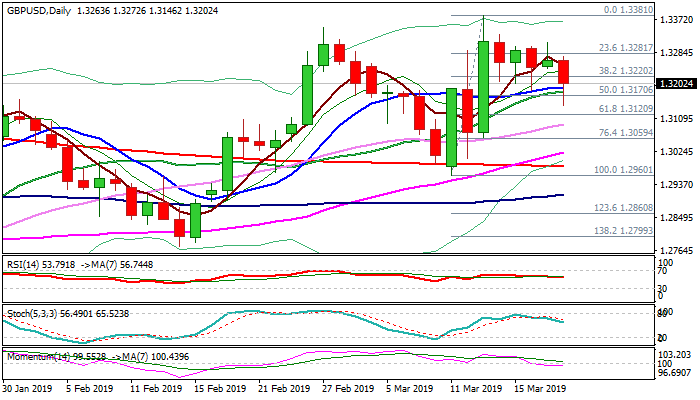
Cable fell to one-week low at 1.3146 on Wednesday, as renewed risk of no-deal Brexit keeps the currency under pressure.
Several scenarios remain on the table and keep high uncertainty in Brexit drama, as PM May asked the EU for three-month extension of Brexit deadline, in attempts to buy some time and try to adjust her plan that the parliament will finally approve after recent double rejection.
PM May wants Britain to leave the EU in an orderly manner and extension of the deadline would give her more space to work on plan modifications, as well as to try to convince the lawmakers.
Break below converged 10/20SMA’s weakens the structure, but confirmation requires close below to signal further weakness.
Close below 10/20SMA’s would risk extension towards 1.3120/95 (Fibo 61.8% / 30SMA and would unmask key 200SMA support (1.2984).
On the other side, renewed optimism over possible Brexit delay (though there is strong opposition to the scenario from France), may reduce immediate bearish pressure, but downside is expected to remain at risk while 1.33 resistance zone stays intact.
Res: 1.3220; 1.3272; 1.3310; 1.3330
Sup: 1.3192; 1.3182; 1.3146; 1.3120
Japanese Yen Listless on Equinox Holiday
It continues to be a quiet week for USD/JPY. In Wednesday’s North American session, the pair is trading at 111.41, down 0.02% on the day. Japanese banks are closed for a holiday. On Tuesday, the BoJ released the minutes of its January meeting.
The global trade war has weighed on the Japanese economy, and the government downgraded its outlook for the economy in the March report, for the first time in three years. The manufacturing and export sectors have been particularly hard-hit. The report added that current economic headwinds could continue for some time. Given the challenging economic conditions, the Bank of Japan is unlikely to change its ultra-accommodative policy anytime soon. The economy remains fragile, but could receive a big boost if the U.S. and China bury the hatchet and reach a deal which removes the tariffs which have damaged the Japanese economy.
All eyes are will be on the Federal Reserve, which holds a policy meeting on Wednesday. The Fed is widely expected to maintain the benchmark rate at a range between 2.25 – 2.50 percent. Investors will be expecting the Fed to play a dovish tune in the March rate statement. The Fed’s balance sheet will also be under scrutiny, with the policymakers expected to announce when they will stop reducing the $4 billion balance sheet. The Fed has been reducing assets by $50 billion a month, but there has been criticism that this tightening is choking economic growth. The Fed will also publish its new dot plot, which is used to convey its interest rate outlook.
New Zealand’s GDP Next for the Kiwi as RBNZ Meeting Nears
The next focal point for the kiwi dollar will be New Zealand’s GDP for Q4, due out on Wednesday at 21:45 GMT. Forecasts point to a pickup in growth, but even if that projection is met, it would still fall short of the RBNZ’s own forecasts. In isolation, this would argue for a slightly more cautious tone when the central bank meets again next week, which represents a risk for the kiwi.
Economic growth is forecast to have picked up some speed in the final quarter of 2018, with the quarterly GDP rate expected to have risen to 0.6%, following a disappointing 0.3% increase previously. Alas, such a print would still cause the yearly rate to tick down to 2.5%, from 2.6% earlier. This discrepancy arises from the fact that growth in the quarter that will drop out of the annual calculation now, Q4 2017, was even stronger than 0.6%.
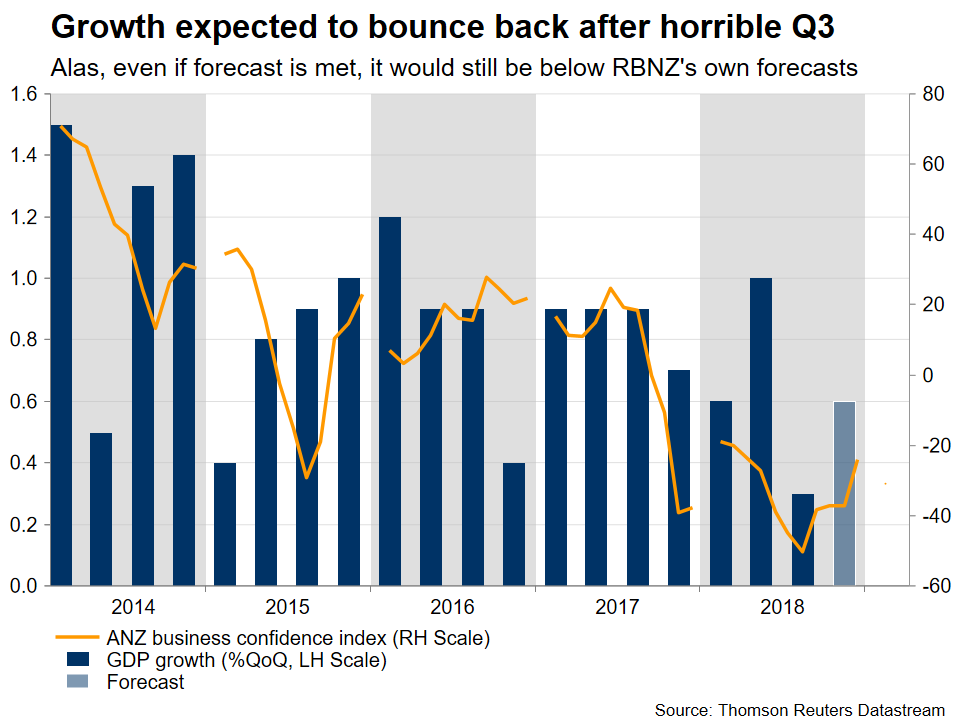
More importantly, such a print would be notably below what the Reserve Bank of New Zealand (RBNZ) anticipated in its latest forecasts back in February, which assumed a growth rate of 0.8% during Q4. The implication is that even if the market forecast is met, that would still be a ‘negative’ development for RBNZ policymakers, relative to their expectations. Other things equal, this would argue for a slightly more dovish tone when the RBNZ meets again, next week.
The last time the central bank met, it surprised traders by maintaining a broadly neutral tone, confounding expectations for a dovish tilt. It continued to indicate that rates could move either up or down, appearing reluctant to place more emphasis on a potential rate cut despite a litany of worrisome developments, ranging from softness in the housing and labor markets to a slowdown in China – New Zealand’s largest export market by far.
On the whole, developments since the February meeting haven’t been disappointing enough for this ‘neutral’ bias to change substantially, in other words for the Bank to adopt an official easing bias. Even if the Q4 GDP disappoints, policymakers may prefer to wait for 2019 data before they make any substantial shift in language. That being said, the broader tone in the statement could contain a slightly more dovish tilt, in a sense paving the way for a formal change in communication later on.
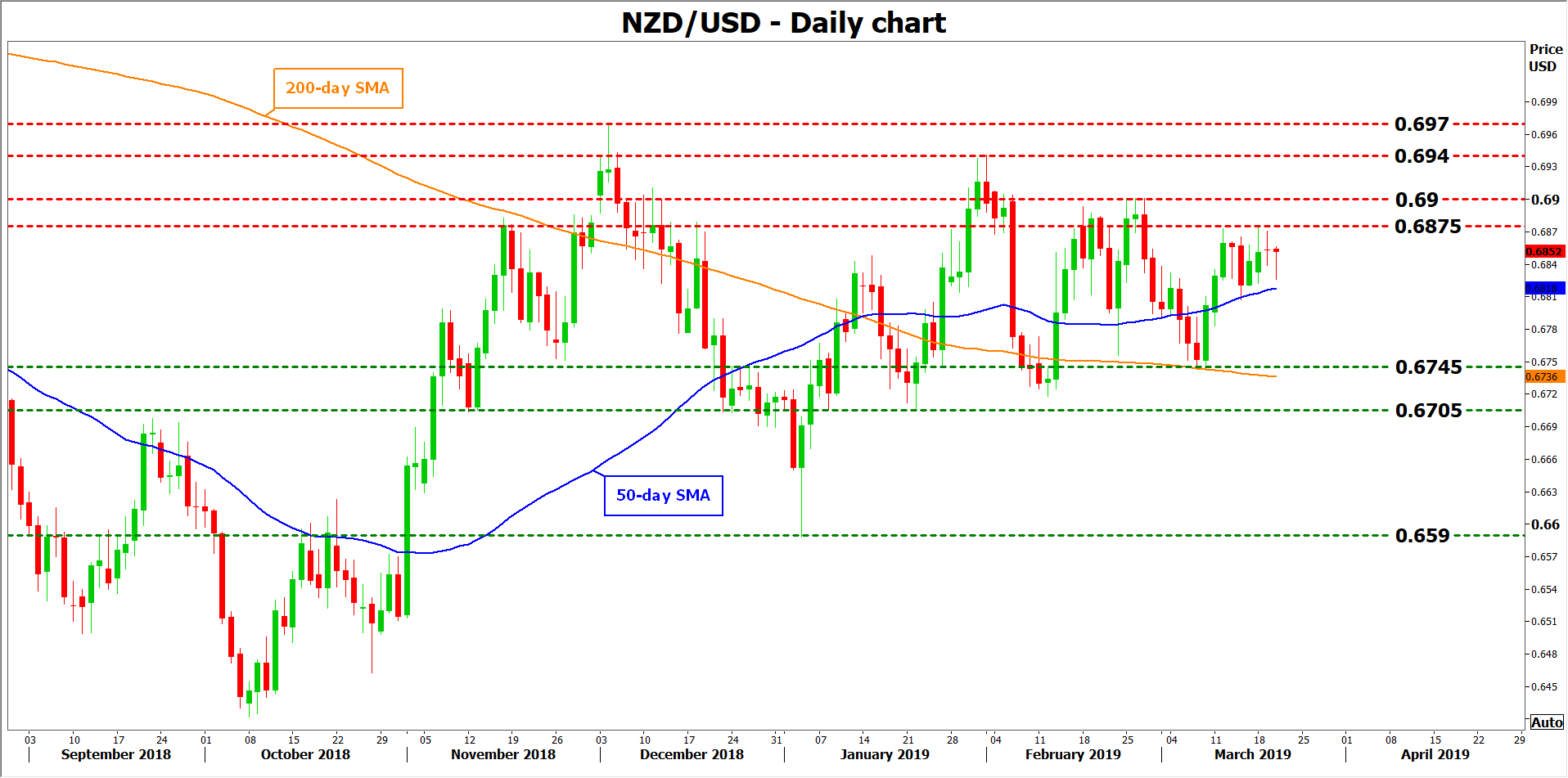
Technically, immediate support to declines in kiwi/dollar may come from the 50-day simple moving average, currently at 0.6817, with a downside break opening the door for a test of the March 7 lows near 0.6745.
On the upside, advances in the pair could stall around 0.6875, which has capped the rallies so far in March. A bullish violation would shift the attention to the February peaks around the 0.6900 handle.
SNB: Staying Dovish, Preventing Franc Strength
The Swiss National Bank (SNB) is expected to keep its policy rates unchanged at the lowest level globally when it announces its decision on Thursday, at 0830 GMT. Domestic data are lackluster, Switzerland’s main export markets are slowing, and most importantly, the ECB turned dovish lately. Combined, these imply the SNB will probably retain an ultra-dovish tone. While such signals would argue for a slow grind lower in the franc, any risk-off global incident could trigger episodes of sudden appreciation in the safe-haven currency.
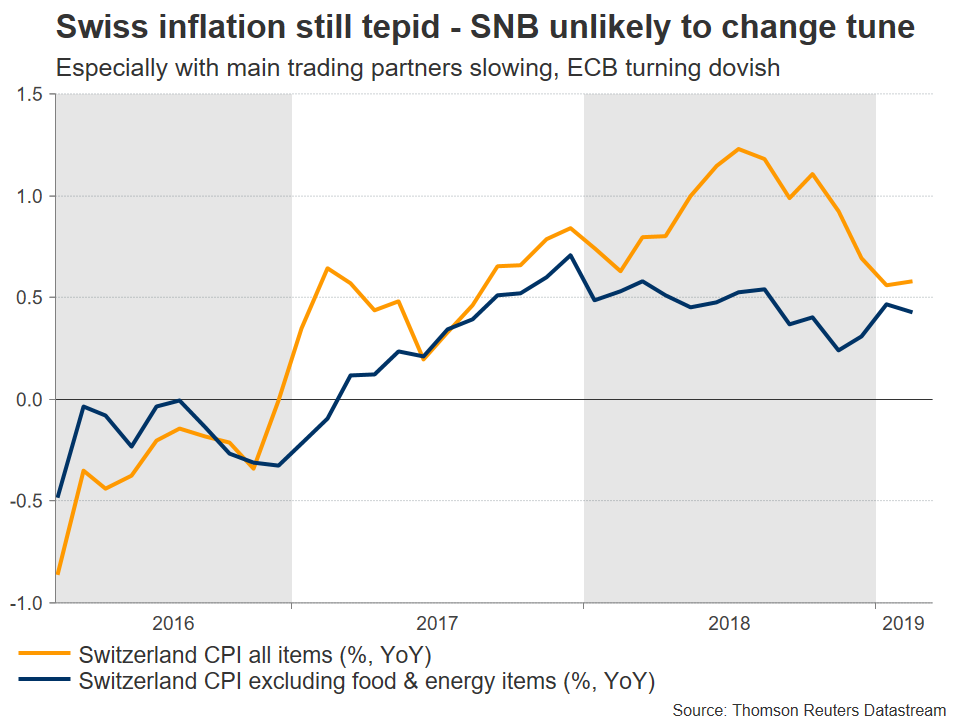
There isn’t much to celebrate in the Swiss outlook. The economy contracted in Q3 2018, and while growth bounced back in Q4, the recovery was short of impressive. Meanwhile, headline and core inflation remain anemic, with both rates hovering near the 0.5% mark in yearly terms. The only bright spot is the labor market, where the unemployment rate is almost at a two-decade low, but that tightness has failed to translate into faster wage growth and hence stronger consumption.
The external environment isn’t any better either. Switzerland’s largest export market, the Eurozone, is mired with issues – most notably a slowdown in growth. The same applies to China, and to a lesser extent the US, the nation’s other main trading partners. Exports account for roughly 65% of Swiss GDP, so faltering growth overseas has severe consequences for the domestic economy as well.
Staying abroad, it’s also crucial that the European Central Bank (ECB) turned more dovish lately. It’s not obvious, but this has enormous implications for SNB policy. To explain – the Swiss central bank typically mimics the ECB’s actions, but with a short lag. This is done to avoid any appreciation in the Swiss franc versus the euro, something the SNB pays a great deal of attention to. A stronger currency makes a nation’s exports less attractive abroad, and also pushes down on the price of imports at home, implying both slower growth and lower inflation.
Hence, the SNB has gone to great lengths to prevent the franc from strengthening, regularly intervening in the FX market directly to weaken the currency, and keeping its interest rates at the lowest level globally. Blending these all together, the ECB’s dovish pivot leaves the SNB no realistic option but to remain extremely dovish, as anything short of that could lead to a sudden and fierce appreciation in the franc against the single currency; a route the SNB definitely wants to avoid.
What does this all mean for the franc? Assuming the SNB reaffirms its dovish bias, and perhaps even strengthens it, for example by signaling it could still ease policy if needed, then that would argue for a slow grind lower in the Swiss currency on a relative interest rates basis. That being said though, interest rate differentials are not all that matters for the currency market. Namely, the franc is widely considered a safe-haven asset, which suggests that if any major risk-off event occurs in global markets, then it may gain rapidly.
Put differently, although the currency could slowly surrender ground on ‘calm’ days owing to monetary policy, any episode that induces ‘panic’ in markets may trigger a sharp rally, potentially erasing months of losses. The flipside to that: any such appreciation would most probably see the SNB step into the market and sell francs, to keep a lid on the currency’s gains.
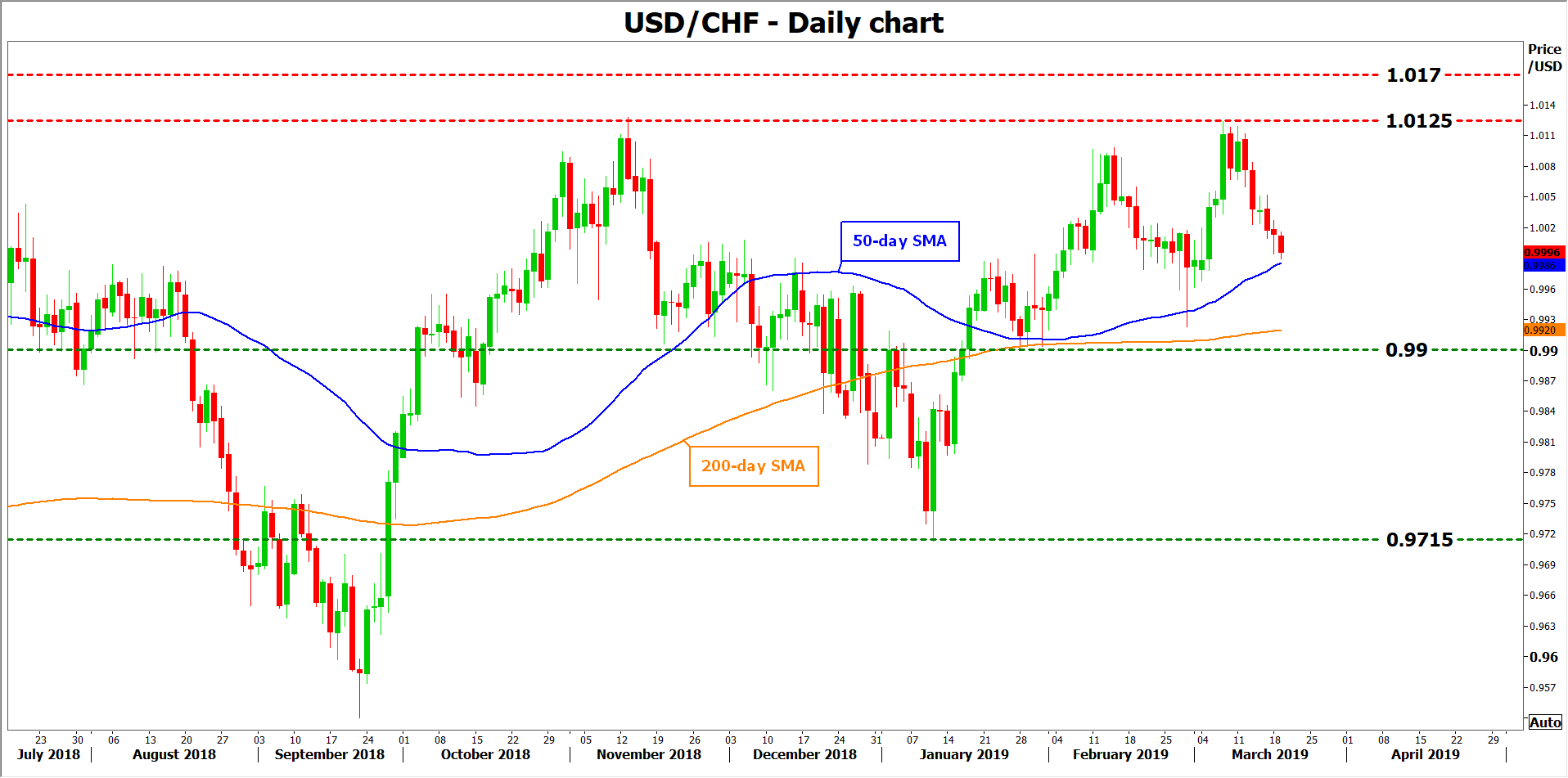
Technically, looking at dollar/franc, advances may encounter resistance at 1.0125, the area that capped that rally in mid-March. An upside break could open the way for 1.0170, marked by the highs of March 2017.
On the other hand, a pullback in the pair may meet immediate support at the 50-day simple moving average (SMA), currently at 0.9986. A downside violation could see the sellers challenge the crossroads of the 200-day SMA at 0.9920 and the 0.9900 handle.
Sunset Market Commentary
Markets
Core bonds gained modest ground today in another low-volume trading session ahead of tonight’s FOMC meeting (see below). European stock markets turned south on mixed Chinese trade news, new brexit hurdles and individual problems (eg Bayer & BMW) with core bonds benefiting from some safe haven flows. US yields shed 1.2 bps (2-yr) to 2 bps (10-yr) in a daily perspective. Changes on the German yield curve vary between +0.3 bps (2-yr) and -1.1 bp (30-yr). Peripheral yield spreads vs Germany widen by 3 to 5 bps.
Today’s UK CPI data were of no importance for sterling whatsoever. With just 9 days on the counter before the UK is to leave the European bloc, Brexit is all that matters to investors. An extension looks inevitable however, as PM Theresa May failed to push her brexitdeal through Parliament twice and was banned from giving the same deal a third try earlier this week. May thus formally requested the EU this morning to postpone Brexit with three months, up until June 30. Markets weren’t expecting the proposed extension to be this short. May repeatedly warned that if her deal didn’t get approved she would have to ask for more than just a technical (three month) delay. The EU however suggests either a short(er) extension, before May 23 (European election day) or a much longer one (at least until the end of the year). The first requires May to strike a refurbished brexitdeal and pass it through Parliament in two months’ time. That is highly improbable and a no-deal scenario would then likely be the result. A long extension is a no-go for May since that would leave all options open, including a 2nd referendum, elections or even no Brexit at all. It also poses legal threats regarding the European elections and whether the UK can/should participate or not. The EU will discuss May’s request during a Summit starting tomorrow. The huge amount of uncertainty is weighing on sterling today. Cable slipped back below the 1.32-handle (-0.65%). EUR/GBP strengthens almost 1%, regaining the 0.86-mark (0.862 currently) and causing some spill overs in EUR/USD. The pair edges higher during an otherwise eventless trading session and changes hands close to 1.136. Moves remain extremely limited however as investors are awaiting tonight’s Fed meeting before taking any directional dollar positions.
Fed chair Powell already suggested in front of US Congress to halt the balance sheet run-off by the end of the year. That’s much sooner than the Fed originally had in mind and market participants had expected until the turn of last year. Communication on the composition of the Fed’s portfolio is a wildcard. The Fed might eg opt to continue to let its MBS-portfolio run off, but replace them by US Treasuries. Another factor the Fed might tweak is the duration of its Treasury portfolio. Shortening it would be considered hawkish and vice versa. Apart from this, we expect the Fed’s plotted rate hikes to drop from 3 currently (2 in 2019 and 1 in 2020) to 1 (in 2019) taking into account weaker growth and inflation forecasts. The Fed’s feared inflation overshoot didn’t happen last year, putting governors at ease to take a more wait-and-see approach as the economy shows first signs of sputtering. Markets remain even softer positioned with unchanged rates this year and a rate cut in 2020.
News Headlines
UK February consumer inflation came in close to expectations. Headline inflation accelerated to 1.9% YoY (0.5% MoM) vs. 1.8% (0.4% MoM) expected. Core measures showed prices increasing at 1.8% YoY, down from 1.9% in January and slightly below estimates. Housing prices advanced at the slowest pace since mid-2013 (1.7%, 2.4% expected).
Germany plans to create a state-owned fund by the end of 2019 that can be used to protect key companies from foreign (Chinese) takeovers. The idea has been launched in February as part of the country’s new industrial strategy and is now being put in draft laws.
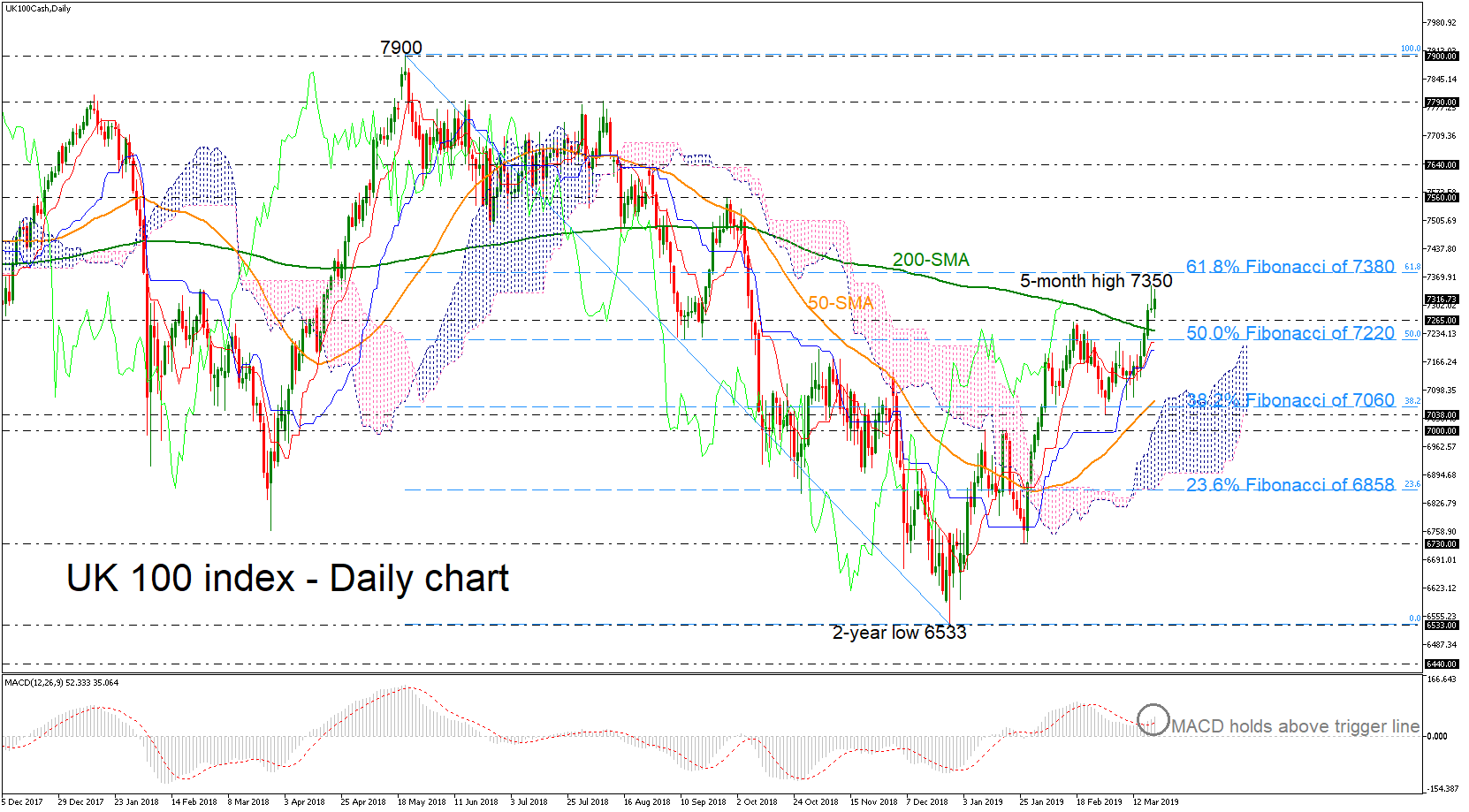
UK 100 Index Runs Towards 5-Month High; SMAs Act as Supports
UK 100 stock index (FTSE 100) has advanced considerably after touching the 38.2% Fibonacci retracement level of the downleg from 7900 to 6533, around 7060. During Tuesday’s session the price gained some more ground driving the market towards a fresh five-month high of 7350. The flatly aligned Tenkan- and Kijun-sen lines are indicative of a possible weaker momentum than before. However, the MACD oscillator is heading north.
If the price manages more bullish actions and surpasses the five-month high, immediate resistance would come from the 61.8% Fibonacci level, around 7380. Further up, the index could rest around the 7560 resistance, identified by the high on September 2017.
On the other hand, in case of bearish structure the market might revisit the 7265 support, which stands near the 50.0% Fibonacci region around 7220. More declines could meet the 40-day simple moving average (SMA) around the 38.2% Fibonacci of 7060.
Overall, the downfall from 7900 is still active and hence the outlook remains negative despite the short-term upward rally. A jump above the 61.8% Fibonacci could confirm the near-term bullish tendency.