Sample Category Title
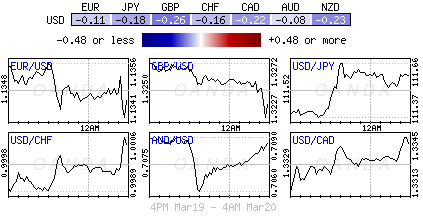
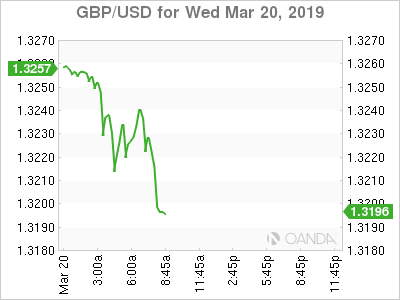
Into US session: Sterling weakest as May seeks short Brexit delay to June 30
Entering into US session, Sterling is undoubtedly the weakest one as Brexit chaos continue. UK PM May confirmed that she is seeking Article 50 extension till June 30. And she intends to have the third meaningful vote on her Brexit deal. At the same times, it's reported that EU would only approve extensions till May 23. And most importantly, we'd repeat our doubt that even with an extension, and another MV, would the deal get through the Commons? If not, then what's next? There is no answer.
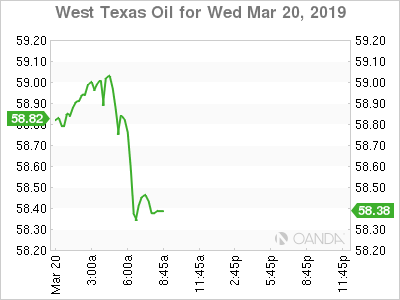
Staying in the currency markets, Kiwiis second strongest weakest. Canadian Dollar is the third weakest as WTI is back below 59 after failing to take out 60 key resistance zone. Swiss Franc, Euro and Aussie are the strongest ones.
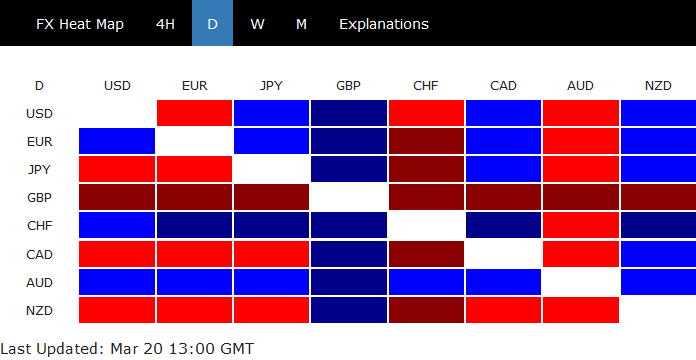
Looking ahead, FOMC rate decision, economic projections and press conference are the main focus of the day. Here are some previews.
In Europe:
- FTSE is up 0.20%.
- DAX is down -1.43%.
- CAC is down -0.19%.
- German 10-year yield is down -0.008 at 0.091.
Earlier in Asia:
- Nikkei rose 0.20%.
- Hong Kong HSI dropped -0.49%.
- China Shanghai SSE dropped -0.01%.
- Singapore Strait Times dropped -0.41%.
- Japan 10-year JGB yield rose 0.0092 to -0.036.
EU could only approval Brexit delay to May 23, not June 30
While UK PM May is seeking Article 50 extension to June 30, an EU document seen by Reuters noted that it won't grant any extension beyond May 23.
The document noted that "any extension offered to the United Kingdom should either last until 23 May 2019 or should be significantly longer and require European elections."
And, "this is the only way of protecting the functioning of the EU institutions and their ability to take decisions."
Dollar Mixed ahead of Fed
- USD – Fed to detail end of QE and possibly inflation targeting
- Trade War – Deal could occur over next two months
- Brexit – May wants short delay
- Oil – Softer on China concerns
- Gold – Rising on tame inflation and trade deal uncertainty
The conclusion of the two-day Fed meeting is expected to see no change with interest rates and confirm the dovish message instilled back in January. Today the Fed will provide clarity on their approach to patience, an update on their forecasts and projections, with many focusing on the dot plots, their ending of quantitative tightening and their approach to inflation.
Investors will primarily focus on the update of the dot plot forecast, which is expected to show 2019 rate hike expectations to fall from two raises to one. Some are expecting the Fed to bring down the forecast to no hikes, but that may be difficult as it would require 7 officials to downgrade their forecast. The 2020 forecast will be just as important, and we could see the Fed target one hike.
The Fed could also lower their economic projections, which could support their cautious tone. Many will pay close attention to their PCE inflation forecast as it could support the argument we are done with rate hikes if we do not see a clear path higher.
In addition to the dot plots, the Fed could end QT, or queue that for the next meeting. Just as important as the ending of the shrinking of the balance sheet, will be what is their plan on what type of debt they will hold, short term bills, or a combination with longer term bonds. Fed Chair Powell may also decide to adopt inflation targeting which would allow them to overshoot inflation.
For doves, the best-case scenario would be the Fed eliminating both hikes for 2019, announcing QT will end at this meeting or the next one, and the adoption of inflation targeting. With global headwinds, such as growth concerns, Brexit and the trade war still persisting, it might be difficult for the Fed at this meeting to come off hawkish, but they could since the market is overly pricing in a dovish meeting. If they keep hope alive for rate hikes over the next two years, we could see that take away some of the air in this recent risk-on rally.
China
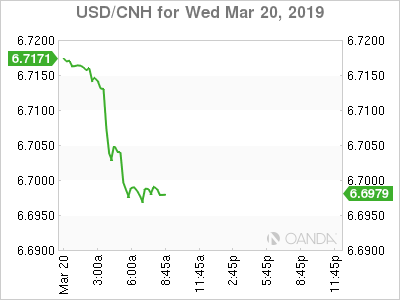
As we near what is expected to be a huge trade deal between the US and China, hurdles and final details will likely deliver many headlines that could raise concerns that talks may fall apart. US officials later commented that this was part of the normal process of negotiations. The market is overly pricing in a trade deal to be done over the next couple months, so it should come as no surprise that we will see stocks selloff when we see news that talks may be hitting roadblocks. Yesterday’s news that China is walking back some trade offers sent a reminder that a deal is still not done. The next step is for Us Trade Representative Robert Lighthizer and Treasury Secretary Steven Mnuchin to go to Beijing the week of March 25th.
Both sides remain motivated to get a deal done and we should see some framework agreement put in place over the next two months.
Brexit
Prime Minister May is running out of time, perhaps that is how she wants it. With nine days left to exit, she is seeking a short extension from the EU, that would give her one more chance to push a revised deal through Parliament. The risk is that if she fails after getting a short extension, we could see the UK go through a hard exit.
If we don’t see a deal by exit day, the UK will also need to decide if they will hold EU elections by mid-April, the problem is that if they don’t, they will exit from the block on July 1st with or without a deal.
The no-deal risks are rising and that is exactly how PM May wants it. She needs to scare her deal down Parliament’s throat and as we near these critical deadlines, she needs more leverage for the EU and her own Parliament.
Oil
Crude prices pulled back from 4-month highs as global growth concerns returned as trade roadblocks were hit between the US and China. The markets are re-pricing their expectations for when we will see a final trade deal and that is important for Chinese demand for oil. The goals of mid-March deal are long gone and now the base case is for a deal to happen over the next two months. Oil still has some good catalysts for higher prices as we approach a key rise in demand from the US. The geopolitical risks and sanction effects are also helping keeping prices bid and we may see sellers come back in force once we see US stockpiles rise and OPEC compliance starts to wane.
Gold
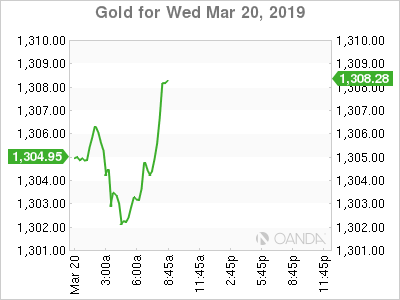
Gold is slightly lower ahead of the Fed but still above the $1,300 an ounce level. The precious metal took some time to rally after the Fed’s dovish pivot in January as investors were more focused on the potential trade deal between US and China. With the market heavily pricing in a trade deal, gold may be free to rally if we see dovishness confirmed by the Fed.
UK PM May seeking Article 50 extensions until June 30
UK Prime Minister Theresa May confirms at PMQs in parliament that has written to European Council President Donald Tusk to seek extension of article 50 until June 30. She noted that MPs voted for only a short extension last Thursday. Also, holding European election would not be in anyone's interest. May also said the government will hold another meaningful vote.
May said: “As prime minister, I am not prepared to delay Brexit any further than the 30th of June ... I have therefore this morning written to President Tusk, the president of the European Council, informing him that the UK seeks an extension to the article 50 period until the 30th June... The government intends to bring forward proposals for a third meaningful vote. If that vote is passed, the extension will give the House time to consider the Withdrawal Agreement Bill. If not, the House will have to decide how to proceed.”
GBPUSD Testing Toward Range Low
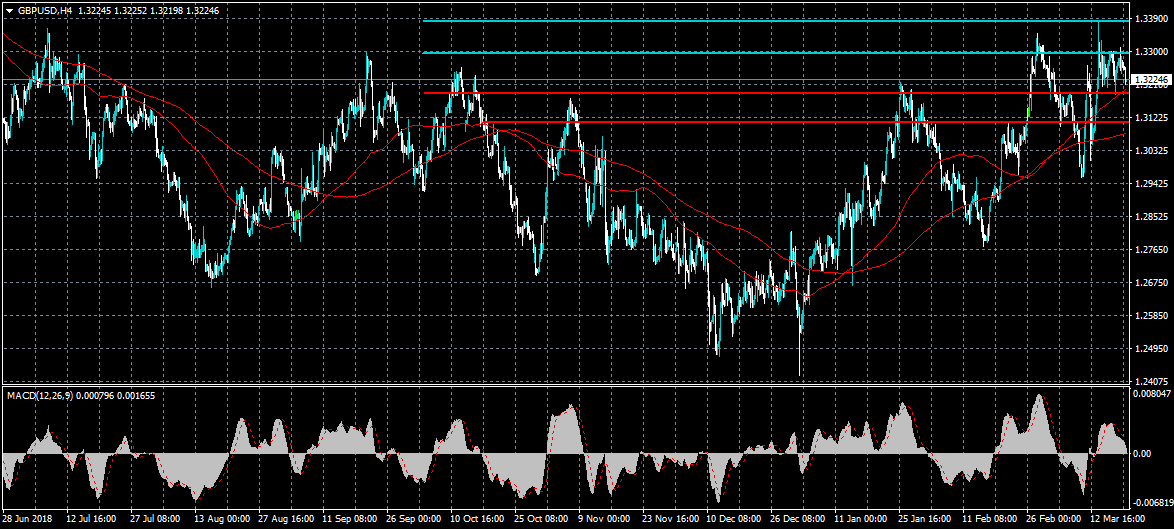
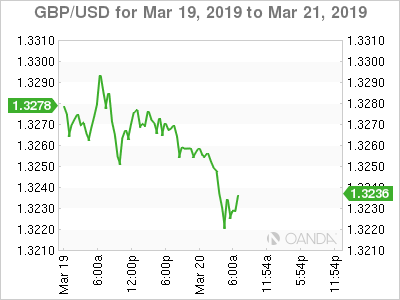
The British pound is weakening towards the worst level of the week against the US dollar as Brexit uncertainty continues to dominate sterling’s trading action. The 1.3190 to 1.3300 is the currently weekly price range, with a sustained break below the 1.3190 level likely to prompt further losses towards the 1.3100 support level. Alternatively, a sustained move above the 1.3300 level could trigger buying interest towards the 1.3400 level.
The GBPUSD pair is only bullish while trading above the 1.3300 level, key technical resistance is found at the 1.3349 and 1.3400 levels
If the GBPUSD pair trades below the 1.3190 level, sellers may test towards the 1.3155 and 1.3100 support levels.
EURUSD Dip Buying Prevails
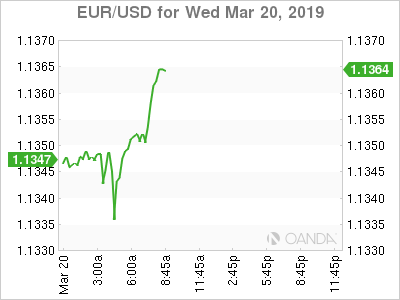
The euro is once again testing key trendline resistance against the US dollar as dip-buyers continue to support the pair on any moves lower. Once above trendline key trendline, EURUSD bulls then need to break through the important 1.1360 technical area. The EURUSD pair could also find additional buying interest if the Federal Reserve is more dovish towards US rate hikes than expected later today.
The EURUSD pair is only bullish while trading above the 1.1345 level, key technical resistance is found at the 1.1360 and 1.1400 levels.
If the EURUSD pair falls below the 1.1325, sellers may test back towards the 1.1290 and 1.1260 support levels.
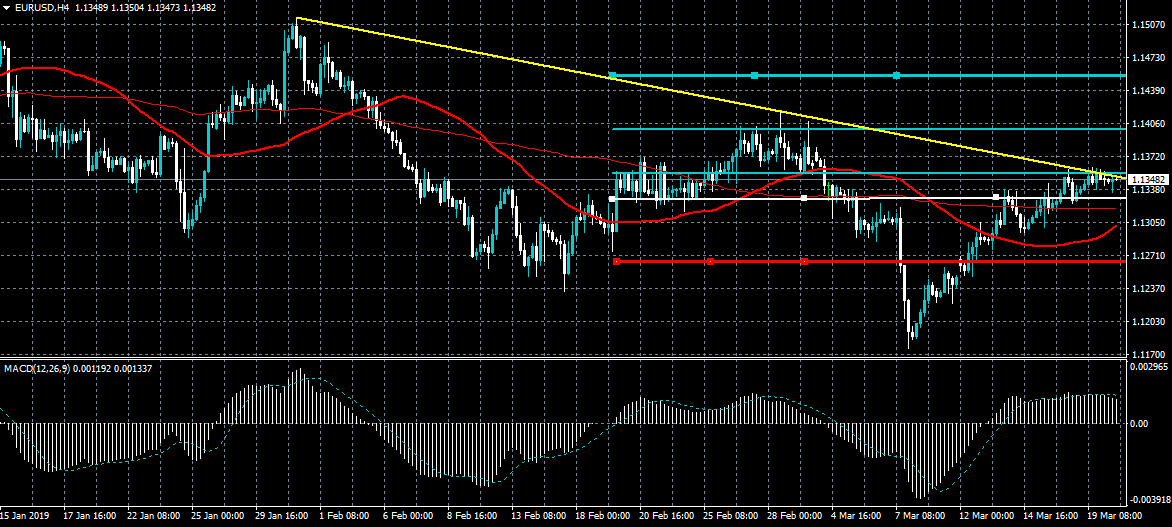
EUR/USD – Euro Drifting Ahead Of Federal Reserve Rate Statement
It continues to be an uneventful week for EUR/USD. The pair is unchanged on Wednesday, trading at 1.1353, up 0.02% on the day. On the release front, German PPI declined by 0.1%, shy of the estimate of 0.2%. This marked the second decline in three months. The Federal Reserve releases its monthly rate statement. On Thursday, the E.U. holds an economic summit. The U.S. will release the Philly Fed Manufacturing Index and unemployment claims.
The Federal Reserve is virtually certain to hold the benchmark rate at the Wednesday meeting, but traders should nonetheless treat the meeting as a market-mover. Policymakers have been sending out dovish messages, and if the Fed reaffirms that it will remain cautious and patient, the dollar could lose ground. The Fed’s balance sheet will also be under scrutiny, with the policymakers expected to announce when they will stop reducing the $4 billion balance sheet. The central bank has been reducing assets by $50 billion a month, but there has been criticism that this tightening is choking economic growth. The Fed will also publish its new dot plot, a quarterly release which is used to convey its interest rate outlook.
European leaders will meet in Brussels on Thursday, where Prime Minister May will request an extension for Brexit. The Europeans are exasperated by turmoil surrounding Brexit and the inability of the British government to pass the withdrawal agreement in parliament. Jean-Claude Juncker, the President of the European Commission, said on Wednesday that the E.U. would not provide May with an answer right away and would meet for consultations next week. The clock is ticking, with Britain scheduled to leave the E.U. on March 29.
AUD/USD Outlook: Aussie Bulls Struggle At 0.71 Zone Resistances, Fed Eyed For Fresh Signals
The Aussie pressures 0.7100 resistance zone (30SMA / daily Kijun-sen) following fresh bullish acceleration in Asian / European trading, driven by improved risk sentiment. Rising momentum helps but mixed setup of daily MA's and south-heading stochastic weigh and limit advance for now. Bulls need sustained break above 0.7100/14 zone barriers (0.7114 is Fibo 38.2% of 0.7295/0.7003 fall) to signal further advance. Daily 30SMA marks next barrier at 0.7130, followed with more significant 100SMA (0.7160) and daily cloud top (0.7171) violation of which is expected to confirm bullish continuation. Expectations that the Fed will show further dovish stance and lower economic growth projection are already priced in and Aussie bulls will be looking for more signs that would include hints of rate cut, to weaken the greenback and open way for fresh advance of the Australian dollar. Conversely increased downside risk could be expected fresh weakness and close below daily cloud base (0.7050).
Res: 0.7100, 0.7114, 0.7130, 0.7160
Sup: 0.7070, 0.7050, 0.7041, 0.7003
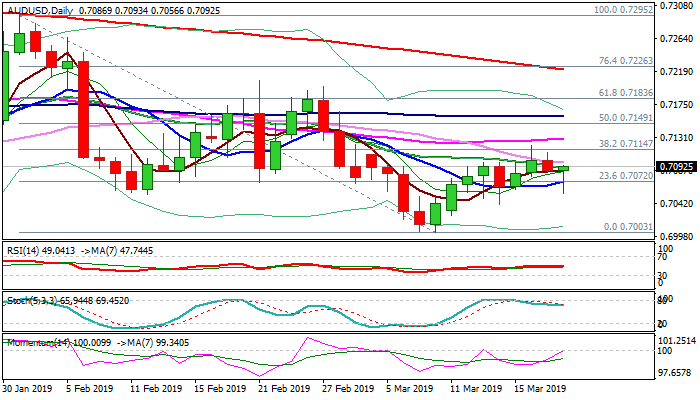
Waiting For FOMC
All Eyes on FOMC
Despite the chaos unfolding in the UK, market volatility has eased ahead of the FOMC (Federal Open Market Committee) meeting. Perhaps the only assets showing real directional momentum are lean hog futures, which hit a new high. The Chinese consumer story remains in play regardless of the economic slowdown and trade tensions with USA. Here's an interesting indicator for the economic health of China: Australia today suggest that RBA (Reserve Bank of Australia) could cut rates. While the move is primarily aimed at the domestic housing market, some will interpret it as a comment on the state of trade with China. Gold prices remained bullish as USD weakened on expectations that the Fed would maintain a dovish policy stance.
During today's March FOMC meeting, the growing expectations is that the Fed will announce that balance sheet runoff will halt by year's end. More details are expected at following meetings, but the loosing of policy should have a negative impact on the greenback. As always, this meeting will be thoroughly dissected for evidence of the timing and direction of the Fed's next move. With patience the key word, we anticipate a less than exciting central bank decision. We are not anticipating adjustments to growth – inflation forecasts or change in dots plot. Should the Fed avoid the temptation for a downgrade, we could the equity relief rally. The probability of a Fed interest rate hike in 2019 has fallen to 60%, while the probability of a rate cut has increased to 25% by the December meeting. This means the risks are relatively balanced. Yet in our view, with downside risk to the US economy exposed, further midterm weakness in USD should be expected.
Brexit Bedlam
There is a high probability that Prime Minster May will pass out due to g-force in the British politics. The UK is hurling towards Brexit with no steering or brakes, so can someone call Denzel Washington, please (see classi film "Unstoppable")?
The most recent update is that May is looking for a short extension to the Brexit schedule. The EU has indicated that any extension would only be granted for a good reason: a deal on the table, elections, a new referendum etc. Sterling volatility has receded in recent day as markets now expect an extension and a deal as the most likely outcome. Currently, no meaningful vote is scheduled in the House of Commons, and we suspect there is also the silent hope that the longer the game is dragged on, the likelihood of Brexit decreases. However, this just feels like a guess with downside extreme. Elsewhere, UK inflation data shows headline CPI inflation steady at 1.8% and core at 1.9% — but data has become extremely irrelevant at this point.
Fed To Set The Tone For The U.S Dollar
Wednesday March 20: Five things the markets are talking about
All eyes are on today’s FOMC meeting where the Fed is expected to hold interest rates steady, announce plans for the end of asset roll-off from its balance sheet, and lower its “dot-plot” projections for the number of interest-rate hikes this year. Market participants will also be scrutinizing whether dealer expectations of a rate cut in 2020 has any substance.
Nevertheless, global equities are either trading mixed or are lower as investors adopt a cautious approach ahead of the Fed’s decision (2 pm EDT) and further news on Sino-U.S trade talks, where negotiators are said to remain at “odds.”
U.S Treasury yields are trading atop of the recent low yields, while the ‘big’ dollar has found some traction after a few sessions of underperforming. Elsewhere, the pound is drifting as the market eyes PM Theresa May’s efforts to draft a request for an extension to conclude a Brexit deal that could pass Parliament in another meaningful vote.
On tap: The Bank of England (BoE) and Swiss National Bank (SNB) deliver their interest rate decisions tomorrow, while on Friday, Euro-zone purchasing manager survey numbers will give an indication of the health of the region’s industrial and service sectors.
1. Stocks mixed results
In Japan, the Nikkei saw a small gain overnight as the market awaits the Fed’s decision. The index share average ended +0.2% higher after trading in negative territory in early trade. The broader Topix added +0.3%.
Note: Japanese markets are closed on Thursday for a bank holiday.
Down-under, Aussie stocks ended lower overnight after reports of tension in Sino-U.S trade talks soured sentiment. The S&P/ASX 200 index declined -0.32% at the close of trade. The benchmark was little changed on Tuesday. In S. Korea, the Kospi stock index ended steady earlier this morning, recouping much of its losses, as tech shares lifted the market in the late trading. The index closed little changed, down -0.02%.
In China, equities were little changed overnight ahead of the Fed decision and on uncertainty surrounding Sino-U.S trade negotiations. Both the Shanghai Composite index and the blue-chip CSI300 index settled unchanged. In Hong Kong, it was a different scenario, both the Hang Seng index and the Hang Seng China Enterprises index ended down -0.5%.
In Europe, regional bourses trade lower across the board following on from a mixed session in Asia and slightly higher U.S futures this morning.
U.S stocks are set to open in the ‘black’ (+0.7%).
Indices: Stoxx600 -0.34% at 382.98, FTSE -0.01% at 7,322.97, DAX -1.02% at 11,669.32, CAC-40 -0.13% at 5,418.75, IBEX-35 -0.17% at 9,476.05, FTSE MIB -0.02% at 21,425.50, SMI -0.40% at 9,487.50, S&P 500 Futures +0.07%
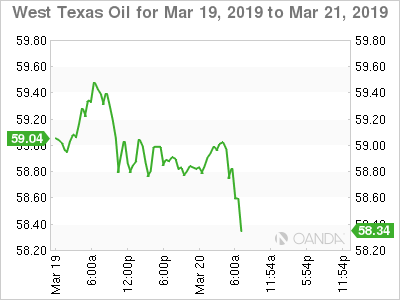
2. Oil prices firm on supply cuts, but slowing economy drags
Oil prices have edged a tad higher, supported by ongoing supply cuts led by OPEC+ and U.S sanctions against Iran and Venezuela, although gains remain capped by market concerns over economic growth.
Brent crude futures are at +$67.79 a barrel, up +18c, or +0.3% from Tuesday’s close. U.S West Texas Intermediate (WTI) crude futures are at +$59.09 per barrel, up +6c, or +0.1% from their previous close.
Note: WTI on Tuesday reached its highest level since Nov. 12 at +$59.57 a barrel, while Brent touched its highest since Nov. 16 at +$68.20 a barrel.
Both global growth concerns and ongoing oversupply fears are creating headwinds for the commodity.
OPEC and a group of 10 oil-producing nations led by Russia are deepening their crude production cuts but remain split on whether the curbs should remain in place through the end of the year.
Data from the API yesterday showed that U.S crude, gasoline and distillate inventories unexpectedly fell in the week to March 15.
Expect dealers to take their cues from today’s U.S EIA report, which is due to publish its weekly crude production and storage level report around 10:30 am EDT.
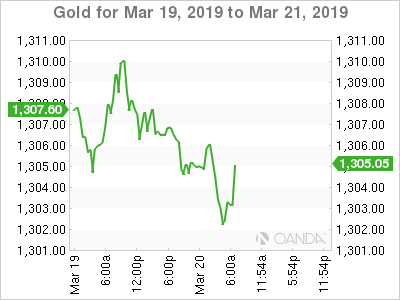
Ahead of the U.S open, gold has slipped as the dollar gains ground ahead of the Fed’s policy decision. Spot gold is down about -0.4% at -$1,301.38 per ounce, while U.S gold futures have also slipped -0.4% to +$1,301.7.
3. Sovereign yields wait for Fed’s Powell
U.S Treasury’s and core eurozone bond yields have eased away from their two-week highs print of yesterday, as dealers wait for further clarity on the direction of U.S rates and the market struggles to make sense of the UK’s Brexit negotiations.
Currently, futures pricing suggests the next move by the Fed will be a rate cut, likely in 2020, though most expect one more hike this year, likely in June. Also, U.S policy makers are expected to release details of their plan to end the monthly reduction of its massive balance sheet.
The yield on 10-year Treasuries remained at +2.61%, while the yield on Germany’s 10-year Bund currently trades at +0.10%. Down-under, Australia’s 10-year bond yield is steady at +1.94%.
Elsewhere, the Bank of Japan (BoJ) minutes last night indicated that Governor Kuroda and the central bank remain on the “dovish” side and will continue its persistent large-scale easing. Japan Finance Minister Aso stated that he had no difference with PM Abe on BoJ’s +2% price target. He indicated that he had discussed numerous times with BoJ’s Kuroda that it was becoming “very difficult to achieve price goal when plunging oil prices weighed on inflation.”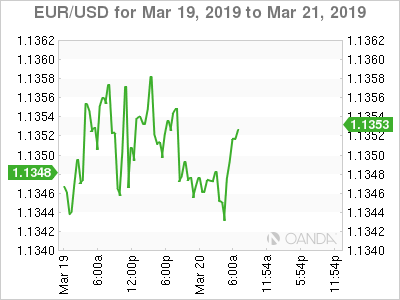
4. Dollar in small demand
The USD is little changed against G10 currency pairs as the markets focus remains on the upcoming Fed policy decision later today. Expectations are for accommodative Fed rhetoric given the recent soft U.S data.
Sterling (£1.3231) is little affected by the modest increase in U.K inflation headline print this morning (see below). The markets focus remains on Brexit and the EU Council meeting on Thursday and Friday.
PM Theresa May is supposedly asking for a three-month Article 50 extension. A longer delay would provide a bid for the pound. However, dealers have noted that the current environment suggested that “no-deal” risk could be back around the end of June. The pound is last down -0.3% at $1.3227. EUR/GBP rises +0.2% to €0.8577.
Elsewhere, EUR/USD is little changed at €1.1345 area, while USD/JPY is at ¥111.55 just ahead of the U.S morning.
5. U.K inflation inches higher last month
Data this morning shows that inflation in the U.K. ticked up in February, fed by higher prices for food, alcohol and video games.
According to the ONS, consumer prices rose +1.9% in the year through February, compared with an annual gain of +1.8% the previous 12 months.
Note: The BoE has signaled to hike up interest rates slowly three or more times in the next couple of years to keep inflation at its +2% annual target, provided that the U.K’s exit from the EU goes smoothly.
Also, the ONS said house prices in London fell -1.6% on year in January, the seventh consecutive month of declines.
Note: Prices in London are now -3.3% below their July 2017 peak.