Sample Category Title
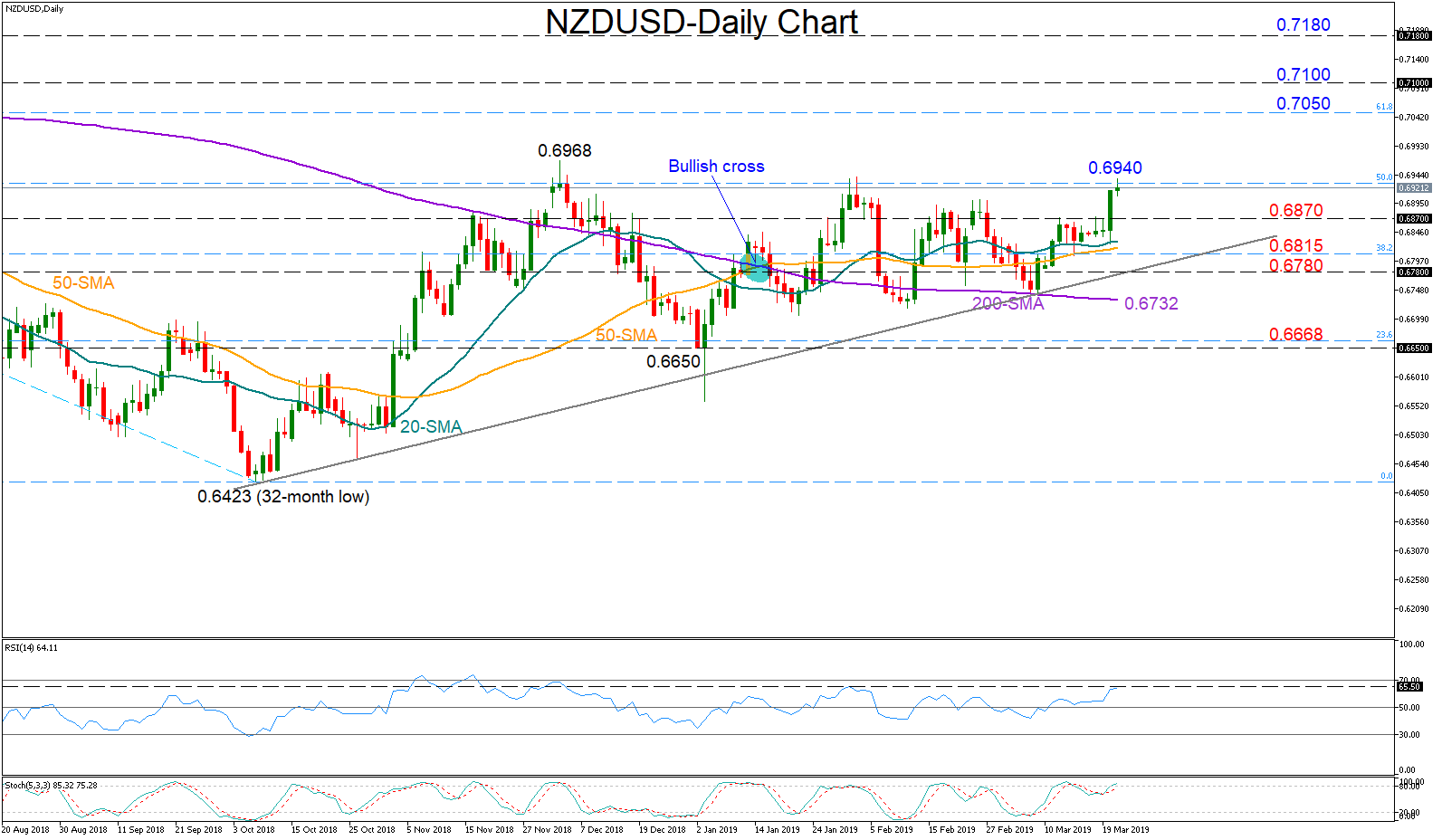
NZDUSD Meets Familiar Resistance At 0.6940
NZDUSD stood tall on Wednesday by almost 1% after trading flat over the past week. The pair stretched further its rally to new one-and-a-half-month highs on Thursday, but the bulls found a familiar barrier around 0.6940, with the Stochastics flagging an overbought market – the red %D line and the green %K line are returning above 80. The RSI continues to point up, though less aggressively than in previous days, giving some signs of weakness near a former resistance area.
In case prices advance beyond 0.6940, breaking the December top of 0.6968 too, the way could open towards 0.7053 which is the 61.8% Fibonacci of the long downleg from 0.7436 to 0.6423. Slightly higher, the 0.7100 round level could be of psychological importance, which if fails to hold, further gains could follow, probably until 0.7180, a key support area in the February-March 2018 period.
On the downside and under 0.69, the bearish action could pause first near 0.6870 before meeting the 38.2% Fibonacci of 0.6815. Another leg lower could bounce on the upward trendline (0.6780) drawn from the 0.6423 bottom. If the line appears easy to break, the 200-day moving average (MA) at 0.6732 could be the next target ahead of the 23.6% Fibonacci of 0.6668.
Meanwhile in the medium-term picture, NZDUSD is trading within the 0.6968-0.6650 range. Chances for a bull market seem to be improving as the 50-day MA keeps increasing distance above the 200-day MA, but slowly so.
In brief, NZDUSD could see a softer positive momentum in short term, while in the medium-term, the pair holds neutral below 0.6968
(SNB) Swiss National Bank leaves expansionary monetary policy unchanged
The Swiss National Bank is maintaining its expansionary monetary policy, thereby stabilising price developments and supporting economic activity. Interest on sight deposits at the SNB remains at –0.75% and the target range for the three-month Libor is unchanged at between –1.25% and –0.25%. The SNB will remain active in the foreign exchange market as necessary, while taking the overall currency situation into consideration.
Since the monetary policy assessment of December 2018, the Swiss franc has depreciated slightly on a trade-weighted basis. Overall, however, it is still highly valued, and the situation on the foreign exchange market continues to be fragile. The negative interest rate and the SNB's willingness to intervene in the foreign exchange market as necessary therefore remain essential. These measures keep the attractiveness of Swiss franc investments low and reduce upward pressure on the currency.
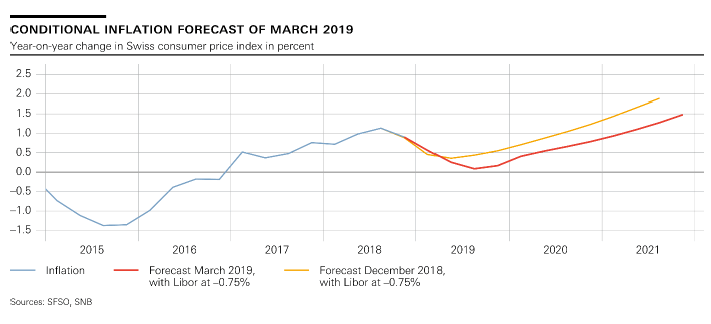
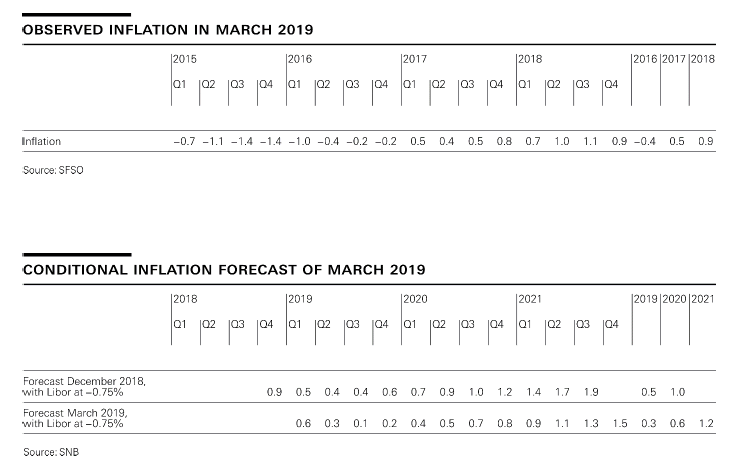
The new conditional inflation forecast is lower than in December. This is primarily attributable to weaker outlooks for growth and inflation abroad, and the resulting reduction in expectations regarding policy rates in the major currency areas going forward. The forecast for the current year has been reduced marginally to 0.3%, from 0.5% in the previous quarter. For 2020, the SNB now expects inflation of 0.6%, compared to 1.0% last quarter. For 2021, it anticipates an inflation rate of 1.2%. The conditional inflation forecast is based on the assumption that the three-month Libor remains at –0.75% over the entire forecast horizon.
Global economic activity has weakened more than expected in recent months. Growth was curbed in part by temporary factors. However, the underlying momentum in many advanced economies also slowed. Production in the manufacturing industry, in particular, was sluggish in a number of countries.
Economic and political uncertainty increased volatility and risk premia on the financial markets at the end of 2018. In addition, growth and inflation in some countries was again weaker than generally anticipated. Both led to lower expectations regarding policy rates in the major currency areas.
Against this backdrop, in its new baseline scenario for the global economy the SNB has made a downward revision to its growth outlook for the advanced economies for the first half of 2019. Nevertheless, the global economy is still likely to grow in line with its potential in the coming quarters. In the advanced economies, expansionary monetary policy and the robust situation on the labour market are lending support, as is fiscal policy in some countries. However, the risks are still to the downside.
Following strong expansion in the preceding quarters, GDP stagnated in Switzerland in the second half of 2018. However, growth for the year as a whole was robust at 2.5%. Companies' production capacities were well utilised and the labour market situation improved continuously. Jobless figures fell further, and in February the unemployment rate stood at 2.4%.
Economic indicators are currently pointing to moderately positive momentum. After stagnating in the second half of 2018, GDP growth is thus likely to pick up again somewhat. For 2019 as a whole, the SNB continues to expect GDP to expand by around 1.5%.
Imbalances persist on the mortgage and real estate markets. Both mortgage lending and prices for single-family homes and privately owned apartments continued to rise slightly in recent quarters, while prices in the residential investment property segment declined somewhat. Nevertheless, due to the strong price increases in recent years and growing vacancy rates there is the risk of a correction in this segment in particular. The SNB will continue to monitor developments on the mortgage and real estate markets closely, and will regularly reassess the need for an adjustment of the countercyclical capital buffer.
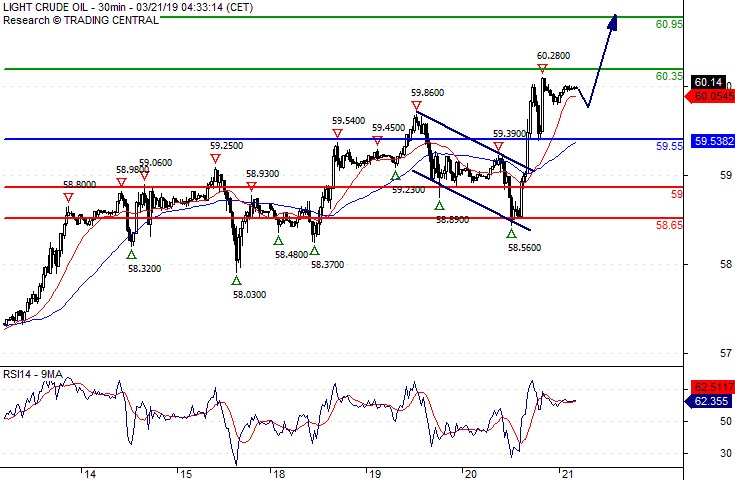
Crude Oil Towards 60.95
Pivot (invalidation): 59.55
Our preference Long positions above 59.55 with targets at 60.35 & 60.95 in extension.
Alternative scenario Below 59.55 look for further downside with 59.00 & 58.65 as targets.
Comment The RSI advocates for further upside.
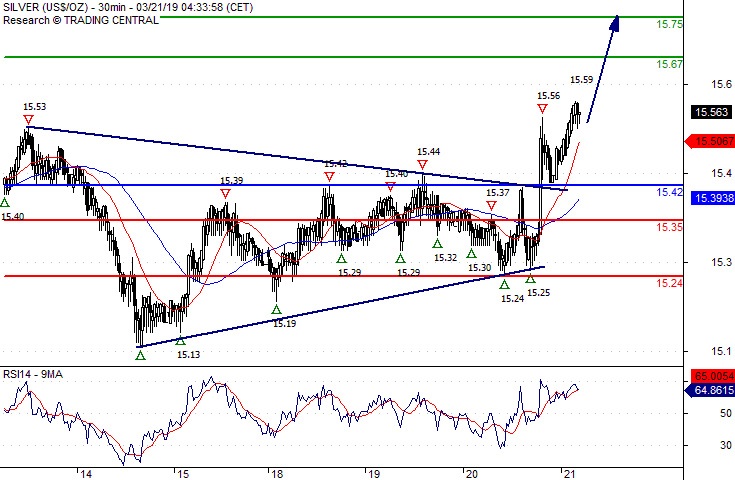
Silver Spot 15.7500 Expected
Pivot (invalidation): 15.4200
Our preference Long positions above 15.4200 with targets at 15.6700 & 15.7500 in extension.
Alternative scenario Below 15.4200 look for further downside with 15.3500 & 15.2400 as targets.
Comment The RSI is bullish and calls for further advance.
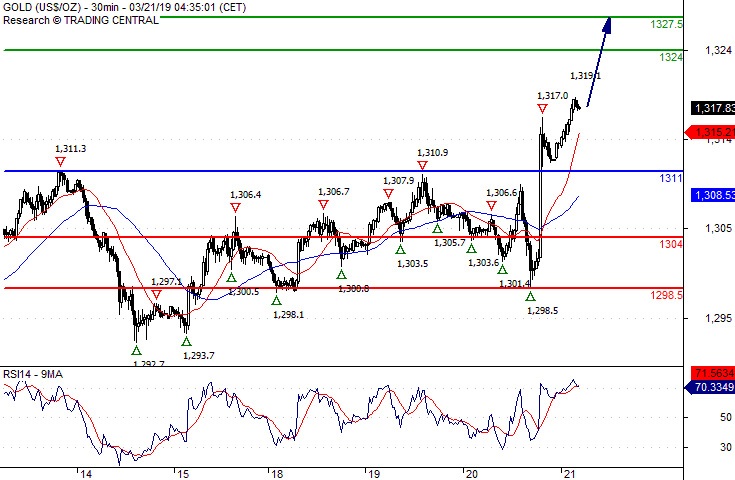
Gold Spot 1327.50 In Sight
Pivot (invalidation): 1311.00
Our preference Long positions above 1311.00 with targets at 1324.00 & 1327.50 in extension.
Alternative scenario Below 1311.00 look for further downside with 1304.00 & 1298.50 as targets.
Comment The RSI shows upside momentum.
Currencies: USD Declines As Fed Deprives Currency Of Additional Interest Rate Support
- Rates: Fed completes U-turn
The Fed cancelled all rate hike intentions this year and announced an end to the balance sheet run-off by September. Some fear the Fed called an end to the eco/monetary cycle all together. Inflation remains muted and international clouds gather above the US economy. US Treasuries rallied with the US 10-yr yield ready to test 2.5% support. - Currencies: USD declines as Fed deprives currency of additional interest rate support
The dollar extended its recent decline yesterday as the Fed is moving ever closer to the soft market positioning. The USD is becoming more vulnerable to disappointing US eco data. In a broader perspective, the ECB and the Fed are now in a prolonged wait-and-see stance. This should cap a big leap higher of EUR/USD, at least for now
The Sunrise Headlines
- US stock markets rebounded after the Fed meeting yesterday, but failed to retain gains. The Dow Jones underperformed (-0.55%). Asian markets are trading mostly positive with China outperforming its peers.
- The Fed left rates stable and expects no more hikes in 2019 and 1 in 2020, citing unconvincing inflation and weaker global growth. It will also conclude its balance sheet reduction in September. The dollar slipped, UST's rallied.
- 2018Q4 growth in New Zealand picked up strongly to 0.6% QoQ (vs. 0.3% in Q3). Investors scaled back bets on a rate cut by the central bank later this year. The kiwi dollar extended its post Fed advance to NZD/USD 0.692.
- US president Trump said that tariffs on Chinese goods will stay in effect until he is certain China will comply with a trade deal that has yet to be signed. Earlier this week US officials were concerned that Beijing is backpedalling on promises.
- Preliminary results of Dutch provincial elections, which have implications on national politics, suggest that right-wing populists (Forum for Democracy) have won 12 Senate seats, stripping the current centre-right coalition of its majority.
- PM Theresa May is heading for Brussels today to ask the EU for an extension of the brexit deadline. European Council President Tusk said that's only possible if the British Parliament approves the already twice rejected existing agreement.
- Today's economic calendar contains the Philly Fed Business Outlook and jobless claims in the US. The E(M)U publishes March consumer confidence and holds a two day summit. We also brace for a central bank bonanza (BoE, SnB, Norges).
Currencies: USD Declines As Fed Deprives Currency Of Additional Interest Rate Support
USD won't get interest rate support this year
Most major USD cross rates drifted sideways in the run-up to the Fed policy decision yesterday. Markets already anticipated a soft Fed with US yields and the dollar drifting lower of late. The Fed (more than) met dovish market expectations. It downgraded its growth forecasts. The governors in the 'dots' on average expect no rate hike this year anymore and see only one additional rate hike next year. The Fed will also stop the reduction of its balance sheet in September, much sooner than expected. In the press conference Fed's Powell stressed that patience is dominant attitude within the FOMC. The USD won't get further interest rate support anytime soon. Markets already discounted the Fed's next step being an interest rate cut. Powell and Co didn't go that far, but markets interpreted yesterday's guidance as the Fed making a big step towards their dovish positioning. US yields and the dollar took another big step south. The trade-weighted dollar (DXY) dropped from the 96.50 area to the 95.75 area. EUR/USD jumped north of 1.14 to close the day at 1.1413 (from 1.1352). USD/JPY closed at 110.70 (from 111.39).
Asian equity markets mostly show modest gains this morning. The dollar stays in the defensive. A softer dollar and lower US yields are in theory supportive for emerging markets, but doubts on global growth (even at the Fed) probably prevent more aggressive risk taking.
Later today, the eco calendar is rather light. EC consumer confidence is expected to bottom further (-7.1 from -7.4). The focus in the region will be on the EU summit handling Brexit. In the US, the Philly Fed business outlook and the jobless claims will be published. Weaker than expected data might confirm the Fed's wait-and-see stance.
The very soft Fed and the US currency losing further interest rate support is evidently USD negative. So, some further ST positioning away from the US dollar is possible. That said, in a broader perspective, the Fed and the ECB are now a similar soft, wait-and-see modus. Of late, the euro had already a good run. In this respect, a sustained break beyond the 1.1514 resistance is not evident. Such a test/break probably needs US data to deteriorate further. A break beyond the 1.1570/1.1621 resistance would signal an profound deterioration in the technical picture of the USD, but we asumme its too early for that.
The EU making a short-Brexit delay conditional to an approval of a deal weighed on sterling yesterday. Combined with EUR/USD strength this propelled EUR/GBP above 0.86. It looks Brexit uncertainty will persist and maybe even intensify till March 29 deadline. We avoid sterling exposure as long as the binary Brexit risk remains this high.
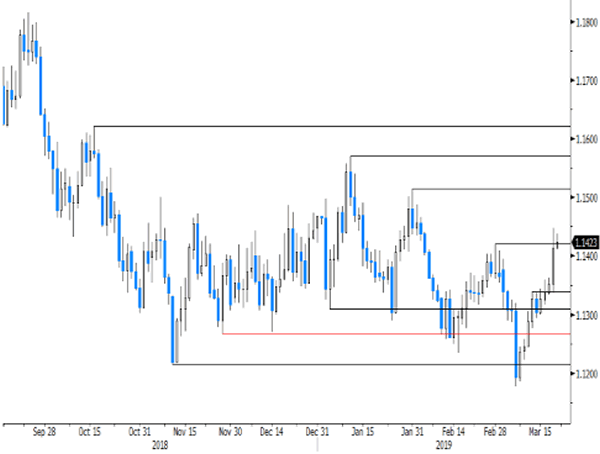
EUR/USD: extends rebound higher in 1.12/1.16 range as Fed deprives USD additional interest rate support
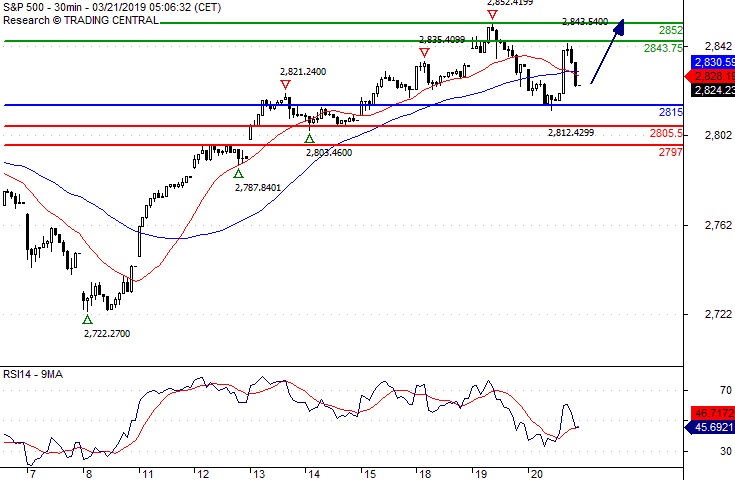
S&P 500 Bullish Bias Above 2815.00
Pivot (invalidation): 2815.00
Our preference Long positions above 2815.00 with targets at 2843.75 & 2852.00 in extension.
Alternative scenario Below 2815.00 look for further downside with 2805.50 & 2797.00 as targets.
Comment The RSI is mixed to bullish.
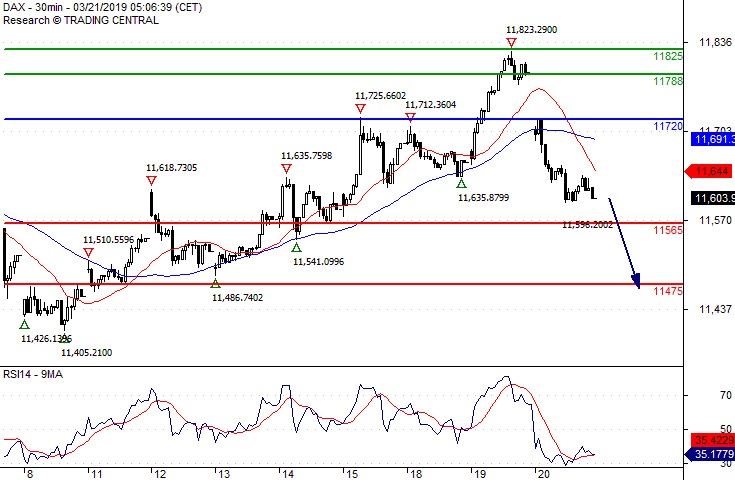
DAX Towards 11475.00
Pivot (invalidation): 11720.00
Our preference Short positions below 11720.00 with targets at 11565.00 & 11475.00 in extension.
Alternative scenario Above 11720.00 look for further upside with 11788.00 & 11825.00 as targets.
Comment The RSI is bearish and calls for further downside.
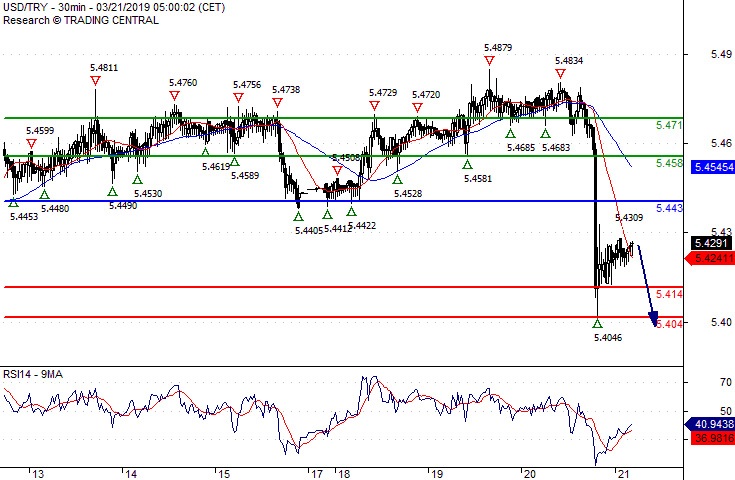
USD/TRY 5.4040 Expected
Pivot (invalidation): 5.4430
Our preference Short positions below 5.4430 with targets at 5.4140 & 5.4040 in extension.
Alternative scenario Above 5.4430 look for further upside with 5.4580 & 5.4710 as targets.
Comment Even though a continuation of the technical rebound cannot be ruled out, its extent should be limited.
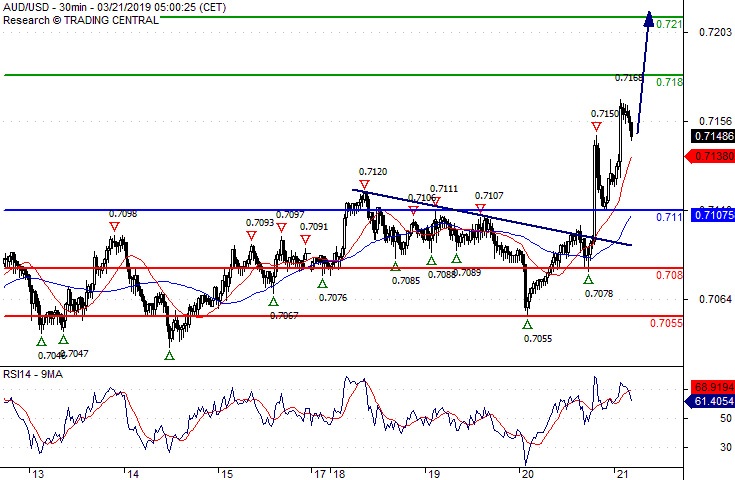
AUD/USD The Upside Prevails
Pivot (invalidation): 0.7110
Our preference Long positions above 0.7110 with targets at 0.7180 & 0.7210 in extension.
Alternative scenario Below 0.7110 look for further downside with 0.7080 & 0.7055 as targets.
Comment The RSI is bullish and calls for further upside.