Sample Category Title
EUR/CHF Daily Outlook
Daily Pivots: (S1) 1.1313; (P) 1.1333; (R1) 1.1348; More...
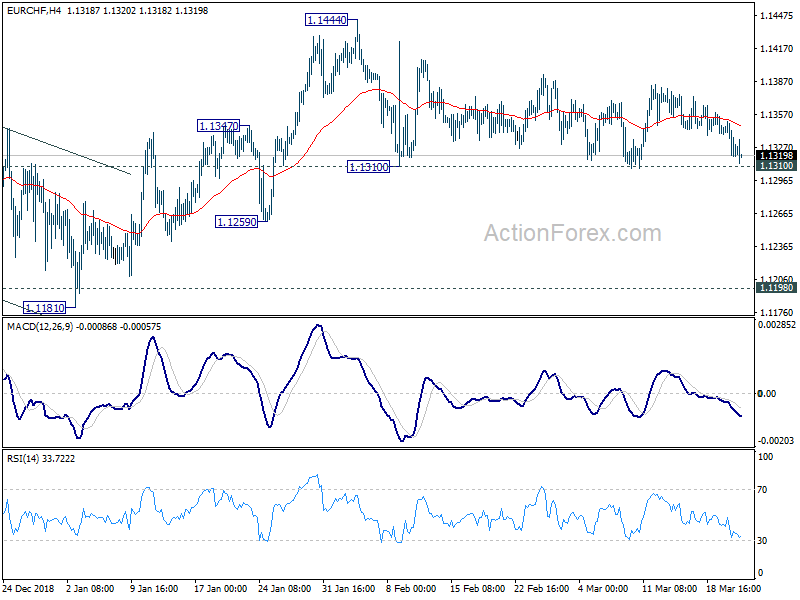
EUR/CHF dropped notably but it's staying above 1.1310 support. Intraday bias remains neutral and further rise remains mildly in favor. On the upside, firm break of 1.1444 resistance will resume the rebound from 1.1181 and target 1.1501 key resistance next. On the downside, firm break of 1.1310 will indicate completion of the rebound. In that case, intraday bias will be turned back to the downside for 1.1181 low again.
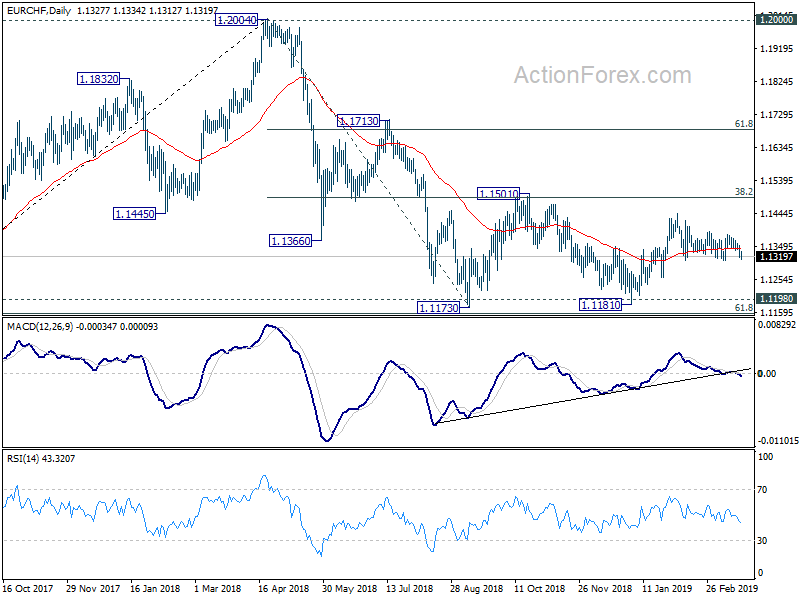
In the bigger picture, price actions from 1.2004 medium term top is seen as a correction only. Downside should be contained by 1.1154/98 support zone to complete it and bring rebound. Decisive break of 1.1501 (38.2% retracement of 1.2004 to 1.1173 at 1.1490) will confirm completion of the correction. Further rise should be seen to 61.8% retracement at 1.1687 and above next.
Brexit, Fed’s Dovish Decision & Gold
Forex market had a volatile day yesterday and we can still feel the effects of the that today. The Federal Reserve decided to practice patience. This was very much anticipated by the market participants, so no shock there. But what wasn’t priced into the markets was that the Fed is going to remove the possibility of any interest rate hike for this year. The Fed took one step further by saying that there may be just one interest rate hike in 2020, this is bizarre.
It appears to me that the Fed has decided to listen to Donald Trump because the president criticized the Fed’s monetary policy several times before and asked them not to raise the interest rates.
Of course, for the Fed, it was really easy to blame the economic data and use that as an excuse to justify their move. There is no doubt that there are some soft patches in the economic data, but not to this extent, they do warrant one interest rate hike for this year.
Nonetheless, Investors should take the Fed’s decision with some pinch of salt because as we said yesterday, it would only take a couple of strong economic readings before we see the pressure building up again on the Fed. The chairman can only use this excuse for so long, and if the economic data shows that the economy has safely sailed through these soft patches, the odds for an interest rate hike would jump substantially.
So overall, we do think that there are still chances for one rate hike for this year and we may hear this from the Fed in the coming months, perhaps towards the end of the Q2 or the beginning of Q3.
Gold Should Have Crossed Above $1350
The bullish move in the gold price is mainly due to the weakness in the dollar. I do not believe that traders are buying the fact that there will be no interest rate hike this year because if that was the scenario then we should have seen some serious moves in the gold price. We should have been able to break above the 1350 mark but we are still trading in this ugly range of 1295 to 1330. The momentum in the gold price doesn’t show that there is any serious strength.
Brexit Is a Self-inflicted Injury
As for Sterling, Theresa May is certainly living in a fool's paradise because she thinks that changing the wording of the current package is going to make things easier for her. We are not expecting any major decision from the EU today, we believe that it is likely that the EU is going to call another emergency meeting before they finally decide on Brexit extension.
If May puts the deal in the parliament next week, she would face the same fate as before. I think it is almost inevitable for a long term extension to become a reality and the possibility of General Elections taking place are seriously high. Of course, one can never discount the fact that the UK can be crashing out of the EU by accident after all Brexit is a self-inflicted injury.
Gold Jumps on Fed Minutes
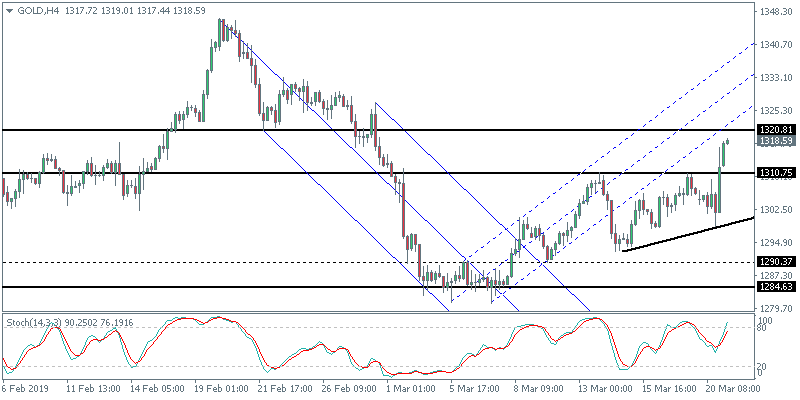
Gold prices rose 0.57% on the day, extending the gains for four consecutive daily sessions. The gains came as the Fed signaled that it would keep interest rates steady at its meeting yesterday evening. Ahead of the Fed meeting, gold prices maintained a steady upside.
What is the Next Target for XAUUSD?
With the current bullish momentum, gold prices will most likely target the 1320 – 1322 level of resistance. This would mark a retest of this level which served as resistance previously. A reversal off this level is required in order to confirm the resistance. In the near term, any pullbacks ahead of the rally to 1320 – 1321 will be seen as bullish in the short term.
Risk Appetite In Check As Yen Rises
The Japanese yen rose sharply yesterday, gaining 0.68% on the day. This reflects the market's risk appetite. UK Prime Minister May wrote a formal letter to the EU seeking a delay to the country's exit from the EU. The UK is expected to leave the EU on March 29 th . The extension will be discussed at the EU parliament today.
Will USDJPY Extend Declines Further?
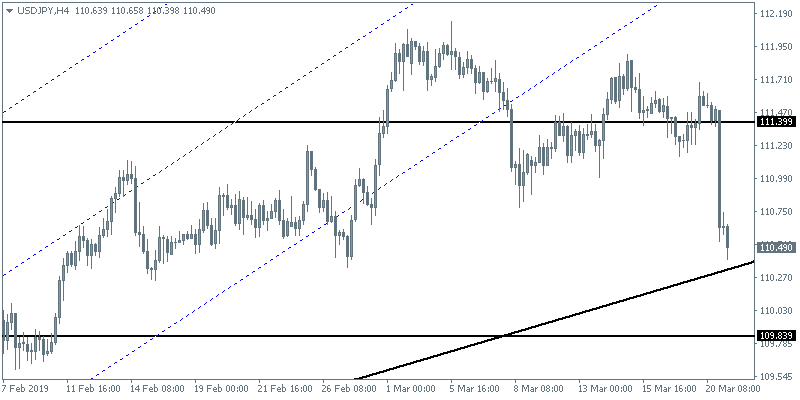
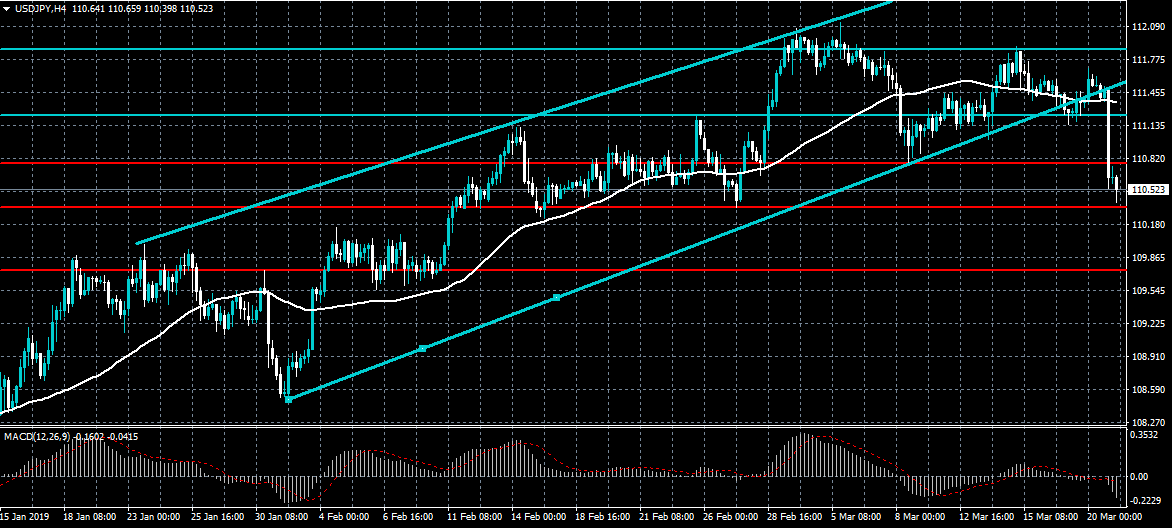
Following the breakdown of prices near 111.40 level of support/resistance, the USDJPY currency pair fell sharply. This has sent prices close to testing the rising trend line from the lows of early January this year through the end of January. We can anticipate the USDJPY to briefly breach the trend line and test the lower support at 109.84 level in the short term. But we can rule out further gains below this support for the moment.
EURUSD Reaches A 6-Week High
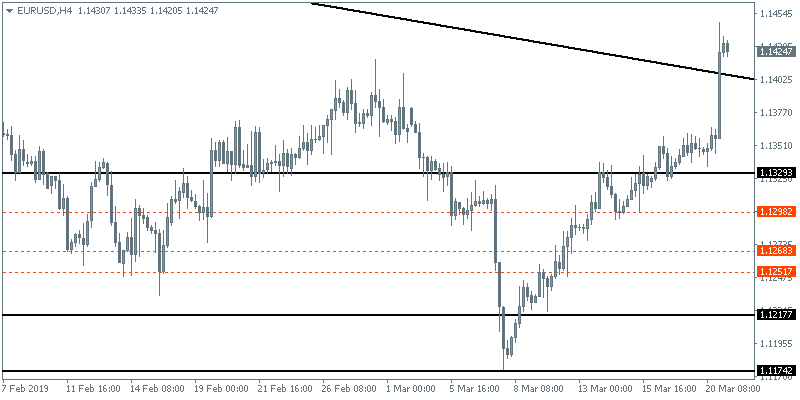
The euro tested a six-week high earlier today, adding to the 0.66% gains made by yesterday's close. Economic data from the eurozone was spare, with only the German PPI reporting coming out. Producer prices fell 0.1% missing estimates, but the news did not impact the currency at all.
Can the Euro Maintain the Gains?
The common currency broke past the major trend line in the early Asian trading session today. The break of the trend line saw price action turning a bit subdued near the top. Given the nature of the breach of the trend line, it is not quite convincing as yet. Therefore, the euro could pull back in the near term. A close below the trend line may see the EURUSD retesting 1.1394 level.
BTCUSD Testing $4,000
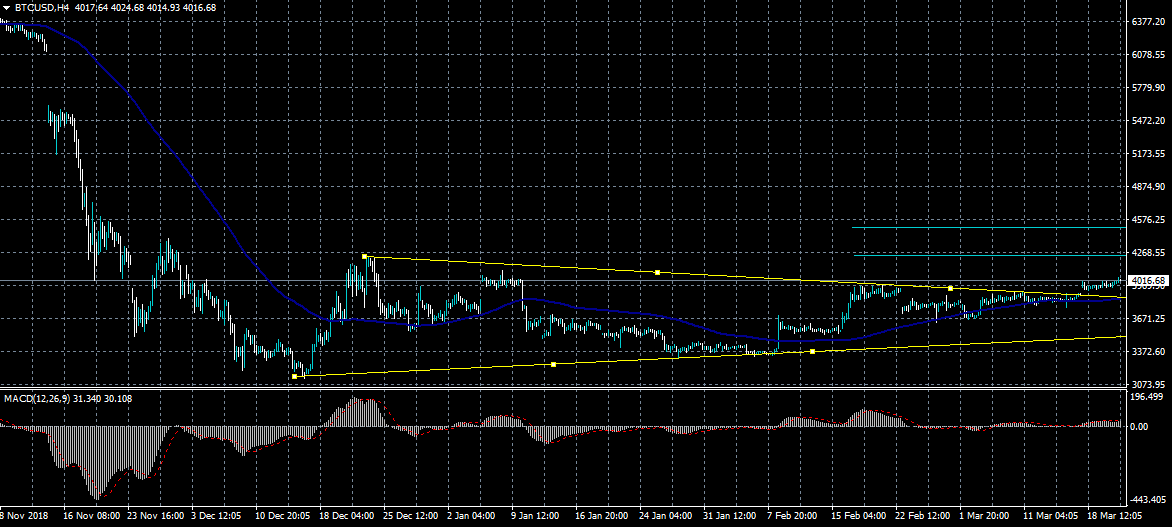
Bitcoin is testing above the $4,000 resistance level in early Thursday trade, with the number one cryptocurrency confined to its smallest two-week trading range since October 2018. Despite the narrow trading ranges, the BTCUSD pair still retains a bullish bias while trading above the symmetrical triangle pattern on the four-hour time frame. Only a sustained move below the $3,850 support level can negate the intraday bullish bias surrounding the BTCUSD pair.
The BTCUSD pair is bullish while trading above the $3,850 level, key technical resistance remains at the $4,240 and $4,400 levels.
If the BTCUSD pair moves under the $3,850 level, sellers may test towards the $3,700 and $3,630 support levels.
EURUSD 1.1500 Key Resistance
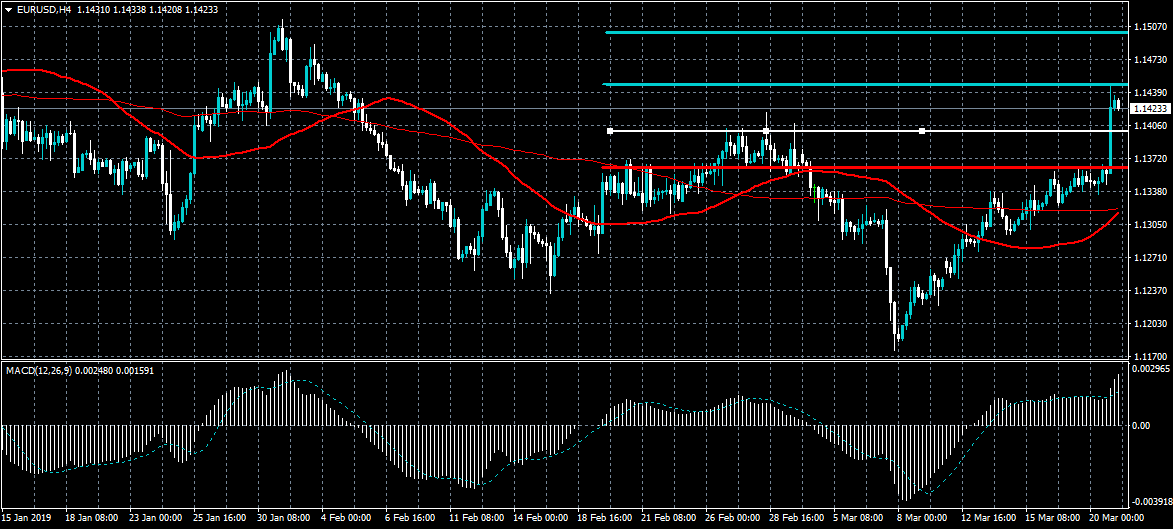
The euro has soared higher against the US dollar after the US FOMC Dot Plot showed that the central bank does not expect to hike US interest rates again this year. The EURUSD pair has a strong intraday bullish bias while trading above the 1.1400 level, key weekly resistance is now found at the 1.1500 level. Only a sustained move under the 1.1360 support level can negate the bullish sentiment surrounding the EURUSD pair.
The EURUSD pair is strongly bullish while trading above the 1.1400 level, key technical resistance is found at the 1.1450 and 1.1500 levels.
If the EURUSD pair trades below the 1.1360, sellers may test back towards the 1.1335 and 1.1290 support levels.
SNB kept interest rate at -0.75%, downgrades inflation forecast
SNB left "expansionary" monetary policy unchanged as widely expected. Sight deposit rate is held at -0.75%. Three-month Libor target range is also kept at -1.25% to -0.25%. The central bank maintained the pledge to "remain active in the foreign exchange market as necessary, while taking the overall currency situation into consideration."
While Swiss Franc has depreciated slightly since December meeting, SNB said "it is still highly valued" and the currency markets situation remain "fragile". Thus, negative interest rate and the SNB's willingness to intervene in the foreign exchange market as necessary therefore remain essential. These measures keep the attractiveness of Swiss franc investments low and reduce upward pressure on the currency.
Inflation forecast in 2019 is downgraded to 0.3%, down from December projection of 0.5%. For 2020, inflation is projected to be at 0.6%, down from 1.0%. For 2020, inflation is projected to pick up to 1.2%. The forecasts are based on keeping three-month Libor rate at -0.75% over the entire horizon. On growth, SNB expects GDP to grow by around 1.5% in 2019 as a whole.
USDJPY Under Pressure
The US dollar is under increasing downside pressure against the Japanese yen currency following yesterday’s FOMC interest rate decision. A bearish triple-top pattern formation is present, while price has also convincingly broken outside of the rising price channel on the four-hour time frame. The 110.40 and 109.80 levels offer bearish weekly targets while the USDJPY pair trades below the 110.80 level.
The USDJPY pair is bearish while trading below the 110.80 level, key support is found at the 110.40 and 109.80 levels.
If the USDJPY pair trades above the 110.80 level, buyers may test towards the 111.20 and 111.50 resistance levels.
US Dollar Falls After Dovish Fed Interest Rates Decision
The US dollar declined sharply against its peers after the Federal Reserve delivered its interest rates decision. As expected, the bank left rates unchanged at the range of 2.25% and 2.5%. The bank also issued a somewhat dovish statement, reiterating that the unlikelihood of an interest rates this year. The bank also said that it will end the reduction of its balance sheet in September. This led to a rise in US yields and for US stocks to pare previous losses. In the current program, the Fed is allowing $30 billion in its treasuries and $20 billion from its mortgage backed securities (MBS) to roll-off and investing the rest. In May, it will drop the treasuries but continue to roll off the MBS.
After rising sharply yesterday, the New Zealand dollar declined slightly during the Asian session after the country released mixed economic data. The final reading of the fourth quarter GDP numbers showed that the economy expanded by 2.3%, which was lower than the expected 2.5%. On a QoQ basis, the economy expanded by 0.6%. The GDP expenditure in the quarter rose by 0.5%, which was lower than the expected 0.6%. These numbers, while lagging, show that the country’s economy continues to face major headwinds.
The Australian dollar dropped after the release of employment numbers. The data showed that 4.6K people were employed in February, which was lower than the expected 14.8K. The participation rate rose to 65.6%, which was lower than the previous 65.7%. These numbers continue to make the case that the RBA will be forced to cut rates later this year. On a positive note, the unemployment rate declined to 4.9%, which was better than the previous 5.0%.
Today, traders will continue to focus on the Brexit drama, the interest rates decision from the Swiss National Bank (SNB), UK retail sales, the Bank of England interest rates decision, and the Philly Fed employment numbers.
EUR/USD
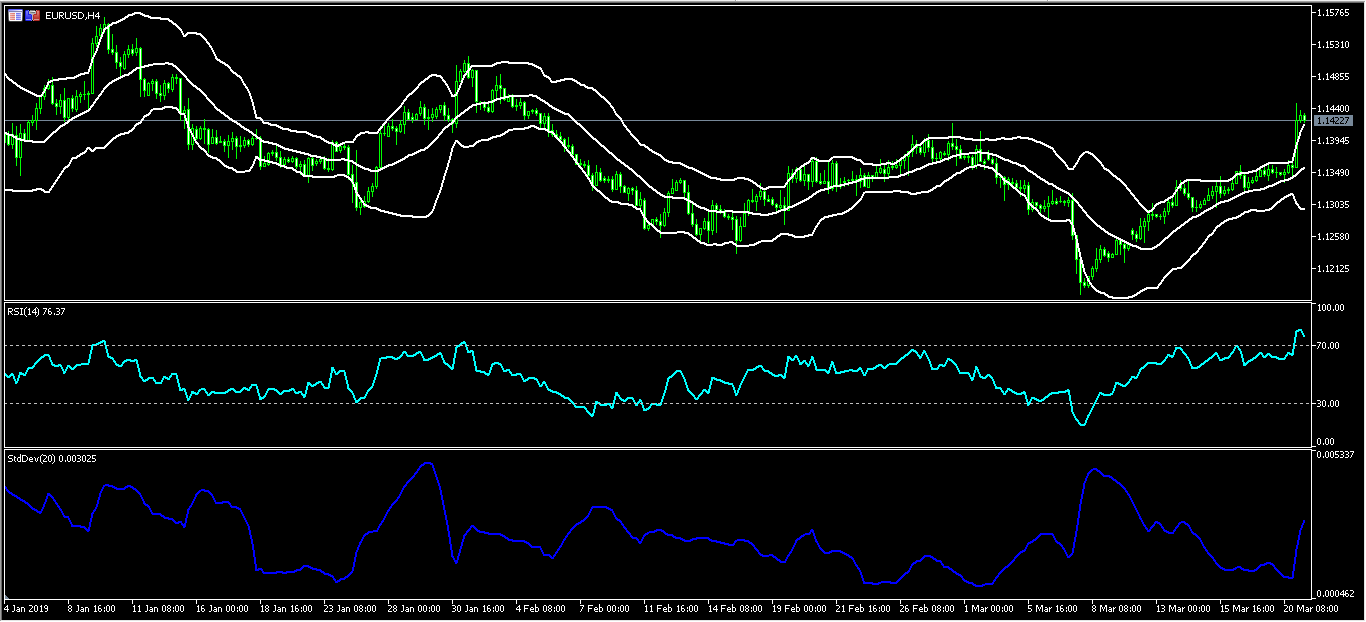
After consolidating for the entire week, the EUR/USD pair broke out in an upward direction after the Fed sounded more dovish than expected. The pair rose to a high of 1.1445, which was the highest level since February this year. The pair has been on a sustained upward trend since March 8. On the hourly chart, this price is slightly below the lower line of the Bollinger Bands while the RSI is above the overbought level of 70. The standard deviation too is moving upwards. In the near-term, the pair could pare these gains and retest the previous support of 1.1350.
USD/CHF
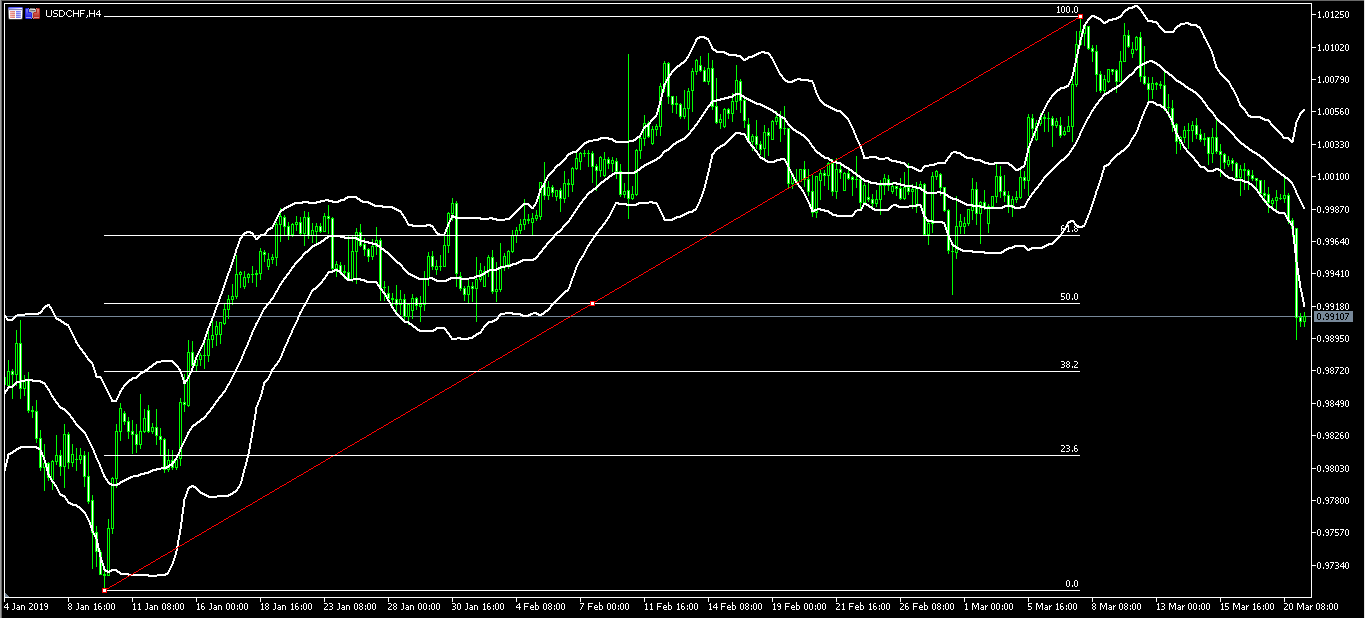
The USD/CHF pair has been declining since early this month. The pair has dropped from a high of 1.0125 and reached a low of 0.9892 after the Fed’s decision. The strengthening of the Swiss Franc will give the SNB more headaches as it releases the interest rates decision today. The current levels are along the 50% Fibonacci Retracement level. It is also along the lower line of the Bollinger Bands. The pair could make some recoveries today, although this depends on the statement by the SNB.
GBP/USD
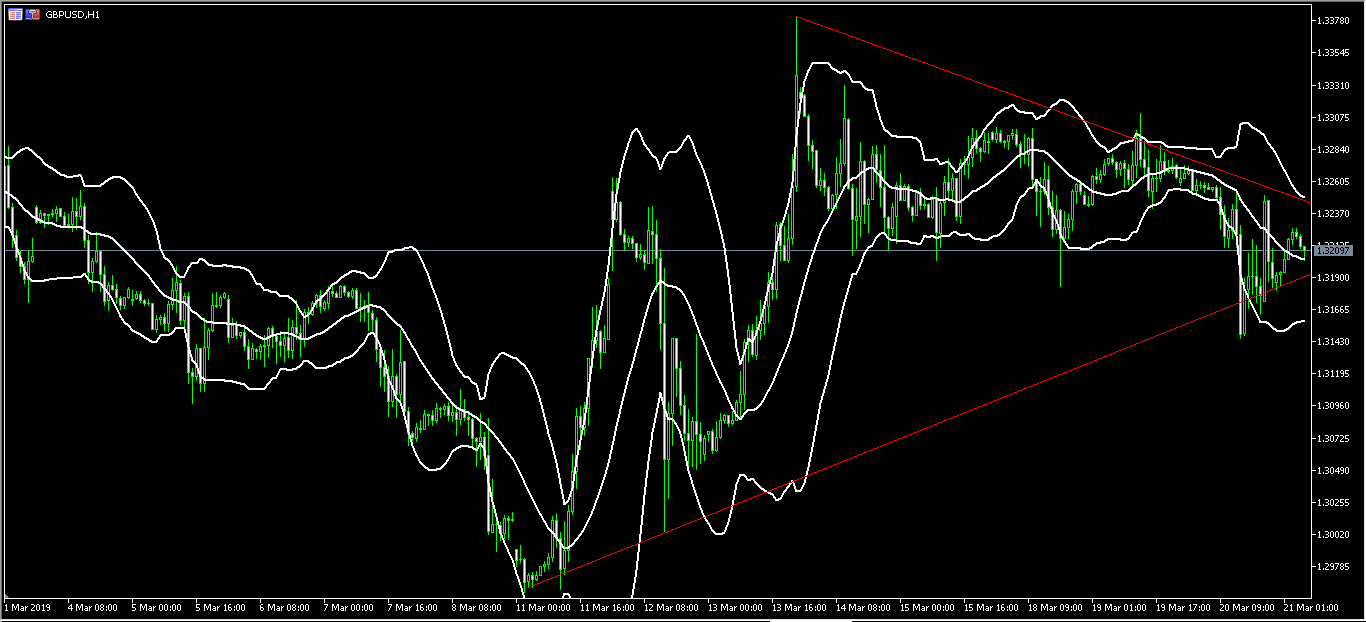
Unlike other currencies that reacted sharply after the Fed’s decision, the GBP/USD pair was somewhat volatile in overnight trading. This is because traders are still concerned about indecisions over Brexit. The pair is now trading at the 1.3206 level, which is along the middle line of the Bollinger Bands. The pair is also forming an asymmetrical triangle pattern, which could continue regardless of the statement by the BOE later today.
NZD/USD
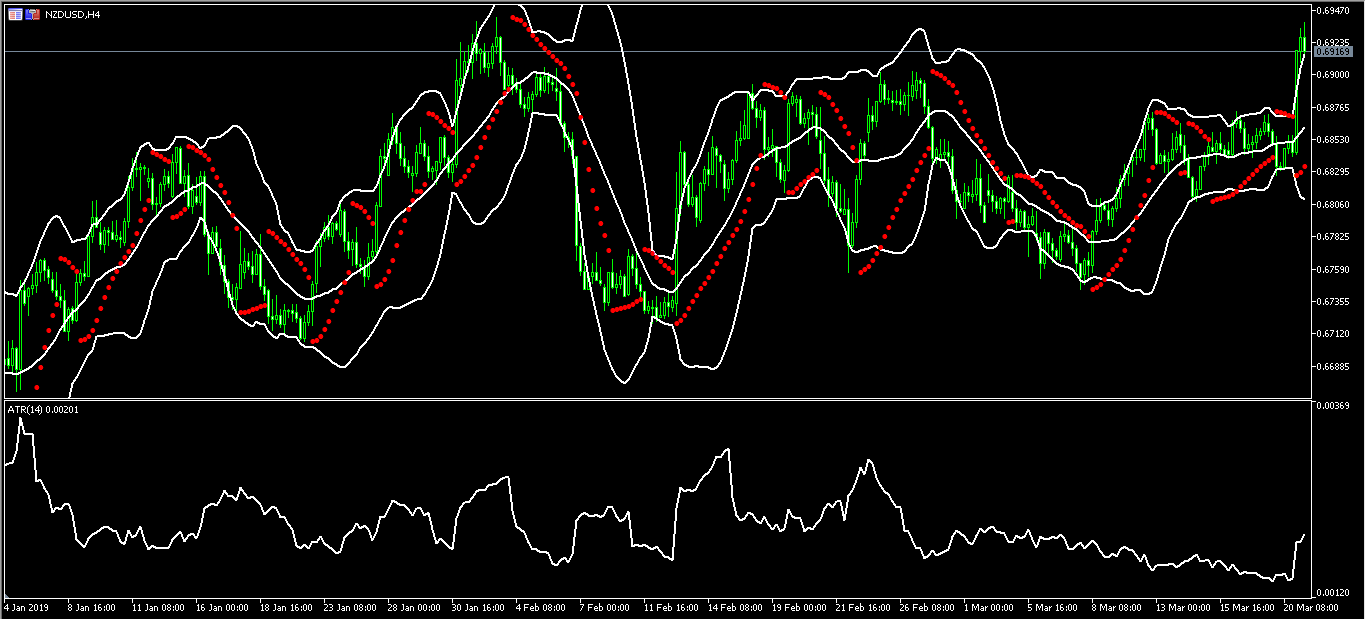
After rising sharply yesterday, the NZD/USD pair declined after the weak economic numbers. It has now declined from 0.6933 to a low of 0.6912, which is along the upper line of the Bollinger Bands. The volatility of the pair has also risen after a few days of being lower. The parabolic SAR dot is currently in the lower side. The pair could continue moving lower today.