Sample Category Title
UK retail sles rose 0.4% mom, 4.0% yoy. Ex-auo sales rose 0.2% mom, 4.0% yoy
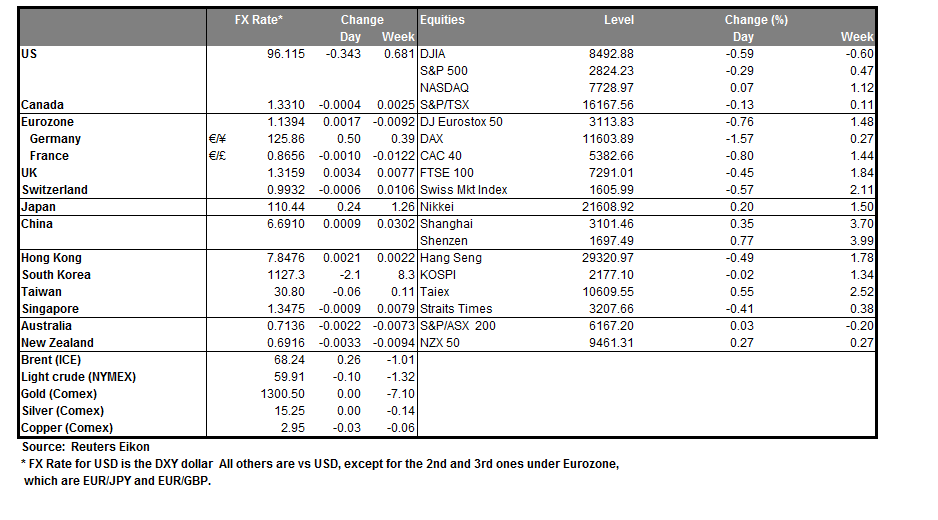
UK retail sales including auto and fuel rose 0.4% mom, 4.0% yoy in February, much better than expectation of -0.4% mom, 3.3% yoy. Retail sales excluding auto and fuel rose 0.2% mom, 4.0% yoy, also much better than expectation of -0.4% mom, 3.5% yoy.
Reactions from Sterling is muted as focuses are on BoE rate decision and EU summit in Brussels.
China MOFCOM confirms USTR Lighthizer’s visit on Mar 28-29
China Commerce Ministry spokesman Gao Feng confirmed in a regular press briefing that US delegation is traveling to Beijing next week to continue trade negotiation. Trade Representative Robert Lighthizer and Treasury Secretary Steven Mnuchin will visit China on March 28-29. After that Vice Premier Liu He will travel to the Washington in early April for more talks.
Gao also noted that the decline is import and expect during the first two months of the year was mainly due to Chinese New Year. He noted the typical pattern of "concentrated export pre CNG, concentrated import post CNY". Though, he also said trade rebounded strongly during the first half of March. And, Q1 trade will remain stability.
The Fed Decided To Remain On Hold, Probably For The Rest Of The Year
The FOMC as was widely expected decided to remain on hold at +2.5% in a unanimous decision. The USD weakened across the board, as the dot plot showed that no rate hike was to be expected in 2019, while one rate hike could be expected in 2020, dovishly surprising the market. The Fed also trimmed its forecasts for economic growth and inflation implying that the US economy could slow down even further. Fed Chair Powell though, in his press conference reiterated that the US economy is in a good place and the goal is to sustain expansion. Analysts point out that the strong majority for no rate hikes in 2019 and the overall package delivered by the Fed yesterday matched the most dovish expectations. The bank seems to be waiting to see what the economic developments will be in China and the Eurozone, as to be able to draw safer conclusions of a possible global economic slowdown and its repercussions on the US economy. In such case the US-Sino negotiations could prove of the essence for the bank's next moves. We could see the USD being more data driven in the near future, with US economics being in focus. EUR/USD rallied yesterday, breaking the 1.1390 (S1) resistance level (now turned to support) and tested the 1.1430 (R1) resistance line, stabilising during the Asian session below it. We could see the pair correcting lower today as the RSI indicator is over the reading of 70 in the 4 hour chart, implying a rather overcrowded long position for the pair. Also today's financial releases could provide some support for the USD side of the pair. Should the pair come under the selling interest of the market, we could see it aiming if not breaking the 1.1390 (S1) support line. Should on the other hand the pair find fresh buying orders along its path, we could see it breaking the 1.1430 (R1) resistance line and aiming for the 1.1480 (R2) resistance level.
Pound remains under Brexit pressure.
The pound weakened yesterday as the UK PM asked for a Brexit delay until the 30th of June. The request faced resistance from the EU and Reuters reported that an EU Commission document was stating that a possible extension could be either until May 23rd or a long delay, of a year or even more, in which case the UK would have to take part in the EU Parliament elections. Such a scenario was categorically rejected by the UK until now. The EU warned the UK that a short period extension would mean that the UK would have to pass the existing deal in order to avoid crashing out of the EU. We see the case for Theresa May trying to push the UK Parliament into a dilemma between her deal or a no Deal Brexit and should that be the case, stakes could not be higher for the pound. An EU summit will be taking place today and more clarity on the issue is to be expected. Analysts avoid taking any directional views currently, however the pound had tended to react rather positively in scenarios of a long Brexit delay in the past. Cable dropped yesterday testing the 1.3175 (S1) support line, yet failing to clearly break it and remaining above it during today's Asian session. We could see the pair maintaining a sideways movement, yet Brexit developments along with financial releases, could keep the pound under pressure, providing for some bearish tendencies for the pair today. Should the bears actually take over, we could see cable breaking the 1.3175 (S1) support line and aim for the 1.3070 (S2) support barrier. Should on the other hand the bulls take over, we could see the pair breaking the 1.3265 (R1) resistance line and aim for the 1.3350 (R2) resistance barrier.
Other economic highlights, today and early tomorrow
In today's European session we get from Switzerland SNB's interest rate decision, form Norway the Norgesbank's interest rate decision and from the UK the retail sales growth rates for February, as well as the BoE interest rate decision. In the American session we get the US the Philly Fed business index and Eurozone's preliminary Consumer Confidence indicator, both for March. During tomorrow's Asian session, we get Japan's inflation rates for February.
EUR/USD
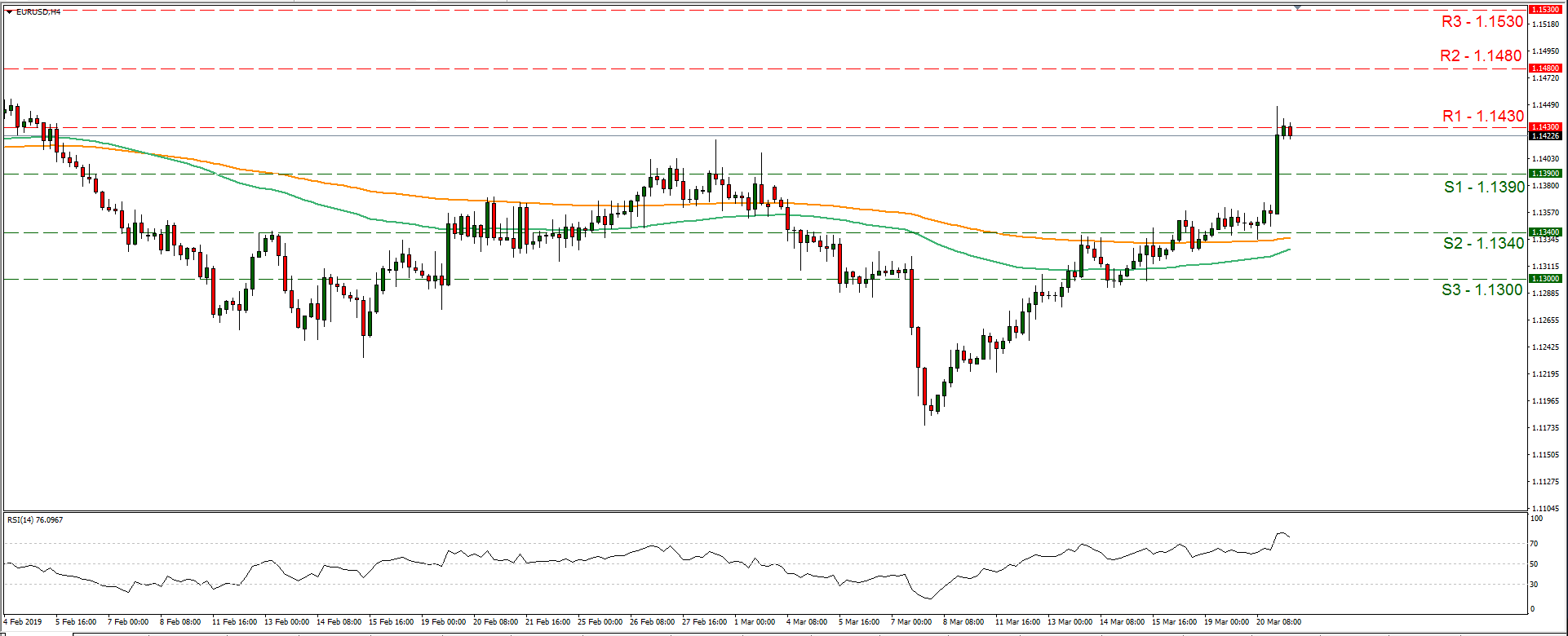
Support: 1.1390 (S1), 1.1340 (S2), 1.1300 (S3)
Resistance: 1.1430 (R1), 1.1480 (R2), 1.1530 (R3)
GBP/USD H4
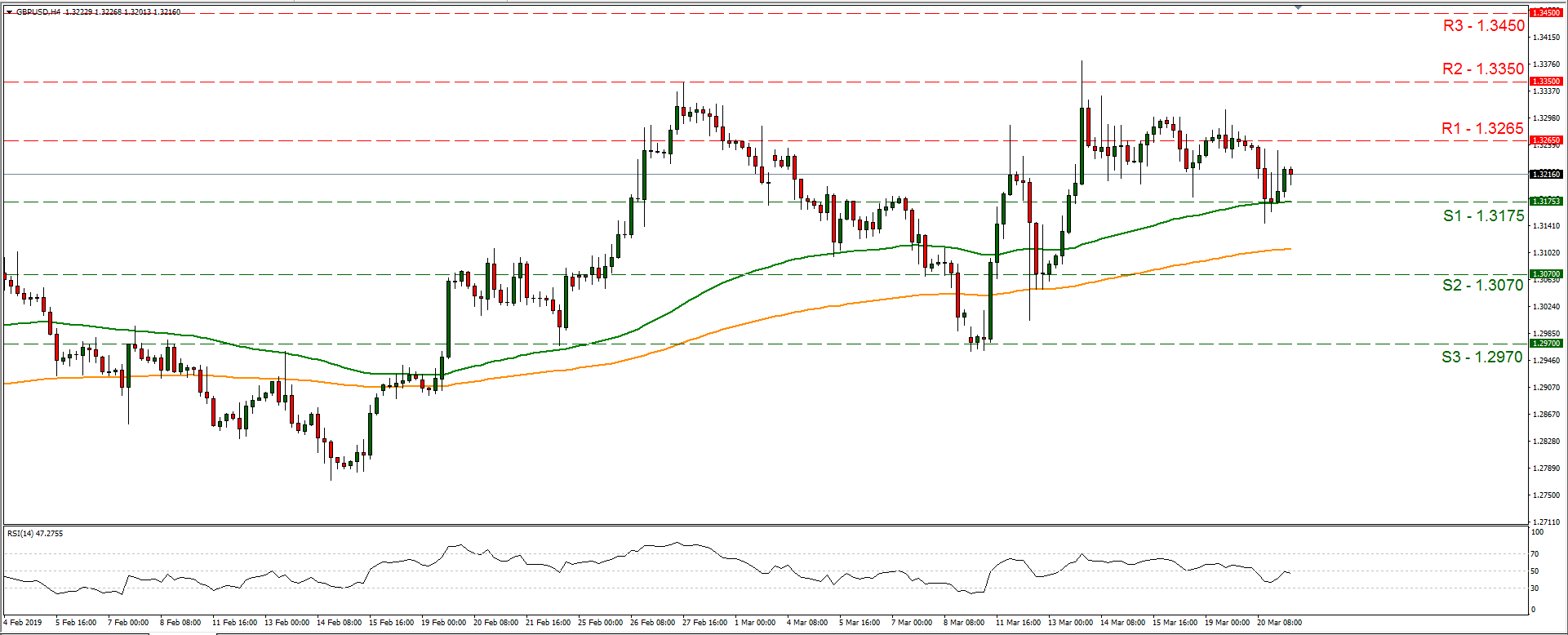
Support: 1.3175 (S1), 1.3070 (S2), 1.2970 (S3)
Resistance: 1.3265 (R1), 1.3350 (R2), 1.3450 (R3)
Sterling On The Decline Ahead Of BoE Announcement
GBP remains under pressure after volatile 24 hours
Sterling volatility has certainly picked up over the last 24 hours, with May's article 50 extension request appearing to be the trigger. While the short extension request itself came as no surprise, it seems the EUs insistence that it's tied to a deal being agreed in Parliament did cause a stir. While this kind of ultimatum may have caught some off-guard and, given the lack of consensus, led some to believe that a default no-deal has become more likely, it also creates urgency for Parliament to pick a side and do so when another vote is not an option.
Ultimately, MPs have clearly indicated that they do not support no-deal and, in the absence of incredible incompetence, it will always be possible to avoid it, especially as they retain the ability to withdraw article 50 if they so choose. What we will therefore more likely see over the next week is MPs will finally be forced to make a choice between no-deal, May's deal or a long extension with a plan on the direction of travel. Until now, this has not been the case. MPs finally have to show their hand and this will favour May. Whether it will be enough, we'll have to wait and see but as ever, I feel there's still time for one more twist, something that gets her deal over the line which would be positive for the pound.
BoE announcement interesting but will it have a big market impact?
One thing that may not rattle the pound too much today is the Bank of England meeting. It's hard to imagine the central bank is going to be too keen to overcommit to anything given the sheer amount of uncertainty that exists around Brexit. Instead I expect it to reflect on the strength and resilience of the economy, low unemployment, strong wage growth, on-target inflation and leave open the possibility of a rate hike this year in the event of a smooth Brexit.
Of course, other central banks have become more dovish recently, in the face of a weaker global economic environment, but then the UK is arguably behind the curve because of the impact of Brexit uncertainty and the economic data may warrant higher interest rates, as long as the economic threat of no-deal Brexit is avoided. With all this in mind, I think the meeting today will absolutely be interesting but may not have the pull in the markets that you would typically expect.
Fed's dovish pivot a step further than markets expected
The decision by the Fed to go all in on the dovish pivot caught markets off guard, with investors expecting a more cautious and gradual approach from a central bank that typically errs on the more hawkish side. Whether this is a sign that policy makers are genuinely concerned about the economy in 2019 or that they've finally bowed to external pressure, it's certainly a bold move following a year in which they hiked rates four times and one they may be forced to retreat back from as the year progresses.
It is consistent with market expectations for interest rates prior to the event though and has even pushed up expectations of a rate cut by next January to above 70%. Slower growth and rate cuts do not bode well for equity markets heading into an election year, a sign possibly that these higher levels of growth are not as easy to come by as Trump assumed and the big, bold stimulus packages – like the tax cuts which drove a stellar year in 2018 – do in fact have a limited life span.
Fed a bullish catalyst for Gold
The dovish surprise from the Fed hit the dollar hard overnight, with the greenback slipping to its lowest point since the start of February. The bleeding could have been worse were it not for the pound giving the greenback a good run for its money. It's not all doom and gloom for the dollar which remains within the range it's traded in since last October – albeit now towards the lower end – but the near-term could be challenging.
This has offered some welcome reprieve for gold, which typically benefits from both a weaker dollar and dovish pivots from central banks, both of which the Fed delivered last night. Gold had been struggling to gather any real upward momentum despite having risen over the last couple of weeks but yesterday's Fed shift may prove to be the catalyst it needed to propel higher. We are seeing some resistance around $1,320 which could prove to be an important level. A break above would be very bullish, with the $1,340-1,350 area being the next major resistance, while a rotation off here could signal a continuation of the correction we've see over the last month.
Fed Crashed The Dollar In Favour Of Trump
The US Federal Reserve yesterday demonstrated a sharp easing of monetary policy plans, triggering a wave of dollar sales. Despite the fact that the markets tuned in to a very mild tone of comments, the US Central Bank managed to surprise the market.
As for technical analysis, it is worth noting the DXY Dollar Index decline below the support line and the close of trading on Wednesday under MA (200), which may be a sign of the further decline. The same applies to EURUSD, which rose to 1.1447, breaking the downtrend. The unexpected easing of the Fed’s rhetoric has enough potential for the dollar to remain under pressure for several more days.
An important step was the announcement that since May, the Fed's balance sheet sales will be halved, and in September the balance will be stabilized. As a result, it should be around 3.8 trillion against peak levels near 4.5 trillion and 0.9 trillion before September 2008.
At the same time, the Fed revised its rate forecasts, suggesting that they remain at their current level throughout 2019 with only one increase in 2020, which contrasts sharply with the December forecasts, which assumed 2 increases in 2019 and another one in 2020. In October, Fed Chairman Powell warned that the rate could exceed the neutral level (estimated by the Fed near 2.75%) as part of the current policy tightening cycle, and in December the Fed adhered to this concept. But the updated forecasts turned out to be noticeably softer: the rates may be below the neutral level up to 2021, i.e. for the whole forecasted period.
Such an approach no longer resembles “patience” but seems as concessions to the President. The economic data, although showing a slowdown of growth, they still do not indicate an approaching of recession. The stock markets dynamics since the beginning of the year also shows a radical improvement of market sentiments. In addition, participants in the trade negotiations on the part of China and the United States are noting progress.
Nevertheless, the Fed continues to soften its rhetoric under pressure of Trump and market participants. Earlier, we noted that Fed Watch points to a 38% chance of lowering rates in the coming year, which sharply contrasted with the forecasts of the regulator. If the Fed intended to narrow the gap between market forecasts and its own, then it did not succeed.
From now on, markets and Trump are unlikely to loosen their grip. Futures on the rate showed a jump in expectations of the Fed rate cut in 2019 to 50%. The US dollar lost 0.8% in response to comments, to the January lows.
Dollar Reels As Fed Abandons Hikes, BoE Decides
- Fed 'dot plot' shows no hikes in 2019, dollar crumbles
- Sterling dives as May requests short extension; BoE meeting and EU summit today
- SNB remains on hold, reiterates readiness to intervene in FX market
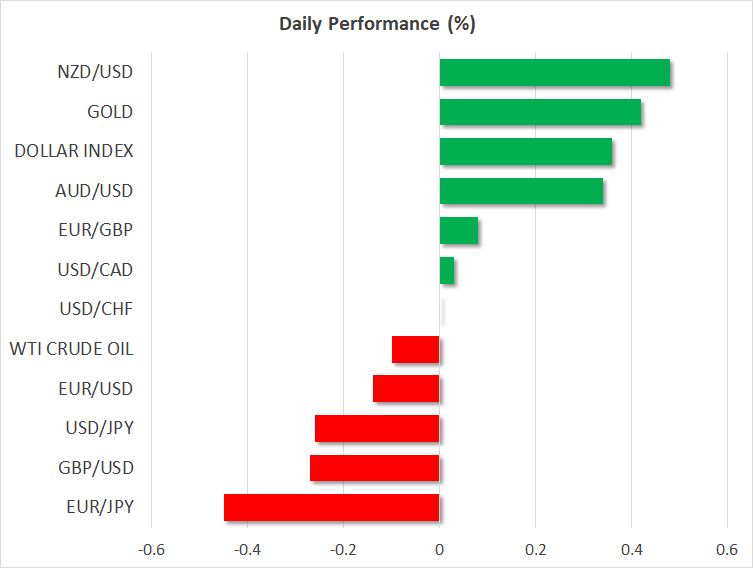
Dollar plunges as Fed abandons rate hike plans – easing bets grow
The Fed meeting wasn't short of surprises. There was no change in policy, as expected, but the officials revised down their rate projections in the famous 'dot plot' quite significantly, to the point that they no longer project any rate increases in 2019, and just one in 2020. This was quite a pivot, considering that the previous 'dots' back in December still pointed to two rate hikes for this year. Policymakers also confirmed that the balance sheet reduction will be halted in September.
In the markets, the result was a plunge in the dollar, which fell in lockstep with US Treasury yields. Judging by the magnitude of the reaction, several investors were likely caught off guard by the Fed's overly dovish signals, igniting a major repricing in the futures market, where the implied probability for a rate cut by December soared further. The message was that the Fed is unlikely to raise rates any more and is comfortable staying on hold as far as the eye can see – which traders interpreted as giving the 'green light' for rate cuts before long, should the economy falter.
US stock indices got a lift by the Fed's cautious tone as financial conditions loosened, but were unable to hold onto their gains and actually closed in the red, with some remarks by Trump that he may keep tariffs on China for 'a long time' likely tempering sentiment.
Pound dives as May requests short extension, BoE meeting in scope
The dollar wasn't the worst performer in the session though, as the British pound fell even more severely, following headlines that PM May asked the EU for a short Brexit extension until late June. However, reports suggest the EU isn't comfortable with that, and prefers either a shorter extension until late-May, or a much longer one of nearly 2 years. The risk is that if the UK gets a short delay, but PM May still can't convince Parliament to approve her deal, then the odds of a no-deal Brexit could soar as another delay after June may be impossible if the UK doesn't participate in the upcoming EU elections.
Today will mark another hectic session for sterling, as the schedule includes both an EU summit where the leaders will respond to May's extension request, and a Bank of England (BoE) policy decision at 12:00 GMT. On the latter, no action is expected and admittedly, the Bank has its hands tied by Brexit uncertainties. Growth has clearly slowed but policymakers have been unwilling to adopt a more dovish tone, reasoning that an 'orderly' Brexit outcome can dispel much of the uncertainty by itself and hence kickstart growth without the BoE's intervention. Given that Brexit remains in limbo, the Bank is unlikely to provide any strong signals today, but if there is any change in tone, it may be towards a more cautious-sounding bias.
UK retail sales for February will be released a few hours ahead of the policy decision.
SNB retains an ultra-dovish stance
The Swiss National Bank (SNB) kept its policy rates unchanged at the lowest level globally earlier today, in line with expectations. The Bank revised down its economic forecasts, reiterated that the franc remains 'highly valued', and that it will continue to intervene in the FX market to weaken it, if needed. Given the absence of any fresh signals, there was no major reaction in the safe-haven currency, which will likely be driven mainly by shifts in risk appetite going forward.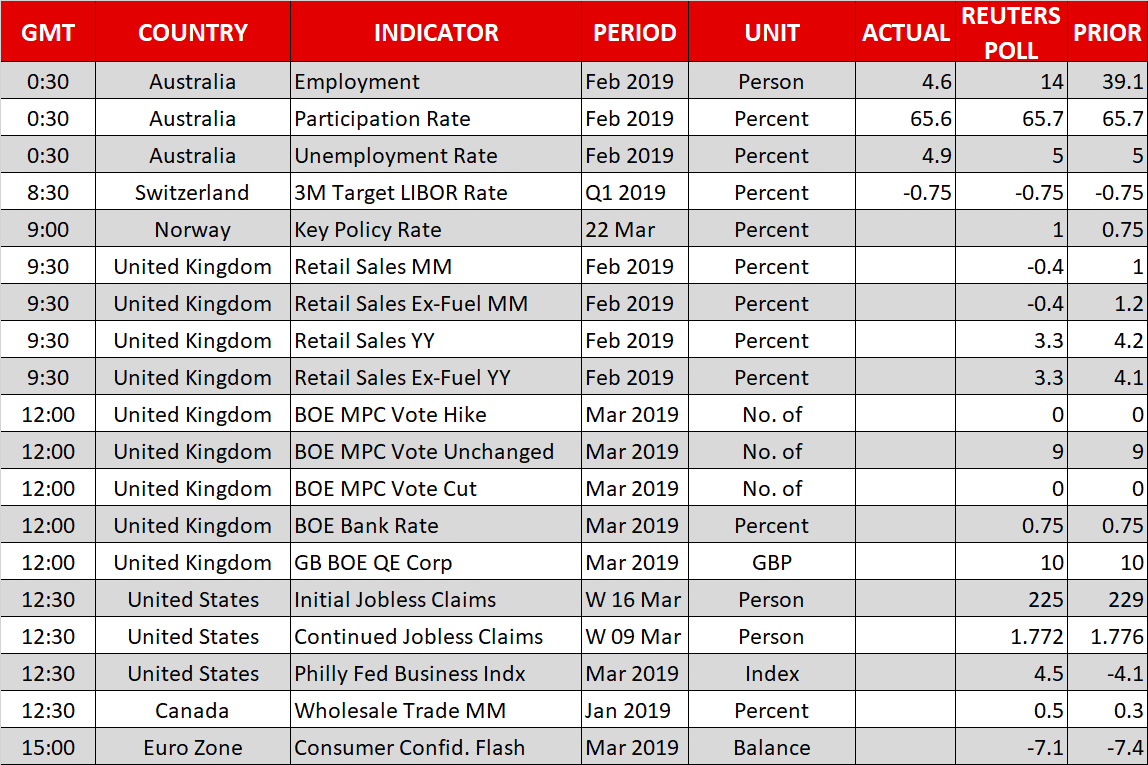
GBP/JPY Daily Outlook
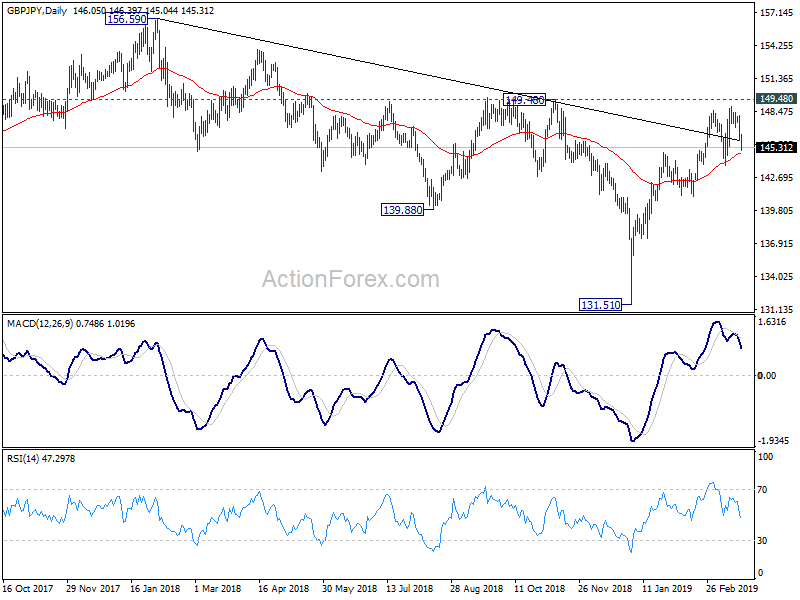
Daily Pivots: (S1) 145.25; (P) 146.66; (R1) 147.45; More...
GBP/JPY 's fall from 148.87 extends lower today but it's still staying above 143.72 support. Intraday bias remains neutral first. On the upside, decisive break of 149.48 key resistance will carry larger bullish implication and target 156.58 resistance next. On the downside, though, break of 143.72 support will indicate near term reversal and turn outlook bearish for 141.00 support.
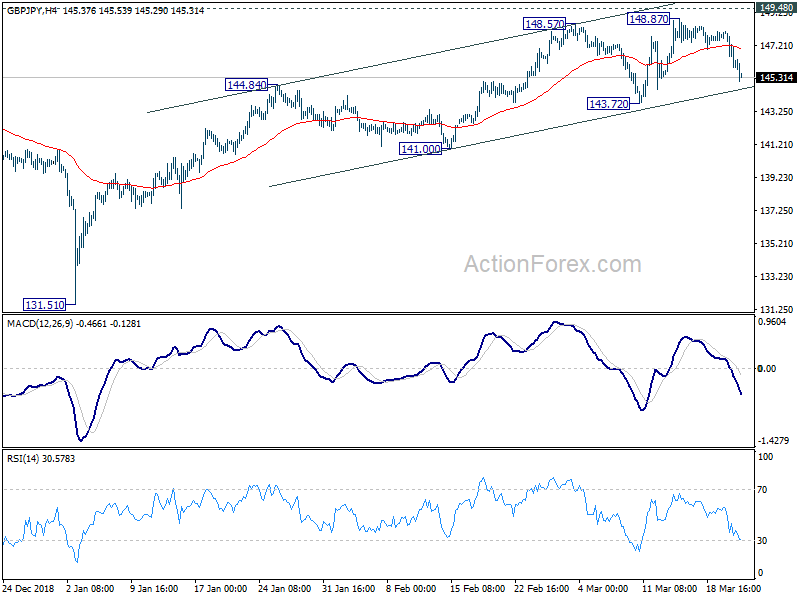
In the bigger picture, the strong rebound from 131.51 suggests that medium term fall from 156.59 (2018 high) has completed already. The corrective structure of such decline in turn argues that it's the second leg of the corrective pattern from 122.36 (2016 low). And this pattern is starting the third leg. On the upside, decisive break of 149.48 will pave the way to 156.59 resistance and above. However, firm break of 141.00 support will dampen this view and turn focus back to 131.51 low instead.
EUR/JPY Daily Outlook
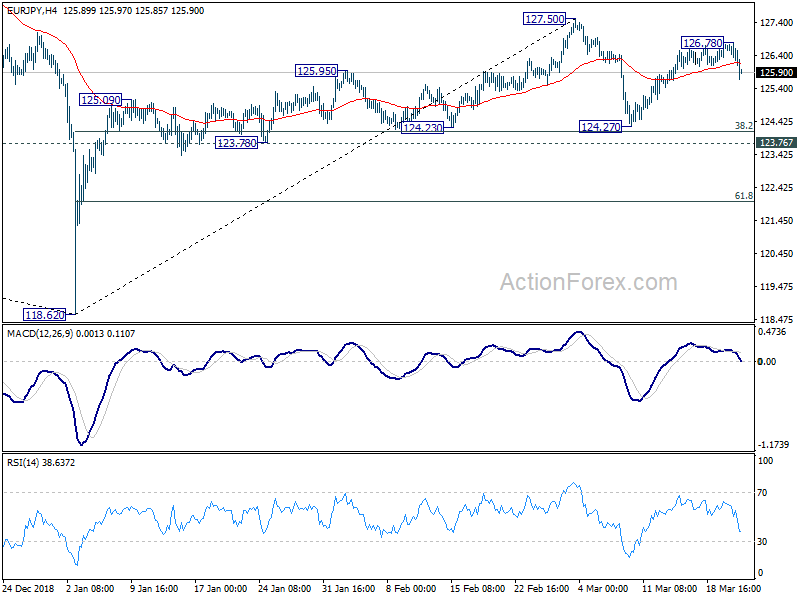
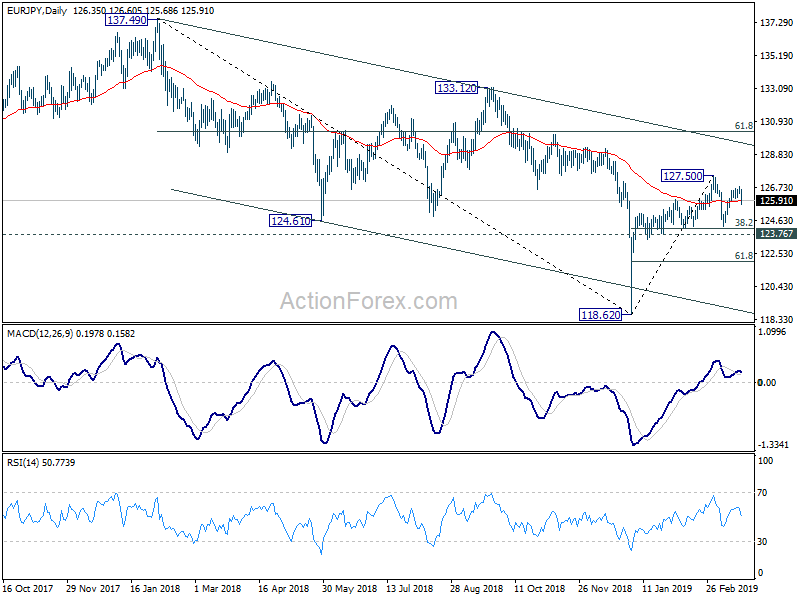
Daily Pivots: (S1) 126.22; (P) 126.50; (R1) 126.66; More....
EUR/JPY's sharp fall today suggests that rebound from 124.27 has completed at 126.78. Deeper decline might now be seen as consolidation from 127.50 extends. But after all, near term outlook will remain bullish as long as 124.23 cluster support (38.2% retracement of 118.62 to 127.50 at 124.10) holds. On the upside, decisive break of 127.50 will resume whole rise from 118.62 and target 129.50 resistance next.
In the bigger picture, current development argues that medium term decline from 137.49 (2018 high) has completed with three waves down to 118.62 already. Decisive break of 133.12 resistance will confirm this bullish case. And whole up trend from 109.03 (2016 low) might resume through 137.49 in that case. On the downside, break of 124.23 support will invalidate this case. And in such case, the down trend from 137.49 could possibly resume through 118.62.
EUR/GBP Daily Outlook
Daily Pivots: (S1) 0.8578; (P) 0.8623; (R1) 0.8695; More...
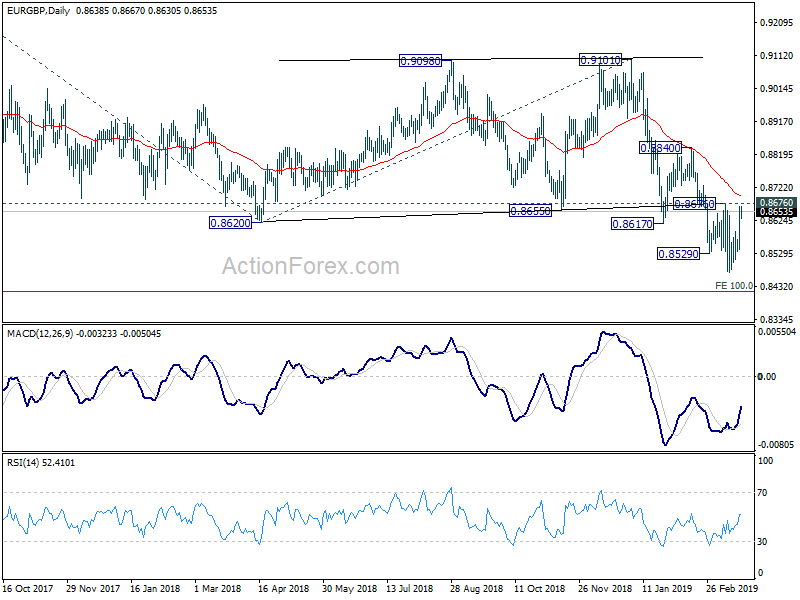
EUR/GBP is staying in range of 0.8474/8676 and intraday bias remains neutral first. With 0.8676 resistance intact, further decline is expected. Firm break of 0.8474 will resume larger down trend to 0.8416 long term projection next. However, on the upside, decisive break of 0.8676 will indicate short term reversal and bring further rise to 0.8840 resistance.
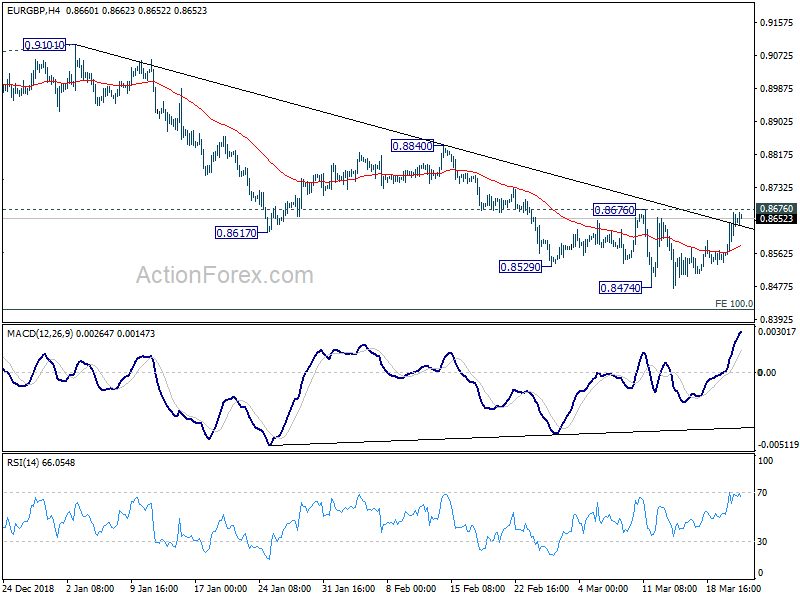
In the bigger picture, EUR/GBP is seen as staying in long term range pattern started at 0.9304 (2016 high). Current fall from 0.9305 (2017 high), is a falling leg inside the pattern. Such decline is now targeting 100% projection of 0.9305 to 0.8620 from 0.9101 at 0.8416 and possibly below. But for now, we'd expect strong support around 0.8312 support to contain downside and bring rebound.
EUR/AUD Daily Outlook
Daily Pivots: (S1) 1.5975; (P) 1.6026; (R1) 1.6086; More...
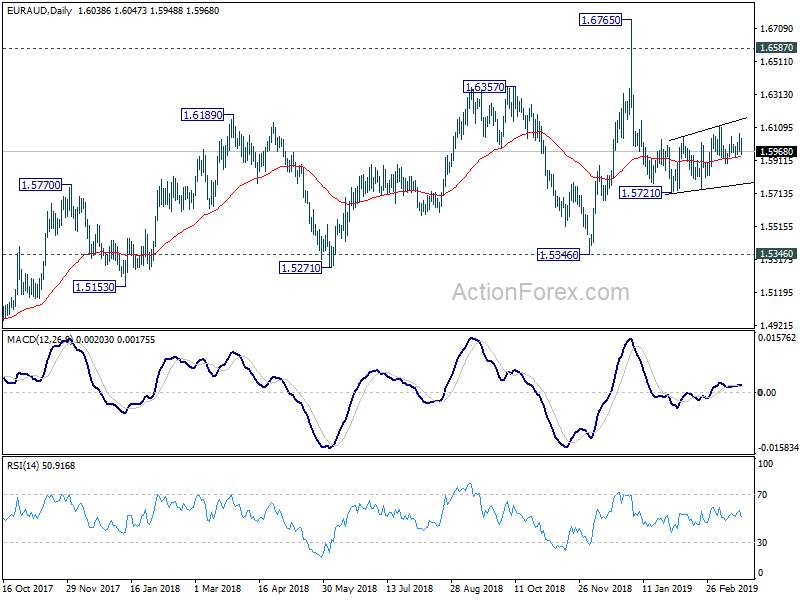
No change in EUR/AUD's outlook as it's staying in consolidation from 1.5721. Intraday bias remains neutral first. On the downside, break of 1.5721 low will resume the decline from 1.6765 and target 1.5346 support. On the upside, above 1.6122 will resume the corrective rise from 1.5721 instead.
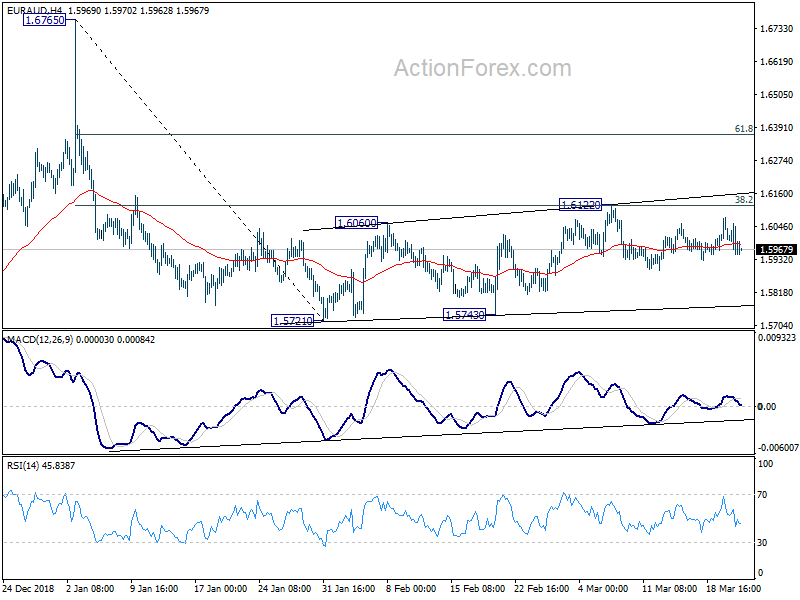
In the bigger picture, as long as 1.5346 support holds, outlook will remain bullish. Uptrend from 1.1602 (2012 low) is expected to resume sooner or later. Break of 1.6765 will target 61.8% retracement of 2.1127 (2008 high) to 1.1602 at 1.7488 next. However, firm break of 1.5346 key support will indicate trend reversal, with bearish divergence condition in weekly MACD, and turn outlook bearish.