

Sample Category Title
Into US session: Sterling suffers selloff as May arrives in Brussels, BoE and SNB yawned
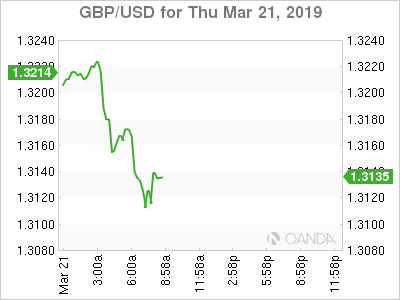
Entering into US session, Sterling suffering another round of selloff as UK Prime Minister Theresa May arrives in Brussels for the EU summit. For now, it's uncertainty how she could get pass Commons Speaker Bercow to hold another meaningful vote for her Brexit deal, get the deal approved, and the secure short Article 50 extension within a week before March 29. Stronger than expected UK retail sales look irrelevant for traders for now. BoE and SNB rate decisions were also largely ignored.
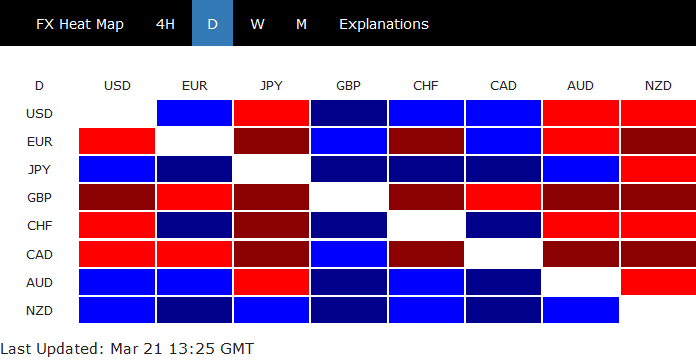
Staying in the currency markets, Canadian Dollar is the second weakest despite resilient strength in oil price. Euro is the third weakest, as dragged down very weak German treasury yield. 10-year bund yield is down -0.039 at 0.047, while was was at high as 0.12 just two day ago. The sharp fall in German yield also helps Dollar recover much of the post FOMC losses. New Zealand Dollar is the strongest one for today so far, followed by Yen and then Australian.
In US:
- DOW opens slightly lower, down -0.13%.
- S&P 50 is down -0.13%.
- NASDAQ is down -0.04%.
In Europe, currently:
- FTSE is up 0.23%.
- DAX is down -0.92%.
- CAC is down -0.43%.
- German 10-year yield is down -0.037at 0.047.
Earlier in Asia:
- Japan was on holiday.
- Hong Kong HSI dropped -0.85%.
- China Shanghai SSE rose 0.35%.
- Singapore Strait Times rose 0.19%.
UK May in Brussels, emphasized Brexit is decision of the people
Arriving at the EU summit in Brussels, UK Prime Minister Theresa May repeated that Brexit delay is a "matter of personal regret". However, "a short extension would give parliament the time to make a final choice that delivers on the result of the referendum." Also, she emphasized again: "What matters is that we recognise that Brexit is the decision of the British people. We need to deliver on that. We are nearly three years on from the original vote. It is now the time for parliament to decide."
Earlier today, German Chancellor Angela Merkel echoed the unified message from EU official regarding Article 50 extensions. She said: "There was a request from Theresa May] to delay the exit date to June 30. The leaders of the EU27 will intensively discuss this request. In principle, we can meet this request if we have a positive vote in the British parliament next week about the exit document.
US initial jobless claims dropped -9k to 221k, Philly Fed manufacturing outlook rose to 13.7
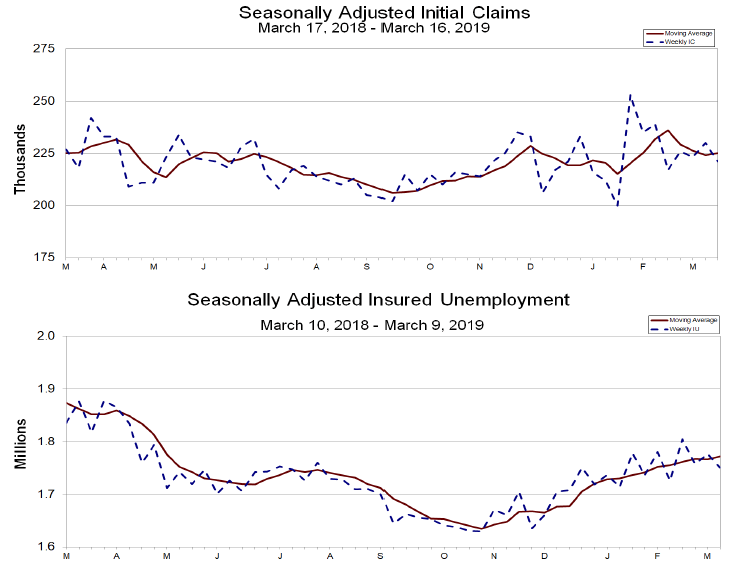
US initial jobless claims dropped -9k to 221k in the week ending March 16, better than expectation of 226k. Four-week moving average of initial claims rose 1k to 225k. Continuing claims dropped -17k to 1.75M in the week ending March 9. Fours week moving average of continuing claims rose 6k to 1.773M.
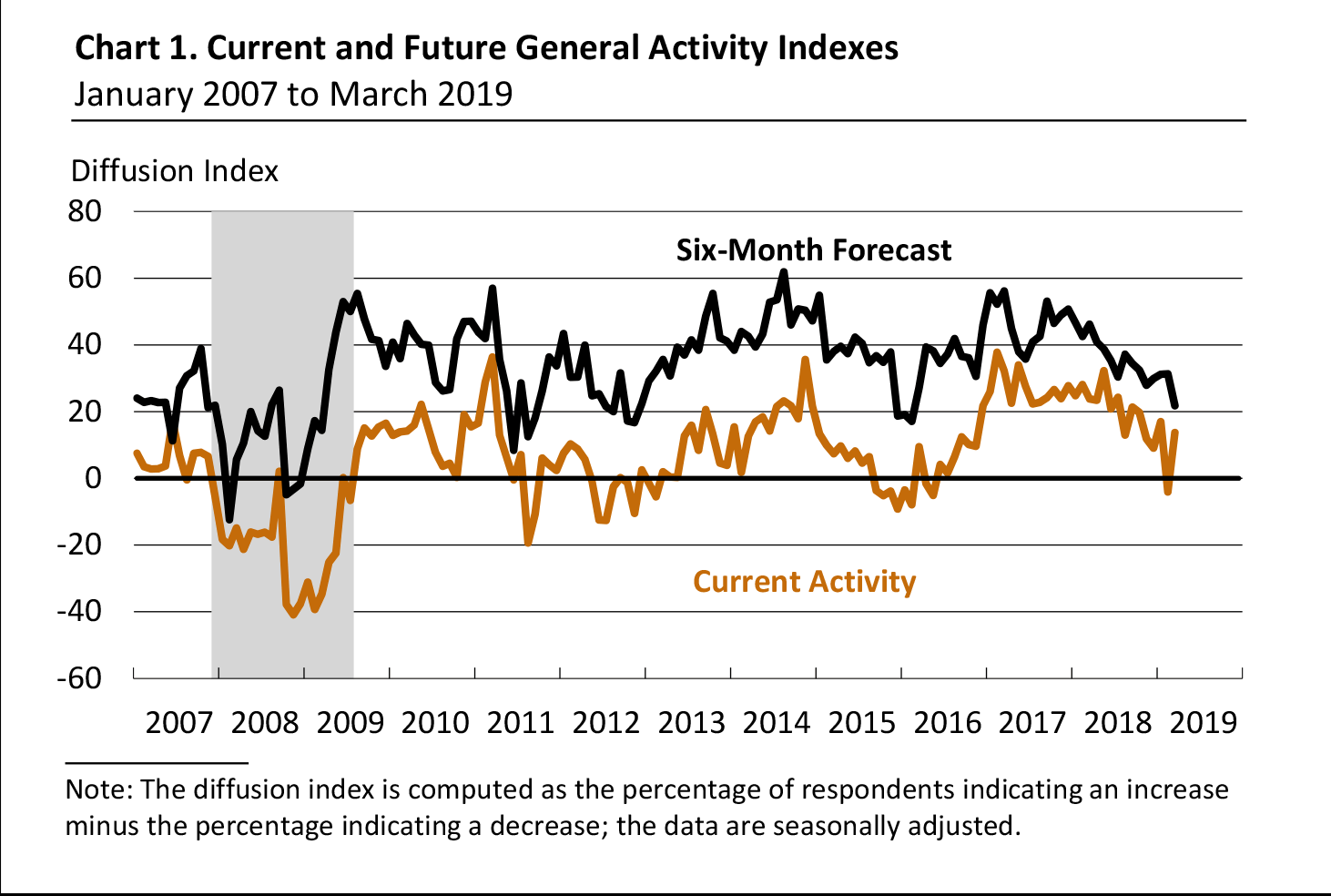
Philadelphia Manufacturing Business Outlook jumped to 13.7 in March, up from -4.1 and beat expectation of 5. Prior month's figure was the first negative reading in almost three news. For this month, new orders rose modestly from -2.4 to 1.9. Shipments index jumped 25 pts to 20.0.
Dollar Mixed as Fed Rally Fizzles
- Fed – Markets are still processing Fed decision
- EUR – Euro falls as German bunds target zero
- BOE – Unchanged on Interest Rate (vote 9-0)
- Oil – Softer on profit-taking
- Gold – Support from dovish Fed, Brexit and Trade risks
Fed
Financial markets are still processing the Fed’s decision to remove all rate hike expectations for 2019. Government yields across the board are all sharply lower, while the dollar traded mixed and stocks retraced some of yesterday’s gains.
Economists will now debate over the coming months whether this dovish commitment is a policy mistake. The Fed’s concern for the economy likely suggests they will be overly cautious reversing course back to a tightening bias even if we see a strong second quarter of data.
US data this morning was strong and will like fuel the fire that is questioning the Fed’s dovish commitment. Jobless claims came in better than expected and the Philadelphia Fed business outlook rebounded sharply
EUR
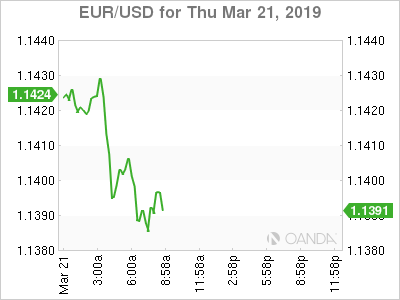
The euro is softer as the dollar mustered up a rebound following yesterday’s FOMC dovish commitment that sent the dollar flailing. The low interest rate environment that was supported by yesterday’s Fed decision will also drive Bund yields down and possibly back to zero. The 10-year Bund yields fell 4.5 basis points to 0.035%, the lowest level since Autumn of 2016.
Key manufacturing data will be released tomorrow, and expectations are for both Germany and the euro zone to rebound. Improving economic data is what will be needed to help take the euro out of its stubborn 1.12 to 1.16 range.
BOE
The Bank of England rate decision went as planned with a unanimous vote on maintaining the Bank Rate at 0.75%, Corporate Bond Target at £10 billion and the Asset Purchase Target at £435 billion. The BOE is pretty much on hold until we get Brexit clarity. They signaled that monetary policy is dependant on whatever form Brexit takes. The British pound slightly came off the session lows following the decision.
Financial markets are no longer as optimistic as they were that the next move will be a rate rise from the BOE. Dwindling expectations on a BOE rate rise are stemming from a global low interest rate environment.
Oil
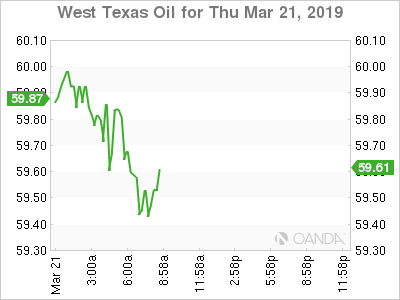
Yesterday’s rise with crude prices was supported by the falling dollar and the biggest plunge in weekly crude inventory data since July. Today’s pullback with oil prices is more of a profit-taking move than anything else. The tentative rise above $60 a barrel signals that we many longer be in an oversupplied market. Oil may have room for one last major push higher, but with US production poised to keep taking production to fresh record levels, we could see prices play ping-pong over the coming months.
Gold
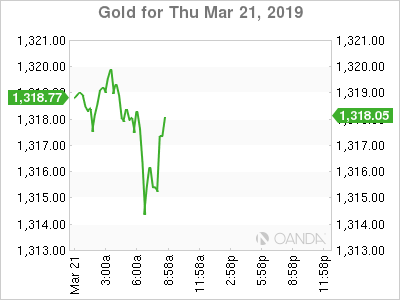
The precious metal is rising for a fifth consecutive day and is benefiting from the very dovish Fed statement delivered yesterday. Gold may continue to have a positive backdrop as two major headwinds to the global economy appear to have substantial updates next week. The Brexit date is just over a week away and it is expected next week will be pivotal and that could be uncertainty should persist to the very end. Trade talks between China and the US enter a high gear next week when Mnuchin and Lighthizer go to Beijing, so it would be unexpected to see a breakthrough before then.
Canadian Dollar Unable to Gain Ground after Dovish Fed
The Canadian dollar has edged lower on Thursday, erasing the gains seen a day earlier. Currently, USD/CAD is trading at 1.3336, up 0.23% on the day. On the release front, Canada releases ADP nonfarm payrolls. In the U.S., the Philly Fed Manufacturing Index is expected to rebound with a gain of 4.6, after a rare decline in January. Unemployment claims are projected to dip to 226 thousand. On Friday, Canada releases CPI and retail sales data, so traders should be prepared for movement from USD/CAD.
The Federal Reserve has been in dovish mode since January, but the pessimistic stance at the Wednesday policy meeting was a surprise. The Fed’s rate outlook (dot plot), which is released each quarter, showed that a majority of FOMC members expect no rate hikes in 2019. This was in sharp contrast to the previous quarter’s forecast, in which the FOMC projected two hikes this year.
The rate statement was markedly dovish, stating that economic activity “has slowed”. Policy makers singled out slower growth in household spending and business investment and noted that inflation has decreased due to lower energy prices. The Fed also announced that it would stop reducing its balance sheet by $50 billion a month. This move is a loosening of policy and is intended to stimulate the economy. The new Fed forecast projects GDP growth of 2.1%, down from 2.3% in December.
The Bank of Canada held the benchmark rate at 1.75% at its last meeting, but the bank’s stance has become more dovish in response to the economic downturn, which is deeper than policymakers estimated. The most recent rate statement noted that the economy could continue to require stimulus and said there was “increased uncertainty” regarding the timing of future rate hikes. If economic conditions remain soft, the BoC may have to consider a rate cut to stimulate growth. Weak oil prices and the global trade war have hurt the Canadian economy and dampened the critical export sector, and the Canadian dollar, which is down 1.2% in March, could face further headwinds.
BoE kept interest rate at 0.75%, economic projections appear on track
BoE kept Bank Rate at 0.75% and asset purchase target at GBP 435B as widely expected. Both decisions were made by unanimous 9-0 vote. The central bank noted that economic data has been mixed since last meeting, but February Inflation Report projections "appear on track".
BoE also noted that shifting expectations about the potential nature and timing Brexit have continued to generate volatility in UK asset prices, particularly the sterling exchange rate. Uncertainties also continue to weigh on confidence and short-term economic activity, notably business investment. Employment growth has been strong and indicators of consumer spending point to ongoing modest growth.
Again, BoE noted that the outlook depend significantly on Brexit. And, the policy response to Brexit "will not be automatic and could be in either direction.
Full statement below.
Bank Rate maintained at 0.75%
Our Monetary Policy Committee has voted unanimously to maintain Bank Rate at 0.75%. The committee also voted unanimously to maintain the stock of corporate bond purchases and UK government bond purchases.
The Bank of England's Monetary Policy Committee (MPC) sets monetary policy to meet the 2% inflation target, and in a way that helps to sustain growth and employment. At its meeting ending on 20 March 2019, the MPC voted unanimously to maintain Bank Rate at 0.75%.
The Committee voted unanimously to maintain the stock of sterling non-financial investment-grade corporate bond purchases, financed by the issuance of central bank reserves, at £10 billion. The Committee also voted unanimously to maintain the stock of UK government bond purchases, financed by the issuance of central bank reserves, at £435 billion.
Since the Committee's previous meeting, the news in economic data has been mixed, but the MPC's February Inflation Report projections appear on track. In those projections, a weaker near-term outlook was expected to lead to a small margin of slack opening up this year. Thereafter, demand growth exceeded the subdued pace of supply growth and excess demand built over the second half of the forecast period.
The broad-based softening in global GDP and trade growth has continued. Global financial conditions have eased, in part supported by announcements of more accommodative policies in some major economies.
Shifting expectations about the potential nature and timing of the United Kingdom's withdrawal from the European Union have continued to generate volatility in UK asset prices, particularly the sterling exchange rate. Brexit uncertainties also continue to weigh on confidence and short-term economic activity, notably business investment. Employment growth has been strong, although survey indicators suggest that the outlook has softened. Most indicators of consumer spending are consistent with ongoing modest growth. As the Committee has previously noted, short-term economic data may provide less of a signal than usual about the medium-term growth outlook.
CPI inflation rose slightly to 1.9% in February and is expected to remain close to the 2% target over coming months. The labour market remains tight and annual pay growth, having risen through 2018, has remained around 3½%. Given continuing weakness in productivity growth, growth in unit wage costs has also risen, although other indicators of domestically generated inflation have remained modest.
The Committee's February Inflation Report projections were conditioned on a smooth adjustment to the average of a range of possible outcomes for the United Kingdom's eventual trading relationship with the European Union. The Committee continues to judge that, were the economy to develop broadly in line with those projections, an ongoing tightening of monetary policy over the forecast period, at a gradual pace and to a limited extent, would be appropriate to return inflation sustainably to the 2% target at a conventional horizon.
The economic outlook will continue to depend significantly on the nature and timing of EU withdrawal, in particular: the new trading arrangements between the European Union and the United Kingdom; whether the transition to them is abrupt or smooth; and how households, businesses and financial markets respond. The appropriate path of monetary policy will depend on the balance of these effects on demand, supply and the exchange rate. The monetary policy response to Brexit, whatever form it takes, will not be automatic and could be in either direction. The MPC judges at this month's meeting that the current stance of monetary policy is appropriate. The Committee will always act to achieve the 2% inflation target.
(BOE) Bank Rate maintained at 0.75%
Our Monetary Policy Committee has voted unanimously to maintain Bank Rate at 0.75%. The committee also voted unanimously to maintain the stock of corporate bond purchases and UK government bond purchases.
The Bank of England's Monetary Policy Committee (MPC) sets monetary policy to meet the 2% inflation target, and in a way that helps to sustain growth and employment. At its meeting ending on 20 March 2019, the MPC voted unanimously to maintain Bank Rate at 0.75%.
The Committee voted unanimously to maintain the stock of sterling non-financial investment-grade corporate bond purchases, financed by the issuance of central bank reserves, at £10 billion. The Committee also voted unanimously to maintain the stock of UK government bond purchases, financed by the issuance of central bank reserves, at £435 billion.
Since the Committee's previous meeting, the news in economic data has been mixed, but the MPC's February Inflation Report projections appear on track. In those projections, a weaker near-term outlook was expected to lead to a small margin of slack opening up this year. Thereafter, demand growth exceeded the subdued pace of supply growth and excess demand built over the second half of the forecast period.
The broad-based softening in global GDP and trade growth has continued. Global financial conditions have eased, in part supported by announcements of more accommodative policies in some major economies.
Shifting expectations about the potential nature and timing of the United Kingdom's withdrawal from the European Union have continued to generate volatility in UK asset prices, particularly the sterling exchange rate. Brexit uncertainties also continue to weigh on confidence and short-term economic activity, notably business investment. Employment growth has been strong, although survey indicators suggest that the outlook has softened. Most indicators of consumer spending are consistent with ongoing modest growth. As the Committee has previously noted, short-term economic data may provide less of a signal than usual about the medium-term growth outlook.
CPI inflation rose slightly to 1.9% in February and is expected to remain close to the 2% target over coming months. The labour market remains tight and annual pay growth, having risen through 2018, has remained around 3½%. Given continuing weakness in productivity growth, growth in unit wage costs has also risen, although other indicators of domestically generated inflation have remained modest.
The Committee's February Inflation Report projections were conditioned on a smooth adjustment to the average of a range of possible outcomes for the United Kingdom's eventual trading relationship with the European Union. The Committee continues to judge that, were the economy to develop broadly in line with those projections, an ongoing tightening of monetary policy over the forecast period, at a gradual pace and to a limited extent, would be appropriate to return inflation sustainably to the 2% target at a conventional horizon.
The economic outlook will continue to depend significantly on the nature and timing of EU withdrawal, in particular: the new trading arrangements between the European Union and the United Kingdom; whether the transition to them is abrupt or smooth; and how households, businesses and financial markets respond. The appropriate path of monetary policy will depend on the balance of these effects on demand, supply and the exchange rate. The monetary policy response to Brexit, whatever form it takes, will not be automatic and could be in either direction. The MPC judges at this month's meeting that the current stance of monetary policy is appropriate. The Committee will always act to achieve the 2% inflation target.
Volatility Continues For DAX As Trade Agreement Remains Elusive
The DAX has edged lower in the Thursday session, after plunging 1.5% on Wednesday. Currently, the DAX is at 11,565, down 0.33% on the day. On the release front, there are no German or eurozone indicators. European leaders are meeting for a summit in Brussels, as the clock winds down on Brexit. Friday will be busy, as On Friday, Germany and the eurozone release services and manufacturing PMI reports.
European markets suffered sharp losses on Wednesday, after pessimistic news about the U.S-China trade talks. The DAX declined 1.5%, as investor jitters over the trade war sent banking and automaker shares sharply lower. President Trump has adopted a tougher negotiating position, saying that the U.S. would maintain tariffs on China until it was clear that China was complying with a deal. Chinese officials are likely to insist that tariffs be removed as soon as a deal is signed, so a deadlock could be in the offing. Trade talks between the two super-economies have taken a pause, but are scheduled to continue next week.
The Federal Reserve has been sending out a steady dose of dovish messages since the start of the year, but the sharply dovish stance at the Wednesday policy meeting was a surprise. The Fed’s rate outlook (dot plot), which is released each quarter, showed that a majority of FOMC members expect no rate hikes in 2019. This was in sharp contrast to the previous quarter’s forecast, in which the FOMC projected two hikes this year.
The rate statement was downright pessimistic, stating that economic activity “has slowed”. Policy makers singled out slower growth in household spending and business investment and noted that inflation has decreased due to lower energy prices. The Fed also announced that it would stop reducing its balance sheet by $50 billion a month. This move is a loosening of policy and is intended to stimulate the economy. The new Fed forecast projects GDP growth of 2.1%, down from 2.3% in December.
USD/JPY Outlook: Extends Weakness Sparked By Dovish Fed
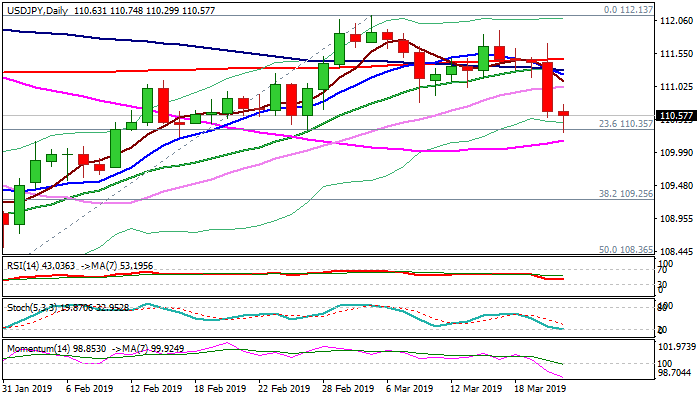
The pair extended weakness to new five-week low at 110.29 on Thursday following strong fall previous day, sparked by Fed surprise on more dovish than expected stance which signaled no rate hikes in 2019 and lowered GDP forecast.
The greenback was sharply lower after announcement (the pair was down 0.68% for the day on Wed) and maintains weak tone today.
Completion of failure swing pattern on daily chart was negative signal, as Wednesday’s fall moved below plethora of converging daily MA’s and rising bearish momentum adds to negative tone.
Bears found footstep just ahead of 55SMA (110.18) and psychological 110 support, violation of which would expose pivotal Fibo support at 109.25 (38.2% of 104.59/112.13).
Fresh weakness undermined larger bulls, with sentiment being soured after Fed surprise that turns near-term bias in bearish mode.
Selling upticks is favored near-term mode, with MA barriers at 111.00/30 zone expected to cap and guar upper breakpoint at 111.44 (200SMA).
Only break here would neutralize bears.
Res: 110.74, 111.02, 111.30, 111.44
Sup: 110.18, 110.00, 109.64, 109.25
The Doves Take Over The Fed
Markets participants broadly expected the FOMC to be quite dovish. They were right. Back in December last year, it was considered reasonable to expect at least one rate hike in 2019. In January and February, multiple speeches from Fed members suggested that it was still a live possibility but that it would depend on developments on the economic side. Yesterday, Federal Reserve Chairman Powell put a final nail in the coffin of a rate hike this year, saying that interest rate could be on hold for “some time”. Looking at the dot-plots, Fed members are expecting one rate hike next year, at the earliest. They also slashed growth forecast for the next two years. The economy should grow 2.1%y/y in 2019 compared to 2.3% estimated in December. For 2020, the initial forecast of 2% has been trimmed to 1.9%. Inflation forecast have also been revised to the downside: 1.8% in 2019 (1.8% in December) and 2% in 2020 (2.1% in December). However, core inflation forecast have been left unchanged at 2% for both 2019 and 2020.
Officials also decided to put an end to their balance sheet reduction program by the end of the third quarter 2019. The reduction is going to start slowly in May. Only a few months ago, the Fed was anticipating that the balance sheet would have to reach around $2tn and $3tn before putting the process on hold, nowadays it looks like $3.7tn is good enough…
The main question is whether the market will focus on the fact that the Fed has put on hold quantitative tightening, which means that we are back to the situation where bad news is good news since it means free money, or the fact that the growth outlook has been slashed, which means that a recession may be around the corner.
In the equity market, most indices reacted negatively in the end, even though investors initially loaded on risk after the announcement (old habits). Today, it like investors do not know where to stand: S&P 500 future are down 0.10%, the German DAX is down 0.30%, while the SMI slid 0.35%. The yellow metal is up 0.42%. Interest rates are down across the board. The greenback took a massive hit as it lost ground against all of its G10 peers, with the exception of the pound sterling, thanks to Brexit uncertainties. We maintain our bearish view on the buck and anticipate that investors would become increasingly cautious against such a negative backdrop.