

Sample Category Title
EURCHF Finds Support Near 23.6% Fibonacci Again; Consolidates in Short and Medium Term
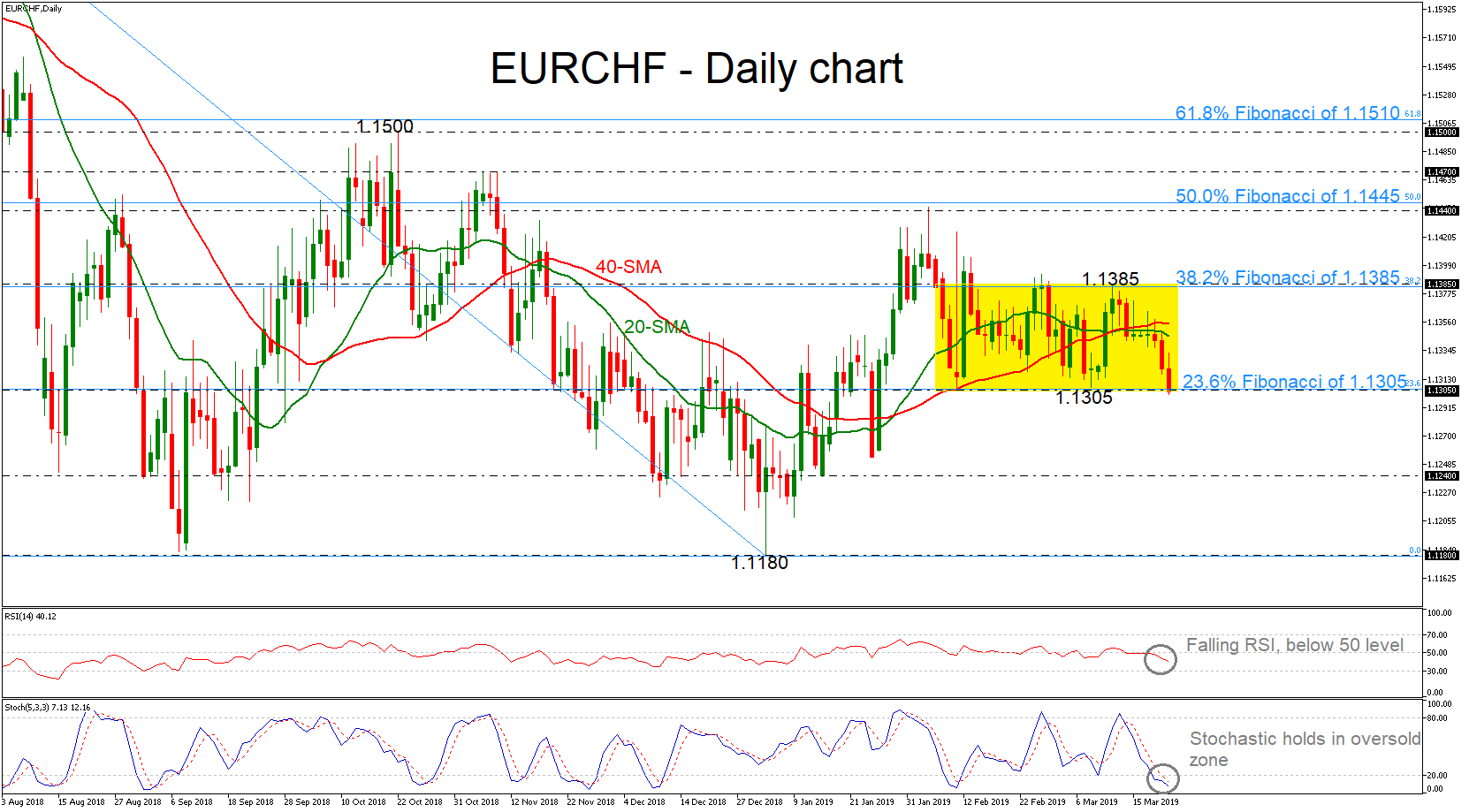
EURCHF has been trading in a relatively narrow range between 1.1385 and 1.1305 from late January onwards, while the past few days the market action has stretched further below the 20- and 40-day simple moving averages (SMAs). Momentum oscillators are losing ground, with the RSI falling below its neutral 50 level and the stochastic dropping into the oversold zone.
Potential declines beneath the 1.1305 level could meet support near the 1.1240 low, identified on January 15. If the bears violate that area, that would turn the bias to cautiously negative, opening the door for a test of 1.1180 – the January 3 low.
On the other hand, advances in the market may stall near the 20- and the 40-SMA currently at 1.1346 and 1.1355 respectively. Even higher, the 1.1385 level, which holds near the 38.2% Fibonacci of the downleg from 1.1710 to 1.1180 would be eyed with another break above that hurdle shifting the focus up to the 1.1440 resistance, registered on February 5.
In the medium-term picture, the market is also neutral, with the price action taking place within a wider range of 1.1180 -1.1500 since August.
Concluding, a violation of 1.1445 could signal more advances, while a move below 1.1305 may be the trigger for more declines.
Pound Under Pressure as May Requests Article 50 Extension
GBP/USD has posted slight losses in the Thursday session. In North American trade, the pair is trading at 1.3165, down 0.22% on the day. On the release front, British retail sales posted a gain of 0.4% in February, compared to a strong gain of 1.0% in January. The U.K. recorded a small budget of GBP 0.7 billion, beating the estimate. There were no surprises from the Bank of England, which left rates pegged at 0.75% for a sixth successive month.
The Brexit saga shifts to Brussels on Thursday, as Prime Minister May will officially request an extension to Article 50 at a meeting of E.U. leaders. May is looking for a 3-month extension, but the Europeans may prefer a longer delay. In any event, all 27 members of the EU must approve any delay to Brexit, which is scheduled for March 29. Parliament will vote on the withdrawal deal again next week, and French Prime Minister Macron said on Thursday that if the deal is voted down, the U.K. will leave without an agreement. With no end in sight to the confusion and uncertaintly, we could see strong swings from the pond in the coming days.
The markets were prepared for a dovish Fed rate statement on Wednesday, but the tone of the statement and the pessimistic rate outlook caught investors off guard. The Fed’s rate outlook (dot plot), which is released each quarter, showed that a majority of FOMC members expect no rate hikes in 2019. This was in sharp contrast to the previous quarter’s forecast, in which the FOMC projected two hikes this year.
The rate statement was markedly dovish, stating that economic activity “has slowed”. Policy makers singled out slower growth in household spending and business investment and noted that inflation has decreased due to lower energy prices. The Fed also announced that it would stop reducing its balance sheet by $50 billion a month. This move is a loosening of policy and is intended to stimulate the economy. The new Fed forecast projects GDP growth of 2.1%, down from 2.3% in December.
Sunset Market Commentary
Markets
Global core bonds gained ground today. The German bund opened lower but started its morning upward trend soon in lockstep with US Treasuries as investors digested the Fed’s dovish turn yesterday. Yields showed signs of bottoming (bonds topping) during early US trading hours. Despite rather poor underlying details, a better than expected headline Philly Fed business outlook (13.7 vs. 4.8 expected) supported US yields in particular. The US yield curve is little changed after yesterday’s blow with the 10y yield heavily testing technical support around the 2.5% area. The German curve bull flattens with yield declines ranging from 1 bp (2y) to 3 bps (5y) over 4bps (10y). Peripheral spreads with Germany’s 10y yield narrow with Italy outperforming (-3 bps).
(FX) markets tried to cope with the new context in the wake of yesterday’s soft Fed communication. Yesterday, the dollar was hammered and EUR/USD gained more than a full big figure after the Fed guidance that it expects its policy rate to stay unchanged this year and its announcement to stop the balance sheet roll-off sooner than expected. EUR/USD still traded north of 1.14 in Asia this morning, but the dollar gradually regained its composure. The growth outlook of the EMU also remains fragile. At the same time, yesterday’s Fed action left investors in risky assets with second thoughts. This kind of global uncertainty is tentatively more supportive for the dollar than for the euro. The US Philly Fed outlook was mixed at best, but had no additional (negative) impact on the dollar. EUR/USD has drifted back below the 1.14 handle (currently 1.1380 area). The pair has returned to the middle of the 1.12/1.16 trading band, awaiting more guidance on the relative balance between the Fed and the ECB. However, this might take time for investors to find out. USD/JPY is holding a rather tight range in the mid 110 area.
The Bank of England as expected left its policy unchanged. In line with its assessment in the February inflation report, the Bank sees room for a very gradual and limited tightening in case of an orderly Brexit. Understandably, the relatively positive assessment of the BoE didn’t help sterling much as the condition of an orderly Brexit is put ever more in doubt. At an EU summit in Brussels, UK PM May will probably receive the message that an approval of Brexit in the UK parliament is needed for the UK to get a (limited) delay to organize its exit from the EU. The high degree of uncertainty on how this process will develop heading toward the March 29 deadline is weighing on sterling. EUR/GBP is trading in the 0.8860 area. Cable is moving up and down in the mid 1.31 area. The risk for sterling trading is becoming ever more binary in nature.
News Headlines
Norges Bank increased interest rates from 0.75% to 1.0% today, citing solid economic growth, above target inflation and a consistently weaker than expected Norwegian krona. The currency jumped to EUR/NOK 9.61. The Swiss National Bank kept rates steady at -0.75%, cut its inflation forecast (again) and kept its currency intervention pledge, saying the Swiss franc is still “highly valued”. Nevertheless, EUR/CHF slipped to 1.13 amid a risk-off environment.
Rating agency Fitch issued a warning to Canada today after releasing the latest budget. The “modest fiscal loosening and sustained deficits will increase the economy’s exposure to a downturn”, Fitch said, adding that the Canadian government debt “remains close to a level that is incompatible with AAA status”. The loonie slipped to USD/CAD 1.336.
CADJPY Turns Slightly Lower; Capped by SMAs
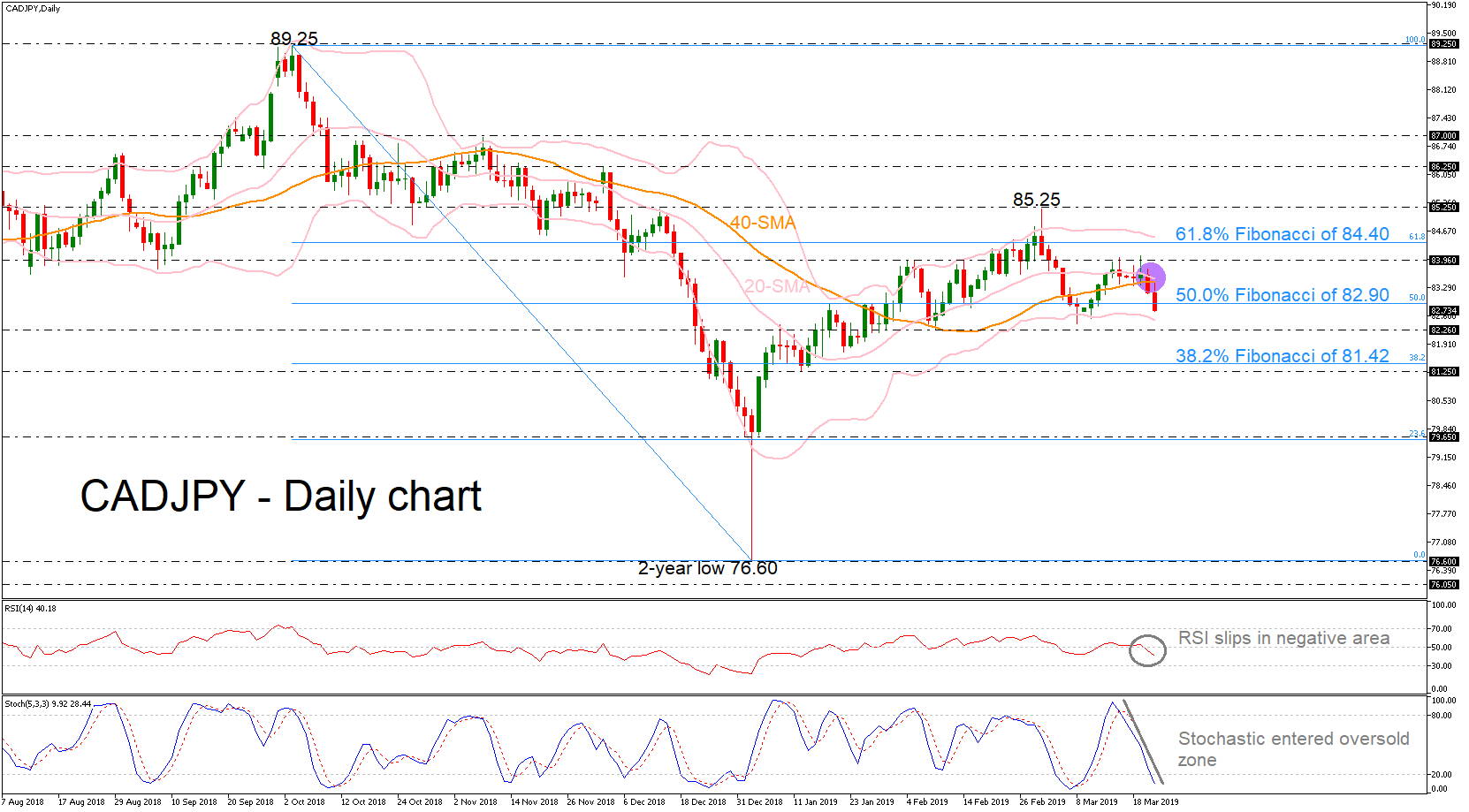
CADJPY was capped by the 20- and 40-simple moving averages (SMAs) in the daily timeframe, declining below the 50.0% Fibonacci retracement level of the drop from 89.25 to 76.60, near 82.90. Currently, the price is standing within the sideways moving Bollinger Bands while the technical indicators suggesting more losses. The RSI is falling in the negative zone and the stochastic entered the oversold territory.
Further losses could find immediate support at the 82.26 barrier, before moving towards the 38.2% Fibonacci of 81.42 and the 81.25 support level. Steeper declines could send the market until the 23.6% Fibonacci, which holds around the 79.65 barrier.
In the event of positive pressures, the market could meet resistance at the 83.96 region and then at the 61.8 % Fibonacci of 84.40, while more gains would endorse the bullish bias, surpassing the upper band of the upper Bollinger band. The next level is coming from the 85.25 obstacle ahead of the 86.25 hurdle.
To sum up, CADJPY holds a slightly neutral to bearish profile in the very short-term as the indicators are pointing down and the SMAs are turning lower.
EUR/USD Mid-Day Outlook
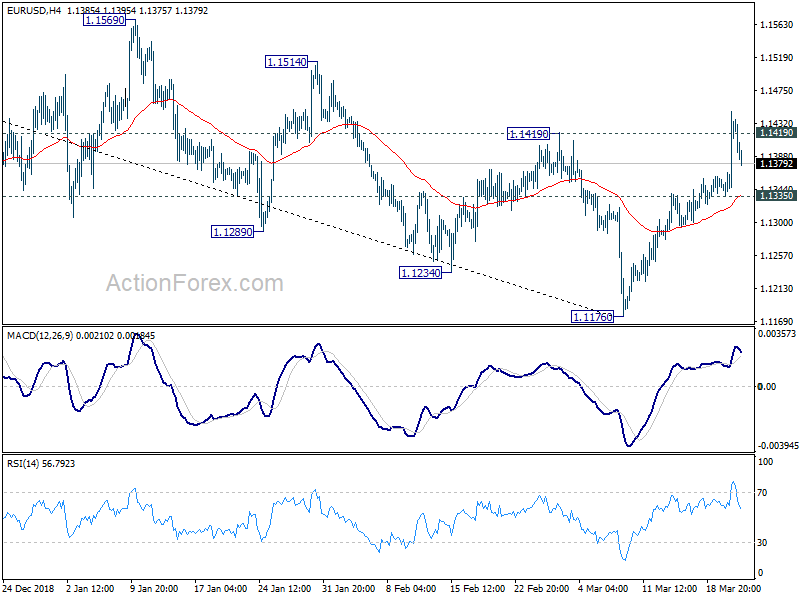
Daily Pivots: (S1) 1.1349; (P) 1.1398; (R1) 1.1462; More.....
As long as 1.1335 minor support holds, further rise is still expected in EUR/USD. Prior break of 1.1419 resistance is taken as the first sign of medium term bottom. Further rally would be seen to 1.1514/1569 resistance zone first. On the downside, break of 1.1335 minor support is needed to indication completion of the rise from 1.1176. Otherwise, near term outlook will remain cautiously bullish in case of retreat.
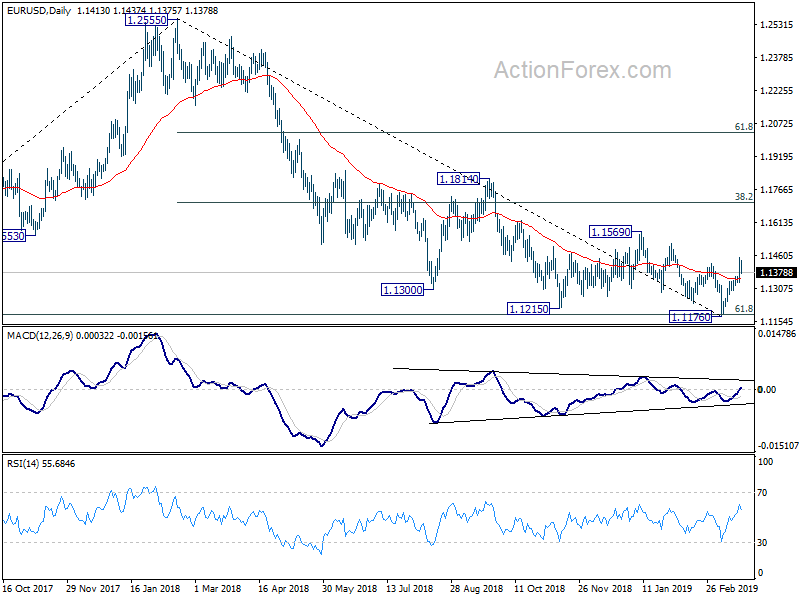
In the bigger picture, current development suggests that a medium term bottom could be formed at 1.1176 already. That came after hitting 61.8% retracement of 1.0339 (2016 low) to 1.2555 (2018 high) at 1.1186, on bullish convergence condition in daily MACD. Further rally could be seen back to 38.2% retracement of 1.2555 to 1.1176 at 1.1703. It's a bit early to confirm medium term bullish reversal. The structure of the rise from 1.1176 and reaction to 1.1703 fibonacci level will be watched for making an assessment later. But in any case, decisive break of 1.1176 is needed to confirm resumption of down trend. Otherwise, outlook is neutral at worst.
GBP/USD Mid-Day Outlook
Daily Pivots: (S1) 1.3133; (P) 1.3204; (R1) 1.3262; More....
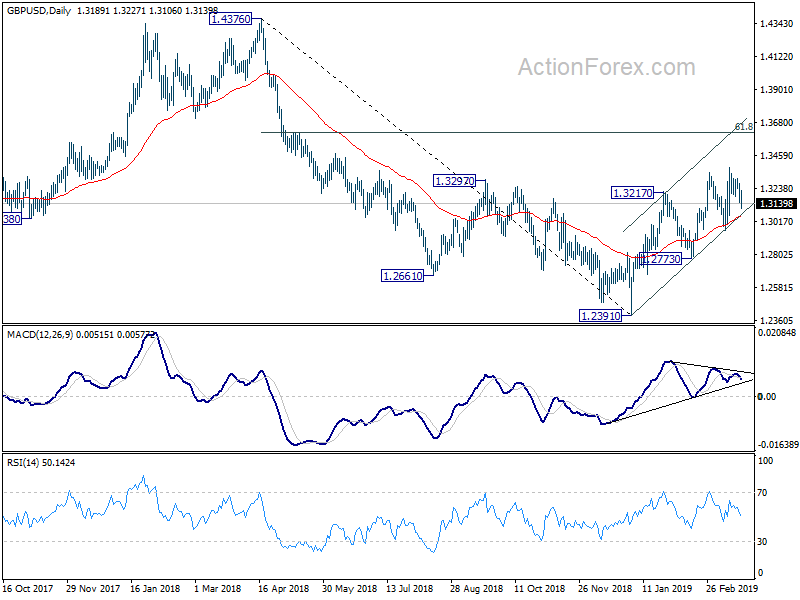
GBP/USD is still holding above 1.2960 support and intraday bias stays neutral. Further rise remains in favor. On the upside, firm break of 1.3381 will target 61.8% retracement of 1.4376 to 1.2391 at 1.3618 next. However, on the downside, firm break of 1.2960 will indicate that rebound from 1.2391 has completed earlier than expected. Deeper fall would then be seen to 1.2773 support for confirmation.
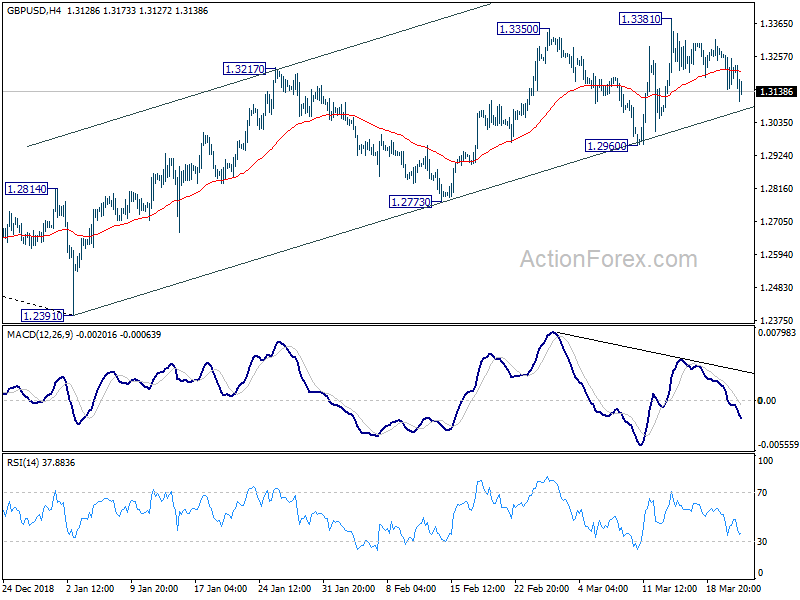
In the bigger picture, medium term decline from 1.4376 (2018 high) should have completed at 1.2391. Rise from 1.2391 is now seen as the third leg of the corrective pattern from 1.1946 (2016 low). Further rise could be seen through 1.4376 in medium term. On the downside, though, break of 1.2773 support will dampen this view. Focus will be turned back to 1.2391 low and break will resume the fall from 1.4376 to 1.1946.
USD/CHF Mid-Day Outlook
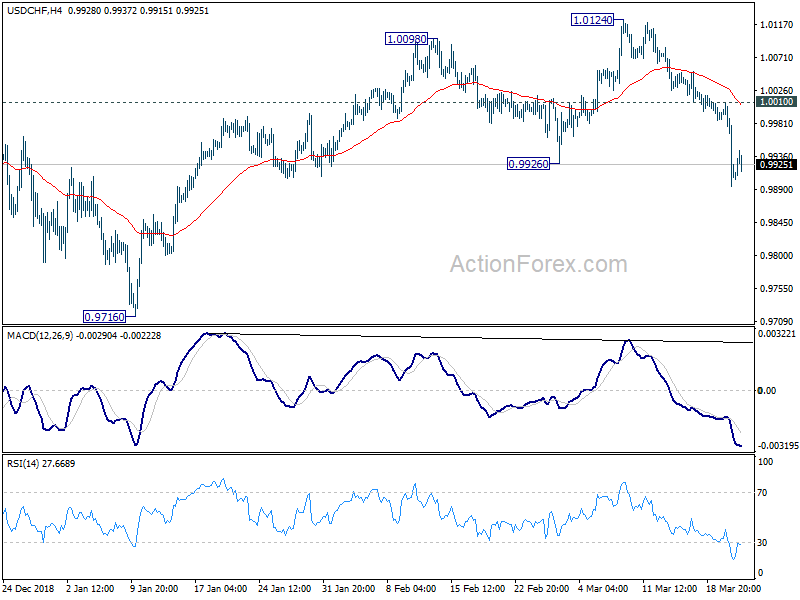
Daily Pivots: (S1) 0.9878; (P) 0.9944; (R1) 0.9994; More.....
Intraday bias in USD/CHF remains on the downside as fall from 1.0124 is in progress. Prior break of 0.9926 support indicates completion of rise from 0.9716 at 1.0124. Further fall should be seen to retest 0.9716 support first. On the upside, break of 1.0010 minor resistance is needed to confirm completion of the fall. Otherwise, near term outlook will remain bearish in case of recovery.
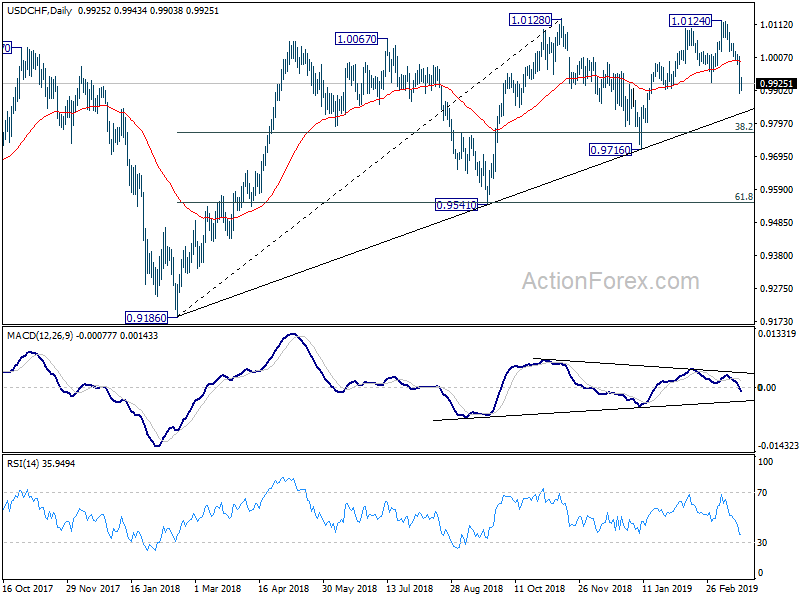
In the bigger picture, focus is back on medium term trend line (now at 0.9803). Decisive break there argue that whole rise from 0.9186 has completed. Further break of 0.9716 will confirm reversal and target next next support level at 0.9541. Nevertheless, there is still a chance that price action from 1.0128 are forming a consolidative pattern with fall from 1.0124 as third leg. If this is the case, stronger support should be seen between 0.9716 and the trend line to contain downside.
USD/JPY Mid-Day Outlook
Daily Pivots: (S1) 110.25; (P) 110.98; (R1) 111.42; More...
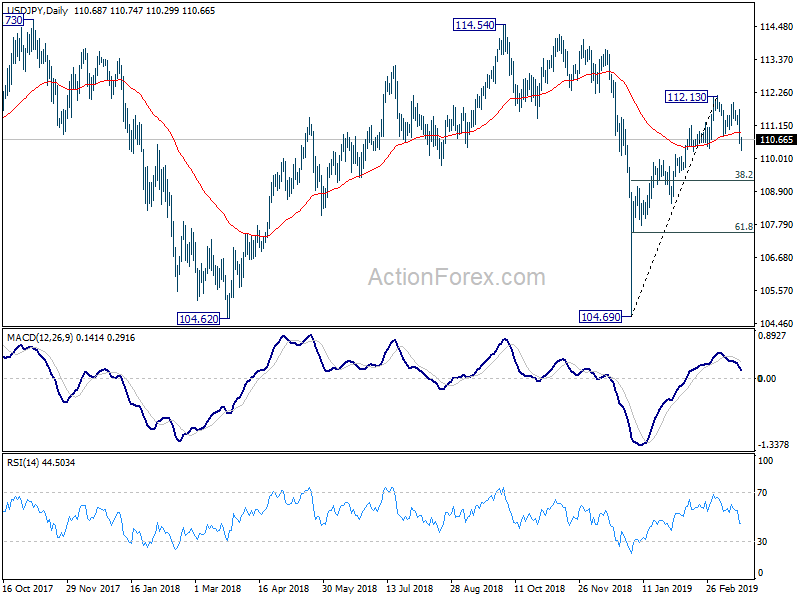
USD/JPY breaches 110.35 to 110.30 but quickly recovered. It's still holding on to 110.35 support and intraday bias remains neutral first. On the downside, decisive break there will confirm that whole rebound from 104.69 has completed at 112.13. In that case, deeper fall should be seen back to 38.2% retracement of 104.69 to 112.13 at 109.28 next. On the upside, break of 111.15 minor resistance will turn bias back to the upside for retesting 112.13 high instead.
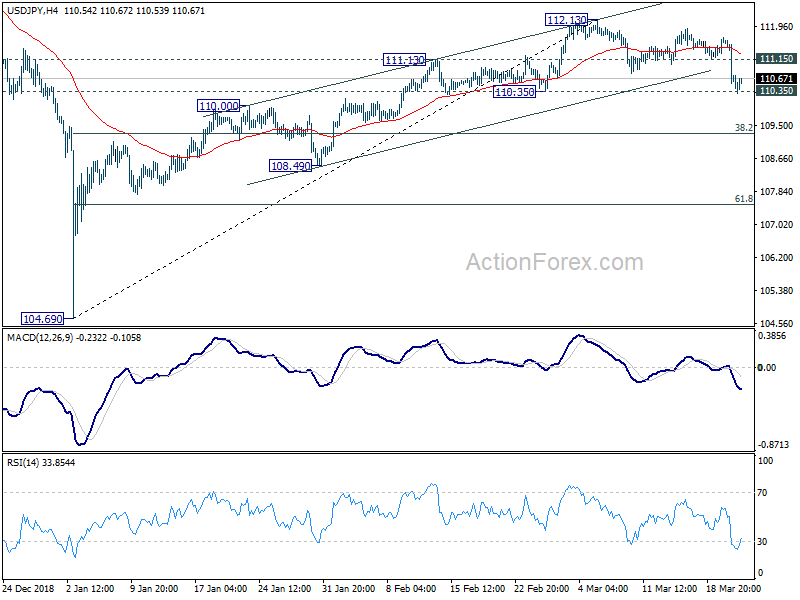
In the bigger picture, strong rebound from 104.69 argues that decline from 118.65 (2016 high) has completed with three waves down to 104.69, after failing 104.62. More importantly, the rise from 98.97 (2016 low) could be resuming. Decisive break of 114.54 resistance will add more credence to this bullish case and target 118.65. This will now be the favored case as long as 110.35 support holds. However, firm break of 110.35 will mix up the medium term outlook again and turn focus back to 104.69 low.
Dollar Recovering Post FOMC Loss, BoE and SNB Shrugged
Dollar is trying to recover some of the steep losses triggered by much more dovish than expected FOMC economic projections. The greenback is now trading mixed for the day, and it's indeed up against Sterling and Canadian for the week. Free fall in Germany yield is another factor lifting Dollar, with 10-year bund yield below 0.05 handle. Putting in to context, 10-year bund yield hit as high as 1.2 just two days ago. US stocks open flat in very tight range while 10-year yield stays pressured. We'd pointed out that yield curve between 3-month and 10-year is now on the brink of indicating recession. It may take some more time for investors to decide whether Fed's dovish turn is positive or negative to the markets.
Back with the currency markets, Sterling suffering another round of selloff as UK Prime Minister Theresa May arrives in Brussels for the EU summit. For now, it's uncertainty how she could get pass Commons Speaker Bercow to hold another meaningful vote for her Brexit deal, get the deal approved, and the secure short Article 50 extension within a week before March 29. Stronger than expected UK retail sales look irrelevant for traders for now. BoE and SNB rate decisions were also largely ignored. Canadian is the second weakest one, followed by Euro. New Zealand Dollar and Australian Dollar are the strongest ones.
In Europe, currently, FTSE is up 0.46%. DAX is down -0.76%. CAC is down -0.20%. German 10-year yield is down -0.039 at 0.047. Earlier in Asia, Japan was on holiday. Hong Kong HSI dropped -0.85%. China Shanghai SSE rose 0.35%. Singapore Strait Times rose 0.19%.
US initial jobless claims dropped -9k to 221k, Philly Fed manufacturing outlook rose to 13.7
US initial jobless claims dropped -9k to 221k in the week ending March 16, better than expectation of 226k. Four-week moving average of initial claims rose 1k to 225k. Continuing claims dropped -17k to 1.75M in the week ending March 9. Fours week moving average of continuing claims rose 6k to 1.773M.
Philadelphia Manufacturing Business Outlook jumped to 13.7 in March, up from -4.1 and beat expectation of 5. Prior month's figure was the first negative reading in almost three news. For this month, new orders rose modestly from -2.4 to 1.9. Shipments index jumped 25 pts to 20.0.
BoE kept interest rate at 0.75%, economic projections appear on track
BoE kept Bank Rate at 0.75% and asset purchase target at GBP 435B as widely expected. Both decisions were made by unanimous 9-0 vote. The central bank noted that economic data has been mixed since last meeting, but February Inflation Report projections "appear on track".
BoE also noted that shifting expectations about the potential nature and timing Brexit have continued to generate volatility in UK asset prices, particularly the sterling exchange rate. Uncertainties also continue to weigh on confidence and short-term economic activity, notably business investment. Employment growth has been strong and indicators of consumer spending point to ongoing modest growth.
Again, BoE noted that the outlook depend significantly on Brexit. And, the policy response to Brexit "will not be automatic and could be in either direction.
Also from UK, retail sales including auto and fuel rose 0.4% mom, 4.0% yoy in February, much better than expectation of -0.4% mom, 3.3% yoy. Retail sales excluding auto and fuel rose 0.2% mom, 4.0% yoy, also much better than expectation of -0.4% mom, 3.5% yoy.
UK May in Brussels, emphasized Brexit is decision of the people
Arriving at the EU summit in Brussels, UK Prime Minister Theresa May repeated that Brexit delay is a "matter of personal regret". However, "a short extension would give parliament the time to make a final choice that delivers on the result of the referendum." Also, she emphasized again: "What matters is that we recognise that Brexit is the decision of the British people. We need to deliver on that. We are nearly three years on from the original vote. It is now the time for parliament to decide."
Earlier today, German Chancellor Angela Merkel echoed the unified message from EU official regarding Article 50 extensions. She said: "There was a request from Theresa May] to delay the exit date to June 30. The leaders of the EU27 will intensively discuss this request. In principle, we can meet this request if we have a positive vote in the British parliament next week about the exit document.
May sent a letter European Council President Donald Tusk yesterday, requesting Article 50 extension until June 30. Tusk offered to give short Article 50 extension. But that would be "conditional on a positive vote on the withdrawal agreement in the House of Commons." If his proposal is approved by all other 27 EU members, and there is a positive vote in the House of Commons next week, the EU can "finalize and formalize the decision on extension in the written procedure". Tusk is ready to call for another EU summit next week if needed.
SNB kept interest rate at -0.75%, downgrades inflation forecast
SNB left "expansionary" monetary policy unchanged as widely expected. Sight deposit rate is held at -0.75%. Three-month Libor target range is also kept at -1.25% to -0.25%. The central bank maintained the pledge to "remain active in the foreign exchange market as necessary, while taking the overall currency situation into consideration."
While Swiss Franc has depreciated slightly since December meeting, SNB said "it is still highly valued" and the currency markets situation remain "fragile". Thus, negative interest rate and the SNB's willingness to intervene in the foreign exchange market as necessary therefore remain essential. These measures keep the attractiveness of Swiss franc investments low and reduce upward pressure on the currency.
Inflation forecast in 2019 is downgraded to 0.3%, down from December projection of 0.5%. For 2020, inflation is projected to be at 0.6%, down from 1.0%. For 2020, inflation is projected to pick up to 1.2%. The forecasts are based on keeping three-month Libor rate at -0.75% over the entire horizon. On growth, SNB expects GDP to grow by around 1.5% in 2019 as a whole.
Suggested reading: SNB Downgraded Inflation Forecast for Switzerland, Pledged to Curb Franc's Strength
Australia unemployment rate dropped to 4.9% as participation rate dropped -0.2%
In seasonally adjusted term, Australian employment market grew 4.6k in February, well below expectation of 15.2k. Full-time employment dropped -7.3k while part-time jobs grew 11.9k. Unemployment rate dropped to 4.9%, down from 5.0%. That's also the lowest level since June 2011. However, participation rate dropped by -0.2% to 65.6%.
The seasonally adjusted unemployment rate increased in New South Wales (up 0.3 pts to 4.3%) and Victoria (up 0.2 pts to 4.8%). Decreases were observed in Western Australia (down 0.9 pts to 5.9%), Queensland (down 0.6 pts to 5.4%), South Australia (down 0.6 pts to 5.7%) and Tasmania (down 0.5 pts to 6.5%).
ABS Chief Economist Bruce Hockman said: "The trend unemployment rate declined 0.5 percentage points over the year, from 5.5 per cent to 5.0 per cent. The pace of decline slowed in recent months, which was consistent with the slowdown seen in recent Job Vacancies and GDP numbers."
New Zealand GDP grew 0.6% qoq, led by services
New Zealand GDP grew 0.6% qoq in Q4, up from Q3's 0.3% qoq and matched expectations. GDP grew 2.8% over the year ended December 2018. While the 0.6% growth missed RBNZ's forecast of 0.8%, it may not be weak enough to prompt an RBNZ rate cut in this month's meeting yet.
Looking at the details, growth was driven by services industries which rose 0.9%, with 9 of 11 services industries recording increases. Agriculture, forestry, and fishing industry contracted -0.6%. construction rose 1.8%. Household spending rose 1.3%. Investment spending rose 1.4%.
China MOFCOM confirms USTR Lighthizer's visit on Mar 28-29
China Commerce Ministry spokesman Gao Feng confirmed in a regular press briefing that US delegation is traveling to Beijing next week to continue trade negotiation. Trade Representative Robert Lighthizer and Treasury Secretary Steven Mnuchin will visit China on March 28-29. After that Vice Premier Liu He will travel to the Washington in early April for more talks.
Gao also noted that the decline is import and expect during the first two months of the year was mainly due to Chinese New Year. He noted the typical pattern of "concentrated export pre CNG, concentrated import post CNY". Though, he also said trade rebounded strongly during the first half of March. And, Q1 trade will remain stability.
Trump said yesterday that administration is talking about leaving tariffs on China for a long period of time. That is, even if a trade agreement is reached, the tariffs won't be limited until China complies with the terms of the deal. He criticized that China "had a lot of problems living by certain deals."
His comments were generally seen as counter-productive to the negotiation, as well as the world economy. Without US stopping the punitive tariffs, China will certainly not agree to correcting its unfair trade practice while lifting its own retaliatory tariffs at the same time. The US won't have it all. That is, even if there is an eventual agreement and China will speed up it's reforms, tariffs from both sides will stay there for much longer. The damage to the world economy would continue.
USD/JPY Mid-Day Outlook
Daily Pivots: (S1) 110.25; (P) 110.98; (R1) 111.42; More...
USD/JPY breaches 110.35 to 110.30 but quickly recovered. It's still holding on to 110.35 support and intraday bias remains neutral first. On the downside, decisive break there will confirm that whole rebound from 104.69 has completed at 112.13. In that case, deeper fall should be seen back to 38.2% retracement of 104.69 to 112.13 at 109.28 next. On the upside, break of 111.15 minor resistance will turn bias back to the upside for retesting 112.13 high instead.
In the bigger picture, strong rebound from 104.69 argues that decline from 118.65 (2016 high) has completed with three waves down to 104.69, after failing 104.62. More importantly, the rise from 98.97 (2016 low) could be resuming. Decisive break of 114.54 resistance will add more credence to this bullish case and target 118.65. This will now be the favored case as long as 110.35 support holds. However, firm break of 110.35 will mix up the medium term outlook again and turn focus back to 104.69 low.
Economic Indicators Update
| GMT | Ccy | Events | Actual | Forecast | Previous | Revised |
|---|---|---|---|---|---|---|
| 21:45 | NZD | GDP Q/Q Q4 | 0.60% | 0.60% | 0.30% | |
| 00:30 | AUD | Employment Change Feb | 4.6K | 15.2K | 39.1K | 38.3K |
| 00:30 | AUD | Unemployment Rate Feb | 4.90% | 5.00% | 5.00% | |
| 08:30 | CHF | SNB Sight Deposit Interest Rate | -0.75% | -0.75% | -0.75% | |
| 08:30 | CHF | SNB 3-Month Libor Upper Target Range | -0.25% | -0.25% | -0.25% | |
| 08:30 | CHF | SNB 3-Month Libor Lower Target Range | -1.25% | -1.25% | -1.25% | |
| 09:00 | EUR | ECB Monthly Bulletin | ||||
| 09:30 | GBP | Public Sector Net Borrowing (GBP) Feb | -0.7B | -0.3B | -15.8B | |
| 09:30 | GBP | Retail Sales Inc Auto Fuel M/M Feb | 0.40% | -0.40% | 1.00% | 0.90% |
| 09:30 | GBP | Retail Sales Inc Auto Fuel Y/Y Feb | 4.00% | 3.30% | 4.20% | 4.10% |
| 09:30 | GBP | Retail Sales Ex Auto Fuel M/M Feb | 0.20% | -0.40% | 1.20% | 1.10% |
| 09:30 | GBP | Retail Sales Ex Auto Fuel Y/Y Feb | 4.00% | 3.50% | 4.10% | |
| 12:00 | GBP | BoE Rate Decsion | 0.75% | 0.75% | 0.75% | |
| 12:00 | GBP | BoE Asset Purchase Target Mar | 435B | 435B | 435B | |
| 12:00 | GBP | MPC Official Bank Rate Votes | 0--0--9 | 0--0--9 | 0--0--9 | |
| 12:00 | GBP | MPC Asset Purchase Facility Votes | 0--0--9 | 0--0--9 | 0--0--9 | |
| 12:30 | CAD | Wholesale Trade Sales M/M Jan | 0.60% | 0.50% | 0.30% | |
| 12:30 | USD | Philadelphia Fed Business Outlook Mar | 13.7 | 5 | -4.1 | |
| 12:30 | USD | Initial Jobless Claims (MAR 16) | 221K | 226K | 229K | 230K |
| 14:00 | USD | Leading Index Feb | 0.2% | 0.10% | -0.10% | |
| 14:30 | USD | Natural Gas Storage | -49B | -204B |
BOE Left Policy Unchanged. Next Move Depends on Brexit Outcome
BOE voted unanimously to leave the Bank rate unchanged at 0.75%, and the asset purchase program at 435B pound, in March. Dataflow during the inter-meeting period was mixed, while the Brexit outlook has become even less certain. The members indicated that domestic economic developments, and hence the monetary policy, would depend significantly on the Brexit outlook, whether the departure would be smooth or not.
On the Brexit outlook, the BOE suggested a survey shows that 80% of businesses have prepared for a no-deal Brexit, up from 50% in January. According to BOE, the respondents, despite their “readiness”, “still expected output, employment and investment over the next 12 months to be significantly weaker under a 'no-deal, no-transition' Brexit".
In light of the improvement in economic data in the first two months of the year, BOE revised higher GDP growth forecast for 1Q19 to +0.3%, up from +0.2% estimated previously. This is also up slightly from 4Q18's growth of +0.2%. Recall that in February, the staff revised lower GDP growth forecast to +1.2% for this year, down from +1.7% in November’s projection. The downgrade was the biggest since the Brexit referendum in 2016. Growth is expected to improve to +1.5% in 2020, compared with November’s estimate of +1.7%.
On the monetary policy outlook, BOE reiterated that the policy rate would increase"at a gradual pace, and to a limited extent” over the next couple of years. Yet, it added that any decision would "not be automatic and could be in either direction".