Sample Category Title
Canadian Dollar Rally Fizzles, Manufacturing Production Next
The Canadian dollar is unchanged in the Friday session, after slight losses on Thursday. Early in the North American trade, the pair is trading at 1.3332, down 0.02% on the day. In the U.S., there are two key events. The Empire State Manufacturing Index is expected to climb to 10.1, while UoM Consumer Sentiment is projected to remain at 95.5 points. Canada releases manufacturing sales,which has rolled off three straight declines. The markets are expecting a better January, with an estimate of 0.4%.
Was the Bank of Canada too aggressive with its rate hikes? The bank raised rates five times between July 2017 and October 2018, but has since stayed on the sidelines. With the Canadian economy in a slowdown, the bank could stay on the sidelines until the second half of 2019. The sharp jump in rates may have been too much for the economy to handle. One sore spot is the housing sector, which has declined for five straight months, as higher rates have made mortgages more expensive and reduced home purchases. If the economy does not rebound, policymakers will have to consider a rate cut, which could stimulate economic activity but would push the Canadian dollar downwards.
In the U.S., February consumer inflation numbers were soft, which means there is little pressure on policymakers to raise rates in the near future. Core CPI edged down to 0.1%, while CPI remained steady at 0.2%. Inflation remains well below the Federal Reserve’s target of 2.0 percent, so there is little pressure on the Fed to raise rates anytime soon. Policymakers have been signaling that the Fed could stay on the sidelines until the second half of 2019, and this stance was underscored by Fed Chair Powell in a television interview earlier this week. Powell left no doubt about where the Fed stands, saying that the Fed would remain patient and was in no hurry to change interest rate policy. The dovish stance of the Fed could weigh on the greenback, as a lack of rate hikes makes the greenback less attractive to investors.
DAX Hits 5-Month High As British Parliament Vote For Brexit Delay
The DAX continues to show strong movement this week, and the volatility has continued on Friday. The index has jumped 1.0% on the day, climbing to its highest level since mid-October. Currently, the DAX is at 11,695. In economic news, the focus is on inflation data. German WPI rebounded after two straight declines, posting a gain of 0.3%. In the eurozone, CPI came in at 1.5% and Core CPI gained 1.0%, as both readings matched their estimates.
The Brexit drama is at fever pitch, after parliament voted on Brexit for a third time this week. As expected, lawmakers voted to ask the European Union for an extension on Article 50. Britain is scheduled to depart the E.U. on March 29, so an extension would give the May government some breathing room. However, the uncertainty surrounding Brexit is far from over. It’s unclear how long an extension the E.U. would be willing to grant, although senior E.U officials have said that a year or more would be acceptable. The E.U. will have to reach a consensus from all 27 members, each of whom must vote in favor of an extension to Article 50. Parliament remains deeply divided over Brexit, and Prime Minister May, though badly shaken, hasn’t given up on her withdrawal deal. With more parliamentary votes expected next week, traders should be prepared for more volatility from European stock markets.
Investors are keeping an eye on developments in the U.S.-China trade war. After four rounds of negotiations, the markets were hoping that President Trump and Chinese President Xi might hold a summit in late March. However, it was reported on Wednesday that the two leaders will not meet before April. This has raised concerns that the sides have not managed to resolve their differences. Trump has said that he is not in a rush to reach an agreement, but a deal with China would be a huge victory for Trump ahead of the U.S. election in 2020. If there are further signs that an agreement between the U.S. and China remains elusive, risk appetite could sour and dampen the high-flying DAX.
AUD/USD Outlook: Aussie Ticks Higher On Improved Risk Sentiment But The Downside Remains Vulnerable
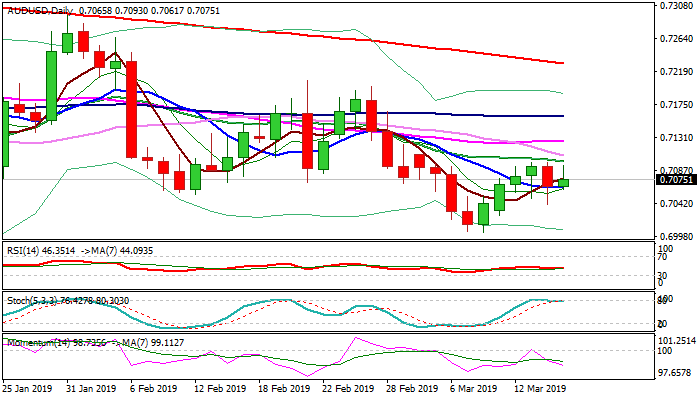
The Aussie stands at the front foot on Friday following double rejection at daily cloud base/10SMA (0.7050/64), but the upside remains limited by cloud top /20SMA (0.7096/98) for now. Improved risk sentiment on US/China trade talk progress inflated the Australian dollar, but doubts persist as initial Trump/Xi summit has been delayed. Also signals of slowdown of Australian economy and increasing possibilities of rate cut, continue to weigh. Daily techs remain bearishly aligned as bearish momentum continues rise, stochastic is reversing from overbought territory and MA's are in bearish setup that keeps the downside vulnerable. Eventual close below 10SMA / cloud base would generate negative signal which could be boosted on extension below 0.7041/39 (Thursday's spike low / Fibo 61.8% of 0.7002/0.7097 recovery leg and risk retest of key 0.70 support.
Res: 0.7096, 0.7106, 0.7126, 0.7159
Sup: 0.7050, 0.7039, 0.7025, 0.7000
EUR/USD Outlook: Repeated Close Above Key Fibo Barrier To Signal Recovery Extension
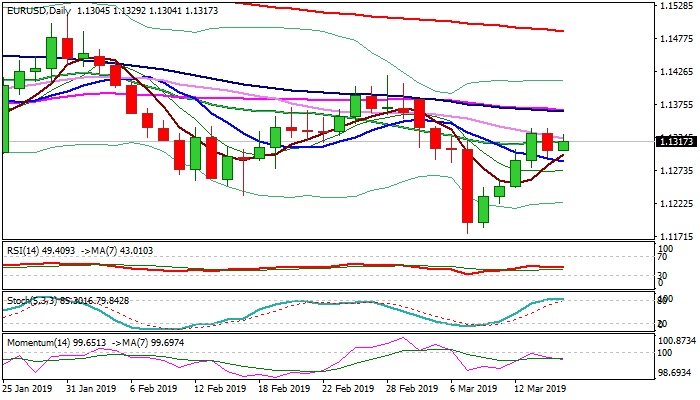
The Euro regained traction on Friday and recovered the most of Thursday's 1.1337/1.1294 dip after four-day rally stalled at falling 30SMA.
Thursday's close in red and failure to repeatedly close cracked Fibo barrier at 1.1326 (38.2% of 1.1569/1.1176) softened near-term structure, though bullish bias is expected to remain intact while 10SMA (1.1287) holds the downside.
However, risk of recovery stall and possible pullback would increase on another failure to clearly break 1.1326 barrier and repeated close below falling 30SMA (1.1322), as momentum is weak and stochastic in overbought territory.
EU benchmark CPI ticked higher in Feb, according to the expectations and supporting the pair, with a series of data from the US, due later today and news about Brexit, eyed for fresh signals.
Weekly close above 1.1326 Fibo barrier would generate bullish signal for extension of recovery leg from 1.1176 (2019 low) and expose barriers at 1.1365/72 (converged 55/100SMA's / 50% of 1.1569/1.1176).
Conversely, close below 10SMA would be initial negative signal for deeper correction of 1.1176/1.1338 upleg.
Res: 1.1322; 1.1338; 1.1369; 1.1382
Sup: 1.1304; 1.1287; 1.1276; 1.1257
Eurozone CPI finalized at 1.5% in Feb, core at 1.0%
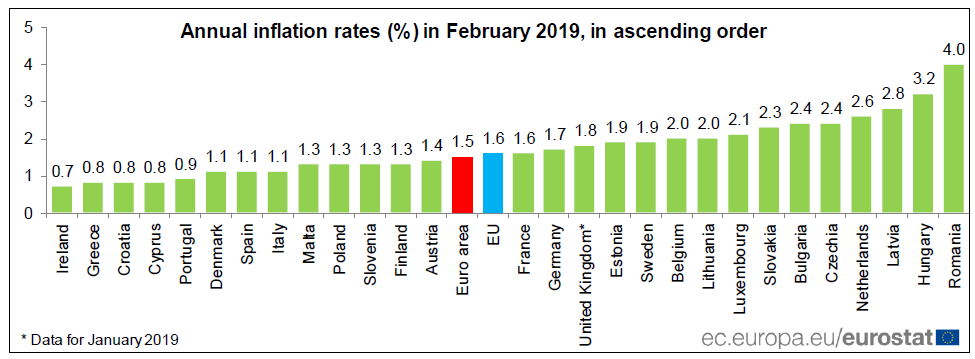
Eurozone CPI was finalized at 1.5% yoy in February, up from January's 1.4% yoy. Core CPI was finalized at 1.0%yoy, down from 1.1% yoy. EU CPI was finalized at 1.6% yoy, up from 1.6%.
The lowest annual rates were registered in Ireland (0.7%), Greece, Croatia and Cyprus (all 0.8%). The highest annual rates were recorded in Romania (4.0%), Hungary (3.2%) and Latvia (2.8%). Compared with January 2019, annual inflation fell in seven Member States, remained stable in one and rose in nineteen.
EUR/USD – Euro Steady As Eurozone Inflation As Expected
EUR/USD has edged higher on Friday, recovering the losses sustained on Thursday. Currently, the pair is trading at 1.1324, up 0.18% on the day. On the release front, the focus is on inflation data. German WPI rebounded after two straight declines, posting a gain of 0.3%. In the eurozone, CPI came in at 1.5% and Core CPI gained 1.0%, as both readings matched their estimates. In the U.S., there are two key events. The Empire State Manufacturing Index is expected to climb to 10.1, while UoM Consumer Sentiment is projected to remain at 95.5 points.
In the eurozone, inflation levels remain below the ECB target of around 2 percent. There were no surprises from February data, as German and eurozone CPI was within expectations. At a time when Germany and the rest of the eurozone are mired in an economic slowdown, the bank is unlikely to raise rates until there is a significant improvement in economic data. Back in 2018, the ECB had projected raising rates later this year, but the worsening economic landscape has forced the ECB to push back its forecast for future rate hikes. In last week’s rate statement, the ECB set guidance at maintaining rates until 2020, and this dovish stance soured investors on the euro, sending the currency sharply lower.
With the U.S-China trade war showing signs of easing, there were expectations that President Trump and Chinese President Xi might hold a summit in late March. However, it was reported on Wednesday that the two leaders will not meet before April. This has raised concerns that the sides have not managed to resolve their differences. Trump has said that he is not in a rush to reach an agreement, but a deal with China would be a huge victory for Trump ahead of the U.S. election in 2020. If there are further signs that an agreement between the U.S. and China remains elusive, risk appetite could sour and hurt the euro.
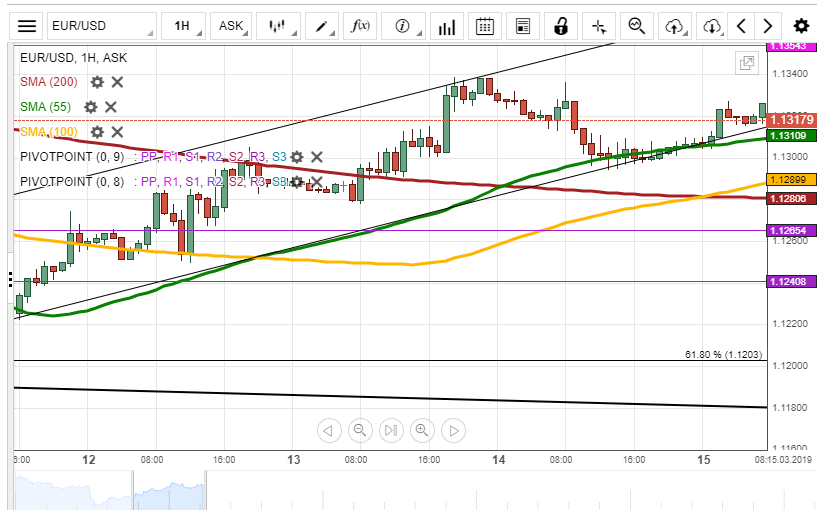
EUR/USD Is Supported By 55-Hour SMA
During Thursday's trading session, the European Single Currency was supported by the 55-hour simple moving average to keep trading inside the trend line at 1.1300. On Friday morning, the rate was located at the 1.1320 mark.
In regards to the near-term future, most likely, the currency exchange rate will trade sideways to end the trading session at the 1.1340 level.
Moreover, it is possible that the rate could bounce off the bottom boundary of the trend line at the 1.1320 mark to surge towards the weekly R1 at 1.1354.
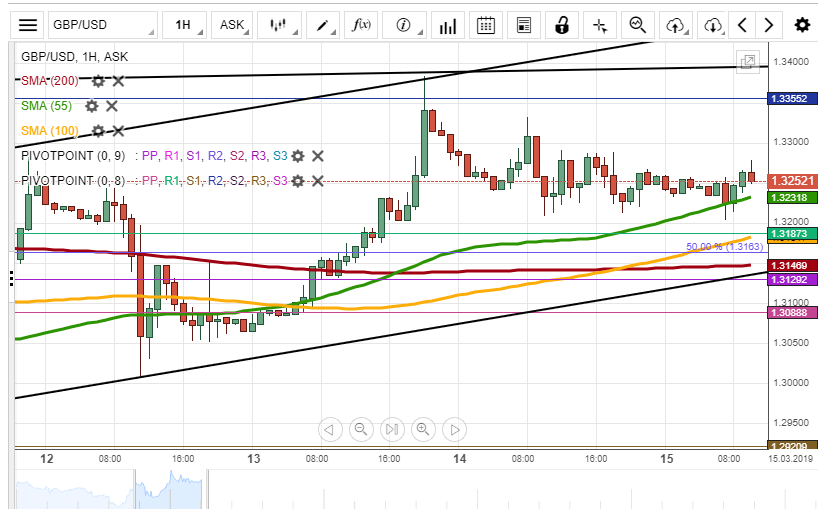
GBP/USD Surges To R2 At 1.3355
During Thursday's trading session, the British Pound traded sideways to stay at 1.3200. On Friday morning, the rate was supported by the 55-hour simple moving average to trade at the 1.3264 mark.
In regards to the near-term future, most likely, the currency exchange rate will keep surging towards the weekly R2 at the 1.3355 mark.
It is expected that the rate will end today's trading session at the 1.3300 level.
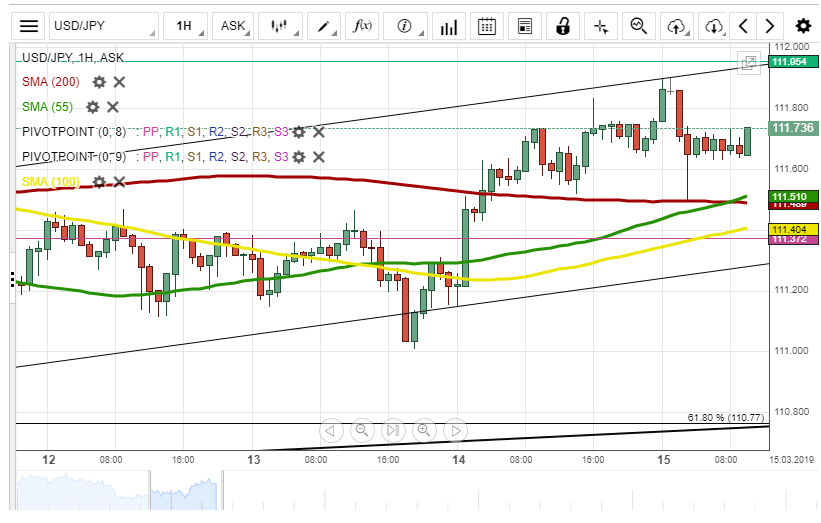
USD/JPY Might Reach R1 At 111.95
During Thursday's trading session, the currency exchange rate was supported by the 200-hour simple moving average to end the trading session at 111.80 as it was expected! On Friday morning, the rate was trading sideways to stay at the 111.65 mark.
In regards to the near-term future, it is expected that the rate will try to reach the weekly R1 at the 111.95 mark.
Besides, the 55-hour and the 200-hour simple moving averages will support the surge during the day!
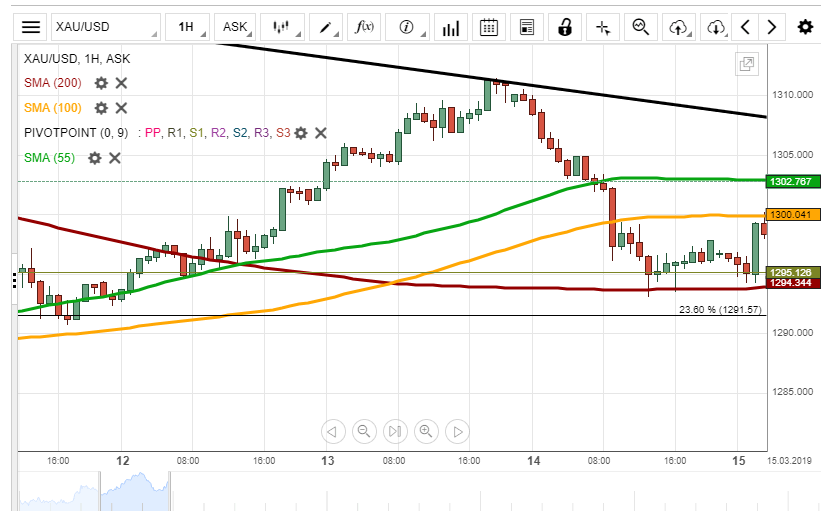
XAU/USD Will Surge To 1,300.00
During Thursday's trading session, the yellow metal passed the 55-hour and the 100-hour simple moving averages to end the trading session at monthly S1. On Friday morning, the 200-hour simple moving averages helped gold to break the resistance levels of the 55-hour and the 100-hour simple moving averages to trade at the 1,302.16 mark.
In regards to the near-term future, it is expected that the yellow metal will bounce off the upper boundary of the medium pattern line at the 1,306.00 mark.
In addition, most likely, the rate will end the trading session at the 1,300.00 level.