Sample Category Title
Week ahead – Fed, BoE, and SNB Policy Meetings Highlight a Packed Agenda
Traders will be glued to their screens next week amid a barrage of crucial events, ranging from a highly-anticipated Fed policy meeting to even more Brexit votes in the British Parliament. At the same time, almost every major economy will see the release of data that could be decisive for their respective currencies, particularly considering the synchronized shift by central banks towards a more ‘cautious’ stance lately.
Fed decides: All eyes on the new ‘dots’
Arguably the main event in the coming week will be the Fed policy meeting, which concludes on Wednesday. No action is anticipated, so market attention will fall on the new economic forecasts, Chairman Powell’s press conference, and the updated interest rate projections in the so-called ‘dot plot’.
Fed officials adopted a much more cautious tone in early 2019, indicating they’ll put their rate-hike plans on ice for the time being while they monitor the risks surrounding the economy. In other words, policymakers sent a clear signal that they won’t touch the hiking button again for at least a few months, or perhaps not at all, depending on how risks evolve – most notably the slowdown in US and global growth. The message was well understood by traders, with market pricing for rate hikes in 2019 evaporating instantly. In fact, futures markets now indicate a modest probability for rate cuts this year, not hikes.
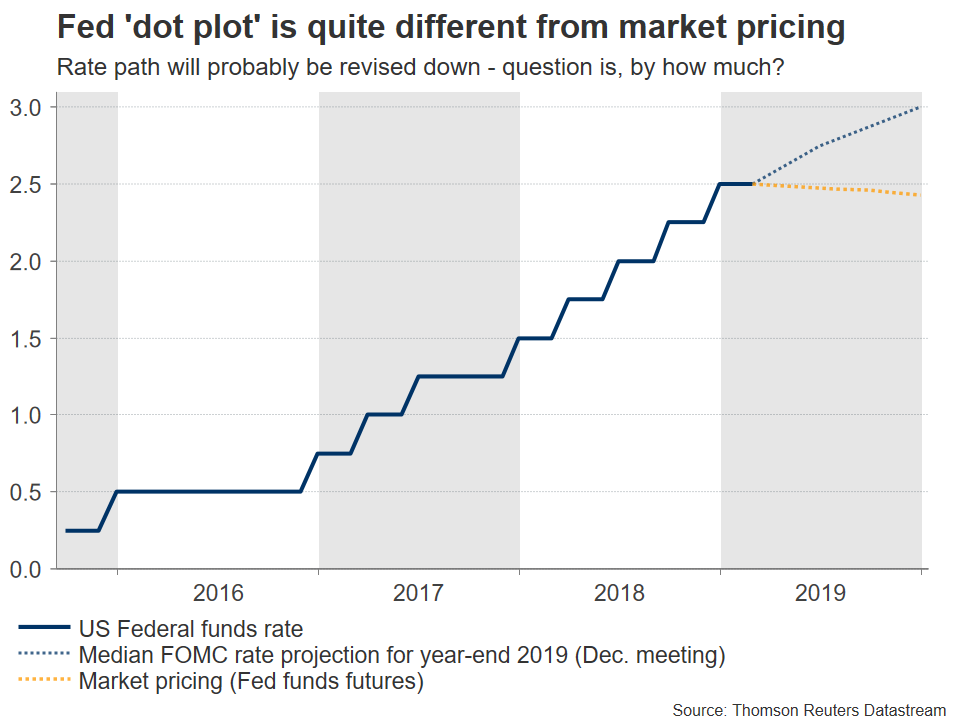
Yet, the latest ‘dot plot’ back in December still pointed to two rate increases in 2019. Hence, investors will focus on by how much these rate projections will be revised lower this time. Specifically, will policymakers keep even a single rate increase in 2019 on the table, or will the median ‘dot’ be marked down more severely to indicate no hikes at all this year? In the context of markets now seeing greater odds for rate cuts moving forward, a dot plot pointing to even one hike in 2019 could come as a ‘hawkish surprise’, putting the wind back into the dollar’s sails.
BoE meeting and raft of UK data eyed, as Brexit saga drags on
Brexit will remain front and center in the UK, with PM May expected to make a third attempt of pushing her deal through Parliament next week, by Wednesday at the latest. Alas, pound traders will have much more to digest, as the Bank of England (BoE) will also conclude its policy meeting on Thursday, while key economic data will be published throughout the week. Generally speaking, politics will probably continue to overshadow economics in driving the British currency overall.
In politics, UK lawmakers overwhelmingly rejected the government’s Brexit deal for a second time this week, instead voting to delay the exit date. Now, attention turns to how long such an extension will be. If Parliament somehow changes its mind and approves May’s deal the third time, then the UK will ask Brussels for a short extension until June at the upcoming EU summit on Thursday. However, if MPs stick to their guns and vote it down again, then a much longer delay of up to 2 years may be requested. The former outcome would likely boost sterling on the news as uncertainty dissipates. Meanwhile, although the latter scenario may initially hurt the currency, such a lengthy delay could also raise the likelihood for another referendum, so it may be a bullish outcome in the longer term as well.
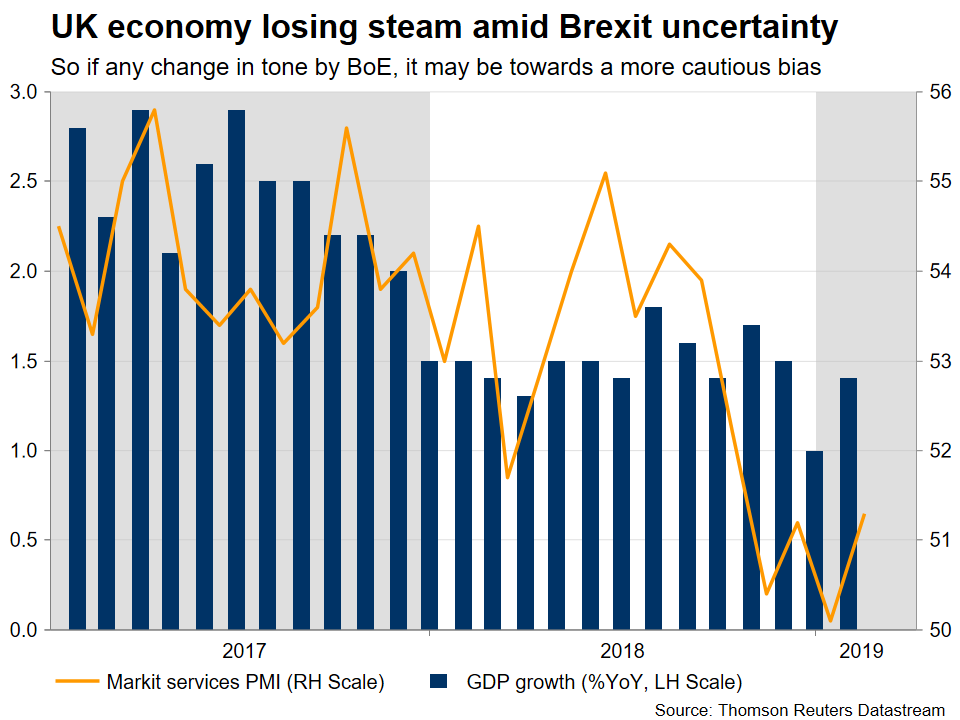
In the economic arena, employment, inflation, and retail sales data will hit the markets on Tuesday, Wednesday, and Thursday respectively. The lion’s share of attention though will be on the BoE gathering. No action is expected and admittedly, the Bank has its hands tied amid the political uncertainty. The economy has no doubt slowed but the Bank seems unwilling to shift to a more dovish stance, reasoning that it should just be patient for now as an ‘orderly’ Brexit outcome can dispel much of the uncertainty by itself and hence, kickstart investment and growth. Overall, the BoE is unlikely to deviate much from this stance, but if there is any change, it’ll probably be towards a more cautious bias.
SNB: Staying as dovish as possible, preventing franc strength
The Swiss National Bank (SNB) will announce its quarterly decision on Thursday. The infamous central bank has moved out of the spotlight lately, but that doesn’t mean policymakers have taken their foot off the accelerator. The nation still has the lowest interest rates globally, and that’s unlikely to change anytime soon. Swiss economic data remain soft, with inflation barely picking up and growth struggling. Meanwhile, Switzerland’s main export market – the Eurozone – is losing steam.
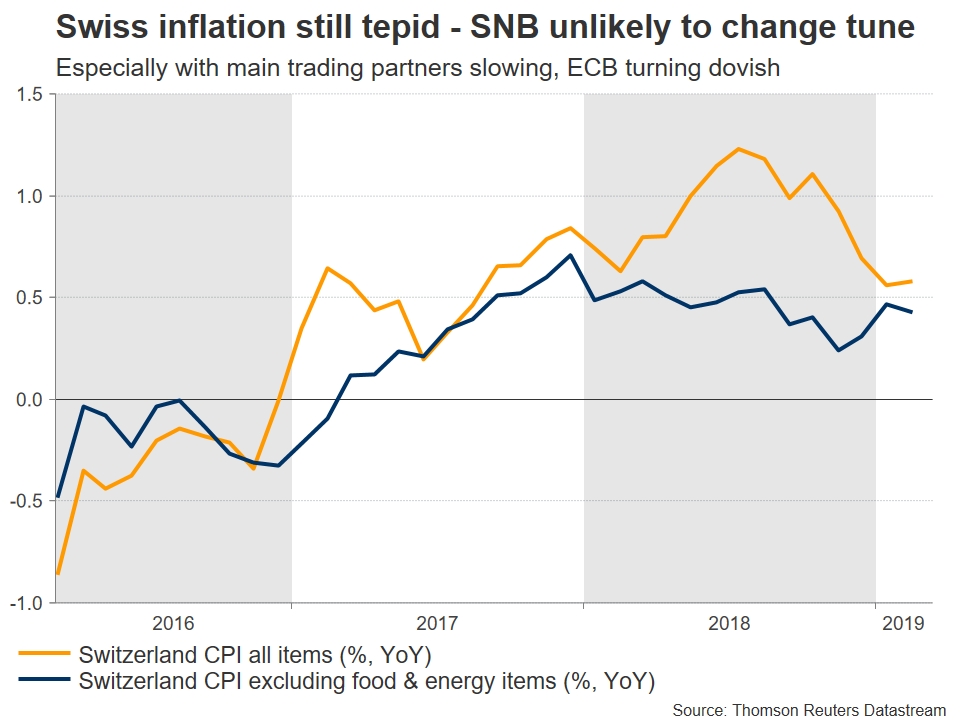
Perhaps most importantly, the ECB has turned dovish lately. Hence, the SNB will probably maintain an ultra-cautious tone, reiterating that negative interest rates are needed and that it will continue to intervene in the FX market if needed to weaken the franc. Anything short of that could trigger a sharp rally in the franc, particularly against the euro, which would undermine the SNB’s inflation-lifting efforts; a route the Bank certainly wants to avoid.
Wounded euro looks to preliminary European PMIs
Euro area growth has slowed drastically in recent quarters, leading the ECB to redeploy its ‘shock and awe’ tactics, pushing back the timing of its first rate increase. A move so aggressive it caught markets by surprise, dragging euro/dollar down to lows last seen in mid-2017. Against this backdrop, traders will eagerly await the bloc’s latest flash PMI data for March – due on Friday.
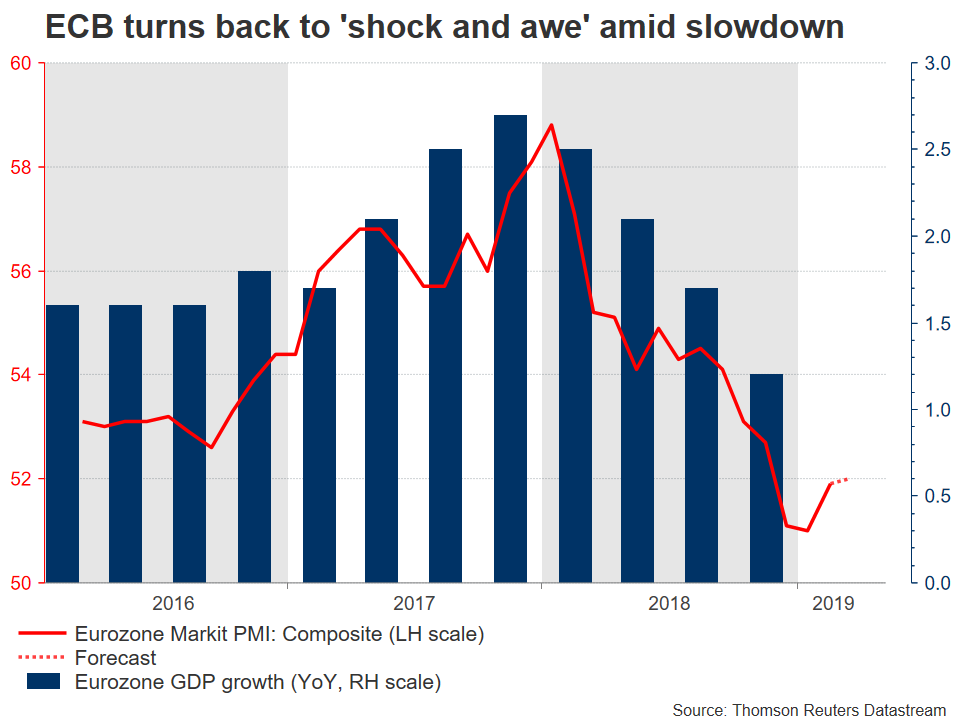
Forecasts point to an uptick in the manufacturing index but a downtick in the services figure, which would keep the composite PMI roughly unchanged, albeit at a low level. Such prints are unlikely to provide meaningful relief to the battered euro as they would merely confirm the economy continues to struggle, vindicating the ECB’s go-slow approach.
Germany’s ZEW survey for March is also due out a few days earlier, on Tuesday.
Commodity-linked currencies to take their cue from data
It will be a busy week for the antipodean currencies too, the aussie and kiwi, as well as for the Canadian dollar. Starting with Australia, the minutes of the latest RBA meeting will be released early on Tuesday, ahead of the nation’s latest employment data on Thursday.
In New Zealand, GDP growth figures for Q4 are due on Wednesday, and may be instrumental in shaping market expectations around whether the RBNZ will cut interest rates later this year.
In Canada, inflation figures for February and retail sales for January will all be published on Friday.
Japanese inflation prints also due, but risk flows more important for yen
In Japan, inflation data for February will attract attention. Headline inflation collapsed to a mere 0.2% in yearly terms in January, though that seems owed to a plunge fresh food prices, as the core rate that excludes that category stands at a healthier 0.8%. Admittedly though, 0.8% isn’t anything to celebrate either, especially considering the unprecedented stimulus the BoJ has unleashed in recent years.
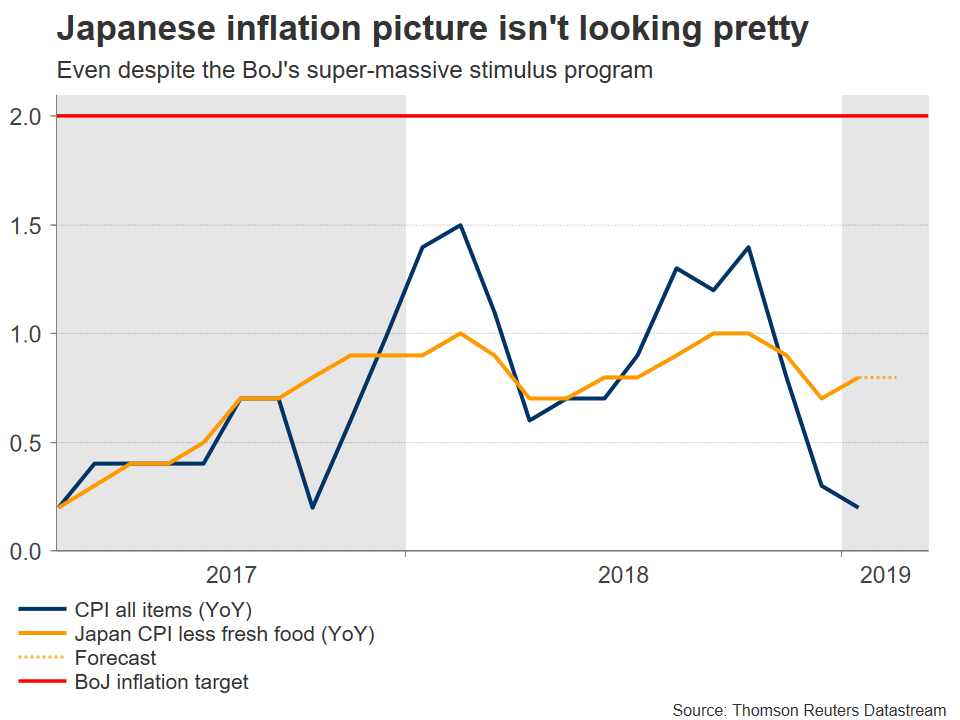
As for the yen, economic data tend to have little effect on the currency, mainly because the BoJ isn’t expected to adjust its massive stimulus program at all going forward. Instead, the Japanese currency may continue to be driven by risk flows, given its safe haven status. In this sense, the biggest upside risk for the yen may be a further deterioration in the global economic outlook that leads domestic investors to cut their exposure to foreign assets, and repatriate funds back to Japan.
Weekly Focus: Norges Bank to Hike as EU Decides on Brexit Extension
Market movers ahead
- On Thursday, we expect Norges Bank to raise its policy rate by 25bp to 1.00% and signal one further rate hike this year.
- We expect the EU27 to accept an extension of Brexit when they meet on Thursday-Friday.
- The Fed is on hold while lowering the 'dot' signal for 2019 to one hike (from two).
- The Bank of England is in no hurry to raise rates in the current environment.
- Preliminary Markit PMIs for euro area, Japan and the US are due out next week. In particular, we hope to see some stabilisation in the euro area PMIs soon.
- In Sweden, Valueguard property prices are due out Monday morning.
Weekly wrap-up
- A dramatic Brexit week ended as expected, as the House of Commons rejected May's deal, rejected leaving the EU without a deal but supported asking the EU27 for an extension. The decision has to be taken unanimously by the EU27 leaders.
- The US-China trade war summit between Trump and Xi Jinping has been delayed at least until April.
- No monetary policy change from the Bank of Japan this week.
- Euro area industrial production surprised on the upside, supporting our view that euro area activity is starting to recover some ground here in Q1 from the weak H2 18.
Full report in PDF.
USD/JPY Mid-Day Outlook
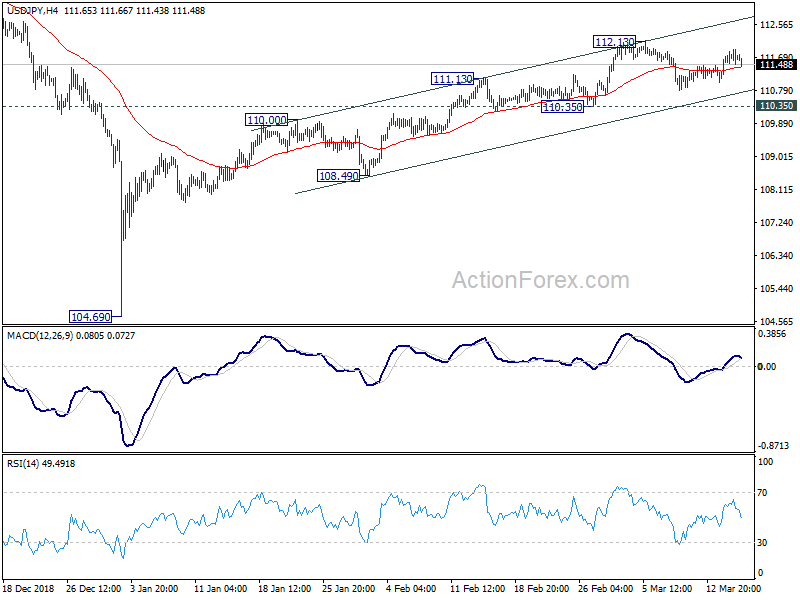
Daily Pivots: (S1) 111.27; (P) 111.56; (R1) 111.98; More...
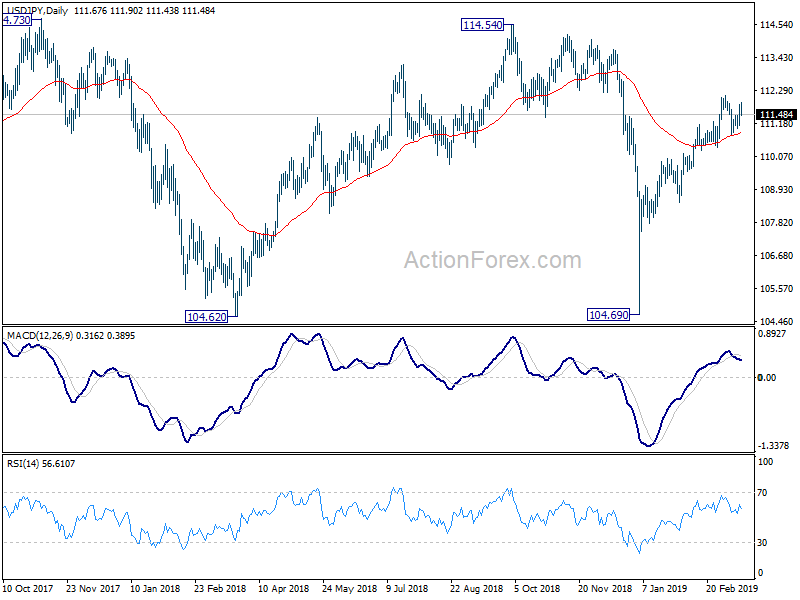
USD/JPY is staying in consolidation from 112.13 and intraday bias remains neutral. As long as 110.35 support holds, near term outlook remains bullish and rise from 104.69 is expected to resume. On the upside, break of 112.13 will target 114.54 resistance next. However, firm break of 110.35 should confirm near term reversal and turn outlook bearish for 108.49 support and below.
In the bigger picture, strong rebound from 104.69 argues that decline from 118.65 (2016 high) has completed with three waves down to 104.69, after failing 104.62. More importantly, the rise from 98.97 (2016 low) could be resuming. Decisive break of 114.54 resistance will add more credence to this bullish case and target 118.65. This will now be the favored case as long as 110.35 support holds. However, firm break of 110.35 will mix up the medium term outlook again and turn focus back to 104.69 low.
GBP/USD Mid-Day Outlook
Daily Pivots: (S1) 1.3181; (P) 1.3269; (R1) 1.3329; More....
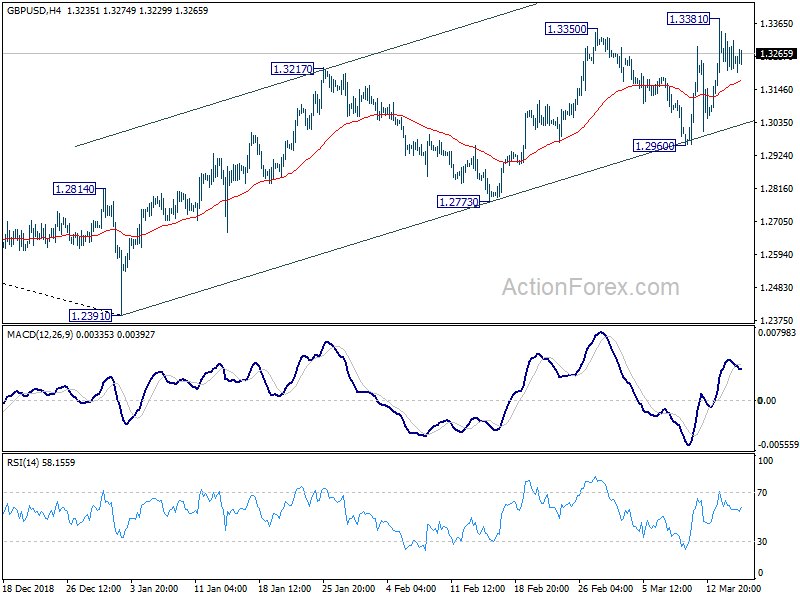
GBP/USD is staying in consolidation below 1.3381 temporary top and intraday bias remains neutral first. As long as 1.2960 support holds, further rally is expected. On the upside, firm break of 1.3381 will resume whole rebound from 1.2391 low to 61.8% retracement of 1.4376 to 1.2391 at 1.3618 next. However, on the downside, firm break of 1.2960 will indicate that rebound from 1.2391 has completed earlier than expected. Deeper fall would then be seen to 1.2773 support for confirmation.
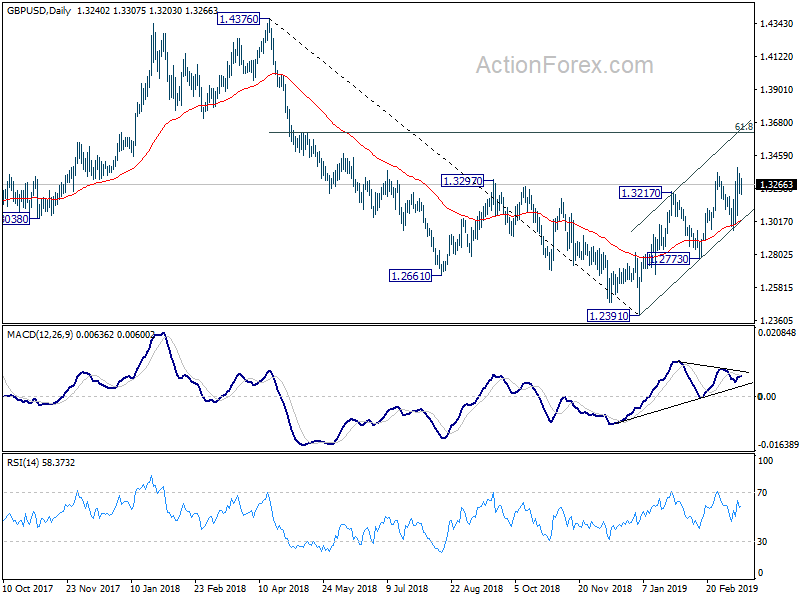
In the bigger picture, medium term decline from 1.4376 (2018 high) should have completed at 1.2391. Rise from 1.2391 is now seen as the third leg of the corrective pattern from 1.1946 (2016 low). Further rise could be seen through 1.4376 in medium term. On the downside, though, break of 1.2773 support will dampen this view. Focus will be turned back to 1.2391 low and break will resume the fall from 1.4376 to 1.1946.
USD/CHF Mid-Day Outlook
Daily Pivots: (S1) 1.0025; (P) 1.0038; (R1) 1.0050; More....
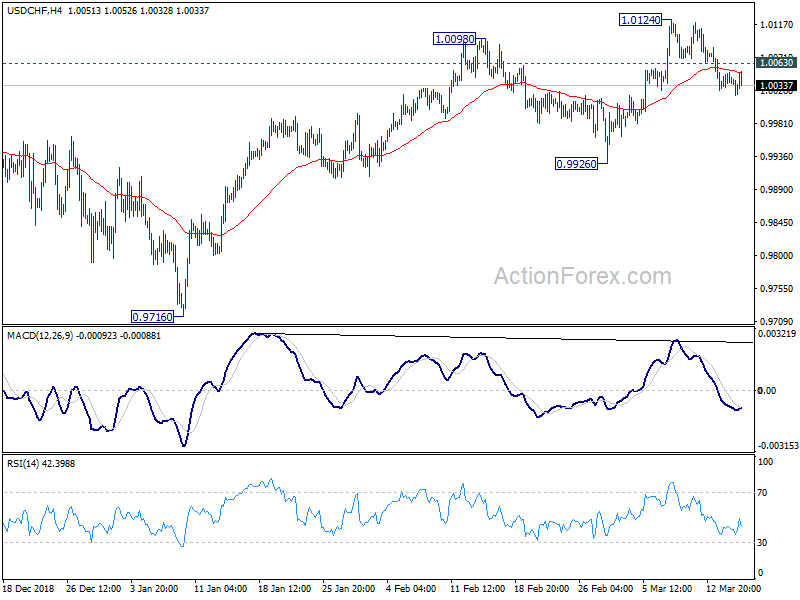
With 1.0063 minor resistance intact, further decline is expected in USD/CHF. Current development argues that rise from 0.9926 could have completed at 1.0124 already. USD/CHF should target 0.9926 key support level. Break will carry larger bearish implication. On the upside, though, break of 1.0063 minor resistance will turn bias back to the upside for retesting 1.0124 instead.
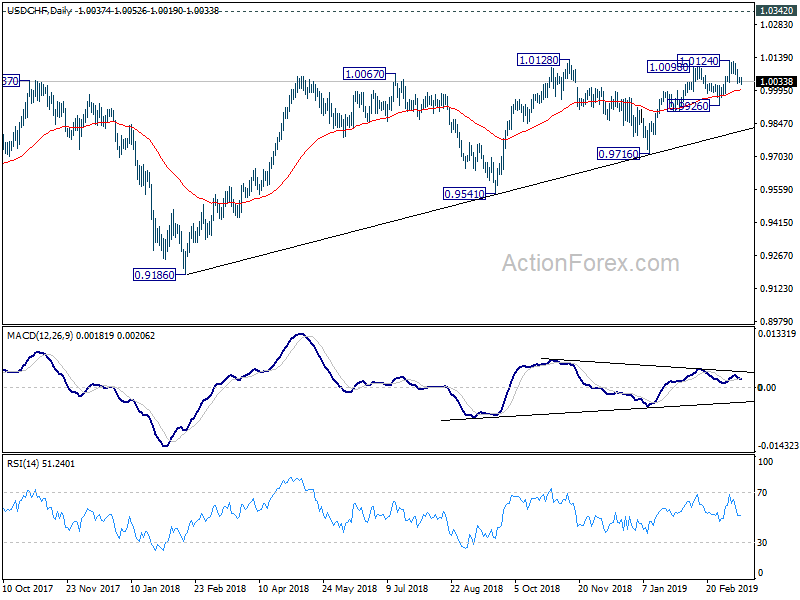
In the bigger picture, USD/CHF drew strong support from medium term trend line and rebounded. That suggests rise from 0.9186 is still in progress. Further break of 1.0128 will confirm up trend resumption and target 1.0342 key resistance. Nevertheless, break of 0.9926 support will be the first signal of medium term reversal and bring another test on the trend line.
NZDUSD Latest Rebound May Stall in Short-Term
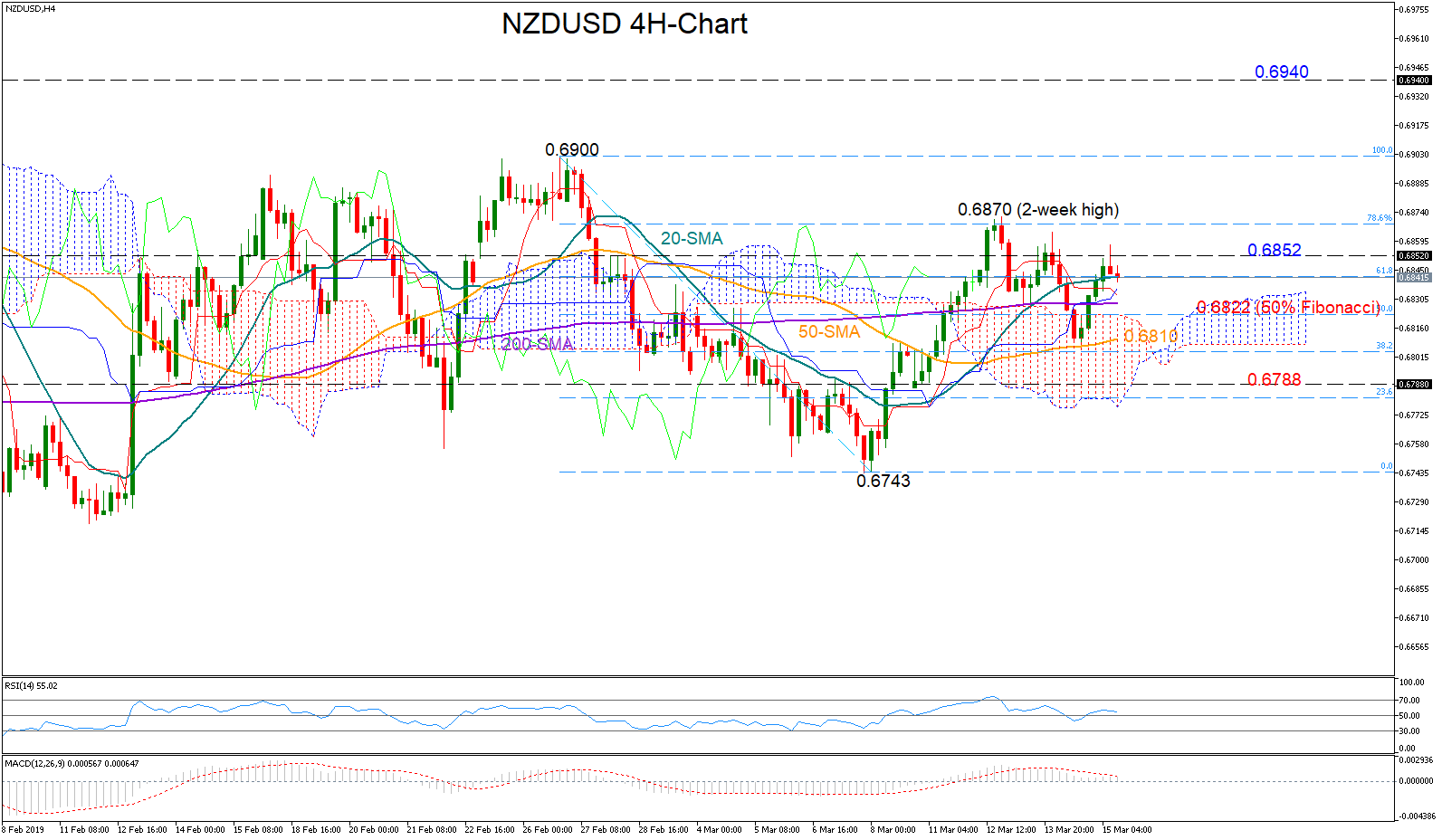
NZDUSD corrected below two-week lows after the RSI reached overbought territory, with the price launching slightly above the 50-period moving average in the four-hour chart on Thursday. On Friday the market resumed bullish momentum, but with the RSI reversing towards its 50 neutral threshold and the MACD moving under its red signal line, the recovery may probably not continue in the short term.
The 50% Fibonacci of 0.6822 of the downleg from 0.6900 to 0.6743 could act as support in case selling pressure strengthens. Another leg lower would open the door for the 50-period MA which currently stands at 0.6810 and marginally above the 38.2% Fibonacci. Should the price continue to decline, attention will shift straight down to the 0.6788 level, a key barrier during February.
On the upside, the area between 0.6852 and 0.6870 will be closely watched if bullish action returns. A rally above this region would bring the 0.69 peak into view, which if broken could shift attention towards the 0.6940 level taken from the high on February 1.
In the bigger picture, NZDUSD is holding a neutral profile within the 0.69-0.6740 area.
EUR/USD Mid-Day Outlook
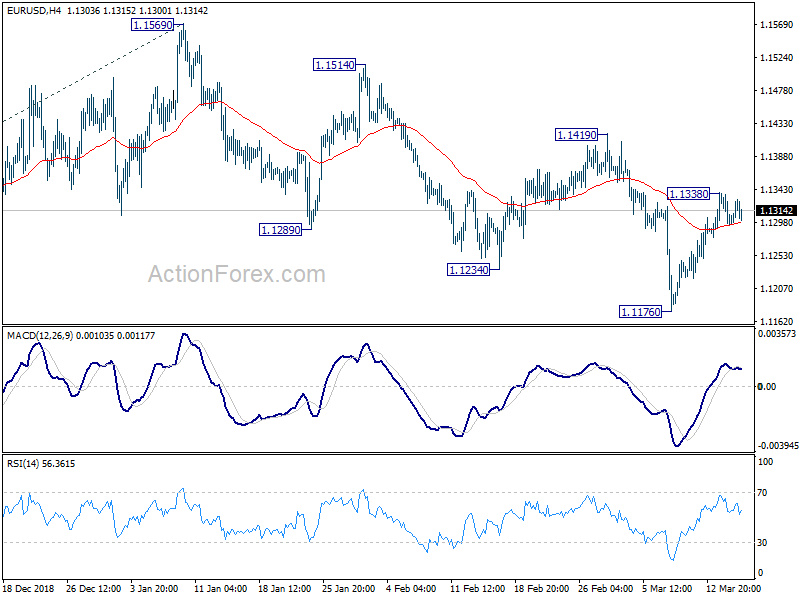
Daily Pivots: (S1) 1.1284; (P) 1.1313; (R1) 1.1334; More.....
EUR/USD is staying in tight range below 1.1338 and intraday bias remains neutral first. Rebound from 1.1176 is seen as a corrective move. In case of another rise, upside should be limited well below 1.1419 resistance to bring fall resumption. On the downside, break of 1.1176 will extend the down trend from 1.2555 and target 100% projection of 1.1814 to 1.1215 from 1.1569 at 1.0970 next.
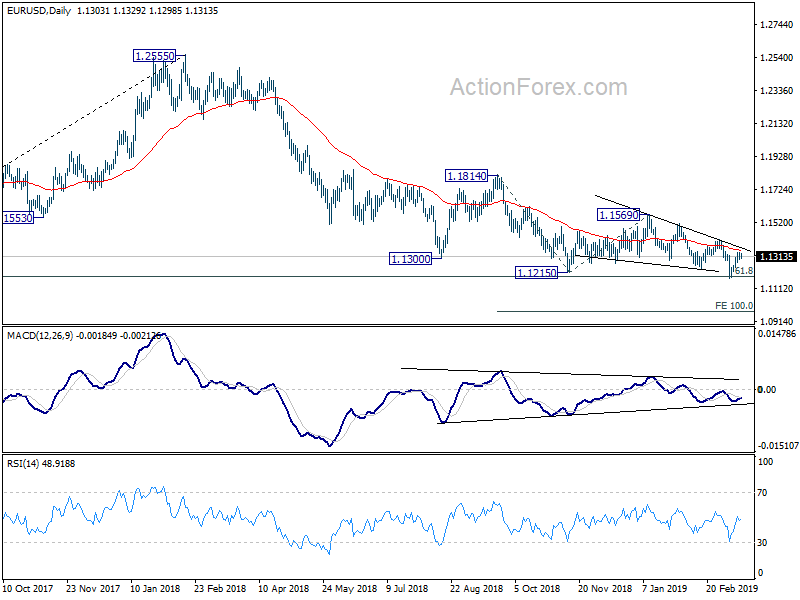
In the bigger picture, down trend from 1.2555 medium term top is still in progress. Bearishness is affirmed by sustained trading below falling 55 week EMA. 61.8% retracement of 1.0339 (2017 low) to 1.2555 at 1.1186 is met. Sustained break there will pave the way to retest 1.0339. On the upside, break of 1.1569 resistance will now indicate completion of such down trend and turn medium term outlook bullish.
Markets Mixed ahead of Weekend, Lack Direction
The forex markets turned mixed ahead of weekend as there is a lack of theme driving the moves. Swiss France turned weakest global stock markets jump mildly. Canadian Dollar is the second weakest as WTI crude oil retreats sharply ahead of 60 handle. Sterling is the third weakest as the length of Brexit extension, be it three months or much longer, will not be known before the third meaningful vote on the Brexit deal next week. On the other hand, New Zealand and Australian Dollar are the strongest ones.
For the week, Sterling remains the strongest one. No-deal Brexit is now politically ruled out even though it's still technically possible. Euro follows as the second strongest, and then New Zealand Dollar. Yen remains the weakest one, followed by Dollar. It's now highly unlikely for US and China to seal a trade agreement this month. Trump said there will be news on the topic in three to four weeks. But it's actually getting more unlikely for a Trump-Xi summit to happen even in April.
In other markets, FTSE is currently up 0.61%. DAX is up 0.93%. CAC is up 0.89%. German 10-year yield is down -0.0102 at 0.078. Earlier in the Asia, Nikkei rose 0.77%. Hong Kong HSI rose 0.56%. China Shanghai SSE rose 1.04%. Singapore Strait Times rose 0.07%. Japan 10-year JGB yield rose 0.0044 to -0.036.
US Empire State Manufacturing index dropped to 3.7
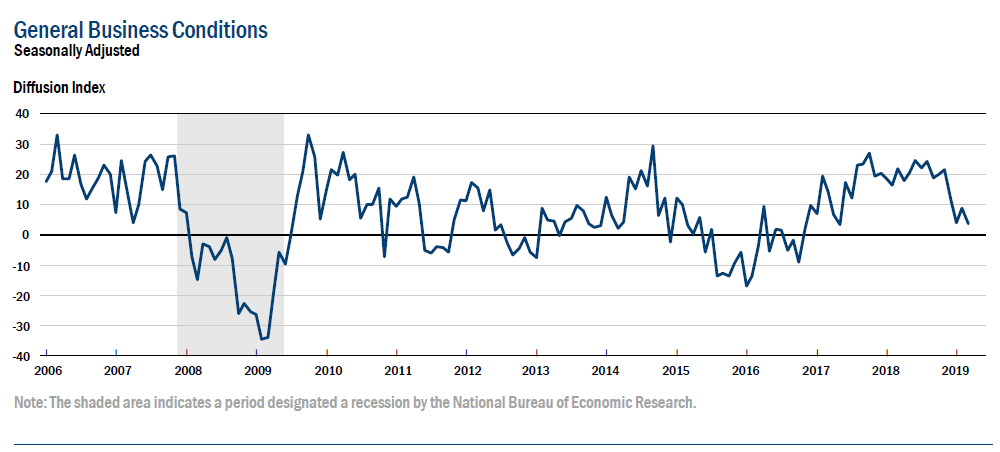
US Empire State Manufacturing index dropped to 3.7 in March, down from 8.8 and missed expectation of 10. It's also the third consecutive month of sub-10 reading, suggesting "growth has remained quite a bit slower so far this year than it was for most of 2018. Looking at some details, new orders index dropped -5pts to 3.0, indicating orders grew at a slower pace. Shipments dropped -3 pts to 7.7, indicating modest shipments growth. Employment index rose to 13.8. But average work week turned negative for the firs time since 2016, at -3.4.
Industrial production rose 0.1% mom in February, below expectation of 0.4% mom. Capacity utilization dropped 0.1% to 78.2%.
ECB Rehn urged policy framework rethink as interdependence of economy and inflation weakened
ECB Governing Council member Olli Rehn urged the central bank to rethink it's policy framework after failing to lift inflation back to target. One explanation for the failure could is that "trust in central banks' ability to influence the inflation rate may have eroded."
He noted that "the interdependence of economic activity and inflationary pressures seems to have weakened in recent years." And, "should this phenomenon prove to be lasting, it would imply a weakening of the impact monetary policy exerts on inflation via aggregate demand."
But he also emphasized that "this would not mean questioning the primary objective of price stability". Instead, the policy rethink would "entail a comprehensive review of the guiding principles, key assumptions and tools used for the implementation of monetary policy".
Eurozone CPI finalized at 1.5% in Feb, core at 1.0%
Eurozone CPI was finalized at 1.5% yoy in February, up from January's 1.4% yoy. Core CPI was finalized at 1.0%yoy, down from 1.1% yoy. EU CPI was finalized at 1.6% yoy, up from 1.6%.
The lowest annual rates were registered in Ireland (0.7%), Greece, Croatia and Cyprus (all 0.8%). The highest annual rates were recorded in Romania (4.0%), Hungary (3.2%) and Latvia (2.8%). Compared with January 2019, annual inflation fell in seven Member States, remained stable in one and rose in nineteen.
UK Lidington still hope to leave EU asap in orderly fashion
UK Cabinet Minister David Lidington told BBC radio the default for the government is still to leave the EU on March 29. He said "I hope still we can leave as soon as possible in an orderly fashion but that depends upon parliamentary approval both in principle of a withdrawal agreement but also then the implementing legislation that has to follow before lawfully we can ratify that treaty".
And, by the end of March we have to have an alternative in place, not just a resolution of the House of Commons, a preference, but a solution in place that enables us to have an extension so there isn't crash out on March 29."
German Justice Minister Katarina Barley told rbb broadcaster that "the EU would be ready to delay Brexit, but one has to have a plan on what is supposed to happen during this period." She added that delaying Brexit doesn't bring a solution.
BoJ Kuroda: Likely to take longer to achieve inflation target
BoJ kept monetary policy unchanged today as widely expected. Short term interest rate is held at -0.1%. The central bank will continue to buy JGBs to keep 10-year yield at around zero percent. But yields are allowed to move upwards and downwards to some extent. Annual pace of monetary expansion is kept at around JPY 80T. Goushi Kataoka and Yutaka Harada dissented again in 7-2 vote.
BoJ continues to expect the economy to continue its "moderate expansion". However, it noted that the economy is "being affected by the slowdown in overseas economies for the time being". In particular, exports are projected to "show some weakness" for the time being. CPI is still "likely to increase gradually toward 2 percent".
In the post meeting press conference, BoJ Governor Haruhiko Kuroda admitted that "Japan's exports and output are being affected by lean overseas growth". However, he also pointed out "domestic demand continues to grow." Hence, BoJ maintained the baseline view that "economy is expanding moderately". Though, regarding inflation he said "it is likely to take longer to achieve our target".
Kuroda also defended BoJ's policy and noted "We are not saying that we only care about achieving our price target." Instead, BoJ's goal is that "prices should rise gradually, reflecting an improvement in corporate profit and job growth rate". For now, there is no need to make any change to the price target.
EUR/USD Mid-Day Outlook
Daily Pivots: (S1) 1.1284; (P) 1.1313; (R1) 1.1334; More.....
EUR/USD is staying in tight range below 1.1338 and intraday bias remains neutral first. Rebound from 1.1176 is seen as a corrective move. In case of another rise, upside should be limited well below 1.1419 resistance to bring fall resumption. On the downside, break of 1.1176 will extend the down trend from 1.2555 and target 100% projection of 1.1814 to 1.1215 from 1.1569 at 1.0970 next.
In the bigger picture, down trend from 1.2555 medium term top is still in progress. Bearishness is affirmed by sustained trading below falling 55 week EMA. 61.8% retracement of 1.0339 (2017 low) to 1.2555 at 1.1186 is met. Sustained break there will pave the way to retest 1.0339. On the upside, break of 1.1569 resistance will now indicate completion of such down trend and turn medium term outlook bullish.
Economic Indicators Update
| GMT | Ccy | Events | Actual | Forecast | Previous | Revised |
|---|---|---|---|---|---|---|
| 21:30 | NZD | BusinessNZ Manufacturing PMI Feb | 53.7 | 53.1 | 53 | |
| 02:40 | JPY | BoJ Rate Decision | -0.10% | -0.10% | -0.10% | |
| 10:00 | EUR | Eurozone CPI M/M Feb | 0.30% | 0.30% | -1.00% | |
| 10:00 | EUR | Eurozone CPI Y/Y Feb F | 1.50% | 1.50% | 1.40% | |
| 10:00 | EUR | Eurozone CPI Core Y/Y Feb F | 1.00% | 1.00% | 1.00% | 1.10% |
| 12:30 | CAD | Manufacturing Sales M/M Jan | 1.00% | 0.40% | -1.30% | -1.10% |
| 12:30 | USD | Empire State Manufacturing Index Mar | 3.7 | 10 | 8.8 | |
| 13:15 | USD | Industrial Production M/M Feb | 0.10% | 0.40% | -0.60% | -0.40% |
| 13:15 | USD | Capacity Utilization Feb | 78.20% | 78.50% | 78.20% | 78.30% |
| 14:00 | USD | U. of Mich. Sentiment Mar P | 95.6 | 93.8 |
GBPJPY Heads Higher Towards Key Resistance Level
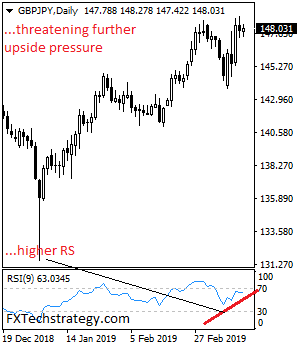
GBPJPY heads higher towards key resistance level as it retain its short term uptrend. On the downside, support comes in at the 147.50 level where a violation will aim at the 147.00 level. A break below here will target the 146.50 level followed by the 146.00 level. Conversely, resistance is seen at the 148.50 level followed by the 149.00 level. A cut through that level will set the stage for a move further higher towards the 149.50 level. Further out, resistance resides at the 150.00 level. Its daily RSI bullish and pointing higher suggesting further strength. All in all, GBPJPY looks to strengthen further lower.
US Empire State Manufacturing index dropped to 3.7
US Empire State Manufacturing index dropped to 3.7 in March, down from 8.8 and missed expectation of 10. It's also the third consecutive month of sub-10 reading, suggesting "growth has remained quite a bit slower so far this year than it was for most of 2018.
Looking at some details, new orders index dropped -5pts to 3.0, indicating orders grew at a slower pace. Shipments dropped -3 pts to 7.7, indicating modest shipments growth. Employment index rose to 13.8. But average work week turned negative for the firs time since 2016, at -3.4.