Sample Category Title
The U.S. Dollar Weakened On Friday
USD
The U.S. dollar weakened on Friday amid the jobs report which dented the market sentiment which was already turning sour. Concerns of a global slowdown engulfed the equity markets. This sent the U.S stock markets weaker with a minor risk on sentiment that prevailed.
China
Data from China showed that dollar-denominated exports had fallen 20.7% in February. This was a bigger than expected slump as economists forecast a decline of just 4.8%. Imports were down 5.2% against expectations of a 1.4% decline. The trade surplus for China came to $4.12 billion which was much below the $26.38 billion anticipated.
Over the weekend, China's inflation data showed that consumer prices eased to an annual pace of 1.5% on the year in February as had been expected. This marked a weaker pace compared to the 1.7% increase the month before. Producer prices index rose 0.1% on the year as expected.
Europe
Economic data on the day showed that Germany's factory orders fell 2.6% on the month in January, missing estimates of a 0.5% increase. January's decline followed December's gain of a revised 0.9% increase.
French industrial production figures were also better than expected, rising 1.3% on the month. This beat estimates of a 0.1% increase while Italian industrial production rose 1.3%.
NY Trading Session
The NY trading session saw Canada's housing starts adding just 173k which missed estimates of an increase to 204k. The monthly employment report showed that Canada added 55.9k jobs during February. This surpassed estimates of a 0.6k increase for the month. The unemployment rate held steady at 5.8% as expected.
The main highlight of the day was the U.S. payrolls report. Following the weak release of ADP private payrolls, data showed that the economy added just 20k jobs during February. This missed estimates of a 180k increase. Data for January was revised up to show 311k jobs added during the month.
Average hourly earnings rose 0.4% beating estimates of a 0.3% increase. Meanwhile, the unemployment rate dipped to 3.8% against forecasts of a drop to 3.9%. In January, the U.S. unemployment rate came in at 4.0%. Building permits and housing starts data released later in the day showed an increase of 1.35 million and 1.23 million respectively.
The Fed
Fed Chair Jerome Powell was speaking over the weekend. In Stanford, California, Powell said that the Fed was in no rush to hike rates amid muted inflation. "Despite this favorable picture, we have seen some cross-currents in recent months," Powell stated regarding labor markets.
"With nothing in the outlook demanding an immediate policy response and particularly given muted inflation pressures, the committee has adopted a patient, wait-and-see approach to considering any alteration in the stance of policy,'
These comments came in a week ahead of the March FOMC meeting.
Today's Schedule
Looking ahead, the economic data today kicks off with Germany's industrial production figures. Economists forecast industrial production to rise 0.5% on the month following a decline of 0.4% in December. Trade balance figures later follow this.
The NY trading session is relatively quiet. The retail sales figures are due for January and economists estimate a 0.4% increase in core retail sales. This follows a big dip of 1.8% for the month before. Headline retail sales are expected to remain unchanged for the month after falling 1.2% previously.
GBPUSD Heavily Bearish Under 1.2970
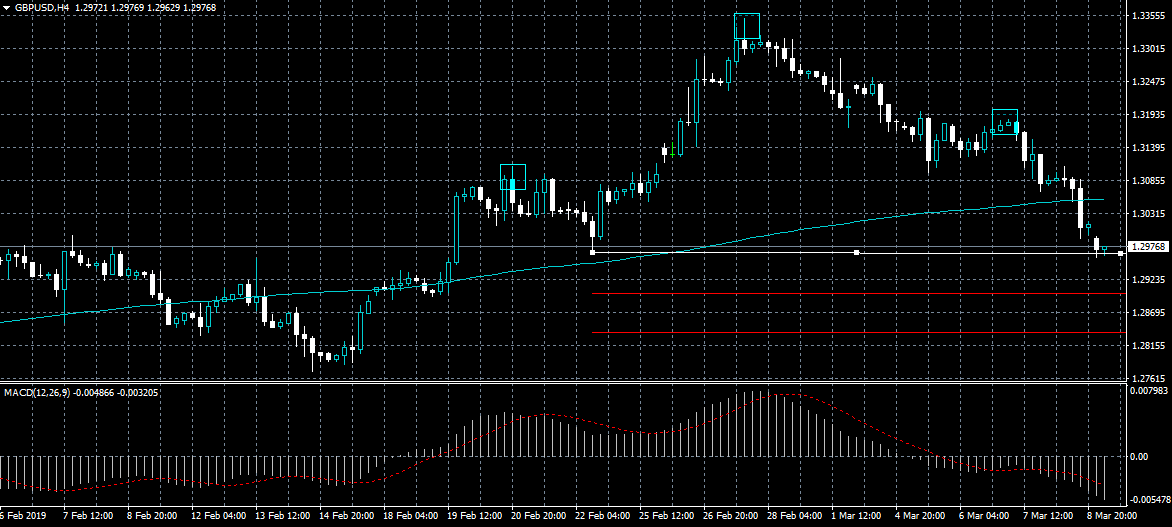
The British pound has opened the new trading week under further downside against the US dollar, as fear of a hard-Brexit scenario increase. The GBPUSD pair has broken below the psychological 1.3000 level and is trading close to the neckline of a large head and shoulders pattern on the four-hour time frame. The overall target for the bearish head and shoulders pattern is around three-hundred and seventy pips below the 1.2975 level.
The GBPUSD pair is heavily bearish while trading below the 1.2975 level, key technical support is found at the 1.2900 and 1.2840 levels
If the GBPUSD pair trades above the 1.3000 level, buyers may test towards the 1.3130 and 1.3055 resistance levels.
EURUSD Bearish Under 1.1230
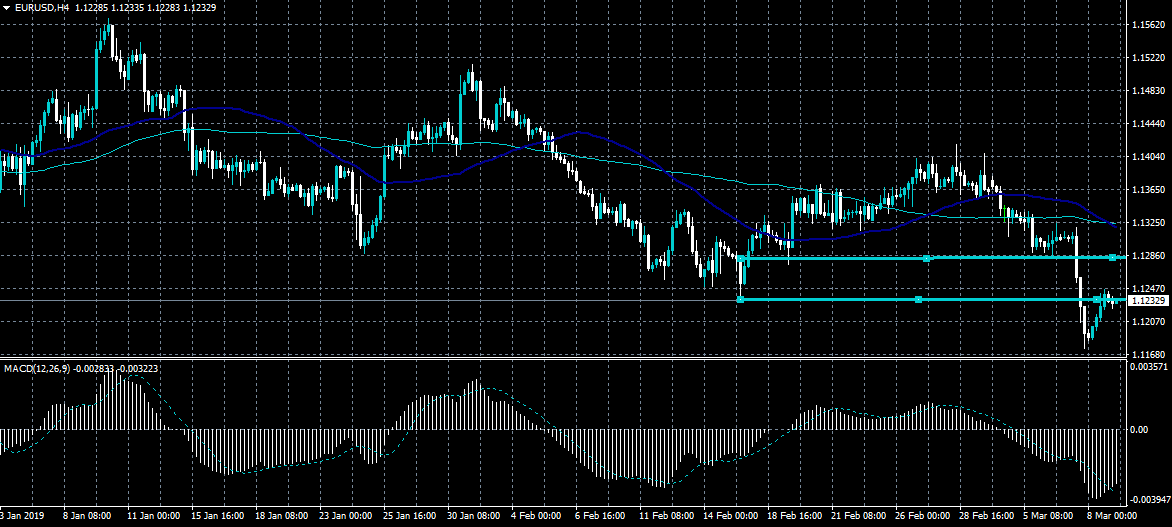
The euro currency is attempting to recover higher against the US dollar in early Monday trade, with the pair testing above key neckline resistance. If short-term buyers take back control of price-action above the 1.1230 level, the EURUSD pair could correct back towards the 1.1290 level. The MACD indicator on the four-hour time frame is also attempting to correct from oversold territory.
The EURUSD pair is intraday bearish while trading below the 1.1230 level, key technical support is found at the 1.1200 and 1.1170 levels.
If the EURUSD pair moves above the 1.1230 level, buyers may test towards the 1.1260 and 1.1290 levels.
US Stocks Continue Losing Streak As Global Growth Fears Mount
On Friday, US stocks ended the day lower after the huge miss on the jobs’ numbers. According to the Labor Department, the economy added just 20K jobs in February, which was lower than the consensus estimates of more than 180K. The numbers led to a sharp decline in stocks, marking the fifth day of consecutive declines as investors continued to worry about global growth. Today, futures point to a lower open with the Dow shedding 90 points. Also today, with no major economic data from the US, investors will focus on Boeing, which is a member of the Dow index. This is after a major accident with its new Boeing 737-Max, in Ethiopia, killing more than 150 people.
The price of gold rose slightly today as deal-making in the sector increased. Over the weekend, it was announced that Newcrest Mining was preparing to pay more than $800 million for New Chris Mining, which is owned by Imperial Metals Corporation. While this is a small deal, it shows the levels at which miners are going to achieve growth as gold becomes rare and costs to mine increase. This year, Newmont Mining announced that it will acquire Goldcorp for more than $8 billion. Shortly afterwards, Barrick Gold announced a hostile takeover of Newmont, which would create the biggest gold mining company in the world. This follows the merger of Sibanye and Stillwater in 2016 and last year’s acquisition of Randgold by Barrick Resources.
Traders will receive more trade-related data today. In the morning hours, they will receive the export and import data from Germany. The exports are expected to decline by 0.5%, which will be lower than the growth of 1.5% a month ago. Imports are expected to increase by 0.2%, which is slightly lower than the previous 1.2%. The trade surplus is expected to increase to €21.2 billion, which will be higher than the previous €19.4 billion. These numbers will come a week after the US trade deficit jumped to a 10-year high.
EUR/USD
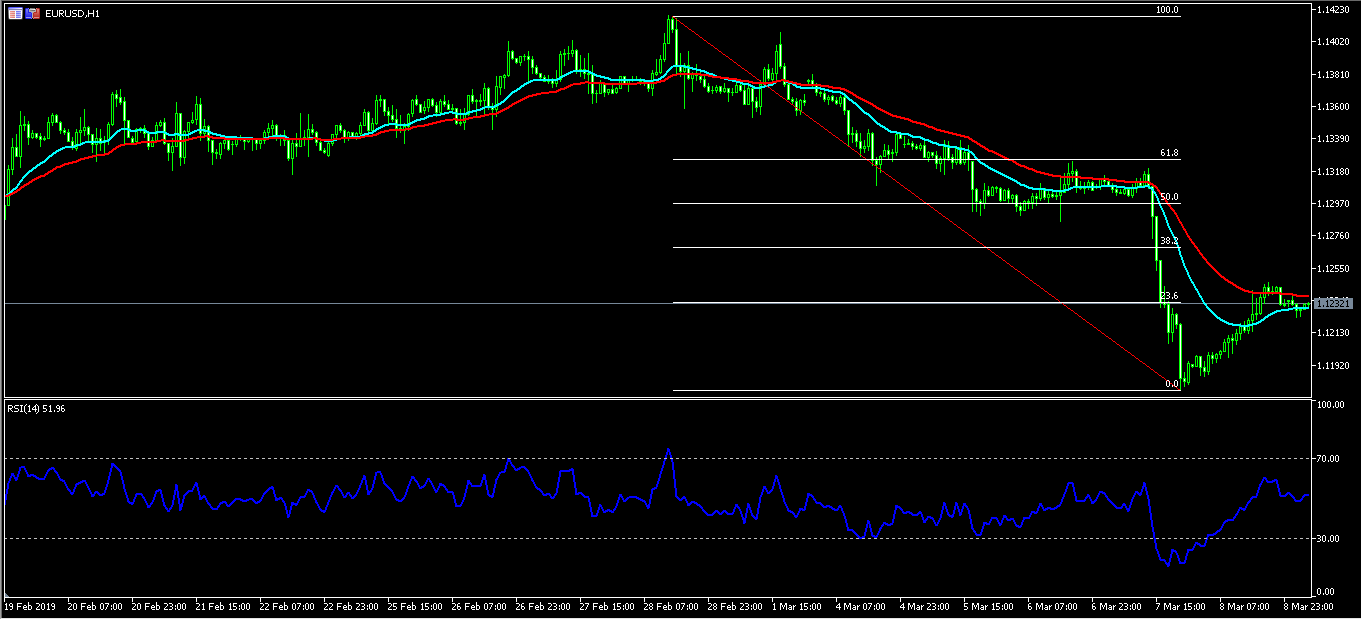
The EUR/USD pair was relatively unmoved in early trading as traders waited for key data from Europe and US, which will release its retail sales data. The pair is currently trading at 1.1232, which is slightly above last week’s low of 1.1175. It is also along the 21.6% Fibonacci Retracement level. This price is slightly along the 42-day and 21-day EMAs while the RSI has moved above the 50. The pair could move higher today to test the 38.6% Fibonacci level of 1.1270 or move lower to test the previous lows of 1.1175.
XAU/USD
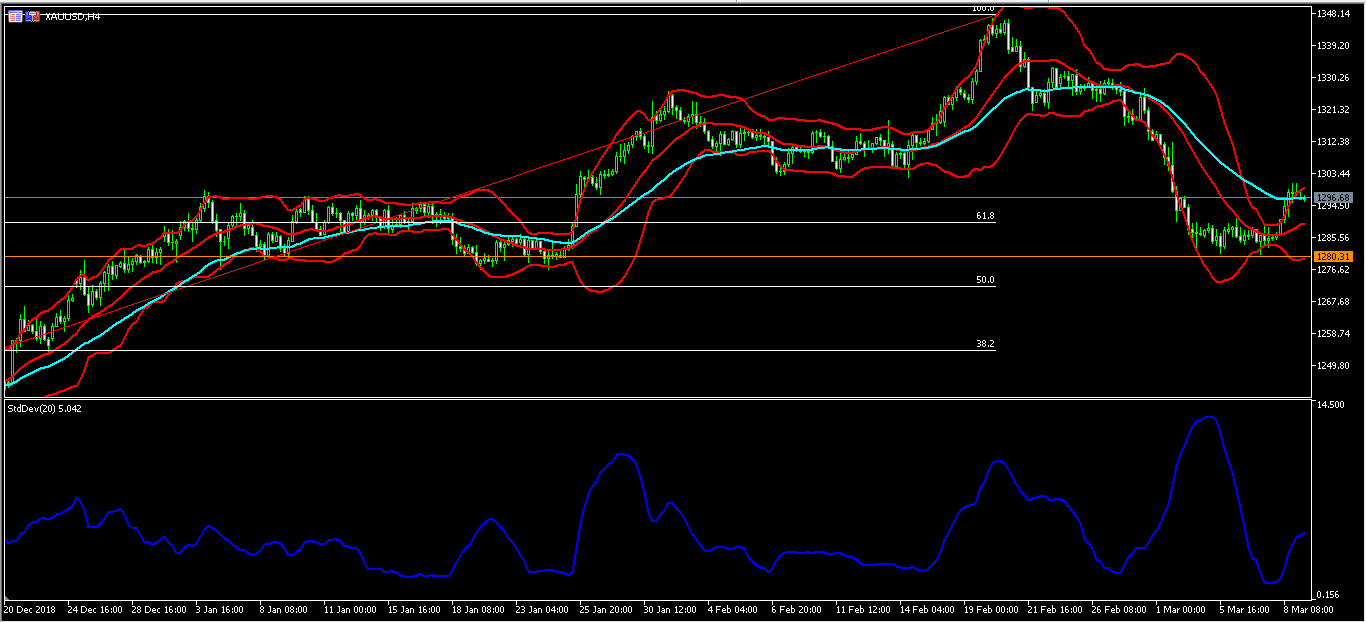
The XAU/USD pair moved slightly higher today as traders cheered the new wave of consolidation in the gold-mining sector. The pair is currently trading at 1296, which is higher than last week’s low of 1280. This level is along the higher line of the Bollinger Bands. The Standard Deviation has been rising while the pair is along the 42-day moving average. The pair will likely continue moving up. Alternatively, it could drop to the 50% Fibonacci Retracement level of 1270.
GBP/USD
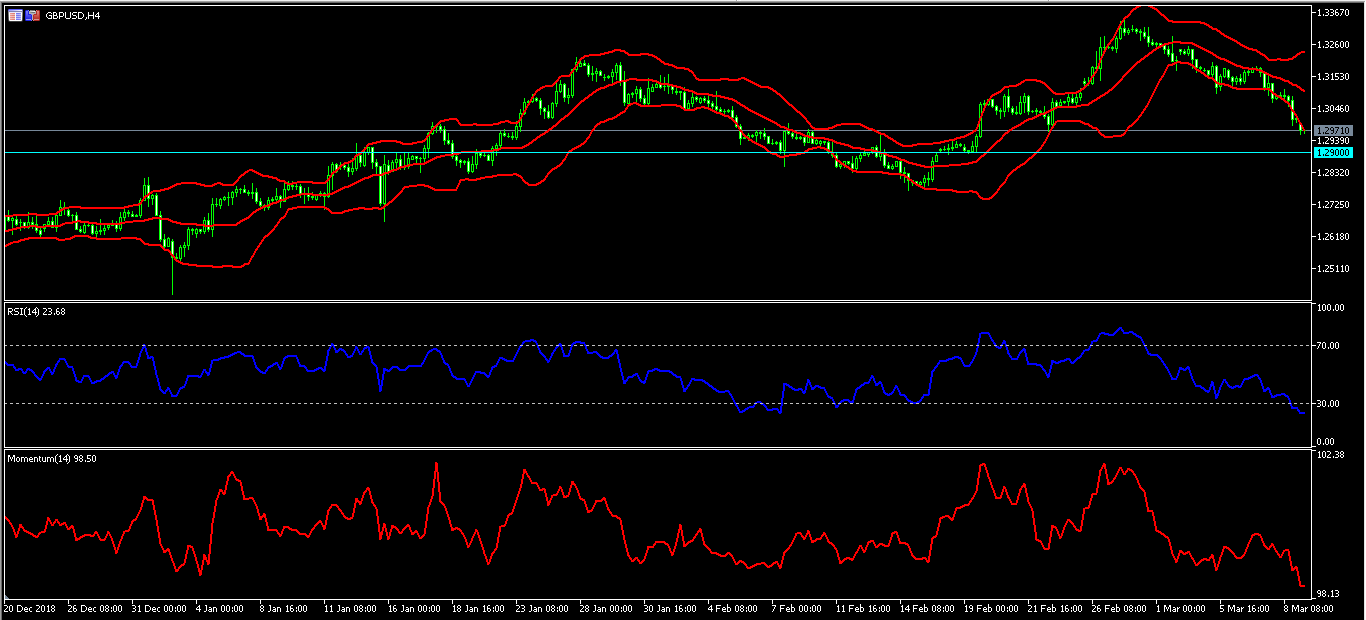
The GBP/USD pair declined today as the deadline for a Brexit deal neared. The pair reached a low of 1.2960, which is along the lower line of the Bollinger Bands on the four-hour chart. The pair is below the oversold level of 30 while the momentum indicator has fallen sharply. The pair could continue moving lower if there are signs that a deal will not be reached. If it does, it will likely test the 1.2900 support level.
Is The Bull Market Under Threat?
It has been a decade since the bull market started back in March 2009. If you dared to invest back then in the US's largest 500 companies, you would have earned more than 300% in returns by now. Ten years into this bull market, the main question now being asked, how much longer can it last?
The bull market has been supported by multiple factors, including steady global economic recovery, cheap money from central banks, record corporate profits and buybacks, and lastly came corporate tax reforms.
Predicting an end to the bull market has always proven a hard call. Bull markets do not expire as they age, but they also do not last forever. One factor that could lead to the end of a bull market is sentiment. When people become tremendously terrified about the economy's performance, they begin to exit.
Last Friday's US jobs data was the latest economic figure showing cracks in the world's largest economy. Despite the unemployment rate droppingto 3.8% from 3.9%, and wage growth acceleratingto 3.4% from 3.1% over the past 12 months, it was the headline number that took markets by surprise. The US economy added only 20,000 jobs in February versus estimates of 180,000. That's a big shock and could certainly indicate the US labor market has reached its full capacity for the current economic cycle. Unless we see an upward revision in March's reading, investors will become increasingly worried.
The poor jobs number came after a series of weak economic data from China and Europe, taking Citi's economic surprise index deeply into the red.
Will Central Banks Intervene?
Central banks have already begun providing signals to intervene. On Thursday, the ECB followed the Federal Reserve's steps by taking a U-turn in policy and revivinga stimulus programme to provide banks with new liquidity “TLTRO”. Interestingly though, the market's reaction wasn't positive, with all major European indices ending the day in red. This shows that central banks' ability to prevent a slowing economy is weakening, given the limited tools currently available.
While central banks have been investors' real friend throughout the past decade, it's now more about how the economy performs in the coming months, and whether we see a significant recovery in the second half of 2019.
Brexit vote
Sterling is the currency to watch this week while traders await Tuesday's vote on Theresa May's Brexit deal with the EU. Passing the deal will be a big positive surprise to Sterling, but chances are too low. It seems the question is whether we get Brexit delayed or crash out on March 29 without a deal. So far a delayed Brexit is what's mostly priced in, and any other scenario will lead to big moves.
Chinese Banks Under Perform After Weaker Feb Lending Data
General Trend:
- The Chinese reportedly removed a trip to Mar-a-Lago from Pres Xi Jinping's calendar (Fox Business TV report from March 8th)
- Chinese markets gained in early trading, declined over 4% on Friday
- Shanghai IT shares outperform, financials lag
- Big banks, Auto, Real Estate and Iron/Steel shares rise in Japan, Softbank gains over 2%; Marine/Transportation and brokerage firms lag
- Declines in energy and resources sectors weigh on equity market in Australia
- China PBOC Official: February money supply data slowdown is normal, in line with historical trends
- USD/JPY remains weaker after recently released US employment data
- Boeing to postpone rollout ceremony for 777X after Ethiopian Airlines plane crash
- China Regulator orders all domestic airlines to suspend use of 737 Max
Headlines/Economic Data
Australia/New Zealand
- ASX 200 opened -0.2%
- (NZ) New Zealand Local Govt Funding Agency (LGFA) cancels proposed bond auction on March 13th
- (NZ) New Zealand Feb Car Spending Retail m/m: 0.9% v 0.3%e; Total m/m: 0.1% v 2.0% prior
- APX.AU To acquire Figure Eight Technologies for $175M plus earn-out consideration of A$60-80M, payable in March 2020
- AAC.AU Reports H1 extra operating expenses A$28.5M, H2 to be similar; Overall livestock losses due to flooding, lower than anticipated
- NCM.AU Enters agreement with Imperial Metals to acquire 70% stake in Red Mine for $806.5M
- AHZ.AU Cardiocel 3D and vascucel receives regulatory approval in Europe; commercial launch expected later this month; +57% in the session
- (AU) Australia RBA paper: Low interest rates (partly reflecting lower world long-term rates) explain much of the rapid growth in housing prices and construction over the past few years
Japan
- Nikkei 225 opened +0.2%
- Omron [6645.JP]: To be added to the Nikkei 225 index, replacing Pioneer; effective March 18th
- RNO.FR Renault, Nissan and Mitsubishi in talks on a new structure for alliance – FT
- (JP) Japan Transport Ministry orders airline maintenance firms to investigate possible misconduct - Japan Press
- (JP) Economists in Japan are split on recession concerns - Japanese Press
- (JP) Japan Feb Money Supply M2 y/y: 2.4% v 2.4%e; M3 y/y: 2.1% v 2.1%e
- (JP) Keidanren chief Hiroaki Nakanishi: Govt has overstepped by giving directives on what raises companies should give employees - press
Korea
- Kospi opens +0.1%
- (KR) South Korea said to be in close communication with US following reports related to North Korea restoring rocket site - financial press
- 000270.KR Considering halting production in Jiangsu China plant (production capacity 140K units/year) due to weak sales – Yonhap
- (KR) US National Sec Adviser Bolton: US is watching North Korean activities "unblinkingly"; in response to speculation that N. Korea could be preparing for another missile test – Yonhap
- (KR) South Korea March 1-10 Exports -19.1% y/y; Imports -15.4% y/y
- (KR) South Korea sells KRW1.5T v KRW1.5T indicated in 5-yr Govt bonds, avg yield 1.86% v 1.84% prior
China/Hong Kong
- Hang Seng opens +0.1%; Shanghai Composite opens flat
- (HK) Hong Kong Monetary Authority (HKMA): On March 8th sold US dollars for Hong Kong dollars of HK$1.51B as HKD traded at weak-side of US dollar trading band; notes significant widening in the interest rate gaps between the HKD and USD
- (CN) CHINA FEB CPI Y/Y: 1.5% V 1.5%E (13-month low); PPI Y/Y: 0.1% V 0.2%E
- (CN) CHINA FEB NEW YUAN LOANS (CNY): 885.8B V 975BE; Outstanding Loan Growth y/y: 13.4% v 13.4% prior
- (CN) CHINA FEB M2 MONEY SUPPLY Y/Y: 8.0% V 8.4%E; M1 MONEY SUPPLY Y/Y: 2.0% V 0.4% PRIOR; M0 Money Supply Y/Y: -2.4% v 17.2% prior
- (CN) China PBOC Official: February money supply data slowdown is normal, in line with historical trends
- (CN) China Feb Total Social Financing (CNY): 703B v 1.45Te
- (CN) China PBoC Gov Yi Gang: China faces financial sector challenges, world economy is facing downward pressure, will never devalue currency to boost exports; room to cut RRR to help reduce risk of sharper slowdown
- (CN) China PBoC Deputy Gov Pan: Will keep liquidity ample and set up counter cyclical adjustments; Will take timely measures on arbitrage activities in bill financing and curb risks (comments from yesterday)
- 2386.HK Reports FY18 (CNY) Net 1.7B v 1.1B y/y; Rev 47.0B v 36.2B y/y
- (CN) China Pres Xi reportedly removes visit to Mar-a-Lago from US trip itinerary - US Press
- (CN) China Vice Commerce Minister Wang Shouwen suggested extra tariffs [on China goods] should be lifted by the US if both sides resolve the remaining issues in trade talks - Japanese Press
- (CN) China PBoC Open Market Operation (OMO): Skips OMO (8th consecutive skip); Net: nil v nil prior
- (CN) China PBoC Sets Yuan Reference Rate: 6.7202 v 6.7235 prior
- (CN) China Feb Retail vehicle sales 1.19M units, -18.5% y/y (released on March 8th)
- (HK) Hong Kong Monetary Authority (HKMA): On March 8th sold US dollars for Hong Kong dollars of HK$1.51B as HKD traded at weak-side of US dollar trading band; notes significant widening in the interest rate gaps between the HKD and USD
North America
- (US) Fed Chair Powell: Reiterates Fed does not feel any hurry to change interest rates again; - Watching retail sales after weak Dec, some evidence sales rebounded in Jan - '60 Minutes' interview
- MLNX Said to be close to being acquired by NVIDIA in $7.0B cash deal - US financial press
- BA Ethiopian Airlines flying a new Boeing 737 Max, cashes shortly after takeoff, killing 157 people (2nd crash of the new 737 Max recently)
- BA China Govt requested all domestic airlines suspend use of 737 Max (after most recent accident), impacting 96 planes - Chinese press
- (VE) Venezuela on its 4th day of nationwide blackout, reports of no cellphone reception, food rotting in stores, lines for fuel and water – press
- DIS "Captain Marvel" top movie at the N. American box office with $153M in sales
- (US) Fed Chair Powell: downside risks to the economic outlook have increased; more economies started slowing 6 months ago - comments at Stanford over the weekend
- (US) White House: President Trump to request avg of 5% cut to non-defense spending in FY2020 budget; budget expected to be released on Monday from 11:30 AM (EST)
Europe
- (UK) Bank of England (BOE) tightens bank liquidity buffers before Brexit; banks should assume they will not be able to exchange dollars and pounds and model balance sheets accordingly - Financial News
- (UK) EU said to prepare multi-billion pound increase on divorce payment from the UK in return for Brexit delay, EU said to consider multi-billion pound increase to the £39B divorce payment - Telegraph
- (UK) MPs warn PM May: Brexit vote must be put on hold - UK Press
Levels as of 01:20ET
- Hang Seng +0.6%; Shanghai Composite +1.5%; Kospi -0.0%; Nikkei225 +0.3%; ASX 200 -0.4%
- Equity Futures: S&P500 +0.1%; Nasdaq100 +0.1%, Dax -0.0%; FTSE100 -0.7%
- EUR 1.1223-1.1239; JPY 110.88-111.17; AUD 0.7027-0.7046; NZD 0.6788-0.6808
- Commodity Futures: Gold -0.1% at $1,297/oz; Crude Oil +0.4% at $56.30/brl; Copper -0.0% at $2.89/lb
GBP/JPY Daily Outlook
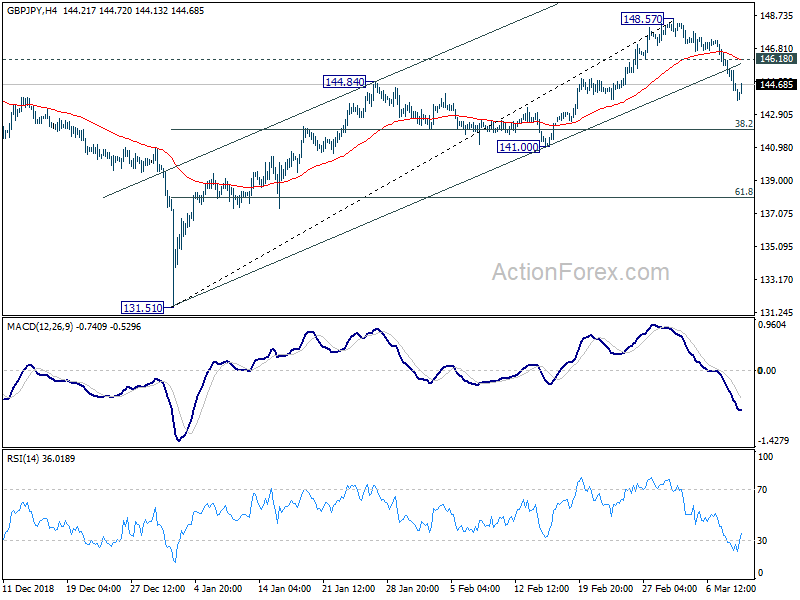
Daily Pivots: (S1) 143.92; (P) 145.06; (R1) 145.80; More...
Intraday bias in GBP/JPY remains mildly on the downside for 38.2% retracement of 131.51 to 148.57 at 142.05. Break will target 141.00 key support level. Nevertheless, on the upside, break of 146.18 minor resistance will indicate completion of the pull back and turn bias to the upside for 148.57.
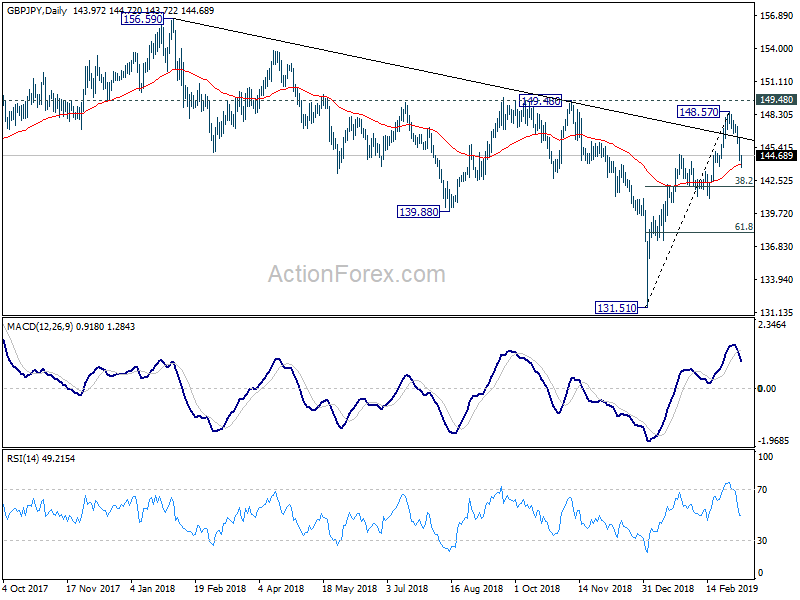
In the bigger picture, the strong rebound from 131.51 suggests that medium term fall from 156.59 (2018 high) has completed already. The corrective structure of such decline in turn argues that it's the second leg of the corrective pattern from 122.36 (2016 low). And this pattern is starting the third leg. On the upside, decisive break of 149.48 will pave the way to 156.59 resistance and above. However, firm break of 141.00 support will dampen this view and turn focus back to 131.51 low instead.
Brexit On Our Minds
Market movers today
Brexit remains very much in focus this week, with three key votes in the House of Commons coming up starting Tuesday, see Brexit Monitor - Brexit goes to overtime . We think the most likely outcome is that the House of Commons will vote in favour of asking the EU27 for a short extension of Article 50.
The US-China trade talks are also entering the final stage and markets will keep an eye on any headlines announcing a date for the summit between Donald Trump and Xi Jinping.
In the euro area, we get German industrial production figures for January today. Factory orders on Friday showed another monthly decline of 2.6% m/m, but the details revealed that orders from car manufacturers continued to recover in a further sign that activity in the sector is normalising, see chart on Twitter .
In the US, retail sales for January will be an important gauge for the strength of the US economy currently. In December, the retail sales control group fell by 1.8% m/m, the biggest drop since January 2000. We think the drop was a one-off and look for January's numbers to come in at 1.0% m/m (3.3% y/y).
In Scandinavia, Danish and Norwegian February CPI inflation are in focus (see next page). In Sweden, Riksbank vice governor Henry Ohlsson holds a speech at 13:00 CET. We expect him to repeat it's justified to continue to hike rates according to plan. This should not be a market mover, unless he surprises on the dovish side.
Selected market news
Chinese credit data fell back in February following the big jump in January. However, for the two months as a whole, aggregate credit was up around 25% compared to last year. M1 growth also increased from 0.4% to 2.0%, the first tentative sign of a turn in M1 growth. China's central bank chief said over the weekend that there was room to cut the Reserve Requirement Ratio further, see Reuters . We look for a further cut fairly soon.
Over the weekend, Fed chair Powell repeated that the Fed is on hold for now. Powell said that the Fed funds rate is "in an appropriate place" and that the Fed will not overreact to inflation moving modestly above the 2% target. In his view, the current policy is "roughly neutral". That said, he still thinks the outlook is "favourable " and risks to the economy come from China and Europe.
In Germany, the CFU chief, Annegret Kramp-Karrenbauer, has dismissed some of French President Macron's ideas of reforming the EU . Kramp-Karrenbauer rejects a European minimum wage, a unified social security system and joint debt issuance.
PM Theresa May has not been able to finalise a new deal with the EU yet but is ready to fly to Brussels today if there is a breakthrough . According to The Times , May is facing an even bigger defeat tomorrow than the first time (biggest on record). Some Conservative MPs are urging May to put tomorrow's vote on hold. Others are calling for May to resign.
EUR/JPY Daily Outlook
Daily Pivots: (S1) 124.42; (P) 124.73; (R1) 125.20; More....
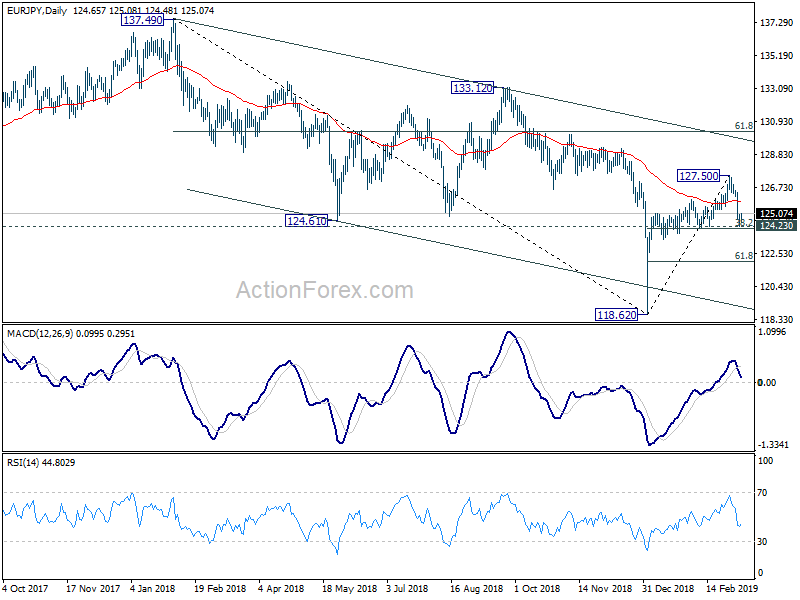
Intraday bias in EUR/JPY remains neutral first. On the downside, decisive break of 124.23 cluster support (38.2% retracement of 118.62 to 127.50 at 124.10) should confirm completion of whole rebound from 118.61. Deeper fall should at least be seen to 61.8% retracement at 122.01 and below. In this case, the chance of resuming larger down trend will also increase. On the upside, though, break of 125.34 minor resistance after defending 124.10/23 will retain near term bullishness. Intraday bias will be turned back to the upside for retesting 127.50 first.
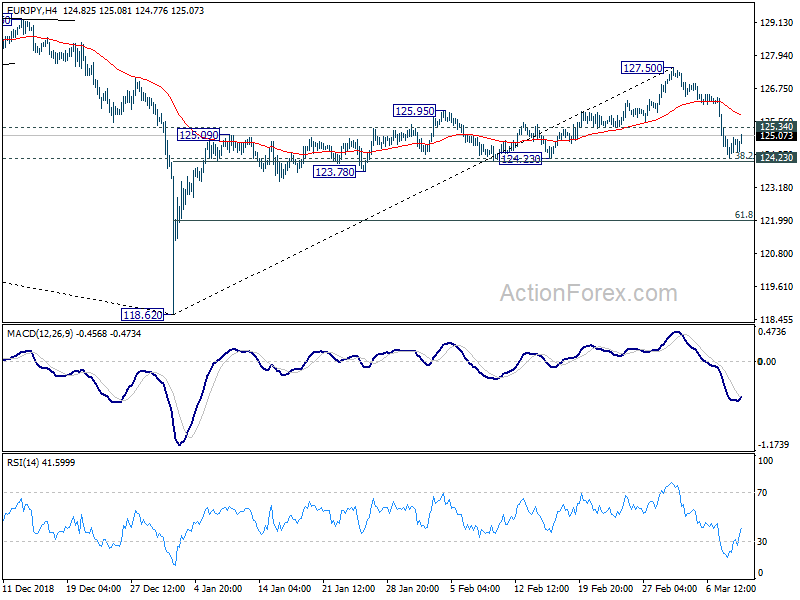
In the bigger picture, current development argues that medium term decline from 137.49 (2018 high) has completed with three waves down to 118.62 already. Decisive break of 133.12 resistance will confirm this bullish case. And whole up trend from 109.03 (2016 low) might resume through 137.49 in that case. On the downside, break of 124.23 support will invalidate this case. And in such case, the down trend from 137.49 could possibly resume through 118.62.
EUR/GBP Daily Outlook
Daily Pivots: (S1) 0.8567; (P) 0.8612; (R1) 0.8675; More...
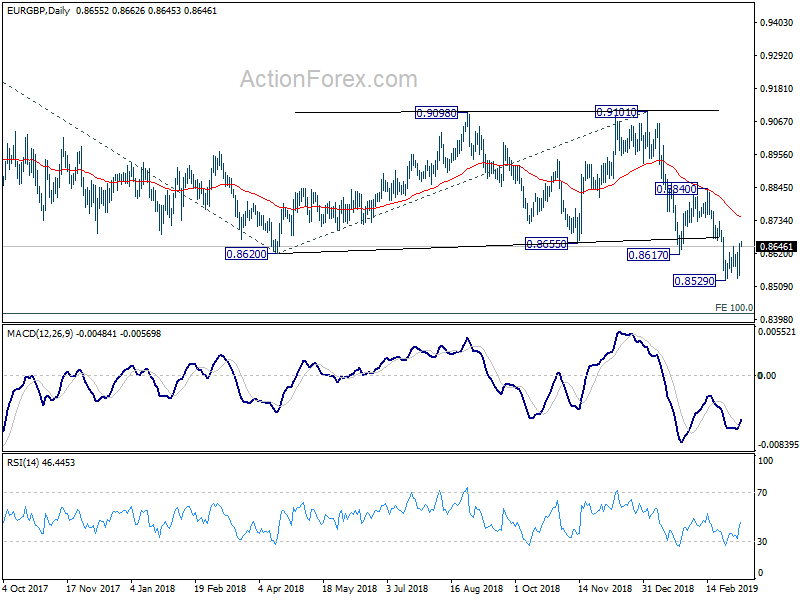
Intraday bias in EUR/GBP remains neutral as consolidation from 0.8529 is extending. In case of stronger recovery, upside should be limited well below 0.8840 resistance to bring fall resumption. On the downside, break of 0.8529 will target long term projection target at 0.8416 next.
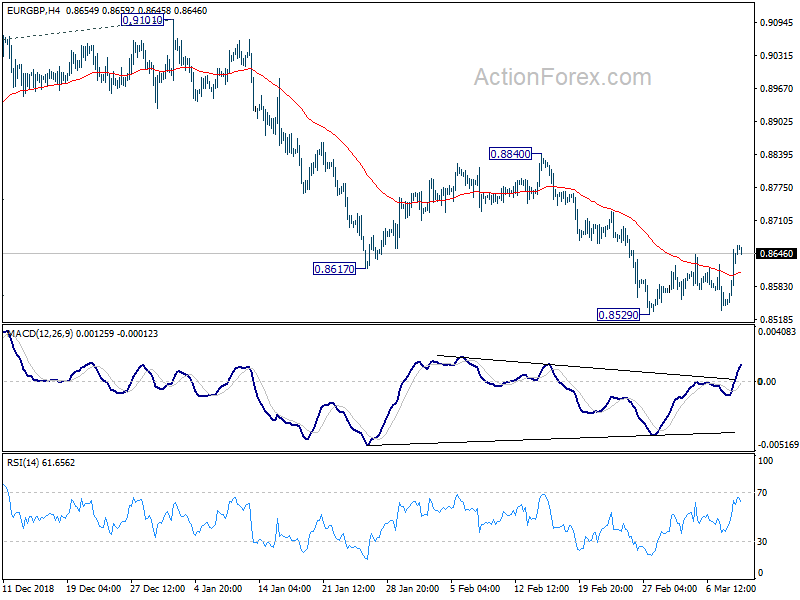
In the bigger picture, EUR/GBP is seen as staying in long term range pattern started at 0.9304 (2016 high). Current fall from 0.9305 (2017 high), is a falling leg inside the pattern. Such decline is now targeting 100% projection of 0.9305 to 0.8620 from 0.9101 at 0.8416 and possibly below. But for now, we'd expect strong support around 0.8312 support to contain downside and bring rebound.