Sample Category Title
EUR/AUD Daily Outlook
Daily Pivots: (S1) 1.5914; (P) 1.5958; (R1) 1.5986; More....
Intraday bias in EUR/AUD remains neutral first. Price actions from 1.5721 so far suggests it's a correction only. That is, fall from 1.6765 isn't over yet. On the downside, break of 1.5721 low will resume the decline from 1.6765 and target 1.5346 support. On the upside, above 1.6122 will resume the corrective rise from 1.5721.
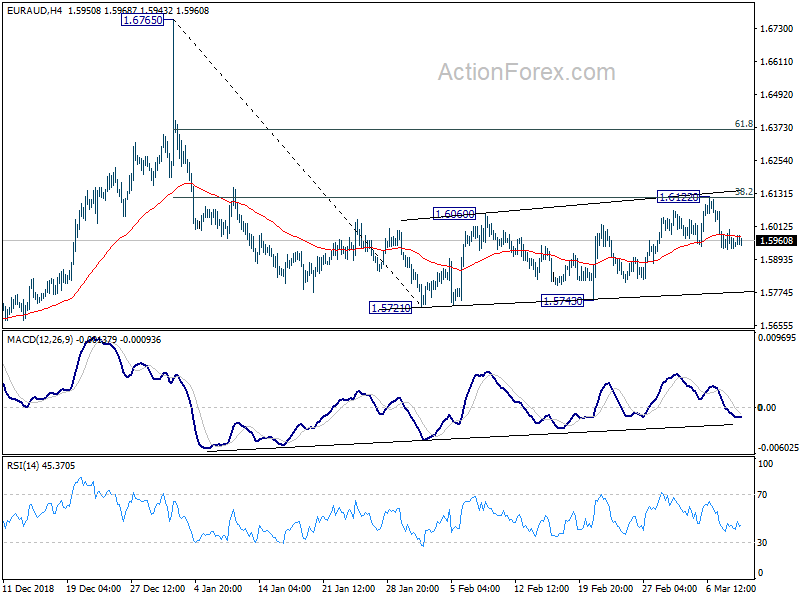
In the bigger picture, as long as 1.5346 support holds, outlook will remain bullish. Uptrend from 1.1602 (2012 low) is expected to resume sooner or later. Break of 1.6765 will target 61.8% retracement of 2.1127 (2008 high) to 1.1602 at 1.7488 next. However, firm break of 1.5346 key support will indicate trend reversal, with bearish divergence condition in weekly MACD, and turn outlook bearish.
EUR/CHF Daily Outlook
Daily Pivots: (S1) 1.1308; (P) 1.1321; (R1) 1.1335; More...
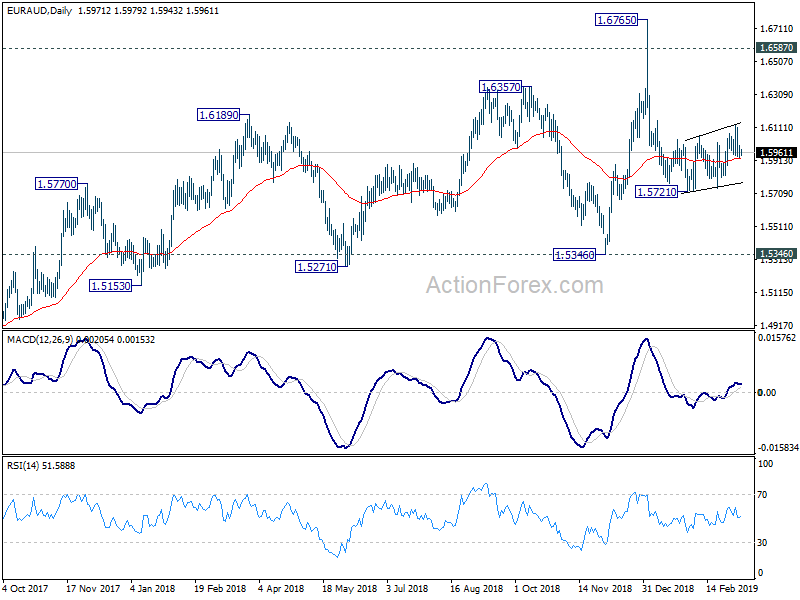
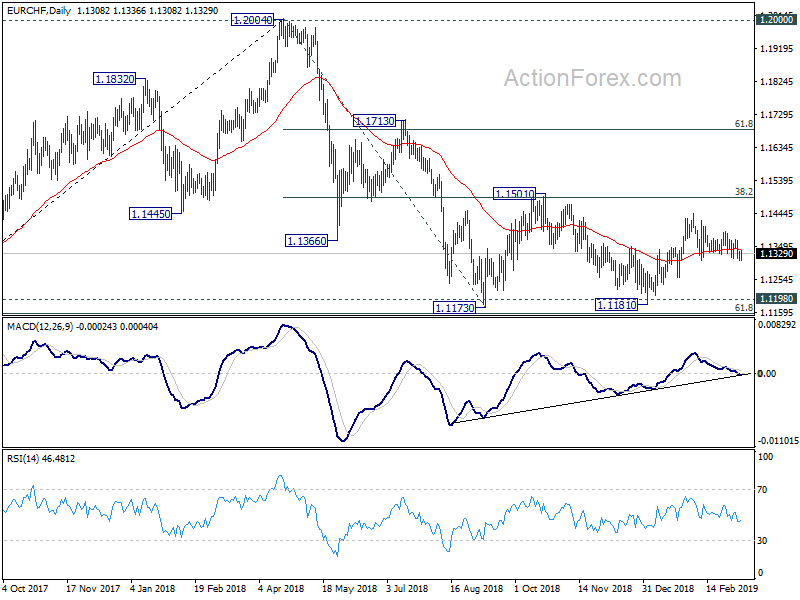
Intraday bias in EUR/CHF remains neutral at this point and more consolidation could be seen. As long as 1.1310 support holds, further rally remains in favor. On the upside, break of 1.1444 will resume the rebound from 1.1181 and target 1.1501 key resistance next. On the downside, firm break of 1.1310 will indicate completion of the rebound. In that case, intraday bias will be turned back to the downside for 1.1181 low again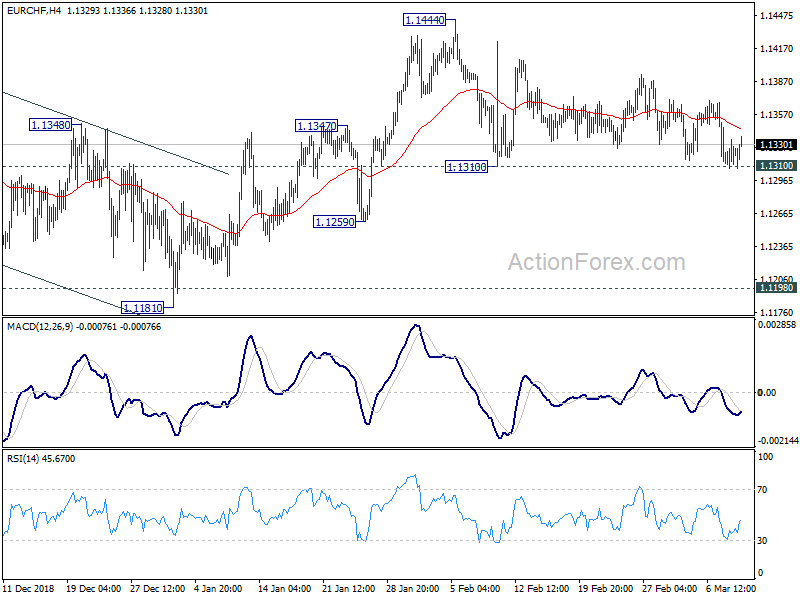
 .
.
In the bigger picture, price actions from 1.2004 medium term top is seen as a correction only. Downside should be contained by 1.1154/98 support zone to complete it and bring rebound. Decisive break of 1.1501 (38.2% retracement of 1.2004 to 1.1173 at 1.1490) will confirm completion of the correction. Further rise should be seen to 61.8% retracement at 1.1687 and above next.
ECB Cœuré: No recession, no turnaround in policy, no need to resume asset purchases
In an interview on March 7, published today, ECB Executive Board Member Benoît Cœuré said the economy slowdown "didn't come as a surprise" even though it has been "stronger than expected and started sooner". ECB's decision last week "don't represent a turnaround in our policy" but just "carefully calibrated to this diagnosis". And ECB was just :adjusting to the new reality rather than reversing our course".
Coeure added "we don't see signs of a recession at present" and "we don't see the need" to resume asset purchases. Economic growth is "robust" although it's "less strong than before". And it will "take longer for inflation to reach our objective, but it will get there".
Coeure also said Italy is "in a difficult juncture" and it's the "only euro area country that is experience a technical recession". There was no improvement in the labor market and in the long term, Italy's problem is well known and it's "productivity growth". But "I don't believe that any of this has to do with the euro, otherwise it would be a general problem across the euro area."
Brexit Uncertainty To Rise In Coming Months
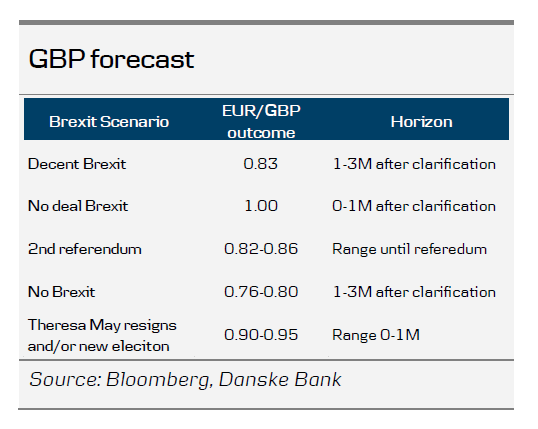
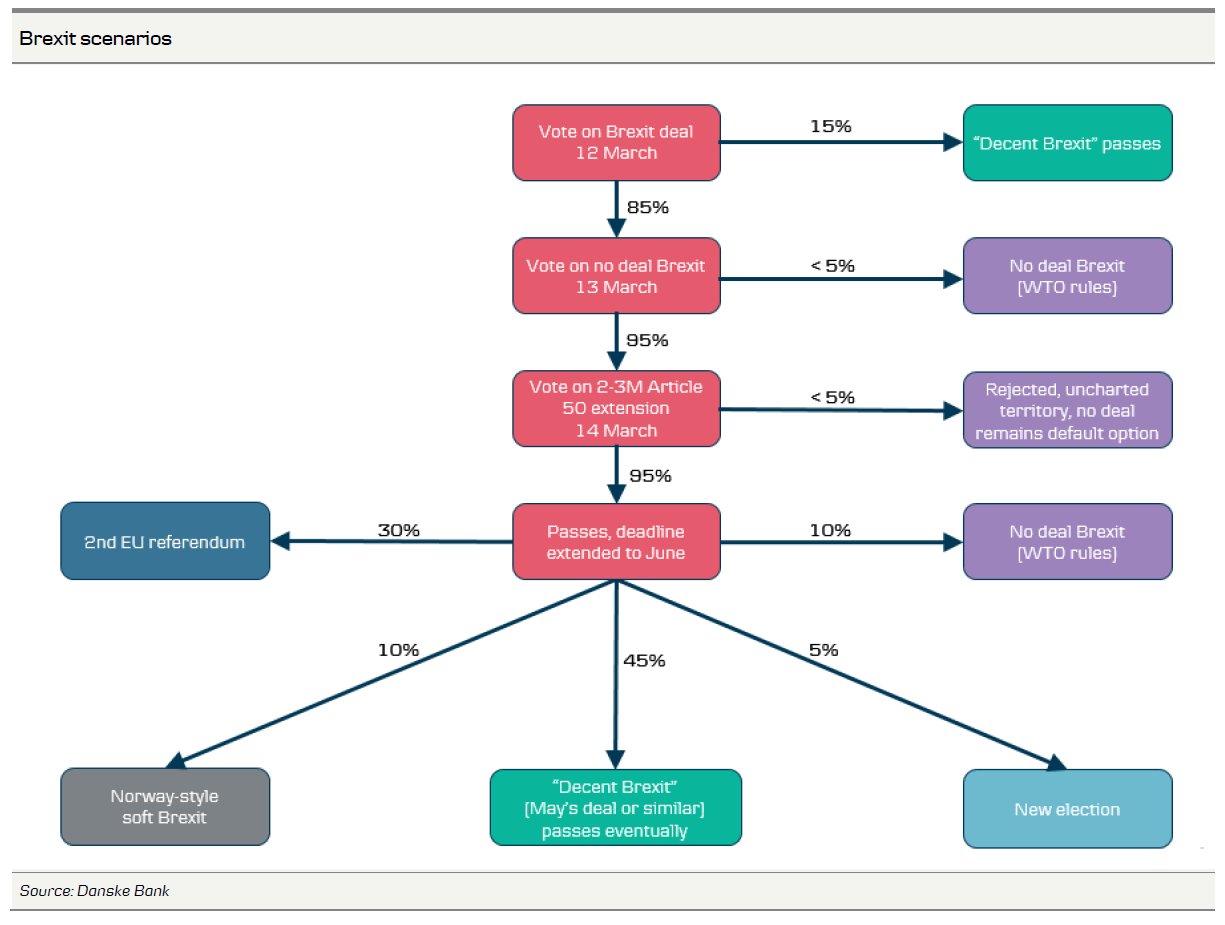
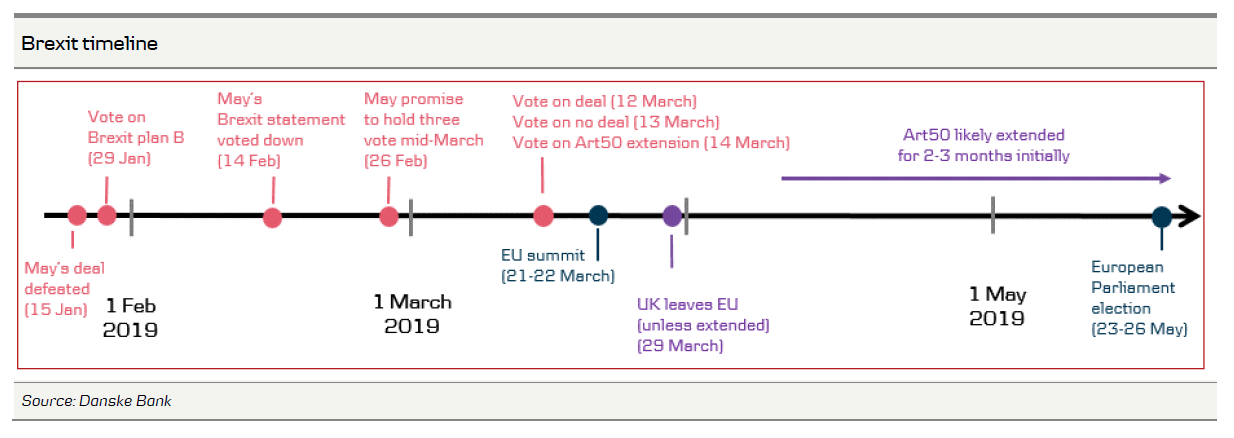
We think the probability of Prime Minister May's deal passing on 12 March is low (15%), although we have seen some softening lately in the Brexiteers' position on the backstop. The defeat, however, may be smaller than in January and media report that May is already planning a third attempt as soon as 18 March. Some Brexiteers fear voting May down will result in a softer, not a cleaner/harder, Brexit. So far the DUP has not jumped on board, which, in our view, would be a big game changer (as many Brexiteers would likely follow suit). If the deal passes, the EU27 can sign it off at the EU summit on 21-22 March, but the UK would probably still need a short extension in order to pass the necessary secondary legislation. If, against our expectation, the deal is passed, we expect EUR/GBP to move down to 0.83.
We think the probability of the House of Commons voting in favour of a 'no deal' scenario on Wednesday 13 March is very slim, likely 5%. This, however, is not the same as the final outcome will be no deal. Some politicians think this step is necessary to keep the pressure on the EU27. Still, this scenario would be GBP negative and we think EUR/GBP will move back to the old 0.87-0.90 range. Eventually, if the UK crashes out without a deal, we expect EUR/GBP to move towards parity, at 1.00.
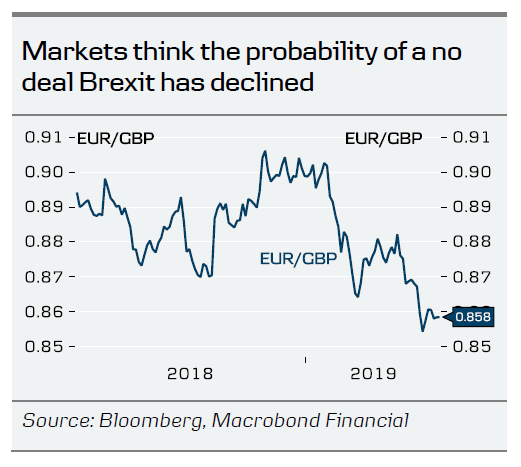
Our base case is that the House of Commons will vote in favour of asking the EU27 for an extension of Article 50 (95% probability) on Thursday 14 March. It is still up to the EU27 leaders to unanimously accept the proposal and the leaders are divided on whether to accept an extension, and if so, how long it should be. While Tusk is in favour of a very long extension, France's President Macron does not sound like he would support an extension unconditionally. As an extension seems to be priced in already, we think the potential for another move lower in EUR/GBP is limited. From a technical perspective, there also seems to be considerable support around the 0.85 mark. We expect EUR/GBP to move a bit lower towards, but not below, the 0.85 mark.
In the event of an extension, the battles are just postponed by two or three months and it is not a given that things would change dramatically from here, at least not in the very near term. This means that EUR/GBP would stay around the current level and we may even see a slightly higher spot level, as we cannot rule out markets starting to worry about a no deal outcome again (and UK macro data will likely remain weak, see next page).
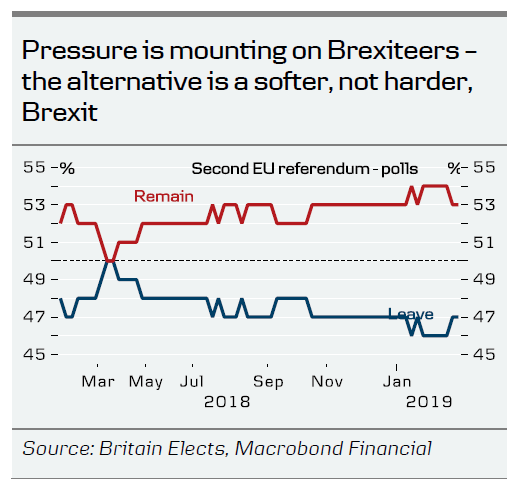
Some still need to compromise and change their views eventually – who blinks first, the moderates or the Brexiteers? We think it is going to be the Brexiteers, which is why we stick to our long-held view that May's deal will pass eventually. When we get Brexit clarification, we foresee EUR/GBP moving down to 0.83. In the event the UK needs to extend further when we reach May, we think the EU will be reluctant to agree unless the extension is very long, possibly until year-end 2020.
Alternatively, we expect the moderate MPs from different parties could combine, forcing May to call for a second EU referendum. This would also lead to a stronger GBP, as polls show a small, but not insignificant, lead for remain.
Macro outlook: Businesses hit by Brexit fears
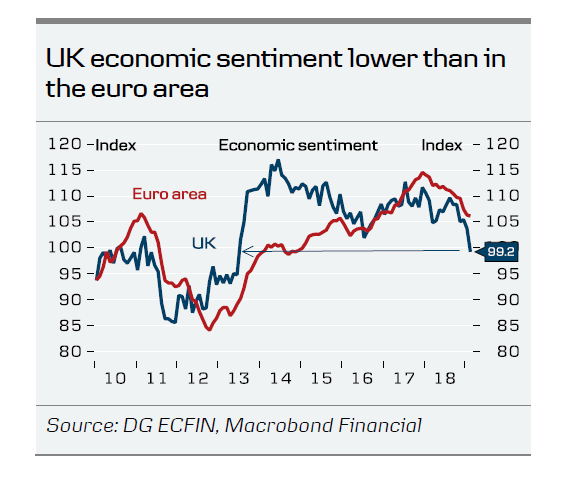
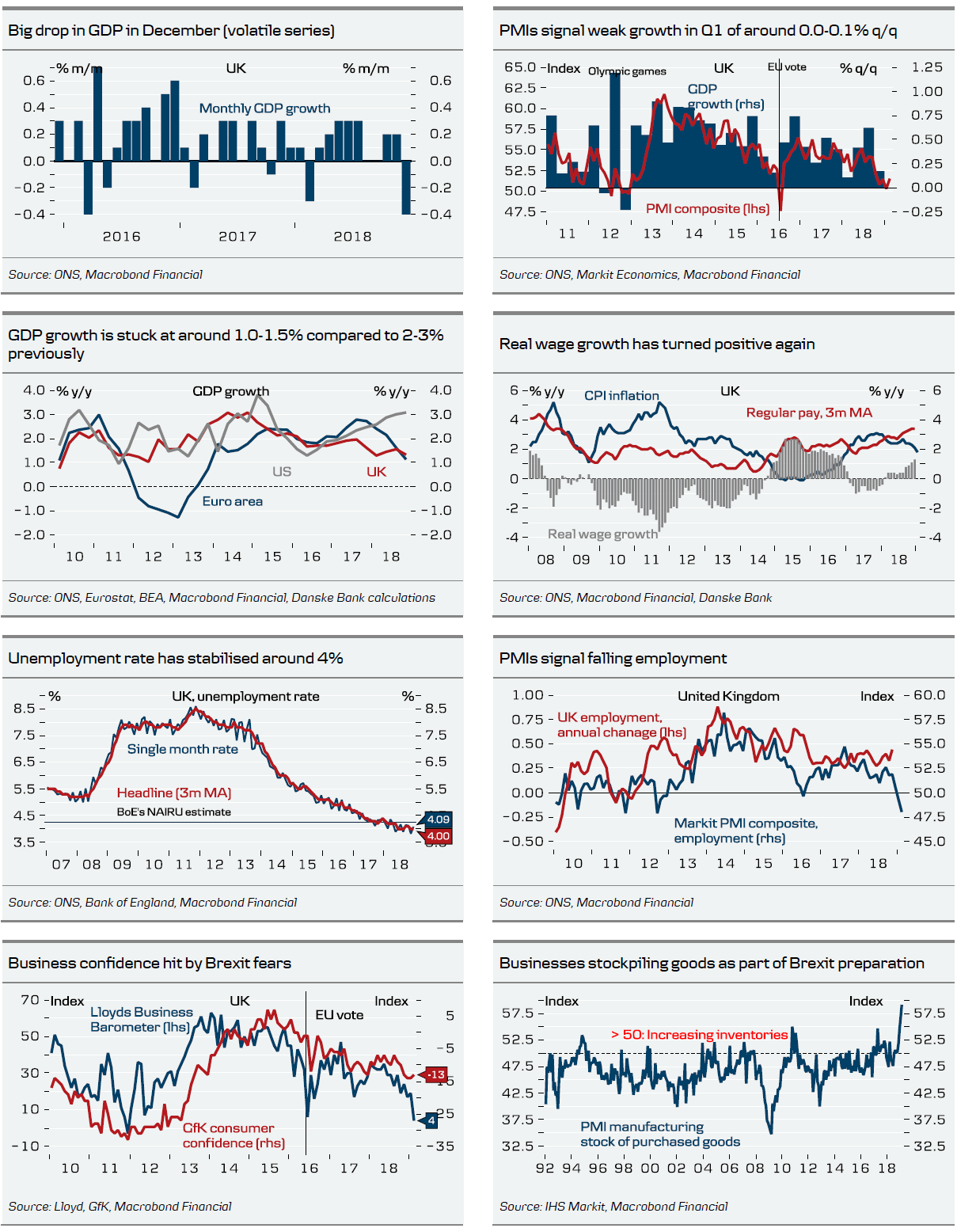
As we are so close to the Brexit deadline, we think it is a good time to take the temperature of the UK economy. In 2018, the UK economy grew by 1.4% y/y, the lowest growth rate since 2009 when the economy was in recession. The UK economy is no longer one of the fastest-growing G7 economies. Signs in early 2019 are not encouraging either, with PMIs suggesting growth of around 0.0-0.1% q/q. While the overall slowdown in Europe explains some of this, it definitely does not explain all. It is very clear Brexit uncertainties are weighing on the economy (particularly on companies). Notably, the UK economic sentiment index is below the equivalent index in the euro area and is at the lowest level since 2013.
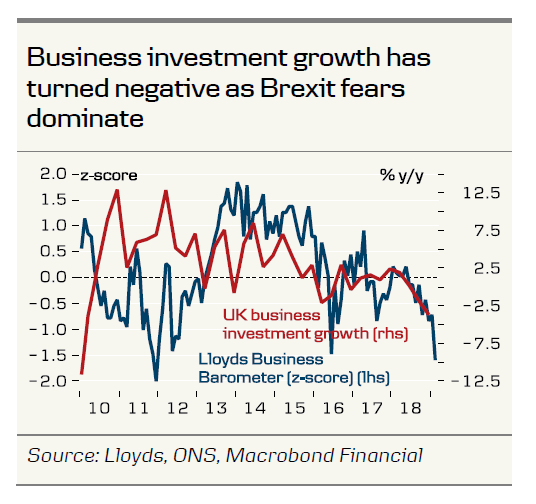
Looking at UK businesses, Lloyds' Business Barometer (confidence indicator) fell in 2018 and in February it declined further. Businesses are craving Brexit clarity but with only three weeks until the UK formally leaves the EU, we have none. Brexit uncertainty is the main reason why business investment declined in every quarter of 2018. It is the first time since the crisis business investment has declined for four consecutive quarters (although definitely not at the same magnitude as then). Investment indicators for Q1 19 are not encouraging either. While an extension of Article 50 is positive, as it would avoid the UK crashing out of the EU without a deal, it is not perfect. The period of high uncertainty would be prolonged and what would change in three months? Even if a Brexit deal is approved, we do not have full details on the future relationship, which is up for negotiation over the next 2-4 years. This also means that while investment growth will likely turn positive again, many long-term investment projects are likely to be postponed.
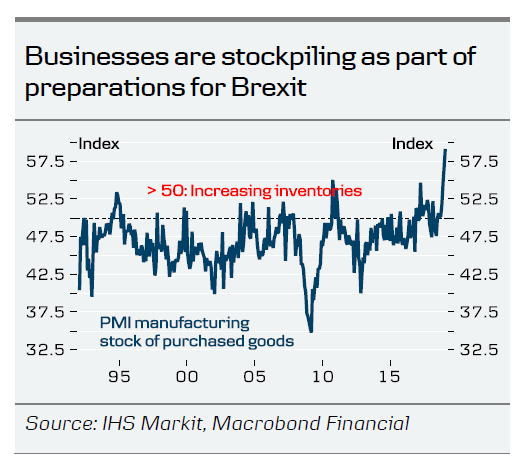
Another indication of how UK companies are hit by Brexit uncertainty is inventories. Business surveys such as PMI and the CBI indicators suggest businesses have activated their contingency plans and are stockpiling goods ahead of Brexit. While investors perceive the probability of a no deal Brexit has declined, companies are preparing for the worst but hope for the best. Responsible companies have to ensure they are able to operate in any circumstances, including a no deal Brexit, despite most observers thinking a deal will pass eventually. This limits the potential for higher growth in Q2 and Q3.
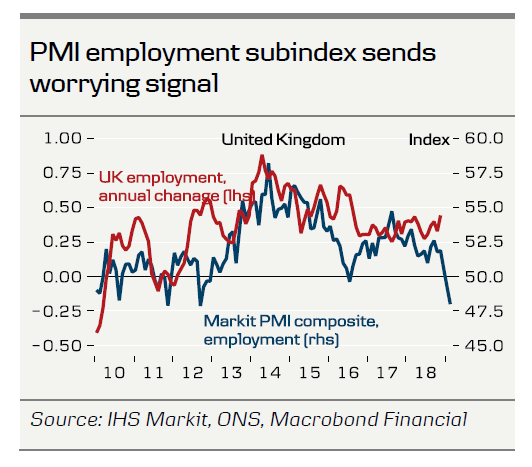
Consumers are not feeling as anxious as businesses. Private consumption is growing at around 2% y/y, which, however, is slower than before the EU referendum. One reason for slower consumption growth is that the big drop in GBP led to negative real wage growth, limiting the potential for consumption growth. That said, everything is not rosy for consumers either. The Brits are the most pessimistic on the economic outlook for the next 12 month in the EU28 and overall consumer confidence has declined gradually since the EU referendum. It is also a concern that the latest PMIs suggest companies are reducing, not increasing, the number of employees, as the employment subindex is below 50. This is usually associated with negative employment growth. Employment growth has been quite robust since the referendum but if the new signal becomes reality, it may trigger an outright downturn in the UK.
 Based on incoming data, we have updated our GDP forecasts for the UK economy, which we now see at just 1% this year, increasing to 1.3% next year (previously 1.2% and 1.4%, respectively). With the ECB on hold over the next 12 months, our case for a Bank of England rate hike in November is also under pressure.
USD/CAD Daily Outlook
Daily Pivots: (S1) 1.3385; (P) 1.3426; (R1) 1.3460; More...
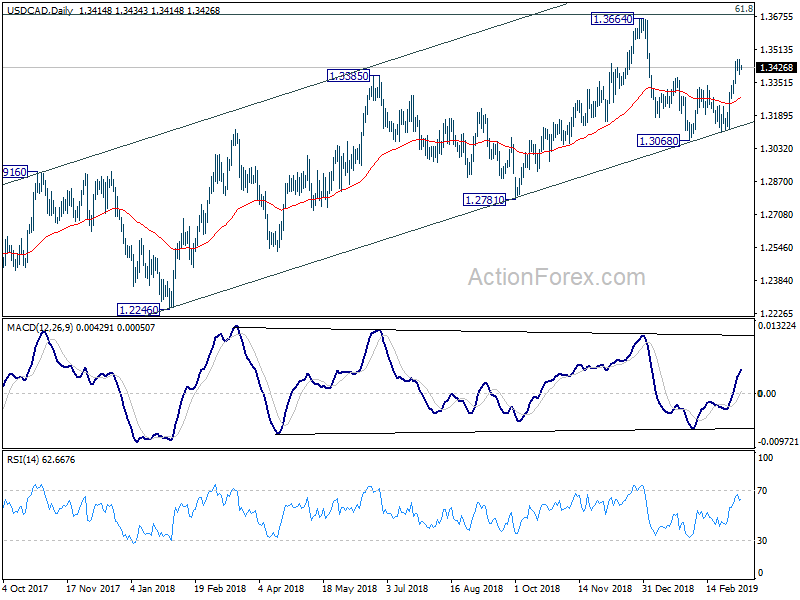
Intraday bias in USD/CAD remains neutral for consolidation below 1.3468 temporary top. Downside of retreat should be contained by 1.3301 support to bring another rally. Corrective fall from 1.3664 has completed at 1.3068 already. Break of 1.3467 will target 1.3664 resistance then 1.3685 fibonacci level.
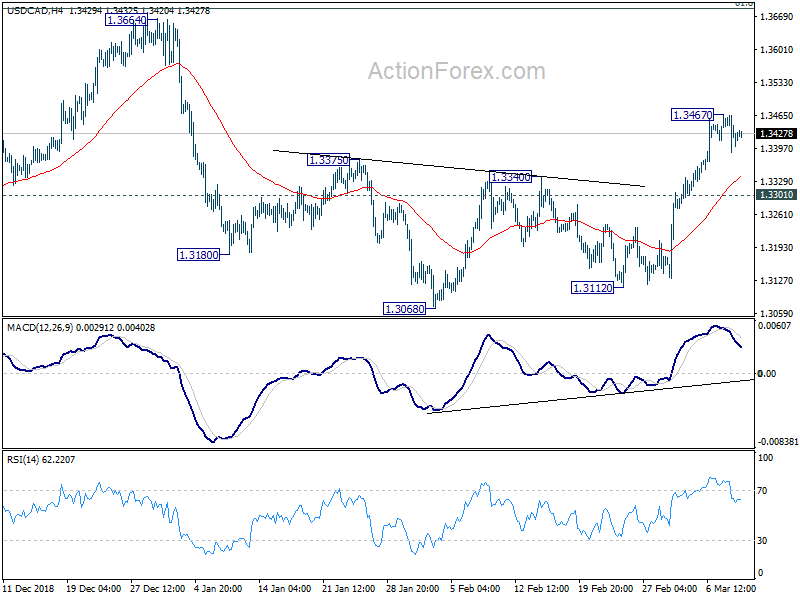
In the bigger picture, structure of the medium term rise from 1.2061 (2017 low) to 1.3664 is not clearly impulsive. Hence, we'd stay cautious on strong resistance from 61.8% retracement of 1.4689 (2016 high) to 1.2061 at 1.3685 and 1.3793 resistance to limit upside, and bring medium term topping. But in any case, medium term outlook will stay bullish as long as channel support (now at 1.3139) holds. Sustained break of 1.3793 will pave the way to retest 1.4689 (2015 high). Firm break of the channel support should confirm reversal target 1.2061 low again.
AUD/USD Daily Outlook
Daily Pivots: (S1) 0.7015; (P) 0.7034; (R1) 0.7065; More...
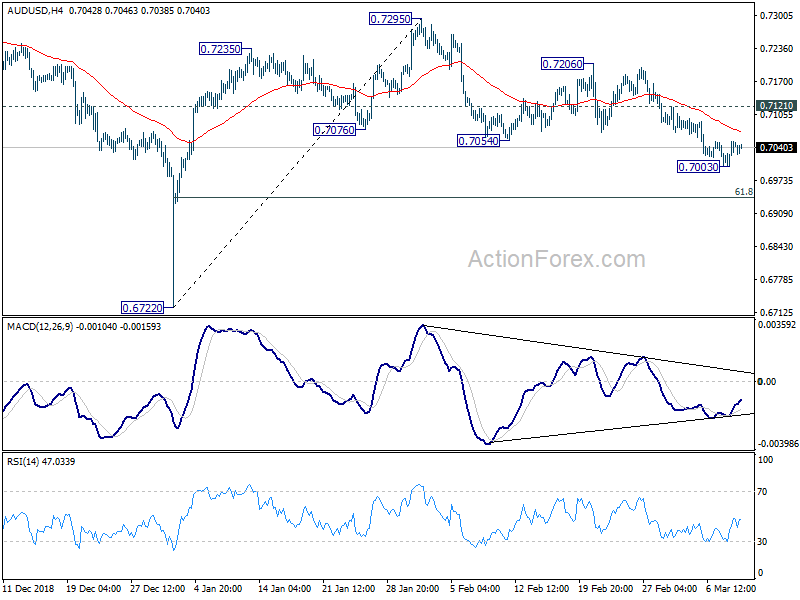
Intraday bias in AUD/USD remains neutral for consolidation above 0.7003 temporary low. Stronger recovery cannot be ruled out. But upside should be limited by 0.7121 resistance to bring fall resumption. On the downside, below 0.7003 will target 61.8% retracement of 0.6722 to 0.7295 at 0.6941 and below.
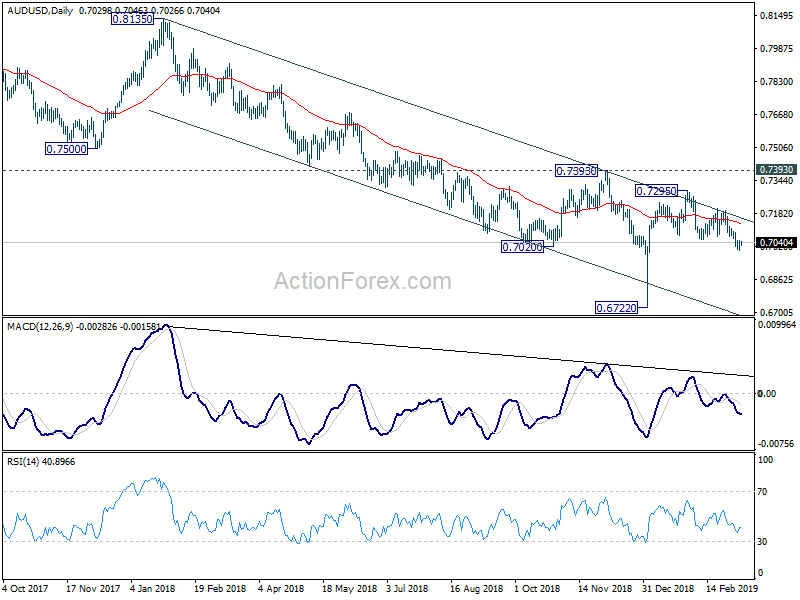
In the bigger picture, as long as 0.7393 resistance holds, we'd treat fall from 0.8135 as resuming long term down trend from 1.1079 (2011 high). Decisive break of 0.6826 (2016 low) will confirm this bearish view and resume the down trend to 0.6008 (2008 low). However, firm break of 0.7393 will argue that fall from 0.8135 has completed. And corrective pattern from 0.6826 has started the third leg, targeting 0.8135 again.
USD/JPY Daily Outlook
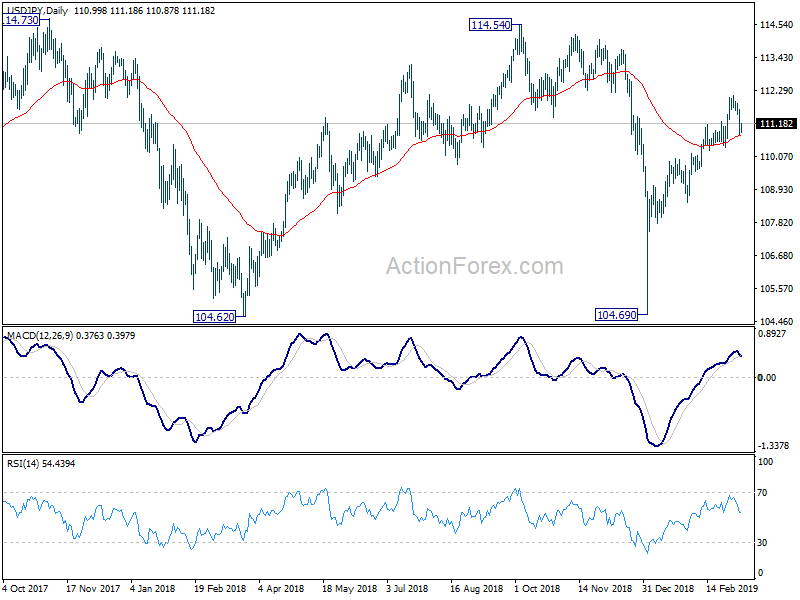
Daily Pivots: (S1) 110.76; (P) 111.20; (R1) 111.62; More...
Intraday bias in USD/JPY remains neutral for consolidations below 112.13 first. As long as 110.35 support holds, near term outlook remains bullish and rise from 104.69 is still in favor to resume. On the upside, break of 112.13 will target 114.54 resistance next. However, firm break of 110.35 should confirm near term reversal and turn outlook bearish for 108.49 support and below.
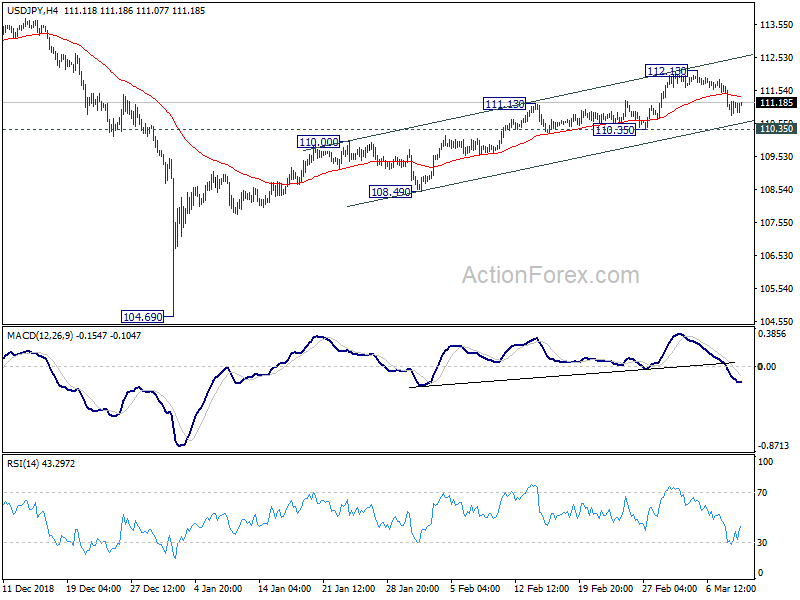
In the bigger picture, strong rebound from 104.69 argues that decline from 118.65 (2016 high) has completed with three waves down to 104.69, after failing 104.62. More importantly, the rise from 98.97 (2016 low) could be resuming. Decisive break of 114.54 resistance will add more credence to this bullish case and target 118.65. This will now be the favored case as long as 110.35 support holds. However, firm break of 110.35 will mix up the medium term outlook again and turn focus back to 104.69 low.
USD/CHF Daily Outlook
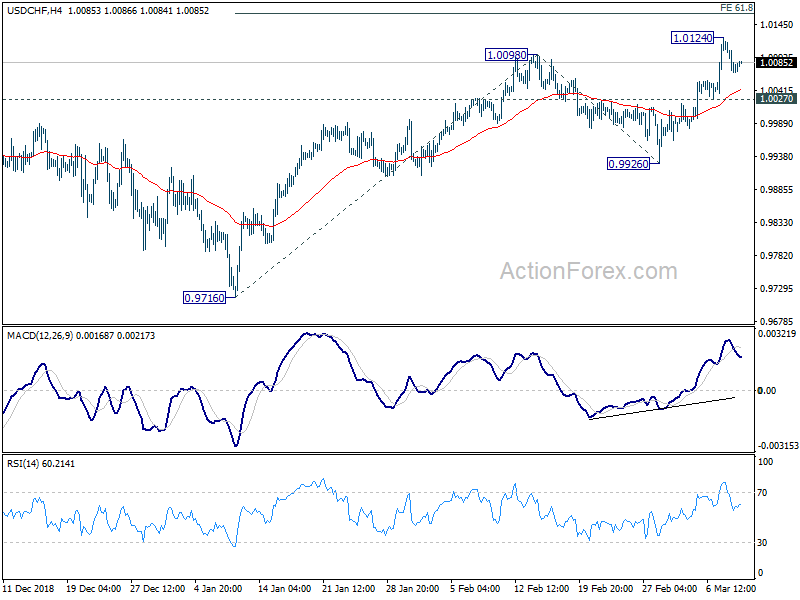
Daily Pivots: (S1) 1.0060; (P) 1.0089; (R1) 1.0110; More....
Intraday bias in USD/CHF remains neutral for consolidation below 1.0124 temporary top. In case of deeper retreat, downside should be contained by 1.0027 minor support to bring another rally. On the upside, break of 1.0124 will target 61.8% projection of 0.9716 to 1.0098 from 0.9926 at 1.0162 and then 100% projection at 1.0308.
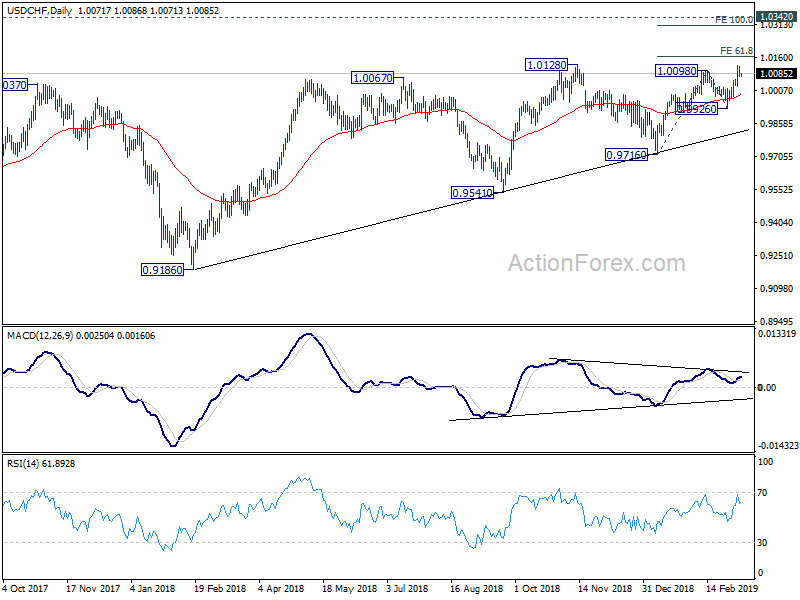
In the bigger picture, USD/CHF drew strong support from medium term trend line and rebounded. That suggests rise from 0.9186 is still in progress. Further break of 1.0128 will confirm up trend resumption and target 1.0342 key resistance. Nevertheless, break of 0.9926 support will be the first signal of medium term reversal and bring another test on the trend line.
EUR/USD Daily Outlook
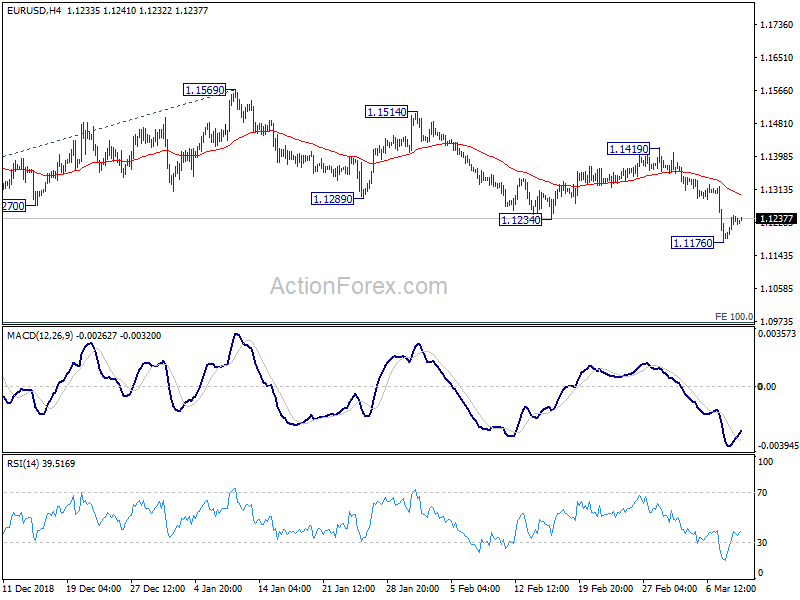
Daily Pivots: (S1) 1.1197; (P) 1.1221; (R1) 1.1258; More.....
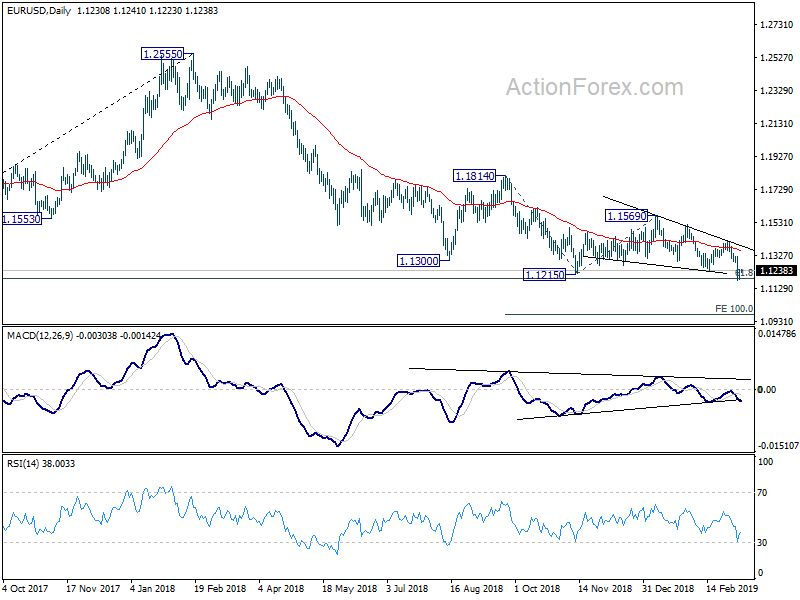
Intraday bias in EUR/USD remains neutral at this point and some more consolidation could be seen above 1.1176 temporary low. Upside of recovery should be limited well below 1.1419 resistance to bring fall resumption. On the downside, break of 1.1176 will extend the down trend from 1.2555 and target 100% projection of 1.1814 to 1.1215 from 1.1569 at 1.0970 next.
In the bigger picture, down trend from 1.2555 medium term top is still in progress. Bearishness is affirmed by sustained trading below falling 55 week EMA. 61.8% retracement of 1.0339 (2017 low) to 1.2555 at 1.1186 is met. Sustained break there will pave the way to retest 1.0339. On the upside, break of 1.1569 resistance will now indicate completion of such down trend and turn medium term outlook bullish.
Germany’s Factory Orders Declined At Its Fastest Pace In Seven Months In January
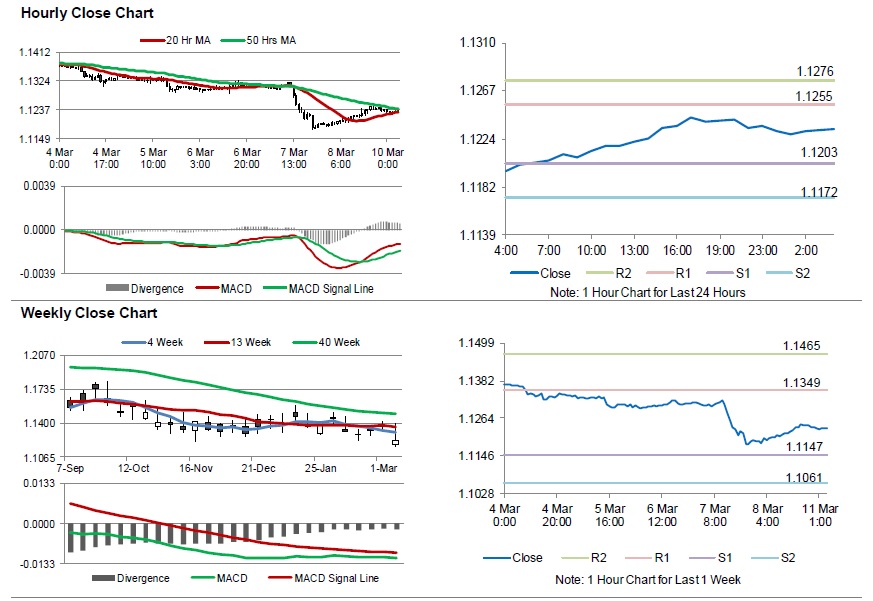
For the 24 hours to 23:00 GMT, the EUR rose 0.42% against the USD and closed at 1.1242 on Friday.
On the macro front, Germany's seasonally adjusted factory orders unexpectedly fell 2.6% on a monthly basis in January, amid drop in foreign demand and compared to a drop of 1.6% in the prior month. Markets participants had anticipated factory orders to advance 0.5%.
The US dollar declined against a basket of currencies on Friday, following weaker-than-expected US jobs data.
In the US, data showed that the US non-farm payrolls advanced by 20.0K in February, less than market expectations for a rise of 180.0K and following a revised gain of 311.0K in the prior month.
Meanwhile, the US building permits surprisingly rose 1.4% on a monthly basis to an annual rate of 1345.0K, defying market expectations for a fall to a level of 1287.0K. In the prior month, building permits had recorded a reading of 1326.0K. Moreover, the nation's housing starts jumped by 18.6% on a monthly basis to an annual rate of 1230.0K in January, beating market expectations for a rise to 1195.0K. Housing starts had recorded a revised level of 1037.0K in the previous month. Additionally, the US unemployment rate fell to 3.8% in February, more than market expectations for a drop to 3.9%. In the preceding month, unemployment rate had registered a reading of 4.0%. Further, the nation's average hourly earnings of all employees rose 3.4% on an annual basis in February, higher than market consensus for a gain of 3.3%. In the prior month, average hourly earnings of all employees had registered a revised climb of 3.1%.
In the Asian session, at GMT0400, the pair is trading at 1.1233, with the EUR trading 0.08% lower against the USD from Friday's close.
The pair is expected to find support at 1.1203, and a fall through could take it to the next support level of 1.1172. The pair is expected to find its first resistance at 1.1255, and a rise through could take it to the next resistance level of 1.1276.
In absence of key economic releases in the Euro-zone today, investors would keep an eye on Germany's industrial production and trade balance data, both for January, scheduled to release in a few hours. Later in the day, the US advance retail sales for January and business inventories for December, will keep traders on their toes.
The currency pair is showing convergence with its 20 Hr moving average and trading below its 50 Hr moving average.