Sample Category Title
UK Hammond: Rejecting the Brexit deal means more uncertainty for Britain and its people
UK Chancellor of Exchequer Philip Hammond warned today "if we don't pass the meaningful vote on Tuesday we'll go into a parliamentary process that very likely will lead to an extension of time and an uncertain outcome, more uncertainty for the British economy, more uncertainty for people across the country".
And he urged "it's very important that my colleagues think about the consequences of not agreeing this deal. This is now the last chance to be confident that we can get this deal done and we can leave the EU on schedule."
The UK parliament is scheduled to have another Brexit deal meaningful vote on March 12. If it's rejected, there will be a vote on no-deal Brexit on March 13. Then if both are rejected, there will be a vote on Article 50 extension.
XAUUSD Intraday Analysis
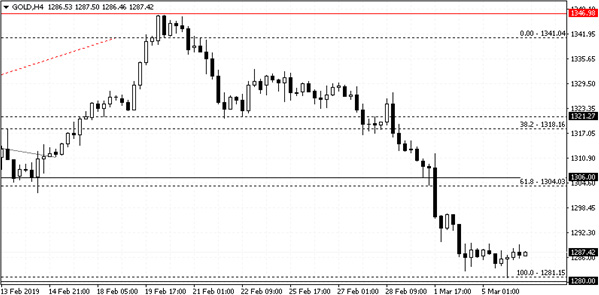
XAUUSD (1287.42): Gold prices settled into a doji pattern for the last two daily sessions. This pattern forms just above the support level at 1281.15. The flat price action is likely to see either the bearish trend resuming, which would mean that price will have to break past the support level at 1281.15, or a retracement. The 38.2% Fibonacci retracement comes near the resistance level that is likely to be tested at the 1306 – 1304 region while a deeper retracement could mean that gold prices will test the next resistance level at the 1321 – 1318 region
USDJPY Intraday Analysis
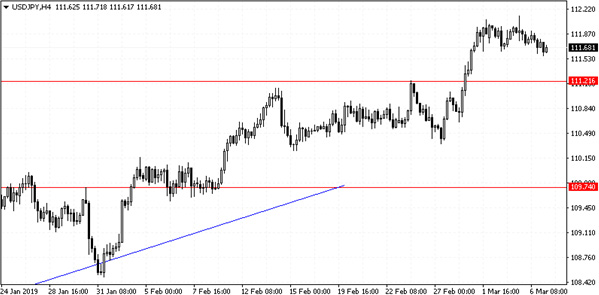
USDJPY (111.68): The USDJPY currency pair has stalled the upside momentum. Price action has failed to post any significant gains. However, we could expect the trend to resume in the near term. This would push the USDJPY to test the next main target at 112.50. Failure to maintain the bullish trend could see the USDJPY easing back to test the breached resistance level at 111.21 where support could be firmly established. This would still see the USDJPY maintaining the upside bias as a result.
EURUSD Intraday Analysis
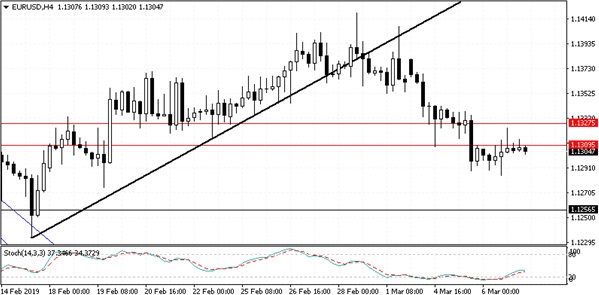
EURUSD (1.1304): The EURUSD currency pair traded below the support area of the 1.1327 – 1.1309 region. Price action has been muted as the lower support level near 1.1256 remains a key target to the downside. Failure to extend the declines could keep the common currency trading flat near the support area. If there is a rebound to the upside, then the EURUSD could push higher to extend the gains toward the previous highs at the 1.1381 region. This would be followed by a move toward the main resistance area of 1.1435.
China: Some region will face relatively big budgetary pressure this year
China plans to cut around CNY 2T in taxes and fees for companies in 2019 as growth could slow to the lowest pace in three decades at 6.0-6.5%. Yet, its Finance Minister Liu Kun warned that "considering the downward pressure on the economy and the upcoming policy of larger tax and fee cuts, some regions will still face relatively big budgetary pressure this year."
Budget deficit is targeted to be at 2.8% of GDP, up from 2.6% in 2018. Liu said "the arrangement on the budget deficit ratio has fully considered factors including fiscal revenue and local government special bonds and leaves more policy room for future macro adjustments." To offset the reduction in tax and fee revenue, Liu noted the government will collect more profits from some state-owned financial institutions and companies. The government is also trying to secure funding via other channels "which allows us not to raise the deficit ratio too high."
ECB’s Monetary Policy Meeting Will Be The Main Highlight For Today
The U.S. dollar maintained the bullish momentum although the pace of gains was somewhat smaller. On the economic front, the data from the eurozone was relatively quiet.
NY Trading Session
The NY trading session saw the February private payrolls rising just 183k. This was below estimates of a 190k increase. The previous month's payrolls were revised to 300k.
The balance of trade figures showed that the U.S. posted a trade definition of $59 billion for December. This was higher than November's deficit of $50.3 billion. Excluding the services sector, the trade deficit rose 10% to $891.25 billion, the largest on record so far.
The NY trading session will see Fed Member, Brainard speaking
BOC
The Bank of Canada held its monetary policy meeting last week. As widely expected, the central bank left interest rates unchanged.
In fact, the BOC issued a rather dovish outlook on the global economy and the risks to Canada's growth. Following the release of the interest rate decision, the Ivey PMI report showed that the index eased to 50.6, missing estimates of an increase to 55.1.
Australia
The economic data from Australia continues with the Asian trading session showing that retail sales rose 0.1%.
Economists forecast that retail sales would rise 0.3% on the month after declining 0.4% previously. Trade balance figures were also released, as the data showed trade balance expanding to 4.5 billion, up from 3.77 billion previously.
Europe
The European trading session will see the release of Switzerland's unemployment data. The unemployment rate is expected to hold steady at 2.4%. The eurozone's final fourth-quarter GDP report will be coming out.
Economists forecast no change to the GDP, maintaining the confirmed 0.2% quarterly growth rate. We can expect the eurozone's final employment change for the quarter to show a 0.3% increase as previously forecast.
The ECB's monetary policy meeting will be the main highlight for today. The central bank is not expected to make any major changes to its monetary policy. However, there is speculation that the central bank could be dovish in its forward guidance as it contemplates relaunching the TLTRO program.
What To Expect From The ECB Meeting
Today's European Central Bank policy meeting might be the most significant risk event of the week. Almost four years since the European Central Bank (ECB) launched its asset purchase program and spent €2.6 trillion, the Eurozone economy has failed to improve. Italy fell into a technical recession in 2018, Germany barely avoided one, core inflation remained stuck at 1%, and most PMI surveys point towards more difficult times ahead.
Mario Draghi, who pledged to do “whatever it takes” to preserve the Euro, has seven months remaining at the helm of the ECB. With little time left until his tenure ends, he has a challenging task to face a global economic slowdown with limited availabletools.
While it's not expected to see changes to interest rates, it's the economic projections, forward guidance and details of any round of multi-year loans that will be market-moving.
Given the latest streak of disappointing economic data, growth and inflation forecasts will likely be lowered. Although Draghi doesn't expect a recession to hit the Eurozone, he believes the current slowdown could be longer than expected. A significant downgrade to economic projections may indicate that interest rates will not rise this summer but given the different needs of the 19 Eurozone countries, the ECB might not commit to delaying a rate hikefurther.
While another QE program isn't on the table, new multi-year loans to banks may be announced. That's likely to be the biggest risk forthe Euro today. The previous four-year targeted long-term refinancing operations (TLTRO) begin to expire in mid-2020, which could lead to a significant tightening in lending. So, it's becoming a question of when, not if, the ECB will launch a new lending scheme.
The details of a new TLTRO arewhat could lead to big moves in the Euro. Is it going to have similar maturities of four years or less? What are the limits? Is it going to be fixed or floating rate? If for example, the ECB launched a new TLTRO with shorter maturity and a variable interest rate, this would signal that the central bank still wants to commit to raising rates by end of year, which could have a positive impact on the Euro. If the opposite is true and rates of the TLTRO are fixed, then that suggests interest rates will remain low, and thus drag the Euro lower.
It remains uncertain whether the ECB will announce full details of the program in today's meeting, or even announce one at all. But given Europe's current economic and political situation, the ECB needs to speed up such actions rather than wait until further deterioration, which could have severe consequences.
GBPCAD Skyrockets To 9-Month High, Positive Risks Not Faded Yet
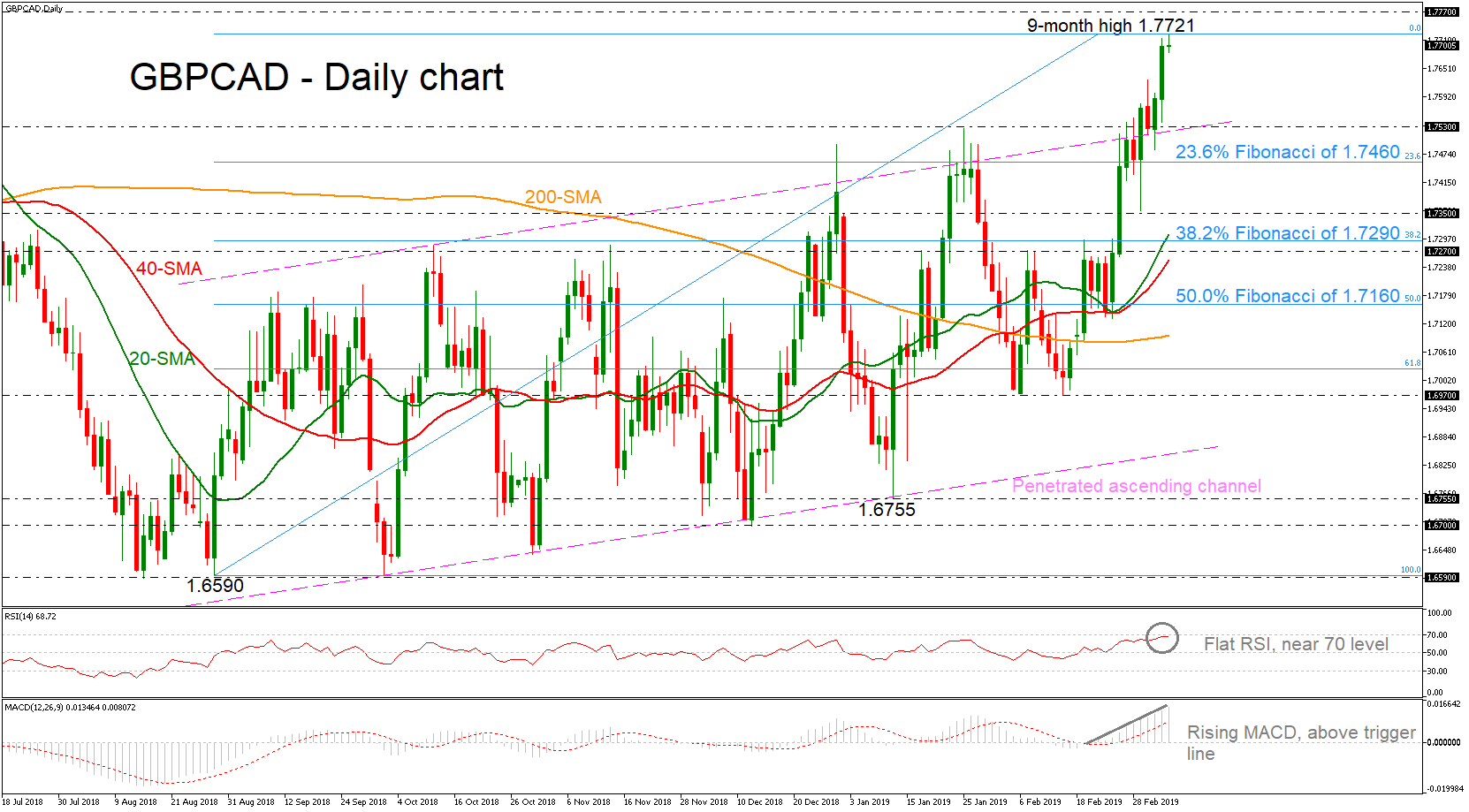
GBPCAD has been skyrocketing over the last couple of days, with a bullish rally today towards a fresh nine-month high of 1.7721. The price violated the ascending channel to the upside, confirming the positive outlook and turning the 20- and 40-simple moving averages (SMAs) to the upside in the daily timeframe.
The technical indicators seem to be overbought as the RSI is flattening near the 70 level, while the MACD oscillator is still strengthening its momentum above the zero and trigger lines.
Immediate resistance to further gains would likely come from the 1.7770 barrier, which overlaps with the 200-SMA in the weekly timeframe, acting as strong obstacle for the bulls. A jump above this hurdle would increase bullish speculation and the market could send investors towards the 1.7980 barrier, where it topped on April 2018.
If, however, the strong upside momentum was to lose steam and the pair reversed lower, support would initially come from 1.7530. Dropping below this area could take prices until the 23.6% Fibonacci retracement level of the upleg from 1.6590 to today’s peak of 1.7721. Failure to hold above this level would switch the focus to the downside until 1.7350.
In the more medium-term picture, the slightly bullish correction shifted to a stronger positive tendency and is likely to stay as long as prices remain well above the short-term SMAs.
USDJPY Stalls At 2 ½-Month Highs And Above 200-Day MA
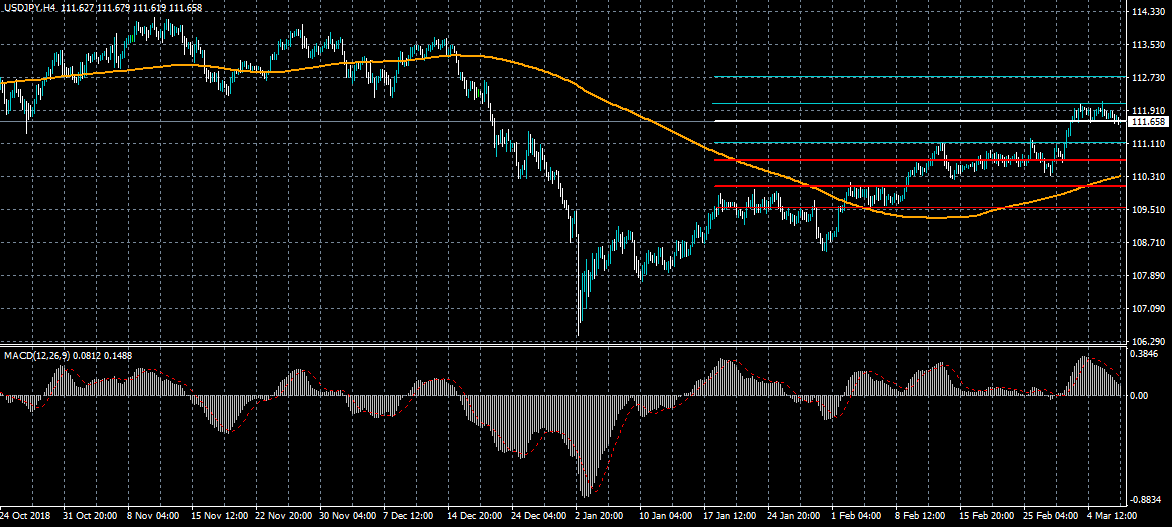
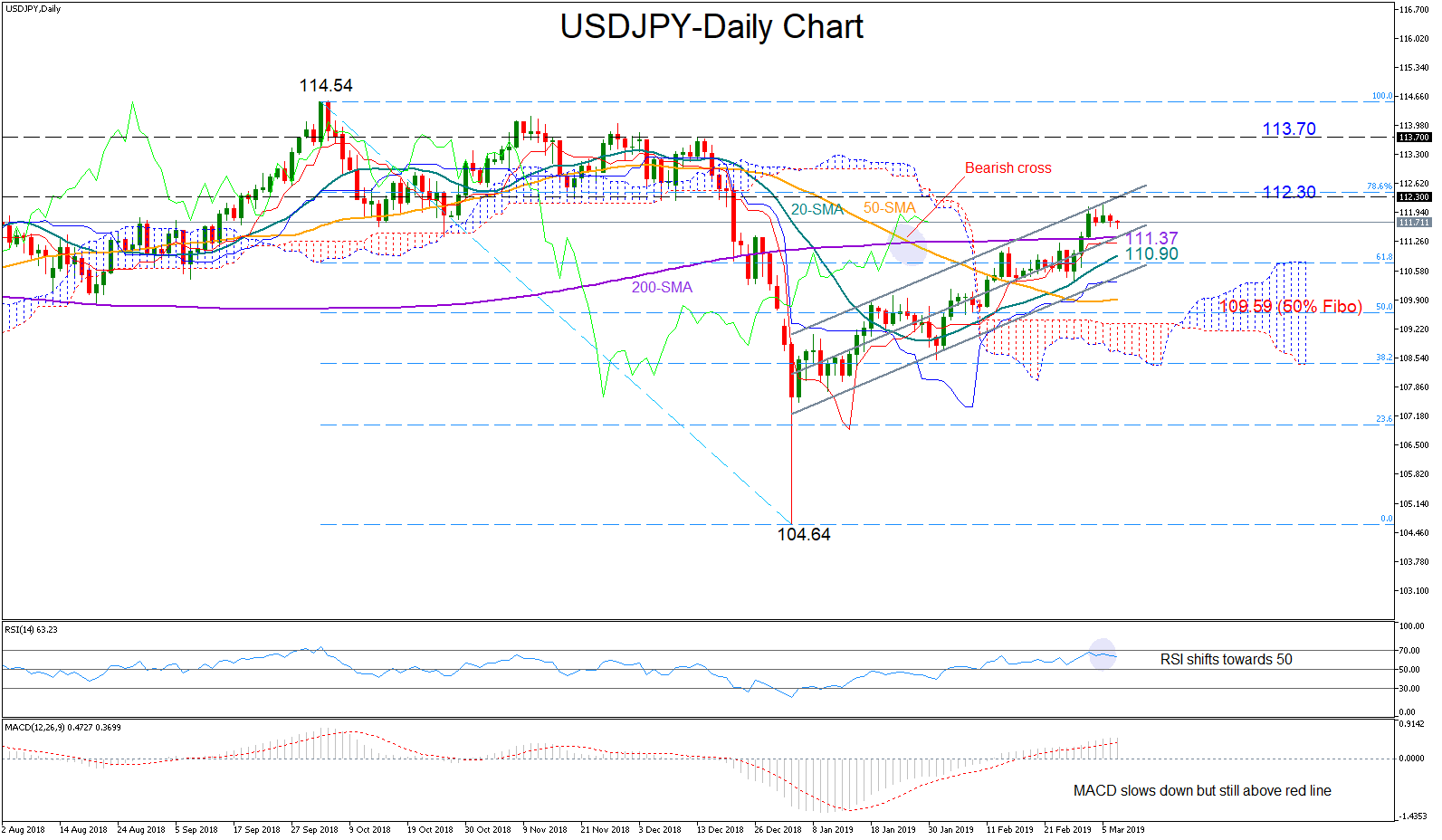
USDJPY crawled above the 200-day moving average (MA) and towards 2 ½-month highs on Monday but the upper bound of the ascending channel capped bullish action, with the price sliding sideways since then.
The RSI and the MACD are still positioned in the bullish zone, with the former above 50 and the latter above its red signal line, but both have already started to trend down, signalling that some weakness may emerge in the market. Meanwhile, the Ichimoku indicators, the red Tenkan-sen and the blue Kijun-sen lines, have paused upside momentum, adding evidence to the cautious mood.
If the pair stands tall again, the upper sloping parallel line of the channel seen at 112.30 would come first into test. A successful break of this wall could lift the price even higher to meet resistance near the 113.70 congested area. Yet the bulls need to overcome the 114.00 mark and more importantly beat the 114.54 top to extend the March uptrend and therefore switch the bigger picture into a bullish one.
Alternatively, if the bears take control, the price would reverse south to retest the 200-day MA currently flat at 111.37. Beneath that, the 20-day MA at 110.90 could also halt downside movements as it did at the end of February, while in case of steeper declines the price could end up near 109.59, the 50% Fibonacci of the downleg from 114.54 to 106.45.
Summing up, the positive short-term bias seems to be turning neutral, while in the bigger picture USDJPY is maintaining a neutral outlook within the 114.54-107.50 area.
USDJPY Sellers In Control Below 111.60
The US dollar is under slight downside pressure against the Japanese yen on Thursday, with sellers testing towards the pivotal 111.60 level. If USDJPY sellers hold price below the 111.60 level, further intraday losses towards the 111.10 level are expected. Traders should note that the recent move lower has invalidated the bullish inverted head and shoulders pattern on the one-hour time frame.
The USDJPY pair is only intraday bullish while trading above the 111.60 level, key technical resistance is found at the 112.00 and 112.20 levels.
If the USDJPY pair trades below the 111.60 level, sellers are expected to test towards the 111.10 and 110.70 support levels.