

Sample Category Title
OECD lowers global growth forecast to 3.3% in 2019 on China and Europe slowdown
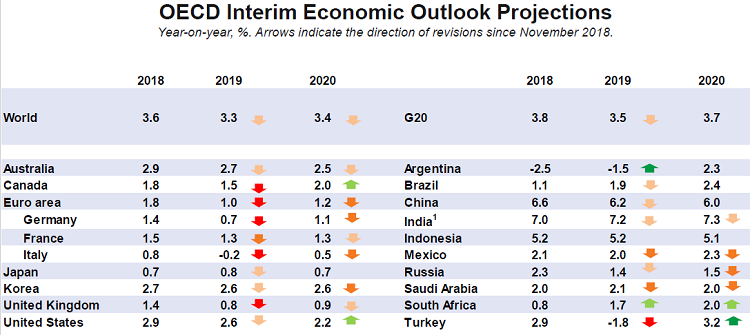
OECD lowered global growth forecast by -0.2% to 3.3% in 2019 and by -0.1% to 3.4% in 2020. G20 growth forecast was lowered by -0.2% to 3.5% in 2019, and kept unchanged at 3.7% in 2020.
In the Interim Economic Outlook, it's noted that Chinese and European slowdown, and weakening global trade growth are the principal factors weighing on the world economy. Also, OECD warned that further trade restrictions and policy uncertainty could bring "additional adverse effects". For China, while policy stimulus should offset weak trade development, "risks remains of a sharper slowdown" that would hit global growth and trade.
"The global economy is facing increasingly serious headwinds," said OECD Chief Economist Laurence Boone. "A sharper slowdown in any of the major regions could derail activity worldwide, especially if it spills over to financial markets. Governments should intensify multilateral dialogue to limit risks and coordinate policy actions to avoid a further downturn," Ms Boone said.
Here are some details:
- World growth forecast is lowered from 3.5% to 3.3% in 2019.
- World growth forecast is lowed from 3.5% to 3.4% in 2020.
- G20 growth forecast is lowered from 3.7% to 3.5% in 2019.
- G20 growth forecast is unchanged at 3.7% in 2020.
- US growth forecast is lowered from 2.7% to 3.6% in 2019.
- US growth forecast is raised from 2.1% to 2.2% in 2020.
- Eurozone growth forecast is lowered from 1.8% to 1.0% in 2019.
- Eurozone growth forecast is lowered from 1.6% to 1.2% in 2020.
- UK growth forecast is lowered from 1.4% to 0.8% in 2019.
- UK growth forecast is lowered from 1.1% to 0.9% in 2020.
- Japan growth forecast is lowered from 1.0% to 0.8% in 2019.
- Japan growth forecast is unchanged at 0.7% in 2020.
- China growth forecast is lowered from 6.3% to 6.2% in 2019.
- China growth forecast is unchanged at 6.0% in 2020.
Lastest OECD forecasts:
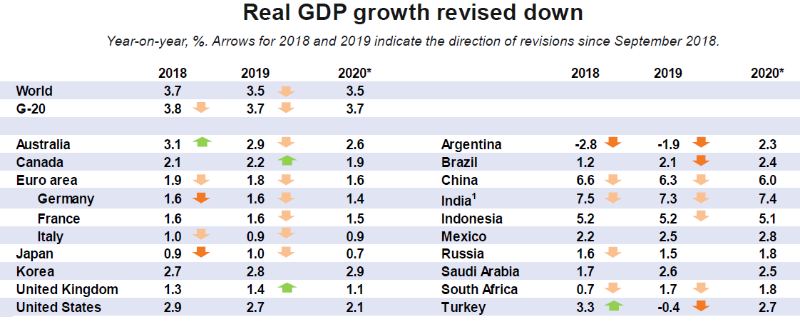
November OECD forecasts:
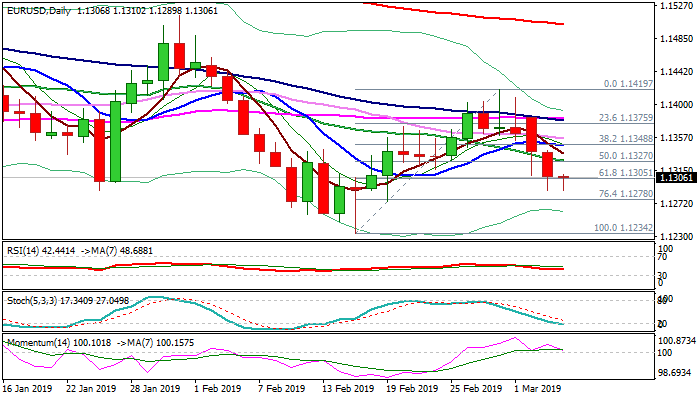
EUR/USD Outlook: The Euro Remains In Defensive But Struggles At Important 1.1305 Fibo Support, ECB In Focus
The Euro probes again below cracked pivotal support at 1.1305 (Fibo 61.8% of 1.1234/1.1419) after strong fall in past three days dipped to 1.1289 but failed to close below 1.1305 in first attempt.
Bearish daily techs and stronger dollar maintain pressure as traders await ECB meeting on Thursday for more signals.
Today's close below 1.1305 would further weaken near-term structure and risk extension through next support at 1.1278 (Fibo 76.4%), while repeated close above 1.1305 would slow bears.
Falling 20SMA marks pivotal barrier at 1.1327, close above which would generate initial reversal signal.
The European central bank is expected to keep policy unchanged and market participants expect dovish tone from President Mario Draghi.
Res: 1.1310, 1.1327, 1.1346, 1.1382
Sup: 1.1289, 1.1278, 1.1234, 1.1200
DAX Dips As Investors Look For Clues
The DAX index has posted slight gains in the Wednesday session, erasing most of the gains seen on Tuesday. Currently, the DAX is at 11,606, down 0.22% on the day. There are no eurozone or German events on the calendar. In the U.S., the major event is ADP nonfarm payrolls, which is expected to dip to 190 thousand. On Thursday, the ECB is expected to maintain interest rates at 0.00%.
The U.S-China trade war has weighed on the global economy and caused significant volatility in the equity markets. Now that trade tensions have eased between the two super-economies, investor risk appetite has improved. If progress continues and the sides ink an agreement, traders can expect the markets to climb sharply. An agreement between the U.S. and China cannot come fast enough for Germany, the locomotive of the eurozone. The OECD has lowered its 2019 GDP forecast to 0.7%, down from 1.6% in November.
All eyes are on the ECB, which releases a rate statement on Thursday. The bank has pegged interest rates at a flat 0.00% since March of 2016. Economic activity in the eurozone has not been strong enough to warrant rate hikes over the past two years. At the same time, with the ECB winding up its massive stimulus program in December, any improvement in economic data (or rise in inflation) will raise speculation about a rate hike. The eurozone economy showed some strength in the first half of 2018, which led to talk of a rate hike in the second half of 2019. However, with Germany and the eurozone in the midst of a slowdown triggered by global trade tensions, it’s unlikely that the ECB will make a rate move before 2020.
No solution on Irish backstop after difficult discussion with robust, strong views
UK Attorney General Geoffrey Cox talked about his meeting with EU in Brussels yesterday. He told Sky News that "we've put forward some proposals, they're very reasonable proposals, and we're now really into the detail of the discussions," regarding the changes needed on Irish backstop. Cox added that "both sides have exchanged robust, strong views and we're now facing the real discussions, talks will be resuming soon."
European Commission spokesman Margaritis Schinas said chief Brexit negotiator Michel Barnier has informed the Commission that "while the talks take place in a constructive atmosphere, discussions have been difficult." Also, "no solution has been identified at this point that is consistent with the Withdrawal Agreement, including the protocol on Ireland and Northern Ireland, which will not be reopened,"
Separately, UK Trade Minister Liam Fox said the government will laid out the tariffs it plans to levy if the parliament chooses a no-deal Brexit. Fox personally prefer to present the tariff plan to MPs before no-deal vote next week. But he said it was not his decision to make.
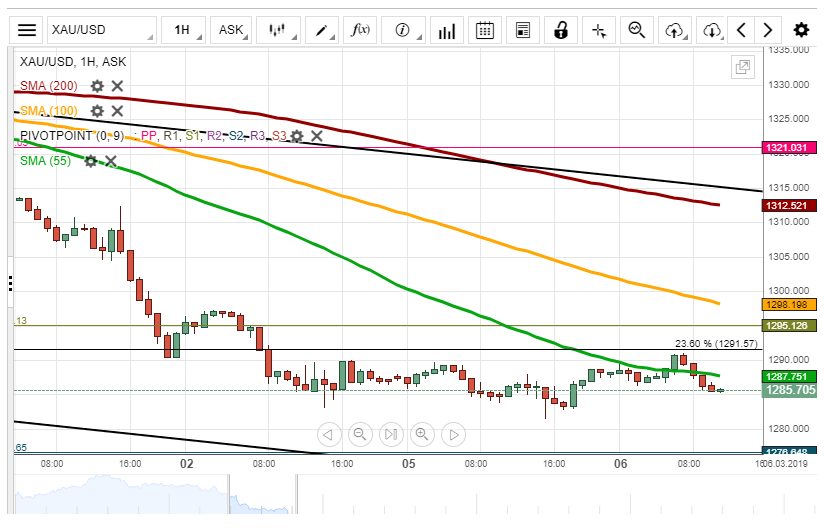
XAU/USD Trades To S2 At 1,276.65 Mark
On Tuesday, the yellow metal traded sideways to stay in the range of the 23.60% Fibo and the monthly S2. During Wednesday's morning hours, gold was resisted by the 23.60% Fibonacci retracement level to trade at the 1,286.31 mark.
In regards to the near-term future, most likely, the yellow metal will keep depreciating against the US Dollar towards the monthly S2 at 1,276.65. Besides, the 55-hour simple moving average will resist the rate during the day!
On the other hand, today's US Crude Oil Inventories data release at 15:30 GMT could push gold to appreciate against the US Dollar to 1,290.00 level.
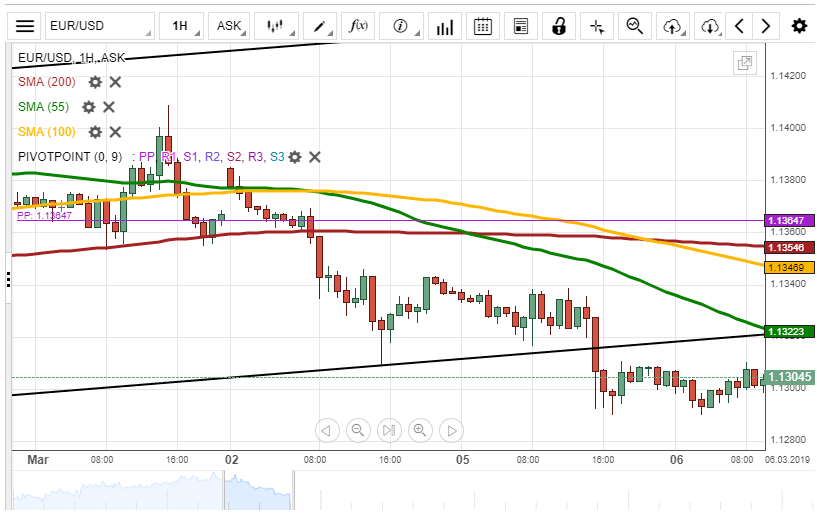
EUR/USD Might Fall To 1.1260
During Tuesday's trading session, the rate broke the freshly drawn pattern line at 1.1320 to fall to the 1.1280 level. On Wednesday morning, the currency exchange rate was trading sideways to stay at the 1.1302 mark.
It is expected that the European Single Currency will continue depreciating against the US Dollar to the 1.1260. Moreover, the resistance levels of the 55-hour simple moving average and the bottom boundary of the medium pattern will resist the rate during the day.
On the other hand, today's US Crude Oil Inventories data release at 15:30 GMT could push the rate to trade in the pattern at the 1.1320 level.
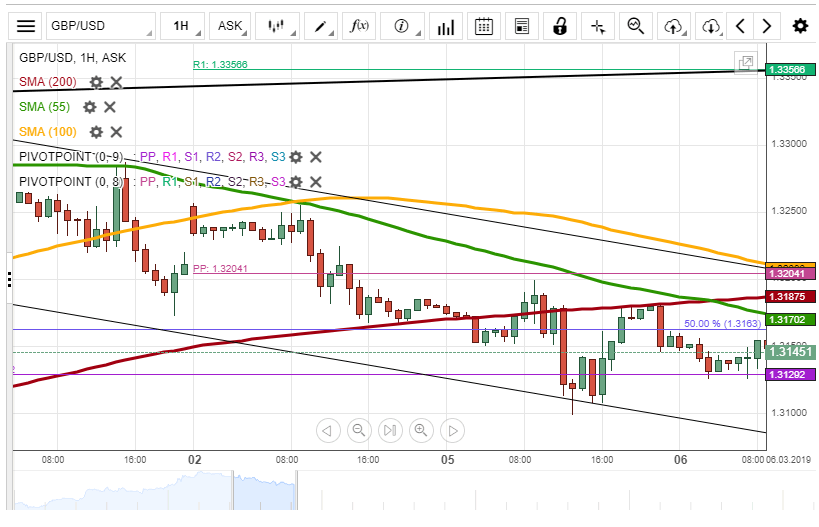
GBP/USD Might Pass Monthly PP At 1.3129
On Tuesday, the rate traded sideways to end the trading session at the 1.3140 level as it was expected! During Wednesday's morning hours, the currency exchange rate kept trading sideways to be located at the 1.3144 mark.
In regards to the near term future, most likely, the British Pound will bounce off the resistance of the 50.00% Fibonacci retracement level at 1.3163 to pass through the monthly pivot point at 1.3129.
Moreover, it is predicted that the British Pound could depreciate against the US Dollar to the 1.3050 level.
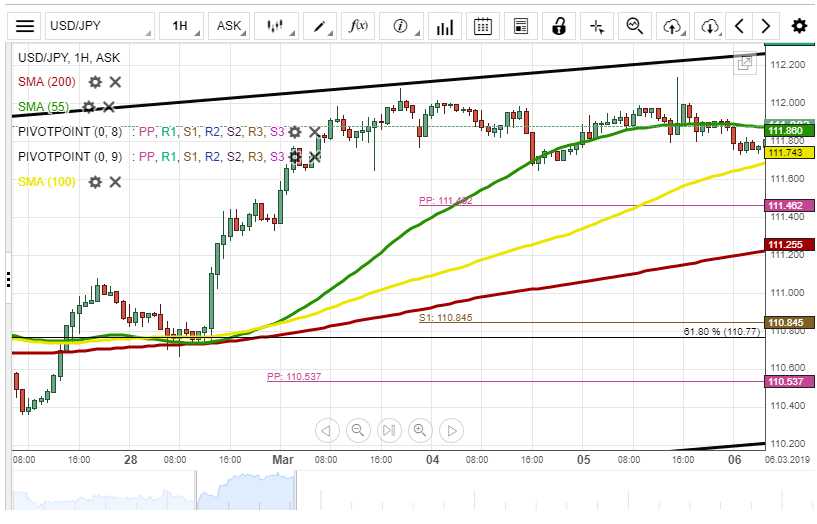
USD/JPY Could Reach R1 At 112.10
On Tuesday, the currency exchange rate passed the support of the 55-hour simple moving average to end the trading session at 111.60. During Wednesday's morning hours, the 100-hour simple moving average supported the rate to push it to the 111.86 mark.
Most likely, the US Dollar will continue appreciating against the Japanese Yen to break the resistance of the monthly R1 at 112.10 to trade at the 112.20 level.
Meanwhile, the 100-hour simple moving average will try to support the rate during the day.
EUR/USD – Euro Under Pressure Ahead Of ECB Decision
EUR/USD is showing little movement in the Wednesday session, but the pair’s trend this week has been downwards. Currently, the pair is trading at 1.1302, down 0.05% on the day. There are no eurozone or German events on the calendar. In the U.S., the major event is ADP nonfarm payrolls, which is expected to dip to 190 thousand. On Thursday, the ECB is expected to maintain interest rates at 0.00%. The U.S. releases unemployment claims.
All eyes will be on the ECB, which releases a rate statement on Thursday. The bank has pegged interest rates at a flat 0.00% since March of 2016. Economic activity in the eurozone has not been strong enough to warrant rate hikes over the past two years. At the same time, with the ECB winding up its massive stimulus program in December, any improvement in economic data (or rise in inflation) will raise speculation about a rate hike. The eurozone economy showed some strength in the first half of 2018, which led to talk of a rate hike in the second half of 2019. However, with Germany and the eurozone in the midst of a slowdown triggered by global trade tensions, it’s unlikely that the ECB will make a rate move before 2020.
In the U.S., the focus for the remainder of the week will be on employment numbers. The key events are nonfarm payrolls and wage growth, which will be released on Friday. Analysts are expecting mixed numbers on Friday. Wage growth is expected to improve to 0.3%, but nonfarm payrolls are projected to slide to 185 thousand, after a strong gain of 304 thousand in the previous release. The unemployment rate has been at record lows, and is expected to dip to a sizzling 3.9% in the February report.
Dollar Gains On Rates And Risk
USD maintains positive momentum despite lack of clear progress on US-China trade talks
On Wednesday morning, the US dollar was better bid against most of its peers despite the Fed dovish U-turn. The greenback rose the most against the Australian dollar, with AUD/USD down 0.72% to $0.7030, amid disappointing growth figures for the fourth quarter (2.3%y/y versus 2.6% exp. and 2.7% in 3Q). Only the Japanese yen was able to hold its head above water - thanks to its safe-haven status – with USD/JPY consolidating around 111.80. Indeed, despite positive headlines regarding trade talks between China and the US, market participants were not entirely reassured. However, it seems that investors have become increasingly less inclined to load on risk following such positive headlines; after all, the Trump administration has been using that trick repeatedly for months. Therefore, it is normal it doesn’t work that well anymore.
We believe that USD bears will continue to struggle, thanks to higher interest rate in the US and a persistent risk aversion. Indeed, rates in the US are more attractive compared to other countries in Europe and Asia, which gives the dollar a clear advantage. Moreover, the elevated risk aversion is benefiting safe-haven assets, such as the yen and the buck. On a side note, it is interesting to notice that the Swiss franc seems to have lose its safe-haven status, which suggests that the strategy implemented by SNB (i.e. negative interest rate coupled with FX interventions) starts to bear fruit finally.
Investors have remained relatively insensitive to the publication of soft and hard data. The positive surprise in ISM non-manufacturing (59.7 versus 57.4 expected) yesterday has had little effect on the USD. Today, traders will be watching MBA mortgage rate application, February ADP employment change (exp. 190k, prev. 213k), December trade balance (exp. -$57.9bn, prev. -$49.3bn) and the Fed Beige book.
Aussie falls on bearish outlook
The AUD/USD pair hit a two-month low as the Australian economy grew by 2.30% in December 2018, its weakest pace since June 2017. Expectations of 2.80% were greatly missed, suggesting the Reserve Bank of Australia’s growth outlook of 3% in 2019 should be downgraded soon. It’s likely the RBA will cut interest rates this year. Wage growth remains far from ranges of 6 years ago (2.30% in Q4 2018) while the sharp drop in investment and construction activity due to declining house prices should prompt a reaction. January capacity utilization of 81.40% is its lowest since April 2017.
Yet fiscal stimulus by the Australian government and rising commodity prices allow the RBA a wait-and-see approach. Lower growth should lead to monetary easing sometime in the first half of 2019. AUD/USD is expected to drop further short-term: currently at 0.7030, AUD/USD is expected to head along 0.7020 short-term.