

Sample Category Title
Sunset Market Commentary
Markets
Today, German and US yields drifted further south despite encouraging service sector confidence data in EMU and the US yesterday. We consider the moves as mainly technical in nature. Bond investors are awaiting guidance from the ECB policy decision tomorrow. The OECD downgraded its growth forecasts for the world economy and for Europe in particular. The downgrade shouldn’t have been a surprise for markets anymore. Still, the headlines were in line with today’s bond-friendly atmosphere. Early in afternoon trading, (European) bond markets were spooked by headlines from sources who were said to have knowledge of the internal debate within the ECB. The sources reportedly said that the scale of the ECB 2019 growth outlook downgrade would be big enough to justify a new program of bank loans (TLTRO’s). However, the design of the new program is said to be still subject to debate. The report caused some shivers in the bond market, but in the end changes were limited. A new loan program is apparently already expected by markets. The ECB’s guidance on interest rates is probably more important for (European) yields. In this respect, the ECB is rumoured to maintain a scenario of the economy returning to trend growth by the end of this year. The German yields declined between 0.8 bp (2-y) and 2.4 bp (10-y). Changes in the US Treasury curve are currently less than 1bp.
The EUR/USD decline/correction from earlier this week slowed today. The OECD downgrading its growth forecast for EMU was apparently already discounted in euro pricing. EUR/USD settled near the 1.13 big figure. The US ADP labour market report was close to expectations and had little impact on the dollar. Headlines from sources on the ECB forecasts and on the internal debate on a new bank loan program (cf supra) pushed EUR/USD temporary below the 1.13 level. As was the case for interest rates, the move was limited and short-lived. EUR/USD is again trading in the 1.13 area. More or less at the same time of the ECB headlines, the US trade deficit for 2018 was reported at the widest level in 10-year. This was maybe a slightly USD negative. USD/JPY is trading in the 111.80 area.
In line with price moves in several other major currencies, sterling trading was some kind of erratic in nature. There were no UK eco data today. Sterling traders were watching headlines from EU-UK Brexit negotiations in Brussels. The EU said the talks were difficult. UK officials labelled them as ‘robust’. However, this time FX markets didn’t feel the need to adapt sterling positioning in a profound way. EUR/GBP hovered in a sideways range near the 0.86 level. Cable (1.3140 area) also shows no clear directional trend.
News Headlines
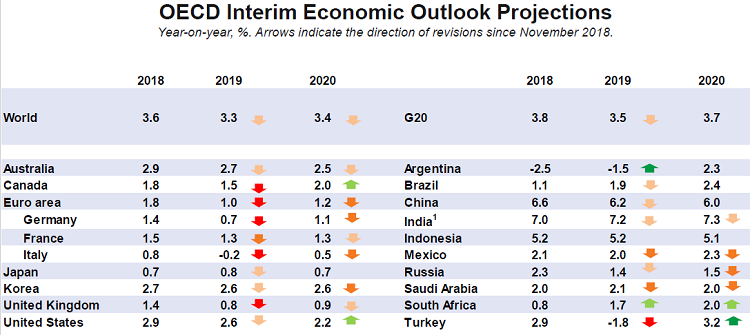
The OECD downgraded its growth forecast for the world economy to 3.3% in 2019 and 3.4% in 2020. It predicted growth of 3.5% for both years in November. High policy uncertainty, ongoing trade tensions and a further erosion of business and consumer confidence are said to be responsible for the slowdown. Especially Europe is seen vulnerable to policy uncertainty.
ADP reported 183 000 private job growth in February. The figure was in line with market expectations. January job growth was upwardly revised to 300 000 (from 213 000), bringing the figure in line with last month’s BLS payrolls release. The US trade deficit widened sharply in December as imports exceeded exports by $59.8 bn ($ 50.3 bn in November). For the whole of 2018, the US trade deficit surged to $ 621 bn, the widest deficit since 2008.
Today, both the Polish Central Bank and the Central Bank of Canada as expected left their policy rates unchanged at respectively 1.50% and 1.75%.
USD/CAD Mid-Day Outlook
Daily Pivots: (S1) 1.3316; (P) 1.3338; (R1) 1.3376; More...
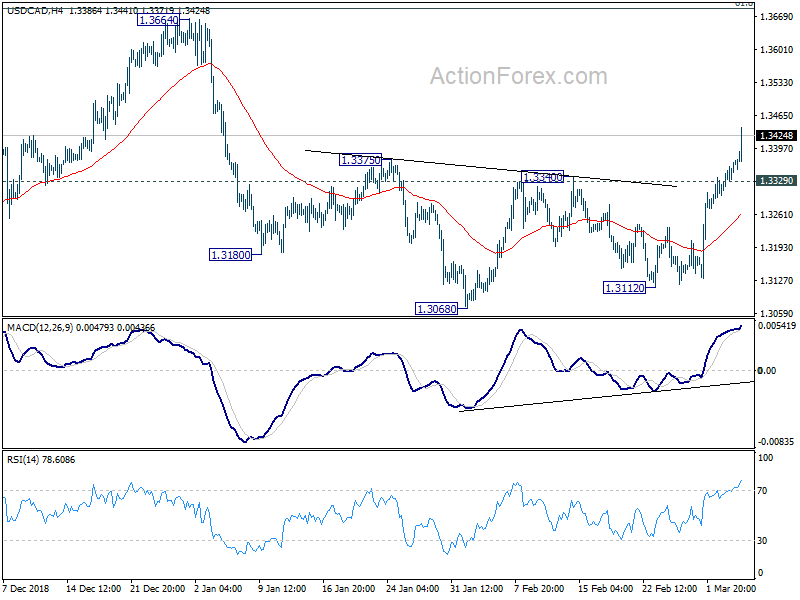
USD/CAD surges to as high as 1.3441 so far in early US session. Intraday bias remains on the upside and outlook is unchanged. The pull back from 1.3664 should have completed at 1.3068. Further rise should be seen for retesting 1.3664 and then 1.3685 fibonacci level. On the downside, below 1.3329 minor support will turn bias neutral first.
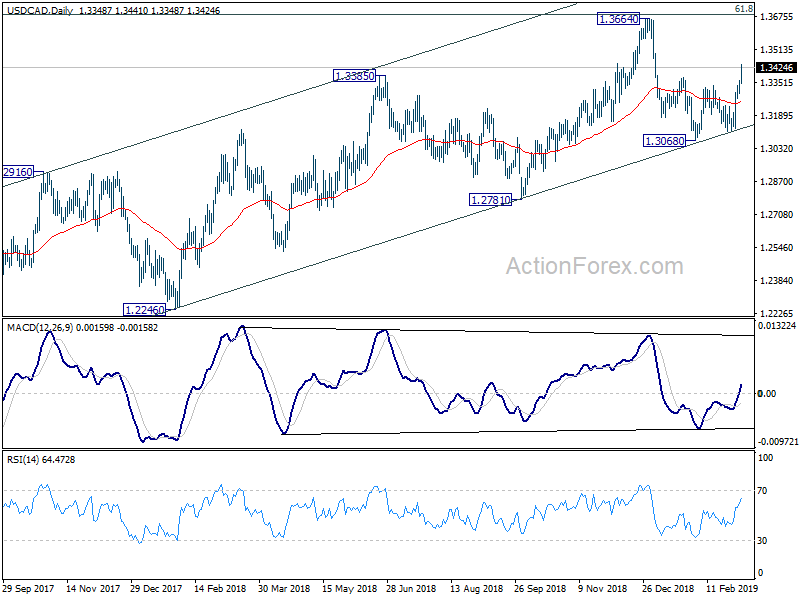
In the bigger picture, structure of the medium term rise from 1.2061 (2017 low) to 1.3664 is not clearly impulsive. Hence, we'd stay cautious on strong resistance from 61.8% retracement of 1.4689 (2016 high) to 1.2061 at 1.3685 and 1.3793 resistance to limit upside, and bring medium term topping. But in any case, medium term outlook will stay bullish as long as channel support (now at 1.3118) holds. Sustained break of 1.3793 will pave the way to retest 1.4689 (2015 high). Firm break of the channel support should confirm reversal target 1.2061 low again.
Canadian Dollar dives as BoC turns cautious and put rate hike off the table, at least temporarily
Canadian Dollar dives sharply after BoC kept interest rate unchanged at 1.75% and turned more cautious. A rate hike should be at least off the table temporarily.
The most important change in the statement is in the last paragraph. BoC now said the outlook "continues to warrant a policy interest that is below its neutral range". And, given the mixed data, "it will take time to gauge the persistence of below-potential growth and the implications for the inflation outlook". Also, with "increased uncertainty" about timing of future hikes, BoC will closely watch developments in household spending, oil and trade.
Also from Canada, Ivey PMI dropped sharply to 50.6 in February, down from 54.7 and way below expectation of 55.1. Trade deficit widened to CAD -4.6B in December versus expectation of CAD -1.7B. Labor productivity dropped -0.4% qoq in Q4.
Here is the full statement:
Bank of Canada maintains overnight rate target at 1 ¾ per cent
The Bank of Canada today maintained its target for the overnight rate at 1 ¾ per cent. The Bank Rate is correspondingly 2 per cent and the deposit rate is 1 ½ per cent.
Recent data suggest that the slowdown in the global economy has been more pronounced and widespread than the Bank had forecast in its January Monetary Policy Report (MPR). While the sources of moderation appear to be multiple, trade tensions and uncertainty are weighing heavily on confidence and economic activity. It is difficult to disentangle these confidence effects from other adverse factors, but it is clear that global economic prospects would be buoyed by the resolution of trade conflicts.
Many central banks have acknowledged the building headwinds to growth, and financial conditions have eased as a result. Meanwhile, progress in US-China trade talks and policy stimulus in China have improved market sentiment and contributed to firmer commodity prices.
For Canada, the Bank was projecting a temporary slowdown in late 2018 and early 2019, mainly because of last year's drop in oil prices. The Bank had forecast weak exports and investment in the energy sector and a decline in household spending in oil-producing provinces. However, the slowdown in the fourth quarter was sharper and more broadly based. Consumer spending and the housing market were soft, despite strong growth in employment and labour income. Both exports and business investment also fell short of expectations. After growing at a pace of 1.8 per cent in 2018, it now appears that the economy will be weaker in the first half of 2019 than the Bank projected in January.
Core inflation measures remain close to 2 per cent. CPI inflation eased to 1.4 per cent in January, largely because of lower gasoline prices. The Bank expects CPI inflation to be slightly below the 2 per cent target through most of 2019, reflecting the impact of temporary factors, including the drag from lower energy prices and a wider output gap.
Governing Council judges that the outlook continues to warrant a policy interest rate that is below its neutral range. Given the mixed picture that the data present, it will take time to gauge the persistence of below-potential growth and the implications for the inflation outlook. With increased uncertainty about the timing of future rate increases, Governing Council will be watching closely developments in household spending, oil markets, and global trade policy.
Information note
The next scheduled date for announcing the overnight rate target is April 24, 2019. The next full update of the Bank's outlook for the economy and inflation, including risks to the projection, will be published in the MPR at the same time.
(BOC) Bank of Canada maintains overnight rate target at 1 ¾ per cent
The Bank of Canada today maintained its target for the overnight rate at 1 ¾ per cent. The Bank Rate is correspondingly 2 per cent and the deposit rate is 1 ½ per cent.
Recent data suggest that the slowdown in the global economy has been more pronounced and widespread than the Bank had forecast in its January Monetary Policy Report (MPR). While the sources of moderation appear to be multiple, trade tensions and uncertainty are weighing heavily on confidence and economic activity. It is difficult to disentangle these confidence effects from other adverse factors, but it is clear that global economic prospects would be buoyed by the resolution of trade conflicts.
Many central banks have acknowledged the building headwinds to growth, and financial conditions have eased as a result. Meanwhile, progress in US-China trade talks and policy stimulus in China have improved market sentiment and contributed to firmer commodity prices.
For Canada, the Bank was projecting a temporary slowdown in late 2018 and early 2019, mainly because of last year's drop in oil prices. The Bank had forecast weak exports and investment in the energy sector and a decline in household spending in oil-producing provinces. However, the slowdown in the fourth quarter was sharper and more broadly based. Consumer spending and the housing market were soft, despite strong growth in employment and labour income. Both exports and business investment also fell short of expectations. After growing at a pace of 1.8 per cent in 2018, it now appears that the economy will be weaker in the first half of 2019 than the Bank projected in January.
Core inflation measures remain close to 2 per cent. CPI inflation eased to 1.4 per cent in January, largely because of lower gasoline prices. The Bank expects CPI inflation to be slightly below the 2 per cent target through most of 2019, reflecting the impact of temporary factors, including the drag from lower energy prices and a wider output gap.
Governing Council judges that the outlook continues to warrant a policy interest rate that is below its neutral range. Given the mixed picture that the data present, it will take time to gauge the persistence of below-potential growth and the implications for the inflation outlook. With increased uncertainty about the timing of future rate increases, Governing Council will be watching closely developments in household spending, oil markets, and global trade policy.
Information note
The next scheduled date for announcing the overnight rate target is April 24, 2019. The next full update of the Bank's outlook for the economy and inflation, including risks to the projection, will be published in the MPR at the same time.
USD/JPY Mid-Day Outlook
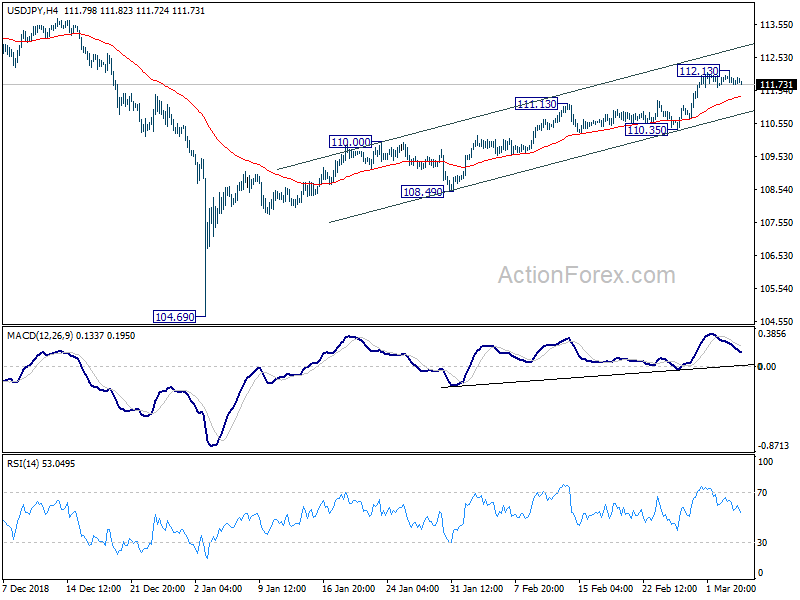
Daily Pivots: (S1) 111.69; (P) 111.92; (R1) 112.11; More...
Intraday bias in USD/JPY remains neutral for consolidation below 112.13 temporary top. In case of deeper pull back, downside should be contained above 110.35 support to bring another rally. On the upside, above 112.13 will resume rise from 104.69 for 114.54 resistance next.
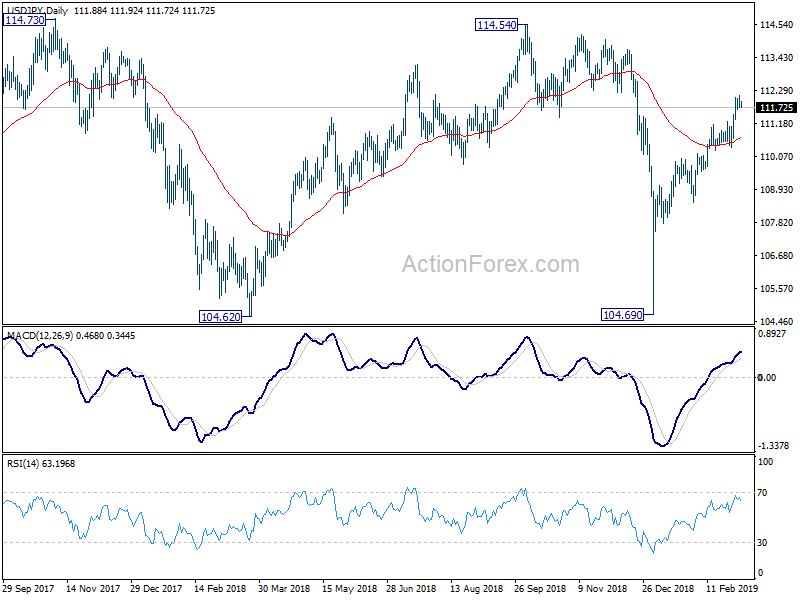
In the bigger picture, current strong rebound from 104.69 argues that decline from 118.65 (2016 high) has completed with three waves down to 104.69, after failing 104.62. More importantly, the rise from 98.97 (2016 low) could be resuming. Focus now turns back to 114.54 resistance, decisive break there will add more credence to this bullish case and target 118.65. This will now be the favored case as long as 110.35 support holds.
USD/CHF Mid-Day Outlook
Daily Pivots: (S1) 0.9999; (P) 1.0027; (R1) 1.0073; More....
Outlook in USD/CHF is unchanged. Corrective pull back from 1.0098 should have completed at 0.9926 already. Intraday bias stays on the upside for retesting 1.0098 first. Break will target 1.0128 key resistance. On the downside, below 0.9997 minor support will turn bias back to the downside to extend the correction from 1.0098 instead.
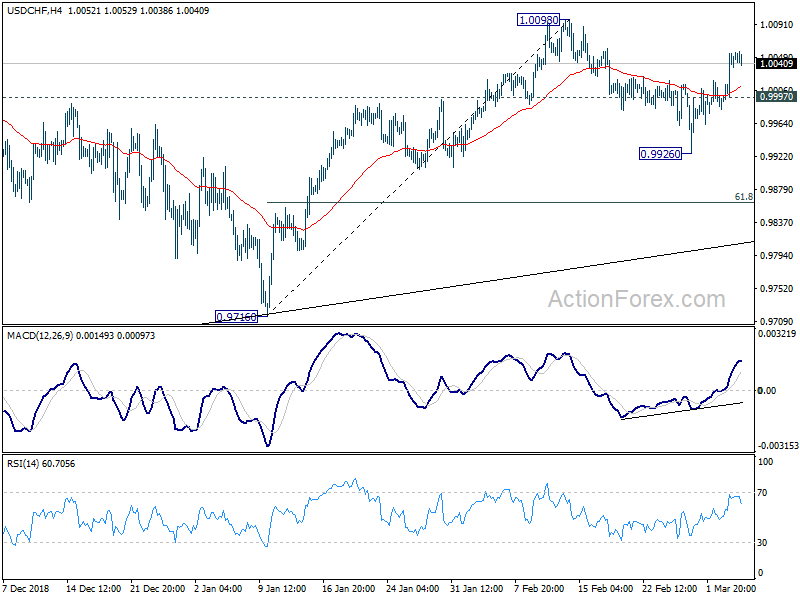
In the bigger picture, USD/CHF drew strong support from medium term trend line and rebounded. That suggests rise from 0.9186 is still in progress. Further break of 1.0128 will confirm up trend resumption and target 1.0342 key resistance. Nevertheless, break of 0.9716 will dampen this bullish view and at least bring deeper fall to 0.9541 key support.

GBP/USD Mid-Day Outlook
Daily Pivots: (S1) 1.3118; (P) 1.3158; (R1) 1.3218; More....
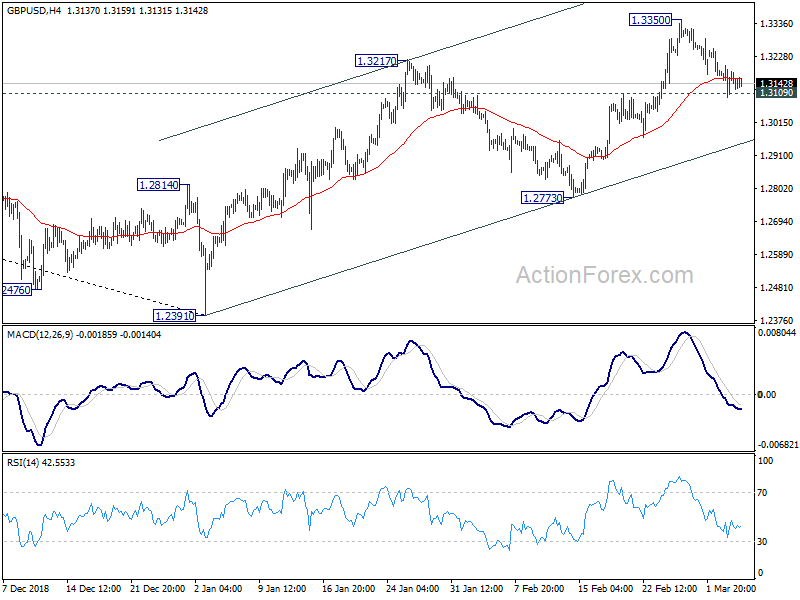
Intraday bias in GBP/USD remains neutral with focus on 1.3109 minor support. Firm break will be an early sign of near term reversal and bring deeper fall to trend line support (now at 1.2954). Break will target 1.2774 support to confirm completion of rebound from 1.2391. Nevertheless, rebound from current level, followed by break of 1.3350, will resume rise from 1.2391 to 61.8% retracement of 1.4376 to 1.2391 at 1.3618 next.
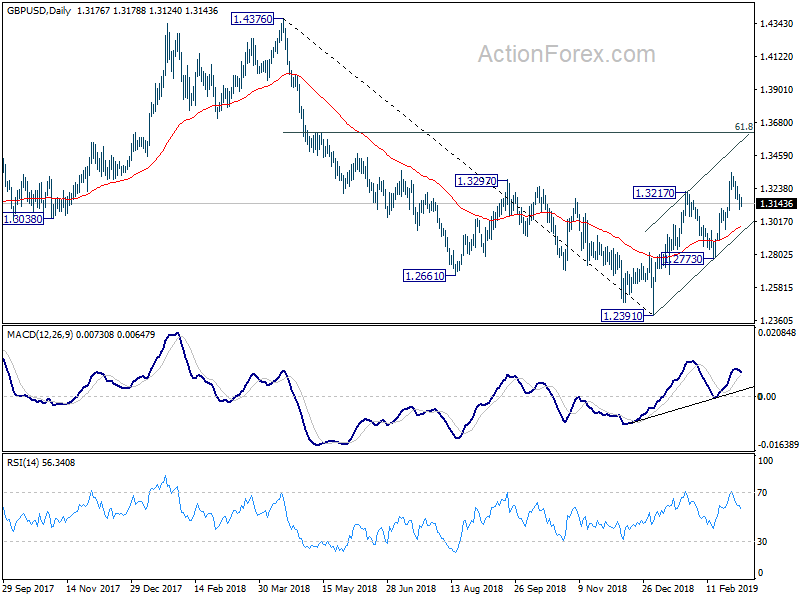
In the bigger picture, medium term decline from 1.4376 (2018 high) should have completed at 1.2391. Rise from 1.2391 is now seen as the third leg of the corrective pattern from 1.1946 (2016 low). Further rise could be seen through 1.4376 in medium term. On the downside, though, break of 1.2773 support will turn focus back to 1.2391 low and then 1.1946.
Canada’s Trade Deficit Widens to a Record in December, Driven by Lower Crude Oil Prices
Canada posted a record $4.6 billion trade deficit in December, up from a downwardly revised $1.98 billion deficit in November (previously reported as $2.1 billion). This was significantly higher than consensus estimates for a $2.1 billion deficit. Exports fell 3.8% (m/m) to $46.3 billion, driven by weaker nominal energy exports. Imports were up 1.6% to $50.9 billion, driven by imports of refined petroleum energy products.
After accounting for price changes, the picture was still somewhat disappointing. Export volumes fell 1.4%, whereas import volumes were up 1.1%.
Consistent with a drop in global and Canadian oil price benchmarks during the fall, the decline in exports was once more an energy price story. Excluding energy products, exports were almost flat on the month. Exports of energy products fell 21.7% in value, with most of the drop driven by declines in crude oil and bitumen exports (- 28.7%). Exports of metal and non-metallic mineral products were also down a significant 9.8% (attributed to lower transfers of gold in December). Providing some partial offset to these drops was a surge in exports of aircraft and other transportation equipment, up 16% on the month.
Imports increased 1.6% in December, driven by energy (+19.7%), metal ores and non-metallic minerals (+32.8%), and motor vehicles and parts (+4%). Statistics Canada attributes the surge in energy imports (mostly refined petroleum products) to temporary maintenance at some Canadian refineries. Imports of machinery were up a modest, but still encouraging 0.8%.
Canada's merchandise trade surplus with the U.S. narrowed to $1.8 billion in December. Its merchandise trade deficit with the rest of the world widened to $6.4 billion.
Key Implications
The deficit widening came in significantly higher than expected, although the energy price story was mostly penciled in. Looking beneath the headline numbers, the broad-based weakness in exports, and the negative volumes print is discouraging. Nevertheless, the increase in imports, especially of interest-sensitive categories (motor vehicles and parts) is somewhat positive, given the otherwise dampened consumer spending outlook. The uptick in machinery and equipment imports, which was also one of the better performing import categories on the year, is also encouraging.
The release doesn't change much given the disappointing Q4 GDP has already been factored in. Our GDP tracking for Q1 remains unchanged at just 0.1%.
EUR/USD Mid-Day Outlook
Daily Pivots: (S1) 1.1284; (P) 1.1313; (R1) 1.1338; More.....
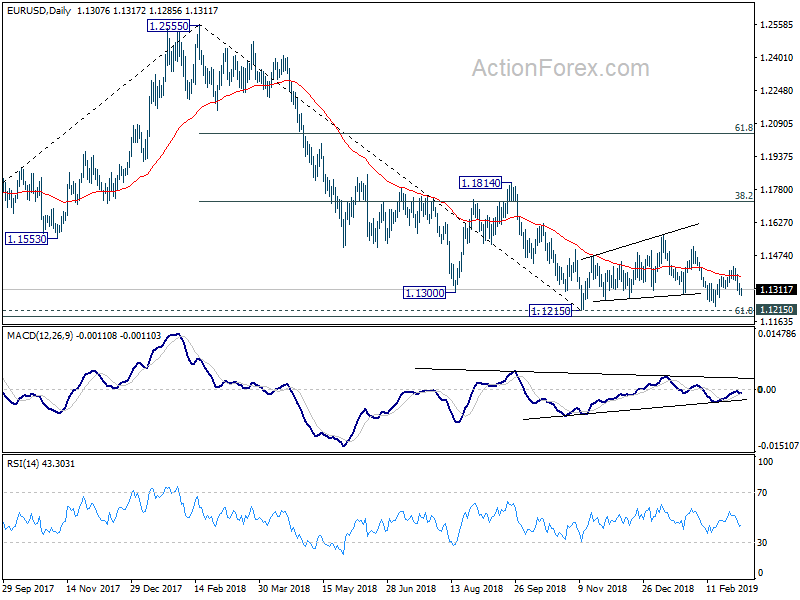
With 1.1345 minor resistance intact, intraday bias in EUR/USD remains on the downside for 1.1215 low. Decisive break there will resume larger down trend from 1.2555. On the upside, above 1.1345 minor resistance will turn bias to the upside for 1.1419 resistance to extend the consolidation from 1.1215.
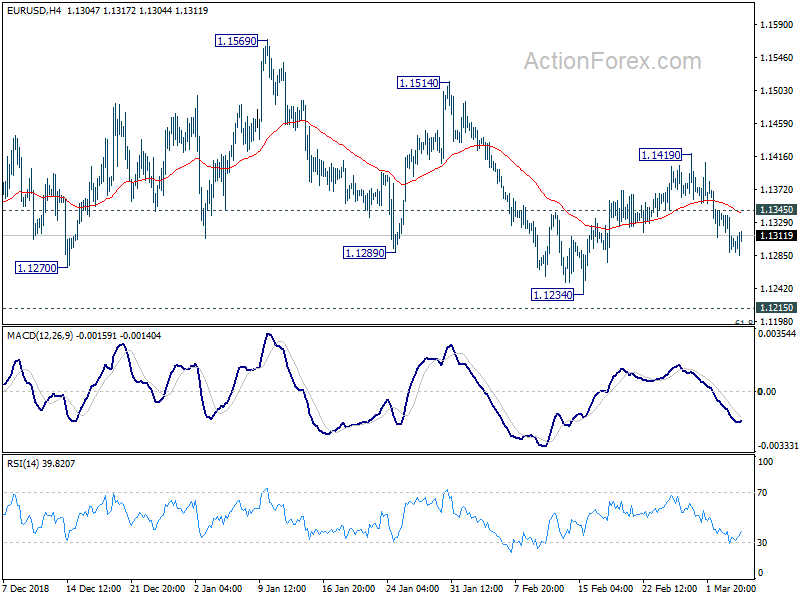
In the bigger picture, as long as 1.1814 resistance holds, down trend down trend from 1.2555 medium term top is still in progress and should target 61.8% retracement of 1.0339 (2017 low) to 1.2555 at 1.1186 next. Sustained break there will pave the way to retest 1.0339. However, break of 1.1814 will confirm completion of such down trend and turn medium term outlook bullish.
US Trade Deficit Ballooned to Decade High, Dollar Shrugs and Stays Firm
Yen and Dollar are trading as the strongest ones for today so far. Slightly lower than expected ADP job growth in February was offset by larger upward revision in January's data. US trade deficit surged for 2018 as a whole jumped to highest in a decade. But these data are largely ignored by the markets. US growth and trade outlook will very much lie on result of trade negotiation with China, with turned quiet this week. Also, markets ignored OECD's downgrade of global growth forecast.
Meanwhile, Australian Dollar remains the weakest on for today as traders increased bet on RBA rate cut this year after dismal Q4 GDP. Sterling is the second weakest as there is no breakthrough on Irish backstop while next week's crucial Brexit votes are approaching. Canadian Dollar is not too far behind as traders await BoC rate decision. Recent economic data from Canada pointed to slowdown in growth momentum. Yet BoC Governor Stephen Poloz maintained tightening bias in recent comments. There is risk of a mild dovish twist in today's BoC statement. If that happens, the Loonie will likely suffer another round of selling.
In other markets, FTSE is up 0.34%. DAX is up 0.03%. CAC is up 0.26%. German 10-year yield is down -0.257 at 0.144. Earlier in Asia, Nikkei dropped -0.60%. Hong Kong HSI rose 0.26%. China Shanghai SSE rose 1.57%. Singapore Strait Times dropped -0.35%. Japan 10-year JGB yield dropped -0.0132 to -0.005, turned negative.
US trade deficit widened to USD 621B in 2018, highest in a decade
US ADP report showed 183k growth in private sector jobs in February, slightly below expectation of 190k. But January's figure was revised up from 213k to 300k. US trade deficit widened to USD -59.8B in December versus expectation of USD -57.8B. For 2018, total trade deficit was at USD 621B, highest in a decade, with goods deficit with China, Mexico and EU widened to records. From Canada trade deficit widened to CAD -4.6B in December versus expectation of CAD -1.7B. Labor productivity dropped to -0.4% qoq in Q4 versus expectation of 0.2% qoq.
No solution on Irish backstop after difficult discussions with robust, strong views
UK Attorney General Geoffrey Cox talked about his meeting with EU in Brussels yesterday. He told Sky News that "we've put forward some proposals, they're very reasonable proposals, and we're now really into the detail of the discussions," regarding the changes needed on Irish backstop. Cox added that "both sides have exchanged robust, strong views and we're now facing the real discussions, talks will be resuming soon."
European Commission spokesman Margaritis Schinas said chief Brexit negotiator Michel Barnier has informed the Commission that "while the talks take place in a constructive atmosphere, discussions have been difficult." Also, "no solution has been identified at this point that is consistent with the Withdrawal Agreement, including the protocol on Ireland and Northern Ireland, which will not be reopened,"
Separately, UK Trade Minister Liam Fox said the government will laid out the tariffs it plans to levy if the parliament chooses a no-deal Brexit. Fox personally prefer to present the tariff plan to MPs before no-deal vote next week. But he said it was not his decision to make.
Australia GDP slowed to 0.2% in Q4, RBA may need to revise down forecasts in May
Australia GDP grew only 0.2% qoq in Q4, slowed from prior quarter's 0.3% qoq and missed expectation of 0.5% qoq. Annual growth slowed to 2.3%, down from Q3's 2.7%. Looking at some details, terms of trade rose 3.2% qoq, 6.1% yoy. But consumer spending rose only 0.4% qoq, 2.0% yoy. Home building contracted -3.4% qoq, slowed to 2.5% yoy. Farm output dropped -4.0% qoq, -5.8% yoy.
Australian Treasurer Josh Frydenberg tried to talk down the slowdown. He noted that "the moderation in part reflects the impact of the drought, lower mining investment and as we continue to move from the construction to the production phase, as well as a decline in residential construction activity from record levels".
However, the country "continues to grow faster than any G7 nation except for the United States". And, 0.2% growth was "within the range of market expectations" to him. Also, "over the past 12 months, more than 270,000 new jobs were created and more than 8 out of every 10 of these jobs were full-time."
Westpac noted that the data now posts a "challenge" for RBA to "credibly maintain its GDP growth forecasts at 3% in 2019 and 2.75% in 2020". Thus RBA is likely to revise down its growth forecasts in May SoMP. And the policy stance could then shift to steady with a clear easing bias. Westpac continued to expect RBA to cut twice this year in August and November.
RBA Lowe: Income growth to provide counterweight to falling house price
RBA Governor Philip Lowe said in a speech that nationwide housing prices have fallen by 9% since peaking in 2017, bringing them back to level in mid-2016. He noted that "declines of this magnitude are unusual, but they are no unprecedented". Movement in house prices would influence consumer spending, building activity, access to finance by small businesses and profitability of financial institutions.
Though, labor market is expected to continue to tighten with gradual increase in wage growth and faster income growth. That should "provide a counterweight to the effect on spending of lower housing prices." And overall, Lowe said the adjustment in our housing market is manageable for the overall economy. It is unlikely to derail our economic expansion. It will also have some positive side-effects by making housing more affordable for many people."
On monetary policy, Lowe also noted that a "strong labour market is the central ingredient in the expected pick-up in inflation". Wag growth would "boost household income and spending and provide a counterweight to the fall in housing price". And, "a lot depends upon the labour market". RBA will "continue to assess the shifts in the global economy, trends in household spending and how the tension between the labour market and output indicators resolves itself. "
Lowe also reiterated that the probabilities for the next move to go up or down are "reasonably evenly balanced".
BoJ Harada: Should strengthen monetary easing without delay if economy deteriorates
BoJ board member Yutaka Harada warned that the economy is facing increasing risks, including slowdown in China, trade tensions and weak private consumptions. Also, subdued inflation could reinforce the public view of low inflation, which would delay the achievement of the 2% target. He urged that "if the economy deteriorates to the extent that achieving the inflation target in the long term becomes difficult, it's necessary to strengthen monetary easing without delay."
For now, Harada said BOJ should commit to loose monetary policy "unless prices show stronger movements than currently anticipated." And the conduct of monetary policy should be "data-dependent, not calendar-based". He also warned that "past episodes of premature monetary tightening worsened the economy, driven down prices and output, and led to declines in interest rates in the longer-term."
OECD lowers global growth forecast to 3.3% in 2019 on China and Europe slowdown
OECD lowered global growth forecast by -0.2% to 3.3% in 2019 and by -0.1% to 3.4% in 2020. G20 growth forecast was lowered by -0.2% to 3.5% in 2019, and kept unchanged at 3.7% in 2020.
In the Interim Economic Outlook, it's noted that Chinese and European slowdown, and weakening global trade growth are the principal factors weighing on the world economy. Also, OECD warned that further trade restrictions and policy uncertainty could bring "additional adverse effects". For China, while policy stimulus should offset weak trade development, "risks remains of a sharper slowdown" that would hit global growth and trade.
"The global economy is facing increasingly serious headwinds," said OECD Chief Economist Laurence Boone. "A sharper slowdown in any of the major regions could derail activity worldwide, especially if it spills over to financial markets. Governments should intensify multilateral dialogue to limit risks and coordinate policy actions to avoid a further downturn," Ms Boone said.
Here are some details:
- World growth forecast is lowered from 3.5% to 3.7% in 2019.
- World growth forecast is lowed from 3.5% to 3.4% in 2020.
- G20 growth forecast is lowered from 3.7% to 3.5% in 2019.
- G20 growth forecast is unchanged at 3.7% in 2020.
- US growth forecast is lowered from 2.7% to 3.6% in 2019.
- US growth forecast is raised from 2.1% to 2.2% in 2020.
- Eurozone growth forecast is lowered from 1.8% to 1.0% in 2019.
- Eurozone growth forecast is lowered from 1.6% to 1.2% in 2020.
- UK growth forecast is lowered from 1.4% to 0.8% in 2019.
- UK growth forecast is lowered from 1.1% to 0.9% in 2020.
- Japan growth forecast is lowered from 1.0% to 0.8% in 2019.
- Japan growth forecast is unchanged at 0.7% in 2020.
- China growth forecast is lowered from 6.3% to 6.2% in 2019.
- China growth forecast is unchanged at 6.0% in 2020.
Latest OECD forecasts:
EUR/USD Mid-Day Outlook
Daily Pivots: (S1) 1.1284; (P) 1.1313; (R1) 1.1338; More.....
With 1.1345 minor resistance intact, intraday bias in EUR/USD remains on the downside for 1.1215 low. Decisive break there will resume larger down trend from 1.2555. On the upside, above 1.1345 minor resistance will turn bias to the upside for 1.1419 resistance to extend the consolidation from 1.1215.
In the bigger picture, as long as 1.1814 resistance holds, down trend down trend from 1.2555 medium term top is still in progress and should target 61.8% retracement of 1.0339 (2017 low) to 1.2555 at 1.1186 next. Sustained break there will pave the way to retest 1.0339. However, break of 1.1814 will confirm completion of such down trend and turn medium term outlook bullish.
Economic Indicators Update
| GMT | Ccy | Events | Actual | Forecast | Previous | Revised |
|---|---|---|---|---|---|---|
| 00:30 | AUD | GDP Q/Q Q4 | 0.20% | 0.50% | 0.30% | |
| 13:15 | USD | ADP Employment Change Feb | 183K | 190K | 213K | 300K |
| 13:30 | CAD | International Merchandise Trade (CAD) Dec | -4.6B | -1.70B | -2.06B | -2.0B |
| 13:30 | CAD | Labor Productivity Q/Q Q4 | -0.40% | 0.20% | 0.30% | 0.20% |
| 13:30 | USD | Trade Balance (USD) Dec | -59.8B | -57.8B | -49.3B | -50.3B |
| 15:00 | CAD | BoC Rate Decision | 1.75% | 1.75% | ||
| 15:00 | CAD | Ivey PMI Feb | 55.1 | 54.7 | ||
| 15:30 | USD | Crude Oil Inventories | 1.2M | -8.6M | ||
| 19:00 | USD | Federal Reserve Beige Book |