

Sample Category Title
Market Morning Briefing: Dollar Yen Has Dipped Slightly
STOCKS
Asian Indices seems to have been positioned better when compared to the Dow and DAX. China's Shanghai and India's Sensex and Nifty 50 are bullish in the near term while Japan's Nikkei is nearing a key support. Dow is likely to fall further in the coming days while the DAX looks mixed in the near term.
Dow Jones (25,673.46, -133.17, -0.52%) continues to remain under pressure as expected. As mentioned yesterday, Dow Dow is in a danger witnessed a sharp corrective fall to 25,100-25,000 in the coming weeks.
DAX (11,587.63, -33.11, -0.28%) is continuing to consolidate between 11,500 and 11,700 within its overall uptrend. A breakout on either side of 11,500 or 11,700 will decide the next move.
Nikkei (21,440.50, -156.31, -0.72%) has come closer to the key 100-day moving average support level of 21,404. A strong bounce from here can take it to 22,000 in the coming weeks. But a break below 21,404 can drag it to 21,250.
Shanghai (3,104.11, +2.17, +0.07%) has gained momentum and can move further higher to test the next key resistances of 3,150 (Fibonacci retracement level) and 3,190 (200-week moving average).
Sensex (36,636.10, +193.56, +0.53%) and Nifty 50 (11,053, 65.55, 0.60%) retains their strength and has risen further. The bullish outlook is intact. Sensex has risen past its resistance at 36,500 and can now test 36,950-37,000 in the near term. Nifty 50 has risen above the psychological level of 11,000 and remains bullish for a test of 11,150.
COMMODITIES
Commodities broadly remains stable and can consolidate in the near term before a clear trend emerges.
Gold (1287) and Silver (15.1) are holding above their key supports of 1280 and 15 respectively but are not gaining strength for a strong bounce. While above 1280, a corrective rally to 1295-1300 cannot be ruled out in gold. Similarly Silver can bounce to 15.4-15.5 on a break above 15.15. On the other hand, a break below 1280 can drag gold to 1275 and 1270 while silver can test 14.85 on a break below 15.
Copper (2.92) has dipped again. As mentioned yesterday it can consolidate between 2.89 and 2.98 before moving up to 3.0 and even higher levels.
WTI (56.3) dipped to 55.45 and has bounced from there. The near-term outlook is mixed and the broad 55-58 sideways range is likely to remain intact for some more time.
Brent (66.15) continues to remain stuck in between 65 and 66.35 with its broad 64-68 sideways range. A strong break above 66.35 can take Brent higher to 67 and 67.30 in the near term.
FOREX
Dollar-Index (96.85) is almost stable and has scope of testing resistance at 97.25 as seen on the daily candles. A decline from 97.25 could be seen next week.
Euro (1.1307) also has immediate support at 1.1250 which is likely to get tested in the next few sessions before a bounce back towards 1.1350/14 is seen. Near term looks bearish while a bounce is expected in the medium term (say next couple of weeks).Markets await ECB meeting today.
Euro-Yen (126.26) is falling as expected. There could be an interim support at 126.0-125.70 which could produce a medium term bounce. Else, a break below 125.70 could take it lower towards 125.20.
Dollar Yen (111.66) has dipped slightly. While trend resistance near 112.5 holds, Dollar-Yen looks bearish towards 111.
Pound (1.3184) has immediate support at 1.31 as mentioned yesterday. If 1.31 holds, we could see a rise back towards 1.33 else the current fall could extend towards 1.30-1.2950 in the coming 1-2 weeks.
Aussie (0.7043) has tested immediate support near 0.7025 on the daily candles. While that holds, Aussie could see a rise to 0.7150. Failure to sustain above 0.7025 could take it towards lower support near 0.6950.
USDCNY (6.7082) has dipped after testing levels near 6.7180 yesterday. Near term trade region is likely to be 6.72-6.66. For now, we could see a dip towards 6.68 while 6.72 holds.
Dollar Rupee (70.29) may test 70.10 today. It would be crucial to see if Dollar-Rupee bounces back from 70.10 or heads lower in the near term. A break below 70.10 could open up chances of falling towards 69.75 in the medium term. Watch price action near 70.10.
INTEREST RATES
The US yields have fallen as expected. The 2Yr (2.52%), 5Yr (2.50%), 10Yr (2.69%) and 30Yr (3.07%) are trading lower today and could continue to fall to test support levels on the short term charts. The 30Yr could fall towards 3% while the 10YR and 5Yr could fall towards 2.64% and 2.45% respectively.
The German-Japan 10Yr (0.13%) has come off sharply to re-test support near 0.11%. A bounce from here towards 0.19% is likely and indicates a rise in Euro-Yen in the near term.
The UK-US 10Yr (-1.46%) is facing rejection from near term resistance and could fall towards -1.50% in the near term. While the spread falls, it could indicate weakness in Pound to continue.
The 10Yr GOI (7.5723%) has risen yesterday. A test of 7.60/65% looks possible in the near term while above 7.52%.
Beige Book Shows Modest Improvement in Economic Conditions at the Start of 2019
Today's Beige Book showed that economic activity increased at a slight-to-moderate pace in ten out of twelve Federal Reserve Districts from late-January through February. This was a slight upgrade from eight districts reporting growth in the previous report. Economic activity was reported be flat in Philadelphia and St. Louis.
Manufacturing activity strengthened relative to the previous report, but manufacturing firms remained concerned about weakening global demand, higher input costs due to tariffs, and trade policy uncertainty. Service-sector activity expanded at a modest to moderate pace in most districts – an upgrade relative to previous assessment in which it was reported to be slowing.
Inflationary pressures remained contained, with prices rising at a modest to moderate pace. A few firms have mentioned that the price of steel, impacted by tariffs, has stabilized or fallen recently. Energy costs have also declined. Still, firms continued to cite pressure on profit margins, as input prices were rising faster than selling prices, and firms' ability to pass higher costs to consumers varied greatly by region and industry.
The tight labor market for all skill levels remained a pressure point for businesses, and was said to be restricting employment growth in some areas. It was also pressuring university enrollment rates in some Districts, as potential students were increasingly choosing to work rather than to study. Wages continued to increase across most Districts and skill levels.
Activity in the housing market remained subdued. Residential construction was steady or slightly higher, while home sales were lower. Inventory of houses on the market was reported to have increased, but was still at low levels, while home price growth continued to moderate.
The government shutdown was reported to have slowed activity in a number of industries in about half of the Districts. In addition to the partial government shutdown, harsh winter weather and higher costs of credit were said to have weighed on consumer spending at the start of the year.
Key Implications
Economic data flow has been disappointing at the start of the year, but this Beige Book shows signs of modest improvement relatively to the past report. Still, we are expecting economic growth to downshift to near 1% (annualized) due in part to the government shutdown and trade policy uncertainty noted in this report. Economic activity should rebound above 2% in Q2 as the impact from temporary headwinds fades, but annual growth is unlikely to match a high water mark seen in 2018.
The tight labor market continues to draw people from the sidelines and encourages more high-school graduates to opt for a job rather than a university degree. Still, the U.S. labor market appears to be reaching a boiling point with payroll gains likely to slow in coming months. Some firms are already reporting that an inability to find workers is weighing on hiring.
Window Closes On Further Bank Of Japan Policy Action
Executive Summary
After a period of steady growth, Japan's economy has slowed more recently. The economy experienced up-and-down growth in 2018, while inflation still remains well below the central bank's target. That sluggish momentum has carried into 2019, with activity indicators suggesting economic growth is likely to remain subdued, while an increase in the consumption tax this year should also weigh on the economy. As the economic outlook remains underwhelming, along with a more dovish tone from other central banks, we no longer expect the Bank of Japan (BoJ) to tighten monetary policy in Q2-2019. Despite our forecast policy change, we believe the path for the yen remains relatively unchanged. At this time, we still expect modest gains in the yen over the mediumterm as the Fed becomes less hawkish and the U.S. dollar shows broad-based softness, while residual volatility could also support the yen given its safe-haven status.
Japan Returns to Stop-Start Economic Growth
After a period of sustained economic growth in 2016 and 2017, when Japan's economy expanded for eight quarters in a row, activity returned to a more familiar stop-start pattern in 2018. On a sequential basis, Japan's GDP has contracted in two of the past four quarters, with a large 2.6% quarter-over-quarter annualized decline in the third quarter, only partially recovered by the 1.4% increase in the fourth quarter (Figure 1). Looking through the details, consumer spending and domestic demand remained reasonably steady, with weakness instead concentrated in a decline in government investment spending and a negative contribution from net exports.
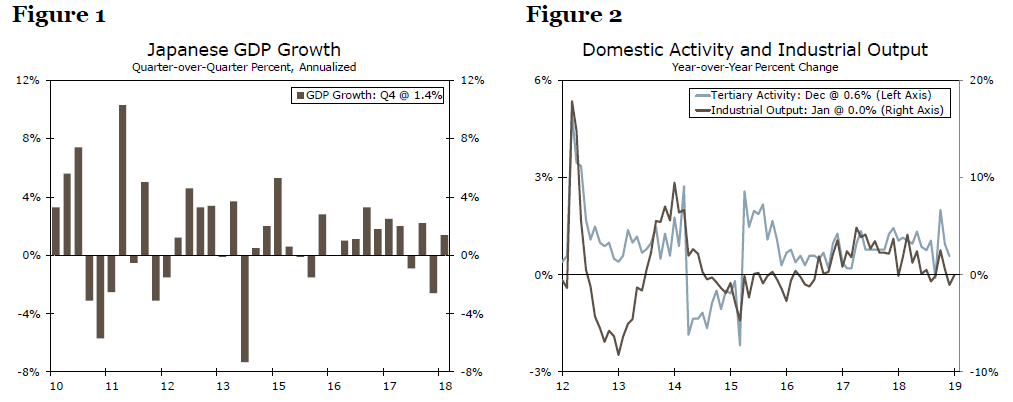
Monthly activity data confirm this subdued picture of Japanese growth, albeit with the service sector somewhat steadier than the manufacturing sector. Service sector output fell in both November and December and registered a gain of just 0.6% year-over-year in the final month of 2018. Meanwhile, industrial output has showed an overall slowing trend over the past several months, and was flat year-over-year in January (Figure 2). Finally we note that the Bank of Japan (BoJ) remains well short of its medium-term 2% inflation goal. In January the CPI excluding fresh food rose 0.8% year-over-year, although that figure was boosted by higher energy prices. The headline CPI rose just 0.2% year-over-year, down from 0.3% a month prior.
This underwhelming performance of the Japanese economy has, in our opinion, important implications for BoJ policy, as well as being an influence for the path of the Japanese yen. In mid-2018, the BoJ adjusted its tolerance around its 10-year government yield target of “around zero percent”, allowing a tolerance of +/-20 basis points. At that time, Japan's economy was growing reasonably steadily, the outlook was for an ongoing rise in global bond yields, and Japanese authorities were perhaps also seeking to improve the functioning of the Japanese government bond (JGB) market. We had expected further adjustment to BoJ monetary policy this year. Specifically, we expected the central bank to raise its policy rate from -0.10% to 0.00%, and to widen the tolerance band for JGB yields during the second quarter of this year.
Fast forward, however, and the outlook in Q1-2019 is noticeably different from that of mid-2018. Upward pressure on global yields has lessened, with the Fed taking a less hawkish stance, while the European Central Bank and the Bank of England continue to move only gradually in the direction of policy normalization. Meanwhile, government bond yields have generally reversed course, with two and 10-year Treasury yields falling markedly over the past few months. Hence the upward pressure on Japanese yields has also dissipated. In addition, subdued Japanese data in our view has altered the balance between adjusting policies aimed at improving market functioning, versus maintaining accommodative monetary policy to support the economy.
We also expect the increase in Japan's consumption tax from 8% to 10%, scheduled for October 1 this year, to proceed as planned. With that planned consumption tax increase now approaching more quickly we believe the window for a central bank policy adjustment has likely closed. We no longer expect the BoJ to adjust monetary policy in the second quarter, or indeed during all of 2019.
What Doesn't Go Up, Doesn't Come Down
We believe recent dovish comments from BoJ policymakers are consistent with our revised outlook for no change in central bank policy. Specifically, speaking to Parliament, Governor Kuroda said that should the yen's exchange rate impact Japan's economy and prices, the BoJ may consider additional easing, potentially including lowering yields or buying assets. Kuroda also mentioned the central bank would carefully consider the benefits and costs of additional easing. Of course “carefully considering” is not the same as “following through” and we do not believe the BoJ will shift policy in either a less accommodative or a more accommodative direction at this time
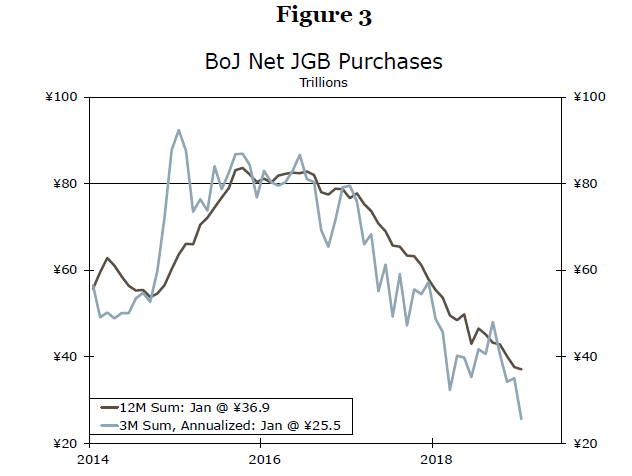
If the BoJ were to tweak policy in a more accommodative direction, perhaps the most likely policy lever to adjust would be to ramp up its bond purchases, which have been scaled back noticeably over the past several quarters (Figure 3), with net JGB purchases slowing to just ¥37 trillion over the past 12 months. However, even quickening the central bank's bond purchases does not come without some technical challenges. Given its large scale asset purchases over the past few years, by late 2018 the BoJ already held around 46% of outstanding government bonds, a potential headwind to just how quickly the central bank could (or would want to) ramp up bond purchases again.
Steady Bank of Japan, Slightly Stronger Yen
The shift in our outlook for BoJ policy has been matched by the shift in our outlook for Federal Reserve policy over the past several months. As a result of a more dovish Fed, we now expect only one Fed rate hike in 2019. Indeed, with little action from the BoJ, it will likely be swings in Federal Reserve monetary policy outlook that will be influential for the dollar/yen exchange rate. Even with the change to our Japanese central bank outlook, our view of the yen's prospects versus the U.S. dollar is little changed, as we still expect the yen to gain moderately against the greenback over the medium-term. One other factor that could have some influence on the USD/JPY exchange rate would be any ongoing market volatility and resulting safe haven support for the yen. While there will likely be episodes of volatility during 2019, some market and event risks appear to be moving in a more favorable direction. For example, U.S.-China trade discussions appear to be moving in a more constructive direction, while we ultimately believe a Brexit deal will be struck between the United Kingdom and the European Union. We believe a less volatile market backdrop could limit the extent of those yen gains.
Fed Beige Book: Government shutdown led to slower economic activity
In the Beige Book economic report, Fed noted that "economic activity continued to expand in late January and February". 10 out of 12 districts reported "slight-to-moderate" growth, except Philadelphia and St. Louis, which were flat.
About half of districts said "government shutdown had led to slower economic activity in some sectors", including retail, auto sales, tourism, real estate, restaurants, manufacturing, and staffing services." Numerous manufacturing contacts expressed concerns on " weakening global demand, higher costs due to tariffs, and ongoing trade policy uncertainty".
Employment increased in most districts, with "modest-to-moderate" gains in a majority. Wages continued to increased, with a majority reported "moderately higher wages". Price continued to increased at a "modest-to-moderate pace". A few districts reported "upward price pressures from tariffs". But several districts noted that steel prices had "stabilized or fallen recently".
USD/CHF Could Revisit February 2019 Highs
Key Highlights
The US Dollar gained traction above the 1.0000 resistance against the Swiss Franc.
USD/CHF broke a crucial bearish trend line at 0.9995 on the 4-hours chart.
The US ADP Employment declined from the last revised reading of 300K to 183K in Feb 2019.
The US Initial Jobless Claims for the week ending Feb 26, 2019 will be released today, which could remain at 225K.
USDCHF Technical Analysis
The US Dollar started a solid upward move from the 0.9926 low against the Swiss Franc. The USD/CHF broke the 0.9965 and 1.0000 resistance level to move into a bullish zone.
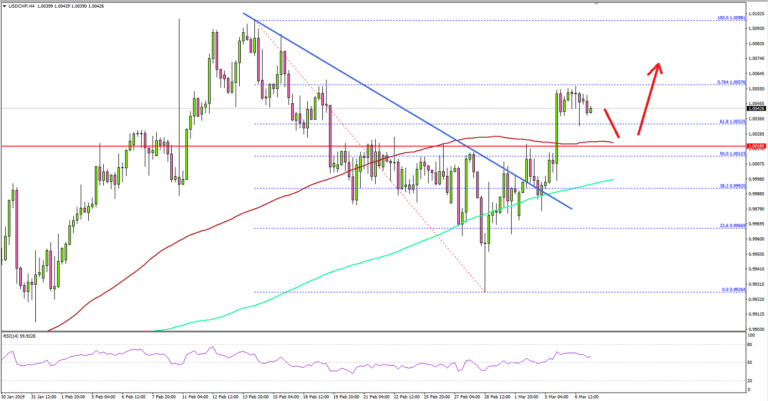
Looking at the 4-hours chart, the pair traded above many resistances on the way up, including the 200 simple moving average (green, 4-hours) and 1.0010. There was a break above the 50% Fib retracement level of the last drop from the 1.0098 high to 0.9926 low.
More importantly, the pair broke a crucial bearish trend line at 0.9995 on the same chart. Finally, the pair closed above the 1.0020 resistance and the 100 simple moving average (red, 4-hours).
The current price action is positive and it seems like the pair could gain traction above the 76.4% Fib retracement level of the last drop from the 1.0098 high to 0.9926 low. Once there is a successful close above the 1.0065 resistance, the pair is likely to revisit the 1.0098 high formed in February 2019.
On the other hand, if there is a downside correction, the pair could find support near the 1.0020 level and the 100 simple moving average (red, 4-hours).
Fundamentally, the US ADP Employment change report for Feb 2019 was released recently. The market was looking for a minor drop from the last reading of 213K to 189K.
The result was mixed as the ADP Employment change came in at 183K, but the last reading was revised up from 213K to 300K, on a seasonally adjusted basis. Commenting on the report, Mark Zandi, chief economist of Moody’s Analytics, stated:
The economy has throttled back and so too has job growth. The job slowdown is clearest in the retail and travel industries, and at smaller companies. Job gains are still strong, but they have likely seen their high watermark for this expansion.
Overall, the US Dollar buyers remain in control, but there could be a short-term downside correction in USD/CHF and recoveries in EUR/USD and GBP/USD.
Economic Releases to Watch Today
- Euro Zone Gross Domestic Product Q4 2018 (QoQ) – Forecast 0.2%, versus 0.2% previous.
- Euro Zone Gross Domestic Product Q4 2018 (YoY) – Forecast 1.2%, versus 1.2% previous.
- ECB Interest Rate Decision – Forecast 0%, versus 0% previous.
- US Initial Jobless Claims – Forecast 225K, versus 225K previous
Australian Retail Sales Tick up, Just
Jan sales: 0.1%mth, 2.7%yr (mkt f/c 0.3%). Weakness continues.
Retail sales rose 0.1% in January, a disappointing result compared to consensus expectations of a 0.3% gain. Retail was coming off a 0.4% fall in the final month of 2018, so the muted January rise speaks to continued weakness carrying into early 2019.
Annual sales growth has slowed to 2.7%yr with the trend pace over the last six months closer to 2%yr.
The detail showed gains were confined to food sub-categories – both basic food and cafes & restaurants up 0.3%mth – with non food categories down 0.1%mth on a combined basis. Within the latter: department stores booked another sizeable decline (–2.1%mth following –1.3% in Dec and a muted 0.4% gain in Nov); clothing was down 0.3% coming off a 3% fall in Dec but a strong 4.4% gain over Oct-Nov; and household goods retail was flat, coming off 0.8% gains in Nov and Dec. The 'other retail' category - mainly 'small ticket' discretionary items – posted a 0.7% gain.
The picture by state did have one slight positive with a solid 0.7% rise in NSW. The state had shown a much weaker finish to 2018, raising concerns that wealth effect drags were starting to bite harder. The Jan gain pares that weakness back a bit although trend sales are still weaker, flat lining vs slight 0.2% a month gains in most other states.
Looking by channel, online sales look to have posted a 2-3% gain for the month, with retail ex online down slightly (–0.1%mth).
By retailer size, small retailers reported a 0.6% fall with non food retailers driving the monthly gain amongst larger retailers. Despite this, large food retailers have still seen the best growth over the last year, sales up 4.9%yr on a combined basis, some of which relates to firmer pricing.
Separate data on vehicle sales have been mixed in early 2019. Our estimates suggest monthly seasonally adjusted sales rose in Jan but slipped back a touch in Feb. Seasonal adjustment is more problematic around this time of year so these moves should be treated with caution. Sales are still down about 10%yr. The Q4 national accounts detail showed a 1.5%qtr decline in consumer vehicle purchases, tracking a 6% annual pace of declines over the last three quarters of 2018.
Overall the slight gain in January retail sales indicates that the soft spending conditions over the second half of 2018 have extended into 2019. While sales may not be contracting in nominal terms they are likely to be down in volume terms once price changes are excluded.
Australia’s Trade Account, Surplus Jumps to $4.5bn, 2nd Largest on Record
January: +$4.5bn; prior: +$3.8bn. Exports +5.0%; Imports +3.3%.
In January, the trade surplus jumped to $4.5bn. This is the second largest surplus on record (in dollar terms) - eclipsed only by a $4.7bn surplus in December 2016.
The January outcome was a $0.8bn improvement on December and exceeded expectations (market median $2.75bn and Westpac $3.1bn).
Imports did rebound in the month, +3.3%, following a 5.5% fall last month (vs a forecast +4%).
Exports were much stronger than anticipated, increasing by 5.0%, up $1.9bn (vs a forecast +2.2%).
Export strength was largely centred on a sharp rebound in gold off a low base, up 174% (we expected a 75% rebound). In dollar terms, gold accounted for $1.4bn of the $1.9bn increase in total exports in the month.
Metal ores and coal both advanced in January, up a combined $0.6bn.
The trade surplus widened in 2018 and in to 2019 on higher export earnings, boosted by rising commodity prices.
Notably, commodity prices have surprised to the high side in part due to supply disruptions having an amplified impact in a market where supply and demand are in relatively tight balance.
The $4.5bn surplus for January compares with a Q4 monthly average of $2.8bn.
The surplus for Q1 as a whole is expected to be a material improvement on that in Q4, with export volumes forecast to rise (following a disappointing second half of 2018) and on a likely further increase in the terms of trade.
EU officials pessimistic on Brexit breakthrough this week
It's less than a week from March 12 when another meaningful vote on Brexit deal could be held in the UK Parliament. But Bloomberg reported that positions on both sides are hardening rather than converging. Both the UK and EU are counting on the other to back down. EU officials are pessimistic about the chance of any breakthrough this week.
In particular, unnamed EU officials described the talks with UK Attorney General Geoffrey Cox earlier this week as some of the worst-tempered of the two-year process. Meanwhile, what Cox requested, independent arbitration of the contentious Irish backstop arrangement outside of European Court of Justice, was seen as unacceptable for the EU.
US-China trade talks going well, getting words down on contract
Ted McKinney, Undersecretary for Trade and Foreign Agriculture Services, said US-China trade talks are going well. And, "presently there's a lot of discussions going on by digital video conference, also a very good and productive thing". Meanwhile, there's just a lot of work in getting words down ... a contract or agreement, and that's the current status".
Trump said in the Oval Office that trade negotiations with China are "moving along well", "very nicely". But he added that "there would either be "a good deal or it's not going to be a deal".
Attention On Deficit Disorder Sinks Stocks
Attention on deficit disorder sinks stocks
Things aren't going to plan in Trump's tariff world with US trade data overnight showing the trade deficit blew out to a 10-year high in 2018. Whether this hardens the President's attitude to a structural deal with the China trade talks or he chooses a quick win is hard to say, but with an election to fight next year, you can almost hear the clanking as the White House swings its heavy artillery in the direction of the other perceived trading bloc culprits.
Having dealt with the North American Free Trade Agreement (NAFTA), Washington's sights may well turn to Japan and Europe. The US is already in preliminary trade talks with Japan – a fact lost among the China noise. The Euro-zone is the prize though, with the US running an eye-watering USD169.3 billion deficit in 2018, according to the US Census Bureau. With a slowing global economy and a potentially ugly economic hit from Brexit, the Euro-zone can ill afford a trade stand-off with Washington. And with interest rates at 0%, the European Central Bank is short of monetary policy wiggle room. One thing is for sure, long after the US-China trade deal is put to bed, we will not have heard the last of the word tariff in 2019.
In other news, the Organisation for Economic Co-operation and Development (OECD) downgraded world growth, and the Bank of Canada (BOC) released the doves instead of the hounds. The BOC held rates steady overnight but joined other central banks' two-step line dance, U-turning on previously hawkish rhetoric.
Wall Street wilted under the barrage of news with the S&P falling 0.65%, the Dow Jones down 0.51% and the Nasdaq taking a 0.95% hit. The S&P has traced out multiple daily highs in 2019 at the five-month resistance at 2,820.00 implying that trade hopes and central bank dovishness may have run their course for now. The small-cap Russel 2000 fell by over 2% on Wall Street to 1,535.00 overnight, its biggest one-day fall in 2019. It too has tested and failed at longer-term technical resistance at 1,600.00.
Asia's data highlight today is the Australian trade balance, which was due at 0830 Singapore time with an expected surplus of AUD 2.90 billion. Given the sell-off in Australian Dollars (AUD) following yesterday's GDP miss, we can expect more fireworks this morning when it is released.
Globally, the highlight will undoubtedly be the European Central Bank (ECB) rate decision where we expect the ECB to hold at 0.00%. Much attention will be on the ECB President Draghi's press conference afterwards and in particular how dovish – or not – the ECB has become.
FX
The dollar reigned supreme overnight as the waves of negative headlines sapped investor confidence leading to haven buying of the greenback. The AUD collapsed following yesterday's poor Australian GDP number. Now sitting at 0.7030 this morning, just above support at 0.7000, traders likely have itchy-trigger fingers today. A poor trade balance reading could see support tested strongly.
The USD/CAD rose 100 points to 1.3450 overnight following the BOC's dovish statement. With a string of other poor data, a political crisis and an impending election, it is hard to see the Canadian dollar finding too many friends in the near term. However, it's likely the US dollar will remain firm in Asia against the regional currencies.
Equities
Regional stock markets will likely endure a tough start to the day following the dismal showing overnight by Wall Street. World growth and tariff fears are likely to be on investors' lips and will cap rallies in stocks during the Asian session.
Gold
Gold held its important 1,280.00 support overnight, but the bounce was anaemic, being capped at 1,290.00 an ounce. For now, gold's best hope as the dollar strengthens is safe-haven buying as investors rotate out of stocks on global uncertainty.
Oil
Much lower US official gasoline inventories cancelled out the negative news from Wall Street, leaving Brent crude and WTI almost unchanged at USD65.95 and USD56.25 respectively. The balance may adjust to the bearish side in Asia if trade worries push regional equity markets deep into the red.