Sample Category Title
USD/CAD Canadian Dollar Falls After BOC Joins Doves Choir
The US dollar is higher against most major pairs on Wednesday. The Japanese yen is the outlier as lack of fundamental data and an OECD global forecast cut lowered investor’s appetite for risk. Central banks this week have stressed their caution as economic performance leaves a lot to be desired. The European Central Bank (ECB) is the next in line to publish its monetary policy statement with a side of dovish rhetoric.
The Canadian dollar fell 0.62 percent on Wednesday after the Bank of Canada (BoC) joined the dovish choir of central banks. The BoC held interest rates unchanged at 1.75 percent and future hikes are uncertain this year. The softer than forecasted fourth quarter of 2018 has forced the central bank to revise it hawkish view in the short term although headwinds could push an interest rate lift off the table for this year.
Oil prices were not supportive of the loonie as higher than expected inventories in the US and Libya’s largest oil field back online dragged energy prices lower.
Global growth warning signs have forced central banks to change their tone, and the BoC’s dovish turn is a direct result of a domestic economic slowdown.
The US dollar rose as investors sought the safety of US debt as treasuries rose as anxiety about the US-China trade deal and Brexit are once again surging.
GOLD
Gold rose 0.28 on Wednesday as the US private payrolls report underperformed ahead of the U.S. non-farm payrolls (NFP) on Friday. The U.S. Federal Reserve has put on pause its monetary policy tightening until growth improves. If American employment disappoints this week the case for a hike of the US fed funds rate will take a hit. The Fed’s beige book released today highlights the aftermath of the government shutdown on economic activity painting a mixed picture as worker shortages remain, while growth is cooling down.
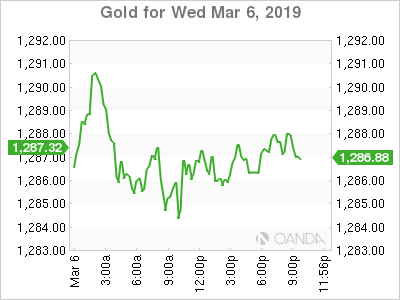
The yellow metal has been under pressure as the US-China trade dispute appears near an agreement putting an end to back and forth tariffs and Brexit entering its final weeks. Optimism on the geopolitical front can be short lived which is why gold is quick to recover in times of uncertainty.
More central banks are taking a wait-and-see approach, the latest being the Bank of Canada (BoC), as global growth has been negatively impacted with the rise of trade barriers between nations.
OIL
Oil is mixed after a larger than expected buildup of US inventories dragged WTI lower. US production has been ramping up and the API estimate and the official Energy Information Administration (EIA) data aligned to pressure prices downward. The decline was not deeper as the same report showed a drop in refined fuel.
Yesterday Chevron and Exxon published their Permian basin projections showing a rise in shale oil production. The balance between rising US production and the OPEC+ efforts to stabilize prices with a production cut was broken by higher than expected US inventories and the OECD warning of lower global growth impacting energy demand going forward.
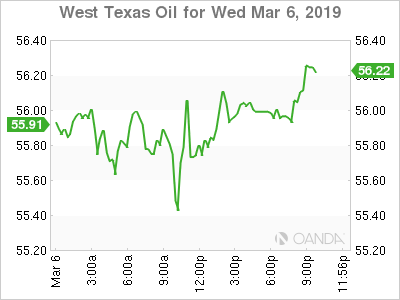
No news was bad news for the energy market as lack of details on the US-China trade agreement meant the wider trade deficit data out of the US and the OECD forecast downgrade took prices lower.
STOCKS
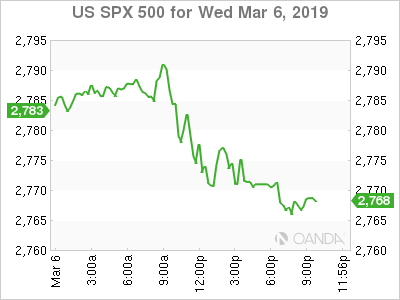
Global indices finished lower as global growth concerns rose after the OECD downgraded its forecasts and there was little news on the US-China trade deal and the Brexit divorce giving investors guidance. With the Bank of Canada (BoC) joining the ranks of the doves, growth anxiety became a widespread theme as treasuries rose.
Eco Data 3/7/19
[php_everywhere instance="1"]
As a Trade Deal Moves Closer, is China at Risk of Overstimulating its Economy?
Growth in China decelerated to the slowest pace since 1990 last year, underlining the challenges the country faces amid sluggish global demand and a more protectionist United States. China’s leaders haven’t been sitting on their hands, however, as an abundance of policy measures have been initiated since last summer when the first wave of US tariffs struck. But with the fiscal and monetary loosening being stepped up amid a continuing downtrend in growth, is the government risking undoing the progress it’s made on deleveraging the economy?
As the government grapples an ongoing slowdown, at least one battle could be about to end as negotiations in the Sino-US trade dispute reportedly move to the “final stages”. It’s worth being reminded, however, that China’s economy started losing steam long before US President Trump triggered the trade war and growth in 2018 was already under pressure from deleveraging and other structural reforms.
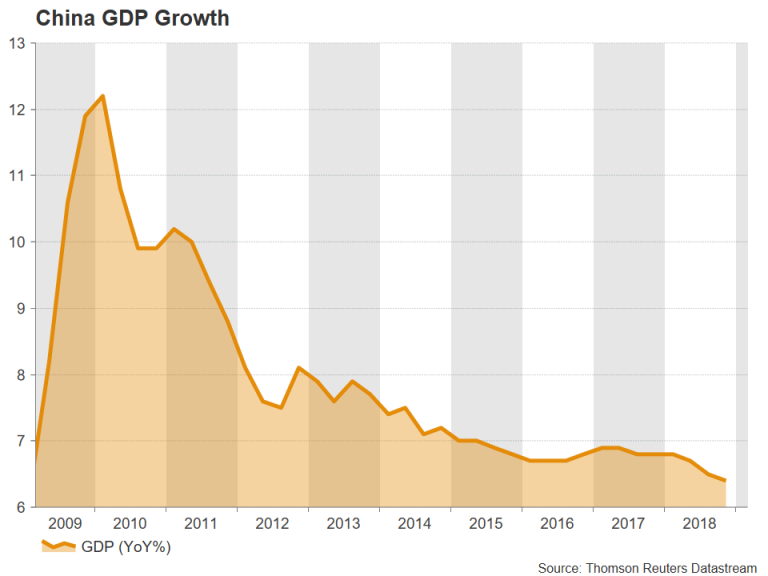
Those reforms, whilst they have been inflicting short-term pain, were considered to be crucial in streamlining inefficient state-owned enterprises and making China’s huge debt burden sustainable in the long run. But with the state desperate to kick-start a flagging economy, it now risks fuelling borrowing by companies and local governments and possibly worsening the debt bubble that has been steadily building over the years.
There is no doubt that the US levies on Chinese imports, totalling $250 billion, have hurt China’s exporters. But perhaps the biggest impact of Trump’s trade war has been the uncertainty it has generated for businesses, both in China and globally, rather than the actual tariffs themselves. Trump’s tough stance on the issue has taken China by surprise and does not reflect too well on President Xi Jingping’s leadership. That probably makes the need for an economic rebound all the more urgent. Hence, is why the government is expected to approve a raft of stimulus measures at this week’s annual gathering of political leaders and delegates – the National People’s Congress.
The biggest boost to the economy could come from tax cuts, totalling 2 trillion yuan, with the most significant being the reduction in value added tax (VAT) for manufacturing firms, as well as for the transportation and construction sectors. Spending will also increase, with more infrastructure projects being planned, and together with lower tax receipts, they are expected to push up the budget deficit for 2019 to 2.8% of GDP from 2.6% in 2018.
More worrying though is the increase in the ceiling of the amount of debt local governments are allowed to issue. Private borrowing is also being encouraged with the government setting a target for commercial banks to increase lending to small businesses by 30%. This means more cuts in the reserve requirement ratio (RRR) are likely, with the People’s Bank of China (PBOC) having cut it five times already since the beginning of 2018.
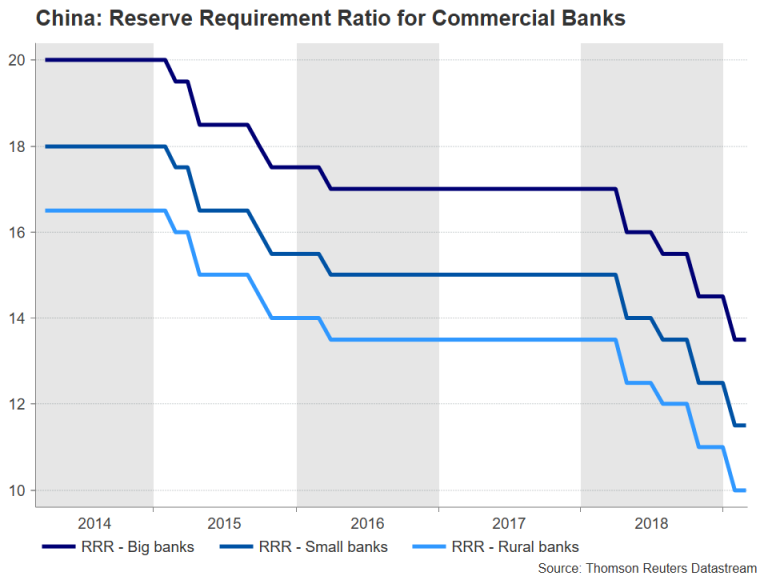
The cuts in RRR are not the only method monetary policy has been slowly loosened. The central bank has been regularly carrying out reverse repo operations to inject liquidity into the banking system. The PBOC has been relying on reverse repos to boost liquidity rather than cutting interest rates, signalling that it will only move to lower its benchmark one-year policy lending rate as a last resort.
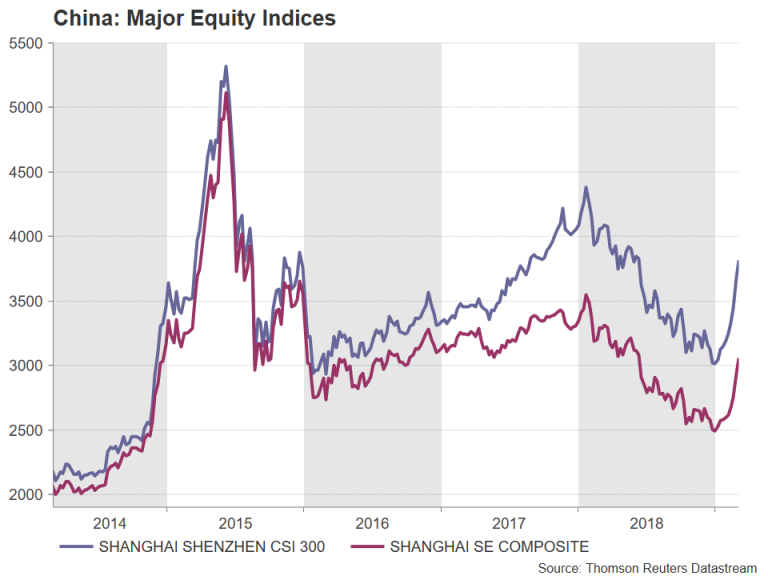
While it’s too early to see the accumulated impact of all these measures, they seem to have been enough to change investor sentiment towards the country’s undervalued stocks. Chinese stocks have been rallying strongly since January on the back of rising optimism of a resolution to the US-China trade conflict. The stock market got an additional lift from this week’s stimulus news, sending the leading share indices, the CSI 300 Index and the SSE Composite Index to 9-month highs. Year-to-date, their gains stand at an incredible 27.8% and 24.3% respectively.
The Chinese yuan has also been rallying, appreciating by about 2.5% against the US dollar so far during 2019. It hit a 7-month high of 6.6718 to the dollar in February. But analysts are not predicting further appreciation for the currency with a median forecast of 6.70 for the year-end.
The yuan’s direction in the coming months will probably depend a lot on what happens on the trade front. The talks appeared to have gained considerable momentum over the past couple of weeks, with a special summit between Trump and Xi at the end of March to sign a potential deal looking likely. U.S. Secretary of State Mike Pompeo sounded upbeat on Monday, saying the two countries were “on the cusp” of a deal.
There’s still plenty that could go wrong, however. Although China appears to have conceded on many of the sticking points such as putting an end to forced technology transfers and providing better protection for the intellectual property of foreign companies, their enforcement and ensuring that China follows through with its pledges could still make or break any deal.
A setback in the talks at this stage of the negotiations could be hugely negative for Chinese equities as well as for global risk appetite. The Australian dollar, which is sensitive to both broader risk sentiment and China-related trades, could come under selling pressure if an agreement is scuppered.
A downside break of the $0.70 handle would be an easy target if the trade optimism faded, opening the way for the January 2016 trough of $0.6824. If, though, a trade accord was finalised, the aussie could overcome the bearish forces driven by expectations of an RBA rate cut to reclaim it’s 50-day moving average, currently around $0.7130. Clearing this level would bring the January top of $0.7295 back within reach.
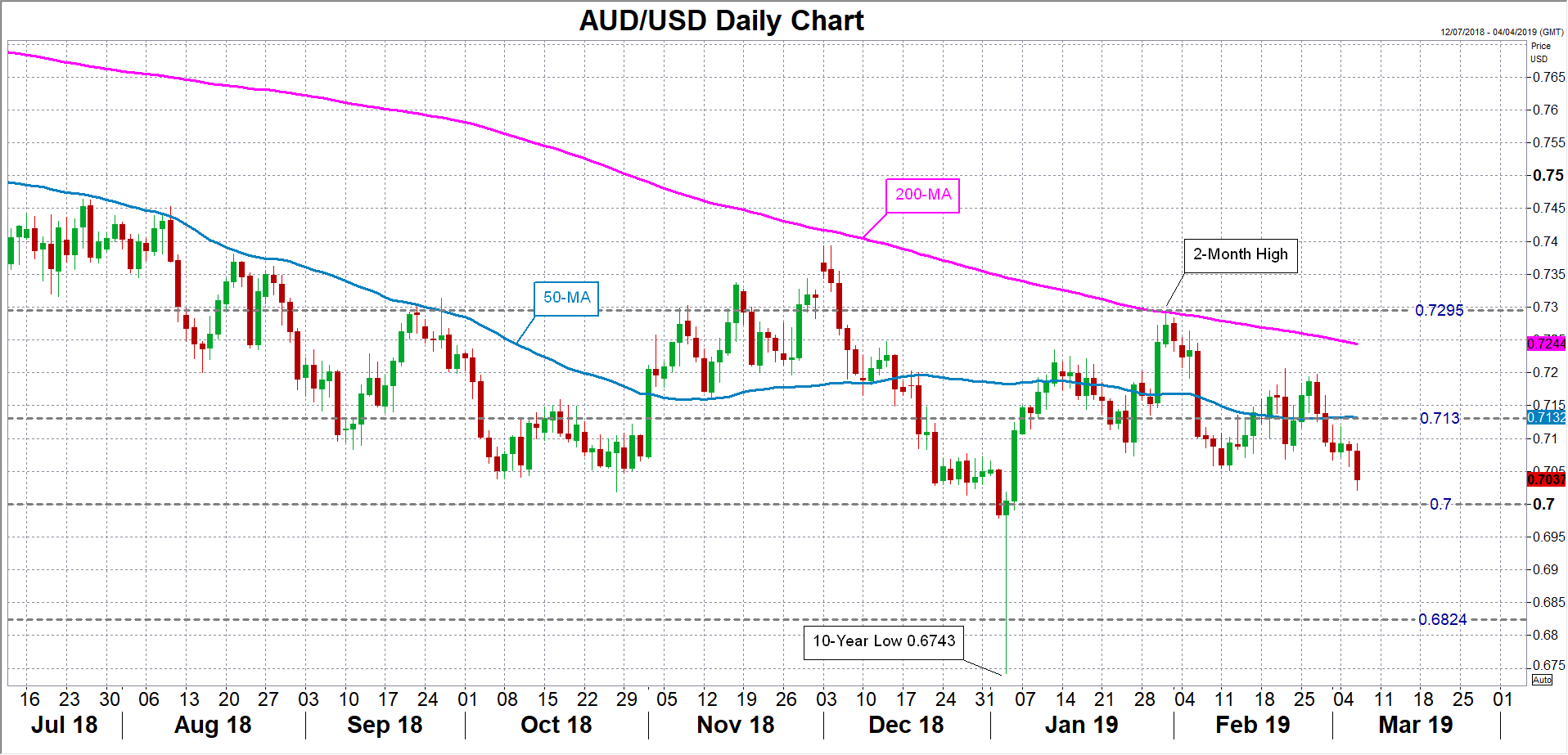
Traders should be wary, however, of how much further the risk rally can run if trade talks are successfully concluded. Most of the gains in equities and other risk assets enjoyed during the past few weeks have been on the back of speculation that a deal is nearing. This suggests there may be limited scope for an extension of the rally once an agreement is reached and opens the prospect of “buy the rumour, sell the news” response by the markets.
Assuming that the US and China do manage to sign a deal soon, the focus will shift to how soon the stimulus measures will begin to feed through the real economy. A rebound in Chinese growth in the second half of the year could provide a lifeline for the world economy, which has also been fast hitting the brakes.
But the boost to growth could come at a heavy price as authorities risk stimulating the economy to the extent that debt surges to unsustainable levels, for which the only remedy would be a sharp tightening in monetary policy. Subsequently, China’s drastic attempts at preventing a hard landing could be responsible for causing exactly that down the line.
For the moment, though, China has bought itself some time by seemingly appeasing US trade demands and announcing a series of policy tools to reinvigorate growth. They’ve also taken the pressure off expectations about economic performance in 2019 by lowering the target for GDP growth. The government is aiming for growth of between 6-6.5% for the year, even slower than 2018’s 6.6%, as it acknowledges the challenges facing the economy.
Canada to Show No Employment Growth in December
Weighed by political jitters and disappointing GDP growth prints earlier this month, the Canadian dollar turns its sights to employment figures for direction. The results, however, published on Friday at 1230 GMT may extend economic uncertainty instead.
After January’s impressive 66.8k rebound, analysts believe that the Canadian economy added no jobs in February, leaving the unemployment rate unchanged at 5.8% and slightly above the 44-year low of 5.6% first reached in December.
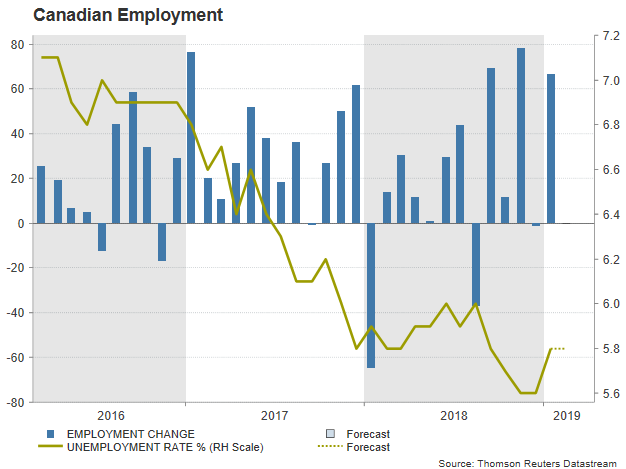
These data follow a row of discouraging stats that turned investors more careful when buying the loonie. First it was inflation that surprisingly decelerated more than expected in January after a strong rebound towards the Bank of Canada’s ideal 2.0% price target in the previous month. Then it was GDP growth readings that hurt sentiment as projections for a softer pullback to 1.2% in the fourth quarter appeared too optimistic when actual numbers arrived much lower at 0.4%. The monthly gauge for December was even more worrying as the evidence displayed a contraction of 0.1% for the second consecutive time.
The central bank – like its main counterparts abroad – relies on the labor market to achieve its inflation goal. Should the labor market tighten further, forcing companies to offer higher payments to attract the skills they desire, household spending and therefore price growth could pick up steam. Policymakers could then resume their rate hiking cycle if inflation moves above the midpoint of the BoC range target of 1-3%. But if February’s employment stagnancy is not a “one-off” situation, then policymakers may even think over a rate cut amid the slump in the energy sector and generally the broader fear over a global economic slowdown.
While the sudden downturn in crude prices has been restored to some degree, it is still uncertain whether the market could fully recover those losses under the ongoing US-Sino trade war that continues to keep businesses cautious with their investment plans. A failure to reach an agreement could see US tariffs on $200 billion Chinese imports doubling and potentially Chinese growth melting, taking the energy industry and thus Canadian economy down as well, as China is the second top buyer of Canadian products after the US. In such a case, Canadian firms could avoid any new hiring or any increase in paychecks, limiting inflation pressures and hence any plans for additional monetary tightening. Note that the trade deficit widened sharply to multi-year highs in December thanks to a 21.7% drop in exports of energy products that resulted on the back of falling crude prices.
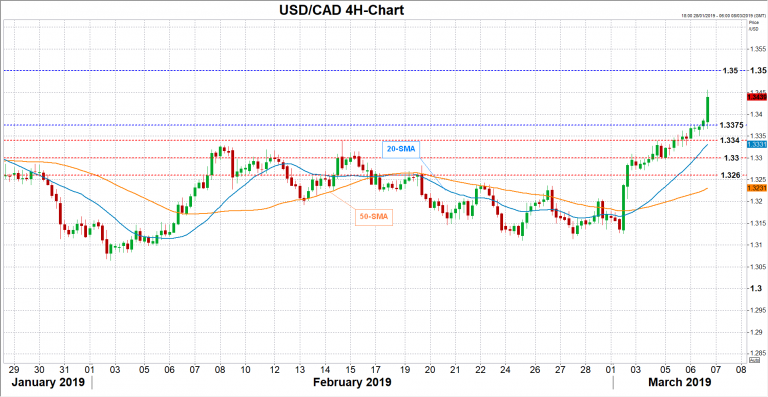
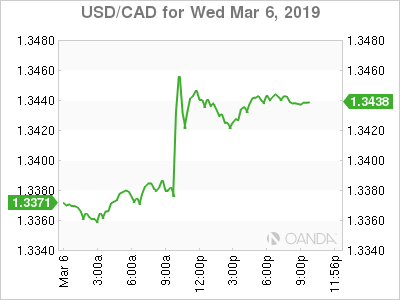
In FX markets, the loonie lost considerable ground against the dollar this month, helping USDCAD to touch a three-month high of 1.3456 on Wednesday. A weaker-than-projected jobs report on Friday, could reduce chances for a rate hike this year and raise speculation for a rate cut, pushing funds out of the Canadian currency. In this case USDCAD could stretch higher to test the 1.35 and 1.36 psychological levels.
On the other hand, if employment shows positive growth or/and the unemployment rate shifts lower, the pair could return to the 1.3375-1.3340 support area, while steeper declines could also revisit the 1.3300-1.3260 congested zone.
Meanwhile on the political front, the Canadian Prime Minister Justin Trudeau is facing mounting criticism over his government’s handling of a fraud, with two ministers quitting the cabinet over the case. Developments around the issue could affect buying interest for the loonie if the scandal intensifies.
US Nonfarm Payrolls Coming Up as Dollar Approaches Key Resistance Levels
The all-important US employment report for February will hit the markets on Friday at 13:30 GMT. Forecasts point to yet another solid report and if so, that could make investors more confident the Fed will raise rates again later in 2019, thereby helping the dollar to extend its latest gains. That being said, the reserve currency is now very close to levels it has consistently failed to overcome in recent months, so buyers should tread lightly.
The labor market remains the bright spot in the US economy, continuing to record robust gains month after month even despite a slowdown in growth and inflation cooling somewhat. In fact, the jobs market is so strong that there are now more job openings than there are unemployed people in the US, something that is starting to attract previously discouraged workers back into the labor force. Perhaps more importantly, wage growth – which the Fed pays a lot of attention to as a forward indicator of inflation – has started to pick up steam. Higher wages imply higher spending by consumers and hence higher future inflation, at least in theory.
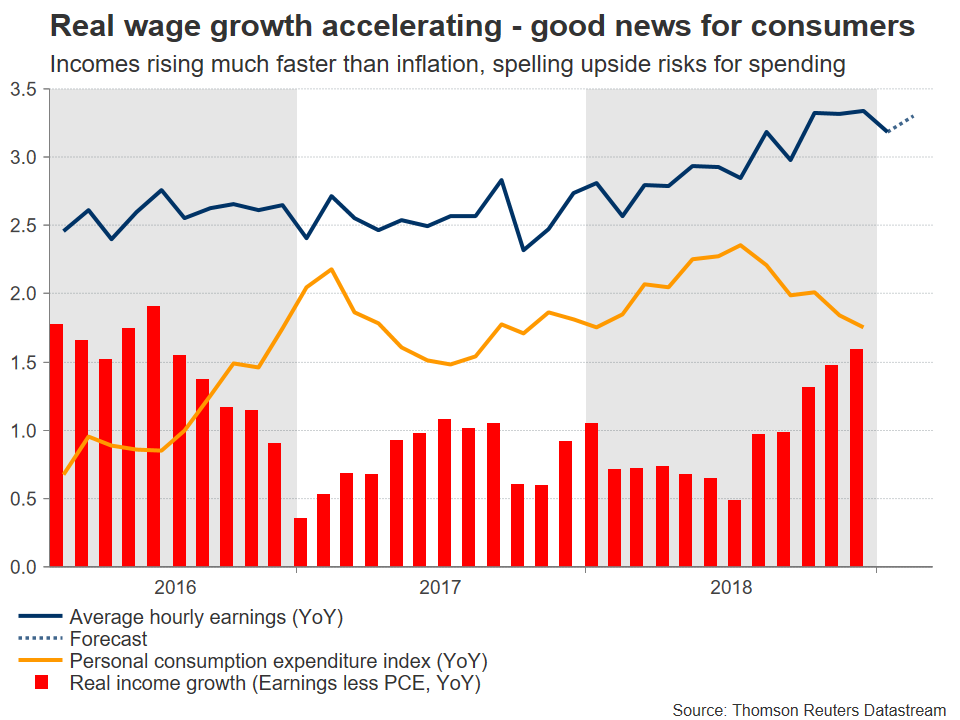
This week’s numbers are expected to confirm all the above. Nonfarm payrolls (NFP) are forecast to have risen by 180k in February, far below the remarkable 304k in January, but still a very healthy number overall. The unemployment rate is anticipated to have ticked down to 3.9% from 4.0% previously, while the all-important average hourly earnings rate is projected to have ticked up to 3.3% year-on-year, from 3.2% earlier.
Gauges of the labor market were mixed during February, so there is no clear sense of what direction a surprise may come from. For instance, both the ISM manufacturing and non-manufacturing surveys signaled a slowdown in employment growth in February, but the Markit composite PMI indicated strong job creation, consistent with an NFP print in the tune of 250k.
In any case, market focus will probably fall mainly on wages, as the Fed has made it clear it needs to see a vigorous pickup in inflation before considering any further rate hikes. On that front, expectations remain subdued. According to the Fed funds futures, the world’s most important central bank is expected to take no action at all this year, with market pricing frequently switching between cuts and hikes lately, but always staying close to neutral levels. In other words, markets don’t see a strong case for neither cuts nor hikes in 2019.
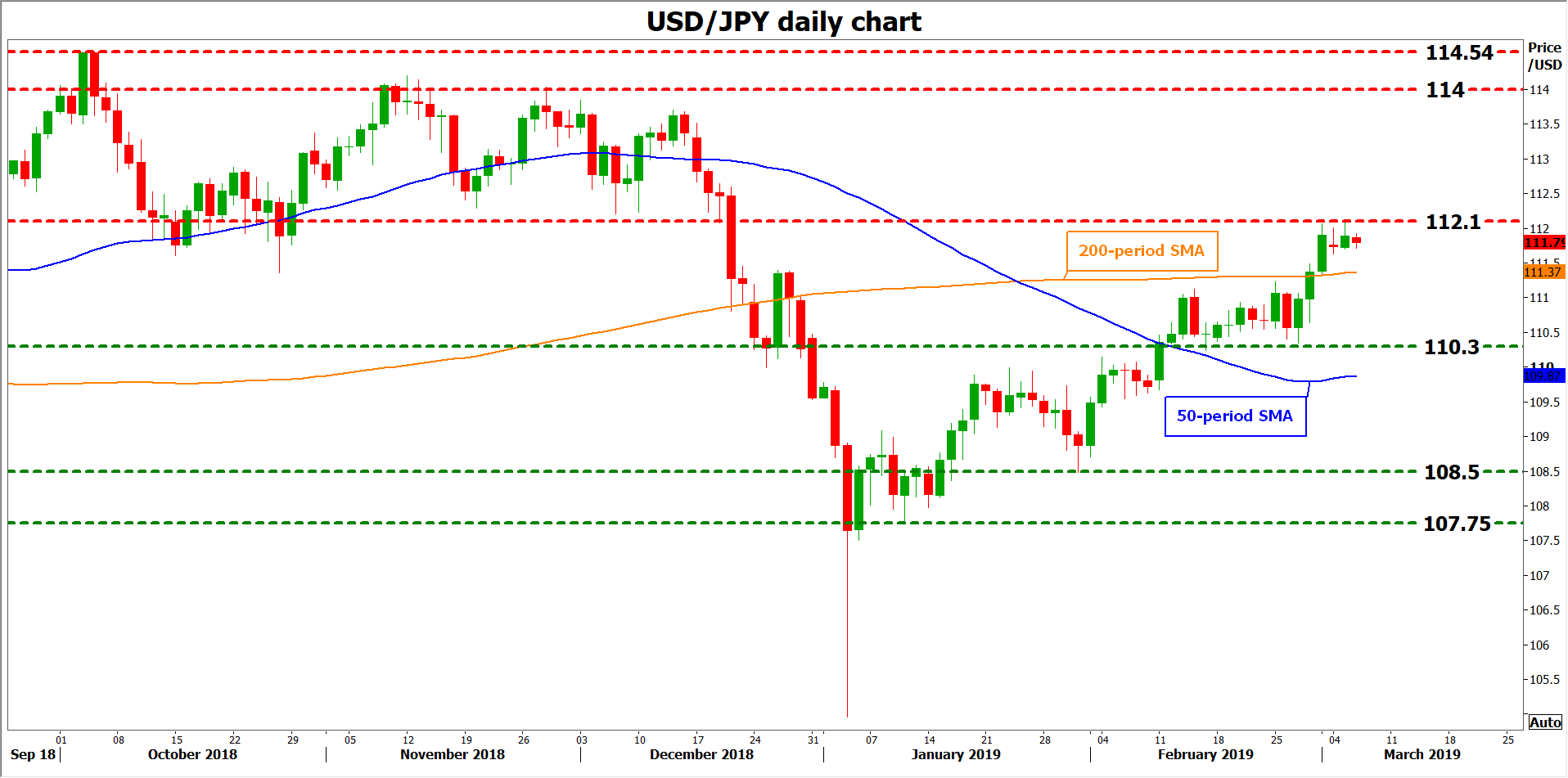
Turning to the market reaction, a strong report overall – particularly on the earnings front – could tilt market pricing towards a Fed rate hike this year, supporting the dollar. Looking at dollar/yen, immediate resistance to advances may be found at 112.20, the March 5 peak, with an upside break opening the door for a test of the 114.0 zone – defined by the November 28 high.
On the flipside, a disappointing set of data could see speculation for a rate cut gain traction, causing the greenback to give back some of its latest gains. Support to declines in dollar/yen may come at the 200-day simple moving average (SMA) at 111.37, with a bearish violation paving the way for the 110.30 area.
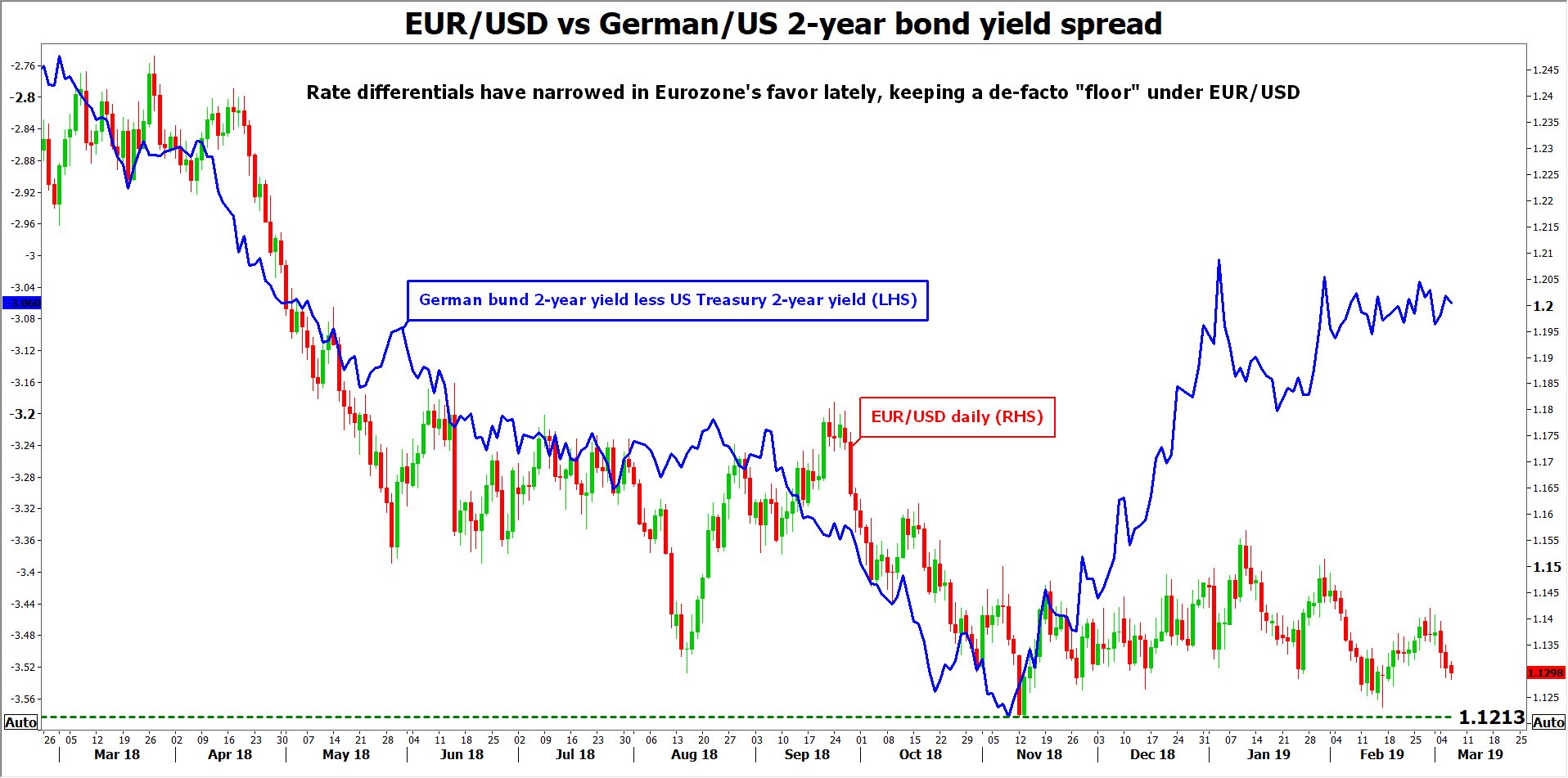
As for what the future holds for the dollar in general, while there may well be some more upside in store from current levels in the near term, a note of caution is warranted as the reserve currency is now very close to regions it has repeatedly failed to overcome recently. Specifically, declines in euro/dollar have consistently run into a wall of buy orders near 1.1250 since November, something owed to the pair receiving support from relative interest rate differentials.
The spread between short-dated EU and US bond yields has narrowed in recent months, as investors priced out Fed rate-hike expectations, and this is keeping a de-facto floor under euro/dollar. Hence, dollar bulls could find it difficult to pierce below the November lows at 1.1213 for instance, and may require some strong catalyst to do so.
Finally, besides the jobs data, some remarks by Fed Chairman Jay Powell will also attract attention. He will discuss monetary policy after the US market close, at 03:00 GMT on Saturday.
Bank of Canada Holds; We May Be Here a While
The Bank of Canada kept its overnight rate unchanged at 1.75% this morning, as was widely expected. The short statement accompanying the decision took a dovish bent.
The Canadian economy lost significant momentum in the latter half of 2018, in part due to oil sector curtailments, but the weakness made itself evident in nearly all components, such that final domestic demand contracted for a second quarter. This was acknowledged in today's statement, which noted that "the slowdown in the fourth quarter was sharper and more broadly based". The statement also indicated that the Bank is likely to mark down its 2019 forecast: "it appears that the economy will be weaker in the first half of 2019 than the Bank projected in January". The Bank had forecast just 0.8% q/q saar growth for 2019Q1 in January.
The Bank also noted that Canada is not alone in seeing a growth moderation, attributing the global growth slowdown to trade tensions and uncertainty that have led other major central banks to acknowledge the headwinds to growth, easing financial conditions.
On the inflation front, the Bank appears to have slightly downgraded its forecast, now expecting inflation to stay below its 2% target this year reflecting energy price impacts and a softer economic backdrop.
The core message today appears to be that the economy requires more stimulus than previously thought. Gone are references to achieving neutral, instead we are told "the outlook continues to warrant a policy interest rate that is below its neutral range". At the same time, there remains some bias towards eventual tightening as shown in the statement "increased uncertainty about the timing of future rate increases".
Key Implications
Borrowing costs are going nowhere fast. The weak end to 2018 and soft momentum heading into 2019 clearly has the Bank of Canada worried about the health of the Canadian economy.
That oil sector developments are holding back near-term growth was a given heading into today's decision (and last week's GDP report). What is more concerning is the broad-based economic deceleration, as now acknowledged by Governor Poloz and team. This may be telling the Bank that their past hikes have been more effective than expected, and that they may be closer to a neutral setting than they had thought.
Near-term economic softness, elevated uncertainty, the clear near-term bias to holding rates, and the likelihood that the neutral interest rate is below the Bank of Canada's estimates all point in the same direction. Unless we see a robust growth recovery mid-year (with that hurdle rising by the day) further rate hikes in 2019 are all but off the table.
Bank of Canada Strikes Cautious Tone; Keeps Rate Unchanged
Highlights:
- As expected, the overnight rate was held steady at 1.75% with the bank indicating policy stimulus is still needed
- The bank pushed out the timing of when the economy will break out of the current weak patch
- The statement still suggests the bank anticipates rates will move higher although the timing is uncer-tain
The bank punted the timing of the economy pulling out of the current weak patch today pointing to the growing downside risks to the economic outlook. While the energy sector is high on the bank's list of things to monitor, the weakness in consumption late last year and continued correction in the housing market also rated on their list of concerns. The optimism about exports and non-energy investments in the January statement was also missing with the bank pointing to these sectors as weaker than expected late last year.
Against an increasingly uncertain global backdrop, the bank is prepared to maintain a policy rate that is providing some support to the economy. That said, the bank did not dispense with the prospect that in-terest rates will rise in the future. The biggest uncertainty is when the economy will be strong enough to warrant another move higher. Our forecast is that Canada's economy will pickup pace in the second quarter as the transitory impact from the weak energy sector fades and the underlying strength in the labour market pumps up wages and limits the slowing in consumption activity. With the economy likely to record another soft quarter in Q1 and global uncertainty persisting, no rate increase is likely until the second half of the year.
Dollar Mixed after ECB Cuts Outlook and Markets Await US-China Trade Details
Downbeat news dominated the headlines overnight and early morning. In Australia a double dose negative news helped drag the Aussie dollar lower. First, RBA governor Lowe signaled it is hard to think rates will rise and then Australia’s fourth quarter GDP reading was the weakest quarterly reading since 2016. Comments from BOJ member Harada added that the BOJ must strengthen easing without hesitation. The OECD also finally updated their forecast and cut their outlooks for 2019 and 2020. They were playing catch up since their last forecast came out four months ago. US trade data also showed that in 2018, the deficit widened to a 10-year high. Under President Trump’s watch, we have also seen the gap increase by $119 billion, and that may not improve immediately as global growth is softening.
ECB
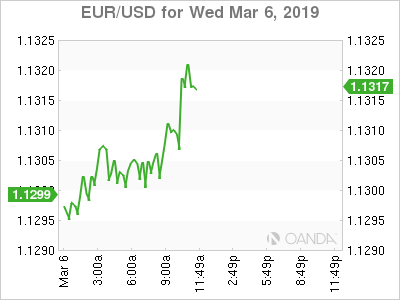
The euro initially fell below the 1.13 handle again after a press report noted ECB officials are ready to cut their outlooks and launch another round of loans for banks. The market was heavily pricing in that the ECB would cut their forecasts, but the big question was will they announce new long-term loans. Judging by the currency reaction, it appears that the street was not overly surprised by the press report of new loans.
Stocks
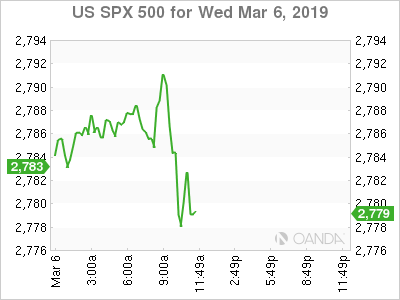
US equities continue to tread water, with little reaction to private payroll and trade data that pretty much confirmed their respective trends. Employment is still strong and the trade gap continues to widen for the US. Consumer discretionary and Consumer Staples stocks were positive after strong results from Abercrombie and Fitch and in-line earnings from Dollar Tree, both stocks traded higher on their cost cutting measures.
Gold
The precious metal is hovering near 5-month lows despite a wrath of negative macro news. The price action emphasizes how focused the market is on the trade war’s next step. Any disappointment on the implantation of the trade deal or concerns that punitive powers would likely seeing tariffs frequently being threatened by the US could be supportive for a rebound in gold prices.
Oil
Oil prices extended declines ahead of the EIA’s weekly crude oil inventory release. The API reading saw inventories rose 7.3 million barrels last week. Oil continues to be under pressure on the rising US production outlook and consistent negative global growth concerns are hurting demand side concerns.
Japanese Yen Remains Listless, Japanese GDP Ahead
USD/JPY continues to have an uneventful week. In Wednesday’s North American session, the pair is trading at 111.71, down 0.16% on the day. On the release front, there are no major Japanese events. In the U.S., ADP nonfarm payrolls dipped to a 3-month low. The indicator fell to 183 thousand, down from 213 thousand in the previous release. On Thursday, the U.S. releases unemployment claims and Japan publishes household spending and fourth-quarter GDP.
In the U.S., the focus will be on February employment numbers for remainder of the week. ADP payrolls was a disappointment, and the official nonfarm payrolls could follow suit, as the key indicator is expected to slide to 185 thousand, after a strong gain of 304 thousand in January. However, analysts are expecting better news from other key numbers – wage growth is expected to improve to 0.3% and the unemployment rate is projected to dip to 3.9%.
The bitter between the U.S. and China may not be over, but there are clear signs that tensions between the two super-economies have eased considerably. Risk appetite remains strong, which could weigh on the yen, a safe-haven asset. At the same time, a breakthrough would herald a new trade relationship between the U.S. and China and would likely boost the lethargic Japanese economy. China is a key trading partner for Japan, and the slowdown in China has hurt the Japanese manufacturing and export sectors.
WTI OIL Outlook: Oil Price May Extend Lower if US Crude Stocks Rise
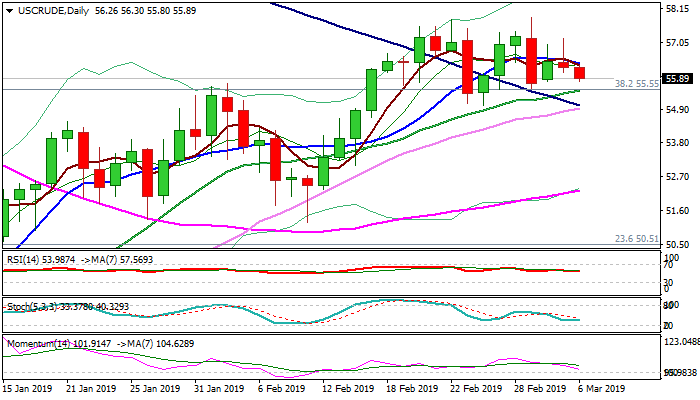
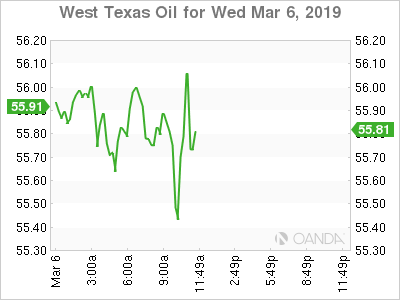
WTI oil price dipped to $55.80 on Wednesday, following double rejection at $57 zone on Mon/Tue, pressured by unexpected rise in US crude stocks (API report on Tuesday showed build of 7.9 mln bls compared to last week's 4.2 mln bls draw) and stronger dollar.
The price bounced briefly after US ADP private sector employment data which fell below expectations (Feb 183K vs 189K f/c) but strong upside revision of Jan's figure (300K from 213K) signals strength of labor in private sector and offsets negative impact for dollar and support for oil prices. Markets await release of EIA report (1.2 mln bls build vs last week's surprise 8.4 mln bls draw).
Another build in crude inventories would add to oil's negative near-term outlook and risk test of significant supports at $55.55 (broken Fibo barrier/rising 20SMA) and $55.01 (26 Feb trough/converged 30/100SMA's) clear break of which would generate initial signal of double-top ($55.79/85) and reversal.
Res: 56.38; 57.17; 57.40; 57.85
Sup: 55.55; 55.01; 54.54; 53.76