

Sample Category Title
Asian update: Forex markets turned quiet, surging treasury yield might drive next move
The forex markets turned mixed in Asian session today, awaiting fresh stimulus. Australian Dollar was briefly lifted by stronger than expected Q4 private capital expenditure. But it's quickly knocked down by poor China PMI manufacturing. USTR Robert Lighthizer's testimony on China trade talk triggered little reactions in the markets. Similar, Fed Chair Jerome Powell's testimony and Trump-Kim summit in Vietnam are shrugged off. Sterling is currently the weakest for today while Swiss Franc is strongest. But major pairs and crosses are bounded in tight range. The picture can be easily changed ahead.
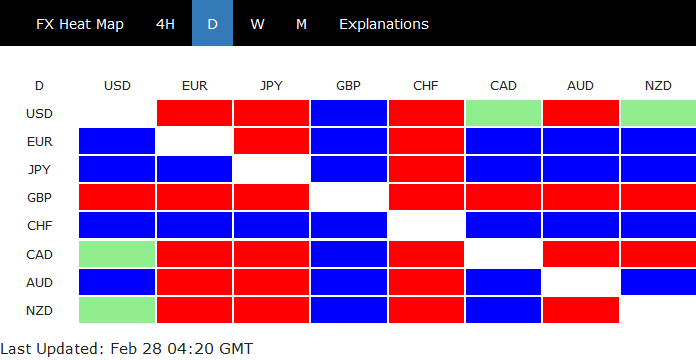
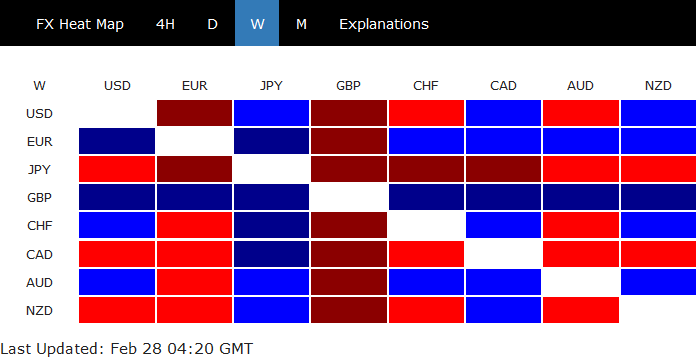
For the week, Sterling remains on the strongest one on fading no-deal Brexit risks. Euro is following as the second strongest. Yen is the weakest one, partly due to strong rally in global treasury yields at the long end. German 10-year yield is back pressing 0.15. US 30-year yield also had the largest jump in about a month yesterday. Canadian Dollar is the second weakest for the week. Focus will now turn to GDP data from US.
In Asia,
- Nikkei is down -0.35%.
- Hong Kong HSI is up 0.10%.
- China Shanghai SSE is down -0.35%.
- Singapore Strait Times is down -0.57%.
- Japan 10-year JGB yield is up 0.0002 at -0.024.
Overnight,
- DOW dropped -0.28%.
- S&P 500 dropped -0.05%.
- NASDAQ rose 0.07%.
- 10-year yield rose 0.057 to 2.693.
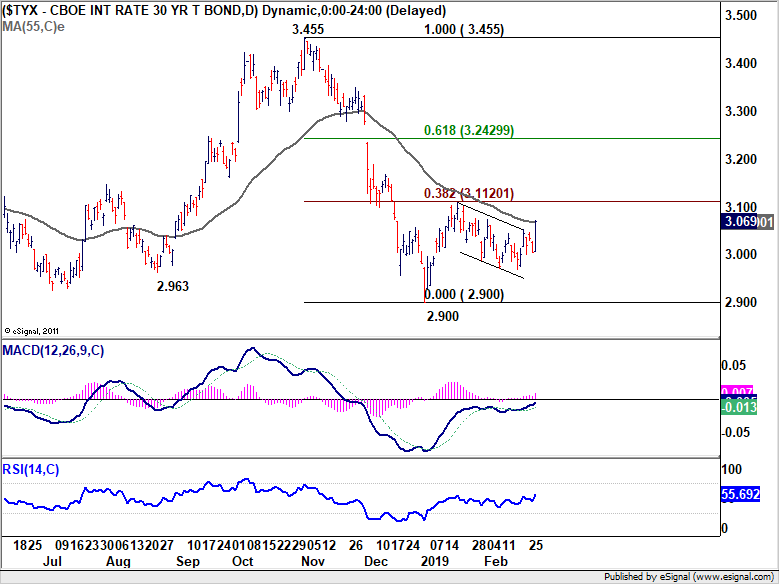
- 30-year yield rose 0.063 to 3.069.
The strong rally in 30-year yield is worth a note. TYX might have completed the consolidation from 3.109 and the rise from 2.900 low could be ready to resume. 55 day EMA is the immediate focus. But the real test will be on 38.2% retracement of 3.455 to 2.900 at 3.112. Surging yields could be the next driver in the forex markets
ANZ business confidence dropped to -30.9, RBNZ to cut in November
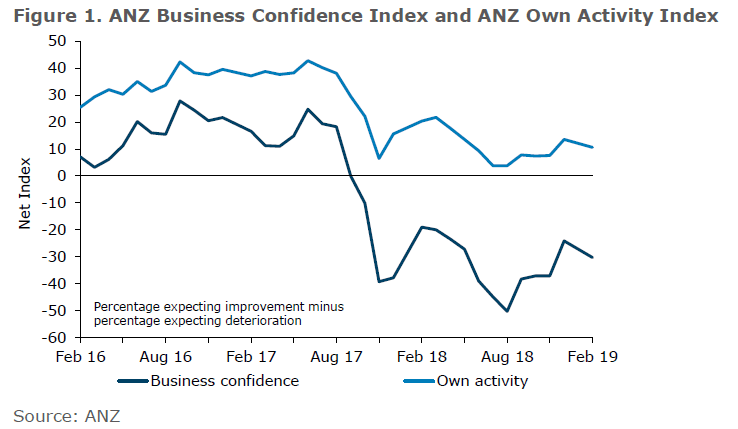
New Zealand ANZ Business Confidence dropped to -30.9 in February, down from -24.1. Activity Outlook dropped to 10.5, down fro 13.6. ANZ noted that recent improvement in business activity stalled. Export intentions fell to the weakest since March 2009. Pricing intentions remain range-bound.
ANZ also noted that "Clearly the economy is stretched at the moment, but it does appear that momentum has waned markedly over the last six months." And it expects RBNZ to become "less certain that core inflation will continue rising towards the midpoint of the target band". ANZ forecasts a cut in OCR in November.
Also from down under, Australia private capital expenditure rose 2.0% in Q4 versus expectation of 1.0%. Private sector credit rose 0.2% mom in January versus expectation of 0.3% mom.
Market Morning Briefing: USDCNY Fell Sharply From 6.69
STOCKS
The rally in the global equities seems to have halted. A near-term correction is on the cards on the back of profit-booking. The increased geopolitical tensions between India and Pakistan keeps the Asian equities under pressure which are trading in the red today following the fall in the US equities overnight.
Dow Jones (25,985.16, -72.82, -0.28%) has declined below the psychological level of 26,000 and looks vulnerable for a fall to 25,750 in the coming days.
DAX (11,487.33, -53.46, -0.46%) remains range-bound between 11,440 and 11,560 over the last few days. While above 11,440, an upmove to 11,700-11,750 is likely. But, a break below 11,440 can drag the index lower to 11,350-11,300 before we see the above-mentioned rally.
Nikkei (21,481.66, -74.85, -0.35%) has failed to breach the 100-day moving average resistance at 21,555. A dip to 21,300 can be seen in the coming sessions.
Shanghai (2,943.42, -10.40, +0.35%) is facing strong resistance around the psychological level of 3,000. This keeps the possibility high of a corrective fall to 2900 or even lower in the near term.
Sensex (35,905.43, -68.28, -0.19%) and Nifty 50 (10,806.65, -28.65, -0.26%) failed to hold on to the opening gains and fell to close in the red yesterday on the back of geo-political tensions. The trendline supports at 10,750 on the Nifty and 35,730 on the Sensex are the crucial levels to watch which are holding well as of now. While above these supports, Sensex can rise to 36,450 and Nifty can test 10,980 in the near term. Bur a break below 10,750 can drag Nifty to 10,680 or 10,620. Sensex can fall to 35,435 on a break below 35,730.
COMMODITIES
Copper regains strength and retains the bullish outlook. Gold and Silver can see an intermediate dip within its overall uptrend. Oil is getting support from the draw-down in the inventory after the data release yesterday.
Gold (1318) has declined below 1320 and can fall to 1310 on a break below 1315. The levels of 1310 and 1300 are strong supports which are likely to halt the fall and a bounce-back to 1330-1340 is possible again. Silver (15.72) can dip to 15.6-15.55 in the near term and then can bounce to 15.8-16 again.
Copper (2.96) has bounced from around 2.93. The bullish outlook is intact for a test of 3.0-3.02 in the coming days.
Brent (66.25) can move further higher to test 67.5 in the coming sessions. A range-bound move between 64 and 68 can be seen for some time. The strong bounce from around 64 this week retains the bias bullish for an eventual break and rise above 68 targeting 70. WTI (56.8) can test 57.5-58 in the near term
FOREX
FED chairman Jerome Powell reiterated the central bank's cautious stance on the monetary policy no leading to any major movement in the currency sector.
Dollar-Index (96.09) near term charts indicates enough room on the downside towards 95.25-95.00 levels. Trading in the middle of the broad 97-95 region, the index could test 95 before again rising back towards 97.
Euro (1.1378) tested 1.14 yesterday before coming off from there. While 1.1450-1.14 holds, euro looks bearish towards 1.1350-1.1320 immediately. However, on the medium term there is room for a fall towards 1.12/11. If Dolar Index moves down to 95, Euro could re-test 1.1450/1.15 levels soon.
Euro-Yen (126.14) has clearly broken above 126 and is now headed towards upper resistance near 126.80-127.00 from where a small dip is possible back towards 125.20.
Dollar Yen (110.86) has scope to rise towards 112 while above 110.50. But stuck within the narrow region of 110.5-111.50 we could see some more of ranged movement before a break on either side is seen. Note 112 is an important near term resistance.
Pound (1.3303) has risen sharply on possibility of delay to the 29 March Brexit deadline. Currently the strongest performed amongst the major currencies; Pound could continue to move up in the near term. The weekly line chart shows a possibility of rising towards 1.36.
Aussie (0.7141) could test support at 0.71 followed by a rise towards 0.72-0.7250. Overall near term trade within 0.7250-0.71 is likely to continue for a few more sessions.
USDCNY (6.6806) fell sharply from 6.69. It could test 6.62 on the downside (while below 6.69) before again bouncing back towards 6.70/72 levels.
Dollar Rupee (71.23) is likely to trade within 71.0-71.50. While preference is for a re-test of 70.80, we are cautious on a rise towards upper resistance near 71.85. The pair rose to our expected 71.50 yesterday pulled up by the news of air strikes between India and Pakistan. We may expect 70.80; but any adverse news from the Indo-Pak tensions could immediately lead to a sharp rise in Dollar-Rupee in the near to medium term. We do not see strength below 70.80 just now.
INTEREST RATES
Powell's comments indicated that the central bank would soon announce end of the runoff assets from its $4 trln balance sheet in its March meeting.
The US yields have risen. The 5Yr (2.47%), 10Yr (2.68%) and 30Yr (3.06%) are up from 2.45%, 2.64% and 3.02% respectively but could see a pause near 2.5%, 2.70% and 3.1% on the upside.
The US-JGB 10Yr (2.70%) rose contrary to our expectation of a fall towards 2.70%. Unless a sustained rise above 2.70% is seen the spread could fall back towards 2.65/60% in the longer run. We keep a close watch on this.
The UK-US 10YR (-1.53%) has risen as expected and could move higher to test -1.50% in the near term.
The German-US 10YR (-2.53%) has dipped a bit from immediate resistance and if that holds, the spread could come off -2.55% or lower in the near term.
The 10Yr GOI (7.6722%) tested immediate resistance near 6.70% yesterday before closing slightly lower. While 6.70% holds, the yield could come off to test 7.60-7.55% again in the near term. Else a rise above 7.7125% is needed to indicate further bullishness for the medium term.
China PMI manufacturing dropped to 49.2, new export orders hit decade low
The official China PMI manufacturing dropped to 49.2 in February, down from 49.5 and missed expectation of 49.5. That's the third straight month of sub-50 reading. Looking at the details new export orders index dropped -1.7 to 45.2, its lowest level in 10 years, suggesting trade war with the US continues to have an impact on exports. Production dropped -1.4 to 49.5. Employment dropped -0.3 to 47.5. PMI services dropped to 54.3, down from 54.7, missed expectation of 54.5.
However, analyst Zhang Liqun tried to talk down the deterioration in the statement. He noted that the decline in PMI was mainly due to Lunar New Year factor. He pointed to the significant decline in the production, the purchase volume, and the raw material inventory as indications.
Also from Asia, Japan industrial production dropped -3.7% mom in January versus expectation of -2.5% yoy. Japan retail sales rose 0.6% yoy in January, below expectation of 1.5% yoy.
USD/CAD In Strong Downtrend Below 1.3200
Key Highlights
- The US Dollar declined heavily and settled below 1.3200 against the Canadian Dollar.
- There is a crucial declining channel in place with resistance at 1.3200 on the 4-hours chart of USD/CAD.
- Canada’s CPI increased 0.1% (MoM) in Jan 2019, less than the 0.2% forecast.
- The US Gross Domestic Product for Q4 2018 (Preliminary) will be released today, which could grow 2.3%.
USDCAD Technical Analysis
The US Dollar formed a significant top near the 1.3300 level against the Canadian Dollar. The USD/CAD pair started a major decline and broke the key 1.3200 support to enter a bearish zone.
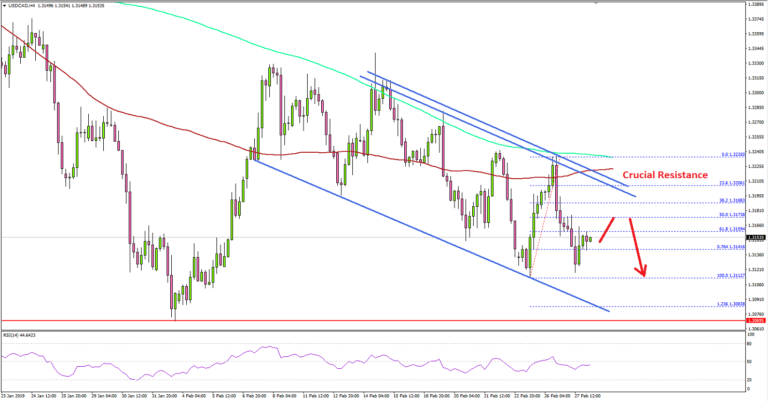
Looking at the 4-hours chart, the pair broke many supports and settled below 1.3220 plus 1.3200. There was also a close below the 100 (red) simple moving average (4-hours). The last correction was capped near the 1.3230 level and later the price declined below 1.3185.
There was a break below the 61.8% and 76.4% Fib retracement levels of the last wave from the 1.3112 low to 1.3235 high. The recent decline has opened the doors for more losses below the 1.3110 and 1.3100 support levels.
The next stop for sellers could be 1.3080 and the 1.236 Fib extension level of the last wave from the 1.3112 low to 1.3235 high. To the topside, there are many hurdles for buyers near the 1.3180, 1.3190 and 1.3200 levels.
More importantly, there a crucial declining channel in place with resistance at 1.3200 on the same chart. Therefore, a break and close above 1.3200 plus the 100 (red) simple moving average (4-hours) is must for a fresh upward move towards 1.3300. If not, there is a risk of more losses towards 1.3080 and 1.3050.
Fundamentally, the Canadian Consumer Price Index (CPI) report for Jan 2019 was released by the Statistics Canada. The market was looking for a 0.2% increase in the CPI in Jan 2019, compared with the previous month.
However, the result was lower than the forecast as the CPI increased 0.1%. The yearly change was 1.4%, less than the 1.5% forecast and a lot less than the last 2.0%.
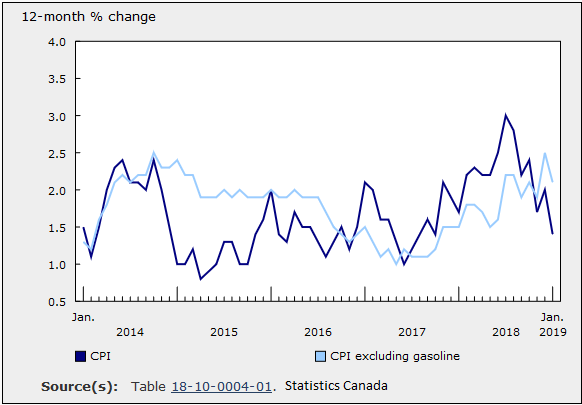
The report added that:
The Consumer Price Index (CPI) rose 1.4% on a year-over-year basis in January, down from a 2.0% increase in December. Energy costs declined 6.9%, while the growth in the price of services slowed to 2.7% as transitory pressures from the air transportation, telephone services and travel tours indexes, which boosted the all-items CPI in December 2018, dissipated. Excluding gasoline, the CPI was up 2.1% on a year-over-year basis.
The Canadian dollar faced sellers after the release, but the recent strength in EUR/USD and GBP/USD kept USD/CAD in a bearish zone below 1.3200.
Economic Releases to Watch Today
- German Consumer Price Index Feb 2019 (Prelim) (YoY) – Forecast +1.5%, versus +1.4% previous.
- German Consumer Price Index Feb 2019 (Prelim) (MoM) – Forecast +0.5%, versus -0.8% previous.
- US Initial Jobless Claims – Forecast 220K, versus 216K previous.
- US Gross Domestic Product Q4 2018 (Preliminary) – Forecast 2.3% versus previous 3.4%.
First Impressions: Australian Q4 capex
Q4: +2.0%, equipment +0.7% (as anticipated). 2019/20: $92bn, Est 1 on Est 1 is +11% but implies a rise of only 1% we estimate.
December quarter
Total private business capex spending in Q4 was stronger than anticipated, up 2.0% (market median 1.0% and Westpac flat)
Building & structures provided the surprise, +3.2%. We expected a fall of around 0.5% and the Construction Work survey (which we feed into our GDP forecast) was a -0.9%.
Equipment spending met our expectations, +0.7% (expected +0.8%).
By industry, mining capex -4.3%; services +5.6%; and manufacturing -4.4%.
2018/19 capex plans
Est 5 is $118.4bn, +3.6% vs Est 5 a year ago.
This implies that capex spend in 2018/19 will be around 3% above that in 2017/18 ~ we calculate, based on average realisation ratios (RRs).
This is in line with the previous survey. Recall that Est 4 was $114bn, some 4.4% above Est 4 a year ago – a figure which implied a 3.4% rise in capex in 2018/19, we estimate.
By industry, Est 5 on Est 5 is: mining -7%; services is +9% and manufacturing +5%.
Based on avg RRs, Est 5 implies by industry: mining -8%; services 8.4%; manufacturing, 5%.
2019/20 capex plans
Est 1 is $92.1bn, +11% vs Est 1 a year ago.
This implies that capex spend in 2019/20 will be 1% above that in 2018/19 ~ we calculate, based on average realisation ratios (RRs).
By industry, Est 1 on Est 1 is: mining +21%; services is +7% and manufacturing +5%.
Based on avg RRs, Est 1 implies by industry: mining +5%; services flat; manufacturing, -9.5%.
Comments
For Q2, the equipment result was as anticipated.
Our forecast for Q4 GDP has been downgraded, to 0.2%qtr, 2.4%yr.
Previously, we were expecting 0.5%qtr, 2.7%yr. Construction activity fell by 3.1% in the quarter, a material downside surprise, as revealed in the Construction Work survey yesterday.
For 2018/19, the capex survey is relatively positive around investment by the service sectors. This is not a great surprise, with strength in transport (spill-overs from the upswing in public infrastructure) and strength in utilities (as investment in renewables increases sharply).
Mining investment in 2018/19 is likely to be below that in 2017/18, with construction of the major gas projects finalised recently.
Turning to 2019/20, we caution that estimates 1 and 2 for any given year can be an unreliable guide to actual spending – the error varies from year to year. This is particularly true for equipment spending – for which decisions / variations can be made with relatively short notice.
Estimate 1 for 2019/20 is $92bn, which is 11% above Est 1 a year ago.
This headline figure, Est 1 on Est 1, appears to be quite positive.
However, we assess that this figure is flattered by base effects – with Est 1 of a year ago relatively weak (compared with the likely outcome for the 2018/19 year).
We interpret the Est 1 reading as describing a much less upbeat outlook than suggested by the headline figure.
Est 1 implies that capex spending in 2019/20 will be 1% above that in 2018/19, we estimate.
Mining investment is now likely to rise, for the first time in a number of years – the investment wind-down is complete and investment in iron ore is moving higher encouraged by high prices and favourable profitability.
Of most interest is the view around the service sectors. Here the capex survey provides some mixed signals. The Est 1 on Est 1 is positive at +7%. However, as discussed above, we see this as flattered by base effects.
We estimate that Est 1 for services implies a flat result for 2019/20 – highlighting the uncertainty around the investment outlook across the broader economy.
By way of context, in the mid-year budget update, the Government forecast real business investment to rise by 5% in 2019/20, including a 5% rise in non-mining investment.
We anticipate a rise which is more muted, forecasting an increase of around 1.5%. This reflects our less upbeat view on the consumer and housing, as well as anticipate headwind associated with the Federal election, due by May – in short, heightened uncertainty may see firms delay their spending.
The capex also provides further detail around investment plans by plans by asset and by industry, which we will review.
Fed Powell: Balance runoff likely settles at around 16-17% of GDP
In the second day of Congressional Testimony, Fed Chair Jerome Powell said Fed will stop the balance sheet runoff this year. The balance sheet will then be at around 16-17% of GDP, up from 6% before the financial crisis. Considering that the US GDP is currently at around USD 20T, the balance sheet would eventually be between USD 3.2T and USD 3.4T. The Balance sheet is currently just over USD 4T.
Powell said "we've worked out, I think, the framework of a plan that we hope to be able to announce soon that will light the way all the way to the end of balance sheet normalization". And, "we going to be in a position ... to stop runoff later this year."
He also bluntly noted that Fed is "not looking at a higher inflation target, full stop", even if Fed is rethinking its policy framework for this year.
Daily Markets Broadcast
Wall Street slumbers with lack of trade talk progress
Wall Street ended mixed yesterday, rebounding from intra-day lows for a nondescript close. US top trade negotiator said China buying more US goods is not enough, need to see structural changes. China’s PMI readings fall in February.
US30USD Daily Chart
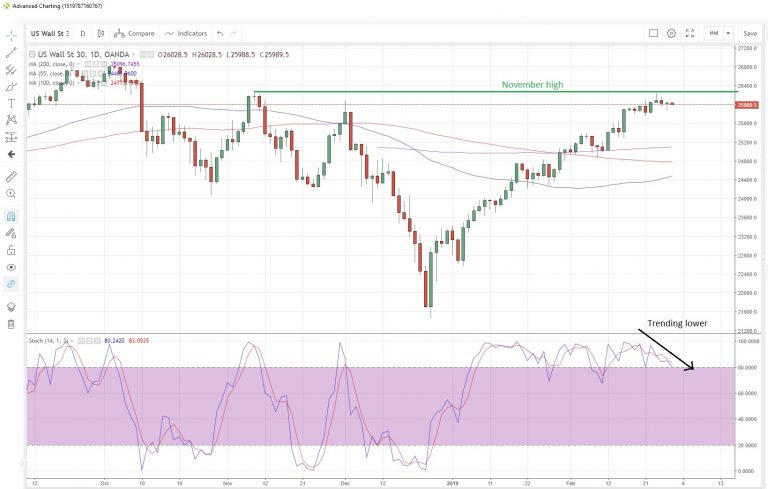
The US30 index rebounded from weekly lows yesterday to close almost flat. US trade negotiator said China not doing enough in trade talks, need to see changes with regard to intellectual property and technology transfer
Resistance at the November high of 26,249 remains intact as the slow stochastics momentum indicator edges lower. Support may be found at the 200-day moving average at 25,096
US releases delayed data for Q4 GDP growth today. Estimates suggest a slowdown to +2.3% y/y from +3.4% in Q3.
DE30EUR Daily Chart
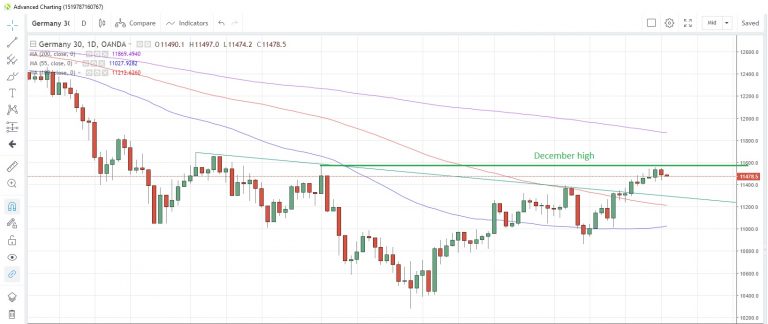
The Germany30 index snapped a three-day winning streak yesterday, falling by the most in two weeks, as M3 money supply growth missed estimates in December
The index is struggling to overcome the December high at 11,571. Trendline support may be found near the 11,298 level
Slowing growth in the money supply is raising concerns that a lack of availability of credit could exacerbate the current economic slowdown. There are no data releases of note today.
CN50USD Monthly Chart
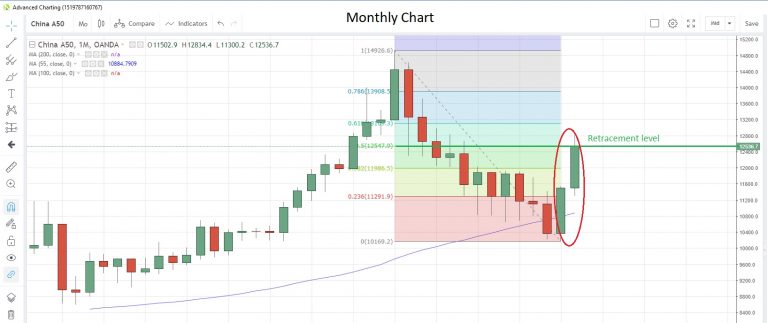
The China50 index continues to consolidate Monday’s strong rally and closed 2.3% below that day’s peak yesterday
The index is sitting at the 50% retracement level of the drop from January 2018 to January 2019, and looks on track to post the second monthly advance in a row
China’s official manufacturing PMI data weakened in February, falling to 49.2 from 49.5. Surveys had expected an unchanged reading. That’s the third straight month below the expansion/contraction threshold of 50. The non-manufacturing PMI eased to 54.3 from 54.7, also below forecast.
You Don’t Bring A MIG-21 To A Gunfight
You don't bring a MIG-21 to a gunfight
Geopolitical tensions ratcheted higher yesterday with Pakistan F-16 fighters shooting down an Indian MIG-21 over Kashmir and capturing the pilot after the Pakistan aircraft had themselves crossed into Indian airspace and conducted retaliatory airstrikes. It's likely India was caught off guard, failing to anticipate Pakistan's response to their air raid earlier in the week. The MiG-21 is an obsolete 1950's vintage Soviet fighter, and you most certainly do not send them up, outnumbered, to intercept modern American F-16s. As the saying goes, you don't bring a knife to a gunfight.
With politicians on both nuclear-armed sides making soothing comments overnight, the trick will be finding a mutually face-saving path to de-escalate the situation. Of course, this will be much easier said than done, and the potential for hostilities to ratchet higher remains very high.
Almost unnoticed, Pakistan also closed their entire airspace, which is part of the primary aircraft “superhighway in the sky” for flights between Asia and Europe. The knock-on effects are already being felt with some Singapore Airlines' European flights adding refuelling stops and Thai Airways cancelling many European-bound flights for example. Many airlines are scrambling to find alternative – albeit more expensive – routes between Asia and Europe as a result. If escalating tensions were to force a closure of Indian airspace as well, the disruption would be enormous, and European and Asian airline stocks would be the first to feel the heat.
Elsewhere, Federal Reserve Chairman Powell's second day of testimony on the Hill passed without incident as he signalled patience and the end of Fed balance sheet reduction this year. US Trade Representative Robert Lighthizer told the markets a US-China trade deal hasn't been agreed yet bringing some reality back to euphoric markets post-Trump's tariff extension, despite the fact Lighthizer also announced both sides had agreed on an enforcement process.
The markets were pinned by ebbs and flows as investors elected to stay on the sidelines until the bigger picture clarified. Wall Street limped to a nondescript close, with the S&P closing down a miserly 0.1% and the US dollar broadly steady against most G7 and regional currencies.
The day will become more interesting in Asia, with the release of the official China Manufacturing PMI at 0900 Beijing time, and median forecasts suggest 49.5. A miss lower could see local stocks and currencies come under pressure. The Trump-Kim summit continues in Vietnam, but realistically we expect nothing market-moving to come from it unless the President takes to social media.
The US GDP will be the highlight of the day, with median forecasts at 2.20%. A miss either way will see increased volatility in stock and currency markets as traders reassess interest rate forecasts.
FX
GBP continued its march higher, rising 100 points to 1.3350 in intra-day trading before closing lower at a still-positive 1.3300. The markets are pricing in that fact that a Brexit no-deal appears doubtful, while it seems likely we'll see an extension of Article 50 following PM May's outline of Parliament's voting options overnight. I won't get into the nitty gritty but to paraphrase Robert Lighthizer, a deal isn't done yet. Being long sterling at these lofty levels remains a potentially perilous trade.
Regional markets will follow North America's lead and open quietly overnight awaiting the China PMI data. A big miss to the downside could see regional currencies come under pressure.
Equities
Regional bourses will await China's PMI data and, much like currencies, may slip into the red on a downside miss. China stocks are also expecting an announcement this week regarding an increase in weighting from 0.7% to 2.8% in the MSCI Emerging Markets Index. China stocks could rise if the announcement is made, potentially resulting in a wave of buying from international passive index funds.
Oil
Official US Crude inventories fell a massive 8.65 million barrels overnight, pushing Brent up 1.90% to USD66.60 per barrel and raising WTI 1.80% to USD57.00 a barrel. Plunging shipments from Saudi Arabia are keeping the squeeze on US refineries starved of Venezuelan crude. For now, OPEC's production cut strategy is continuing to work, and price action is positive on both contracts – a theme that should flow into Asian trading.
Gold
Gold fell 10 dollars to USD1,320.00 an ounce overnight as stale long positioning and a lack of clarity on the macro-economic front took its toll. Traders should beware of escalating tensions between India and Pakistan, which could cause gold to move higher, perhaps rather quickly. In the bigger picture, despite gold's overnight set back, the longer-term technical view remains positive.
USTR Lighthizer: Market outcomes to determine winners, not state-capitalism and technology theft
In his testimony to House Ways and Means Committee on China trade negotiation, US Trade Representative Robert Lighthizer laid down the principle that the US "can compete with anyone in the world". But he emphasized "we must have rules, enforced rules". And "market outcomes" rather than "state-capitalism" and "technology theft" determine winners. China's unfair trade practices are "major threats to our economy".
Lighthizer said there were "very intense, extremely serious, and very specific negotiation with China on crucial structural issues for several months" and "real progress" were made. US could "turn the corner" in the economic relationship with China "if" they can reach a satisfactory solution to the all-important outstanding issue of enforceability as well as some other concerns. But "much still needs to be done" before an agreement is reached, and "more importantly, after it is reached."
He also emphasized that the administration is "pressing for significant structural changes" rather than "soybean solution". The US is "very aware of " the history with China and the "disappointments that have resulted from promises that were not kept" And, "the reality is this is a challenge that will go on for a long, long time." He added that "if there is disagreement at my level, the U.S. would expect to act proportionately but unilaterally."
Meanwhile, as the agreements are settlements of China's violations of Section 301 of the Trade Act of 1974. So they are executive actions that do not require Congress' approval. China talks are more in common with a sanctions-monitoring regime than a traditional trade pact.