Sample Category Title
Japanese Yen Steady, Investors Eye Japanese Manufacturing, Retail Sales
USD/JPY has recorded slight gains on Wednesday. In the North American session, the pair is trading at 110.85, up 0.25% on the day. On the release front, U.S. data was mixed. Factory orders were up 0.1%, well off the forecast of 1.5%. Pending Home Sales sparkled with a gain of 4.6%, its highest gain in two years. In Japan, Preliminary Industrial Production has posted four straight declines and the markets expect a sharp drop of 2.5%. Retail sales is projected to edge higher to 1.4%.
There were no surprises from Powell’s testimony before a senate committee on Tuesday, as Powell preached patience with regard to changes in interest rates. Powell stated that the Fed was in “no rush to make a judgment” and made reference to “conflicting signals in the economy”. The labor picture remains bright, with strong hiring and low unemployment. At the same time, consumer spending and housing data have been soft. The markets are expecting the Fed to remain on the sidelines in May and June, meaning that the first hike of 2019 will not come before the second half of the year.
Inflation remains stubbornly low in Japan. Annual core consumer inflation was just 0.8% in January, as the BoJ has been unable to boost inflation to its target of around 2%. The BoJ has long stuck to its current monetary policy, but there are dissenting voices calling for change. On Wednesday, BoJ member Goushi Kataoka called on the bank to increase stimulus in order to achieve its inflation target. However, unless BoJ Governor Kuroda decides to take stronger easing steps, current monetary policy will remain in place.
Sunset Market Commentary
Markets
Global core bonds are gaining ground today. German Bunds started a downleg at the opening bell despite a risk-off sentiment on equity markets. Bundesbank chief Weidmann said there is no acute need to adjust the ECB rate guidance, confirming yesterday’s Philip Lane. The EMU consumer confidence declines little to 106.1 in February but is showing signs of cautious bottoming out. German Bunds temporarily paired losses by noon. Core bonds fell again afterwards with no clear signal. UK gilts underperform. The German yield curve is bear steepening with yield changes up to +3.3 bps (30-yr).US Treasuries whipsawed through European trading hours but followed the final downleg in core bonds. Focus was on Fed chairman Powell’s second part of the US Congress testimonial, but given yesterday’s lack of surprise, we don’t expect any market-moving comments. The US yield curve is bear steepening with changes up to +3.5 bps (30-yr). The European Commission has warned Italy, together with Greece and Spain, over ‘excessive’ imbalances. With the Italian budget perils again resurfacing, BTP futures edged lower. Peripheral spreads are tightening, with only Italy underperforming (+5 bps).
EUR/USD maintained most of this week’s gains today. However, it is a bit unclear whether this move should be considered euro strength or USD softness. Maybe a cautious euro bid prevailed. Most sub-components of the EC business confidence didn’t deteriorated further. In line with yesterday’s assessment of ECB’s Lane, Bundesbank chief Weidmann didn’t sound that negative on prospects for the ECB to start policy normalization further down the road, despite current soft patch in the economy. Whatever the reason, EUR/USD continued to trade with reach of yesterday’s ST peak around 1.14. USD/JPY also made an interesting intraday reversal. This morning in Asia, geopolitical tensions (India-Pakistan) and an easing of recent positive risk sentiment supported the yen. During the day, the rise in European and US interest rates put the yen again in the defensive. USD/JPY is again changing hands in the 110.75 area. EUR/JPY is also trading with reach of the 126.30 ST resistance.
The sterling rebound/short-squeeze simply continued. Even as the UK parliament retained the option of leaving the EU without a deal next month, investors apparently assumed that approval of a deal or a delay are the mostly likely scenarios. With respect to the first option, Brexit hardliner Jacob Rees-Mogg was quoted to have toned down its request to resolve the Irish backstop. This headlines can be seen as an illustration of the first option. Interest rate differentials of sterling versus the euro and the dollar also widened (admittedly in a modest way) in favour of the UK currency. This evening, the UK parliament will have the chance to vote on amendments regarding the Brexit procedure, but they are unlikely to change the Brexit roadmap in a profound. EUR/GBP is currently trading in the 0.8550 area, well below the 0.8620 support. Cable regained the 1.33 big figure.
News Headlines
The European Commission identified 13 EU member states suffering from economic imbalances, according to its regular check-up. Three of them – Italy, Greece and Cyprus – face “excessive” shortfalls which require policy action. The EC is most worried by the high ratio of bad loans in their banking sectors and by their large shares of public and private debt.
While German growth is expected to be “well below” potential in 2019, one should not be “overly pessimistic” about the medium-term outlook, Bundesbank President Weidmann said today. He also believes the ECB should look through the current but temporary EMU wide weakness, dismissing the case for an adjustment to the ECB rate guidance. His comments echoed Philip Lane yesterday, who showed no willingness to alter guidance either.
Canadian headline inflation slowed to 1.4% YoY (0.1% MoM) in January as the surge in airfare prices that unexpectedly propelled December data to 2.0% YoY, was reversed. Core measures stabilized close the Bank of Canada’s 2% target at 1.9% YoY, providing the recently sidelined BoC with time to assess economic developments.
Canadian January Inflation Rate Dipped as Expected
Highlights:
- Headline CPI inf lation growth slowed as expected to 1.4% year-over-year from 2.0% in December
- Airfares retraced most of a 22% m/m surge in December but were still up 4.1% from a year ago. Energy prices fell as expected given earlier-reported gasoline price declines.
- The BoC's three preferred core measures averaged 1.9%, unchanged from December. Ex food and energy inf lation slipped to 1.9% from 2.3% in December (ref lecting the pullback in airfares)
Most of the dip in the headline rate to 1.4% year-over-year from 2.0% in December came from a pullback in energy prices and a retracement of a December surge in airfares. The latter has been highly volatile since Statistics Canada implemented a new methodology for tracking airfares last year. Unpredictable volatility might persist for a while. In perhaps a sign of things to come, rent prices rose 1.0% monthover- month in January — the largest increase since 1988 — as Statistics Canada implemented a new methodology for calculating that monthly data. However, the overall January inf lation report came in as expected with the move in rent prices generally offset elsewhere in the report.
Beyond energy price volatility and wild swings in airfares, underlying inf lation trends are still running right around the Bank of Canada's 2% price target. The Bank of Canada's three preferred 'core' inf lation measures — the common, trim, and median CPIs — averaged 1.9% in January and have been remarkably stable in the 1.9%-2.0% range since February of last year. The inf lation data is still consistent with an economy running at capacity, but has shown no sign of breaking unsustainably higher. We continue to think there is a little more room for official policy interest rates to move up from still-low levels but with earlier interest rate hikes and regulatory measures already successfully slowing household debt growth and inf lation trends still tame there is little push for the central bank to rush.
EUR/GBP Mid-Day Outlook
Daily Pivots: (S1) 0.8549; (P) 0.8611; (R1) 0.8659; More...
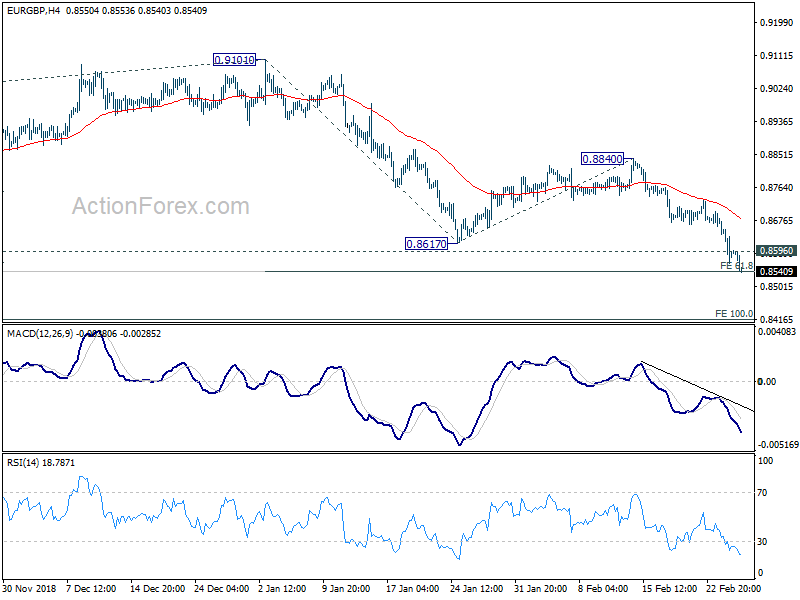
EUR/GBP's decline accelerates to as low as 0.8540 so far. 61.8% projection of 0.9101 to 0.8617 from 0.8840 at 0.8541 is already met but there is no sign of bottoming. Intraday bias remains on the downside for long term projection target at 0.8416 next. On the upside, above 0.8596 minor resistance will turn intraday bias neutral and bring consolidation, before staging another fall.
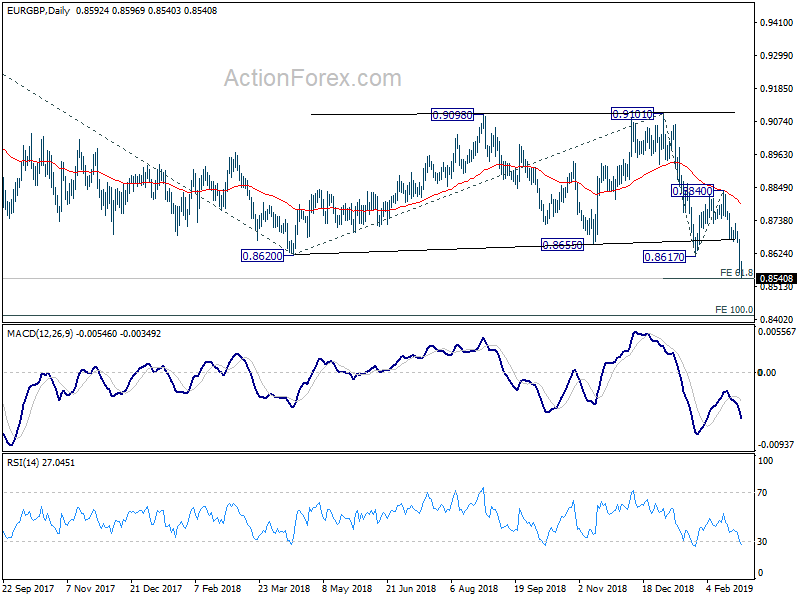
In the bigger picture, EUR/GBP is seen as staying in long term range pattern started at 0.9304 (2016 high). On the downside, decisive break of 0.8620 support resumed the falling leg from 0.9305 (2017 high). Next target is 100% projection of 0.9305 to 0.8620 from 0.9101 at 0.8416. In this case, we'd expect strong support around 0.8312 to contain downside and bring rebound.
Canada: Inflation Dips on Lower Gasoline Prices
The consumer price index (CPI) rose 1.4% (year-on-year) in January, down from 2.0% in December and right on the median survey estimate. Falling energy prices (-6.9%) were the main factor pulling down inflation. Excluding energy, prices were up 2.1%.
Services prices also decelerated to 2.7% (from 3.5%) in December. Air transportation appears to be giving the statisticians some trouble: following a 28% (y/y) gain in December, it fell back to 4.1% in January. The volatility in this component has risen dramatically over the past year alongside methodology changes, increasing the variability in headline inflation.
The Bank of Canada's preferred measures of core inflation were flat in January. CPI-common and CPI-trim remained at 1.9% year-on-year (a five month trend in the former and three month in the latter), while CPI-median held at 1.8% for the third straight month.
Key Implications
Outside of the usual noise in energy and (now) air transportation, there is little to report inflation-wise in Canada. Core measures are steady at just below 2% and appear likely to stay there as the economy faces a near-term growth slowdown.
The Bank of Canada is maintaining a bias to further tightening, but with limited inflation and slowing growth there is little urgency on this front. Indeed, much like their counterpart stateside, the benign inflation environment may lead policymakers to question whether further rate hikes are even necessary or whether the current policy setting is the fabled goldilocks "just right".
Soybeans Futures On Course for Possible Downward Movement
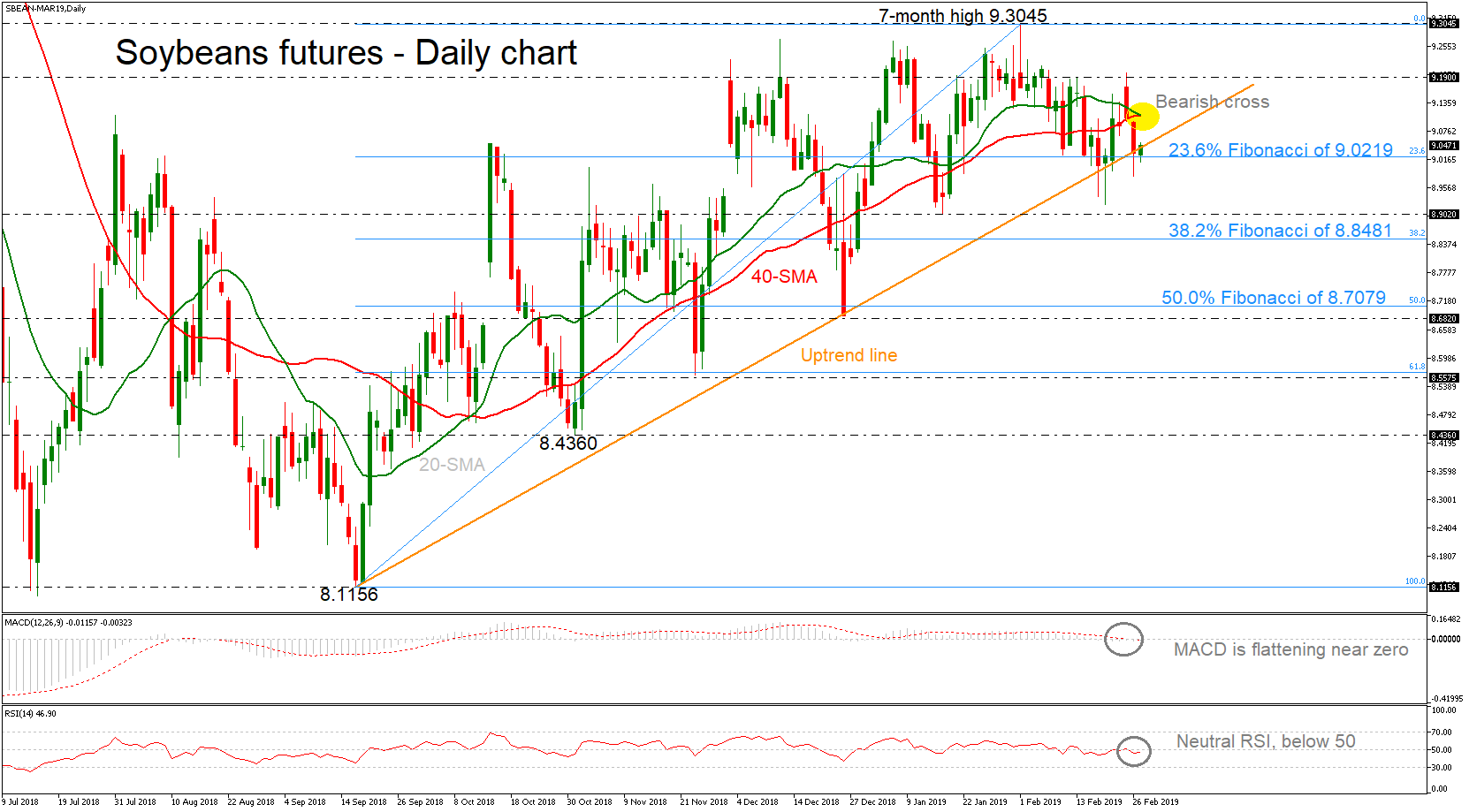
Soybeans futures pulled back on the medium-term ascending trend line and the 23.6% Fibonacci retracement level of the upleg from 8.1156 to 9.3045 near 9.0219, confirming the medium-term upside rally in the daily timeframe. Currently, the price is trading below the bearish cross within the 20- and 40-simple moving averages (SMAs), pointing to a possible fall below the trend line. The MACD and the RSI are flattening near their neutral levels, suggesting that the recent view is weakening.
A decline below the 23.6% Fibonacci of 9.0219 and the diagonal line could shift the positive picture to a more neutral one, challenging the 8.9020 support. Beneath this level, the 38.2% Fibonacci of 8.8481 could act as strong support before heading towards the 50.0% Fibonacci of 8.7079.
Alternatively, if the price jumps above the SMAs, the next level to turn traders’ attention could be the 9.1900 resistance barrier. More advances could push the price towards the seven-month high of 9.3045 resistance.
Summarizing, Soybeans maintains a bullish bias in the medium-term timeframe, recording higher highs and higher lows. This structure could be confirmed once again if the market surpasses the upper multi-month high, registered on February 1.
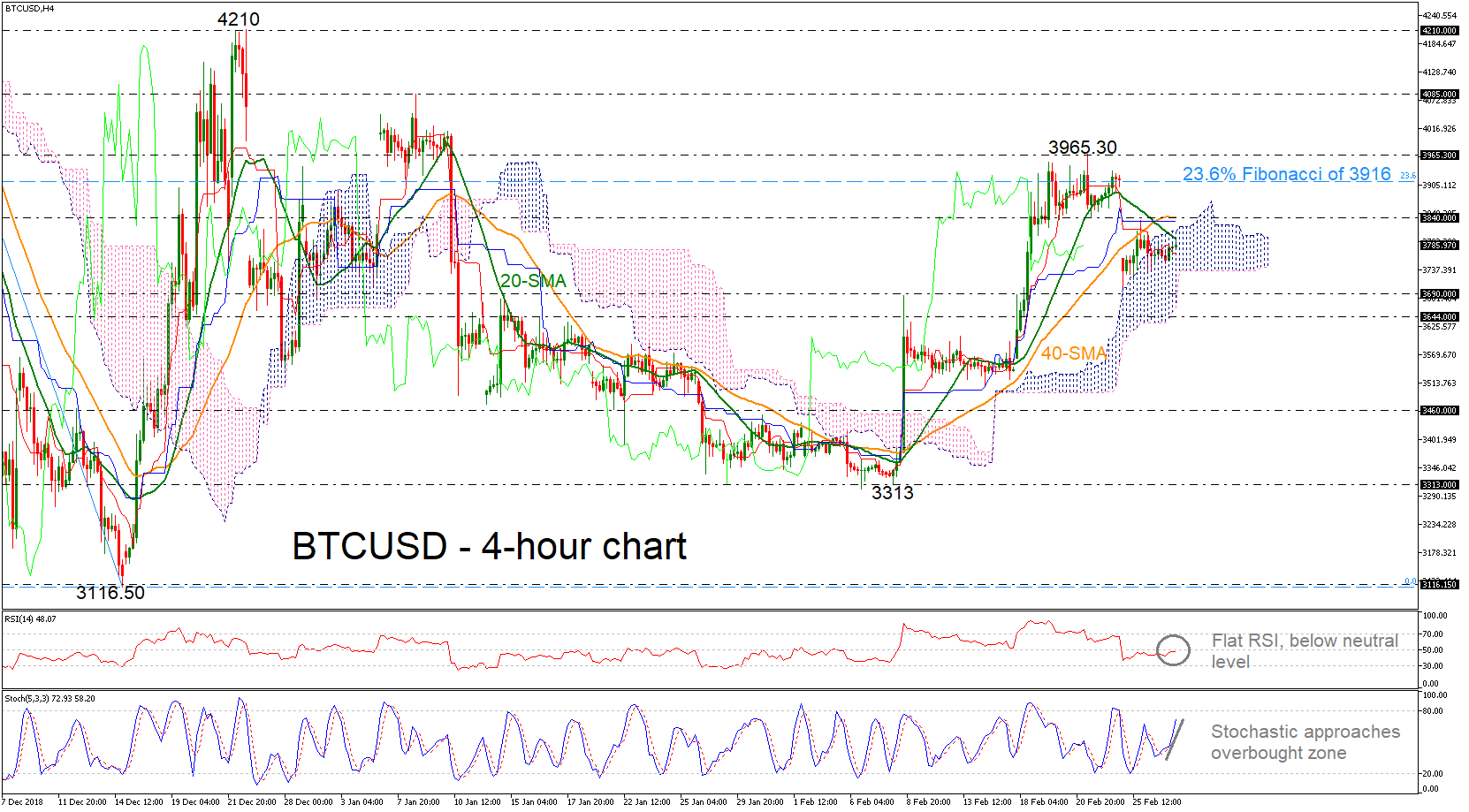
BTCUSD Hovers Inside Ichimoku Cloud; Immediate Resistance 20-SMA
BTCUSD is currently hovering within the Ichimoku cloud and is approaching the 20-simple moving average (SMA) in the 4-hour chart after it posted a bearish crossover with the 40-SMA in the past sessions. The RSI indicator is holding slightly below the 50 level, while the stochastic oscillator is approaching the overbought zone with strong momentum.
Should the price extend higher, it could find immediate resistance at the 3840 level, which currently coincides with the 40-SMA. Also, an advance above this region would increase speculation that a bullish move is in progress towards the 23.6% Fibonacci retracement level of the downleg from 6508 to 3116.50, around 3916. More gains could send prices until 3965.30, identified by the peak on February 21.
On the other hand, should the bitcoin stretch southwards, immediate support could come from the lower band of the Ichimoku cloud around 3736 and then could hit again 3690. A step lower could bring the price towards the 3644 support.
To sum up, the very short-term bias remains slightly bullish especially as BTCUSD rebounded on the 3313 barrier. However, in the medium-term, the price lacks direction, while in the long-term remains strongly bearish.
USD/JPY Mid-Day Outlook
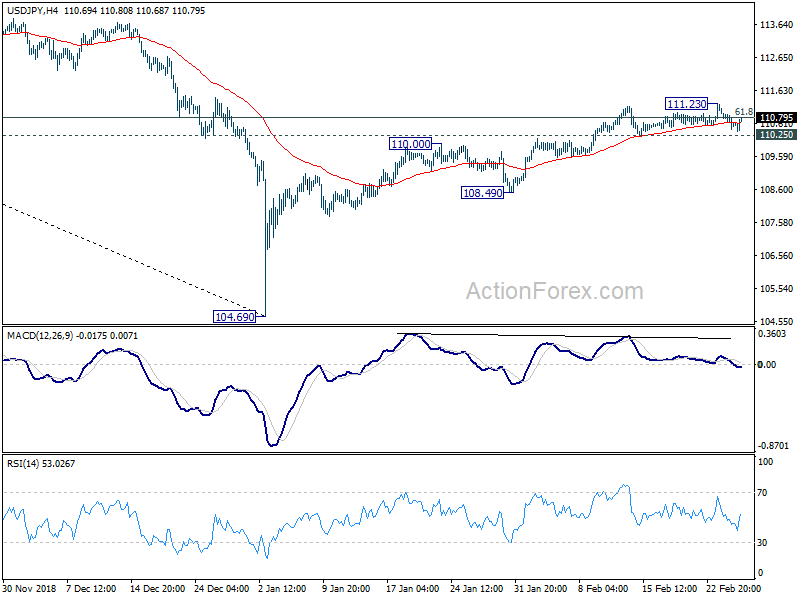
Daily Pivots: (S1) 110.28; (P) 110.68; (R1) 110.99; More...
Intraday bias in USD/JPY remains neutral for the moment. On the downside, break of 110.25 minor support will suggest rejection by 61.8% retracement of 114.54 to 104.69 at 110.77. And in that case, the rebound from 104.69 has likely completed. Intraday bias will be turned back to the downside for 108.49 support for confirmation. Nevertheless, firm break of 111.23 should confirm resumption of rise from 104.69 for 114.54 resistance.
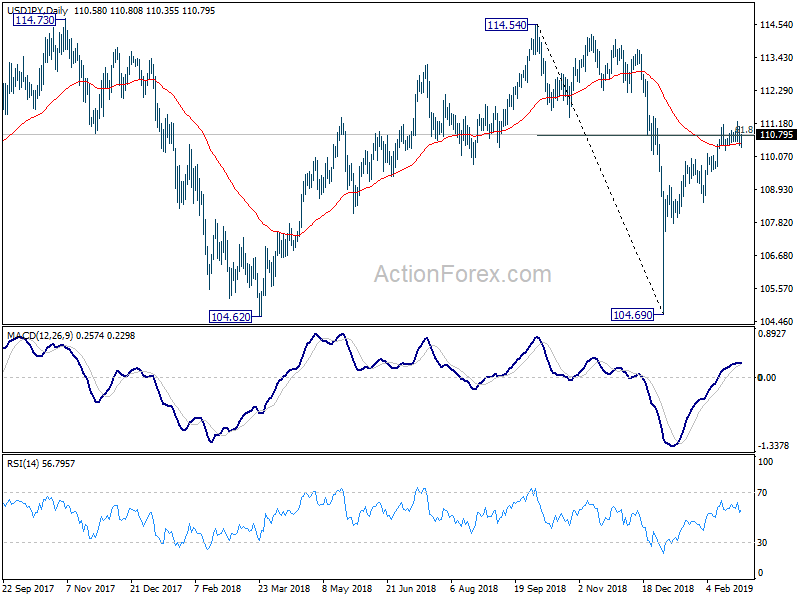
In the bigger picture, while the rebound from 104.69 was stronger than expected, it's struggle to get rid of 55 day EMA completely. Outlook is turned mixed first. On the downside, break of 108.49 support will revive that case that such rebound was a correction. And, larger down trend is still in progress for another low below 104.62. But sustained trading above 55 day EMA will turn focus to 114.54. Decisive break there will confirmation completion of the decline from 118.65 (2016 high).
USD/CHF Mid-Day Outlook
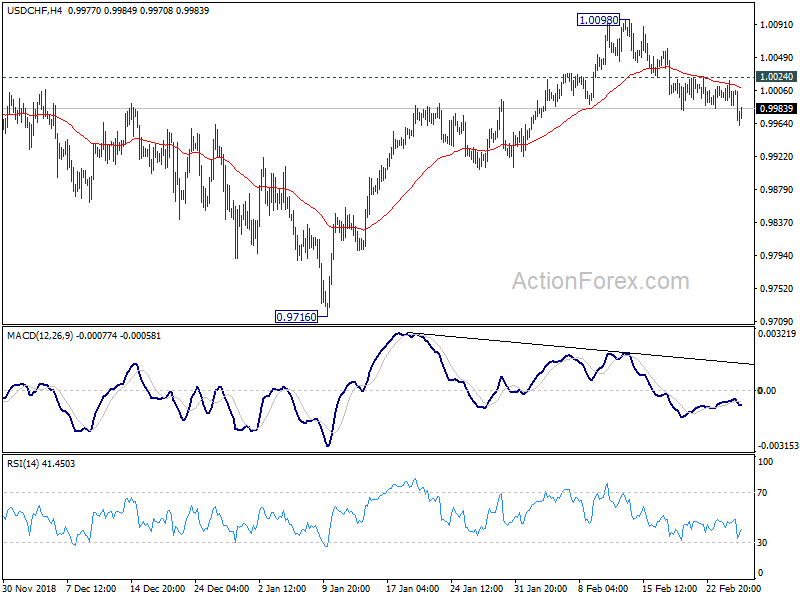
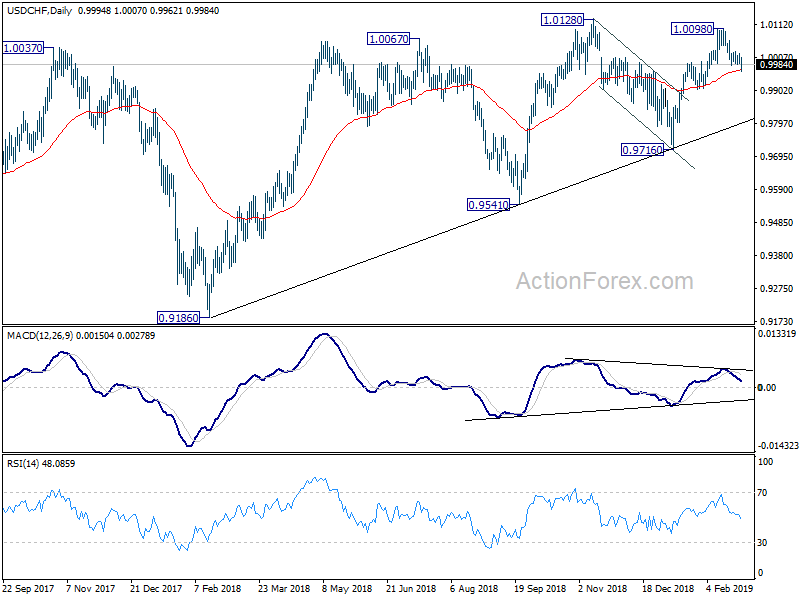
Daily Pivots: (S1) 0.9986; (P) 1.0003; (R1) 1.0019; More...
USD/CHF's decline from 1.0098 resumes today and intraday bias is back on the downside. Sustained trading below 55 day EMA (now at 0.9967) should confirm completion of rise form 0.9716, after rejection by 1.0128 resistance. In that case, deeper fall would be seen back towards 0.9716 support. On the upside, break of 1.0024 minor resistance will turn bias back to the upside for 1.0098 instead.
In the bigger picture, USD/CHF drew strong support from medium term trend line and rebounded. That suggests rise from 0.9186 is still in progress. Further break of 1.0128 will confirm up trend resumption and target 1.0342 key resistance. Nevertheless, break of 0.9716 will dampen this bullish view and at least bring deeper fall to 0.9541 key support.
EUR/USD Mid-Day Outlook
Daily Pivots: (S1) 1.1355; (P) 1.1379; (R1) 1.1412; More.....
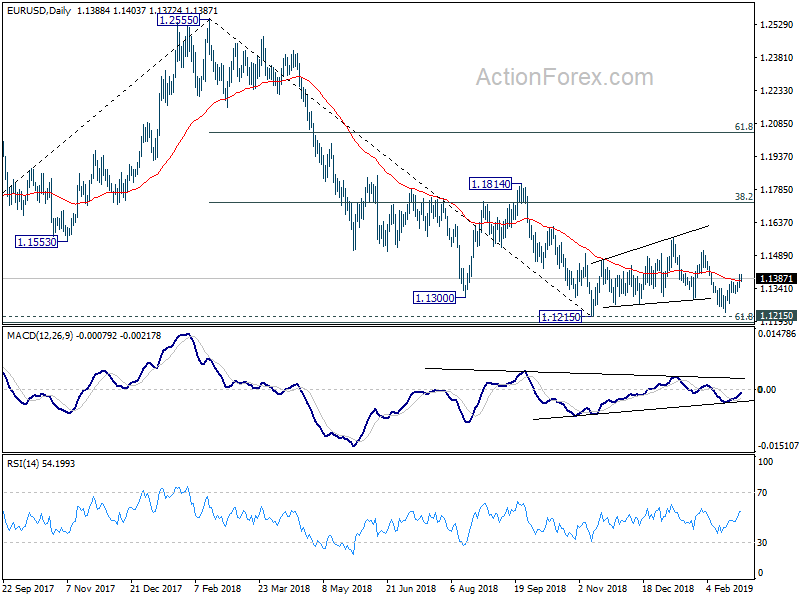
Intraday bias in EUR/USD remains on the upside as rebound form 1.1234 is in progress. Current rise is seen as another leg in the consolidation pattern from 1.1215 and could target 1.1514 resistance and above. On the downside, though, break of 1.1316 minor support will argue that the rebound is completed. Intraday bias will be turned back to the downside for 1.1215 low.
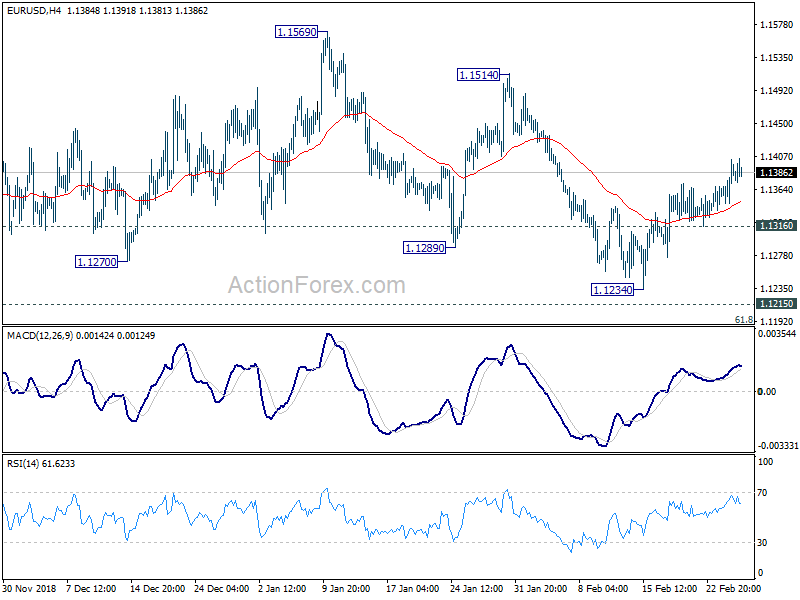
In the bigger picture, as long as 1.1814 resistance holds, down trend down trend from 1.2555 medium term top is still in progress and should target 61.8% retracement of 1.0339 (2017 low) to 1.2555 at 1.1186 next. Sustained break there will pave the way to retest 1.0339. However, break of 1.1814 will confirm completion of such down trend and turn medium term outlook bullish.