Sample Category Title
Crude Oil Inventory Surprisingly Declined in US
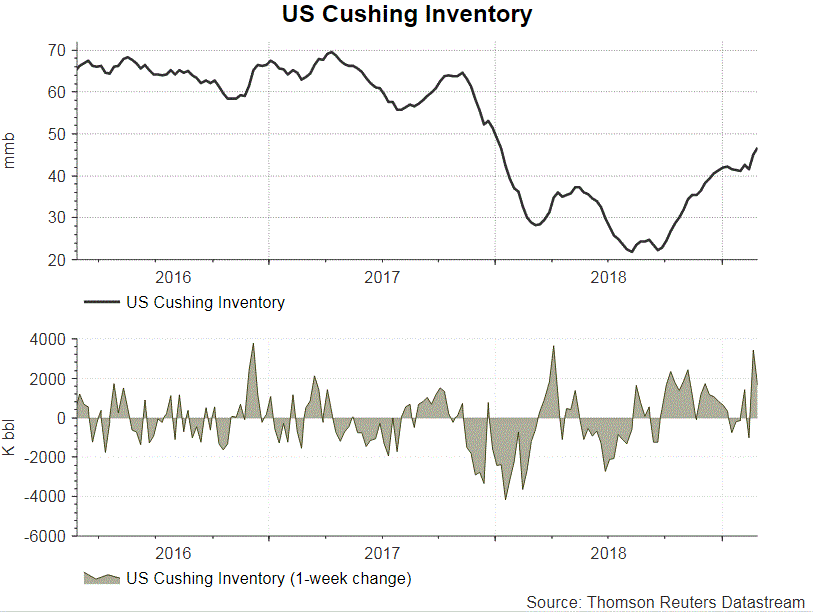
The report from the US Energy Information Administration (EIA) shows that total crude oil and petroleum products (ex. SPR) stocks fell -2.49 mmb to 1263.03 mmb in the week ended February 22. Crude oil inventory plunged -8.65 mmb to 445.87 mmb (consensus: +2.84 mmb). Inventories declined in 4 out of 5 PADDs with PADD 3 (Gulf Coast) seen remarkable -6.76 mmb withdrawal. Meanwhile, Cushing stock added +1.63 mmb to 46.65 mmb. Utilization rate gained +1.2% to 87.1% while crude production climbed +0.1 mmb higher to 12.1M bpd for the week. Crude oil imports dropped -1.61M bpd to 5.92M bpd in the prior week.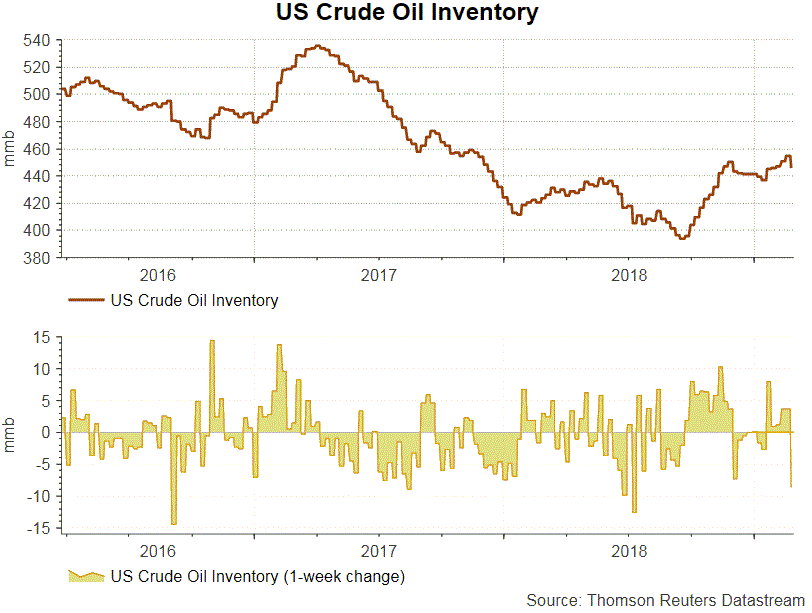
 Concerning refined oil product inventories, gasoline inventory declined -1.91 mmb to 254.94 mmb as demand added +2.06% to 8.98M bpd. The market had anticipated a -1.69 mmb drop in stockpile. Production added +0.67% to 9.55 bpd while imports soared +12.62% to 0.47M bpd during the week. Distillate inventory fell -0.3 mmb to 138.38 mmb. Demand slipped -3.32% to 4.0M bpd. The market had anticipated a -1.95 mmb decline in inventory. Imports slumped -23.2% to 0.33M bpd while production gained +1.2% to 4.82M bpd during the week.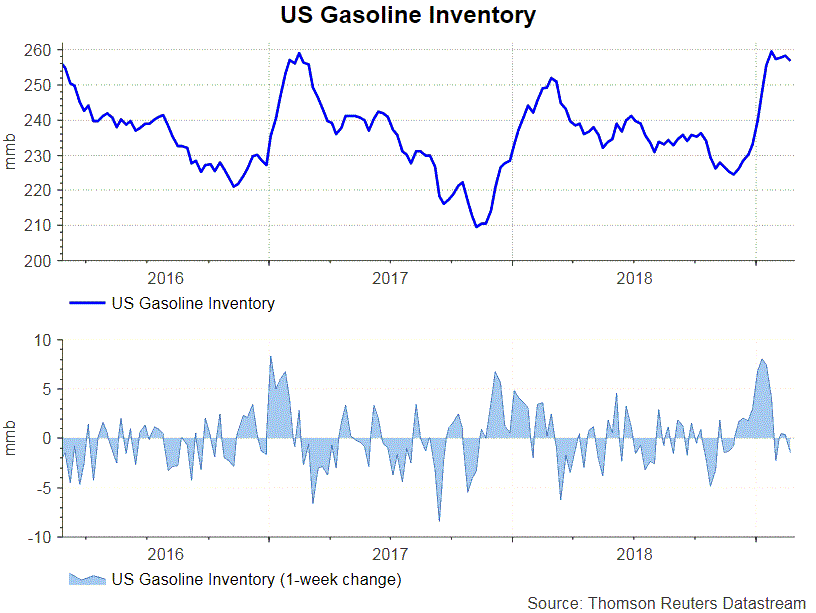
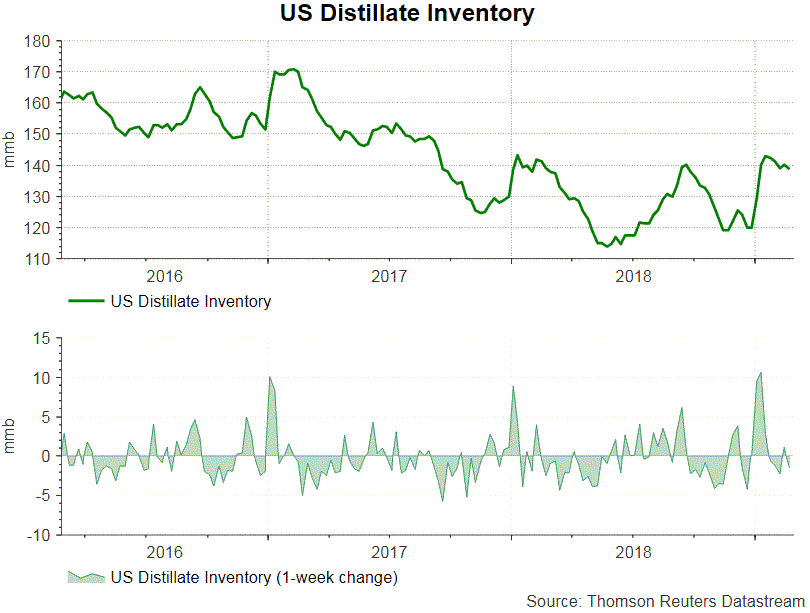
Released after market close on Wednesday, the industry- sponsored API estimated that crude oil inventory declined -4.2 mmb during the week. For refined oil products, gasoline stockpile drew -3.8 mmb while distillate increased +0.4 mmb.
Eco Data 2/28/19
[php_everywhere instance="1"]
British Pound Climbs as Parliament Eyes No-Deal Vote
GBP/USD continues to rally this week. In Wednesday’s North American session, the pair is trading at 1.3308, up 0.42% on the day. The streaking pound touched a high of 1.3350 earlier on Wednesday, its highest level since July. In economic news, U.S. data was mixed. Factory orders were up 0.1%, well off the forecast of 1.5%. Pending Home Sales sparkled with a gain of 4.6%, its highest gain in two years. The U.K. will release GfK Consumer Confidence, with the markets projecting a weak reading of -15 points. On Thursday, the U.S. releases Advance GDP and unemployment claims.
Prime Minister May’s dramatic announcement of another parliamentary vote on Brexit has galvanized the pound, which has climbed 2.0% this week. May said that parliament would vote on the government’s withdrawal agreement no later than March 12. If lawmakers reject that proposal, they will vote the next day on two separate proposals – one on a no-deal Brexit, and the second on requesting the EU to extend Article 50 and delay Brexit past March 29. Investors are confident that this makes a no-deal scenario even more unlikely, which has resulted in sharp gains for the pound.
There were no surprises from Powell’s testimony before a senate committee on Tuesday, as Powell preached patience with regard to changes in interest rates. Powell stated that the Fed was in “no rush to make a judgment” and made reference to “conflicting signals in the economy”. The labor picture remains bright, with strong hiring and low unemployment. At the same time, consumer spending and housing data have been soft. The markets are expecting the Fed to remain on the sidelines in May and June, meaning that the first hike of 2019 will not come before the second half of the year.
Dollar Eyes Delayed US GDP and Inflation Data, ISM PMI
The first estimate of US GDP for Q4 will hit the markets on Thursday, ahead of core PCE inflation figures and the latest ISM manufacturing index on Friday. Markets could focus mainly on the ISM survey, as the GDP and inflation data may be viewed as somewhat outdated. In the big picture, the outlook for the dollar remains neutral, though with risks likely skewed to the downside.
It’s finally time for traders and policymakers to get a detailed look at how the US economy closed 2018. Several key data points that were postponed due to the government shutdown will be made public this week, starting with the preliminary GDP estimate for Q4 on Thursday at 13:30 GMT. It’s no secret that the US economy slowed during that quarter, so traders will focus on how severe the slowdown was. Forecasts suggest the US economy expanded at an annualized pace of 2.3%, though considering that models like the Atlanta Fed’s GDPNow suggest growth of only 1.8%, a negative surprise may be in store.
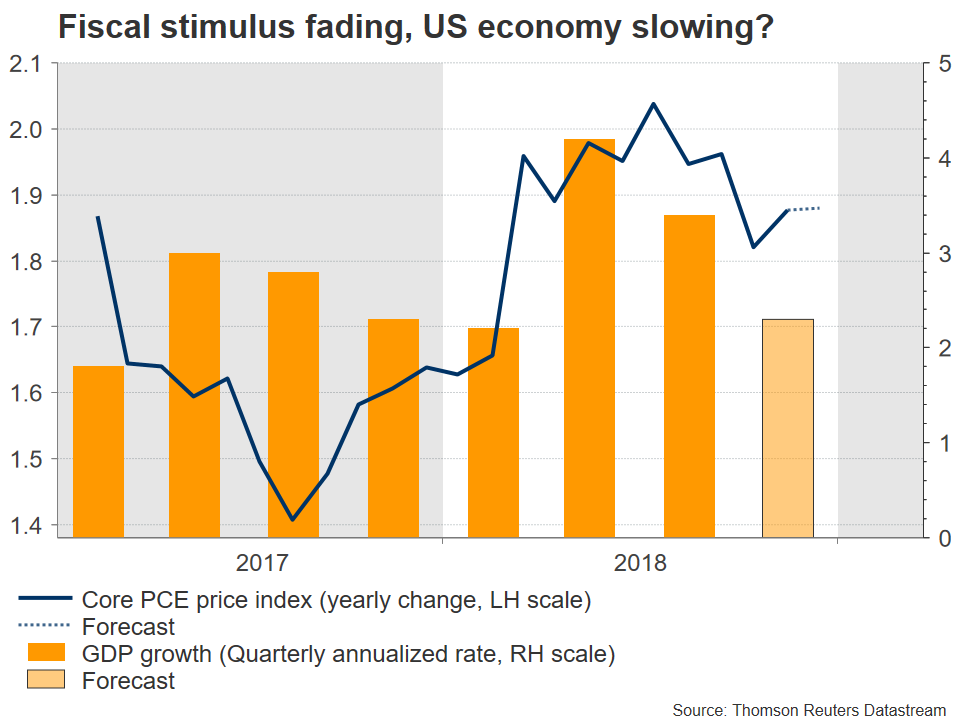
The following day, a raft of key data for December will be released at 13:30 GMT, including personal consumption and income, as well as the core PCE price index – the Fed’s preferred inflation gauge. Although these figures are always important, they may attract less attention this time, as they are a little out-of-date and there’s a clear sense of what to expect in all these areas by now. Namely, the collapse in retail sales for December suggests consumption was likely soft, whereas the steady average hourly earnings print implies another solid personal income number. Meanwhile, since the core CPI rate for December remained unchanged, there’s little scope for any major move in the core PCE rate either.
Instead, the ISM manufacturing index for February that is due at 15:00 GMT could attract the most attention. This survey will provide a much more up-to-date snapshot of the US economy, and thus may hold more importance in the eyes of investors. Expectations are for the PMI to dip to 55.5, from 56.6 previously. Even though such a decline would signal weakening momentum, 55.5 is still a strong number consistent with solid expansion, and hence is unlikely to weigh on the dollar much, if met.
In the bigger picture, the outlook for the US currency remains neutral, though with risks tilted to the downside. On the one hand, a major rally for the dollar seems unlikely given that the Fed is now at – or near – ‘peak rates’ and markets are increasingly pricing in rate cuts by 2020. Equally though, any massive weakness in the greenback is unlikely too as long as other major currencies like the euro and sterling lack appeal, amid growth and political risks. Thus, the dollar’s broader path appears neutral, but with some downside risks – most notably a potential rebound in European growth that boosts the euro, or a resolution in the trade dispute that leads to an unwinding of safe-haven bets on the world’s reserve currency.
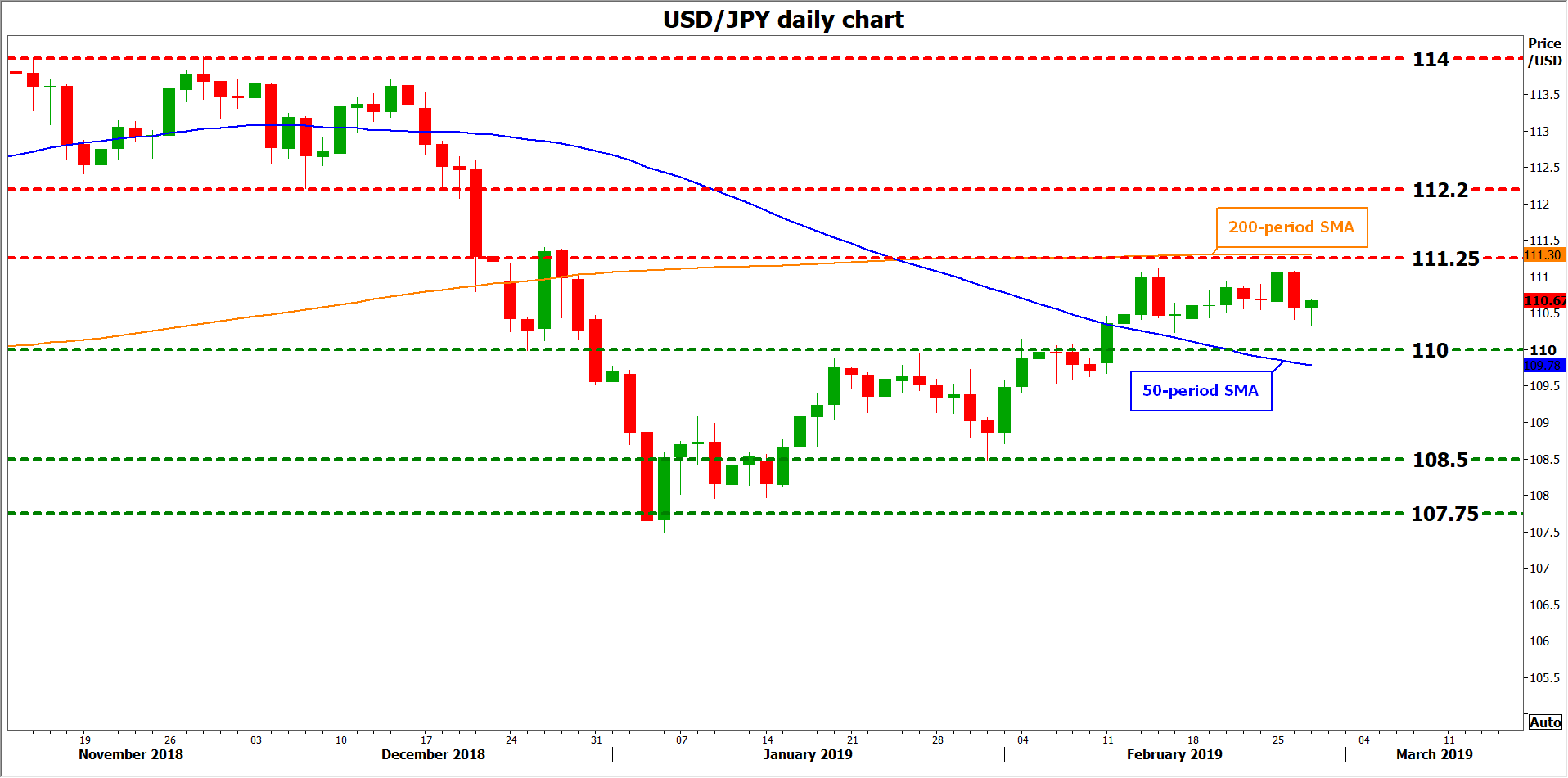
Technically, a wave of declines in dollar/yen could stall initially near the 110.00 handle. Notice that the 50-day simple moving average (SMA) at 109.78 is not far off and may be considered part of the same area. A bearish violation could open the door for the January 31 low of 108.50.
On the flipside, resistance to advances may be found around 111.25, where the 200-day SMA is roughly located as well. If the bulls pierce above that zone, the next obstacle may be the 112.20 area.
MARKET WRAP: Geopolitical Tensions Pushed Stocks Lower
Markets remained uncertain due to the heightened geopolitical tensions. Investors took profit off the table and risk off assets such as VIX moved higher by nearly 5 percent
Stocks
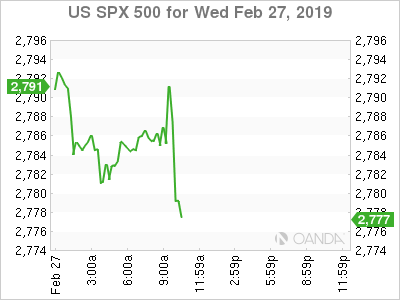
- The S&P 500 Index failed to keep its upward momentum as investors were wary of geopolitical tensions in Asia. The index moved lower by 0.53 percent as of 15:23 London time, while the Nasdaq Composite Index dropped more than 0.75 percent and the Dow Jones Industrial Average also fell nearly 0.55 percent.
- The Stoxx Europe 600 continued its downward move and fell by 0.26 percent.
- The MSCI Emerging Market Index was under the influence of global factors which pushed the index lower by 0.4 percent, the second drop in seven sessions.
- The VIX index moved higher by 5.14 percent and VTSOXX index soared by 3.3 percent
Currencies
- The Dollar spot index remains under the selling pressure ahead of GDP data which is due tomorrow. At 15:27 London time, it jumped a little higher by 0.8 percent.
- The Euro still maintained its 1.13-mark against the dollar and moved higher by 0.2 percent to $1.1382.
- The British pound is back in the game and moved higher by 0.54 percent. The high of the day was 1.3336 and low of the day was 1.3233.
Bonds
- The yield on 10-year Treasuries jumped up by three basis points to 2.66 percent.
- Germany’s 10-year yield also soar by two basis point to 0.13 percent.
- Britain’s 10-year yield jumped higher by three basis point to 1.19 percent.
Commodities
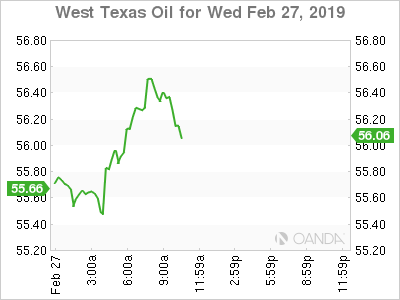
- West Texas Intermediate recovered some of its losses from yesterday and climbed nearly 1.64 percent.
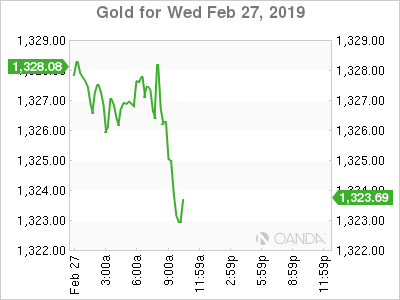
- Gold dropped today as the Fed’s chairman’s started to deliver his statement. It moved lower by 0.23 percent to $1,322 an ounce.
EUR/GBP: Break Below Multi-Month Range Could Signal Stronger Bearish Acceleration
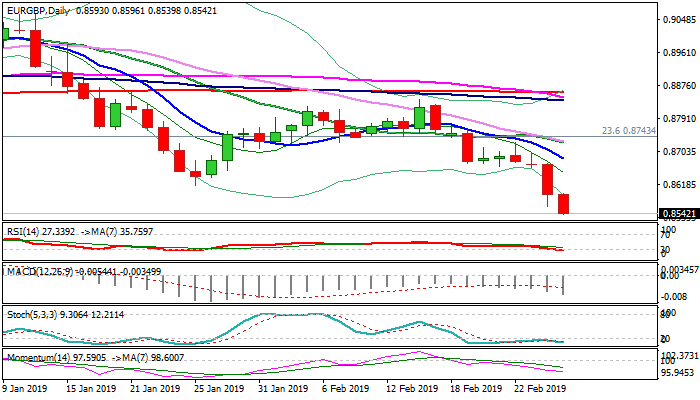
The cross accelerated lower on Wednesday and broke below the floor of Oct 2017/Jan 2019 range, to hit the lowest levels since May 2017.
Extension of larger downtrend from 0.9113 (range top) cracked support at 0.8547 (Fibo 76.4% of 0.8312/0.9306 ascend) that opens way towards key supports at 0.8395 (Fibo 38.2% of July 2015 / Oct 2016 0.6924/0.9305 rally) and 0.8370 (rising 200WMA).
Pound’s strong bullish sentiment over fresh Brexit optimism supports scenario, but bears are expected to pause in coming sessions, due to oversold daily studies and expected profit-taking.
Immediate focus remains at the downside as indicators continue to head south and lack any reversal signal for now.
Res: 0.8564; 0.8596; 0.8617; 0.8669
Sup: 0.8531; 0.8479; 0.8395; 0.8370
USTR Robert Lighthizer testimony on China trade negotiations
https://www.youtube.com/watch?v=plJBuKzC_Hg
Australia’s Q4 CAPEX to Guide on Growth
Although upbeat trade comments by the US President helped the risk-sensitive aussie to grab some buying interest earlier this week, investors maintained some of their wait-and-see attitude as the spotlight shifts back to the calendar and Australia’s capital expenditures reading on Thursday, which could give clues on what to expect from next week’s Q4 GDP growth figures.
On Thursday at 0030 GMT, the Australian Bureau of Statistics is forecast to show that capital expenditures made by private businesses rose by 0.5% in the three months to December after a decline of an identical magnitude in the third quarter. The data are also following a bigger pullback of 0.9% in the second quarter.
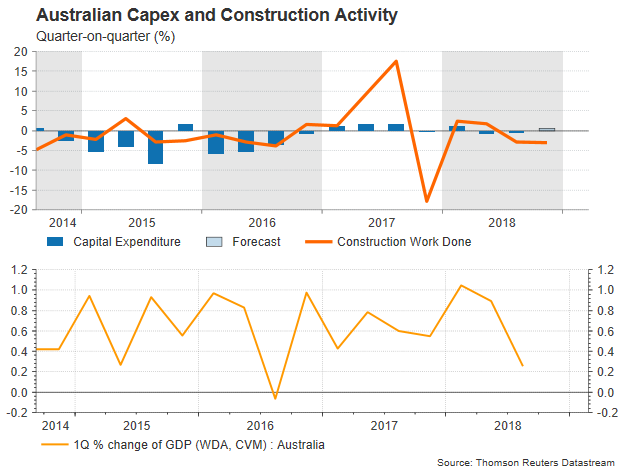
Unlike the highs in early 2018, business conditions deteriorated substantially throughout the year according to the National Australia Bank’s business surveys, with the biggest loss coming in December when the relative index appeared the weakest in four years. The massive Australian household debt-to-disposable income which is twice as high as in the US and surpasses the levels in Canada has led to tighter lending terms and eventually to cooler house prices, discouraging new spending on investments. Consumption was not much helpful to companies either, as wage increases were insufficient to meet the high credit liabilities, leaving little room for other purchases.
Concerns over a struggling business sector returned on Tuesday after the total value of construction completed in the fourth quarter contracted sharply for the second consecutive time, missing significantly projections of a 0.4% increase. The results are now raising speculation that Thursday’s overall capital expenditures (CAPEX) might disappoint as well, potentially subtracting from GDP growth figures for the December quarter next week as infrastructure has been essential for Australia’s economic expansion for many years. Still, the elevated Iron ore and coal prices, which Australia exports the most, accompanied with a falling exchange rate and a greater trade surplus have likely offset some downside from the falling housing prices and subdued consumption at the end of 2018.
But this is not the end of the story as there are other factors aside that firms need to consider for the new year. The trade conflict between the US and China, that have already started to weigh on the Chinese economy, is a key risk for Australian growth as China is a major buyer of aussie products. Hence any further economic deterioration in China would likely spill over to Australia as well. Diplomatic relations with Beijing, will be separately monitored too, given recent reports that a major Chinese port had banned imports of Australian coal even if officials claimed later that the measures were not aimed at the country. Recall that Australia blocked Huawei Technologies from rolling into its 5G networks earlier this month.
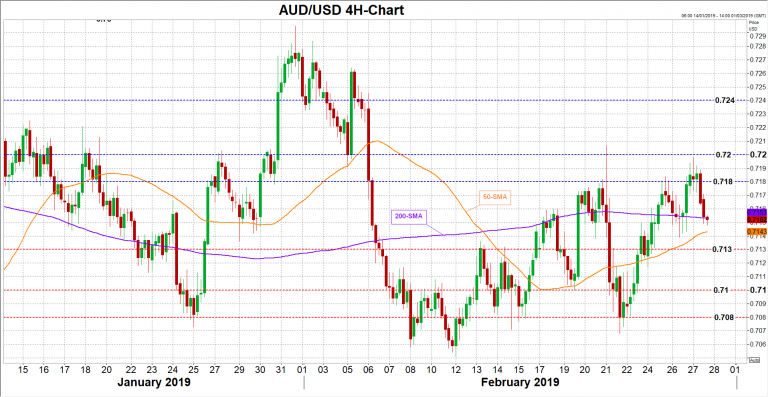
On the monetary front, the Reserve Bank of Australia has acknowledged the uncertainties arising in the domestic and global economy in the latest policy meeting, revising down its growth forecasts for 2019 and 2020. It also left the window for a rate cut open, with overnight indexed swaps giving a 60% probability for such a move by October. On Thursday, chances for a policy easing could increase again if the Q4 CAPEX reading appears surprisingly GDP-negative. In such as a case, the aussie could bear the consequences, with AUDUSD falling first to the 0.7140-0.7130 support area and then to the 0.7100-0.7080 zone.
Should the data beat forecasts, the pair could rebound to test resistance between 0.7180 and 0.7200. Higher, the rally could pause near 0.7240.
It is also worth noting that Thursday’s private sector credit numbers for January and Friday’s AIG manufacturing index for February could disrupt the market as well, while China’s Caixin/Markit manufacturing PMI due on Thursday could also trigger a response by investors.
Chinese Manufacturing PMIs to Point to Further Contraction in February
Manufacturing PMIs from China this week are expected to show factory activity declining for a third straight month in February even as the US and China close in on a trade deal. The February PMIs will likely be skewed due to the long Lunar New Year holiday during the first week of the month. Nevertheless, investors will be keeping an eye on any hints of a change to the subdued picture, whether positive or negative. In forex markets, the Australian dollar – a liquid proxy for China-related risks – would see the most reaction from any surprises to the data.
The official manufacturing PMI of China’s National Bureau of Statistics is released first on Thursday at 01:00 GMT, together with the non-manufacturing PMI. The manufacturing PMI is forecast to hold steady at 49.5 in February, staying below the 50 level that separates expansion from contraction for the third consecutive month. The non-manufacturing PMI will also be attracting attention on Thursday as a strong rebound in January had raised hopes that conditions in the broader economy may have started to improve.
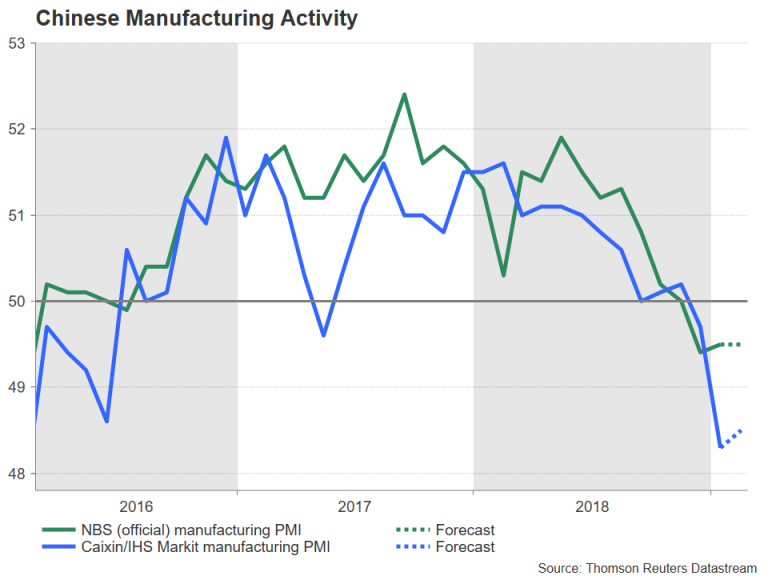
A second gauge of manufacturing activity will follow on Friday with the release of the Caixin/Markit PMI at 1:45 GMT. The Caixin manufacturing PMI, which includes a larger share of private and small-to-medium sized enterprises in the survey than the official one, is also anticipated to remain below 50. However, a small increase from 48.3 to 48.5 is being forecast for February. China’s exporters have been struggling since the escalation of the tariff war between the US and China in 2018. But the negative pressure on the sector may be starting to ease as the trade talks progress and recently announced stimulus measures kick-in.
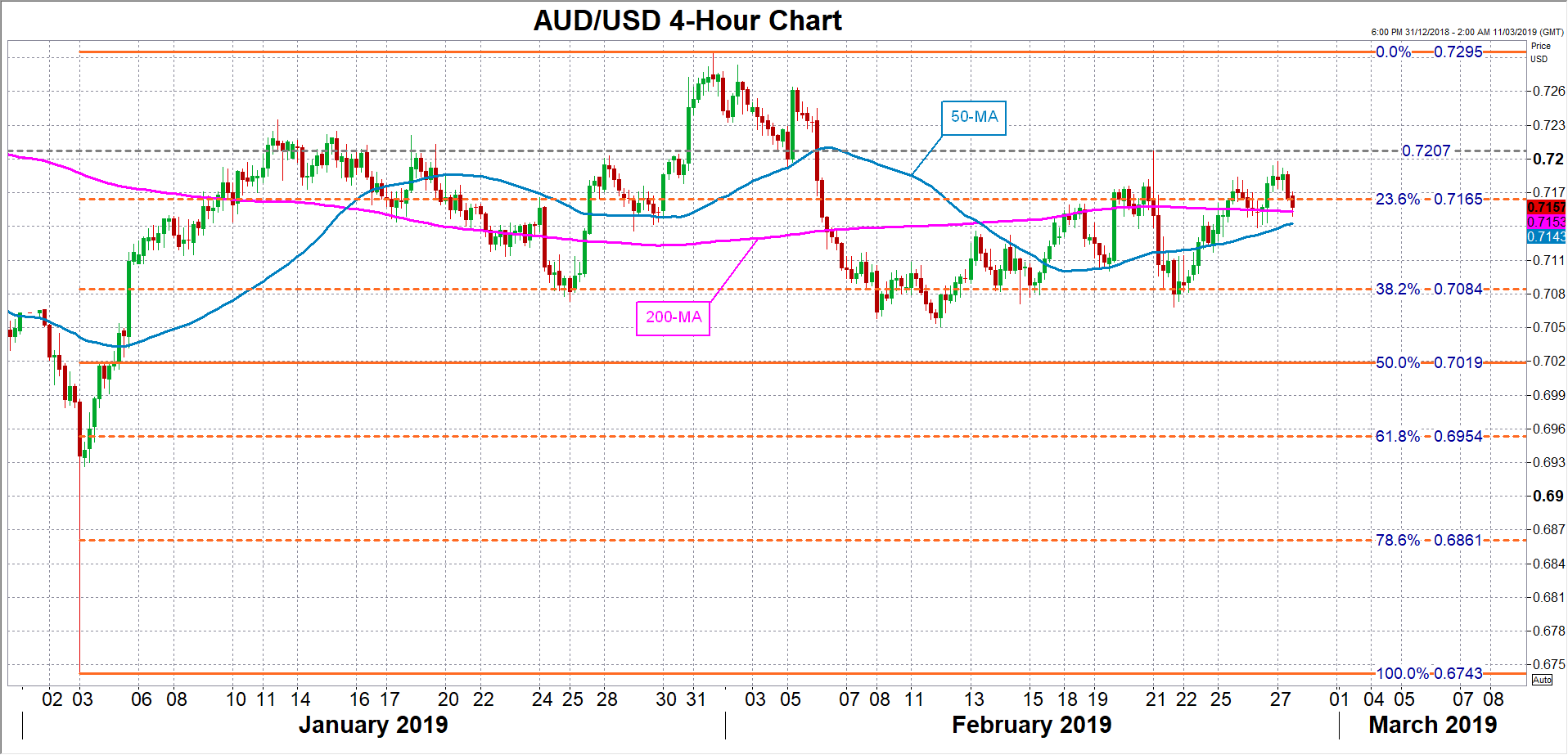
The aussie, which is sensitive to Chinese economic indicators due to Australia’s reliance on China for its exports, is at risk of receiving a double blow from negative surprises as important domestic data are also published on Thursday. Aussie/dollar could cross below the 200- and 50-period moving averages (MA) in the 4-hour chart at 0.7153 and 0.7143, respectively. A break below the 50-period MA would increase the downside risks and bring into view another key support around the 38.2% Fibonacci of the upleg from 0.6743 to 0.7295, at 0.7084.
Alternatively, should there be any encouraging signs in the Chinese PMIs, as well as upbeat data out of Australia, aussie/dollar could aim for the February high of 0.7207 before targeting the January top of 0.7295.
Heading into March, the markets’ focus will turn to the National People’s Congress in China that commences on March 5. The annual parliamentary event is typically used by the state to set new policies and announce new economic growth targets. Of specific interest will be new legislation being considered by the government that could help it seal a trade deal with the United States. Parliament is expected to vote on a new foreign investment law that would protect foreign companies’ intellectual property in China as well as restrict state interference in foreign-owned businesses.
If the legislation goes far enough in appeasing the US, it could pave the way for some sort of a trade accord being signed by the two countries in the coming weeks.
India-Pakistan Tensions Weigh on Risk Appetite
Safe-haven currencies were bid overnight as the border clash intensified between Pakistan and India. Air strikes between both nations over the past couple of days elevated tensions to the highest level since 2001, when both sides moved ballistic missiles to their respective borders. This historic conflict has been going on for several decades and a quick de-escalation should not be expected.
Today will also highlight another day of testimony from Fed Chair Powell, but more interestingly US Trade Representative Robert Lighthizer will be questioned on the US-China trade war. Trump’s former lawyer, Michael Cohen will also testify to Congress and is expected to accuse the President of being a con man and a cheat. President Donald Trump and North Korea’s Kim Jong Un will also attempt to make further progress at their second summit. The bar is very low for any meaningful progress on denuclearization to take place.
The headlines will be plentiful for geopolitics, but the key focus remains on whether equities will finally see a pullback from its v-shaped recovery.
- GBP – Cable rises on May’s offer of a Brexit delay
- OIL- Saudis ignore Trump’s power move
- GOLD- Remains stuck despite Powell and war concerns
- STOCKS – Is the economic cycle already over?
GBP
The British pound continues to climb higher as the threat of a Brexit no-deal appears off the table. The influx of uncertainty however on the timing of Brexit, the question of what type of trade deals will be reached, and how the UK economy will hold up following Brexit, will reach a peak level possibly in a month and it will be difficult for the British pound to continue to steadily climb higher.

Oil
President Trump’s request for OPEC to take it easy is likely to be ignored. Saudi Arabia decided to stand up against the President and expects the production cuts to continue until year end. Rising US stockpiles may keep oil gains capped, but any short-term draws with inventories could see oil prices keep the rally going.
GOLD
The precious metal has not reacted normally to recent risk events and central bank stances. We live in an accommodative world and the risk-on and risk-off moves that stemmed from the trade war, global growth concerns, and possible war between India and Pakistan, have not delivered traditional moves for gold. The yellow metal may need the dollar to finally weaken for bullish momentum to reassert itself.
STOCKS
US equities were little changed after a wrath of earnings results delivered a fairly number of risers and losers. Yesterday, Fed Chair Powell confirmed the dovish pivot they announced last month and it appears that for the stock market to continue to rise they will require the Fed to signal that the next move will be a cut. Range trading may remain until we see the fourth quarter GDP reading. A bad miss my signal that a rate cut could occur by the end of the year.