

Sample Category Title
WTI OIL outlook: Oil Extends Recovery as Negative Impact Fades and Bulls Return to Play
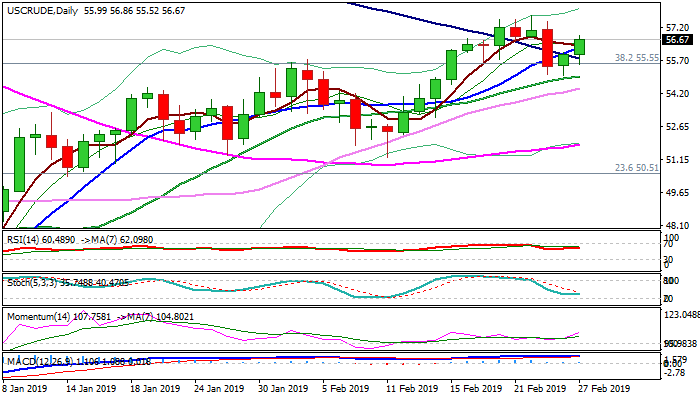
WTI oil extends recovery on Wednesday, as negative tone from President Trump's warning to OPEC about high oil prices, fades.
Fresh extension higher retraced slightly over 61.8% of $57.79/$55.01 after strong fall on Monday (oil price was down 3%) found footstep at psychological $55.00 support.
OPEC remains committed to its production cut policy and market returned to bullish mode that was interrupted by $57.79/$55.01 corrective pullback.
The action was also supported by strong draw of US oil stocks (API report on Tuesday showed 4.2 mln bls draw vs previous week's build of 1.2 mln bls). Rising bullish momentum and daily MA that returned to bullish configuration support and turn near-term focus towards new 2019 high at $57.79 (22 Feb) and upper 20-d Bollinger band at $58.10.
US EIA crude inventories report is in focus today (2.8 mln bls build f/c vs 3.6 mln bls build previous week) and could further boost oil prices on surprise release under expectations.
Broken rising 10SMA offers initial support at $56.31, with falling 100SMA ($55.82) required to hold and keep fresh bulls intact.
Res: 56.86; 57.13; 57.79; 58.45
Sup: 56.50; 56.31; 55.82; 55.55
GBP/USD Mid-Day Outlook
Daily Pivots: (S1) 1.3135; (P) 1.3212; (R1) 1.3328; More....
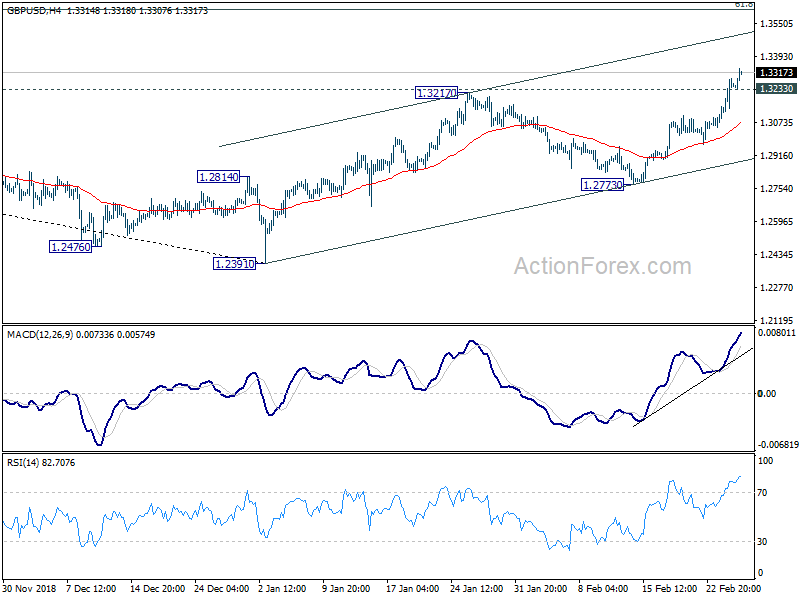
GBP/USD's rally accelerates to as high as 1.3336 so far today and intraday bias remains on the upside. As noted before, whole decline from 1.4376 should have completed at 1.2391. Further rise should be seen to 61.8% retracement of 1.4376 to 1.2391 at 1.3618 next. Sustained break will pave the way to 1.4376. On the downside, below 1.3233 will turn bias neutral and bring consolidations first, before staging another rally.
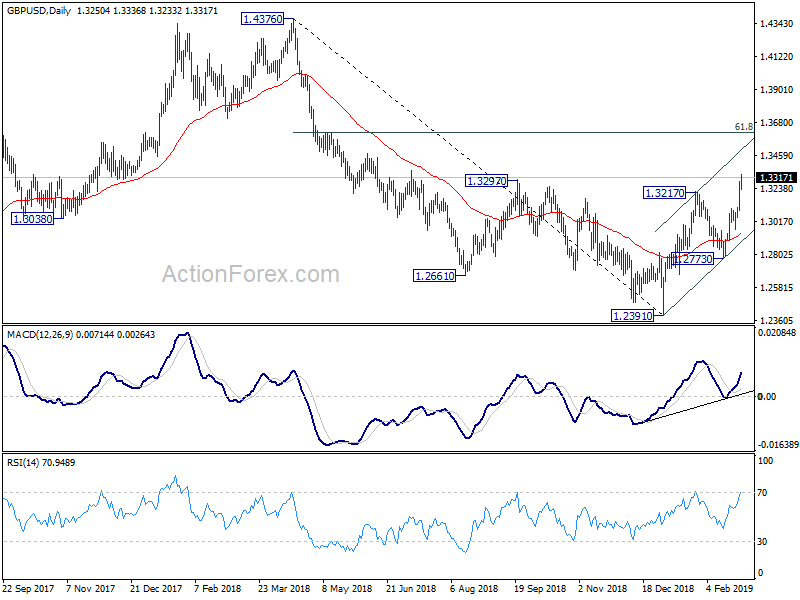
In the bigger picture, medium term decline from 1.4376 (2018 high) should have completed at 1.2391. Rise from 1.2391 is now seen as the third leg of the corrective pattern from 1.1946 (2016 low). Further rise could be seen through 1.4376 in medium term. On the downside, though, break of 1.2773 support will turn focus back to 1.2391 low and then 1.1946.
Sterling Extends Unstoppable Rally, Swiss Rises on Pakistan-India Tensions
After taking a brief Brexit, Sterling's rally extends again today on optimism that risk of no deal Brexit is fading. Also, key figure of Brexiteer also expressed condition support for UK Prime Minister Theresa May's Brexit deal. For now, with some key resistance levels already taken out, the Pound is rather unstoppable. Meanwhile Swiss Franc follows as the second strongest on escalation in tensions between Pakistan and India. The Franc is usually more sensitive to geo-tensions than Yen.
On other hand, Australian and New Zealand Dollar are the weakest ones for today so far. Yen is following s the third weakest. Dollar is mixed as markets are watching Trump-Kim summit in Vietnam, Trump gave warm greeting to his friend Kim and hailed "our relationship is a very special relationship". Kim also said "we'll have a very interesting dialogue". as Testimony of USTR Robert Lighthizer will also be closely watched as he might reveal some of the little known substantial progress in trade talks with China. Fed Chair Jerome Powell will also have his second day of Congressional testimony.
Technically, USD/CHF's break of 0.9981 support is a sign of rejection by 1.0128 resistance and further decline is now mildly in favor back to 0.9716 support. USD/CAD is looking at 1.3112 temporary low and break will target 1.3068 key support. GBP/JPY's strong break of medium term trend line add to the case of underlying strength in the Pound. Next is 150 handle.
In Europe, currently, FTSE is down -0.79%. DAX is down -0.37%. CAC is down -0.08%. German 10-year yield is up -0.0092 at 0.129. Earlier in Asia, Nikkei closed up 0.50%. Hong Kong HSI dropped -0.05%. China Shanghai SSE rose 0.42%. Singapore Strait Times dropped -0.36%. Japan 10-year JGB yield rose 0.0019 to -0.024.
Swiss Franc jumps on Pakistan/India tension
Tensions at the border of Pakistan and India escalate today as both side they've shot down the other's fighter jets. The tension started after a suicidal car bombing by Pakistan-based militants in Kashmir that killed at least 40 paramilitary policy on February 14. It escalated quickly on Tuesday after India launched air strike on a militant training base. Pakistan's fighter planes have shot down two Indian jets as their entered the country's airspace today. Swiss Franc surges broadly in response to the development.
Canada CPI slowed to 1.4%, CAD rise as CPI risks cleared
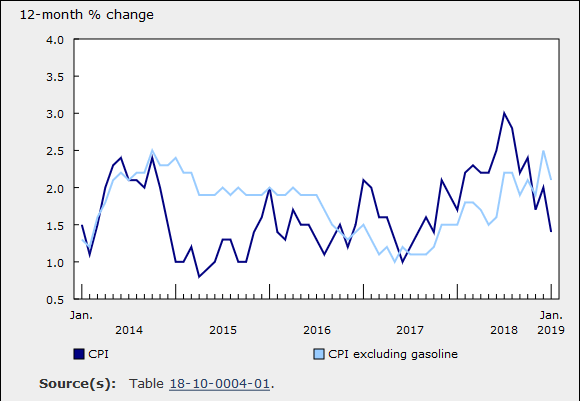
Canada headline CPI slowed to 1.4% yoy in January, down from 2.0% yoy, matched expectations. CPI core-common was unchanged at 1.9% yoy. CPI core-median was unchanged at 1.8% yoy. CPI core-trim was unchanged at 1.9% yoy. Energy costs declined 6.9%, while the growth in the price of services slowed to 2.7% as transitory pressures from the air transportation, telephone services and travel tours indexes dissipated. USD/CAD drops again as the CPI risk is now cleared. Rebound in oil price is helping the Loonie. WTI crude is now back above 56.7, comparing to this week's low at 55.11.
Bundesbank Wedimann, growth to fall well short of 1.5% potential this year
Bundesbank President Jens Weidmann said today that German economy growth will "fall well short of the potential rate of 1.5 percent in 2019". That's because "there is much to suggest that the dip in growth here in Germany has persisted into the current year". However, he emphasized that the prerequisites for growth remain intact, including low financing cost, expansion in employment market and rising wages. Thus, there is no reason for pessimism yet.
On ECB policies, he said that the central bank should looks through short term fluctuations in inflation caused by oil prices to temporary slowdown. He emphasized that ECB's "price stability target is medium term, so we should look through these fluctuations". Also, "it is clear that short-term fluctuations in oil prices — like the sharp decline at the end of 2018 — but also corrections in growth expectations for 2019, could temporarily influence the inflation outlook."
Separately, it's reported that German cabinet gave green-light for a second eight-year term for Weidmann, as the current term expires at the end of April.
Eurozone economic sentiment dropped to -0.2, business climate unchanged at 0.69
Eurozone Economic Sentiment Indicator dropped -0.2 to 106.1 in February, slightly above expectation of 106.0. The broadly unchanged reading resulted from "weaker industry and construction confidence in combination with more upbeat signals from the services sector, as well as, to a lesser extent, retail trade and consumers". Meanwhile the ESI dropped in Franc (-0.9%) and Italy (-1.6), practically flat in Germany (-0.1) and Spain (0.0), but improved in the Netherlands (+3.0).
Business Climate Indicator is flat at 0.69 in February, slightly above expectation of 0.67. Eurostats noted "Managers' production expectations, as well as their assessments of the stocks of finished products, overall- and export order books clouded over. Meanwhile, the appraisals of past production rebounded from last month's sharp drop."
Also from Eurozone, industrial confidence dropped to -4. Services confidence rose to 12.1. Consumer confidence was finalized at -7.4. M3 money supply rose 3.8% yoy in January.
Rees-Mogg could back May's Brexit deal with reasonably effective time limit on Irish backstop
Jacob Rees-Mogg, a high profile Brexiteer Conservative, said that the could back Prime Minister Theresa May's Brexit deal if there is a reasonably effective time limit on the Irish backstop.
Rees-Mogg told BBC ratio that "I can live with the de facto removal of the backstop…. I mean that if there is a clear date that says the backstop ends, and that is in the text of the treaty or equivalent of the text of the treaty".
But he also insisted that the time limit should be "a short date, not a long date, then that would remove the backstop in the lifetime of parliament and that would have a reasonable effect from my point of view."
BoJ Kataoka: Uncertainty heightened if current monetary easing is prolonged
BoJ board member Goushi Kataoka continued his call for more monetary stimulus in a speech to business leaders today. He argued that the central bank should ramp up its monetary easing to achieve inflation target earlier.
And he warned, "if the current monetary easing is prolonged, it would mean the period in which Japan's economy faces various uncertainties will be longer. That means uncertainty on achieving our price target will heighten."
Kataoka is a known dove who persistently vote against BoJ's policy in push for more easing.
GBP/USD Mid-Day Outlook
Daily Pivots: (S1) 1.3135; (P) 1.3212; (R1) 1.3328; More....
GBP/USD's rally accelerates to as high as 1.3336 so far today and intraday bias remains on the upside. As noted before, whole decline from 1.4376 should have completed at 1.2391. Further rise should be seen to 61.8% retracement of 1.4376 to 1.2391 at 1.3618 next. Sustained break will pave the way to 1.4376. On the downside, below 1.3233 will turn bias neutral and bring consolidations first, before staging another rally.
In the bigger picture, medium term decline from 1.4376 (2018 high) should have completed at 1.2391. Rise from 1.2391 is now seen as the third leg of the corrective pattern from 1.1946 (2016 low). Further rise could be seen through 1.4376 in medium term. On the downside, though, break of 1.2773 support will turn focus back to 1.2391 low and then 1.1946.
Economic Indicators Update
| GMT | Ccy | Events | Actual | Forecast | Previous | Revised |
|---|---|---|---|---|---|---|
| 21:45 | NZD | Trade Balance Jan | -914M | -300M | 264M | 12M |
| 00:01 | GBP | BRC Shop Price Index Y/Y Feb | 0.70% | 0.30% | 0.40% | |
| 00:30 | AUD | Construction Work Done Q4 | -3.10% | 0.50% | -2.80% | -3.60% |
| 09:00 | EUR | Eurozone M3 Money Supply Y/Y Jan | 3.80% | 4.00% | 4.10% | |
| 10:00 | EUR | Eurozone Business Climate Feb | 0.69 | 0.67 | 0.69 | |
| 10:00 | EUR | Eurozone Economic Confidence Feb | 106.1 | 106 | 106.2 | 106.3 |
| 10:00 | EUR | Eurozone Industrial Confidence Feb | -0.4 | 0.1 | 0.5 | 0.6 |
| 10:00 | EUR | Eurozone Services Confidence Feb | 12.1 | 11 | 11 | |
| 10:00 | EUR | Eurozone Consumer Confidence Feb F | -7.4 | -7.4 | -7.4 | |
| 13:30 | CAD | CPI M/M Jan | 0.10% | 0.10% | -0.10% | |
| 13:30 | CAD | CPI Y/Y Jan | 1.40% | 1.40% | 2.00% | |
| 13:30 | CAD | CPI Core-Common Y/Y Jan | 1.90% | 1.90% | 1.90% | |
| 13:30 | CAD | CPI Core-Median Y/Y Jan | 1.80% | 1.80% | 1.80% | |
| 13:30 | CAD | CPI Core-Trim Y/Y Jan | 1.90% | 1.90% | 1.90% | |
| 13:30 | USD | Advance Goods Trade Balance (USD) Dec | -79.5B | -75.3B | -71.6B | |
| 13:30 | USD | Wholesale Inventories M/M Dec F | 1.10% | 0.40% | 0.30% | |
| 15:00 | USD | Fed Powell testifies Before House Panel | ||||
| 15:00 | USD | Pending Home Sales M/M Jan | 0.80% | -2.20% | ||
| 15:00 | USD | Factory Orders Dec | 0.80% | -0.60% | ||
| 15:30 | USD | Crude Oil Inventories | 3.7M |
Canada CPI slowed to 1.4%, CAD rise as CPI risks cleared
Canada headline CPI slowed to 1.4% yoy in January, down from 2.0% yoy, matched expectations. CPI core-common was unchanged at 1.9% yoy. CPI core-median was unchanged at 1.8% yoy. CPI core-trim was unchanged at 1.9% yoy. Energy costs declined 6.9%, while the growth in the price of services slowed to 2.7% as transitory pressures from the air transportation, telephone services and travel tours indexes dissipated.
USD/CAD drops again as the CPI risk is now cleared. Rebound in oil price is helping the Loonie. WTI crude is now back above 56.7, comparing to this week's low at 55.11.
Canadian Dollar Slightly Lower ahead of CPI
The Canadian dollar has posted slight gains in the Wednesday session. Currently, the pair is trading at 1.3145, down 0.19% on the day. On the release front, Canada releases a host of inflation indicators, led by CPI. The key inflation indicator is expected to gain 0.2%, after two straight declines. The U.S. posts minor manufacturing and housing reports, but the focus will be on Fed Chair Powell’s testimony before a congressional committee. On Thursday, the U.S. will post Advance GDP and unemployment claims. Canada will release current account and the raw materials price index.
There were no surprises from Powell’s testimony before a senate committee on Tuesday, as Powell preached patience with regard to changes in interest rates. Powell stated that the Fed was in “no rush to make a judgment” and made reference to “conflicting signals in the economy”. The labor picture remains bright, with strong hiring and low unemployment. At the same time, consumer spending and housing data have been soft. The markets are expecting the Fed to remain on the sidelines in May and June, meaning that the first hike of 2019 will not come before the second half of the year.
Will the Bank of Canada raise rates in the first half of 2019? Canadian numbers have been mixed, making it difficult for the Bank of Canada to step in and raise rates for the first time in 2019. Similar to the Federal Reserve, the BoC was aggressive in 2018, but has applied the brakes in 2019. The Bank hiked rates three times last year, but has since stayed on the sidelines, with the benchmark rate pegged at 1.75%. It’s unlikely that the bank will make any rate moves unless the Canadian economy shows clear signs of gathering steam. Consumer spending data in December was a disappointment, with retail sales and core retail sales posting declines. If inflation remains weak, there will be little pressure on the bank to raise rates in the next few months.
Into US session: Sterling extends rally, Swiss Franc strong on Pakistan/India tensions
Entering US session, Sterling is back in the driving seat again and is extending this week's rally on fading chance of no-deal Brexit. Swiss Franc follows as the second strongest, lifted by escalating Pakistan/India tensions after both shot down each others' fighter jets. Canadian Dollar is now the third strongest, as oil price rebound. WTI is back above 56.7 as the impact of Trump's tweet fades. Meanwhile, Aussie and Kiwi are the weakest ones.
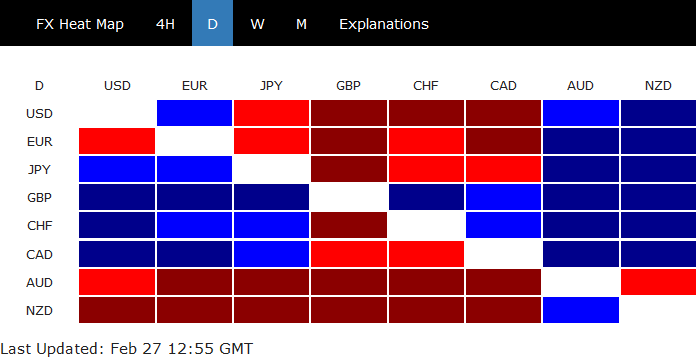
Focus will now turn to Canadian CPI first. US will also release trade balance pending home sales and factory orders. Fed chair Jerome Powell will have the second day of Congressional testimony. But testimony of USTR Robert Lighthizer's testimony will catch more attention. Lighthizer might reveal some of the little known substantial progress in trade talks with China.
In Europe, currently:
- FTSE is down -0.70%.
- DAX is down -0.37%.
- CAC is down -0.15%.
- German 10-year yield is down -0.0127 at 0.107.
Earlier in Asia:
- Nikkei closed up 0.50%.
- Hong Kong HSI dropped -0.05%.
- China Shanghai SSE rose 0.42%.
- Singapore Strait Times dropped -0.36%.
- Japan 10-year JGB yield rose 0.0019 to -0.024.
USDCHF Risk Remains Lower Towards 0.9921 Support Zone
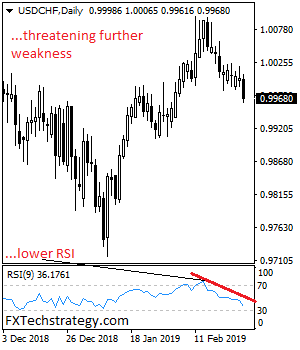
USDCHF risk remains lower towards 0.9921 support zone. Resistance comes in at the 1.0000 level. A break of here will clear the way for more gain towards the 1.0050 level. Above here, resistance lies at the 1.0100 level and then the 1.0150 level. On the downside, support is seen at the 0.9950 level. A turn below here will set the stage for more decline towards the 0.9900 level. And then the 0.9850 level. Its daily risk is bearish and pointing lower suggesting further weakness. All in all, USDCHF faces further downside pressure on price weakness.
DAX Dips, German CPI Ahead
The DAX has dropped considerably in the Wednesday session. Currently, the DAX is at 11,511 down 0.56% on the day. In economic news, there are no major German or eurozone events. On Thursday, Germany releases Preliminary CPI.
Risk appetite remains strong, and the DAX has responded well. On Tuesday, the DAX climbed to 11,556, its highest level since early December. With President Trump waiving his threat to impose new tariffs on China next week, risk appetite remains strong. There is even talk of a meeting between Trump and Chinese President Xi at the end of March if the sides reach an agreement. However, significant questions remain. With almost no news about the substance of the talks, it remains unclear if China will agree to substantial structural changes in trade, as demanded by the United States. Another question mark is whether the current set of tariffs will be completely removed if a deal is reached. Still, if the sides reach a deal, it could fuel a strong rally in global stock markets. Meanwhile, Trump is meeting with North Korean leader Kim in Hanoi, and any tangible steps to denuclearize North Korea could trigger strong gains for equities.
Bundesbank Weidmann: OIl price and growth expectation could temporarily influence inflation
More from Bundesbank President Jens Weidmann, he said that ECB should looks through short term fluctuations in inflation caused by oil prices to temporary slowdown. He emphasized that ECB's "price stability target is medium term, so we should look through these fluctuations".
Also, "it is clear that short-term fluctuations in oil prices — like the sharp decline at the end of 2018 — but also corrections in growth expectations for 2019, could temporarily influence the inflation outlook."
EUR/USD – Euro Inches Higher, Investors Eye Powell, Part II
EUR/USD is showing little movement in the Wednesday session. Currently, the pair is trading at 1.1404, up 0.10% on the day. On the release front, there are no major German or eurozone events. The U.S. posts minor manufacturing and housing reports, but the focus will be on Fed Chair Powell’s testimony before a congressional committee. On Thursday, Germany releases Preliminary CPI, and the U.S. will post Advance GDP and unemployment claims.
With a lack of major events on either side of the pond, the markets will have time to focus on Federal Reserve Chair Powell’s testimony before the House Financial Services Committee. There were no surprises from Powell’s testimony before a senate committee on Tuesday, as Powell preached patience with regard to changes in interest rates. Powell stated that the Fed was in “no rush to make a judgment” and made reference to “conflicting signals in the economy”. The labor picture remains bright, with strong hiring and low unemployment. At the same time, consumer spending and housing data have been soft. The markets are expecting the Fed to remain on the sidelines in May and June, meaning that the first hike of 2019 will not come before the second half of the year.
With President Trump waiving his threat to impose new tariffs on China next week, risk appetite remains strong. There is even talk of a meeting between Trump and Chinese President Xi at the end of March if the sides reach an agreement. However, significant questions remain. With almost no news about the substance of the talks, it remains unclear if China will agree to substantial structural changes in trade, as demanded by the United States. Another question mark is whether the current set of tariffs will be completely removed if a deal is reached. If not, market enthusiasm could slip, as the tariffs have caused enormous turmoil in international trade and dampened global growth. Still, if the sides reach a deal, it would be positive news for the struggling eurozone economy and could trigger gains for the euro.