

Sample Category Title
Market Morning Briefing: Aussie Is Trading Below Resistance Zone Of 0.72-0.7250
STOCKS
Major global indices continues to remain bullish and has room for further rise in the short term. On the domestic front, though the Sensex and the Nifty 50 opened on a nervous note yesterday after the air-strike on terrorist camp, it has bounced sharply from the day's low thereby keeping the bias positive for further upmove in the coming days.
Dow Jones (26,057.98, -33.97, -0.13%) though sustaining above the psychological level of 26,000 seems to be lacking strong follow-through buyers. A break below 26,000 can take the index lower to 25,800 and 25,750. On the upside resistance is around 26,300 which has to be broken for a further rally.
DAX (11,540.79, +35.40, +0.31%) continues to inch higher and keeps the bullish outlook intact for a test of 11,700 and 11,750.
Nikkei (21,553.22, +103.83, +0.48%) fell breaking below 21,500 yesterday but has bounced back sharply again. This keeps the bias bullish for a rise to 22,000 in the coming days. A strong close above the 100-day moving averag at 21,558 will pave way for this rally.
Shanghai (2,963.21, +21.70, +0.74%) tested the psychological 3000 mark yesterday and has come-off from there. As mentioned yesterday 3014 (50% Fibonacci retracement level) and 3053 (100-week moving average) are the crucial resistances which can halt the current rally and can trigger a corrective fall to 2900-2850 or even lower levels going forward. A strong break and a close below 2940 can trigger this corrective fall.
Sensex (35,973.71, -239.67, -0.66%) and the Nifty 50 (10,835.30, -44.80, -0.41%) has bounced sharply from the day's low recovering most of the loss on Tuesday. Though the daily candle on the sensex is indecisive, the Nifty 50 looks positive. The Nifty has reversed higher from a key trendline support level of 10,730 and keeps the outlook bullish for a test of 10,950 in the coming days. Sensex has an intermediate support at 35,900 and while it sustains above it an upmove to 36,450 and 36,500 is possible in the short term.
COMMODITIES
Gold remains stable and Silver looks vulnerable for an intermediate dip within its broad sideways range. Copper remains bullish but can see a corrective dip before moving further higher.
Key supports on the WTI and Brent Crude oil are holding well now and the prices have bounced after testing them. A near-term upmove looks possible in oil.The American Petroleum Institute (API) reported a surprise draw in crude oil inventory of 4.2 million barrels for the week ending February 22, against the analyst expectations of crude oil inventories to build by 2.842 million barrels. This has added on to a rise in the crude prices apart from the technical supports seen on the charts.
Gold (1328) continues to trade within the narrow 1320-1335 sideways range. The view remains the same. Gold can trade broadly in the 1320 and 1340 range and a breakout on either side of 1320 or 1340 will decide the next move.
Silver (15.75) has come-off in the Asian session today from around 15.9. Support is at 15.7 a break below which can drag silver to 15.6 and 15.55
Copper (2.95) oscillates around and remains bullish for a rise to 3 and 3.02. However, a dip to 2.92-2.90 cannot be ruled out before we see a further rise.
WTI (55.9) is holding above 55 and has bounced slightly. An upmove to 57 and 58 looks possible again. The 21-day moving average at 54.81 is a key support to watch and the WTI will come under pressure only if it breaks below this support.
The 65-64 support cluster seems to be holding well for Brent (65.5) which has bounced from around 64.35 yesterday. While above 65, a rise to 67 and 67.5 can be seen again in the near term.
FOREX
The FED would be patient about further changes to policy just now and wait for things to clarify. Markets were majorly unmoved after his testimony yesterday. Powell is due to appear before the House of Representatives Financial Services Committee today.
Dollar-Index (96.12) has been stable without any major movement yet. Sideways consolidation within 96.25-96.75 is possible with possible extension to 96 and 97 on either side. We could soon see a sharp break on either side to bring some clarity to further direction.
Euro (1.1381) has been fairly stable too, inching up slightly towards 1.14. Note that 1.1450-1.1400 is an important near term resistance and could keep Euro lower. There is room on the downside towards 1.12-1.11 that could be tested while 1.1450 holds. Keep an eye on the German-US 10YR (-2.51%) which if breaks above the immediate resistance could be indicative of bullishness in Euro.
Euro-Yen (125.83) is stable. We continue to look at resistance at 126 from where a dip is expected. Break above 126 would open up 126.80-127.00.
Dollar Yen (110.56) has come off from immediate resistance at 111.00/50 on the daily chart and while that holds, we could see the fall continue in the next few sessions towards 110 or lower. Also the US-JGB 10YR (2.66%) has scope of falling towards 2.6% which could indicate a fall in Dollar-Yen given to positive directional correlation between the two. At the same time possible rise in Nikkei towards 22000 is to be kept an eye on.
Pound (1.3247) has risen sharply but has immediate resistance at 1.33. Similar resistance is seen on the UK-US 10YR (refer interest rates section below) which if falls could pull down Pound towards 1.30.
Aussie (0.7182) is trading below resistance zone of 0.72-0.7250 and could come off soon from here towards 0.7100. While Copper looks bullish towards a rise to 3 (refer Commodities section above), Aussie could move up too in the near term.
USDCNY (6.6919) has risen above 6.69 and while that holds, a test of 6.70/72 levels on the upside looks possible.
Dollar Rupee (71.07) is trading within the narrow 70.80-71.50 region. While we prefer a fall below 71 in the near term, there is some scope of re-testing immediate resistance levels of 71.35/50 again.
INTEREST RATES
The FED is in no rush to make any judgment about further changes to the interest rates. In his testimony, he elaborated on the conflicting signals that the FED has tried to put forth in the recent weeks in contrast to the strong signals of low unemployment and higher wage growth. The recent retail sales figures have been disappointing but overall slower growth overseas could drag on the US economy, said Powell. The FED would remain patient with the policy and wait for things to clarify.
Powell is due to address the House of Representatives Financial Services Committee today.
The US yields dipped slightly. The 2Yr (2.48%), 5Yr (2.45%), 10Yr (2.63%) and 30Yr (3.01%) are down from yesterday’s levels of 2.50%, 2.46%, 2.66% and 3.02% respectively. As mentioned yesterday, we continue to look for a fall in the yields in the next few sessions towards supports near 2.44% (5YR) and 2.95% (30YR). The 10Yr has fallen to our expected 2.63% and could now move down further to test 2.60% before bouncing from there.
The US-JGB 10Yr (2.66%) has fallen from 2.68% and could move down a bit towards 2.60%. The yield spread has not been moving up in line with the rise in Dollar-Yen in the recent weeks. If the yield spread does not move up from current levels and fails to rise from 2.60%, we could see a sharp fall that could pull down Dollar-Yen with itself in the near term.
The UK-US 10YR (-1.55%) has risen sharply and could test -1.50% in the near term but note that there is resistance at current levels on the medium term chart coming from Sep’17 and Dec’18. While that holds, upside could be restricted just now.
The German-US 10YR (-2.51%) seems to be breaking above the important resistance and if the rise sustains, it could be a crucial indicator of a rise in Euro in the near term. On the flipside, a fall from here immediately would favor Euro to come off from 1.14-1.1450 levels.
Trump to friend Kim: Denuclearize and thrive like Vietnam
Trump arrived in Vietnam for the summit with Korean leader Kim Jong-un. Ahead of the meeting, he urged his "friend" Kim to denuclearize and said North Korea could be like Vietnam, "thriving like few places on earth". He added that "he potential is AWESOME, a great opportunity, like almost none other in history".
https://twitter.com/realDonaldTrump/status/1100584141274398720
The two are expected to meet at French-colonial-era Metropole Hotel in Hanoi at 1130 GMT and have a 20-minute one-on-one conversation before a dinner.

New Zealand: Trade Deficit Larger than Expected in January
The trade deficit was larger than expected in January, with exports slowing while imports held up.
NZ merchandise trade, January 2019
- Balance: -$914m (Westpac f/c: -$500m, Market: -$300m)
- Exports: $4,403m (Westpac: $4,600m, Market: $4,800m)
- Imports: $5,317m (Westpac: $5,100m, Market: $5,000m)
- Annual balance: -$6,358m (last: -$6,106m)
New Zealand’s trade deficit for January was much larger than expected, reaching close to a billion dollars. There was also an unusually large $158m downward revision to the December surplus. The annual deficit is now at its widest since October 2006.
Most of the surprise was due to weaker exports, which were down 7.8% in seasonally adjusted terms. Commodity exports performed largely as we expected, with gains in dairy and wood products against a fall in meat exports. Rather, the weakness appears to have been in manufactured goods, though this is a fairly diverse category and there is no standout factor behind the decline.
Imports were largely in line with our forecast, except for the purchase of a large plane worth around $200m (we expected this to be recorded in the February figures). Oil import volumes remained high in January, and the prices paid have yet to fully reflect the plunge in world oil prices in recent months. On a more positive note, imports of capital equipment rose strongly for the month.
Australia: Construction Work Fell Sharply in Q4, Down by 3.1%.
Construction work in Q4 was much weaker than anticipated, declining by 3.1%.
Detail
Construction activity surprised to the downside for a second consecutive quarter.
Q4 was a -3.1% vs an expected +0.5% market and +0.4% Westpac. That follows a -3.6% for Q3, revised lower from -2.8%. Key surprises were: public works, down sharply; and housing, falling at a more rapid pace.
The numbers are:
- Public works, -6.0% (including public infrastructure, -10.3%)
- Private construction, -2.2%; including …
- New home building, -3.6%;
- Renovations, -4.0%;
- Infrastructure, -1.3%; and
- Commercial building, -0.2%.
Comment
Over the second half of 2018, construction activity was much weaker than anticipated. This poses a downside risk to our forecast for Q4 GDP, which is currently 0.5%qtr, 2.7%yr.
It does help to explain the loss of momentum in business conditions evident in the private business surveys.
A key dynamic is that the new home building cycle has turned. Strong gains in Q1 and Q2, +4.3% and 4.0%, have been followed by sizeable falls in Q3 and Q4, -2.5% and -3.6%. The slump in dwelling approvals over the second half of 2018, following a strong run, points to the downswing being a significant drag on growth during 2019 and in to 2020.
Public infrastructure activity is the surprise – with a quarterly profile during 2018 of: +6.7%, +1.1%, -2.6%, and -10.3%. Possibly bottlenecks is a constraint or it may have been weather disruptions. Given the sizeable amount of work yet to be done and with new projects being add to the investment pipeline we expect public works to add to activity in 2019.
Tomorrow we receive an update on business investment, with the capex survey, ahead of the national accounts on Wednesday March 6.
USD/CHF Could Extend Losses Below 0.9980
Key Highlights
- The US Dollar declined recently and broke the 1.0050 support against the Swiss Franc.
- There is a key bullish trend line in place with support at 0.9990 on the 4-hours chart of USD/CHF.
- The US Building Permits in Dec 2018 increased 0.3%, while Housing Starts declined 11.2%.
- The US Durable Goods Orders figure for Jan 2019 will be released today, which could increase 0.2%.
USDCHF Technical Analysis
The US Dollar faced a strong resistance just below 1.0100 against the Swiss Franc. As a result, the USD/CHF pair started a major decline and broke the 1.0050 and 1.0040 support levels.
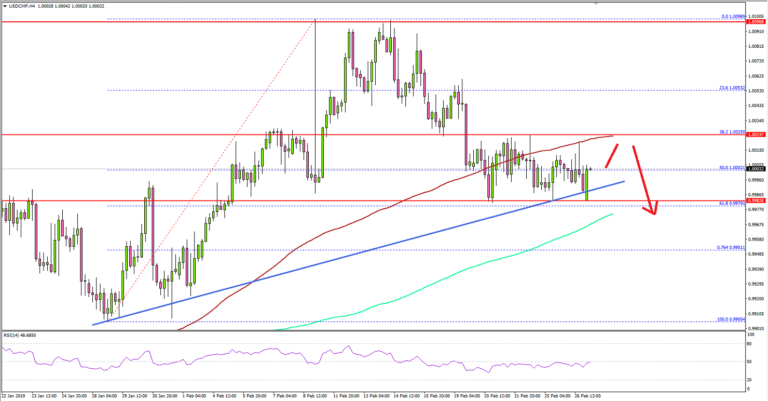
Looking at the 4-hours chart, the pair topped at 1.0098 and later dipped below the 23.6% Fib retracement level of the last wave from the 0.9905 low to 1.0098 high. More importantly, there was a break below the 1.0025 support and the 100 (red) simple moving average (4-hours).
The pair even traded below the 1.0010 support and the 50% Fib retracement level of the last wave from the 0.9905 low to 1.0098 high. However, there is a decent support formed near the 0.9980 level.
There is also a key bullish trend line in place with support at 0.9990 along with the 61.8% Fib retracement level of the same wave. If there is a downside break below the 0.9980 support, the pair could extend losses towards the 0.9950 and 0.9940 support levels.
On the other hand, if the 0.9980 support prevent losses, the pair could bounce back towards the 1.0050 and 1.0060 resistance levels in the near term.
Fundamentally, the US Building Permits figure for Dec 2018 was released recently by the US Census Bureau, at the Department of Commerce. The market was looking for a 2.8% decline in Building Permits, compared with the last increase of 5.0%.
However, the result was better than the forecast as there was an increase of 0.3% in Building Permits. On the other hand, there was a sharp decline in Housing Starts in Dec 2018 by 11.2%, whereas the market was looking for only -0.5%.
The US Dollar faced an increase in selling pressure, supporting EUR/USD and GBP/USD. Therefore, a successful break below 0.9980 in USD/CHF could spark further losses.
Economic Releases to Watch Today
- Euro Zone Consumer Confidence Feb 2019 – Forecast -7.4, versus -7.4 previous.
- Euro Zone Services Sentiment Feb 2019 – Forecast 11.0, versus 11.0 previous.
- US Durable Goods Orders for Jan 2019 – Forecast +0.2% versus +1.2% previous.
- US Pending Home Sales for Jan 2019 (YoY) – Forecast +0.4%, versus -2.2% previous.
- Canadian Consumer Price Index Jan 2019 (MoM) – Forecast +0.2%, versus -0.1% previous.
- Canadian Consumer Price Index Jan 2019 (YoY) – Forecast +1.5%, versus +2.0% previous.
Daily Markets Broadcast
Wall Street softens with Fed in no rush
In his first day of testimony, Fed Chairman Powell highlighted “crosscurrents and conflicting signals” facing the US economy, hence the move to a more patient outlook. UK PM May promises a vote to delay Brexit if her deal fails. Trump and Kim to meet in Hanoi, Vietnam.
US30USD Daily Chart
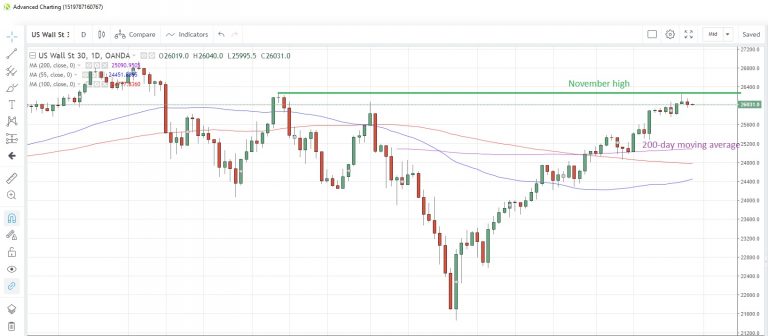
The US30 index snapped a two-day winning streak yesterday as investors struggled to find positives in Powell’s testimony. Very weak housing starts data added to the gloom
Resistance at the November high of 26,249 remains intact. Support may be found at the 200-day moving average at 25,090
US housing starts fell 11.2% m/m, weakest print since May last year. Today it’s the turn of pending home sales to see if a similar picture is unfolding in that part of the housing sector. Powell’s second day of testimony is also on tap. Trump is in the region, so his tweets may come at a more favourable time, for Asia.
DE30EUR Daily Chart
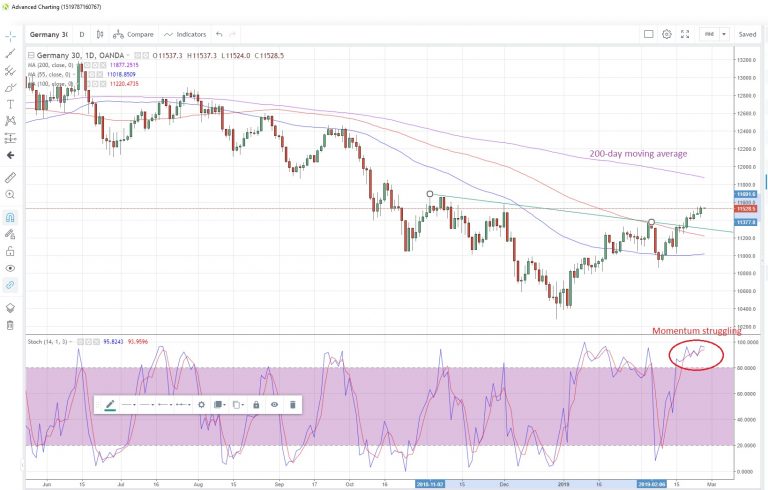
The Germany30 index edged higher for a third straight day yesterday, reaching the highest since December 3, after German consumer confidence held steady in March
The 200-day moving average at 11,877 appears to be a tough hurdle to cross, especially since slow stochastics are in overbought territory and showing signs of turning bearish
Euro-zone confidence indicators for February feature on the data slate today. Let’s see if they can match the stable readings out of Germany yesterday.
UK100GBP Daily Chart
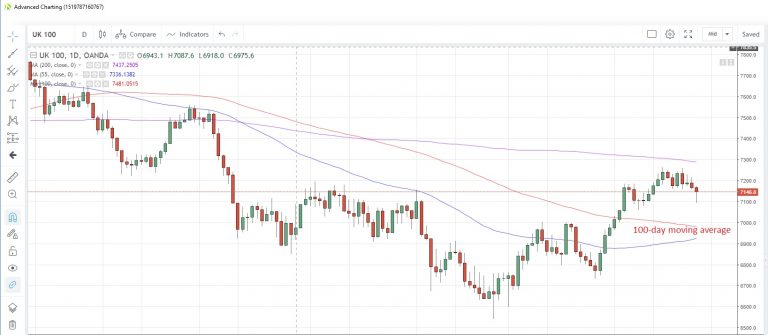
UK shares fell yesterday, but the pound rose, after PM May promised a vote to delay Brexit if her proposed deal fails to get Parliament’s approval
The UK100 index fell for a second consecutive day, dropping to a two-week low. The 100-day moving average is at 6,981
UK shop prices rose by the most since January 2017 this month, jumping 0.7% y/y, according to British Retail Consortium data which was released earlier this morning.
BoJ Kataoka: Uncertainty heightened if current monetary easing is prolonged
BoJ board member Goushi Kataoka continued his call for more monetary stimulus in a speech to business leaders today. He argued that the central bank should ramp up its monetary easing to achieve inflation target earlier.
And he warned, "if the current monetary easing is prolonged, it would mean the period in which Japan's economy faces various uncertainties will be longer. That means uncertainty on achieving our price target will heighten."
Kataoka is a known dove who persistently vote against BoJ's policy in push for more easing.
UK Gov’t: Lack of preparation by businesses on no-deal Brexit, particular SMEs
In a report titled "Implications for Business and Trade of a No Deal Exit on 29 March 2019", the UK government noted that businesses and individuals are under-prepared for no-deal Brexit because they see it as unlikely. But it's warned that the disruption risk could heighten if it does eventually take place.
The reported noted that "despite communications from the government, there is little evidence that businesses are preparing in earnest for a no-deal scenario, and evidence indicates that readiness of small and medium-sized enterprises in particular is low".
The government "judges that the reason for this lack of action is often because a no-deal scenario is not seen as a sufficiently credible outcome to take action or outlay expenditure". And "the lack of preparation by businesses and individuals is likely to add to the disruption experienced in a no-deal scenario".
Brexit debates will continue today and some amendments will be voted for. But the overall plan should now be set after Prime Minister Theresa May's statement yesterday. There will be another meaningful vote on the Brexit deal on March 12. May could get a last minute provisional agreement from EU on March 11, if any, with needed change on Irish backstop. If the deal is voted down, there will be a vote on March 13 for the Parliament to give explicit consent to no-deal Brexit. Then on March 14, if no-deal Brexit is ruled out, there will be another vote on Article 50 extension.
Fed Powell: We’re going to be patient to allow things to clarify
In the semi-annual testimony, Fed Chair Jerome Powell said there were "crosscurrents and conflicting signals" in the past few months. He explained that the conflicting signals include disappointing data, like retails, that's in contrast to strong job data. And there will be drags from slowdown overseas that US may "feel more of" in the coming months. But he emphasized that the "baseline outlook is a good one".
For now, Powell added, "we have the makings of a good outlook and our committee is really monitoring the crosscurrents, the risks, and for now we are going to be patient with our policy and allow things to take time to clarify."
He also reiterated that "going forward, our policy decisions will continue to be data dependent and will take into account new information as economic conditions and the outlook evolve."
Markets Cancel Mayday On Brexit
Markets cancel Mayday on Brexit
Lots of noise, but precious little to show for it: this sums up Wall Street overnight. All three major indices rallied intraday on much higher than expected US Consumer Confidence, only to retreat as US residential housing starts fell 11.2% in December. Once the dust had settled, the S&P, Dow Jones and Nasdaq all closed down 0.1%.
Federal Reserve Chairman Powell navigated his first day of testimony on Capitol Hill overnight, reiterating the Fed’s, “All we need is a little patience,” mantra with regards to interest rates. Powell said the Fed had growing concerns about China and Europe and were happy to wait for more data to clarify the picture. He heads back to the Hill again today, but the chances of a surprise are low. We expect him to repeat yesterday’s comments, albeit dressed up in a slightly different way.
The UK sterling (GBP) rocketed above 1.3200 against the dollar overnight as PM May caved to demands for a binding vote from Parliament to ask for a Brexit delay should her next “Brexit deal” proposal be hung from the gates of the Tower of London.
The second Trump-Kim nuclear summit kicks off today in Hanoi, but don’t expect the meeting to deliver anything of substance given the question, “What is the definition of denuclearisation?” remains on the agenda. At a denuclearising summit, this is never a good start to proceedings. Still, they can enjoy Hanoi’s amazing food, and if the President gets bored, there’s always his social media account to give a spark to global markets.
Both globally and regionally, the data calendar is quiet today suggesting a dull trading day across the financial markets with intra-day spikes in volatility driven by news headlines, not data.
FX
The greenback fell across the board overnight with the US dollar index down by 0.4%. The rotation out of safe-haven dollars and into more risk-seeking majors and emerging market currencies continues apace post the Trump extension to the China tariff cut-off date.
The GBP was the star of the show overnight, rocketing 1.20% higher to 1.3260 on Brexit delay hopes. The street is clearly second-guessing both the UK Parliament and the European Union, moving to a Brexit delay followed by a Brexit deal scenario. This seems like a perilous game to play, but the momentum of this hope-versus-reality trade could push the GBP to much higher levels yet. Be warned though that a disappointment in this glossy scenario could see just as ugly a move back down.
Equities
With Wall Street lacking in direction, attention will turn to China again today. After the breathless rally of the last seven days, it was unsurprising that both Shanghai and Shenzhen gave up some of their gains yesterday. Regional bourses will follow China’s lead intra-day.
Oil
Oil clawed back some of its losses overnight with Brent climbing by 0.9% to USD65.40 per barrel and WTI up 0.3% to USD55.60 per barrel. This rise is entirely technical given the scale of the losses from the day before. The technical picture for both contracts continues to look constructive, with Monday’s drop bringing a welcome reduction in some overbought technical indicators.
Gold
Gold holds steady yet again at USD1,330.00 an ounce caught between the cross-currents of a weaker dollar and rising risk sentiment.