

Sample Category Title
EURAUD Stays Neutral in Short- and Long-Term Timeframes
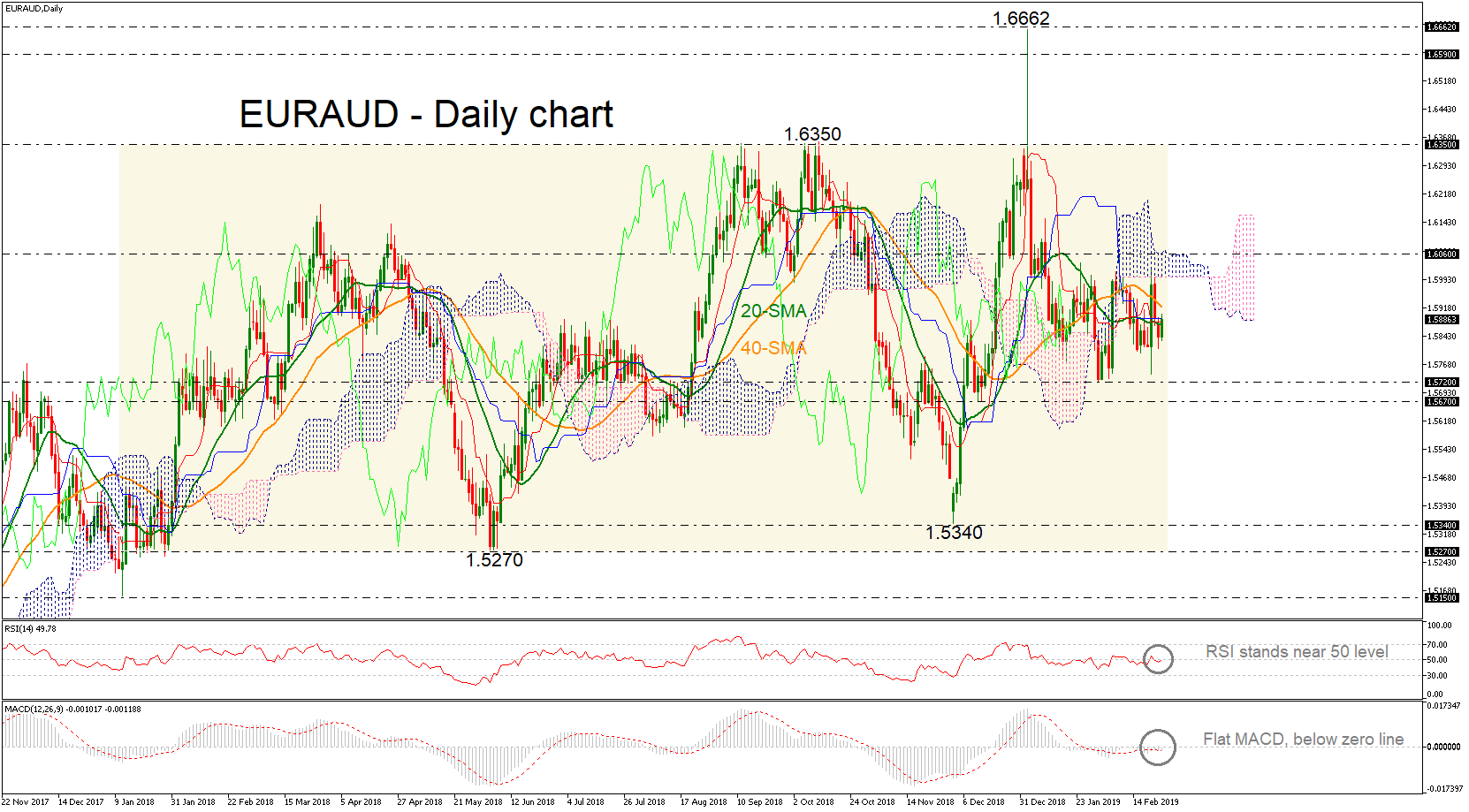
EURAUD has been moving sideways in the short-term and long-term timeframes. Over the last two-months, the price has been developing between the 1.6060 resistance level and the 1.5720 support barrier, trading near the 20- and 40-simple moving averages (SMAs) in the daily chart.
In addition, the red Tenkan-sen and the blue Kijun-sen lines are flattening, confirming the neutral structure. The market could maintain its consolidation mode as the RSI and the MACD are holding near their neutral levels with weak momentum.
An extension to the upside and above the Ichimoku cloud could meet the next resistance level of 1.6155, taken from the latest highs, while even higher, the upside rally could send the price towards the upper boundary of the long-term trading range near 1.6350, identified by the peaks on October 2018.
However, if the pair weakens, it could slip until the 1.5720 key level, before shifting the bias back to bearish and heading towards 1.5670. Even lower, the 1.5340 level could attract greater attention as any leg lower could worsen the market’s bearish outlook, opening the way towards the 1.5270 support area.
Regarding the long-term picture, the slight bullish sentiment deteriorated after the price failed to close above 1.6350, though it remains above 1.5270, underpinning the neutral picture.
US: Housing Starts Fall in December to Two-Year Low
U.S. housing starts plunged 11.2% to 1.08 million (annualized) in December from a downwardly revised 1.21 million in November. The decline was broad-based with the volatile multi-family segment, plummeting 20.4% to 320k units. Single-family starts also declined 6.7% to 758k units. The median consensus forecast was for starts to remain unchanged.
Building permits eked out a meager gain of 0.3% in December, rising to 1.33 million (from 1.32 million in November). The gain was concentrated in the multifamily segment, which rose 4.9% for the month, while single family permits were down 2.2%.
The regional outturn was decidedly on the negative side. While starts in the Northeast were unchanged, all other regions were down – the West by 26.3%, Midwest by 13.2% and the South by 6.0%.
Key Implications
December was a disappointing end to what has been a rough few months for the residential construction market, with starts dropping to the lowest level since September 2016. Nevertheless, for the year, starts were up 3% relative to 2017.
The decline in starts to close the year partially reflects the volatility of financial markets during this period which may have rattled builder confidence, resulting in a three-year low for homebuilder sentiment in December. This added to other headwinds which builders were already facing including higher input costs driven by a tight labor market and tariffs. The notable decline of starts in the West may continue to reflect the impact of wildfires in California which put a dent in homebuilding activity.
Residential building construction has decelerated recently suggesting that contribution to economic activity in Q4 was likely much more muted. While buyers have been grappling with elevated prices and a dearth of inventory, the recent decline in mortgage rates and uptick in wages should support demand going forward. To this end, residential activity is expected to rebound modestly in 2019.
ECB Lane: Down revisions to forecasts mean slower path of normalization
ECB Governing Council member Philip Lane said earlier today that there will be only be "reasonably small adjustments" in the upcoming economic forecasts in March. And, the "downward revisions in data to mean a slower path of normalization".
But he believed the current strategy can "cater to limited downside revisions" and the "forward guidance can accommodate revision to the projections. Currently, ECB maintained that interest rates will stay at present levels at least through Summer of 2019.
Lane is currently the only candidate to replace ECB chief economist Peter Praet from June.
USD/JPY Mid-Day Outlook
Daily Pivots: (S1) 110.68; (P) 110.96; (R1) 111.33; More...
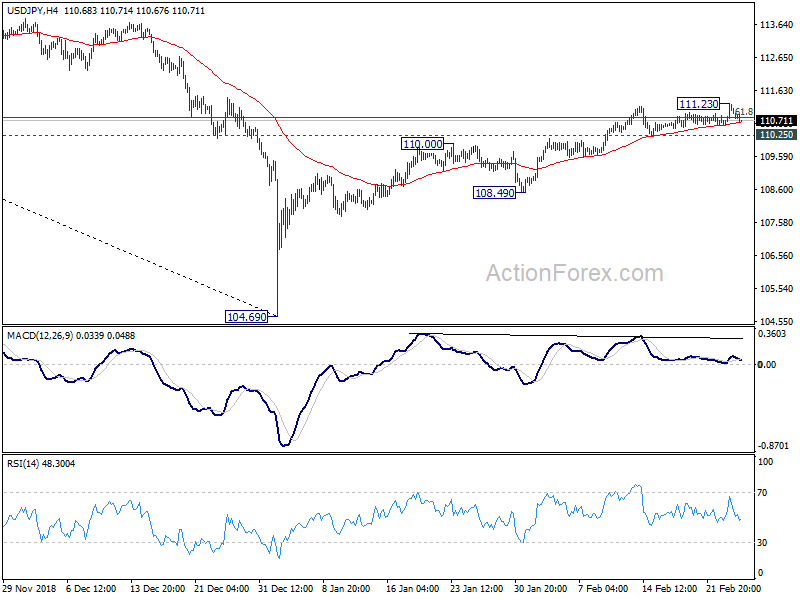
Intraday bias in USD/JPY remains neutral at this point. On the downside, break of 110.25 minor support will suggest rejection by 61.8% retracement of 114.54 to 104.69 at 110.77 and the rebound from 104.69 has likely completed. Intraday bias will be turned back to the downside for 108.49 support for confirmation. Nevertheless, firm break of 111.23 should confirm resumption of rise from 104.69 for 114.54 resistance.
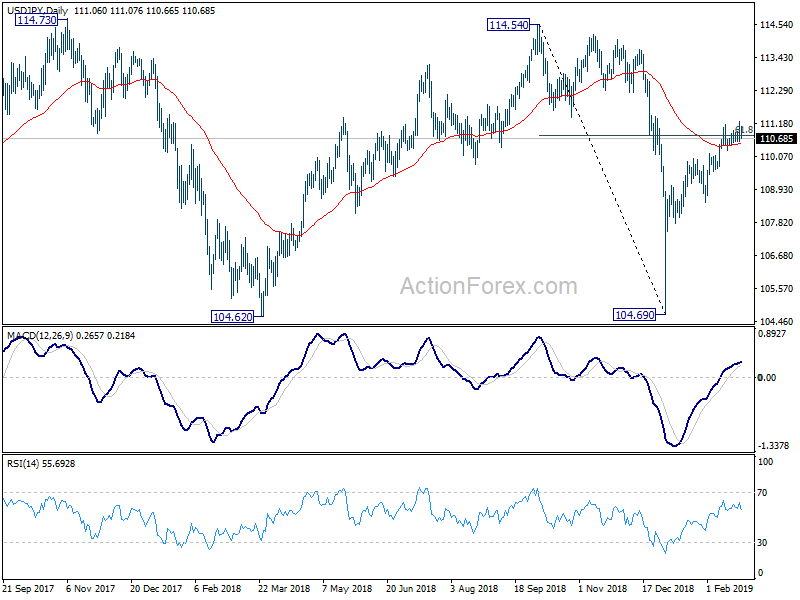
In the bigger picture, while the rebound from 104.69 was stronger than expected, it's struggle to get rid of 55 day EMA completely. Outlook is turned mixed first. On the downside, break of 108.49 support will revive that case that such rebound was a correction. And, larger down trend is still in progress for another low below 104.62. But sustained trading above 55 day EMA will turn focus to 114.54. Decisive break there will confirmation completion of the decline from 118.65 (2016 high).
USD/CHF Mid-Day Outlook
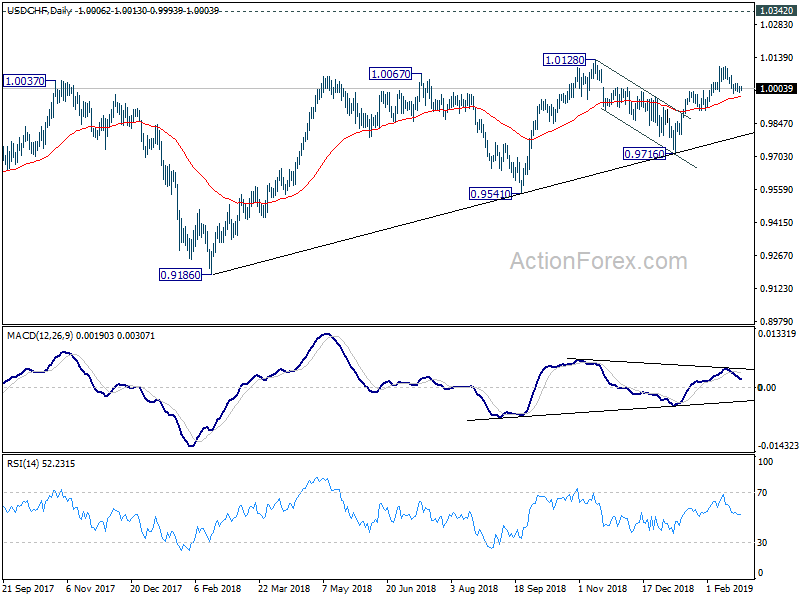
Daily Pivots: (S1) 0.9988; (P) 1.0000; (R1) 1.0018; More...
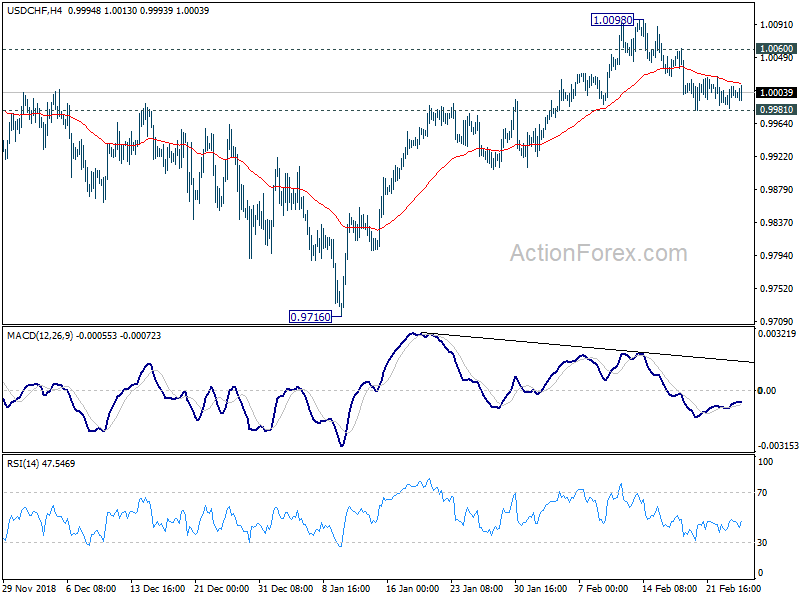
Intraday in USD/CHF remains neutral at this point. On the downside, break of 0.9981 will resume the decline from 1.0098. Sustained trading below 55 day EMA (now at 0.9966) should confirm completion of rise form 0.9716, after rejection by 1.0128 resistance. In that case, deeper fall would be seen back towards 0.9716 support. On the upside, break of 1.0098 will extend the rise from 0.9716 to 1.0128 high next.
In the bigger picture, USD/CHF drew strong support from medium term trend line and rebounded. That suggests rise from 0.9186 is still in progress. Further break of 1.0128 will confirm up trend resumption and target 1.0342 key resistance. Nevertheless, break of 0.9716 will dampen this bullish view and at least bring deeper fall to 0.9541 key support.
EUR/USD Mid-Day Outlook
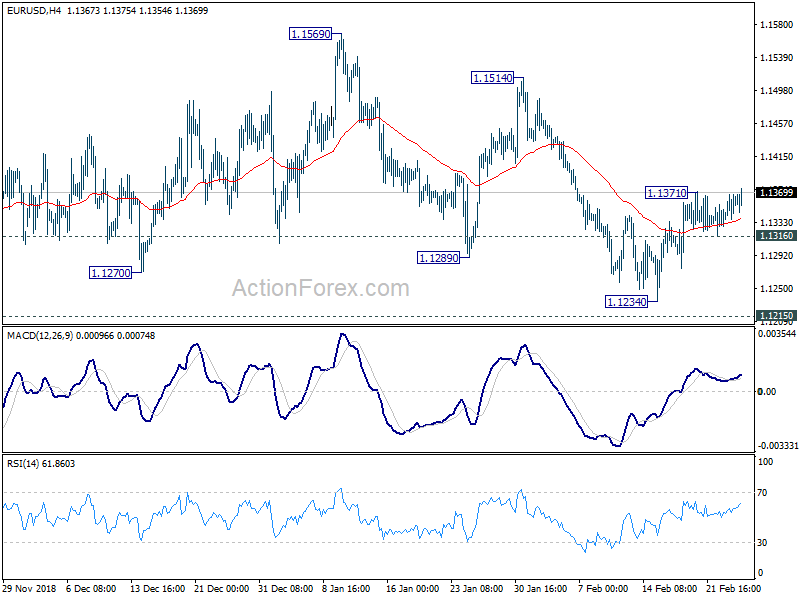
Daily Pivots: (S1) 1.1334; (P) 1.1351; (R1) 1.1375; More.....
EUR/USD's breach of 1.1371 suggests resumption of rebound from 1.1234. Intraday bias is turned back to the upside. Rise from 1.1234 is seen as another leg in the consolidation pattern from 1.1215 and should target 1.1514 resistance. On the downside, though, break of 1.1316 minor support will argue that the rebound is completed. Intraday bias will be turned back to the downside for 1.1215 low.
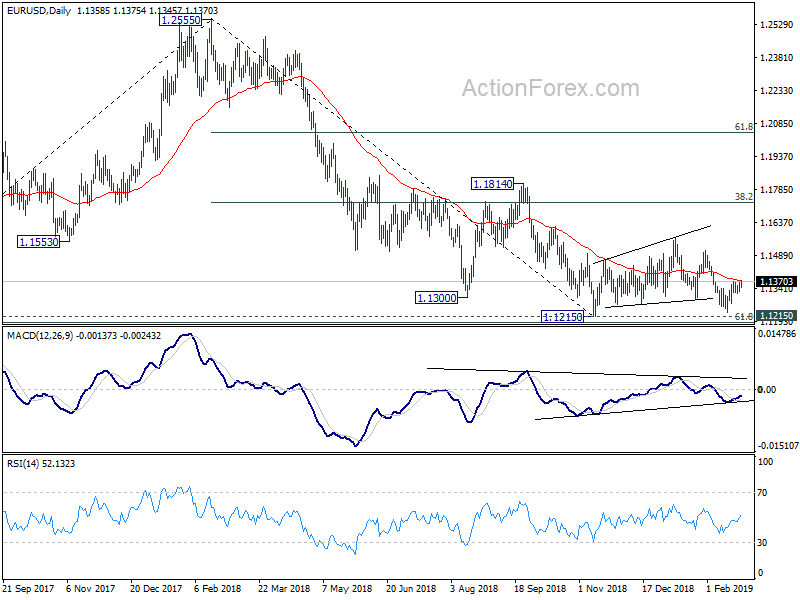
In the bigger picture, as long as 1.1814 resistance holds, down trend down trend from 1.2555 medium term top is still in progress and should target 61.8% retracement of 1.0339 (2017 low) to 1.2555 at 1.1186 next. Sustained break there will pave the way to retest 1.0339. However, break of 1.1814 will confirm completion of such down trend and turn medium term outlook bullish.
GBP/USD Mid-Day Outlook
Daily Pivots: (S1) 1.3055; (P) 1.3085; (R1) 1.3128; More....
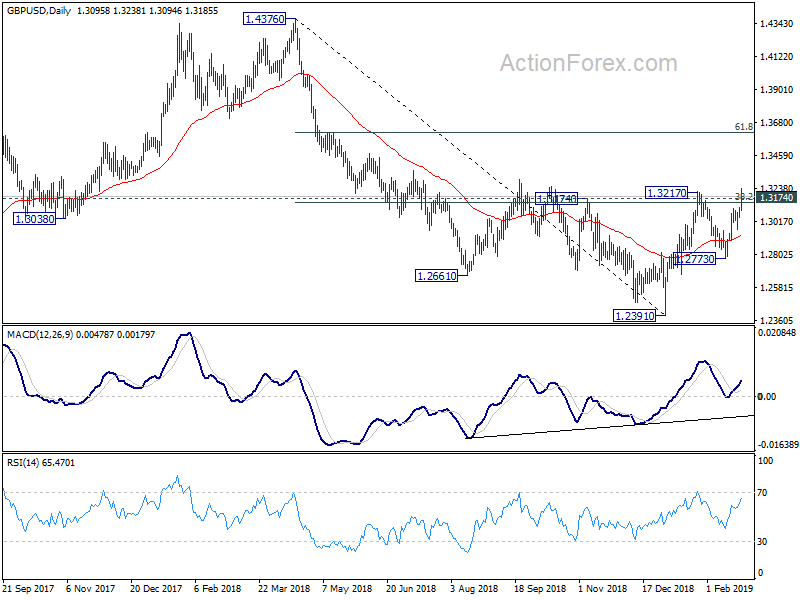
GBP/USD rises to as high as 1.3238 so far today and intraday bias remains on the upside. Sustained trading above 1.3174/3217 resistance zone will complete a head and shoulder bottom pattern (ls: 1.2661, h: 1.2391, rs: 1.2773). That would indicate bullish reversal for 61.8% retracement of 1.4376 to 1.2391 at 1.3618 next. On the downside, break of 1.2968 minor support is needed to indicate short term topping. Otherwise, outlook will remain bullish in case of retreat.
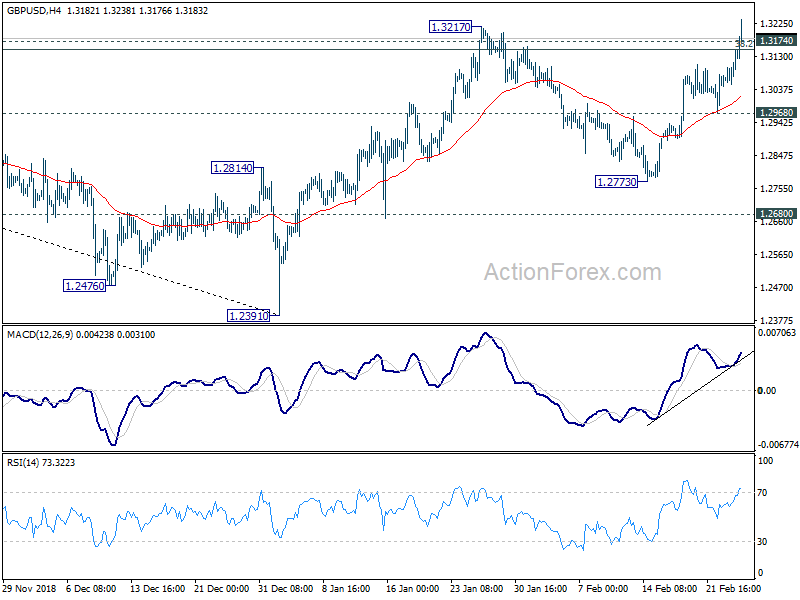
In the bigger picture, focus is back on 1.3174 resistance with current rebound. Sustained break will indicate completion of decline from 1.4376. Rise from 1.2391 would then be seen as the third leg of the corrective pattern from 1.1946 (2016 low). In that case, further rise could be seen through 1.4376 resistance. Nevertheless, rejection by 1.3174 again will extend the decline from 1.4376 through 1.2391 to 1.1946 low.
EUR/GBP Mid-Day Outlook
Daily Pivots: (S1) 0.8657; (P) 0.8679; (R1) 0.8696; More...
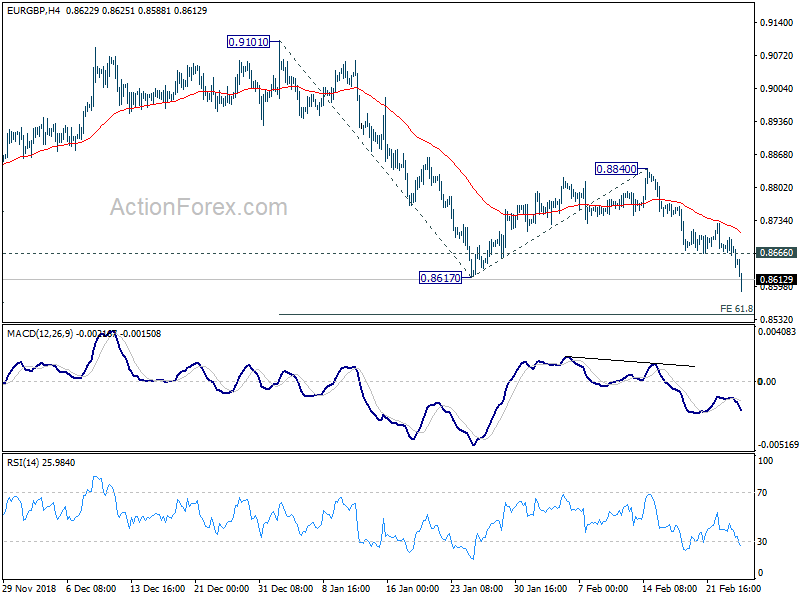
EUR/GBP drops sharply to as low as 0.8588 so far today. The break of 0.8617/20 key support zone suggests resumption of larger decline from 0.9305. Intraday bias stays on the downside. Next target will be 61.8% projection of 0.9101 to 0.8617 from 0.8840 at 0.8541. On the upside, break of 0.8666 minor resistance will turn intraday bias neutral first. But recovery should be limited well below 0.8840 resistance to bring another decline.
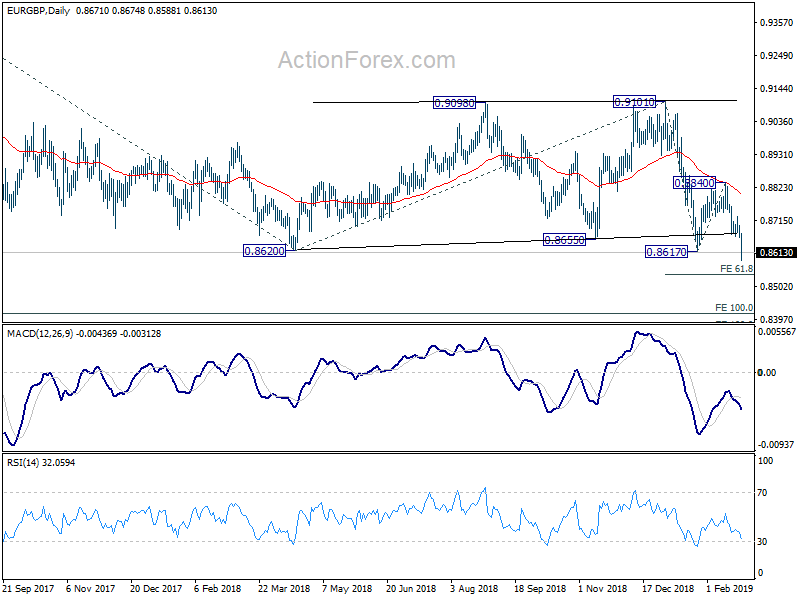
In the bigger picture, EUR/GBP is seen as staying in long term range pattern started at 0.9304 (2016 high). On the downside, decisive break of 0.8620 support will resume the falling leg from 0.9305 (2017 high) to 100% projection of 0.9305 to 0.8620 from 0.9101 at 0.8416. In that case, we'd expect strong support around 0.8312 to contain downside and bring rebound.
Sterling Breaks Key Resistance as UK Moves a Big Deal to Avoid No-Deal Brexit
Sterling rises broadly today and takes out key resistance against Dollar and Euro. UK has moved a big step in avoiding no-deal Brexit. Prime Minister Theresa May announced to hold three separate votes on Brexit deal, no-deal Brexit and delay. The key is, no-deal Brexit is no longer the default position on March 29. But it could only happen with explicit consent of the Parliament.
Staying in the currency markets, Yen follows as the second strongest and stock markets pare back trade optimism triggered gains. Commodity currencies are trading generally lower, as led by Australian Dollar. But Canadian Dollar is not far behind despite slight recovery in oil price. Dollar is mixed, awaiting Fed chair Jerome Powell's testimony.
Technically, GBP/USD breaks 1.3173/3217 key resistance zone. A head and should bottom would be formed if GBP/USD can sustain above this zone, which confirms medium term bullish reversal. . EUR/GBP also broke key support level at 0.8617/20, resuming medium term decline for 0.8416 projection level. GBP/JPY is pressing medium term trend line. Sustained break will pave the way back to 150.
In Europe, currently, FTSE is down -0.76%, DAX is down -0.13%, CAC is down -0.15%. German 10-year yield is down -0.007 at 0.112. Earlier in Asia, Nikkei dropped -0.37%. Hong Kong HSI dropped -0.65%. China Shanghai SSE dropped -0.67%. Singapore Strait Times dropped -0.33%. Japan 10-year JGB yield rose 0.0089 to -0.027.
UK PM May: There'll be a second vote on Brexit deal, a vote on no-deal, then a vote on extension
UK Prime Minister Theresa May announced today three additional commitments in the parliament regarding Brexit. Firstly, there will be a second meaningful vote on the withdrawal agreement by March 12. Secondly, If the government loses the meaningful vote, on March 13, there will be a vote on whether to leave without a deal. And UK will only leave EU on March 29 without a deal, with explicit consent of the House.
Then, if both the withdrawal agreement and no-deal Brexit are voted down, there will be another vote on a short, limited extension to Article 50 on March 14. If the parliament passes the motion, the government will seek to get that extension. Though, May insisted that she doesn't not want to see Article 50 extension, and the focus is still on leaving on March 29.
BoE Carney: Short-term data volatility less of a signal about medium-term outlook
In the annual report to the Treasury Select Committee, BoE Governor Mark Carney said UK growth "slowed sharply in late 2018 and appears to have remained weak in early 2019". The slowdown reflects both "softer activity abroad" and "greater effects from Brexit uncertainties". Brexit uncertainties is "creating a series of tensions for business, households and in financial markets". But that will only cause "short-term volatility in the economic data" and provide "less of a signal about the medium-term outlook".
Carney added that the " fundamentals of the UK economy are sound. The financial sector is resilient. Corporate balance sheets are strong. And the labour market is tight." If the economic conditions evolve in line with BoE projections, which are conditioned on a smooth Brexit, "limited and gradual rate rises are likely to be needed to return inflation sustainably to target."
BoE Vlieghe: Easing or extended pause in monetary policy more likely in case of no-deal Brexit
BoE MPC external member Gertjan Vlieghe reiterate his view that in case of no-deal Brexit, not all paths are equally likely. He said that "in the case of a no-deal scenario I judge that an easing or an extended pause in monetary policy is more likely to be the appropriate policy response than a tightening."
Also, BoE "will have to judge in real time how well inflation expectations remain anchored, and how households and businesses are reacting to the disruptions." And "even if the direction and scale of monetary policy changes are unknown beforehand, monetary policy will do what it needs to do to bring inflation back to target within a horizon that is consistent with our mandate."
German GfK: Economic expectations continued steep downward spiral
Germany GfK consumer confidence for February was unchanged at 10.8. GfK noted that "mood of consumers paints a mixed picture. Income expectations remain stable. But propensity to buy lost ground again. Economic expectations continued their "steep downward spiral". Economic expectation dropped -6.5 pts to 4.2. That's the fifth decline in a row and the lowest reading since March 2016. Gfk said "Consumers feel that the risk of the German economy slipping into recession again has tangibly increased in recent weeks". A technical recession was only "narrowly avoided" last year, with 0% growth in Q4.
And, "external factors are primarily responsible for the lack of momentum in the German economy.". Gfk cited trade dispute between Europe, China and US is "causing growing uncertainty among consumers". And, they " worry that Germany, as a strongly export-oriented economy, would suffer negative consequences if this dispute led to trade barriers such as rising customs tariffs." How and when Brexit will take place is far from certain and "This makes planning more difficult for companies on all sides.
BoJ Kuroda: Chinese economy to remain in doldrums in first half
BoJ Governor Haruhiko Kuroda told the parliament that China's economy "slowed quite significantly in the latter half of last year". And he predicts that it may "remain in the doldrums in the first half of this year." Nevertheless, Kuroda expects Chinese even economy to "pick up thereafter, as authorities have taken fiscal and monetary stimulative action."
Domestically, Kuroda expected that the net burden on households from this year's scheduled sales tax hike to be smaller than previous hike in 2014. And he added that BOJ will be watching the impact of the sales tax hike on the economy. The impact could change depending on consumer sentiment, job and income conditions at that time.
EUR/GBP Mid-Day Outlook
Daily Pivots: (S1) 0.8657; (P) 0.8679; (R1) 0.8696; More...
EUR/GBP drops sharply to as low as 0.8588 so far today. The break of 0.8617/20 key support zone suggests resumption of larger decline from 0.9305. Intraday bias stays on the downside. Next target will be 61.8% projection of 0.9101 to 0.8617 from 0.8840 at 0.8541. On the upside, break of 0.8666 minor resistance will turn intraday bias neutral first. But recovery should be limited well below 0.8840 resistance to bring another decline.
In the bigger picture, EUR/GBP is seen as staying in long term range pattern started at 0.9304 (2016 high). On the downside, decisive break of 0.8620 support will resume the falling leg from 0.9305 (2017 high) to 100% projection of 0.9305 to 0.8620 from 0.9101 at 0.8416. In that case, we'd expect strong support around 0.8312 to contain downside and bring rebound.
Economic Indicators Update
| GMT | Ccy | Events | Actual | Forecast | Previous | Revised |
|---|---|---|---|---|---|---|
| 7:00 | EUR | German GfK Consumer Confidence Mar | 10.8 | 10.8 | 10.8 | |
| 10:00 | GBP | BoE Inflation Report Hearings | ||||
| 13:30 | USD | Housing Starts Dec | 1.25M | 1.26M | ||
| 13:30 | USD | Building Permits Dec | 1.29M | 1.32M | ||
| 14:00 | USD | House Price Index M/M Dec | 0.40% | 0.40% | ||
| 14:00 | USD | S&P/Case-Shiller Composite-20 Y/Y Dec | 4.90% | 4.70% | ||
| 15:00 | USD | Consumer Confidence Feb | 124.1 | 120.2 | ||
| 15:00 | USD | Fed Powell testifies Before Senate Banking Panel |
Canadian Dollar Dips, CPI Ahead
The Canadian dollar is slightly lower in the Tuesday session. Currently, the pair is trading at 1.3220, up 0.24% on the day. On the release front, Canada releases corporate profits. It’s a busy day in the United States. We’ll get a look at construction and manufacturing data, as well as CB Consumer Confidence. All eyes will be on Fed Chair Jerome Powell, who will testify before the Senate Banking Committee. On Wednesday, Powell speaks before the House Financial Services Committee.
The Federal Reserve will be on center stage this week, as Fed Chair Jerome Powell testifies before congressional committees on Tuesday and Wednesday. The Fed has been decidedly dovish early in 2019, in sharp contrast to 2018, when the Fed raised rates four times in order to keep the red-hot U.S. economy from overheating. However, the global trade war has taken a bite out of global growth, and the U.S. economy is unlikely to repeat last year’s performance. The markets will be listening closely for hints regarding future interest rate policy and whether the Fed plans to remain dovish in stance.
Canadian numbers have been mixed, making it difficult for the Bank of Canada to step in and raise rates for the first time in 2019. Similar to the Federal Reserve, the BoC was aggressive in 2018, but has applied the brakes in 2019. The Bank hiked rates three times last year, but has since stayed on the sidelines, with the benchmark rate pegged at 1.75%. It’s unlikely that the bank will make any rate moves unless the Canadian economy shows clear signs of gathering steam. Consumer spending data in December was a disappointment, with retail sales and core retail sales posting declines.