

Sample Category Title
Eco Data 2/27/19
[php_everywhere instance="1"]
Canadian Inflation and GDP Data Eyed as BoC Rate Hikes Disappear Over the Horizon
Canada will publish January inflation and Q4 GDP numbers this week, which should provide investors some clues as to the possibility of a near-term rate hike by the Bank of Canada amid a slowing economy. The CPI figures are due on Wednesday and the GDP estimates will be released on Friday, both at 13:30 GMT. The Canadian dollar is vulnerable to upside surprises given that investors have almost priced out the likelihood of any rate hikes this year.
After peaking at a near 7-year high of 3.0% year-on-year in July 2018, headline inflation in Canada has since been trending downwards. While an unexpected jump from 1.7% to 2.0% in December may have briefly boosted rate hike expectations, the strong reading is seen as a one-off and in January, the CPI rate is forecast to turn lower again, falling to 1.5% y/y.
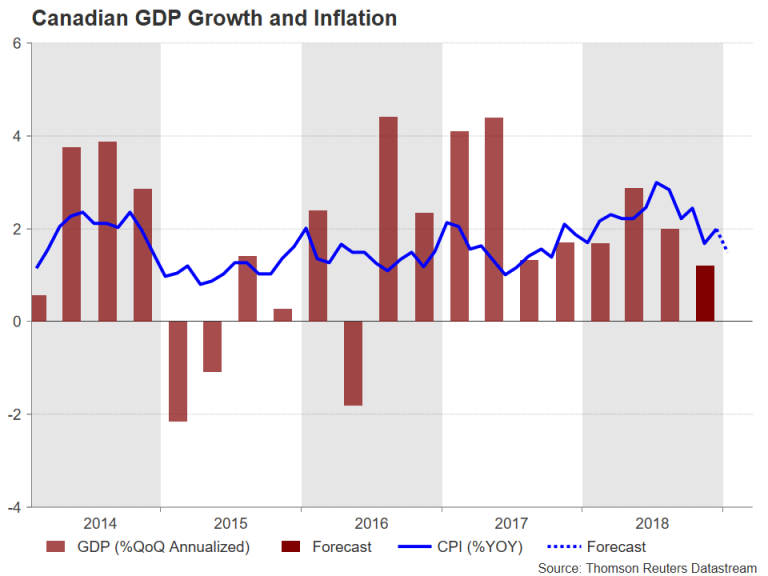
Core inflation, meanwhile, remains steady. The Bank of Canada’s preferred measures of core inflation, the CPI median, CPI trim and CPI median stood at 1.8%, 1.9% and 1.9%, respectively, in December, where they’ve been hovering for much of 2018. Without a clear trend upwards, the Bank of Canada is not likely to be in a hurry to resume its rate hike cycle as the economy goes through a soft patch. The BoC raised rates three times in 2018 but recently signalled that further increases would be dependent on the data improving.
The GDP figures due at the end of the week are anticipated to confirm the moderating growth picture in Canada. Annualized growth during the final three months of 2018 is forecast at 1.2% quarter-on-quarter, slowing from the prior 2.0%. On a month-on-month basis, GDP growth is forecast to have been flat in December.
Canada’s economy has been hit by the downward reversal in oil prices in Q4, which have hurt business investment in the energy sector – the country’s largest export segment. The BoC is also worried about the cooling housing market, while consumer spending has also slowed substantially. The Bank’s governor, Stephen Poloz, recently said that the path for its policy rate towards the neutral range is “highly uncertain”, suggesting there will be no rate hikes until the economy regains some momentum.
The Canadian dollar has come under pressure over the past day after oil prices slid when US President Trump called on OPEC to lower oil prices. Dollar/loonie jumped back above the 1.32 level only to find resistance near 1.3221 – the 50% Fibonacci retracement of the upleg from 1.2778 to 1.3664. An overall weak set of readings in this week’s data could lift dollar/loonie above the 50% Fibonacci and drive the pair towards the 38.2% Fibonacci at 1.3326, which lies slightly above the 50-day moving average (MA).
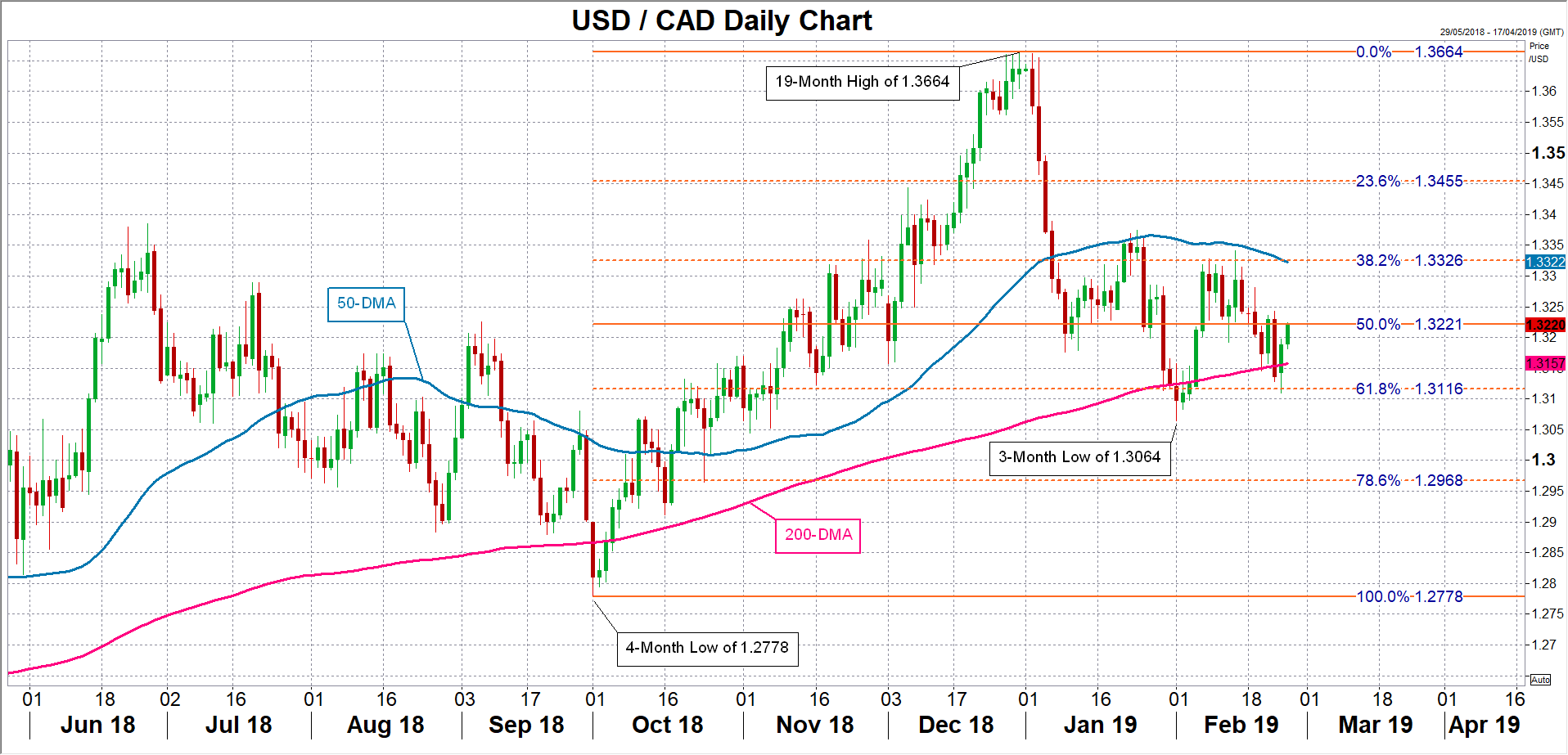
However, if there are positive surprises in the numbers, this could take the pair back down towards the 200-day MA, which has been acting as strong support since late January. Not too far below the 200-day MA (currently at 1.3157), is the 61.8% Fibonacci at 1.3116. A break below this level would risk a breach of the 3-month low of 1.3064 set earlier in February.
British Pound Jumps as Parliament to Vote (Again) on Brexit
GBP/USD has posted considerable gains on Tuesday. In North American trade, the pair is trading at 1.3263, up 1.27% on the day. In economic news, BoE Governor Mark Carney testified at the quarterly inflation report hearings. In the U.S., construction numbers were mixed. CB Consumer Confidence sparkled, with a score of 131.4, well above expectations. As well, the Richmond Manufacturing Index jumped to 16 points, a 5-month gain. All eyes are on Fed Chair Jerome Powell, who is testifying before the Senate Banking Committee. On Wednesday, Powell speaks before the House Financial Services Committee.
With just over a month until Brexit Day, there is plenty of activity in London and Brussels. British Prime Minister May said on Monday that parliament would have the opportunity to vote on the government’s withdrawal agreement no later than March 12. If lawmakers shoot down that proposal, they will vote the next day on two separate proposals – one on a no-deal Brexit, and the second on requesting the EU to extend Article 5 and delay Brexit past March 29. May’s dramatic announcement is sure to trigger plenty of reaction in parliament, so traders should be prepared for volatility from the pound, ahead of next week’s drama in parliament.
The Federal Reserve is back in the spotlight this week, as Fed Chair Jerome Powell testifies before congressional committees on Tuesday and Wednesday. The Fed has been decidedly dovish early in 2019, in sharp contrast to 2018, when the Fed raised rates four times in order to keep the red-hot U.S. economy from overheating. However, the global trade war has taken a bite out of global growth, and the U.S. economy is unlikely to repeat last year’s performance. The markets will be listening closely for hints regarding future interest rate policy.
Sunset Market Commentary
Markets:
Global core bonds are trading mixed today with US Treasuries outperforming German Bunds. Risk sentiment opened with a downward bias, tracking losses in Asia. The German Bund initially jumped higher but reversed the trend on comments of Philip Lane. The ECB’s chief economist to be said the current ECB policy strategy can cope with the current downturn in economic momentum. His comments downplay a policy adjustment (and introduction of a fresh TLTRO) at the ECB March meeting, indicating a rate hike remains possible after the Summer. The German yield curve edged higher with changes up to +2.2 bps (2-yr). Fed governor Powell testifying before the US Senate Banking Panel was the talk of the day but his statement didn’t surprise. He said the “crosscurrents and conflicting signals” that the healthy US economy is facing, warrant a patient approach to future interest-rate changes, but repeats the Fed is ready to adjust balance-sheet normalization if needed. US Treasuries paired some of their gains and moved south. The US yield curve is edging lower with changes varying between -0.8 bps (30-yr) to -1.9 bps (5-yr). The 15-year Spanish bond syndication attracted large bids, confirming strong demand for peripheral debt. Peripheral spreads over the German 10-yr yield are tightening with Italy (-7 bps), Greece (-7 bps) and Portugal (-5 bps) outperforming.
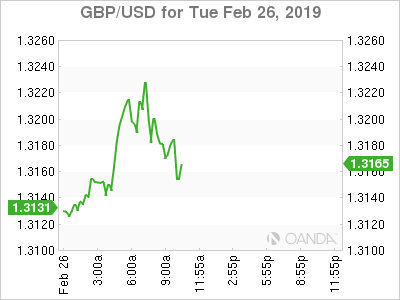
USD trading mainly developed in a wait-and-see modus as markets awaited the testimony of Fed’s Powell before the Senate. On the euro side of the story, recent cautious EUR/USD bias was supported by comments from ECB’s Lane, as he indicated that ECB might only make limited downward revisions to its forecasts at the March meeting. EUR/USD retested the 1.1370 area, but a real break didn’t occur. Early in US dealings, the dollar was sold on poor US housing starts. EUR/USD set a minor correction top beyond 1.1370. USD/JPY dropped to the 110.70 area. Still, investors were reluctant to sell the dollar ahead of Powell’s testimony. Powell held a cautiously positive tone on the economy allowing the Fed to be patient. Little news compared to recent communication. The USD reaction was close to non-existent, but the dollar profited slightly from stronger than expected mid-morning US confidence data. EUR/USD is trading in the 1.1350 area. USD/JPY regains a few ticks and is again trading in the 110.80 area.
The sterling rally reaccelerated this morning. At that time, it was still difficult to predict the twists in the Brexit drama. However, markets assumed that chances for a ‘no-deal Brexit’ were declining in the most likely scenarios. EUR/GBP filled bids below 0.86. Cable jumped north of 1.32. In a new appearance before Parliament, UK PM May clarified the Brexit-roadmap. She still seeks approval for a Brexit deal in a vote on March12. If the deal receives no majority, Parliament will have to vote on a no-deal Brexit. If both options are rejected, a vote on a ‘limited’ delay will be held on March 14. The sterling rally stalled after PM May’s appearance in Parliament. MPs will have a chance to vote on a delay, but the option of a no deal Brexit isn’t formally ruled out as well. EUR/GBP is again trading in the 0.8625 area. Cable returned below the 1.32 handle. That said, sterling de facto preserved most of its recent gains.
News Headlines:
Philp Lane, ECB’s chief economist to be, said that the current ECB’s monetary policy strategy can handle with minor downward revisions to the GDP path at the March meeting. His comments suggest no willingness to extend the current forward guidance on interest rates which states “at least unchanged until the Summer of 2019”.
The Hungarian central bank kept its monetary policy unchanged. The NBH nevertheless stays on track for a near start of policy normalization as the probability of core inflation rising above the 3% inflation target has increased. Tightening will begin with unwinding of unconventional measures.
US housing data disappointed in December. The most eye-popping release was an unexpected 11.2% (M/M) decline in housing starts. One upbeat detail were 187k homes which were authorized, but not yet started in December. The February consumer confidence (131.4 from 121.7) and Richmond Fed Manufacturing (16 from –2) indices rebounded much more than forecast in February.
US consumer confidence rose to 131.4, moderate economic expectation in 2019
US Conference Board Consumer Confidence jumped sharply to 131.4 in February, up from 120.2 and beat expectation of 124.1. Present Situation Index improved to 173.5, up from 170.2.
"Consumer Confidence rebounded in February, following three months of consecutive declines," said Lynn Franco, Senior Director of Economic Indicators at The Conference Board. "The Present Situation Index improved, as consumers continue to view both business and labor market conditions favorably. Expectations, which had been negatively impacted in recent months by financial market volatility and the government shutdown, recovered in February. Looking ahead, consumers expect the economy to continue expanding. However, according to The Conference Board's economic forecasts, the pace of expansion is expected to moderate in 2019."
Powell Sticks to the Script in His Text Release
The greenback and US stocks are trading lower as softer housing data along with disappointing results from Home Depot and a key downgrade on industrial bellwether, Caterpillar, raised concerns economic cycle may have peaked. The trade tariff delay rally appears to have run its course and it appears markets will wait to hear if Fed Chair Powell confirms his dovish pivot in his Semi-Annual Testimony.
- USD – New Home Construction falls to a 2-year low
- GBP – Rose to 5-month high as PM May considers delaying Brexit
- Powell – Semi-Annual Testimony expected to confirm dovish pivot
- GOLD – Remains stuck in key range
- OIL – Vulnerable to further downside
USD
The US dollar softened slightly after new home construction in December dropped to the lowest level since September 2016. The S&P CoreLogic Case-Shiller readings also all came lower than their prior readings and missed analysts’ consensus. Continued weakening data will likely support the Fed’s dovish stance.
GBP
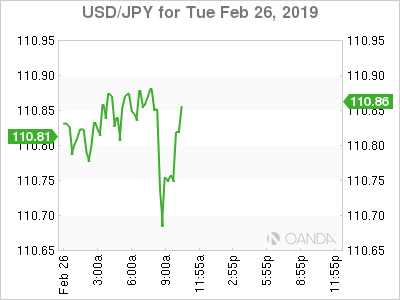
The British pound is trading closely to every Brexit headline. Cable was higher and even broke above the 1.32 on optimism that the no-deal Brexit would be avoided. PM May told the House of Commons that the UK will leave without a deal only if there is explicit consent for that outcome. By mid-March, we will know if Parliament will vote for her deal, and if not if they will vote for a no-deal Brexit, which no one expects they would do. The likely outcome would then be a vote on March14th to extend Article 50. Sterling eventually gave up half of its gains after the Prime Minister noted she does not want extension.
Powell
Fed Chair Powell’s text noted that current economic conditions as healthy and the economic outlook as favorable, over the past few months we have seen some crosscurrents and conflicting signals. Regarding QT, he reiterated they are prepared to adjust completing the balance sheet normalization.
When it comes to the testimony, he does not want to make another mistake like he did in the tail end of his rookie year. His first mistake was the comment that rates could go beyond neutral and the second one was that QT was autopilot.
Powell will try not to be too overly optimistic on the economy and will maintain the dovish pivot that Fed will be patient and flexible. His goal is to be consistent and not deviate from his recent communication, which would be supportive for financial markets.
Markets will eagerly await further clarification on when he will end QT. The Fed is showing diverging views on whether we could still see rate rises this year if growth remains robust. Powell needs to stick to the script of being data dependent and not show he is leaning towards being more optimistic.
GOLD
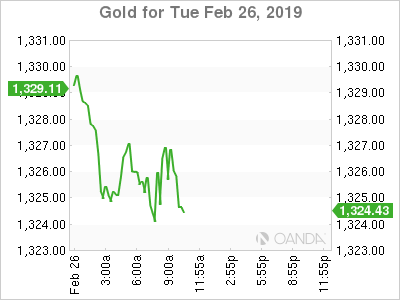
Gold remains in no man’s land. The precious metal’s tight range over the past few days could finally see a substantial move if Fed Chair Powell does not deviate from the dovish pivot that was announced in January.
OIL
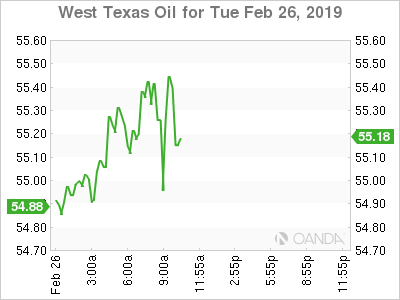
Crude prices are finding tentative support following yesterday’s plummet which stemmed from President Trump’s attack on OPEC driving oil prices higher. Despite the bounce, oil prices could remain vulnerable as oversupply concerns are likely to return as we approach the warmer months.
Japanese Yen Edges Higher as Inflation Within Expectations
USD/JPY has edged lower on Tuesday, erasing most of the gains made on Monday. In the North American session, the pair is trading at 110.80, down 0.23% on the day. On the release front, BoJ Core CPI edged up to 0.5%, just shy of the estimate of 0.6%. In the U.S., construction numbers were mixed. CB Consumer Confidence sparkled, with a score of 131.4, well above expectations. As well, the Richmond Manufacturing Index jumped to 16 points, a 5-month gain. All eyes are on Fed Chair Jerome Powell, who is testifying before the Senate Banking Committee. On Wednesday, Powell speaks before the House Financial Services Committee.
Investor enthusiasm over the U.S-China trade talks has cooled on Wednesday. President Trump had said that he would raise tariffs on Chinese goods from 10% to 25% on March 1, but hinted last week that the deadline was flexible. On Sunday, Trump tweeted that he was waiving the deadline, since the parties had made “significant progress”. Trump added that he was open to meeting with Chinese President Xi, if there was further progress. Although there is optimism that the sides will reach an agreement, there is some anxiety over the lack of any details about what a possible deal will look like. The U.S. has presented a wide range of demands, but it’s unclear what the Chinese will agree to and how any agreement will be enforced. Will the current set of tariffs be completely removed if a deal is reached? If not, market enthusiasm could evaporate, as the tariffs have caused enormous turmoil in international trade and dampened global growth.
The Federal Reserve will be back in the spotlight this week, as Fed Chair Jerome Powell testifies before congressional committees on Tuesday and Wednesday. The Fed has been decidedly dovish early in 2019, in sharp contrast to 2018, when the Fed raised rates four times in order to keep the red-hot U.S. economy from overheating. However, the global trade war has taken a bite out of global growth, and the U.S. economy is unlikely to repeat last year’s performance. The markets will be listening closely for hints regarding future interest rate policy.
GBPUSD Faces More Upside Pressure On Bullish Offensive
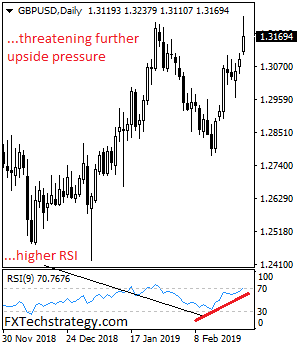
GBPUSD faces more upside pressure on bullish offensive. looks to recover further higher on bull pressure. Support stands at 1.3100 level. Further down, support comes in at the 1.3050 level where a break will turn focus to the 1.3000 level. Further down, support lies at the 1.2950 level. Below here will set the stage for more weakness towards the 1.2900 level. On the upside, resistance stands at the 1.3200 with a turn above here allowing for additional strength to build up towards the 1.3250 level. Further out, resistance stands at the 1.3300 level followed by the 1.3350 level. On the whole, GBPUSD faces further upside pressure on more strength.
Fed Powell: There were crosscurrents and conflicting signals in the past few months
In his prepared remark for semi-annual testimony to Congress, Fed chair Jerome Powell acknowledged "crosscurrents and conflicting signals" in the past few months. Financial markets became "more volatile" toward year-end. Financial conditions are now "less supportive". Also, growth slowed in some major foreign economies, "particularly China and Europe". And there is "elevated" uncertainty in issues including Brexit and trade negotiations.
Domestically, the US is facing "important longer-run challenges". Productivity "has been too low". Labor force participation among "prime-age men and women" is now lower in the US than in most other advanced economies. "relatively stagnant incomes", "lack of upward economic mobility" are also important challenges. Federal government debt is also on an "unsustainable path".
On monetary policy, Powell reiterated that "the extent and timing of any further rate increases would depend on incoming data and the evolving outlook." He noted that inflation pressure were "muted" in January. and the cumulative development warranted "taking a patient approach" to future policy changes. Also, Fed will evaluate the appropriate timing and approach for the end of balance sheet runoff. ahead.
(FED) Chairman Jerome H. Powell – Semiannual Monetary Policy Report to the Congress
Good morning. Chairman Crapo, Ranking Member Brown, and other members of the Committee, I am happy to present the Federal Reserve's semiannual Monetary Policy Report to the Congress.
Let me start by saying that my colleagues and I strongly support the goals Congress has set for monetary policy--maximum employment and price stability. We are committed to providing transparency about the Federal Reserve's policies and programs. Congress has entrusted us with an important degree of independence so that we can pursue our mandate without concern for short-term political considerations. We appreciate that our independence brings with it the need to provide transparency so that Americans and their representatives in Congress understand our policy actions and can hold us accountable. We are always grateful for opportunities, such as today's hearing, to demonstrate the Fed's deep commitment to transparency and accountability.
Today I will review the current economic situation and outlook before turning to monetary policy. I will also describe several recent improvements to our communications practices to enhance our transparency.
Current Economic Situation and Outlook
The economy grew at a strong pace, on balance, last year, and employment and inflation remain close to the Federal Reserve's statutory goals of maximum employment and stable prices‑‑our dual mandate.
Based on the available data, we estimate that gross domestic product (GDP) rose a little less than 3 percent last year following a 2.5 percent increase in 2017. Last year's growth was led by strong gains in consumer spending and increases in business investment. Growth was supported by increases in employment and wages, optimism among households and businesses, and fiscal policy actions. In the last couple of months, some data have softened but still point to spending gains this quarter. While the partial government shutdown created significant hardship for government workers and many others, the negative effects on the economy are expected to be fairly modest and to largely unwind over the next several months.
The job market remains strong. Monthly job gains averaged 223,000 in 2018, and payrolls increased an additional 304,000 in January. The unemployment rate stood at 4 percent in January, a very low level by historical standards, and job openings remain abundant. Moreover, the ample availability of job opportunities appears to have encouraged some people to join the workforce and some who otherwise might have left to remain in it. As a result, the labor force participation rate for people in their prime working years‑‑the share of people ages 25 to 54 who are either working or looking for work‑‑has continued to increase over the past year. In another welcome development, we are seeing signs of stronger wage growth.
The job market gains in recent years have benefited a wide range of families and individuals. Indeed, recent wage gains have been strongest for lower-skilled workers. That said, disparities persist across various groups of workers and different parts of the country. For example, unemployment rates for African Americans and Hispanics are still well above the jobless rates for whites and Asians. Likewise, the percentage of the population with a job is noticeably lower in rural communities than in urban areas, and that gap has widened over the past decade. The February Monetary Policy Report provides additional information on employment disparities between rural and urban areas.
Overall consumer price inflation, as measured by the 12-month change in the price index for personal consumption expenditures (PCE), is estimated to have been 1.7 percent in December, held down by recent declines in energy prices. Core PCE inflation, which excludes food and energy prices and tends to be a better indicator of future inflation, is estimated at 1.9 percent. At our January meeting, my colleagues and I generally expected economic activity to expand at a solid pace, albeit somewhat slower than in 2018, and the job market to remain strong. Recent declines in energy prices will likely push headline inflation further below the Federal Open Market Committee's (FOMC) longer-run goal of 2 percent for a time, but aside from those transitory effects, we expect that inflation will run close to 2 percent.
While we view current economic conditions as healthy and the economic outlook as favorable, over the past few months we have seen some crosscurrents and conflicting signals. Financial markets became more volatile toward year-end, and financial conditions are now less supportive of growth than they were earlier last year. Growth has slowed in some major foreign economies, particularly China and Europe. And uncertainty is elevated around several unresolved government policy issues, including Brexit and ongoing trade negotiations. We will carefully monitor these issues as they evolve.
In addition, our nation faces important longer-run challenges. For example, productivity growth, which is what drives rising real wages and living standards over the longer term, has been too low. Likewise, in contrast to 25 years ago, labor force participation among prime-age men and women is now lower in the United States than in most other advanced economies. Other longer-run trends, such as relatively stagnant incomes for many families and a lack of upward economic mobility among people with lower incomes, also remain important challenges. And it is widely agreed that federal government debt is on an unsustainable path. As a nation, addressing these pressing issues could contribute greatly to the longer-run health and vitality of the U.S. economy.
Monetary Policy
Over the second half of 2018, as the labor market kept strengthening and economic activity continued to expand strongly, the FOMC gradually moved interest rates toward levels that are more normal for a healthy economy. Specifically, at our September and December meetings we decided to raise the target range for the federal funds rate by 1/4 percentage point at each, putting the current range at 2-1/4 to 2-1/2 percent.
At our December meeting, we stressed that the extent and timing of any further rate increases would depend on incoming data and the evolving outlook. We also noted that we would be paying close attention to global economic and financial developments and assessing their implications for the outlook. In January, with inflation pressures muted, the FOMC determined that the cumulative effects of these developments, along with ongoing government policy uncertainty, warranted taking a patient approach with regard to future policy changes. Going forward, our policy decisions will continue to be data dependent and will take into account new information as economic conditions and the outlook evolve.
For guideposts on appropriate policy, the FOMC routinely looks at monetary policy rules that recommend a level for the federal funds rate based on measures of inflation and the cyclical position of the U.S. economy. The February Monetary Policy Report gives an update on monetary policy rules. I continue to find these rules to be helpful benchmarks, but, of course, no simple rule can adequately capture the full range of factors the Committee must assess in conducting policy. We do, however, conduct monetary policy in a systematic manner to promote our long-run goals of maximum employment and stable prices. As part of this approach, we strive to communicate clearly about our monetary policy decisions.
We have also continued to gradually shrink the size of our balance sheet by reducing our holdings of Treasury and agency securities. The Federal Reserve's total assets declined about $310 billion since the middle of last year and currently stand at close to $4.0 trillion. Relative to their peak level in 2014, banks' reserve balances with the Federal Reserve have declined by around $1.2 trillion, a drop of more than 40 percent.
In light of the substantial progress we have made in reducing reserves, and after extensive deliberations, the Committee decided at our January meeting to continue over the longer run to implement policy with our current operating procedure. That is, we will continue to use our administered rates to control the policy rate, with an ample supply of reserves so that active management of reserves is not required. Having made this decision, the Committee can now evaluate the appropriate timing and approach for the end of balance sheet runoff. I would note that we are prepared to adjust any of the details for completing balance sheet normalization in light of economic and financial developments. In the longer run, the size of the balance sheet will be determined by the demand for Federal Reserve liabilities such as currency and bank reserves. The February Monetary Policy Report describes these liabilities and reviews the factors that influence their size over the longer run.
I will conclude by mentioning some further progress we have made in improving transparency. Late last year we launched two new publications: The first, Financial Stability Report, shares our assessment of the resilience of the U.S. financial system, and the second, Supervision and Regulation Report, provides information about our activities as a bank supervisor and regulator. Last month we began conducting press conferences after every FOMC meeting instead of every other one. The change will allow me to more fully and more frequently explain the Committee's thinking. Last November we announced a plan to conduct a comprehensive review of the strategies, tools, and communications practices we use to pursue our congressionally assigned goals for monetary policy. This review will include outreach to a broad range of stakeholders across the country. The February Monetary Policy Report provides further discussion of these initiatives.
Thank you. I am happy to respond to questions.