Sample Category Title
UK PM May: There’ll be a second vote on Brexit deal, a vote on no-deal, then a vote on...
UK Prime Minister Theresa May announced three additional commitments in the parliament regarding Brexit. Firstly, there will be a second meaningful vote on the withdrawal agreement by March 12. Secondly, If the government loses the meaningful vote, on March 13, there will be a vote on whether to leave without a deal. And UK will only leave EU on March 29 without a deal, with explicit consent of the House.
Then, if both the withdrawal agreement and no-deal Brexit are voted down, there will be another vote on a short, limited extension to Article 50 on March 14. If the parliament passes the motion, the government will seek to get that extension. Though, May insisted that she doesn't not want to see Article 50 extension, and the focus is still on leaving on March 29.
https://www.youtube.com/watch?v=SdZhy0hI4k0
Into US session: Sterling breaks key resistance as UK PM May ready to rule out no-deal Brexit
Entering into US session, Sterling remains the overwhelmingly strongest one. It started as a rumor earlier today. But it's now widely reported that UK Prime Minister Theresa May is proposing to formally rule out a no-deal Brexit. There are many versions and one option is to have a vote on no-deal or Brexit delay for March 12 in the parliament, if the withdrawal agreement is voted down. May is due to speak soon and we'll quickly finally within an hour.
Technically, GBP/USD broken 1.3173/3217 key resistance zone. A head and should bottom would be formed if GBP/USD can sustain above this zone. EUR/GBP also broke key support level at 0.8617/20, resuming medium term decline.
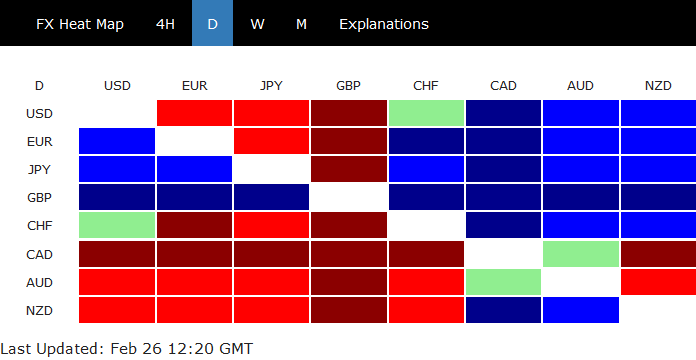
For now, Yen follows as the second strongest as global stock markets lose ground. Commodity currencies are all under pressure. Canadian Dollar is getting little help from oil prices, which is recovering from yesterday's low. Dollar is mixed awaiting Fed chair Jerome Powell's testimony.
In Europe, currently:
- FTSE is down -1.02%.
- DAX is down -0.29%.
- CAC is down -0.27%.
- German 10-year yield is up 0.0055 at 0.119.
Earlier in Asia:
- Nikkei dropped -0.37%.
- Hong Kong HSI dropped -0.65%.
- China Shanghai SSE dropped -0.67%.
- Singapore Strait Times dropped -0.33%.
- Japan 10-year JGB yield rose 0.0089 to -0.027.
Pound Gains On Brexit Postponement
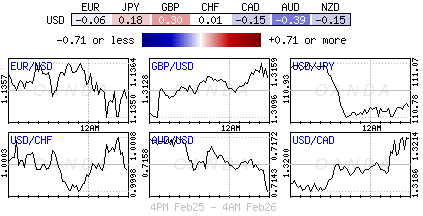
GBP appreciated against G10 currencies and by 0.70% against both the greenback and EUR, with the pound highest against the single currency since May 2017. Currently trading at 1.3172, GBP/USD is heading along 1.32 short-term.
Investors have decided to support Sterling, as the government is expected to rule out a no-deal Brexit and delay its exit beyond the official 29 March deadline. This should push opposition Labour party leader Jeremy Corbyn to request a second referendum on Brexit. So as far as major importers and exporters are concerned, fog is still in the Channel. Stockpiling has started, but we don’t see the Bank of England acting anytime soon.
A sell-off in both equities and treasuries suggest a deeper uncertainty. Caution should be exercised regarding GBP. Despite potential exclusion of a hard Brexit, nothing is solved, and the backing of a second referendum remains weak.
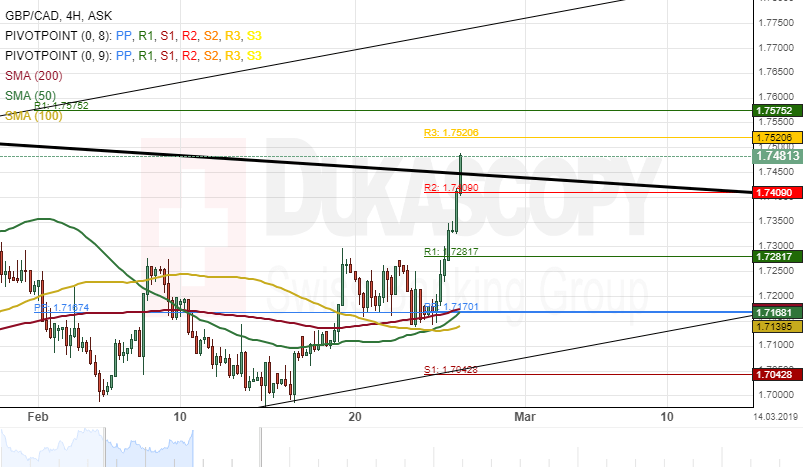
GBP/CAD 4H Chart: Short-Term Surge Expected
The British Pound has appreciated about 1.58% in values against the Canadian Dollar since last week. The currency pair was supported by a cluster formed by the of the weekly and the monthly PPs and the combination of the 50-,100 and 200-hour SMAs at 1.7170.
A for the near future, it is likely that the currency exchange rate continues its bullish movement. Buyers could push the pair towards the upper boundary of a dominant descending channel pattern at 1.7409.
Most likely, the GBP/CAD currency pair makes a brief retracement towards a psychological level of 1.7200 during the following trading sessions.
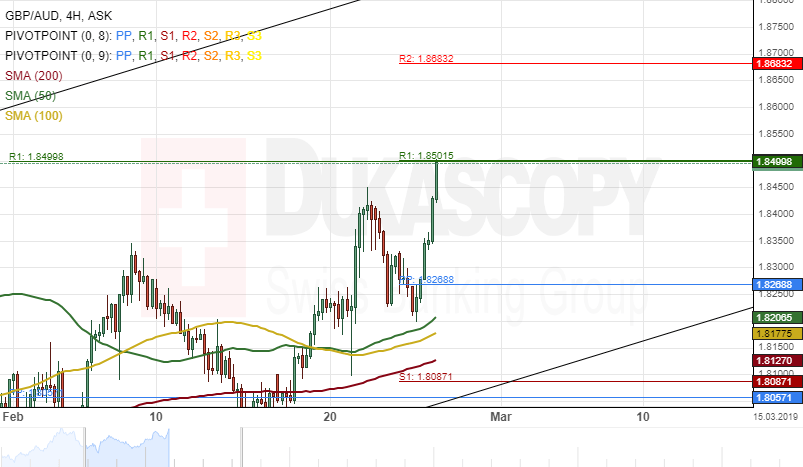
GBP/AUD 4H Chart: Bulls Market
The Pound Sterling increased by about 1.91% in values against the Australian Dollar during the last week. The currency pair breached February 8 swing high of 1.8350 during this short period.
Everything being equal, it is likely that the British Pound will continue to gain strength during the following trading sessions. Buyers could push the exchange rate towards a resistance cluster formed by the weekly and the monthly pivot points at 1.8501.
Meanwhile, technical indicators flash bullish signals on both the daily and weekly time frames.
GBP Currency Firmer On Speculation PM May To Delay The Brexit By A Few Months, Rule Out No-Deal Scenario
Notes/Observations
- Hopes of a softer Brexit; PM May said to consider plan to postpone Brexit
- Spain 15-year syndicate receiving strong demand; yields at 2-year lows
- Fed Chair Powell’s semi-annual testimony to Congress to be in focus
Asia:
- India said to have struck a terrorist camp in Pakistan side of Kashmir via its aircraft
- Pakistan Foreign Minister: India 'violated line of control'. Emergency meeting had been called by the PM to discuss Indian strikes. Pakistan reserved the right to reply
- China Banking and Insurance Regulatory Commission (CBIRC): Large state owned lenders loans to small and micro firms (for amounts CNY10M or less) to rise 30% y/y or more in 2019 v +21% in 2018
- BOJ Gov Kuroda: China economy had been slowing down, and very significantly since second half of 2018. Expected China growth to pick up in later half of 2019 as authorities take both fiscal and monetary simulative steps
- Japan PM Abe: Hopeful that Trump/Kim summit would lead to resolution of problems
Europe:
- PM May said to be considering plan to win over Remain MPs; she would offer vote on no-deal if she failed to get deal by March 12th; after that, there would be vote on Article 50 extension
- PM May said to consider plan to postpone Brexit. PM expected to allow her Cabinet to discuss extending the deadline beyond March 29th at a critical meeting on Tuesday, Feb 26th
- Labour Party spokesperson confirmed that if Parliament rejected Labour's Brexit plan, party would support a public vote on Brexit
Americas:
- Fed's Vice Chair Clarida (moderate, voter): Now was a good time to review Fed policy framework; Fed could afford to be patient with inflation remaining muted
Macro
- (US) United States: SF Fed Letter estimates a 0.10% increase in consumer price inflation so far due to tariffs on Chinese goods, and 0.4% for prices inflation of business investment goods. The study looked only at short-term, direct effects and did not consider supply adjustments, mark ups, or the responses of importers, domestic producers, and consumers. The Letter noted that an across-the-board 25% tariff on all Chinese imports would boost inflation by an additional 0.3%, and investment prices another 1.0%.
- (EU) Eurozone: The ECB's De Cos said slowing growth is posing a challenge for banks. The ECB then continues to appear to setting the stage for another round of TLTRO loans. De Cos added that reinvestments will continue to help the corporate bond market. Banks have been struggling with the negative interest rate environment for a while and as rate hikes are being pushed back, this will continue for longer than previously expected, which clearly also means ongoing pressure on profit margins.
- (UK) United Kingdom: PM Ma will reportedly now offer members of parliament the chance to delay the Brexit process beyond the March 29 deadline. The BBC reported that about a dozen Europhile ministers have threatened to resign unless this happens. Reports also suggest the Labour Party would back calls for a second referendum on EU membership if parliament rejects its alternative Brexit plan. There doesn't appear to be sufficient support in Parliament for a new referendum, though nothing can be ruled out at this juncture.
SPEAKERS/FIXED INCOME/FX/COMMODITIES/ERRATUM
Equities
- Indices [Stoxx600 % at #, FTSE -1.00% at 7,112.25, DAX -0.24% at 11,478.33, CAC-40 -0.27% at 5,217.61, IBEX-35 -0.32% at 9,174.72, FTSE MIB -0.05% at 20,426.50, SMI 0.00% at 9,402.70, S&P 500 Futures -0.23%]
Market Focal Points/Key Themes:
- European Indices trades lower across the board following weaker Asian Indices and weaker US Equity futures. The FTSE underperforms trading over 1% lower as Cable continues to strength approaching the 1.32 handle.
- On the corporate front German chemical giant BASF trades over 3% higher as Op profit and Revenue handily beat forecasts and estimates slightly higher sales and EPS growth for 2019. French Car manufacturer trades over 3% lower on earnings and the announcement its to launch its Peugeot brand in the US and Canada. Elsewhere Fincantieri, James Fisher, Devro trades higher on earnings with UK home builders Travis Perkins and Persimmon also higher on earnings. Meanwhile Fresnillo, Implenia, Babcock, Drax Group, Aixtron and Thales are among the names trading lower on earnings.
- In other news Santhera continues to rise up another 45% after yesterday's Syros study update, Implenia trades lower on earnings and the announcement of a new CEO.
Looking ahead notable earners include retailers Home Depot, Macy's Autozone as well as Thomson Reuters and Canadian Banking names Bank of Nova Scotia and Bank of Montreal among others.
Equities
- Consumer discretionary: Travis Perkins [TPK.UK] +2% (earnings), Brown (N) Group [BWNG.UK] -0.5% (CEO appointed), Persimmon [PSN.UK] +2% (earnings; appoints Global Chief Executive)
- Financials: Swiss Life [SLHN.CH] n/c (earnings), Standard Chartered [STAN.UK] -1% (earnings)
- Industrials: PSA [UG.FR] -5% (earnings; raises dividend and targets; to expand brand to Northern America), Babcock [BAB.UK] -5% (trading update), Thales [HO.FR] -2% (earnings), Implenia [IMPN.CH] -7% (earnings), Aixtron [AIXA.DE] -8% (earnings), James Fisher & Sons [FSJ.UK] +2.5% (earnings), Meggitt [MGGT.UK] -2.5% (earnings)
- Materials: Fresnillo [FRES.UK] -8% (earnings)
Speakers
- ECB’s Lane (Ireland) stated that data-dependent strategy to provide flexibility. Remained confident that underlying mechanism to raise inflation was still active. He only saw small adjustments to ECB Staff forecasts
- EU High Court overruled Latvia suspension of central bank gov Rimsevics as part of a bribery probe
- BOE to perform 6-month GBP-enhanced liquidity repo operation (ILTR) on a weekly basis from March 12th (move to step up Brexit liquidity operation for banking sector)
- BOE Gov Carney with members Ramsden, Vlieghe and Haskel testified to Treasury Select Committee. Gov Carney stated that was not seeing any liquidity stresses in market and the announced extra liquidity plans were cautionary. Fundamentals of the domestic economy was strong and reiterated its forward guidance that gradual rate hikes would be needed if economy developed as forecast
- BOE Member Ramsden: Comfortable with BOE guidance on interest rates
- BOE Member Vlieghe: Direction of rate move in a no-deal Brexit to be a trade-off between supporting the economy and stopping temporary inflation overshoot
- BOE Member Haskel: Agree with collective view that policy could move in either direction in a no-deal Brexit scenario. Would need to distinguish between temporary and longer-term disruption in a no-deal outcome
- UK Govt official Lidington (de facto Dep PM): In the national interest for Cabinet to get behind PM May's Brexit deal
- Italy Dep PM Salvini (League) reiterated stance that Govt to last 5 years and saw no need for any budget adjustment
- Spain Fin Min Calvino: Domestic economy doing well; upcoming elections will not affect performance
- Hungary Central Bank (MNB) Gov Matolcsy stated in parliament that it had achieved financial and price stability as macro data was showing substantial improvement
- Poland Central Bank Zyzynski stated that he fully backed a steady policy until 2022. He cautioned that the govt fiscal stimulus might spur rate hike talk as it could boost domestic growth
- German BDI Industry Association: Contingency measures taken by politicians and companies can help to water down the worst effects of a disorderly Brexit but situation would still have an impact. Hard Brexit could shave off 0.5% to German GDP
- China Foreign Ministry Spokesman Lu Kang: to prepare for potential Xi-Trump meeting
Currencies/ Fixed Income
- USD was hovering near 1-month lows but well contained within recent quarterly ranges for the major pairs. Fed Chair Powell’s semi-annual testimony to Congress to be in focus given the recent dovish tone of the central bank.
- British pound (GBP) was firmer to test 1-month highs just under the 1.32 area on speculation PM May would propose to formally rule out a ‘no-deal’ Brexit. PM May seen opening the way for a short Brexit delay. If the meaningful vote by, likely on March 12th, failed, Parliament would be given a second vote on leaving with no deal or delaying Brexit which would almost certainly result in delay and this now appeared the most likely path forward. EUR/GBP cross at 21-month lows as it tested 0.8615 area.
- Indian Rupee (INR) weighed down by geopolitical concerns related to Pakistan. USD/INR at 71.05 (Rupee softer by 0.2%)
Economic Data
- (N)) Norway Q1 Consumer Confidence Index: 12.7 v 14.2 prior
- (DE) Germany Mar GfK Consumer Confidence: 10.8 v 10.8e
- (NL) Netherlands Jan House Price Index M/M: +1.8% v -0.6% prior; Y/Y: 8.7% v 8.4% prior
- (FI) Finland Jan Unemployment Rate: 6.8% v 5.4% prior
- (FI) Finland Jan Preliminary Retail Sales Volume Y/Y: -1.3% v -0.1% prior
- (ZA) South Africa Dec Leading Indicator: 105.2 v 105.7 prior
- (FR) France Feb Consumer Confidence: 95 v 92e
- (TW) Taiwan Jan Industrial Production Y/Y: -1.9% v -1.7%e
- (TW) Taiwan Jan Unemployment Rate: 3.7% v 3.7%e
- (TW) Taiwan Jan M2 Money Supply Y/Y: 3.1% v 3.1% prior; M1 Money Supply Y/Y: 6.6% v 5.7% prior
- (HK) Hong Kong Jan Trade Balance (HKD): -10.3B v -30.1Be; Exports Y/Y: -0.4% v -2.8%e; Imports Y/Y: -6.0% v -2.2%e
- (AT) Austria Feb Manufacturing PMI: 51.8 v 52.7 prior (37th month of expansion)
- (UK) Jan BBA Loans for Housing (unadj): 29.2K v 26.2K prior
Fixed Income Issuance
- (ES) Spain Debt Agency (Tesoro) opened its book to sell €5.0B in July 2035 SPGB bond via syndicate; guidance seen +85bps to mid-swaps
- (ZA) South Africa sold total ZAR2.85B vs. ZAR2.85B indicated in 2023, 2030 and 2048 bonds
- (IT) Italy Debt Agency (Tesoro) sold €6.0B vs. €6.0B indicated in 6-month bills; Avg Yield: -0.007% v -0.025% prior; Bid-to-cover: 1.65x v 1.82x prior
- (CH) Switzerland sold CHF504.1M in 3-month Bills; Avg Yield: -0.781% v -0.774% prior
Looking Ahead
- (PT) Portugal Year-to-Date Budget Report
- (ID) Indonesia to sell IDR15.0T in 3-month, 6-month Islamic Bills, 5-year, 10-year, 15-year and 20-year bonds
- 05:30 (UK) Weekly John Lewis LFL Sales data
- 05:30 (EU) ECB allotment in 7-Day Main Refinancing Tender (MRO)
- 05:30 (HU) Hungary Debt Agency (AKK) to sell in 3-month Bills
- 05:30 (DE) Germany to sell €5.0B in new 0% Mar 2021 Schatz
- 05:30 (UK) DMO to sell £1.1B in 0.125% Index-linked 2028 Gilt
- 06:00 (FI) Finland to sell 3-month and 6-month Bills
- 06:45 (US) Daily Libor Fixing
- 07:30 (UK) PM May to update Parliament on Cabinet meeting
- 07:45 (US) Weekly Chain Store Sales data
- 08:00 (HU) Hungary Central Bank (MNB) Interest Rate Decision: expected to leave Base Rate unchanged at 0.90% and leave Overnight Deposit Rate unchanged at -0.15%
- 08:00 (BR) Brazil Jan Total Federal Debt (BRL): No est v 3.877T prior
- 08:00 (UK) Baltic Dry Bulk Index
- 08:00 (RU) Russia announces upcoming OFZ Bond issuance
- 08:30 (US) Dec Housing Starts: 1.256Me v 1.256M prior; Building Permits: 1.290Me v 1.322M prior (revised from 1.328M)
- 08:30 (BR) Brazil Jan Total Outstanding Loans (BRL): No est v 3.260T prior; M/M: No est v 1.8% prior
- 08:55 (US) Weekly Redbook Retail Sales data
- 09:00 (US) Dec S&P Case-Shiller House 20-City M/M: 0.30%e v 0.30% prior; Y/Y: 4.50%e v 4.68% prior; House Price Index (HPI): No est v 213.66 prior
- 09:00 (US) Dec S&P Case-Shiller (overall) YoY: No est v 5.19% prior; Overall HPI Index: No est v 205.85 prior
- 09:00 (US) Dec FHFA House Price Index M/M: 0.4%e v 0.4% prior; Q/Q: No est v 1.3% prior
- 09:00 (MX) Mexico Dec Retail Sales M/M: -1.0%e v +0.4% prior; Y/Y: 2.7%e v 3.4% prior
- 09:00 (EU) Weekly ECB Forex Reserves
- 09:00 (HU) Hungary Central Bank (MNB) Gov Matolcsy to hold his post rate decision statement
- 09:30 (LX) ECB’s Mersch (Luxembourg)
- 10:00 (US) Feb Richmond Fed Manufacturing Index: +5e v -2 prior
- 10:00 (US) Feb Consumer Confidence: 124.9e v 120.2 prior
- 10:00 (US) Fed Chair Powell testifies before Senate Banking Committee (Semi-annual testimony)
- 10:00 (MX) Mexico weekly International Reserves
- 11:30 (US) Treasury to sell 52-week Bills
- 13:00 (US) Treasury to sell 7-year notes
- 14:00(US) Fed Discount rate minutes
DAX Dips As Investor Optimism Over Trade Talks Cools
The DAX has edged lower in the Tuesday session. Currently, the DAX is at 11,469, down 0.31% on the day. In economic news, the sole event was German GfK Consumer Confidence. The indicator remained steady, with a second straight gain of 10.8 points.
The optimism over the trade war between the U.S. and China has boosted global stock markets, as risk appetite has risen on the hope that the sides will reach an agreement. The parties concluded a fourth round of talks last week and President Trump has said that the U.S. will not impose new tariffs on China on March 1, crediting 'substantial progress' in the negotiations. There is even talk of a meeting between Trump and Chinese President Xi at the end of March, if an agreement is reached. Some analysts have declared that an agreement could fuel a stock market rally as much as 10 percent. Still, with almost no news about the substance of the talks, there are plenty of question marks. It remains unclear if China will agree to substantial structural changes in trade, as demanded by the United States. Will the current set of tariffs be completely removed if a deal is reached? If not, market enthusiasm could evaporate, as the tariffs have caused enormous turmoil in international trade and dampened global growth.
Investors may be excited about an end to the U.S-China trade spat, but there has been little to cheer about on the domestic front. German data disappointed last week, raising concerns that after a slowdown in the fourth quarter, Q1 will also be a soft quarter. On Friday, Germany’s fourth-quarter GDP showed no change, after a contraction of 0.2% in the third quarter. The Ifo Business Climate survey slowed for a sixth successive month, indicating concern in the business sector about the country’s economic outlook. Manufacturing and inflation data also disappointed. The manufacturing PMI contracted for a second straight month, while German CPI declined in January for the first time in a year. If the weak numbers continue, investor risk appetite could fall and weigh on the DAX.
WTI Oil Outlook: WTI Pauses After Strong Fall But Risk Of Deeper Fall Exists As Sentiment Weakened After Trump’s...
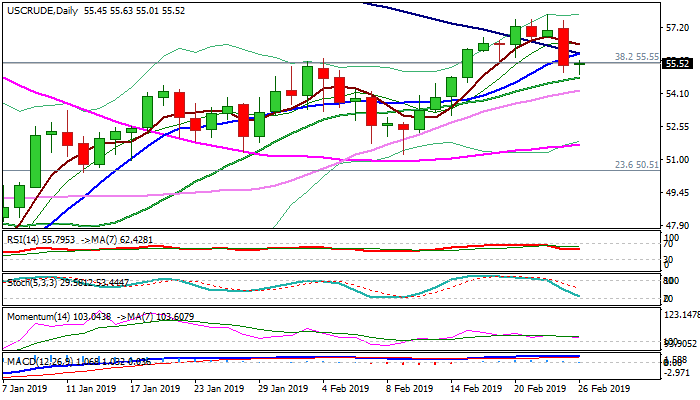
WTI oil ticked higher from new 1 ½ week low at $55.01 on Tuesday, following 3% fall on Monday, which marked the biggest one-day loss since 24 Dec.
Oil prices came under increased pressure after President Trump’s message to OPEC, in which he pointed to too high oil prices and urged the cartel to curb efforts to further boost prices.
Fresh bears surged through 100SMA and generated further bearish signal on marginal close below broken Fibo barrier at $55.55 (38.2% of $76.88/$42.36) and brief probe below pivotal support at $55.28 (Fibo 38.2% of $51.23/$57.79).
Dip found footstep just above rising 20SMA ($54.84), but lack momentum for stronger recovery.
While the price holds below falling 100SMA ($55.98), risk for further weakness is expected to remain in play.
Sustained break below cracked $55.28) Fibo support would add to negative signals, with loss of 20SMA needed to confirm negative near-term stance and risk fresh bearish acceleration towards $54.23 (30SMA) and $53.74 (Fibo 61.8% of $51.23/$57.79) in extension.
Traders will look for release of US crude stocks reports (API, due later today and EIA on Wednesday) for fresh signals.
Res: 55.63, 55.98, 56.41, 57.51
Sup: 55.28, 55.01, 54.51, 54.23
Eurozone Inflation Expected To Edge Up, But No Improvement Anticipated In Economic Sentiment
Economic releases out of Europe this week are unlikely to offer much new insight into the Eurozone economy but will nevertheless be watched closely as the European Central Bank’s March policy meeting nears. The European Commission’s economic sentiment gauge is up first on Wednesday at 10:00 GMT, with the flash inflation print following on Friday, also at 10:00 GMT. The euro, which has been largely moving sideways since November, will probably struggle to break out of this range.
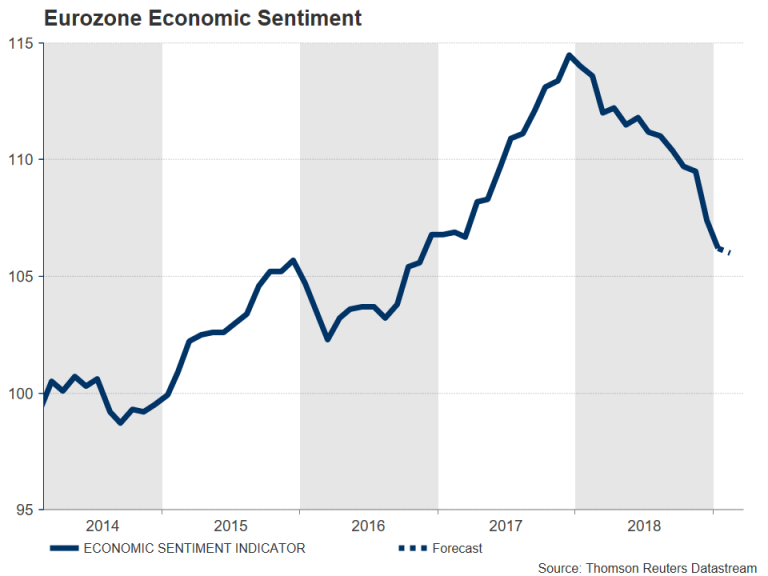
The economic sentiment index had fallen to a more than two-year low of 106.2 in January, reflecting the fast-deteriorating economic environment in the euro area. While a turnaround is not being predicted just yet in February, there have been some signs that the deceleration in the growth momentum may be bottoming out. The economic sentiment indicator is forecast to drop by 0.2 points to 106.0 in February.
The flash February PMIs released last week also pointed to a steadying picture, in the services sector at least, although many would argue it’s too soon to price out the risk of a recession just yet.
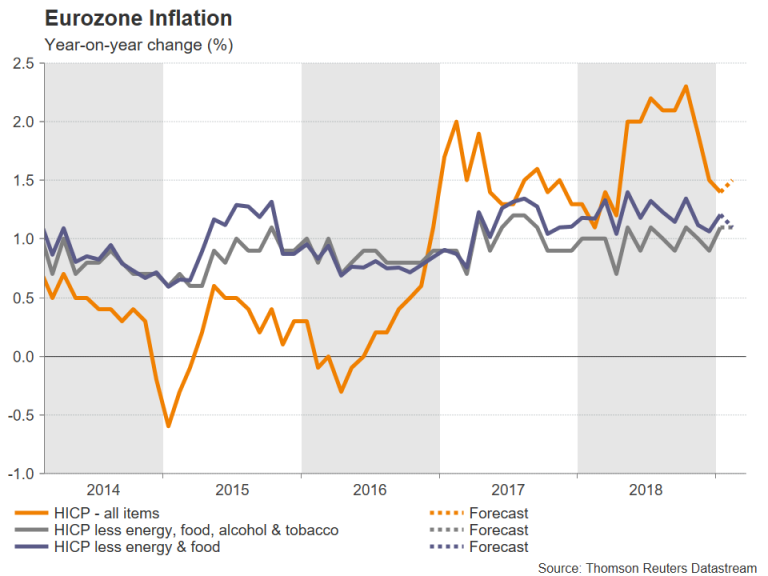
The ECB, which next meets on March 7, might have something positive to talk about, though, if Eurozone inflation turns higher in February as expected. The flash reading of the harmonised consumer price index (HICP) is projected to rise from 1.4% to 1.5% year-on-year in February.
However, rather frustratingly for the central bank, there’s not likely to be much progress with underlying inflation. The two core measures, HICP excluding food and energy and HICP excluding food, energy, alcohol and tobacco, are both forecast to come in at 1.1% y/y. Underlying inflation has been stubbornly stuck around 1% since 2015, persistently falling short of the ECB’s target of close to but below 2%.
The ECB is widely anticipated to discuss at their next meeting whether to launch a new round of cheap long-term loans for Eurozone banks in order to stimulate lending in the region. The extent and depth of the Eurozone slowdown has taken policymakers by surprise, who last year ended their bond buying program on the expectations that growth would quickly bounce back. The ECB is also seen as tiptoeing towards pushing back its timeline of beginning to raise interest rates after the summer.
A stronger-than-forecast set of figures next week are unlikely to alter expectations about a new cheap finance scheme by the ECB but may provide the euro with some support, especially as the US dollar comes under pressure from the receding trade tensions.
Euro/dollar could break above immediate resistance at the 50% Fibonacci retracement of the downleg from 1.1515 to 1.1231 at 1.1373 if the data surprise to the upside. This could be a difficult barrier to overcome as the 200-period moving average (MA) is also close to this level in the 4-hour chart, making the 1.1370-1.1375 region a potentially critical resistance zone. Clearing this area would open the way for the 61.8% Fibonacci at 1.1407.
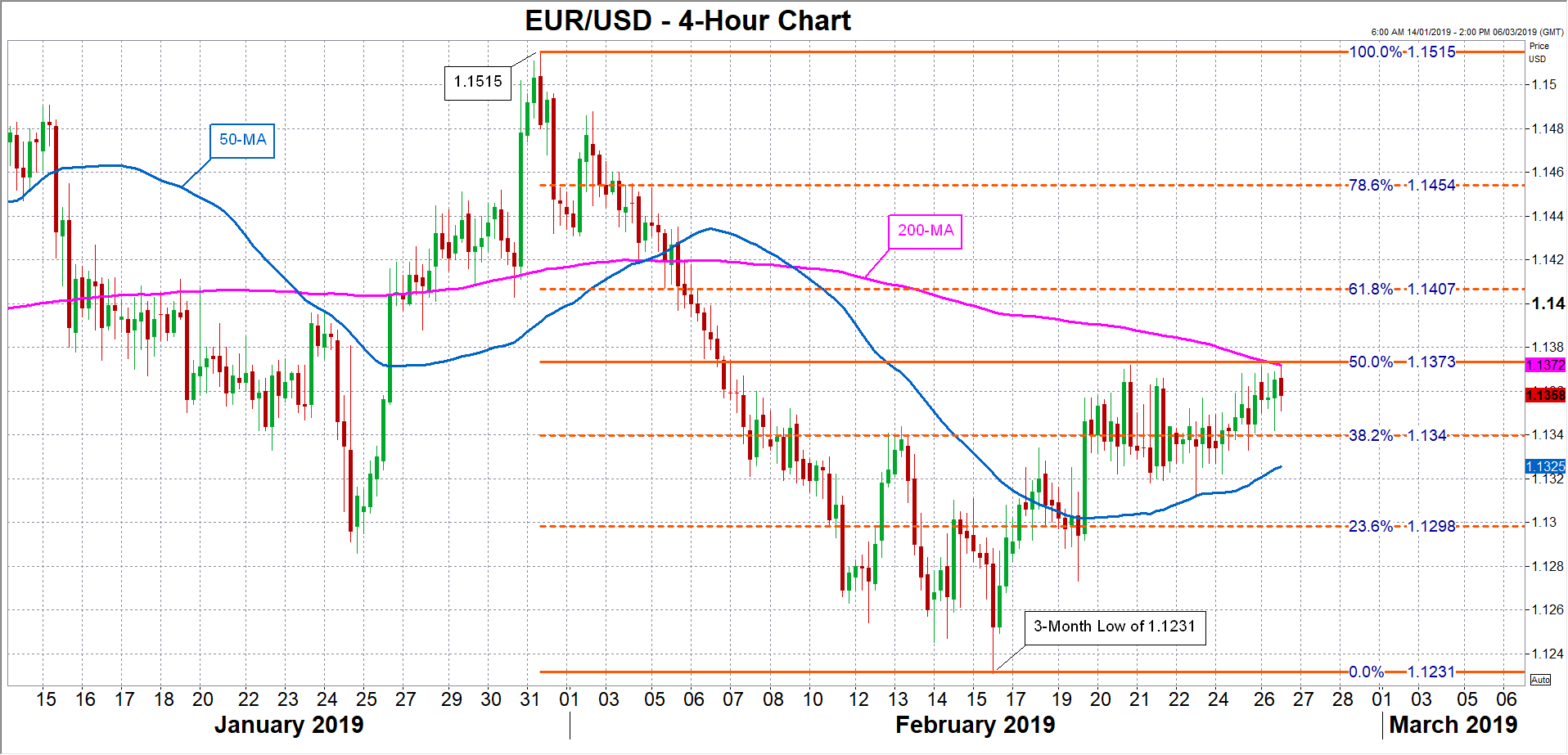
However, any weakness in either the economic sentiment or inflation numbers could erase the euro’s soft bullish bias in the near term. Euro/dollar could slip below immediate support around the 38.2% Fibonacci at 1.1340. This would bring the 50-period MA into range, presently at 1.1325, while deeper losses could see the 1.13 handle being tested as it’s near the 23.6% Fibonacci at 1.1298.
Sterling Finds Support On Brexit Delay Talk
Tuesday February 26: Five things the markets are talking about
Global equities are trading under pressure in the overnight session, while sovereign bond prices have found a bid as investors pare back a portion of their initial euphoria surrounding the Sino-U.S trade talks. The pound (£1.3208) has found its ‘sea legs’ after U.K PM Theresa May is said to be considering a plan to delay Brexit.
Brexit agenda
PM May is expected to allow her cabinet to discuss extending the deadline beyond March 29 at a meeting this morning and then reveal the cabinet’s conclusions in an announcement to Parliament later (07:30 am ET).
On the central bank front, Fed Chair Powell will deliver his semi-annual testimony on monetary policy and the state of the U.S economy over the next two-days (Feb 26/27) to House and Senate committees. In addition, several of his colleagues will also be speaking this week.
Elsewhere, crude oil prices have extended their losses after tumbling the most in over a month so far this week on criticism from President Trump that prices are too high.
On tap: U.S consumer confidence at 10 am EDT and New Zealand trade balance (04:45 pm ET). President Trump and North Korea leader Kim Jong Un are expected to meet later today for a second summit.
1. Stocks see red
In Japan, the Nikkei share average closed a tad weaker overnight, under selling pressure ahead of Japan’s fiscal year-end in March. The Nikkei ended the session down -0.37%, while the broader Topix shed -0.23%.
Down-under, Aussie shares have snapped a three-session winning streak overnight, with financials and resources stocks leading broad-based losses. The S&P/ASX 200 index fell -0.9% at the close of trade, its worst session in nearly eight-weeks. The benchmark rallied +0.3% yesterday. In S. Korea, the Kospi index traded essentially flat at -0.15%.
In China, stocks fell overnight in heavy volume as a percentage of investors took profits on heavyweight financial shares, believing that Monday’s “spectacular surge” is unsustainable. The CSI300 settled down -1.2% lower, while the Shanghai Composite Index fell -0.7%. The CSI300’s rise in yesterday’s session was its biggest one-day gain in three-years.
In Hong Kong it was a similar story. Stocks fell, tracking other regional bourses, as investors waited to see if the U.S and China can clinch a trade deal. At the close, the Hang Seng index fell -0.7%, while the China Enterprises Index lost -0.8%.
In Europe, regional indexes are following suit and trade lower along with Asia. However, the U.K’s FTSE 100 index is underperforming its regional counterparts, falling -1% as the sterling rallies against both the dollar and the EUR.
U.S stocks are set to open in the ‘red’ (-0.23%).
Indices: Stoxx600 % at #, FTSE -1.00% at 7,112.25, DAX -0.24% at 11,478.33, CAC-40 -0.27% at 5,217.61, IBEX-35 -0.32% at 9,174.72, FTSE MIB -0.05% at 20,426.50, SMI 0.00% at 9,402.70, S&P 500 Futures -0.23%
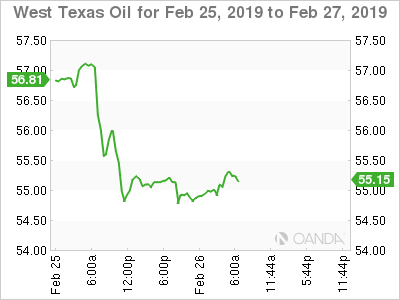
2. Oil eases after Trump urges OPEC to curb prices, gold unchanged
Oil prices are again a tad lower, extending yesterday’s losses of more than -3% after President Trump called on OPEC+ to rein in its efforts to boost prices.
Brent futures are at +$64.70 a barrel, down -6c, or -0.1% from Monday’s close, while U.S West Texas Intermediate (WTI) crude futures are at +$55.26 per barrel, down -22c, or -0.4%.
Note: Brent plunged -3.5% in yesterday’s session.
Tweeting yesterday, President Trump expressed his concern about higher oil prices (supported by production cuts) and repeated his previous calls on OPEC+ to keep prices steady.
Aiding Trumps tactics is the fact that oil markets were trading higher on Sino-U.S trade optimism. With some investors cashing in on the recent equity rally overnight have naturally put commodity prices on the back foot.
However, sanctions by the U.S against oil exporters Iran and Venezuela have contributed to the recent gains and should also provide a floor for prices.
Ahead of the U.S open, the ‘yellow’ metal is little changed despite President Trump stating that he would delay an increase in tariffs on Chinese goods. Spot gold is flat at +$1,327.40 per ounce, while U.S gold futures are steady at +$1,329.9 per ounce.
Elsewhere, Palladium hit a record high this morning, surging above +$1,550 as a threatened strike by South African mineworkers added to supply concerns in an already tight market.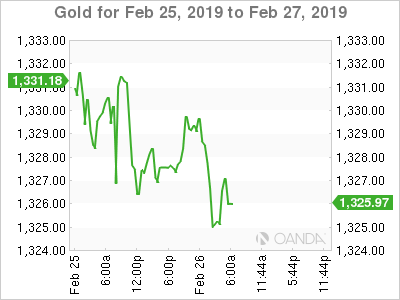
3. French yields at two-year low as “yellow vest” effect wanes
In this morning’s Euro session, France’s 10-year government bond yield has dropped to its lowest level in over two-years as the effect of the country’s “yellow vest” protests fade. Also aiding French bond prices is the fact that French President Macron’s popularity has recovered to levels not seen since the protests broke out three-months ago.
Elsewhere, broader eurozone yields are under pressure from next week’s European Central Banks (ECB) monetary policy expectations.
French 10-yea yields have dropped to +0.506%, down nearly -2 bps in the session, while the German 10-year Bund yield are hovering atop of the +0.10% mark, slightly lower on the day.
Fixed income traders will take their cue from the Fed this morning (09:45 am ET). Fed chair Jerome Powell will testify to the U.S Senate on the semi-annual monetary policy report before the Senate Banking Committee. Markets will be looking for signs on potential interest rate hikes this year and that U.S policymakers will stop running down the central bank’s balance sheet.
The yield on 10-year Treasuries has declined -1 bps to +2.65%, while in the U.K, the 10-year Gilt yield has advanced less than +1 bps to +1.18%.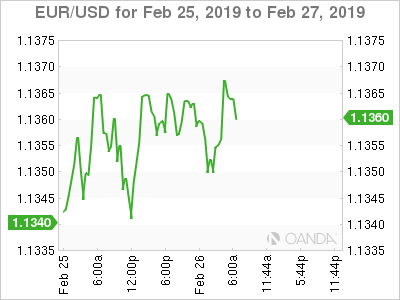
4. Sterling finds support on Brexit delay talk
The pound is rallying after reports that U.K PM Theresa May is considering a plan to delay the country’s scheduled departure from the EU next month. Sterling (£1.3203) was recently +0.7% stronger against the U.S dollar.
With a little more than a month to go before the UK’s scheduled exit from the E.U, lawmakers have yet to settle on a deal with the bloc. Yesterday, the Labour Party said it would be prepared to back a second Brexit referendum, adding to uncertainty about the path the UK will take in the coming weeks.
Elsewhere, the ‘big’ dollar continues to hover atop of its one-month lows (C$1.3207, €1.1362, ¥110.86) and seems well contained within recent quarterly ranges for G10 currency pairs.
Dealers have shifted their focus to Fed Chair Powell’s semi-annual testimony to Congress – will we hear more ‘dovish’ comments from the central banker?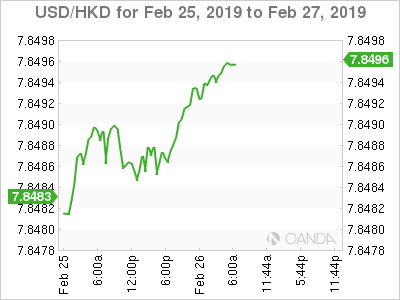
5. Hong Kong exports down for a third consecutive month
Data earlier this morning showed that Hong Kong’s export-oriented economy suffered further from Sino-U.S trade tensions as outbound shipments fell year-over-year for a third consecutive month in January.
The headline print showed a -0.4% decline which was still better that the December -0.5% drop.
The city’s government says the external environment is “still challenging,” noting moderating economic growth in many key trading partners will likely weigh on Hong Kong’s merchandise exports near-term.
Note, imports dropped -6% from January 2018.