Sample Category Title
Euro-Zone’s Industrial Production Declined For The Second Consecutive Month In December
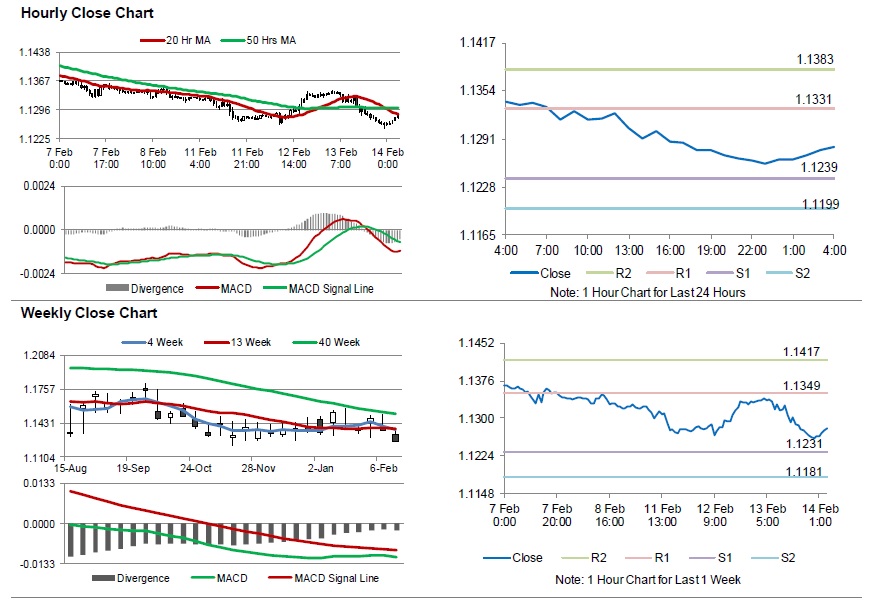
For the 24 hours to 23:00 GMT, the EUR declined 0.65% against the USD and closed at 1.1259.
On the data front, the Euro-zone's seasonally adjusted industrial production fell for the second consecutive month by 0.9% on a monthly basis in December, more than market expectations for a drop of 0.4%. In the prior month, industrial production had registered a fall of 1.7%.
The US dollar rose against a basket of currencies yesterday, following stronger than expected US inflation data.
In the US, data indicated that the US consumer price index advanced 1.6% on an annual basis in January, surpassing market expectations for a rise of 1.5% and compared to a rise of 1.9% in the prior month. Additionally, average hourly earnings rose 1.7% on a yearly basis in January, compared to a gain of 1.3% in the prior month. Meanwhile, the nation's mortgage applications dropped 3.7% on a weekly basis in the week ended 08 February 2019, declining for the fourth straight week regardless of weak borrowing costs and marking its lowest level in 11 months. Mortgage applications had recorded a decline of 2.5% in the prior week. Moreover, monthly budget deficit narrowed less than market forecast to $13.50 billion in December, compared to a deficit of $23.20 billion in the prior month.
In the Asian session, at GMT0400, the pair is trading at 1.1280, with the EUR trading 0.19% higher against the USD from yesterday's close.
The pair is expected to find support at 1.1239, and a fall through could take it to the next support level of 1.1199. The pair is expected to find its first resistance at 1.1331, and a rise through could take it to the next resistance level of 1.1383.
Going ahead, traders would closely monitor both the Eurozone and Germany's gross domestic product for the fourth quarter, scheduled to release in a few hours. Later in the day, the US producer price index for January, advance retail sales for December and business inventories for November, along with the US initial jobless claims will be on investors radar.
The currency pair is showing convergence with its 20 Hr moving average and trading below its 50 Hr moving average.
UK’s Consumer Price Inflation Slowed To A Two-Year Low Level In January
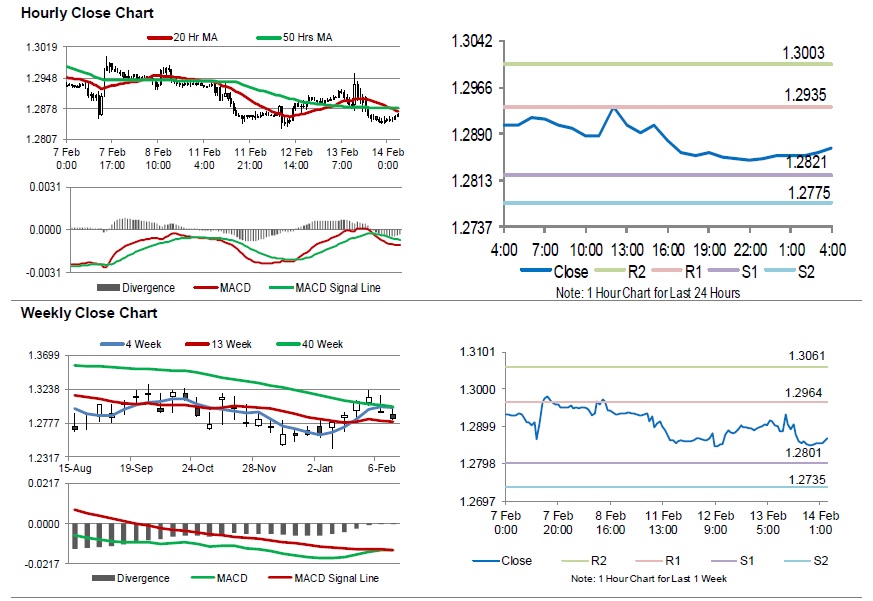
For the 24 hours to 23:00 GMT, the GBP declined 0.34% against the USD and closed at 1.2850, after UK's consumer price inflation (CPI) slowed to a two-year low level of 1.8% on a yearly basis in January, weighed down by falling energy prices and compared to a climb of 2.1% in the prior month. Market had anticipated the CPI to record a reading of 1.9%.
Other data showed that the nation's retail price index rose 2.5% on an annual basis in January, compared to a gain of 2.7% in the preceding month. Additionally, the house price index climbed 2.5% on an annual basis in January, meeting market expectations. The index had recorded a revised rise of 2.7% in the previous month. Also, the non-seasonally adjusted output producer price index (PPI) advanced 2.1% on an annual basis in January, compared to a revised rise of 2.4% in the preceding month. Markets had expected the PPI to climb to 2.2%.
In the Asian session, at GMT0400, the pair is trading at 1.2866, with the GBP trading 0.12% higher against the USD from yesterday's close.
Overnight data revealed that UK's RICS house price balance declined to -22.0% in January, higher than market consensus for a drop to -20.0%. In the previous month, house price balance had registered a reading of -19.0%.
The pair is expected to find support at 1.2821, and a fall through could take it to the next support level of 1.2775. The pair is expected to find its first resistance at 1.2935, and a rise through could take it to the next resistance level of 1.3003.
Amid lack of macroeconomic releases in UK, traders would focus on global macroeconomic releases for further directions.
The currency pair is trading below its 20 Hr and 50 Hr moving averages.
Japan’s Annualised Gross Domestic Product Climbed As Estimated In 4Q 2018
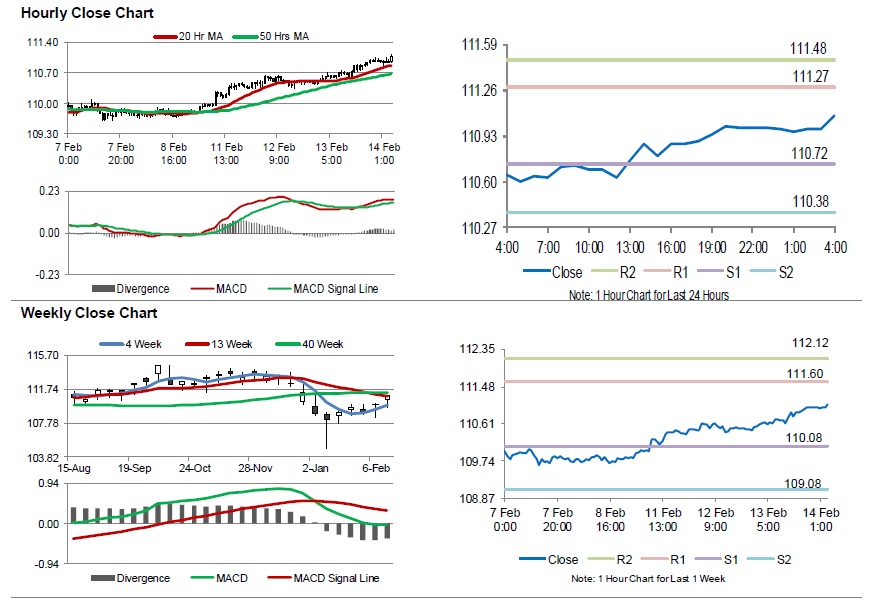
For the 24 hours to 23:00 GMT, the USD rose 0.49% against the JPY and closed at 110.99.
In the Asian session, at GMT0400, the pair is trading at 111.07, with the USD trading 0.07% higher against the JPY from yesterday's close.
Overnight data revealed that Japan's preliminary annualised gross domestic product (GDP) rebounded 1.4% on a quarterly basis in the fourth quarter of 2018, at par with market expectations. GDP had recorded a decline of 2.5% in the previous quarter.
The pair is expected to find support at 110.72, and a fall through could take it to the next support level of 110.38. The pair is expected to find its first resistance at 111.27, and a rise through could take it to the next resistance level of 111.48.
The currency pair is trading above its 20 Hr and 50 Hr moving averages.
US Inventory Rose More than Expected. Yet, Crude Oil Price Strengthened on US-China Trade Hopes
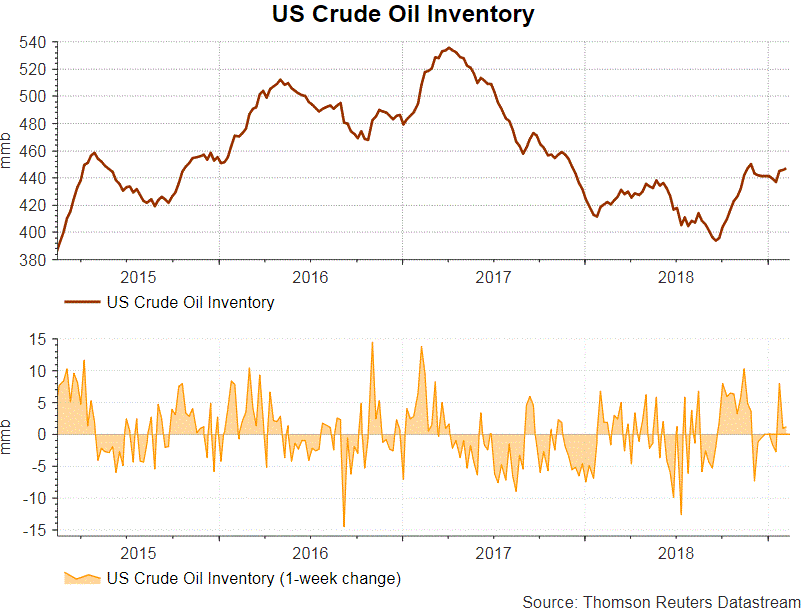
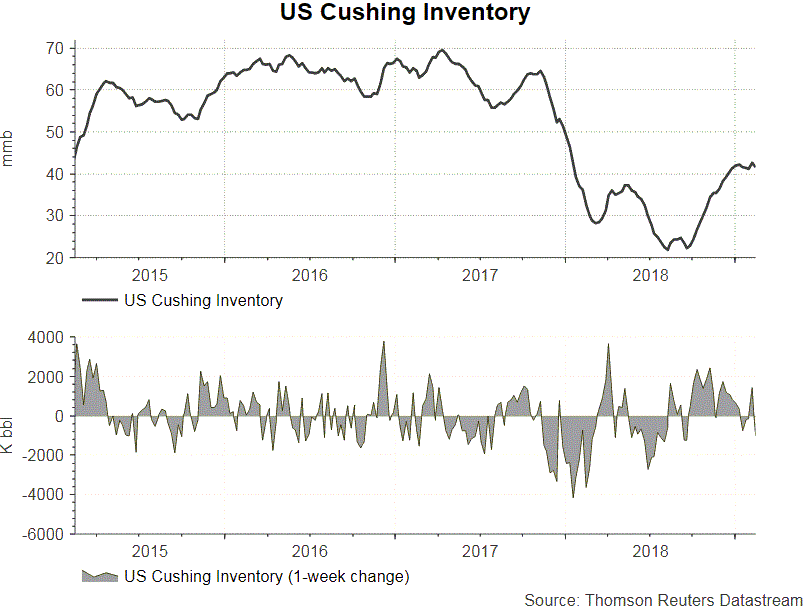
The report from the US Energy Information Administration (EIA) shows that total crude oil and petroleum products (ex. SPR) stocks jumped +6.53 mmb to 1265.51 mmb in the week ended February 8. Crude oil inventory added +3.63 mmb to 450.84 mmb (consensus: +2.67 mmb). Inventories increased in 3 out of 5 PADDs. Meanwhile, Cushing stock dropped -1.02 mmb to 41.61 mmb. Utilization rate plunged -4.8% to 85.9% and crude production steadied at 11.9M bpd for the week. Crude oil imports fell -0.94M bpd to 6.21M bpd in the prior week.
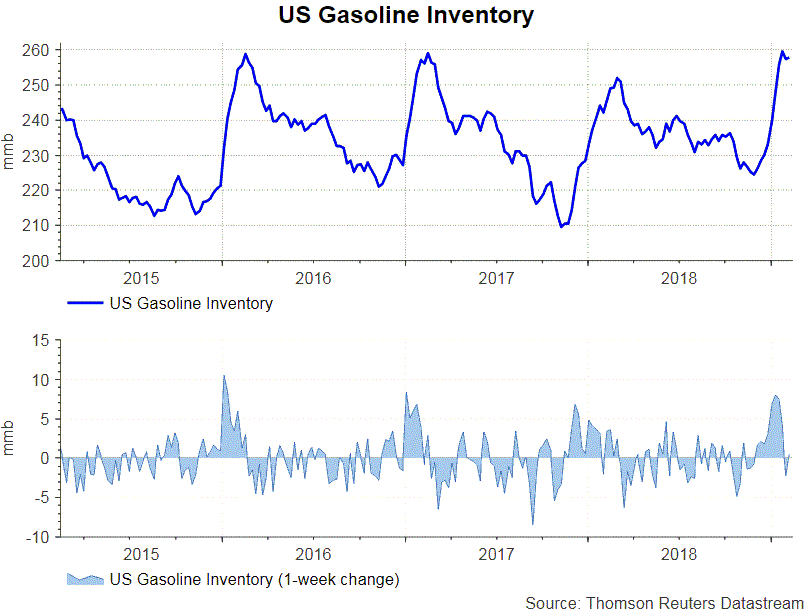
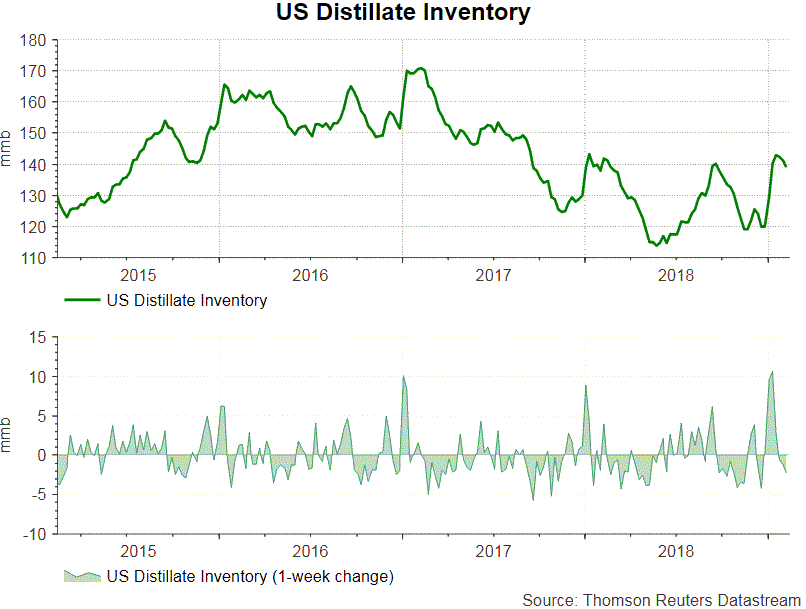
 Concerning refined oil product inventories, gasoline inventory added +0.41 mmb to 258.31 mmb as demand plunged -4.68% to 8.65M bpd. The market had anticipated a +0.83 mmb increase in stockpile. Production slipped -2.4% to 9.62 bpd while imports plunged -26.88% to 0.46M bpd during the week. Distillate inventory gained +1.19 mmb to 140.2 mmb. Demand slumped -19.39% to 3.77M bpd. The market had anticipated a -1.14 mmb drop gain in inventory. Production fell -6.97% to 4.76M bpd while imports declined -4.58% to 0.44M bpd during the week.
Released after market close on Wednesday, the industry- sponsored API estimated that crude oil inventory fell -1 mmb during the week. For refined oil products, gasoline stockpile gained +0.75 mmb while distillate plunged -2.48 mmb.
Swiss Franc Reverses Its Losses In The Asian Session
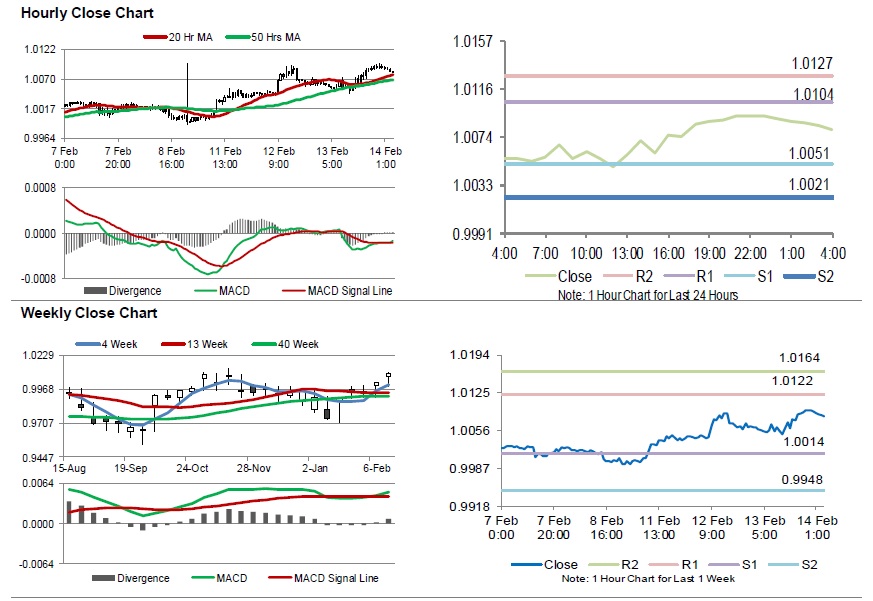
For the 24 hours to 23:00 GMT, the USD rose 0.31% against the CHF and closed at 1.0092.
In the Asian session, at GMT0400, the pair is trading at 1.0081, with the USD trading 0.11% lower against the CHF from yesterday’s close.
The pair is expected to find support at 1.0051, and a fall through could take it to the next support level of 1.0021. The pair is expected to find its first resistance at 1.0104, and a rise through could take it to the next resistance level of 1.0127.
Looking forward, traders would keep an eye on Switzerland’s producer & import prices for January, scheduled to release in a while.
The currency pair is trading above its 20 Hr and 50 Hr moving averages.
Loonie Trading Higher In The Asian Session
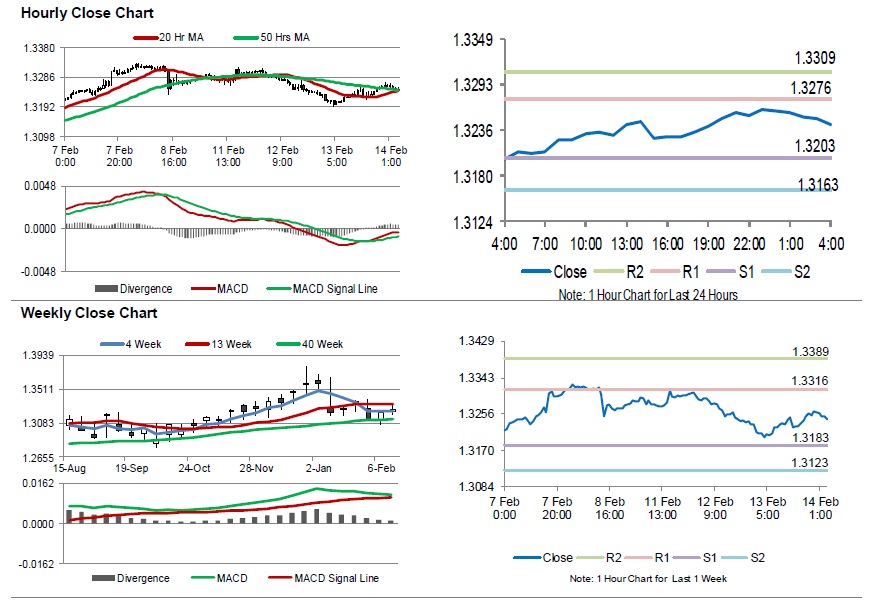
For the 24 hours to 23:00 GMT, the USD rose 0.23% against the CAD and closed at 1.3262.
In the Asian session, at GMT0400, the pair is trading at 1.3243, with the USD trading 0.14% lower against the CAD from yesterday’s close.
The pair is expected to find support at 1.3203, and a fall through could take it to the next support level of 1.3163. The pair is expected to find its first resistance at 1.3276, and a rise through could take it to the next resistance level of 1.3309.
Trading trend in the Loonie today is expected to be determined by Canada’s manufacturing shipments and new housing price index, both for December, slated to release later in the day.
The currency pair is showing convergence with its 20 Hr and 50 Hr moving averages.
Australia’s Consumer Inflation Expectations Advanced In February
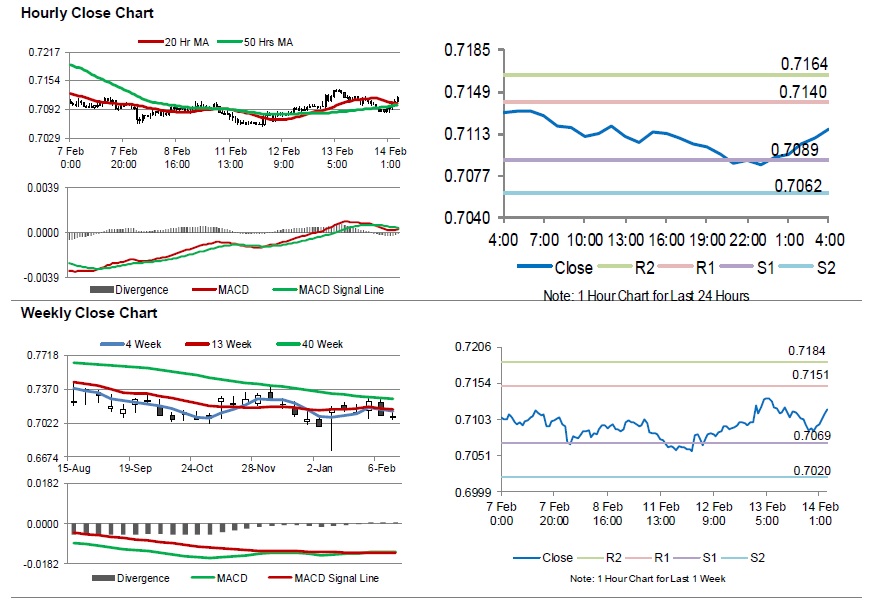
For the 24 hours to 23:00 GMT, the AUD declined 0.17% against the USD and closed at 0.7086.
LME Copper prices rose 0.3% or $18.0/MT to $6120.0/MT. Aluminium prices rose/declined 0.03% or $0.5/MT to $1840.0/MT.
In the Asian session, at GMT0400, the pair is trading at 0.7117, with the AUD trading 0.44% higher against the USD from yesterday's close.
Overnight data indicated that Australia's consumer inflation expectations advanced to 3.7% in February, compared to 3.5% in the prior month.
Elsewhere in China, Australia's largest trading partner, trade surplus narrowed to a level of $39.2 billion in January, compared to a level of $57.1 billion in the prior month. Market participants had expected the nation to post a surplus of $32.0 billion.
The pair is expected to find support at 0.7089, and a fall through could take it to the next support level of 0.7062. The pair is expected to find its first resistance at 0.7140, and a rise through could take it to the next resistance level of 0.7164.
The currency pair is showing convergence with its 20 Hr moving average and 50 Hr moving averages.
Gold: Yellow Metal Reverses Its Losses In The Morning Session
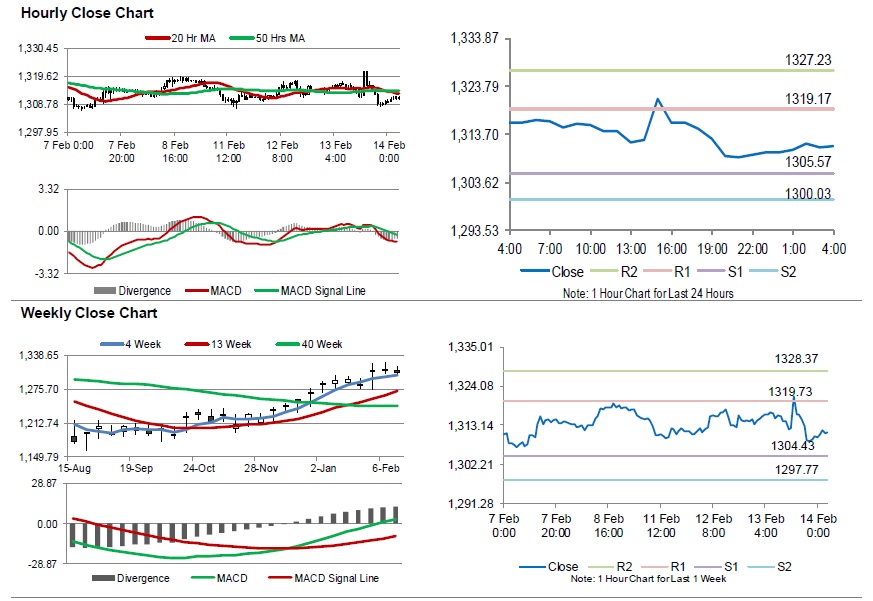
For the 24 hours to 23:00 GMT, Gold declined 0.41% against the USD and closed at USD1309.30 per ounce, as strength in US dollar dampened demand for the precious yellow metal.
In the Asian session, at GMT0400, the pair is trading at 1311.10, with gold trading 0.14% higher against the USD from yesterday’s close.
The pair is expected to find support at 1305.57, and a fall through could take it to the next support level of 1300.03. The pair is expected to find its first resistance at 1319.17, and a rise through could take it to the next resistance level of 1327.23.
The yellow metal is trading below its 20 Hr and 50 Hr moving averages.
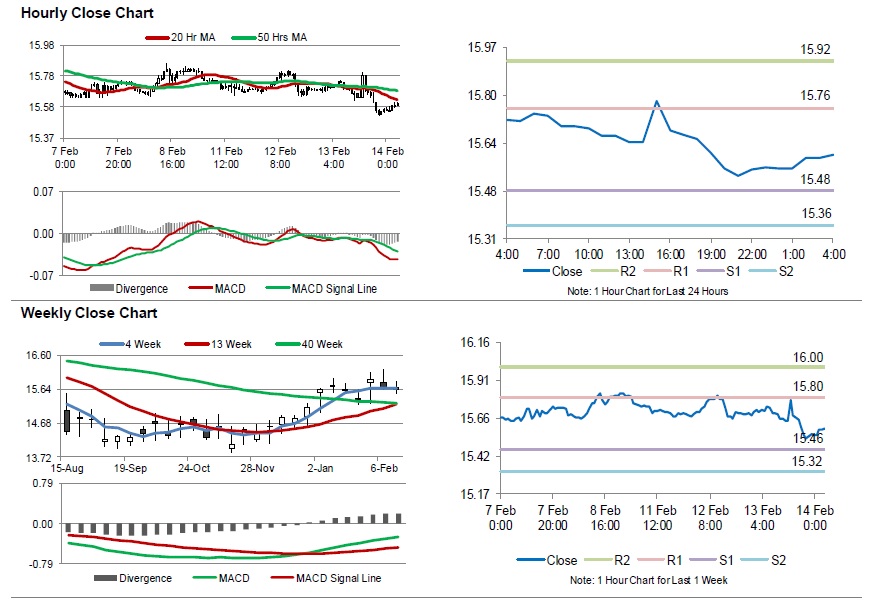
Silver: White Metal Trading On A Positive Footing This Morning
For the 24 hours to 23:00 GMT, Silver declined 0.86% against the USD and closed at USD15.56 per ounce, tracking losses in gold prices.
In the Asian session, at GMT0400, the pair is trading at 15.60, with silver trading 0.26% higher against the USD from yesterday’s close.
The pair is expected to find support at 15.48, and a fall through could take it to the next support level of 15.36. The pair is expected to find its first resistance at 15.76, and a rise through could take it to the next resistance level of 15.92.
The white metal is trading below its 20 Hr and 50 Hr moving averages.
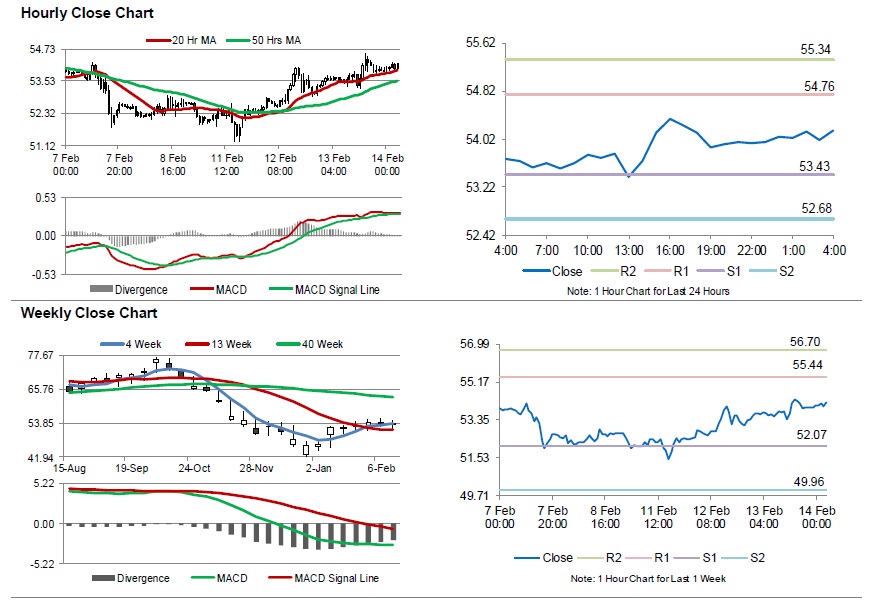
Crude Oil: Oil Trading On A Stronger Footing In The Asian Session
For the 24 hours to 23:00 GMT, Crude Oil rose 1.11% against the USD and closed at USD53.96 per barrel, after Saudi Arabia decided to maintain crude oil output at 9.8 million barrels per day by trimming an additional output of 0.5 million barrels per day in March. Additionally, the International Energy Agency, in its monthly report, indicated that the global supply dropped by 1.54 million to 99.7 million barrels per day in January.
Separately, the Energy Information Administration (EIA) report indicated that US crude oil stockpiles advanced by 3.6 million barrels to 450.8 million in the week ended 08 February 2019, notching its highest level in one year.
In the Asian session, at GMT0400, the pair is trading at 54.17, with oil trading 0.39% higher against the USD from yesterday’s close.
The pair is expected to find support at 53.43, and a fall through could take it to the next support level of 52.68. The pair is expected to find its first resistance at 54.76, and a rise through could take it to the next resistance level of 55.34.
Crude oil is showing convergence with its 20 Hr moving average and trading above its 50 Hr moving average.