Sample Category Title
Focus On Cryptocurrencies Return As US Debt Reaches $22 Trillion
The history of cryptocurrencies can be traced back to the 2008/9 financial crisis. The inspiration for the launch of Bitcoin was that fiat currencies, which are regulated by the central banks, had failed the system. Therefore, the goal of Satoshi Nakamoto was to create a currency that is decentralized and under no-one’s specific control. All this happened because of the financial crisis, which was caused by the increased use of subprime mortgages.
Today, the global economy has continued to be riskier than it was before the financial crisis. This is because of the vast amount of corporate, federal, and municipal debt. Yesterday, the government debt of the US moved above $22 trillion. The growth of debt has been accelerated by the tax cuts that were implemented by the Trump administration. Corporates too have been increasing the debt, fueled by a prolonged period of low interest rates. In total, companies hold more than $9 trillion in debt. Most of this debt has gone to mergers and acquisitions, dividends, and share buybacks. Households too have continued to load up more debt, with estimates showing a combined household debt of more than $13 trillion. As interest rates continue to rise, delinquencies could happen, which could expose the US economy to huge risks.
As the situation continues, many crypto enthusiasts have continued to focus on digital assets. They believe that cryptos could become safe havens because they are not regulated by anyone. In fact, renown crypto enthusiast and hedge fund manager, Michael Novogratz said that this could be the best time to hold crypto because of the increasing risks. A number of renowned economists have also warned that the US economy could be heading towards a crash.
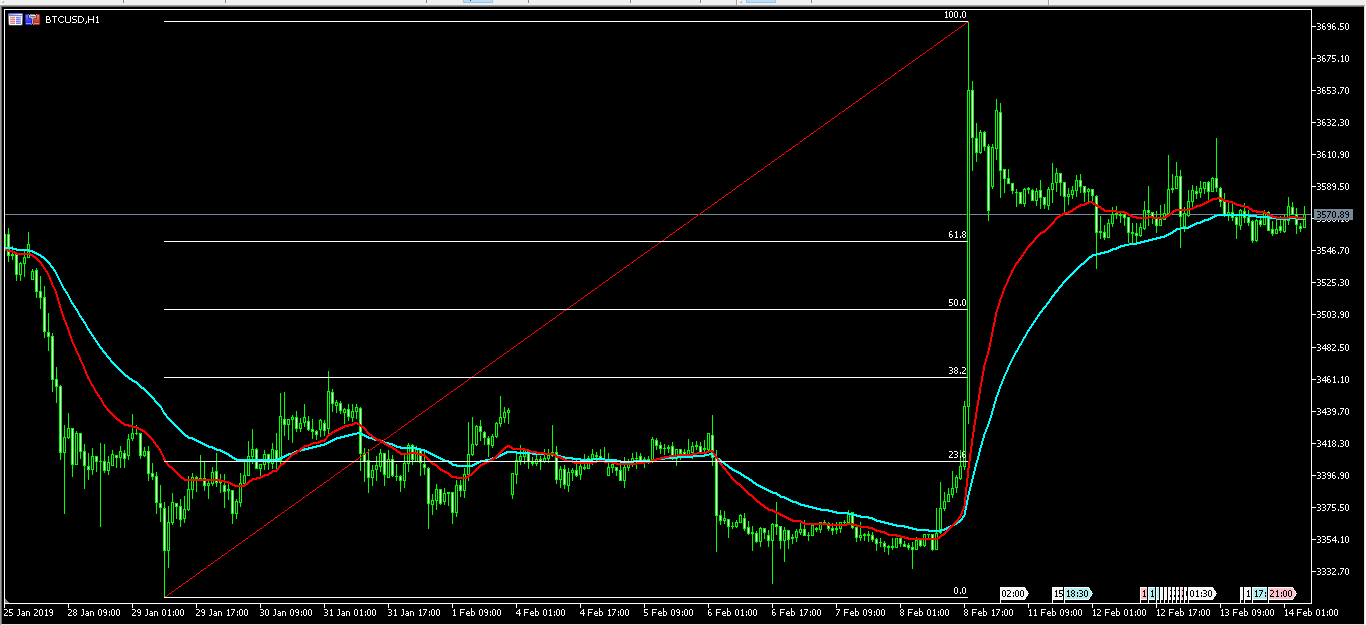
Positive sentiment has caused the price of cryptocurrencies to rise. This week, the price of Bitcoin reached a high of $3700. The price has eased a bit and is currently at $3660. This price is slightly above the 61.8% Fibonacci Retracement level. It is also along the 21-day and 42-day EMAs on the hourly chart. The pair could break out of this channel in either direction.
USD/CAD Daily Outlook
Daily Pivots: (S1) 1.3214; (P) 1.3238; (R1) 1.3279; More...
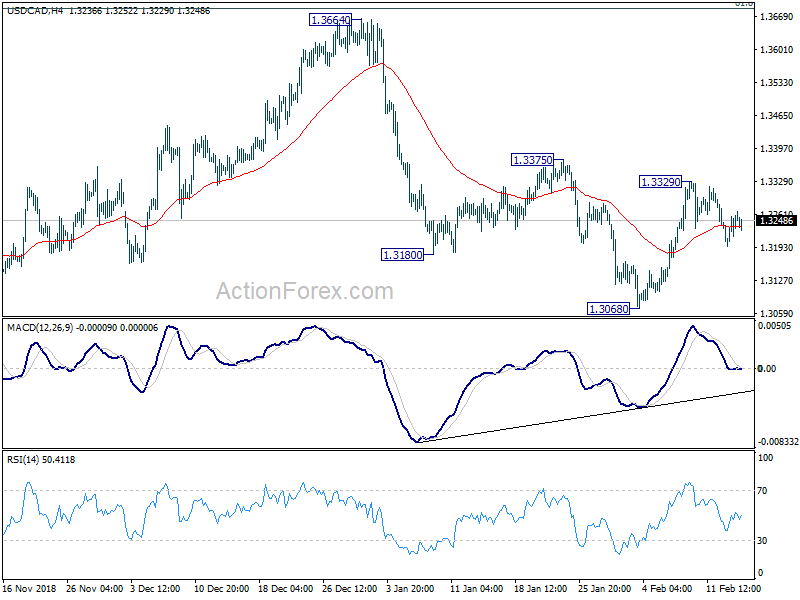
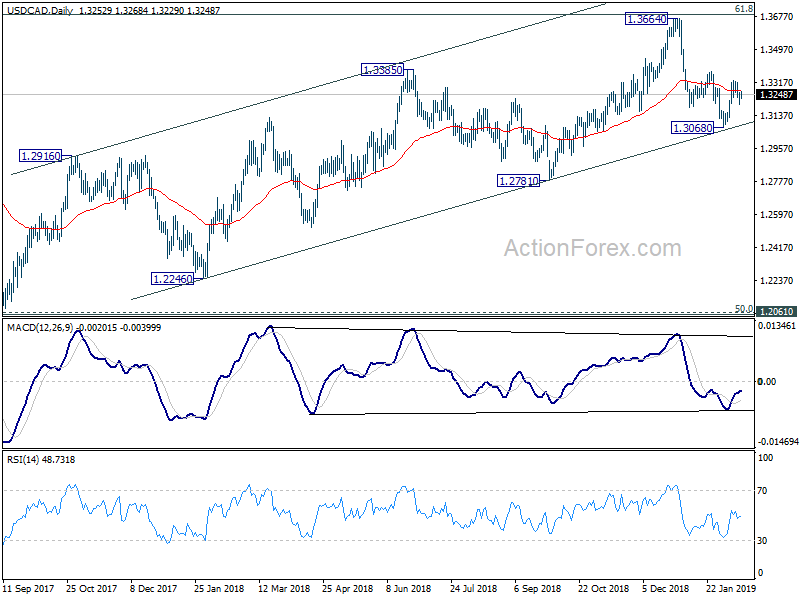
USD/CAD is staying in consolidation from 1.3329 temporary top and intraday bias remains neutral. We're holding on to the view that decline from 1.3664 has completed with three waves down to 1.3068 already, on bullish convergence condition in 4 hour MACD, just ahead of medium term channel support. Hence, risks will stay on the upside as long as 1.3068 holds. On the upside, break of 1.3375 resistance will confirm this bullish case and target a test on 1.3664 high.
In the bigger picture, structure of the medium term rise from 1.2061 (2017 low) to 1.3664 is not clearly impulsive. Hence, we'd stay cautious on strong resistance from 61.8% retracement of 1.4689 (2016 high) to 1.2061 at 1.3685 and 1.3793 resistance to limit upside, and bring medium term topping. But in any case, medium term outlook will stay bullish as long as channel support (now at 1.3086) holds. Sustained break of 1.3793 will pave the way to retest 1.4689 (2015 high). Firm break of the channel support should confirm reversal target 1.2061 low again.
Japanese Yen Declines After Weak GDP Numbers
US stocks gained yesterday, continuing a four-day streak, as investors remain hopeful about a trade deal between the United States and China. The Dow, Nasdaq, and S&P gained by 117, 6, and 8 points respectively. Today, US Secretary of the Treasury Steve Mnuchin and Trade Representative Robert Lighthizer will meet with Chinese officials to try and come up with a deal. They are also scheduled to meet with Xi Jinping. Investors are also optimistic about avoiding the government shutdown. The White House has said that the President is likely to sign the deal negotiated between the Democrats and Republicans in Congress.
The Japanese yen weakened slightly against the USD after the country’s GDP numbers. The numbers showed that the economy expanded by 1.4% in the fourth quarter. This was in line with expectations and higher than the previously-released contraction of -2.6%. On a QoQ basis, the economy expanded by 0.3%, which was lower than the expected 0.4%. The GDP external demand contracted by -0.3%, which was better than the expected -0.4%.
Traders will also focus on the euro as they receive key data from the region. Germany will release the GDP numbers, which are expected to show an annual growth of 0.9%, lower than the previously-released 1.1%. the Wholesale Price Index (WPI) for January is expected to show an increase of 0.3%. for the EU27, the GDP is expected to have grown by 1.2% in the fourth quarter. These numbers are important because investors have been concerned about the systemic weakness of the European Union.
EUR/USD
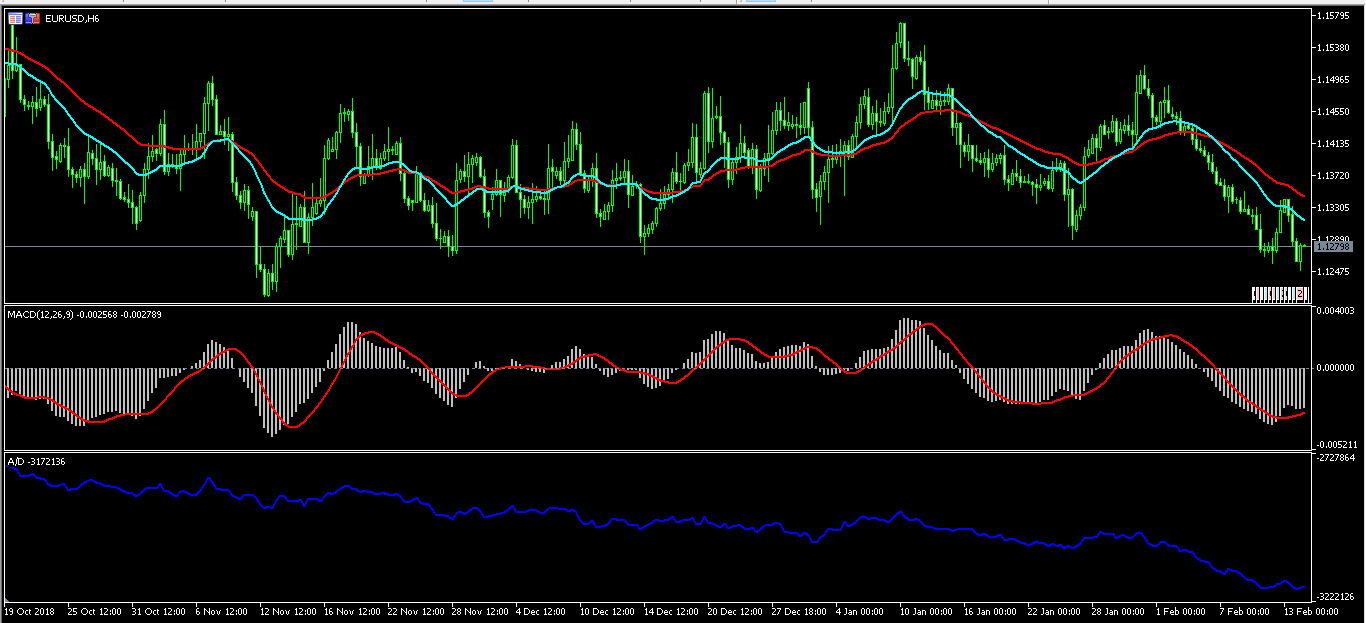
The EUR/USD pair moved up slightly ahead of the important GDP numbers from the EU. The pair reached a high of 1.12900. On the four-hour chart, this price is still above the 21-day and 42-day EMAs. The signal line of the MACD appears to be moving higher as shown below while the accumulation and distribution indicator has continued to move lower. The pair will likely resume the downward trend but this will depend on the GDP numbers from Europe and US retail sales.
USD/JPY
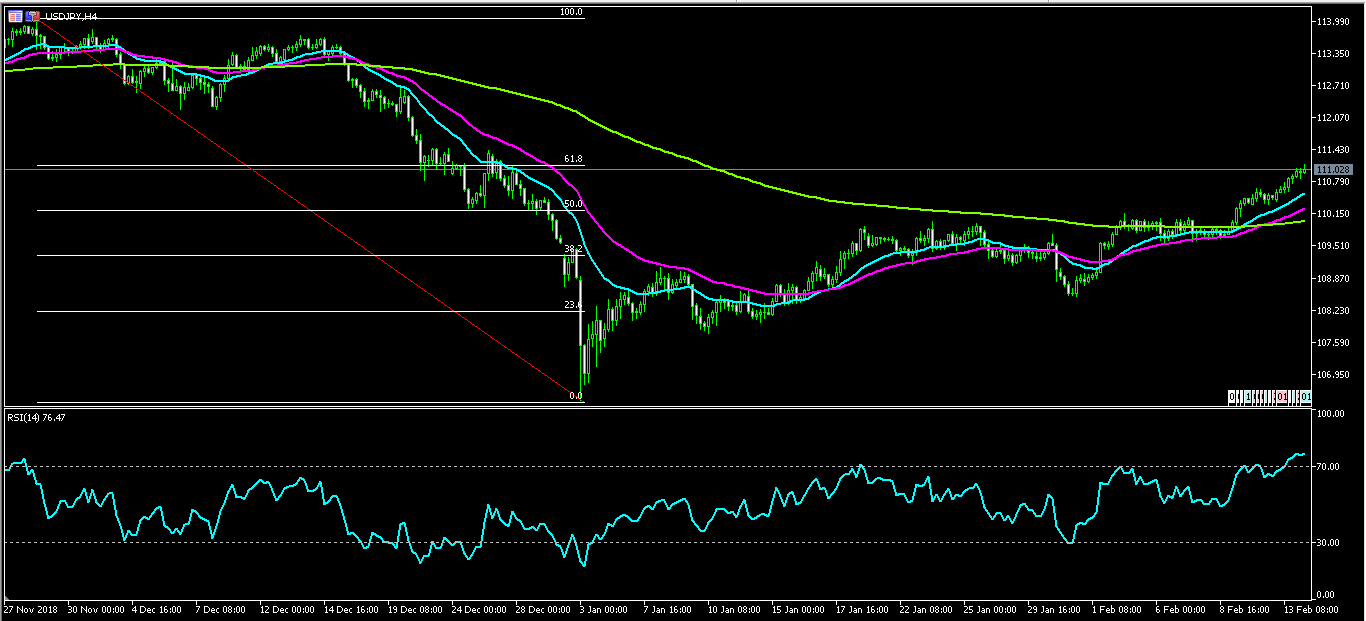
The USD/JPY pair continued the upward momentum that was started on January 3. Since then, the pair has moved up from a low of 106.4 to a high of 111.12. On the four-hour chart, the pair’s current price is above the 42-day and 21-day EMA. The upward trend has also been accompanied by a rise in RSI, which has moved to a high of 76. This is considered an overbought area. The current price is also along the 61.8% Fibonacci Retracement level. While the upward momentum could continue, it could see a retracement to the 50% Fibonacci level of 101.20.
XAU/USD
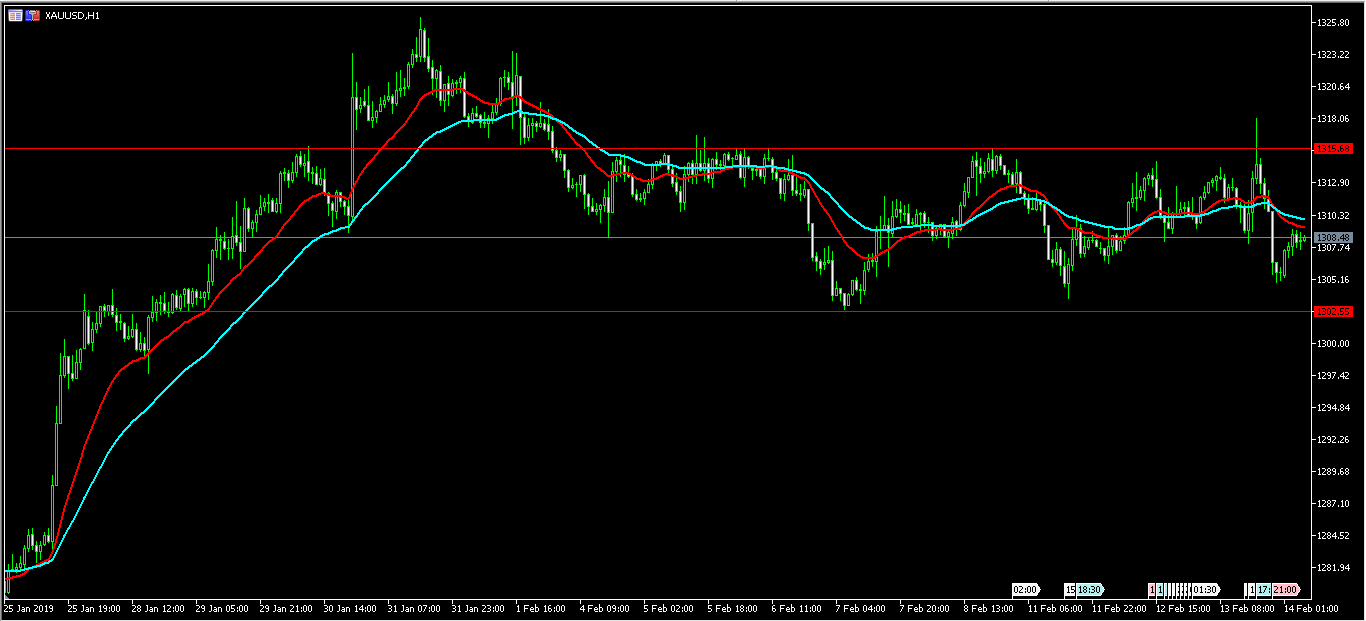
The price of gold rose slightly in overnight trading to a high of $1310. This week, the price declined sharply from a high of $1320 and reached a low of $1304. On the hourly chart, this price is slightly lower than the 21-day and 42-day EMA. It is also above the narrow channel shown above. There is a likelihood that the XAU/USD pair will continue to rise to the important resistance level of 1315.
EURNZD Posts New 2-Month Low Around 1.6500
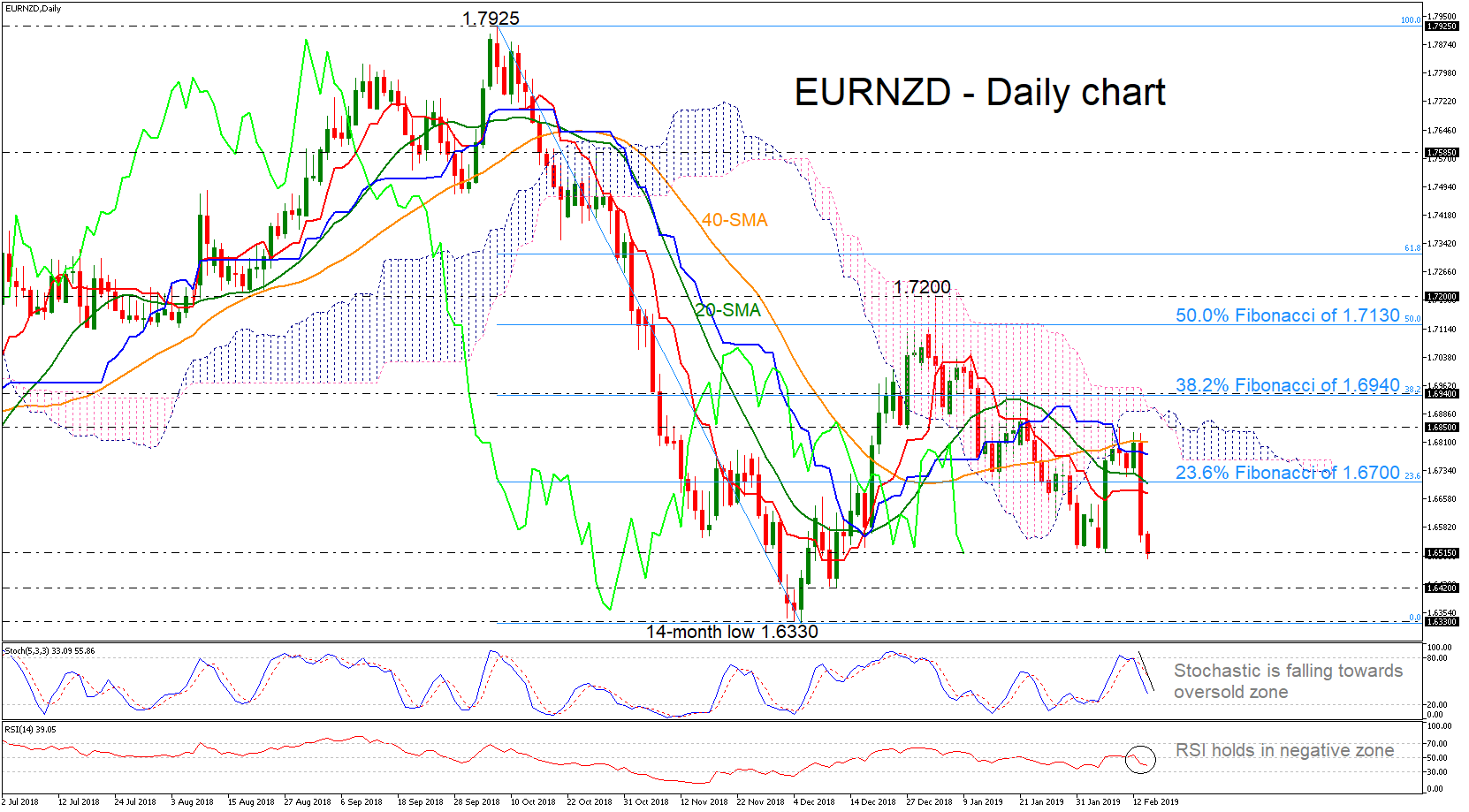
EURNZD is printing its second strong day of losses after the failed attempt to break above the area which encapsulates the 38.2% Fibonacci retracement level of the downleg from 1.7925 to 1.6330, around 1.6940. Currently, the pair is recording a fresh two-month low of 1.6500 as it also declined below the 20- and 40-simple moving averages (SMAs) in the daily timeframe.
Chances for a reversal, however, are decreasing as the 20-day simple moving average dropped below the 40-day SMA, creating a bearish cross, while the red Tenkan-sen line has a steeper negative slope now, suggesting that the next move in the price is more likely to be down. The RSI continues to strengthen to the downside in the negative territory and the stochastic oscillator is approaching the oversold zone.
If the price continues to head lower, investors could turn their focus on the 1.6420 support, where it bottomed on December 12. More losses could find strong obstacle at the 14-month low of 1.6330 before creating a new lower low and endorsing the medium-term bearish structure. Beneath the latter the market could challenge the 1.6140 barrier, taken from the trough on September 2017.
However, if the pair reverses back to the upside, investors could move towards the immediate resistance level of the 23.6% Fibonacci of 1.6700, which holds near the 20-SMA. A penetration of this line would reinforce a bullish move until 1.6850. Higher, resistance could run towards the 38.2% Fibonacci of 1.6940.
In the medium-term picture, euro/kiwi is trying to extend its bearish view, posting a negative tendency. A new lower low below the 1.6330 would confirm this structure.
Currencies: EUR/USD Returns To Recent Lows And Struggles To Prevent Further Losses
- Rates: More underperformance of US Treasuries?
We expect core US retail sales to be strong given the tight labour market and rising disposable income. This might trigger a negative reaction in US Treasuries in line with yesterday’s move following higher (wage) inflation. Stock markets can’t really profit overnight from rumours that US President Trump contemplates a 2-month extension to reach a trade deal with China. - Currencies: EUR/USD returns to recent lows and struggles to prevent further losses
Tuesday’s EUR/USD rebound proved short-lived. The ongoing contrast between poor EMU data and decent US eco evidence revived a USD supportive ‘divergence trade’. EUR/USD is nearing the bottom of a MT trading range. The euro desperately needs EMU and global event risk to cool down and signs of a gradual economic improvement in EMU.
The Sunrise Headlines
- US equities edged modestly higher yesterday with gains up to +0.46% (Dow Jones). Asian equity markets are trading mixed this morning despite rumours of a 60-day extension to the US-China trade deadline.
- US President Trump is said to be open to extending the China tariff deadline (March 1) by 60 days, to give negotiating parties more time if they are close to a deal that addresses deep structural changes to China’s economic policy.
- US President Trump was cautious about the preliminary border security deal. He will look at the final legislation before deciding whether to sign it but said a shutdown would be a “terrible thing”. The House votes on the proposal tonight.
- UK Parliament decides today if it gives PM May another two weeks to secure changes to the Brexit deal. The anti-EU European Research Group is weighing to vote against May’s motion as they do not want to rule out a no-deal Brexit.
- Chinese export unexpectedly grew 9.1% (Y/Y) in January (vs. -3.3% exp.), partly supported by front-loading before the Lunar New Year. Imports declined 1.5% (Y/Y), less than the 10.2% drop expected, resulting in a $39.16 trade surplus.
- Japan’s economy grew 1.4% (Q/Q annualized) in Q4 last year, rebounding from a sharp contraction during a natural disaster-hit 3rd quarter (-2.6% Q/Q). The Q4 expansion was fuelled by business investment and consumer spending.
- Today’s eco calendar contains US producer price inflation, weekly jobless claims, retail sales and the 2nd reading of EMU Q4 GDP. UK Parliament votes on more time for UK PM May, while BoE’s Vlieghe speaks
Currencies: EUR/USD Returns To Recent Lows And Struggles To Prevent Further Losses
EUR/USD rebound proves short-lived
Tuesday’s EUR/USD rebound proved short-lived. Yesterday, EUR/USD failed to extend gains beyond the 1.1340 area. EMU production data were again weak, dampening the potential for further euro gains. Later, the dollar was supported by (slightly) higher than expected US CPI data and by solid real labour earnings. The dollar was again in the driver’s seat, profiting from higher US yield. USD/JPY closed just north of 111. EUR/USD completely reversed Tuesday’s rebound to finish at 1.1261. Overnight, Asian equities are taking a breather after recent rally. Headlines from the US China trade talks remain constructive. President Trump is rumoured considering delaying a rise in import tariffs on Chinese goods. The yuan (USD/CNY 6.76 area) stabilizes despite broad USD strength. China January foreign trade data were strong, but distorted due to the Lunar New Year. The trade weighted dollar (97.05 area) and USD/JPY (111 area) are holding near recent peaks. In the same context, EUR/USD set a minor correction low in the mid 1.12 area this morning. At 1.1275 the pair still struggles to prevent further losses. The Aussie and the Kiwi dollar maintain recent bid tone. EMU Q4 GDP is expected at a meagre 0.2% Q/Q today. End 2018 EMU eco weakness is well documented. Still, additional evidence recently often continued to weigh on the euro. In the US, PPI inflation, jobless claims and retail sales will be released. Headline US sales are expected soft (0.1%) but control group sales are expected OK (0.4%). December data are a bit outdated so we don’t expect a big reaction. That said, there is little evidence that today’s data will change the US/EMU divergence trade that weighed on EUR/USD of late. Headline risk on Spain is a wildcard. A protracted ST EUR/USD downtrend pushed EUR/USD to the lower part of the MT 1.12/1.16 trading range. A temporary rebound on Tuesday proved unsustainable. The dollar profits for ongoing (relative) eco strength. A sustained euro rebound probably needs some of the global (trade) and EMU political event risks to be solved and more comforting EMU data. This condition isn’t met. The day-to-day EUR/USD picture remains fragile. EUR/USD 1.1216 marks the Nov low. EUR/USD 1.1287 is 61% retracement 2016 low/2018 top).
EUR/GBP touched an intraday top in the 0.8790 area around the publication of softer UK price data yesterday. Later, sterling rebounded on rumours that a Brexit delay might still be an option for the government. Today, UK PM May seeks Parliamentary approval to extend negotiations with the EU, but the conservative party stays divided on tactics. Sterling trading will again develop according to the tone of the Brexit headlines. We stay sterling cautious.
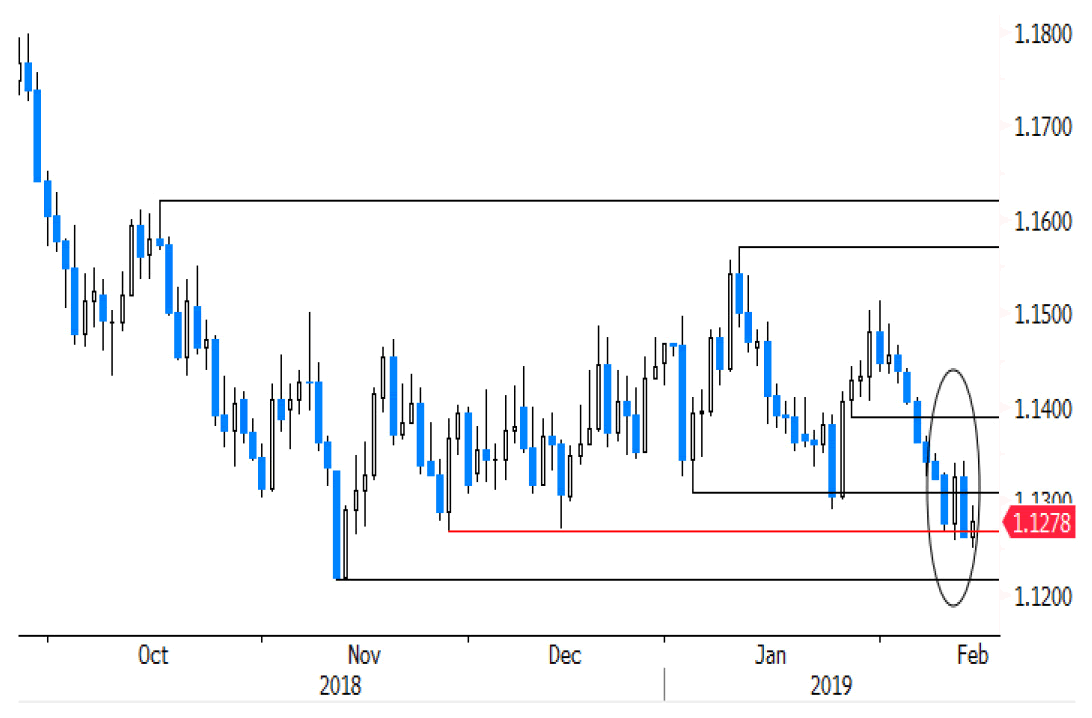
EUR/USD returns to recent lows and struggles to prevent further losses
AUD/USD Daily Outlook
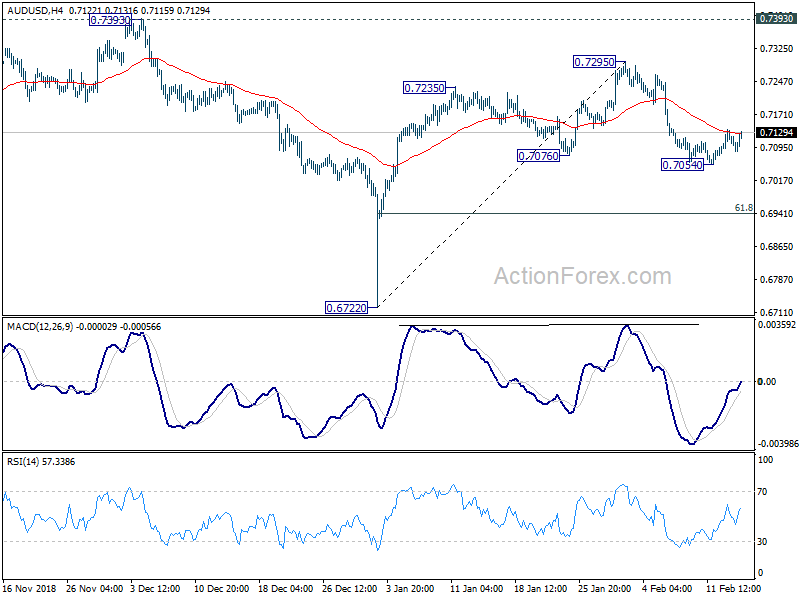
Daily Pivots: (S1) 0.7071; (P) 0.7103; (R1) 0.7122; More...
Intraday bias in AUD/USD remains neutral at this point. Consolidation from 0.7054 is still in progress. Stronger rise could be seen but upside should be limited well below 0.7295 resistance to bring another decline. We're holding on to the view that rebound from 0.6722 has completed at 0.7295 already. On the downside, break of 0.7054 will turn bias to the downside for 61.8% retracement of 0.6722 to 0.7295 at 0.6941 next.
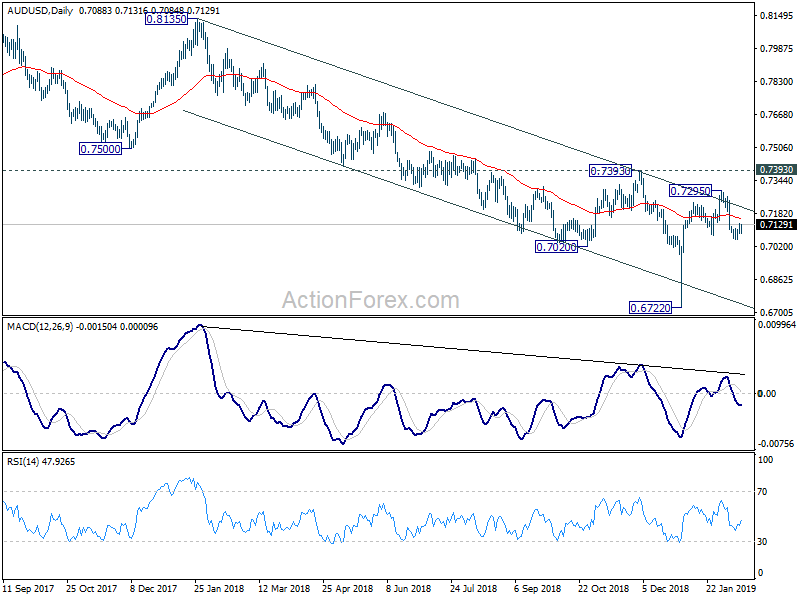
In the bigger picture, as long as 0.7393 resistance holds, we'd treat fall from 0.8135 as resuming long term down trend from 1.1079 (2011 high). Decisive break of 0.6826 (2016 low) will confirm this bearish view and resume the down trend to 0.6008 (2008 low). However, firm break of 0.7393 will argue that fall from 0.8135 has completed. And corrective pattern from 0.6826 has started the third leg, targeting 0.8135 again.
Japan & Germany Avoided Recession, Trade Talk Optimism, Yen Pressured
Australian and New Zealand Dollar are the strongest ones for today so far as the forex markets seem to be cheering positive developments in US-China trade negotiations. The idea of 60-day extension to trade truce is certainly welcomed given the complexity in the deal, in particular enforcement. Data from Japan and Germany also showed both countries avoided technical recession in H2 2018. But such positive sentiment is actually not reflected in the stock markets. Though, for now, Yen is the weakest one for today, followed by Dollar.
Over the week, commodity currencies remain the strongest ones, led by New Zealand Dollar. Dollar received some blessing from stronger than expected CPI overnight and it's trading down only against NZD, AUD and CAD. The greenback will look into retail sales and PPI today for some more strength. Yen is the worst performing one, followed by Swiss Franc. Sterling is not too far away and it's awaiting Brexit debate in the Commons.
Technically, USD/JPY's stronger than expected rise now puts 114.20/54 resistance into focus. EUR/USD breached 1.1257 overnight but quickly recovered. Similarly, USD/CHF breached 1.0092 resistance but retreated quickly. The greenback is still in favor to rise against the two. GBP/USD is eyeing 1.2832 temporary low. Break there will likely give Dollar a hand.
In other markets, Nikkei closed down -0.02%. Hong Kong HSI is down -0.25%. China Shanghai SSE is down -0.05%. Singapore Strait Times is up 0.07%. Japan 10-year JGB yield is down -0.0093 at -0.016, staying negative. Overnight, DOW rose 0.46%. S&P 500 rose 0.30%. NASDAQ rose 0.08%. 10-year yield rose 0.024 to 2.708, reclaimed 2.7 handle. 30-year yield rose 0.012 to 3.034, staying above 3.0 handle.
Trump considering 60-day extension to trade truce as high level talks start
High level US-China trade negotiations started in the Diaoyutai state guest house in Beijing today, involving US Treasury Secretary Steven Mnuchin and Trade Representative Robert Lighthizer, and Chinese Vice Premier Liu He. Ahead of that, Mnuchin said he's "looking forward to discussions today". There was no elaborate and so far, there is no news leaked regarding the talks.
Trump indicated earlier this week that he's willing to let the March 1 trade truce deadline slide a little bit. Trump further added that the talks are "going along very well" and the Chinese are "showing us tremendous respect." Bloomberg reported that Trump is indeed considering to extend the deadline by 60 days, after rejecting the initial request by China of 90 days extension. But the rumor is not confirmed.
China trade balance: Import from US plunged -41%, from EU rose...
January trade data from China showed a better picture. Exports grew 9.1% yoy versus expectation of -3.3% yoy. Import dropped only -1.5% yoy versus expectation of -10.2% yoy. Trade surplus narrowed to USD 39.2B, above expectation of USD 32.0B. However, it should be noted that the trade data for the first two months of the year are generally distorted by Lunar New Year holidays. Thus, while the data are positive, it's premature to declare that the slow down in China has bottomed. Nevertheless, it's worth noting that exports to the US since tariff war began were not so much affected. But import from the US plunged, quite notably in Jan by -41%.
In USD terms, total trade rose 4.0% yoy to USD 396B. Import dropped -1.5% yoy to USD 178.4B. Exports rose 9.1% yoy to USD 217.6B. Trade surplus rose to USD 39.2B.
With EU, total trade rose 12.4% yoy to USD 64.5B. Import rose 8.2% yoy to 25.9B. Export rose 15.3% yoy to USD 38.6B. Trade surplus was at USD 12.7B.
With US, total trade dropped -13.9% yoy to USD 45.8B. Import dropped -41% yoy to USD 9.2B. Exports dropped -2.4% yoy to USD 36.5B. Trade surplus was at USD 27.3B.
With AU, total trade rose 10.8% yoy to USD 14.4B. Import rose 7.6% yoy USD 10.1B. Export rose 19.1% yoy to USD 4.3B. Trade deficit was at USD 5.8B.
German economy stagnated in Q4, but narrowly escaped recession
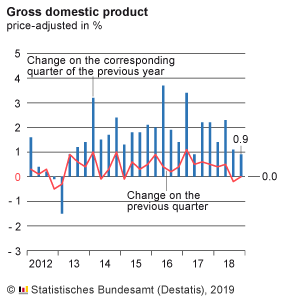
Germany GDP stagnated in Q4 and grew 0.0% qoq. But that was enough to narrow escape a technical recession following -0.2% contraction in Q3. Over the year, GDP grew 0.9% yoy in Q4. For the whole year of 2018, GDP grew 1.5% calendar adjusted.
Looking at the details, positive contributions mainly came from domestic demand. Development of foreign trade did not make a positive contribution to growth in the fourth quarter. According to provisional calculations, exports and imports of goods and services increased nearly at the same rate in the quarter-on-quarter comparison.
UK RICS house price balance dropped, resolution of Brexit negotiations critical
UK RICS house price balanced dropped to -22 in January, below expectation of -20. RBIC noted that activity measures for both buyers and sellers continue to slip. Also, price balance weakens at the national level, led by London and the South East. And, as sales drop, the lettings market is faring better with demand rising.
Simon Rubinsohn, RICS chief economist, warned that "resolution of the Brexit negotiations is widely seen as critical to encouraging potential buyers back into the market, although whether that will be sufficient in London and parts of the South East where affordability remains stretched and the tax changes are most penal remains to be seen."
Japan GDP rebounded with weak momentum, but avoided recession
Japan GDP grew 0.3% qoq in Q3, rebounding from Q3's -0.6% qoq contraction. The good news is that Japan avoided a technical recession of two consecutive quarters of contraction. But growth was disappointing and missed expectation of 0.4% qoq. GDP deflator dropped -0.3% yoy, slightly better than expectation of -0.4% yoy.
Japanese Economy Minister Toshimitsu Motegi said in a statement that "the economy is in gradual recovery as growth is led by private demand". However, "China-bound exports of information-related materials have weakened as the Chinese economy slowed". He added that the government needs to "monitor uncertainty over global economic outlook including Chinese economy as well as fluctuations in financial markets."
Looking head
Eurozone GDP and employment will be the main feature in European session. Later in the data, US data will take center stage. Retail sales, PPI, jobless claims and business inventories will be released. Canada will also release manufacturing sales and new housing price index.
AUD/USD Daily Outlook
Daily Pivots: (S1) 0.7071; (P) 0.7103; (R1) 0.7122; More...
Intraday bias in AUD/USD remains neutral at this point. Consolidation from 0.7054 is still in progress. Stronger rise could be seen but upside should be limited well below 0.7295 resistance to bring another decline. We're holding on to the view that rebound from 0.6722 has completed at 0.7295 already. On the downside, break of 0.7054 will turn bias to the downside for 61.8% retracement of 0.6722 to 0.7295 at 0.6941 next.
In the bigger picture, as long as 0.7393 resistance holds, we'd treat fall from 0.8135 as resuming long term down trend from 1.1079 (2011 high). Decisive break of 0.6826 (2016 low) will confirm this bearish view and resume the down trend to 0.6008 (2008 low). However, firm break of 0.7393 will argue that fall from 0.8135 has completed. And corrective pattern from 0.6826 has started the third leg, targeting 0.8135 again.
Economic Indicators Update
| GMT | Ccy | Events | Actual | Forecast | Previous | Revised |
|---|---|---|---|---|---|---|
| 23:50 | JPY | GDP Q/Q Q4 P | 0.30% | 0.40% | -0.60% | |
| 23:50 | JPY | GDP Deflator Y/Y Q4 P | -0.30% | -0.40% | -0.30% | |
| 00:00 | AUD | Consumer Inflation Expectation Feb | 3.70% | 3.50% | ||
| 00:01 | GBP | RICS House Price Balance Jan | -22.00% | -20.00% | -19.00% | |
| 02:00 | CNY | Trade Balance (USD) Jan | 39.2B | 32.0B | 57.1B | |
| 02:00 | CNY | Trade Balance (CNY) Jan | 271B | 235B | 395B | |
| 07:00 | EUR | German GDP Q/Q Q4 P | 0.00% | 0.10% | -0.20% | |
| 07:30 | CHF | Producer & Import Prices M/M Jan | -0.40% | -0.60% | ||
| 07:30 | CHF | Producer & Import Prices Y/Y Jan | -0.20% | 0.60% | ||
| 10:00 | EUR | Eurozone GDP Q/Q Q4 P | 0.20% | 0.20% | ||
| 10:00 | EUR | Eurozone Employment Q/Q Q4 P | 0.20% | 0.20% | ||
| 13:30 | CAD | Manufacturing Sales M/M Dec | 0.70% | -1.40% | ||
| 13:30 | CAD | New Housing Price Index M/M Dec | 0.00% | 0.00% | ||
| 13:30 | USD | Initial Jobless Claims (FEB 09) | 225K | 234K | ||
| 13:30 | USD | PPI M/M Jan | 0.10% | -0.20% | ||
| 13:30 | USD | PPI Y/Y Jan | 2.10% | 2.50% | ||
| 13:30 | USD | PPI Core M/M Jan | 0.20% | -0.10% | ||
| 13:30 | USD | PPI Core Y/Y Jan | 2.50% | 2.70% | ||
| 13:30 | USD | Retail Sales Advance M/M Dec | 0.10% | 0.20% | ||
| 13:30 | USD | Retail Sales Ex Auto M/M Dec | 0.00% | 0.20% | ||
| 15:00 | USD | Business Inventories Nov | 0.20% | 0.60% | ||
| 15:30 | USD | Natural Gas Storage | -237B |
Awaiting News From Beijing
Market movers today
Key focus remains on trade negotiations between the US and China as two days of high level talks have started in Beijing today. Focus at these meetings are on how to enforce a trade deal with the aim of finalising a framework. According to Chinese media US representatives Mnuchin and Lighthizer will meet China president Xi tomorrow.
Today's highlight in the euro area is the German GDP figure for Q4 2018. We expect the German economy avoided slipping into technical recession, however the quarterly growth pace is likely to have remained subdued at 0.1% q/q. In Q3, the German economy experienced its first contraction since 2015 with GDP growth rates at -0.1% q/q. External factors such as the trade war, Brexit, as well as domestic problems in the car sector and low water levels in the Rhine River continued to hamper activity in Q4. (see Research Germany- The epicentre of the euro area slowdown , 27 January).
In the UK , the House of Commons will vote on Brexit. While the next 'meaningful vote' on a full Brexit deal has been postponed as PM Theresa May and the EU27 have agreed to continue negotiations in late February, this is an indicative vote. May will deliver a statement to the Commons, which the MPs will vote on and which is amendable. Based on what we know so far, we may be in for another "kicking the can down the road", as PM Theresa May has promised another vote also late-February. Bloomberg has a good overview here. The vote begins 18:00 CET.
In the Scandies focus turns to Swedish labour market data and Norges Bank's Olsen's annual address to the Norwegian people. For more information see Scandi page 2.
Selected market news
US equities ended yesterday in green on the back of not least Trump further opening the door for an extension of the trade truce with China if the parties were close to a "real deal". Meanwhile, comments from Senator Marco Rubio that he intends to submit a bill to tax corporate buybacks limited the equity rally. This morning most Asian equity indices are trading flat in a fairly eventless session as markets await news from Beijing on trade talks. Chinese trade data showed a surprising rise in exports but the shutdown for Lunar New Year - which this year comes 10 days earlier - likely boosted the figures.
Yesterday the Spanish minority government lost a vote on the 2019 budget bill in parliament, putting snap elections in Q2 19 back on the cards. Markets shrugged off the risk of renewed political uncertainty in Spain, as the economy remains solid and as the risk of a euro-sceptic government is small, as the three leading parties all have pro-EU views.
The Riksbank meeting yesterday played out more or less as we expected: the rate was left unchanged, as were both the rate path and the inflation forecast, while the projected growth for 2019 and 2020 was revised marginally down. The board did comment on the increased downside risks to global economic outlook, but did also point out that they still see fairly good economic activity over the next few years, with "low unemployment and rising wage growth in many countries". The only real news was that the FX intervention mandate was not renewed which contributed to a stronger SEK, see FX Section page 2 . We still do not expect any 2019 Riksbank rate hikes following the announcement.
Equities Trade Generally Mixed Ahead Of US/China Trade Talks
General Trend:
- Telecom Services index declines in China, gained over 6% on Wed ahead of trade talks
- S&P ASX 200 Energy index outperforms , Woodside Petroleum rises after earnings
- Telecom index drops in Australia after earnings from Telstra
- Australia’s AMP declines over 8%, reported net outflows from wealth management business
- Large gold miner Newcrest declined after H1 results
- Real Estate index outperforms in Japan, Q4 housing investment rose at fastest pace since 2017
- Japan Q4 GDP rebounds on domestic demand, external demand weighs
- New Zealand Dollar (NZD) and bond yields extend gains following recent RBNZ statement
- China Commerce Ministry may hold weekly press conference later today
- The high level US/China trade talks are due to occur in Beijing from Feb 14-15th (Thursday-Friday).
- US President Trump said to be considering 60-day extension for deadline on higher tariffs for China imports - US financial press
- US companies expected to report earnings on Thursday include Applied Materials, Arch Coal, Avon, Bombardier, CBS, CME Group, Canopy Growth, Coca-Cola, Fannie Mae, Generac, NVIDIA and Waste Management (includes after hours)
Headlines/Economic Data
Japan
- Nikkei 225 opened flat
- (JP) Japan 2019 Spring Wage Talks: Nissan, Honda labor unions all requesting ¥3,000 base pay raise, flat y/y; Toyota makes no request yet -Japanese press
- (JP) JAPAN Q4 PRELIM GDP Q/Q: 0.3% V 0.4%E; ANNUALIZED Q/Q: 1.4% V 1.4%E; GDP Business Spending q/q: 2.4% v 1.8%e
- (JP) Japan Economy Min Motegi: Economy is in gradual recovery; expects domestic demand to lead recovery; China-bound exports of goods weakened in Q4; will closely monitor effects of trade issue on global economy
- (JP) Bank of Japan (BoJ) said to be shifting its view on CPI, to wanting to include effect of sales tax hike (prior wanted to exclude, on grounds it would be a temporary factor); now expects targeted policies to nearly offset the effect - Nikkei
Korea
- Kospi opens -0.3%
- (KR) South Korea and Russia sign action plan to boost bilateral cooperation; key areas of cooperation between the two countries, including shipbuilding, natural gas, railways, electricity, agriculture, Arctic shipping routes and fisheries – Yonhap
- 034020.KR Reports Q4 (KRW) Net -421.7B v -109.7B y/y; Op 1.0T v 913.4B y/y; Rev 14.8T v 13.8T y/y
- 000240.KR Reports Q4 (KRW) Net 67.7B v 87.2B y/y, Op 146B v 140B y/y, Rev 1.73T v 1.68T y/y
- (KR) South Korea President Moon approval rating slides back under 50%; economic issues cited -Korean Press
China/Hong Kong
- Hang Seng opens -0.4%; Shanghai Composite opens -0.2%
- (CN) CHINA JAN TRADE BALANCE (CNY): 271.2B V 245.0BE; Exports y/y: 13.9% v 3.8%e; Imports y/y: +2.9% v -1.9%e
- (CN) CHINA JAN TRADE BALANCE: $39.2B V $34.3BE; Exports y/y: +9.1% v -3.3%e; Imports y/y: -1.5% v -10.2%e
- High level US China trade talks have started, as expected
- (US) Pres Trump: Trade talks with China are going very well
- (CN) US President Trump said to be considering 60-day extension for deadline on higher tariffs for China imports - US financial press
- (CN) China PBoC Open Market Operation (OMO): Skips reverse repo operations for 4th consecutive session; Net: CNY200B drain v CNY270B drain prior
- (CN) China PBoC sets Yuan Reference Rate: 6.7744 v 6.7675 prior
- (CN) China manufacturers increasingly turning to automation; 100M jobs threatened; Dongguan city allocated $56M to increase automation in 2018 - SCMP
Australia/New Zealand
- ASX 200 opened +0.1%
- TWE.AU Reports H1 (A$) Net 219.2M v 187.2M y/y; EBITSA 338.3m v 283.3M y/y; Rev 1.54B v $1.5Be
- NCM.AU CEO: Will keep disciplined approach to growth, do not need M&A; gold at $1,300/oz or higher is good for miners
- TLS.AU Reports H1 (A$) Net 1.2B v 1.7B y/y; EBITDA 4.3B v 5.1B y/y; Rev 13.8B v 14.4B y/y
- (AU) Australia Feb Consumer Inflation Expectation: 3.7% v 3.5% prior
- (AU) Australia sells A$500M v A$500M indicated in April 2019 notes, avg yield 1.9478% v 2.0115% prior, bid to cover 4.34x v 3.78x prior
Other Asia
- (MY) Malaysia Q4 GDP Q/Q: 1.4% v 1.3%e; Y/Y: 4.7% v 4.5%e
- (MY) Malaysia Central Bank (BNM): Reiterates monetary policy remains accommodative and supportive of economic activity; External uncertainties will continue to impact outlook for Ringgit (MYR)
- STEL.SG Reports Q3 (S$) Net 822.8M v 959.2M y/y; Op 972.6m v 1.12B y/y; Rev 4.63B v 4.58B y/y
North America
- (US) Fed's Harker (non-voter, moderate): we are in wait and see mode on rates; sees one rate hike in 2019 and one in 2020
- (US) Pres Trump: will look out for 'landmines' in the govt funding bill but does not want to see a shutdown; giving funding bill a very serious look
- (US) DOE CRUDE: +3.6M V +2ME; GASOLINE: +0.4M V +1ME; DISTILLATE: +1.2M V -1.5ME
- (US) Senator Rubio (R-FL) plans to 'soon' introduce legislation aimed at taxing corporate stock buybacks like dividends, move seen as attempt to increase corporate investment - financial press
Europe
- (UK) Jan RICS House Price Balance: -22% v -20%e (lowest since July 2012)
Levels as of 12:50ET
- Hang Seng -0.3%; Shanghai Composite -0.1%; Kospi 0.0%; Nikkei225 0.0%; ASX 200 -0.1%
- Equity Futures: S&P500 +0.2%; Nasdaq100 +0.2%, Dax +0.2%; FTSE100 +0.2%
- EUR 1.1249-1.1284; JPY 110.86-111.12; AUD 0.7085-0.7123; NZD 0.6793-0.6834
- Commodity Futures: Gold -0.3% at $1,311/oz; Crude Oil +0.7%at $54.26/brl; Copper +0.2% at $2.78/lb
German economy stagnated in Q4, but narrowly escaped recession
Germany GDP stagnated in Q4 and grew 0.0% qoq. But that was enough to narrow escape a technical recession following -0.2% contraction in Q3. Over the year, GDP grew 0.9% yoy in Q4. For the whole year of 2018, GDP grew 1.5% calendar adjusted.
Looking at the details, positive contributions mainly came from domestic demand. Development of foreign trade did not make a positive contribution to growth in the fourth quarter. According to provisional calculations, exports and imports of goods and services increased nearly at the same rate in the quarter-on-quarter comparison.