

Sample Category Title
Eco Data 2/14/19
[php_everywhere instance="1"]
Gold Edges Higher Despite Stronger Risk Appetite
Gold has edged higher in the Wednesday session, continuing the trend seen on Tuesday. In North American trade, the spot price for one ounce of gold is $1313.54, up 0.20% on the day. In the U.S., CPI ticked up to 0.0%, shy of the estimate of 0.1%. Core CPI posted a gain of 0.2%, matching the estimate. On Thursday, the U.S. publishes retail sales and PPI.
Gold often loses ground when investor optimism rises, but that hasn’t been the case this week. Risk appetite has improved, courtesy of positive news on two fronts. Domestically, lawmakers have tentatively agreed on a proposal which will avert another government shutdown, which would take effect on Friday. However, the deal needs to be approved by Congress and President Trump. The agreement does not provide Trump will funding for a border wall, and the deadlock between Congress and Trump over this issue triggered a government shutdown in January which lasted 35 days. Both sides are eager to avoid blame for a second shutdown, and Trump hinted earlier in the week that he would go along with the deal, albeit with reservations.
On the trade front, U.S. and Chinese officials are meeting for a third round of talks in Beijing. Investors have been frustrated by the lack of progress, but were relieved when Trump said that he could postpone a March 1 deadline for new tariffs on Chinese imports if the trade talks made sufficient progress. The U.S-China trade spat has rocked global equity markets and hurt global growth, which has boosted gold above the $1300 level. The metal vaulted 7.9% in the December-January period, but has settled down in February.
Pound Yawns as British CPI Slips Below 2.0%
GBP/USD is almost unchanged in the Wednesday session. In North American trade, the pair is trading at 1.2882, down 0.10% on the day. On the release front, inflation levels were soft on both sides of the pond. In the U.K., headline inflation dipped to 1.8%, shy of the estimate of 1.9%. In the U.S., CPI ticked up to 0.0%, shy of the estimate of 0.1%. Core CPI posted a gain of 0.2%, matching the estimate. On Thursday, the U.S. publishes retail sales and PPI.
British CPI slowed to 1.8% in January, falling below the 2.0% level for the first time since January 2017. Inflation has now dropped for three successive months, pointing to weakness in the British economy. This was underscored by soft GDP data earlier in the week. GDP for Q4 slowed to 0.2%, and the monthly GDP reading for December has raised alarm bells, with a decline of 0.4%. The British pound is down 1.8% in February, as nervous investors shake their heads at the turmoil surrounding Brexit. Prime Minister May and her European counterparts have all said they don’t want to see Britain crash out of the EU without a deal, but that seems to be the extent of any consensus.
Another factor weighing on the British economy and the pound is the U.S-China trade war. The U.S. has imposed 10% tariffs on Chinese goods and has threatened to raise the tariffs to a punishing 25% on March 1. Trade officials from the U.S. and China are meeting for a third round of negotiations, and U.S. Treasury Secretary Steven Mnuchin has joined the talks. There was positive news on Tuesday, as President Trump said that he could postpone the March 1 deadline if the trade talks made sufficient progress.
Position trading update: Entered AUD/JPY short
This is an update to our position trading strategy as mentioned in the weekly report. We'd sold AUD/JPY at 78.40 with today's strong rebound. The rebound off 77.51 support was as expected even though the strength is a bit surprising, mainly thanks to return of risk appetite.
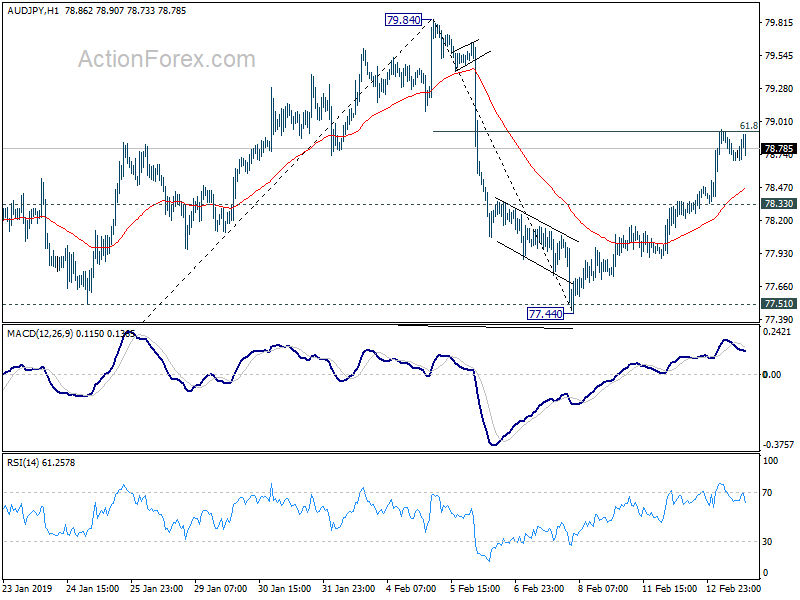
At this point, there is no overwhelming strength in Aussie elsewhere. AUD/USD is just in corrective recovery. EUR/AUD is held well above 1.5721 support. GBP/AUD also held well above 1.7868 support. AUD/CAD is in very tight range around 0.94. On the other hand, EUR/JPY stays below 125.95 resistance. GBP/JPY is well below 144.84 resistance. CAD/JPY is also below 83.98 high too.
Thus, for now, there is no change in the view AUD/JPY's rebound from 77.44 is a corrective rise. And we maintain the view that whole rise from 70.27 has completed at 79.84, on bearish divergence condition in 4 hour MACD, after failing to sustain above 55 day EMA.
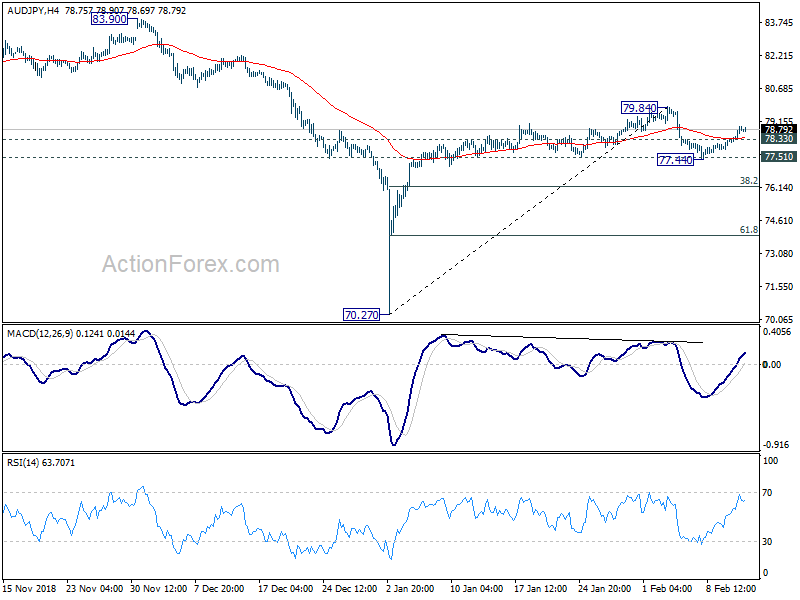
While current rebound form 77.44 might extend, we don't expect a break of 79.84 resistance. A break of 78.33 minor support will suggest that the recovery is completed and add some credence to our bearish case.
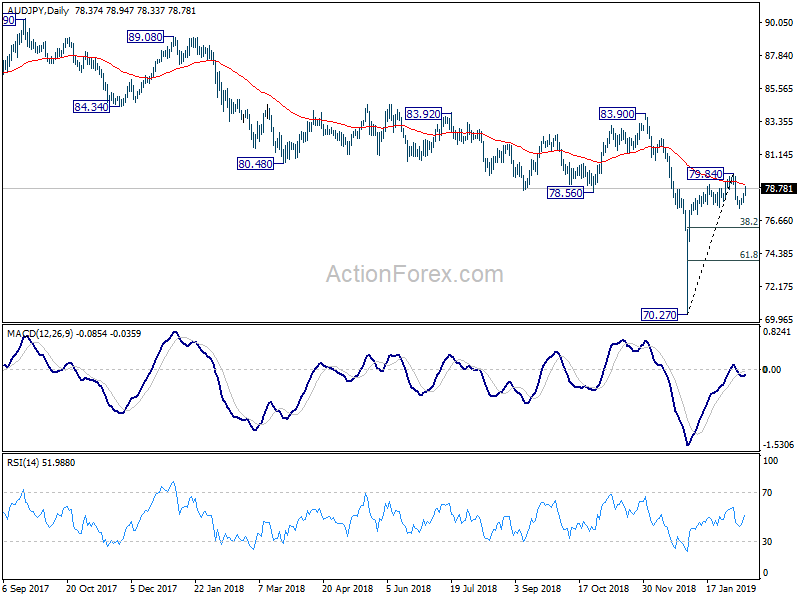
We'll hold short in AUD/JPY (sold at 78.40). Stop is kept at 79.84. As we don't expect a break of 70.27 with the next fall, our target will be put at 61.8% retracement of 70.27 to 79.84 at 73.92.
Aussie Looks to Key Chinese Data and Conclusion of Trade Talks
China’s trade and inflation figures for January will hit the markets early on Thursday and Friday, respectively. Forecasts point to further weakness, which may spell some trouble for “China-sensitive” currencies like the aussie. That said, the far bigger driver for market sentiment will likely be any updates in the US-China trade talks, the latest round of which concludes in Beijing on Friday.
The Chinese economy continued to slow at the beginning of 2019, if the forecasts for the upcoming indicators are anything to go by. Exports and imports are both expected to have contracted again in January on a yearly basis, with exports seen falling by 3.2%, a slower pace of decline compared to December’s 4.4% drop. However, imports are projected to have dipped by 10.0%, faster than the -7.6% previously.
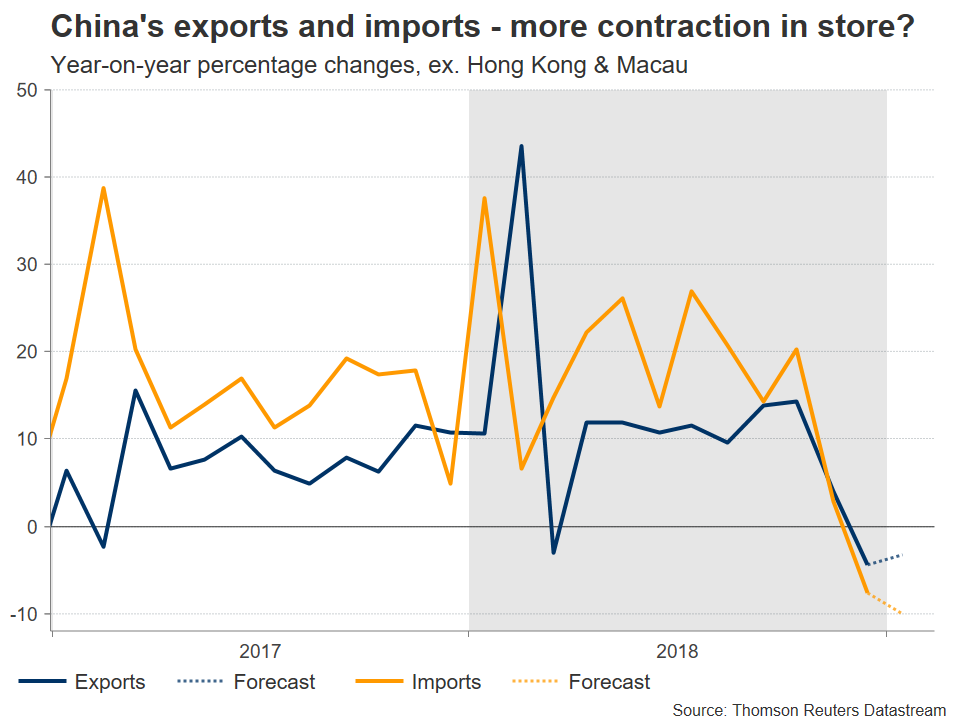
On the price front, consumer prices are expected to have held steady at 1.9% annually, well below the central bank’s 3% target. Meanwhile, the more closely watched producer price index is anticipated to have cooled to a mere 0.2% in yearly terms, from 0.9% in December. If confirmed, this would be particularly discouraging, as it would signal that factory demand in the world’s second-largest economy continues to weaken, spelling downside risks for both domestic and global growth.
An overall soft set of prints could amplify concerns around the Chinese economy, and by extent push the yuan and the Australian dollar lower. Since China is Australia’s largest export and import partner, the aussie is typically correlated with developments in China, as they tend to be reflected in Australia over time.
Looking past economic data, another – and probably more important – variable for the aussie’s overall direction will be what signals come out of the latest round of US-China trade negotiations, which will conclude on Friday. Optimism that a solution will be reached is riding high, following news that President Xi will meet with US negotiators himself this week, and remarks from President Trump that he would consider extending the March 1 deadline for raising tariffs if a deal is close by that point.
In particular, it seems the US may be willing to settle for a “smaller victory” that doesn’t necessarily include major concessions on issues like IP theft and forced technology transfer, but instead focuses on eliminating the trade deficit, curbing industrial subsidies, and opening up Chinese markets. This is evident by the fact that the conversation has shifted to the enforcement mechanisms of any deal, like a clause that automatically reintroduces tariffs if the accord is violated in the future. In any case, for financial markets overall, the specifics of any deal may not matter as much as actually getting a deal done, and by extent taking the trade war risk off the table.
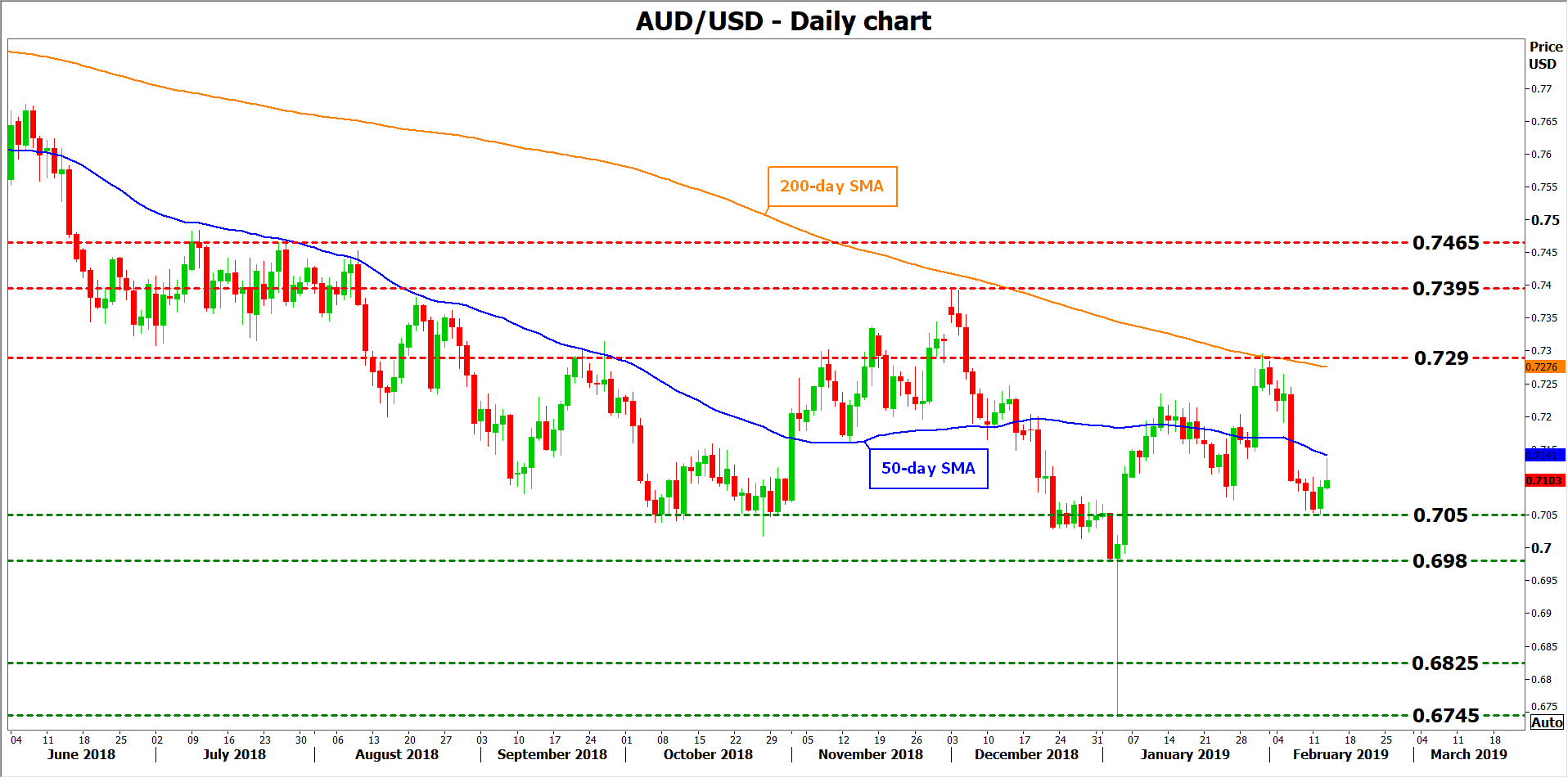
Technically, a pullback in aussie/dollar – perhaps on soft Chinese data – may stall initially around 0.7050, with a downside break opening the way for the January 2 trough at 0.6980. Even lower, support may be found around 0.6825, a zone marked by the January 2016 lows.
On the other hand, advances in the pair – for instance on the back of encouraging trade news – could encounter immediate resistance at the 50-day simple moving average (SMA), currently at 0.7141. A bullish break could see scope for a test of the 0.7295 area, where the 200-day SMA is also roughly located.
Beyond the Chinese and Australian currencies, any major surprises in these data or developments in the trade saga could affect broader risk sentiment as well, impacting stock markets and safe-haven assets.
Japan to Return to Growth in Q4 But Global Slowdown to Weigh on Outlook
Japan will post fourth quarter GDP numbers on Thursday (23:50 GMT, Wednesday) with growth expected to have partially recovered from a third quarter contraction. But with global growth decelerating at a worrying rate and the sales tax in Japan due to rise in October, a modest rebound at the end of 2018 is unlikely to diminish the risk of more negative quarters to come in 2019.
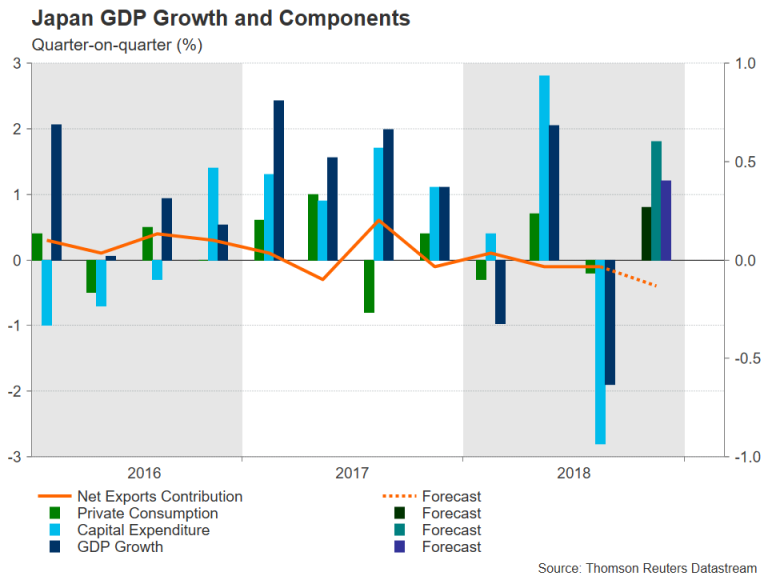
A rebound in business spending and private consumption is expected to have lifted Japanese growth in the December quarter. Capital expenditure had plunged by 2.8% q/q in the third quarter, while domestic consumption was subdued, falling by 0.2% q/q. Businesses likely upped their expenditure by 1.8% q/q in Q4 and consumer spending is expected to have picked up by 0.8% q/q. However, the deteriorating global trade environment probably acted as a drag on growth for a third consecutive quarter, with analysts predicting that net exports subtracted 0.4% from GDP growth in Q4.
Overall, the economy is expected to have increased by 1.4% on an annualized basis in the three months to December, improving on Q3’s 2.5% drop. On a quarterly basis, growth is projected at 0.4% compared with a 0.6% contraction in the prior period.
The data is unlikely to have a major impact on monetary policy so little reaction is being anticipated in forex markets. The yen could firm slightly if there is an upside surprise to the headline GDP figure or there are positive aspects in the breakdown numbers such as stronger-than-expected consumer spending.
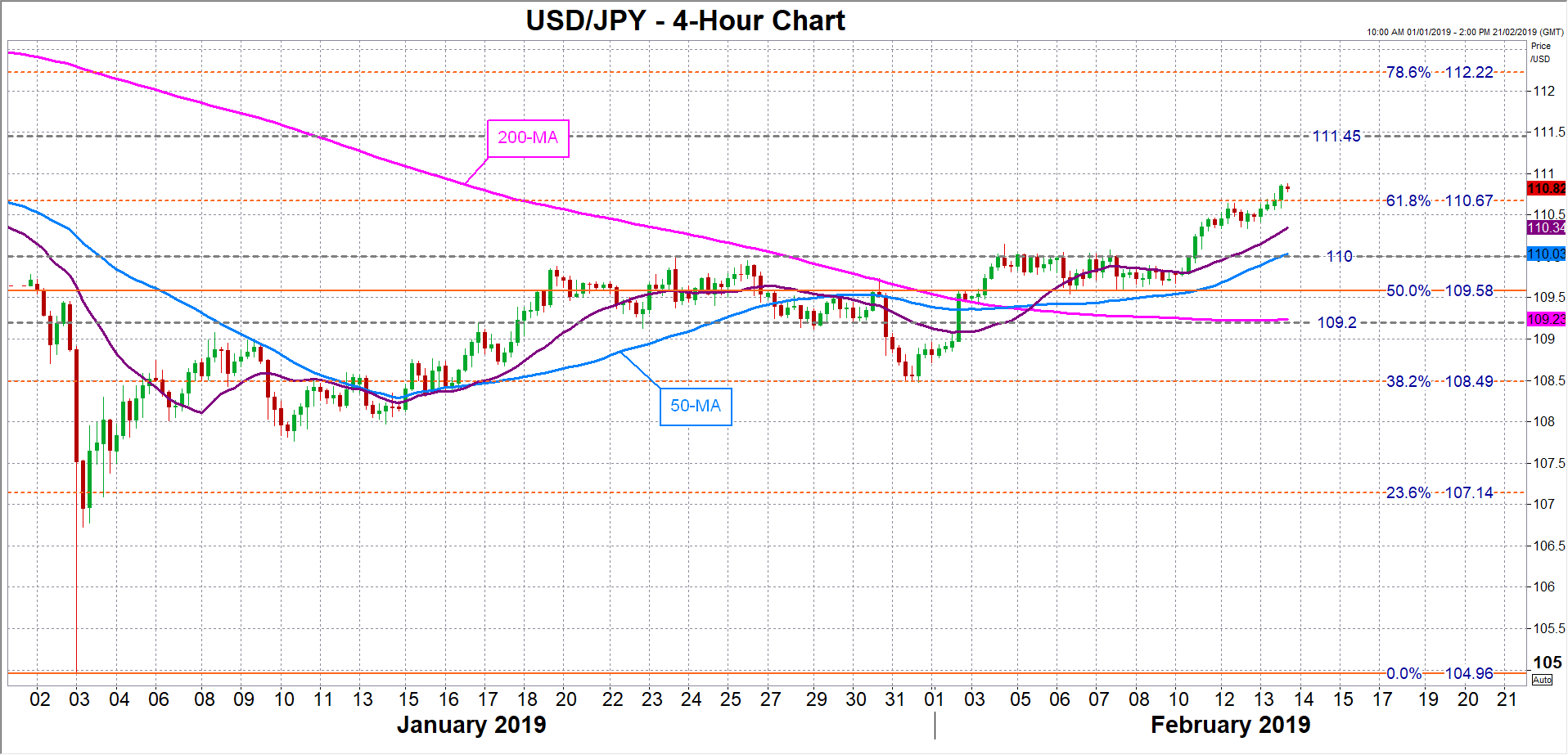
Initial support for dollar/yen in the event of a boost to the Japanese currency could come at the 110 level, where the 50-period moving average (MA) is currently positioned in the 4-hour chart. This has also been an important support and resistance barrier in the past. A breach of this support would open the way for the 109.60 area, which is the 50% Fibonacci retracement of the downslide from 114.20 to 104.96. Lower down, prices could stall near the 200-period MA at 109.20.
If, however, the data misses the consensus forecasts and doubts are raised about Japan’s economic momentum, dollar/yen could extend its February uptrend, though it would first need to overcome resistance at the 61.8% Fibonacci retracement around 110.67. A daily close above this level would bring the 111.45 resistance region into range before traders turn their sights onto the 78.6% Fibonacci around 112.20.
After inflation turned lower in Q4, the Bank of Japan is not about to pull the plug on its massive stimulus program anytime soon even if growth bounced back more strongly than anticipated. On the other hand, a disappointing reading would only reinforce the BoJ’s commitment to sticking with its ultra-loose policy until inflation has reached 2%. The Bank’s targeted price gauge, CPI minus fresh foods, moderated to 0.7% year-on-year on December, having reached 1% in September.
With trade tensions still running high and the government set to increase the sales tax in October, the downside risks to Japanese growth are substantial, even though the BoJ remains cautiously optimistic about the outlook. The country’s exports slumped by almost 4% in the 12 months to December, as heightened trade uncertainty hit manufacturers globally. There has, however, been some progress in raising wage growth, which edged up to 1.8% y/y in December, though this has yet to significantly lift household spending.
Policymakers in Japan will therefore be keeping a close eye on the US-China trade talks as an escalation in trade frictions could potentially tip Japan’s economy into a recession. However, should the US and China achieve a trade settlement in the coming weeks, this would be a double boon for Japanese exporters as it would not only boost global trade but would also lead to a depreciation in the yen as the trade-related risk aversion receded.
NZDJPY Jumps Higher But Capped By Upper Bollinger Band
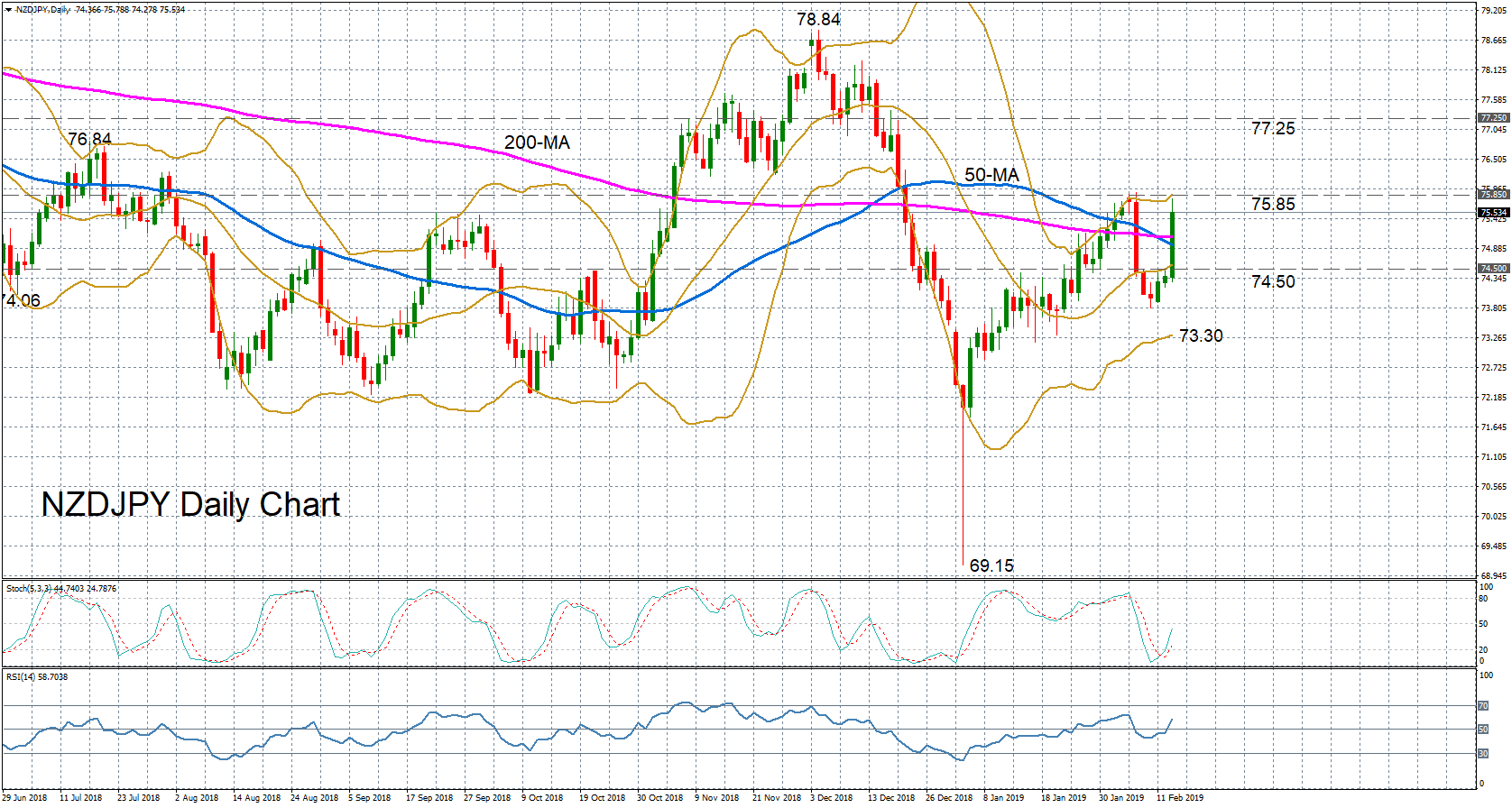
NZDJPY is looking strongly bullish in the short term after surging above its daily moving averages (MA) on Wednesday. Prices hit a one-week high of 75.79 and the technical indicators are all pointing to further positive momentum in the near term.
The stochastics are heading upwards, but the %K line has yet to cross above 50, suggesting plenty of scope for additional upside moves. The RSI has crossed into bullish territory but has yet to approach the 70 overbought level.
Immediate resistance to further gains would likely come from the upper Bollinger band, around 75.85, which capped prices earlier today. This is also near the February 6 peak of 75.90 so this could prove a potentially difficult hurdle for the pair to overcome. If there is a successful break above this area, further resistance could be met around 77.25, which was a congested region during November and December. Higher up, the December top of 78.84 – a 7-month high – would be the next target.
If, however, the strong upside momentum was to lose steam and the pair reversed lower, support would initially come from the 20-day MA, also the middle Bollinger band, around 74.50. Slipping below this level could take prices towards the lower Bolling band at 73.30. Failure to hold inside the Bollinger bands would switch the focus back to the downside and attention would increasingly turn to the 2½-year low of 69.15 reached in early January.
In the more medium-term picture, the bearish outlook recently shifted to a neutral one and is likely to stay neutral as long as prices remain close to the 50-day MA.
Risk Appetite Still Riding Trade Optimism Wave
Global stocks continue to ride the wave of optimism that trade talks between China and the US are getting closer to a framework agreement. The dollar maintained a strong footing, mainly on the weakness of the euro and Treasury yields continued to climb higher after the US CPI report signaled inflation remains subdued.
- USD – Inflation remains subdued
- NZD – RBNZ still sees next move as a hike
- EUR – Industry production falls for third consecutive month
- Teva – signals tough 2019
- GOLD – Remains supported as global risks remain
- OIL – OPEC may cut again to counter US production
USD
US inflation is unlikely to steal headlines today as it remained steady for a third consecutive month and reemphasizes the view that the Fed is likely to do nothing for a very long time. Interest rate expectations following the release show that for the December meeting a rate cut is 19.9% likely, while a rate hike is seen at only 7.1%.
NZD
Last night, the New Zealand Central Bank (RBNZ) Governor reiterated that the chance of rate cut has not increased and that the central bank sees rates at current level through 2019 and 2020. The RBNZ did lower their forecast for rates in December 2020, from 2.0% to 1.84% and if the they continue to see GDP stabilize and global risks ease, they could signal in the middle of the year they will end their easing cycle and move rates next year above the record low of 1.75%.

EUR
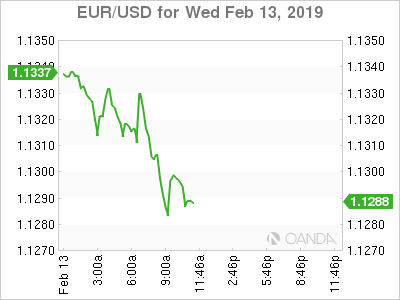
Europe appears to be the weakest of the advanced economies and the continued sluggishness in the industrial sector will add to concerns that the 19-country eurozone recession risks will rise. The annual rate of industrial production came in worst than expected at -4.2%, the poorest reading since the financial crisis.
With the most important cog, Germany also showing signs of weakness, we could very well see expectations dwindle for the ECB to deliver that rate hike until next year. Tomorrow, Germany is expected to avoid a technical recession with the quarterly reading rising from -0.2% to +0.1%. A big miss from Germany could signal more red flags for the eurozone and help sink the euro even further.
Teva
Teva shares got slammed after their guidance for 2019 widely missed analysts’ expectations. The Israeli specialty pharmaceutical company also forecasted a return to growth in 2020, not 2019. Teva noted they continue to expect 2019 to be a “trough” year for business. They will also close 11 manufacturing facilities in 2019.
Oil
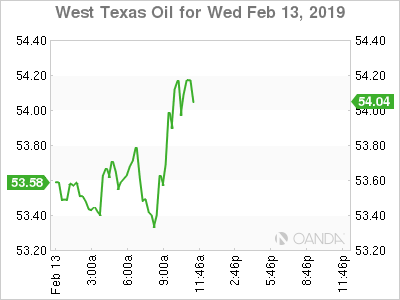
Crude prices remained bid following the general theme of optimism in the financial markets. Yesterday’s news that Saudi Arabia would over deliver on their crude production cuts continued to help to ease oversupply concerns. Despite today’s rise, oil remains vulnerable and may not see another push higher if we do not see the dollar have a strong pullback here.
MARKET WRAP: Trade Hopes Drove Markets Higher
Investors are factoring in a strong possibility of a trade deal between the US and China and this pushed the markets higher.
Stocks
- The S&P 500 Index jumped 0.32 percent on the prospects of no US government shutdown as of 15:20 London time.
- The Nasdaq 100 soared 0.36 percent and the Dow Jones Industrial Average also added to its yearly gains by 0.46 percent.
- The Stoxx Europe 600 Index moved higher by 0.76 percent.
- Germany’s DAX Index jumped 0.60% percent.
- The MSCI Emerging Market Index moved higher on a volume of 146K and gained 0.86%.
Currencies
- The Dollar Spot Index gained more strength today due to the decent US CPI reading and it rose by 0.30%.
- The Euro broke its critical level of 1.13 and dropped by 0.22 percent against the dollar to $1.1293.
- The British pound recovered some of its losses as Theresa May battled in the parliament for another day. It jumped up by 0.06%
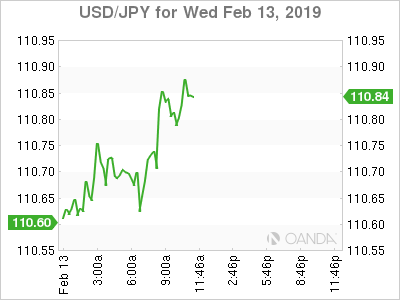
- The Japanese yen is still out of luck and dropped by 0.29 percent to 110.36 per dollar.
Bonds
- The yield on 10-year Treasuries jumped by two basis points to 2.70 percent.
- Germany’s 10-year dropped nearly a basis point to 0.13 percent.
- Britain’s 10-year yield continued to move higher and jumped by one basis point to 1.195.
Commodities
- West Texas Intermediate crude soar again today and jumped by 1.21 percent to $53.74.
- Gold moved higher as the chances of Fed increasing the interest rates aren’t changed because of the CPI number. The price popped by 0.19%.
Japanese Yen Continues to Slide after Weak Inflation Report
USD/JPY has gained ground in the Wednesday session. In the North American session, the pair is trading at 110.76, up 0.25% on the day. On the release front, Japanese PPI disappointed with a gain of 0.6% in January, shy of the estimate of 1.0%. This was the lowest level since January 2017. Later in the day, Japan releases GDP for the fourth quarter, with an estimate of 0.4%. In the U.S., consumer inflation data for January was soft. CPI ticked up to 0.0%, shy of the estimate of 0.1%. Core CPI posted a gain of 0.2%, matching the estimate. On Thursday, the U.S. publishes retail sales and PPI.
Inflation levels in the U.S. remain low, despite a strong U.S. economy and strong labor market. CPI showed no change in January, and has failed to post a gain since November. Core CPI has recorded weak gains of 0.2% for four successive months. On an annualized basis, CPI gained 1.6% in January, the weakest year-over-year gain since mid-2017. The soft inflation numbers were a result of low energy prices, which fell 3.1% in January as oil prices remain under pressure.
Are we close to a breakthrough in the U.S-China trade war? The crisis between the two largest economies in the world has rocked equity markets and dampened risk appetite. The U.S. has imposed 10% tariffs on Chinese goods and has threatened to raise the tariffs to a punishing 25% on March 1. Trade officials from the U.S. and China are meeting for a third round of negotiations, and U.S. Treasury Secretary Steven Mnuchin has joined the talks. There was positive news on Tuesday, as President Trump said that he could postpone the March 1 deadline if the trade talks made sufficient progress. If the negotiations yield an agreement, risk appetite will jump and the safe-haven yen could head lower.