Sample Category Title
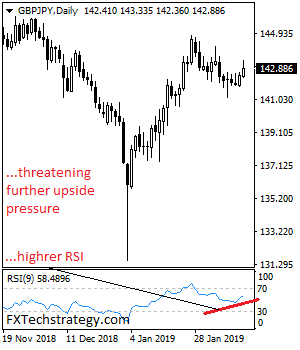
GBPJPY Eyes Upside Pressure On Further Corrective Recovery
GBPJPY eyes upside pressure on further corrective recovery as it retain its bull pressure. On the downside, support comes in at the 142.50 level where a violation will aim at the 142.00 level. A break below here will target the 141.50 level followed by the 141.00 level. Conversely, resistance is seen at the 143.00 level followed by the 143.50 level. A cut through that level will set the stage for a move further higher towards the 144.00 level. Further out, resistance resides at the 144.50 level. All in all, GBPJPY looks to recover higher.
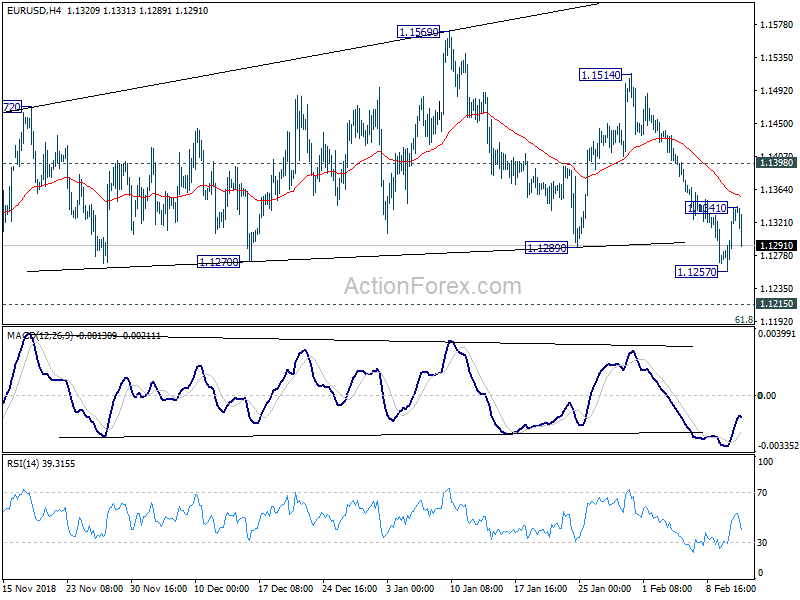
EUR/USD Mid-Day Outlook
Daily Pivots: (S1) 1.1277; (P) 1.1308; (R1) 1.1359; More.....
EUR/USD recovers to 1.1341 earlier today but drops sharply in early US session. Intraday bias remains neutral as consolidation from 1.1257 temporary low might extend. Though, upside should be limited below 1.1398 minor resistance to bring fall resumption. We're holding on to the view that corrective pattern from 1.1215 has completed already. On the downside, below 1.1257 should see further decline through 1.1215 low to 1.1186 fibonacci level. However, break of 1.1398 will dampen this bearish view and bring stronger rebound back to 1.1514/69 resistance zone.
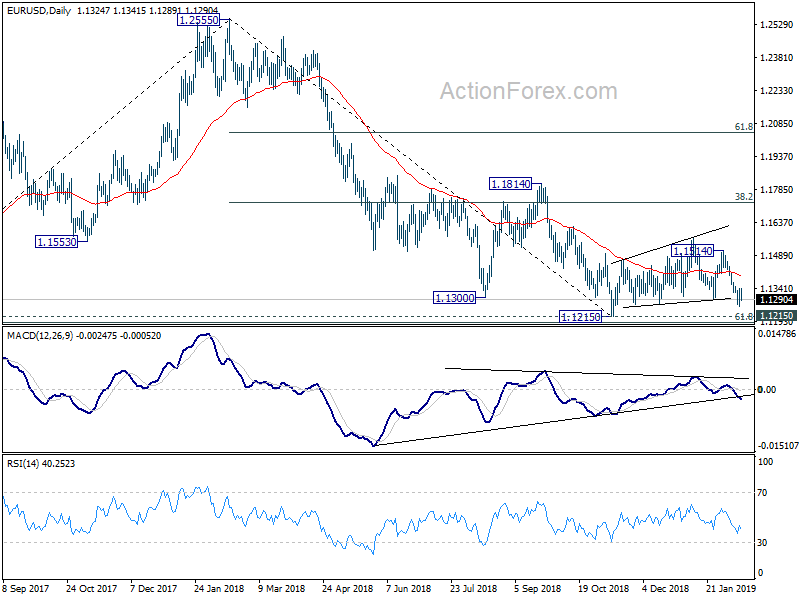
In the bigger picture, as long as 1.1814 resistance holds, down trend down trend from 1.2555 medium term top is still in progress and should target 61.8% retracement of 1.0339 (2017 low) to 1.2555 at 1.1186 next. Sustained break there will pave the way to retest 1.0339. However, break of 1.1814 will confirm completion of such down trend and turn medium term outlook bullish.
Dollar Trying to Rebound on CPI, Risk Appetite Continues
Strong risk appetite remains the main theme for today on trade optimism. Though, Dollar is trying to steal the show in early US session with stronger than expected inflation data. For now, Yen remains the weakest one for today. Euro follows as weighed down by poor industrial production data, then Swiss Franc. On the other hand, New Zealand was boosted by less dovish than expected RBNZ MPS today. At least, RBNZ suggests that it's not on track for a rate cut. Meanwhile, Aussie is supported by strong risk appetite based on trade-deal optimism.
Trump indicated yesterday that he's willing to let the March 1 trade truce deadline with China slide a little. White House spokeswoman Sarah Huckabee Sanders was quoted by Fox news saying that Trump is weighing possibilities regarding China trade deadline. Though, the trade deal will only be finalized at Trump-Xi meeting. In Beijing, Treasury Secretary Steven Mnuchin said talks in Beijing are "so far, so good".
US headline CPI slowed to 1.6% yoy in January, down from 1.9% yoy but beat expectation of 1.5% yoy. CPI core was unchanged at 2.2% yoy, beat expectation of 2.1% yoy. Core CPI has been at or above 2.2% for eight out of the past nine-months.
In Europe, currently, FTSE is up 0.70%. DAX is up 0.44%. CAC is up 0.50%. German 10-year yield is up 0.144 at 0.0105. Earlier in Asia, Nikkei rose 1.34%. Hong Kong HSI rose 1.15%. China Shanghai SSE rose 1.84%, reclaimed 2700 handle. Singapore Strait Times rose 1.36%. Japan 10-year JGB yield rose 0.0051 to -0.005, staying negative.
UK CPI slowed to 2-year low
UK CPI slowed to 1.8% yoy in January, down from 2.1% yoy and missed expectation of 2.0% yoy. That's also the lowest level since January 2017. Core CPI was unchanged at 1.9% yoy, matched expectations. ONS noted that the largest downward contribution to the change in the 12-month rate came from electricity, gas and other fuels. Meanwhile, these downward effects were partially offset by air fares.
Also from UK, RPI slowed to 2.5% yoy, down from 2.7% yoy, below expectation of 2.5% yoy. PPI input slowed to 2.9% yoy, down from 3.2% yoy and missed expectation of 3.8% yoy. PPI output slowed to 2.1% yoy, down from 2.4% yoy and missed expectation of 2.2% yoy. PPI output core was unchanged at 2.4% yoy, above expectation of 2.3% yoy. House price index slowed to 2.5% yoy, down from 2.7% yoy, matched expectations.
UK Barclay: Not in anyone's interest to extend Article 50
In the UK, ITV news reported that its correspondent overhead lead Brexit negotiator Olly Robbins said the parliament is facing a choice of Prime Minister Theresa May's deal or a long article 50 extension. And, the issue is whether Brussels is clear on the terms of extension.
On the other hand, Brexit Minister Steve Barclay is quick to clarify that "the prime minister has been very clear that we are committed to leaving on the 29th of March… It's not in anyone's interest to have an extension without any clarity."
And, the Financial Times reported that PM Theresa May told business leaders that extending Article 50 process beyond March 29 serves no purpose.
Eurozone industrial production dropped -0.9% mom in Dec
Eurozone industrial production contracted -0.9% mom in December, much worse than expectation of -0.4% mom. Over the year, IP dropped -4.2% yoy. Looking at the industrial groupings, production of both capital goods and non-durable consumer goods fell by -1.5% and energy by -0.4%, while production of intermediate goods remained unchanged and durable consumer goods rose by 0.7%. For EU 28, industrial productions dropped -0.5% mom, -2.7% yoy.
NZD jumps on less dovish than expected RBNZ
New Zealand Dollar jumps sharply after RBNZ turned out to be less dovish than expected. OCR was kept at 1.75% as widely expected. And, the central bank restored the language that "the direction of our next OCR move could be up or down" in the statement. However, there was no more dovish tweak.
In short, RBNZ expected interest rate to be unchanged at current level "through 2019 and 2020". It maintained the view that "As capacity pressures build, consumer price inflation is expected to rise to around the mid-point of our target range at 2 percent."
And, there were upside and downside risks to the outlook. RBNZ noted "there are upside and downside risks to this outlook. A more pronounced global downturn could weigh on domestic demand, but inflation could rise faster if firms pass on cost increases to prices to a greater extent."
The overall statement was pretty balanced and did nothing to endorse market speculation of a rate cut by year end.
Suggested readings:
- NZD Jumped although RBNZ Postponed Timing of Rate Hike (At Least Not Expecting a Cut)
- First Impressions: RBNZ Leaves OCR at 1.75%
Also released in Asian session, Australia Westpac consumer confidence rose 4.3% in February. Japan domestic CGPI rose 0.6% yoy in January versus expectation of 1.0% yoy.
EUR/USD Mid-Day Outlook
Daily Pivots: (S1) 1.1277; (P) 1.1308; (R1) 1.1359; More.....
EUR/USD recovers to 1.1341 earlier today but drops sharply in early US session. Intraday bias remains neutral as consolidation from 1.1257 temporary low might extend. Though, upside should be limited below 1.1398 minor resistance to bring fall resumption. We're holding on to the view that corrective pattern from 1.1215 has completed already. On the downside, below 1.1257 should see further decline through 1.1215 low to 1.1186 fibonacci level. However, break of 1.1398 will dampen this bearish view and bring stronger rebound back to 1.1514/69 resistance zone.
In the bigger picture, as long as 1.1814 resistance holds, down trend down trend from 1.2555 medium term top is still in progress and should target 61.8% retracement of 1.0339 (2017 low) to 1.2555 at 1.1186 next. Sustained break there will pave the way to retest 1.0339. However, break of 1.1814 will confirm completion of such down trend and turn medium term outlook bullish.
Economic Indicators Update
| GMT | Ccy | Events | Actual | Forecast | Previous | Revised |
|---|---|---|---|---|---|---|
| 23:30 | AUD | Westpac Consumer Confidence Feb | 4.30% | -4.70% | ||
| 23:50 | JPY | Domestic CGPI Y/Y Jan | 0.60% | 1.00% | 1.50% | |
| 01:00 | NZD | RBNZ Official Cash Rate | 1.75% | 1.75% | 1.75% | |
| 09:30 | GBP | CPI M/M Jan | -0.80% | -0.70% | 0.20% | |
| 09:30 | GBP | CPI Y/Y Jan | 1.80% | 2.00% | 2.10% | |
| 09:30 | GBP | Core CPI Y/Y Jan | 1.90% | 1.90% | 1.90% | |
| 09:30 | GBP | RPI M/M Jan | -0.90% | -0.80% | 0.40% | |
| 09:30 | GBP | RPI Y/Y Jan | 2.50% | 2.60% | 2.70% | |
| 09:30 | GBP | PPI Input M/M Jan | -0.10% | 0.30% | -1.00% | -1.60% |
| 09:30 | GBP | PPI Input Y/Y Jan | 2.90% | 3.80% | 3.70% | 3.20% |
| 09:30 | GBP | PPI Output M/M Jan | 0.00% | 0.00% | -0.30% | |
| 09:30 | GBP | PPI Output Y/Y Jan | 2.10% | 2.20% | 2.50% | 2.40% |
| 09:30 | GBP | PPI Output Core M/M Jan | 0.40% | 0.20% | 0.20% | 0.10% |
| 09:30 | GBP | PPI Output Core Y/Y Jan | 2.40% | 2.30% | 2.50% | 2.40% |
| 09:30 | GBP | House Price Index Y/Y Jan | 2.50% | 2.50% | 2.80% | 2.70% |
| 10:00 | EUR | Eurozone Industrial Production M/M Dec | -0.90% | -0.40% | -1.70% | |
| 13:30 | USD | CPI M/M Jan | 0.00% | 0.10% | -0.10% | 0.00% |
| 13:30 | USD | CPI Y/Y Jan | 1.60% | 1.50% | 1.90% | |
| 13:30 | USD | CPI Core M/M Jan | 0.20% | 0.20% | 0.20% | |
| 13:30 | USD | CPI Core Y/Y Jan | 2.20% | 2.10% | 2.20% | |
| 15:30 | USD | Crude Oil Inventories | 2.1M | 1.3M | ||
| 19:00 | USD | Monthly Budget Statement Dec | -10.0B | -204.9B |
BTCUSD Weakens after Strong Upside Rally in Short Term
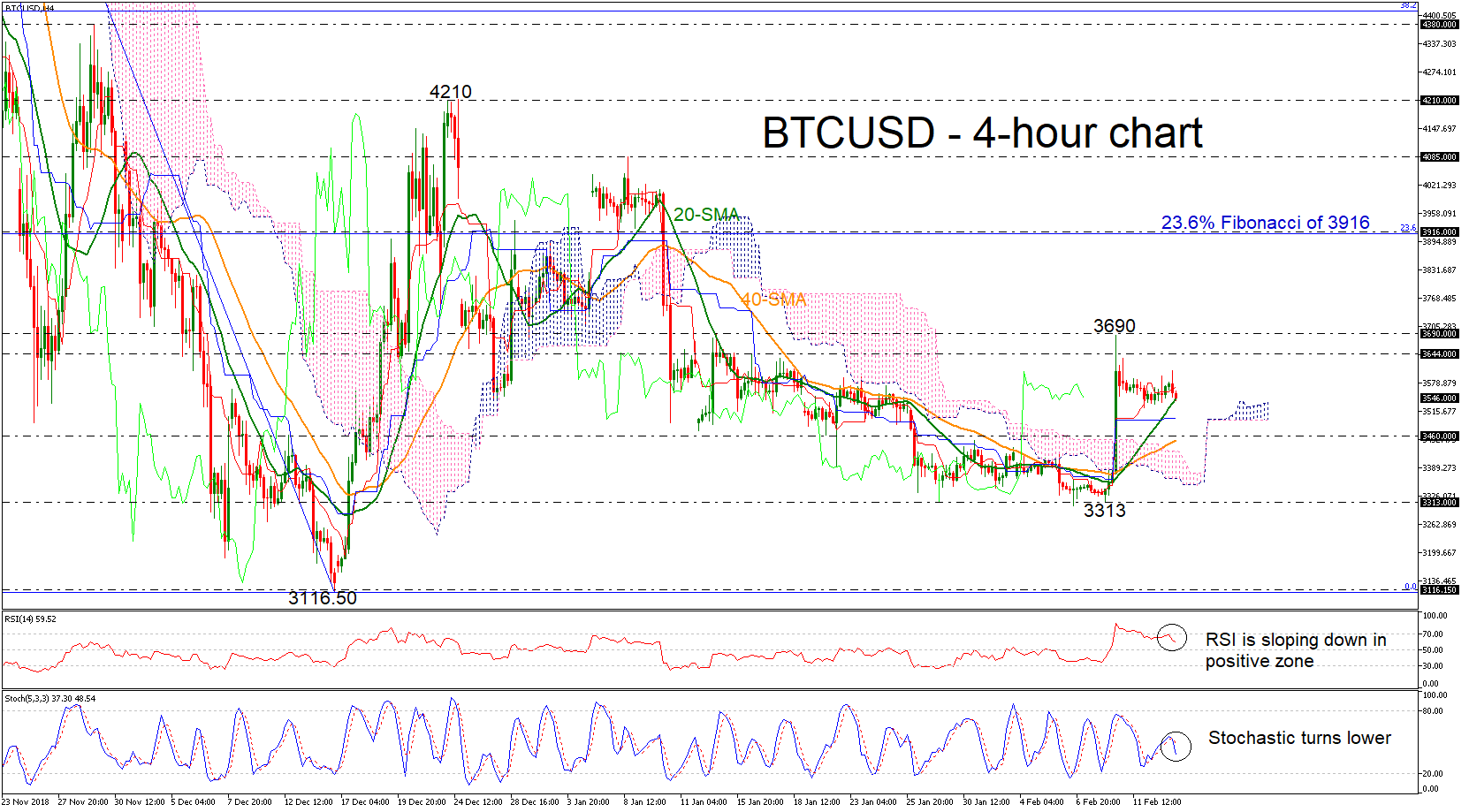
BTCUSD skyrocketed last Friday, jumping above the Ichimoku cloud and the 20- and 40-simple moving averages (SMAs) in the 4-hour chart. Currently, the price is moving sideways, and the technical indicators have turned lower. The RSI indicator is moving down in the positive zone while the stochastic oscillator is approaching the oversold territory.
Should the price extend higher, it could find resistance at the 3644 level, before touching the latest high of 3690. Also, an advance above this region would increase speculation that a bullish move is in progress towards the 23.6% Fibonacci retracement level of the downleg from 6508 to 3116.50, around the 3916 resistance level.
On the flipside, if the price heads south, immediate support is coming from the 3460 barrier, which stands near the 40-SMA. A step lower could bring bearish sentiment back into play in the near term taking the price towards the 3313 hurdle.
To sum up, the very short-term bias remains neutral, however, in the long-term view the bearish structure holds, as it has over the last year.
Dollar rebounds after stronger than expected US CPI
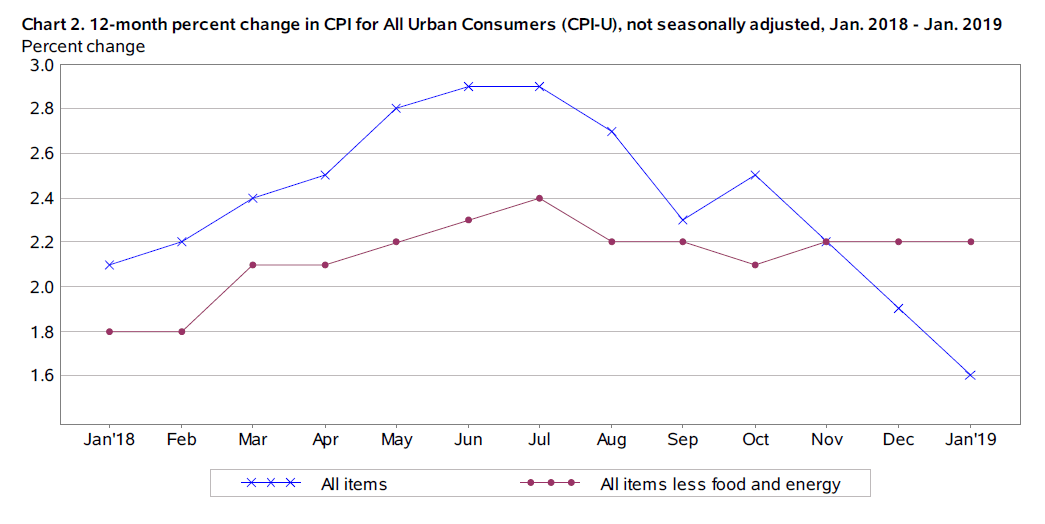
Dollar rebounds in early US session after stronger than expected inflation data. Headline CPI slowed to 1.6% yoy in January, down from 1.9% yoy but beat expectation of 1.5% yoy. CPI core was unchanged at 2.2% yoy, beat expectation of 2.1% yoy.
Canadian Dollar at 1-Week High, U.S. Inflation Next
USD/CAD is unchanged in the Wednesday session. Currently, the pair is trading at 1.3243, up 0.05% on the day. On the release front, there are no Canadian events until Thursday. In the U.S., the markets are expecting soft numbers from consumer inflation. CPI and Core CPI are forecast to post gains of 0.1% and 0.2%, respectively. On Thursday, the U.S. publishes retail sales and PPI.
The Canadian dollar is sensitive to the mood of investors, and positive news on Tuesday could bode well for the currency. In the U.S., lawmakers have tentatively agreed on a proposal which will avert another government shutdown, which would take effect on Friday. However, the deal needs to be approved by Congress and President Trump. The agreement does not provide Trump will funding for a border wall, and the deadlock between Congress and Trump over this issue triggered a government shutdown in January which lasted 35 days. Both sides are eager to avoid blame for a second shutdown, and Trump hinted earlier in the week that he would go along with the deal, albeit with reservations.
Taking a page out of the Federal Reserve’s playbook, the Bank of Canada has become more dovish, after raising rates three times in 2018. The BoC is expected to stay on the sidelines at its next policy meeting in March 6. The Canadian economy is being hampered by the global trade war, which has reduced the demand for Canadian exports. Weak oil prices have also weighed on the economy and kept inflation at low levels. The Canadian dollar is under pressure, and has lost close to 1.0% in February.
Into US session: Risk appetite continues, Euro weighed by poor production data
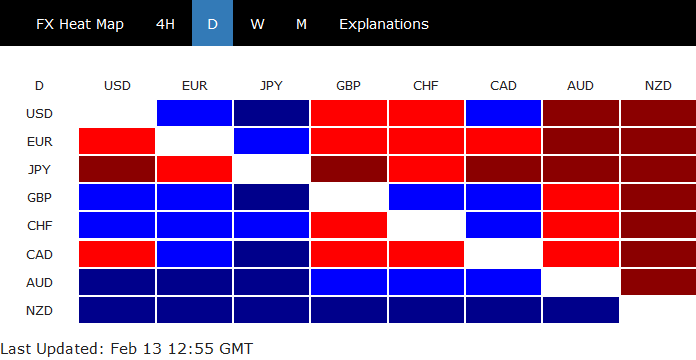
Entering into US session, New Zealand and Australian Dollar remain the strongest ones for today. Kiwi was boosted by less dovish than expected RBNZ MPS today. At least, RBNZ suggests that it's not on track for a rate cut. Meanwhile, Aussie is supported by strong risk appetite based on trade-deal optimism. Trump indicated yesterday that he's willing to let the March 1 trade truce deadline with Chine slide a little. Treasury Secretary Steven Mnuchin also said talks in Beijing are so far, so good.
Yen remains the weakest one for today, naturally on risk appetite. Euro follows as weighed down by poor industrial production data, then Swiss Franc. Sterling shrugs of weaker than expected inflation reading, with headline CPI dropped to 2-year low in January. Focus will now turn to US CPI.
In Europe, currently:
- FTSE is up 0.57%.
- DAX is up 0.19%.
- CAC is up 0.30%.
- German 10-year yield is down -0.0025 at 0.131. That's another factor weighing on Euro.
Earlier in Asia:
- Nikkei rose 1.34%.
- Hong Kong HSI rose 1.15%.
- China Shanghai SSE rose 1.84%, reclaimed 2700 handle.
- Singapore Strait Times rose 1.36%.
- Japan 10-year JGB yield rose 0.0051 to -0.005, staying negative.
‘Risk-on’ Sentiment Boosted by Trade Optimism; US CPI in Focus
There was a collective sigh of relief across financial markets after President Donald Trump hinted that he could extend the March 1 deadline for increasing tariffs on Chinese goods if the two sides get close to a deal.
The positive mood felt across global equity markets following Trump’s comments continues to highlight how sentiment remains heavily influenced by US-China trade developments. While Asian, European and US shares are seen pushing higher amid the ‘risk-on’ mood, this positivity is likely to be short lived. It is certainly too early for any celebrations, especially when considering how lessons of the past have repeatedly taught investors how unpredictable the Trump administration can be. If talks drag on after the deadline extension, global optimism will most likely fade as renewed trade uncertainty adds to the bucket load of geopolitical risks draining investor confidence.
Pound unfazed by UK inflation report
Sterling offered a fairly muted reaction this morning despite UK inflation dropping below the Bank of England’s 2% target in January for the first time in two years. Consumer prices fell to 1.8% last month thanks to cheaper energy prices.
Subdued inflation in the UK is likely to lower the odds of the Bank of England raising UK interest rates anytime soon, which is inevitably negative for the British Pound. Sterling’s price action witnessed in recent weeks confirms how Brexit continues to overshadow economic fundamentals. With six weeks to go until Britain leaves the EU, the Pound is poised to remain highly sensitive and volatile as markets closely monitor Brexit developments.
When looking into the technical picture, the GBPUSD remains under noticeable selling pressure on the daily charts. Sellers need to secure an intraday breakdown below 1.2850 to encourage a decline towards 1.2780. For bulls to jump back into the game, prices need to breakout and close above 1.2900.
Will US inflation test the Fed’s data dependence?
Across the Atlantic, investors will direct their attention towards the pending US core inflation report for January which is expected to print at roughly around 2.2%. The CPI readings will be closely watched because markets will use these announcements to gauge the Fed’s level of data dependence and whether the central bank's dovish tone is justified. Should inflation tick higher in the US, the central bank may be prompted to resume its rate hikes, which could translate to more gains for the Dollar.
Commodity spotlight – Gold
The ‘risk-on’ vibe sweeping across global markets and the stabilizing US Dollar are bad news for Gold which tends to shine in times of uncertainty.
Appetite for the metal is likely to take a hit today as trade optimism sends investors to riskier assets. However, Gold has nothing to worry about in the longer term given the unfavourable market conditions and geopolitical risks bubbling in the background. With concerns over slowing global growth on the mind of many investors, Brexit drama, China slowdown fears and many other negative themes floating in the air, Gold bulls are safe. A primary driver that will heavily support the precious metal this year will be expectations over the Fed taking a break on US rate hikes.
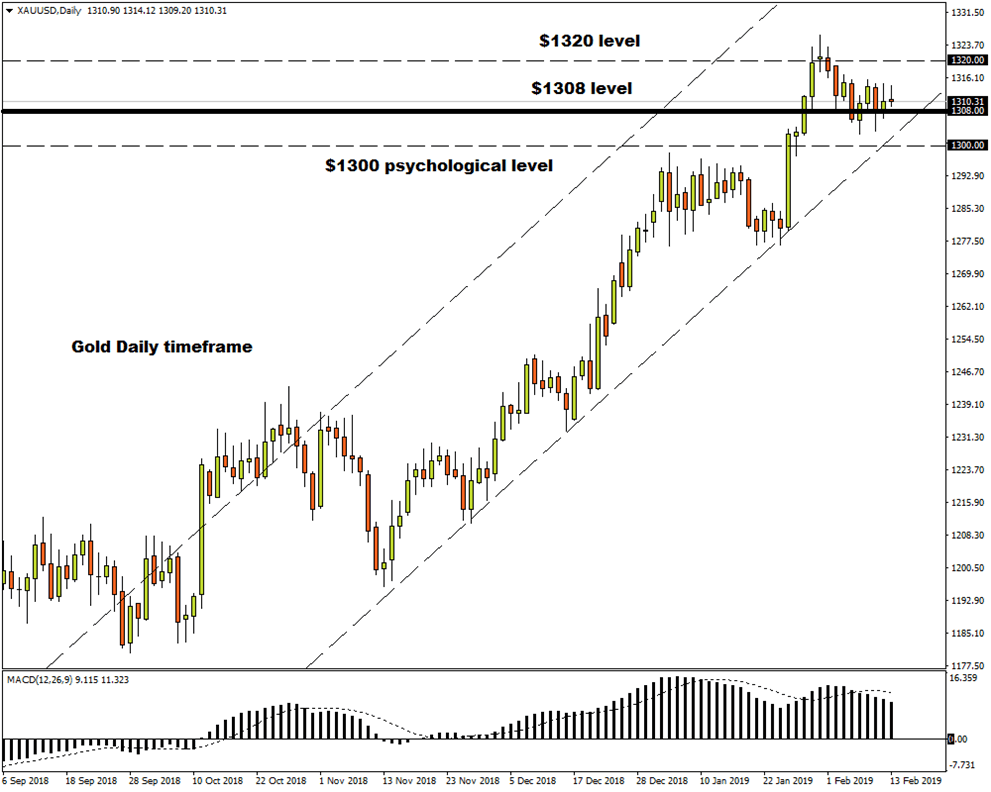
Focusing on the technical picture, Gold remains bullish on the daily charts as there have been consistently higher highs and higher lows. If $1,308 proves to be a reliable support level, then prices could challenge $1,320. However, a breakdown below $1,300 will most likely open a clear path back towards the $1,300 psychological level.
DAX Edges Higher As Risk Appetite Improves
The DAX index has steadied on the Wednesday session, after jumping 1.0% on Tuesday. Currently, the DAX is at 11,133, up 0.07% on the day. On the release front, eurozone industrial production declined 0.9%, below the estimate of -0.4%. On Thursday, the eurozone and Germany release GDP reports.
The DAX has climbed 2.2% this week, erasing almost all of the losses sustained in the first week of February. On Tuesday, European blue-chip indices posted strong gains, courtesy of unexpectedly strong earnings at Michelin, the giant French tire maker. This triggered strong gains for German and French automakers and boosted the DAX and CAC, which gained 1.0% and 0.84%, respectively.
The U.S-China trade war has rocked equity markets and dampened risk appetite. The U.S. has imposed 10% tariffs on Chinese goods and has threatened to raise the tariffs to a punishing 25% on March 1. Trade officials from the U.S. and China are meeting for a third round of negotiations, and U.S. Treasury Secretary Steven Mnuchin has joined the talks. There was positive news on Tuesday, as President Trump said that he could postpone the March 1 deadline if the trade talks made sufficient progress.
The global trade war has dampened the appetite for German and eurozone exports, which has weighed on the manufacturing sector. On Wednesday, eurozone industrial production in December fell 0.9%, its third decline in four months. Last week, German industrial production and factory both posted declines.
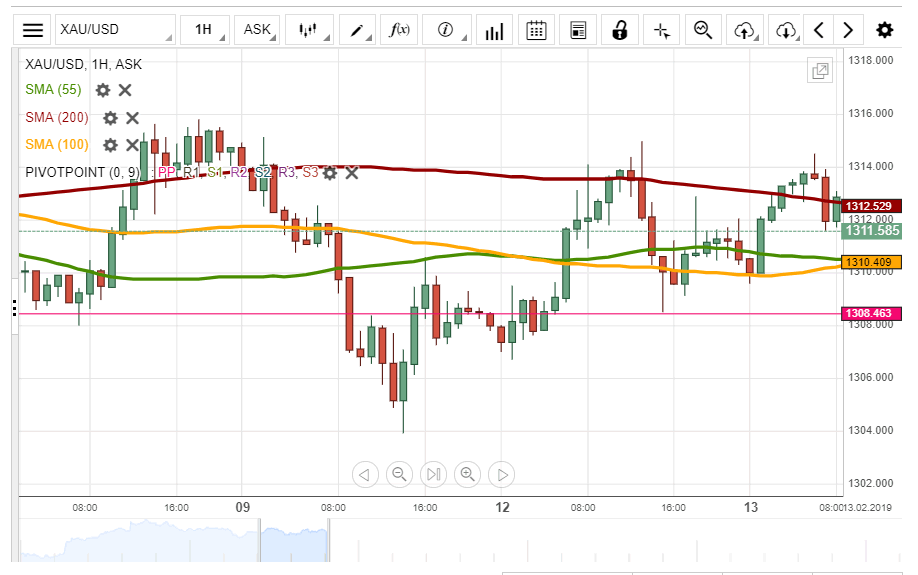
XAU/USD Is Supported By SMAs
During Tuesday's trading session, the yellow metal was trading between the 200-hour and the 100-hour SMAs. During Wednesday's morning hours, the 100-hour simple moving average supported the rate at the 1,310.50 mark.
In regards to the near-term future, it is expected that the 55-hour and the 100-hour SMAs will push the rate to break the resistance of the 200-hour simple moving average.
In addition, today's US CPI and Core CPI data release at 13:30 GMT might support the US Dollar to appreciate against the gold to trade at the 1,314.00 level.