Sample Category Title
Fed Bostic: No need to rush to neutral interest rate
Atlanta Fed President Fed Bostic said that one more rate hike this year remains his model projection, provided that the economy growths by 2.5%.
However, he emphasized "it's important that we don't go too fast and act in a non-prudent way that lines up inadvertently restricting the economy and weakening the economy."
Also he noted nervousness among business has "informed my view of how we should think about it. It's made me feel I don't need to rush to get us into neutral, we can take our time to get to that point."
Sunset Market Commentary
Markets
Global core bonds are losing ground today with US Treasuries underperforming German Bunds. The preliminary deal in the US on border security funding and positive signals from the US-Sino trade talks lifted sentiment across the US and Asia, but lost some magnitude in European trading. Industrial production for the EMU fell 0.9% (M/M) in December, more than the expected 0.4% drop. German Bunds moved higher throughout the day while US Treasuries were little changed. US CPI and earnings data surprised on the upside, sending US Treasuries (and German Bunds in its wake) south. The German yield curve is bear flattening with changes up to +0.9 bps (2-yr). The US yield curve edges higher too with changes in the range of +1.4 bps (30-yr) to +3.5 bps (5-yr). The Spanish parliament rejected the ruling Socialist party’s 2019 budget proposal, significantly increasing the chances that PM Sanchez will call a snap election. The widening of the Spanish spread over the German 10-yr yield remains limited. Any politically-related spread widening might remain small as the chances of an Italian-like, more Eurosceptic, outcome is unlikely. Italian BTP’s advanced on a successful 2025 bond sale. Peripheral spreads over the German 10-yr yield are stable with only Italy (-5 bps) and Spain (-4 bps) outperforming.
Yesterday’s euro-short squeeze/dollar correction already halted today. The topside in EUR/USD was capped near yesterday’s intraday peak (1.1340 area). EMU December production data were weak, but that shouldn’t be a surprise anymore. Evidently, it also didn’t help the euro. The US CPI printed marginally higher than expected. Markets also picked up the signal of higher January real US earnings. US yields and the dollar jumped higher. EUR/USD dropped again below the 1.13 handle, reversing a big part of yesterday’s rebound. USD/JPY also resumed its uptrend and is currently trading in the 110.80 area. So, for now the dollar-friendly environment persists.
GBP trading was mostly technical in nature and order driven. EUR/GBP drifted higher into the UK inflation release. Most price indicators, including headline CPI (1.8%), printed slightly softer than expected but deviations from consensus were limited. EUR/GBP tested the 0.8790 area around the time of the release, but with no follow-through losses for sterling. The data apparently weren’t enough to question recent ‘positive’ BoE communication. Later, Brexit-noise came back on the radar. According to headlines/rumours the UK government might consider a last minute Brexit-delay in case the risk of a no-deal Brexit was likely to materialize. It is all rumours and speculation, but maybe the perceived higher chance of a delay was slightly GBP-supportive. EUR/GBP trades currently again in the 0.8760 area. Cable (1.2890 area) is little changed on a daily basis, but this is partially due to the USD-rebound.
News Headlines
The Swedish central bank kept its policy rate unchanged at -0.25%. The Riksbank doesn’t take a dovish turn like other global policy makers amid marginal downgrades to the economic forecasts. The domestic economy is expected to remain firm for the next years with inflation evolving to the 2% inflation target. The Rikbank still envisages a Q4 2019 rate hike. The mandate for intervening in the FX market was not extended. EUR/SEK fell from 10.5 to 10.4.
The Spanish parliament voted the ruling Socialist party’s budget proposal down. The plan was rejected by 191 votes in the 350-seat parliament. Socialist PM Sanchez’ minority government is now under heightened pressure to call snap elections. El Pais reports that the government will announce its plans on Friday.
January US headline inflation was flat for a third month in a row. Core inflation rose by 0.2% M/M as expected. Energy prices (-3.1% M/M) dragged headline CPI lower. On a yearly basis, they respectively printed at 1.6% Y/Y and 2.2% Y/Y. US real average weekly earnings accelerated to 1.9% Y/Y, the fastest pace since October 2015.
GBP/USD Outlook: Roller Coaster Action on High Volatility; Weak CPI Weighs; 100SMA Remains Key
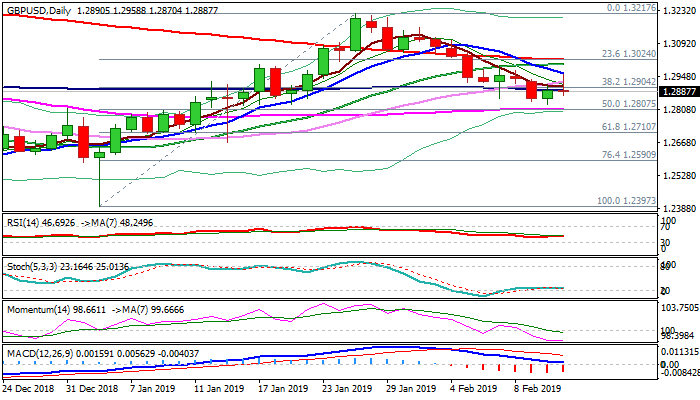
Cable hit daily low at 1.2870 in early American session on Wednesday, on fresh weakness from daily high at 1.2958, hit after sizeable buy order was triggered minutes before noon fix. Sterling returned to bearish mode after UK inflation dropped below 2% and hit lowest level in two years (Jan CPI y/y 1.8% vs 1.9% f/c and 2.1% prev), although immediate reaction wasn't as strong as anticipated, as the situation remains overshadowed by developments around Brexit. The pair remains highly volatile, as expected, with bearishly aligned near-term picture as long as the price is unable to clearly break above 100SMA (1.2889). Daily techs are in negative setup and support the notion. Bearish scenario would include attack at 1.2807 Fibo support/55SMA, violation of which would risk extension towards 1.2710 (Fibo 61.8% of 1.2397/1.3217). Conversely, close above 100SMA would sideline bears, however, further recovery would face tough barriers at 1.2961 (10SMA); 1.2999 (20SMA) and 1.3020 (200SMA) break of which would provide stronger bullish signal.
Res: 1.2961; 1.2999; 1.3020; 1.3051
Sup: 1.2870; 1.2832; 1.2807; 1.2786
GBPAUD Slide Stops Around 20-day SMA; Positive Risks Not Faded Yet
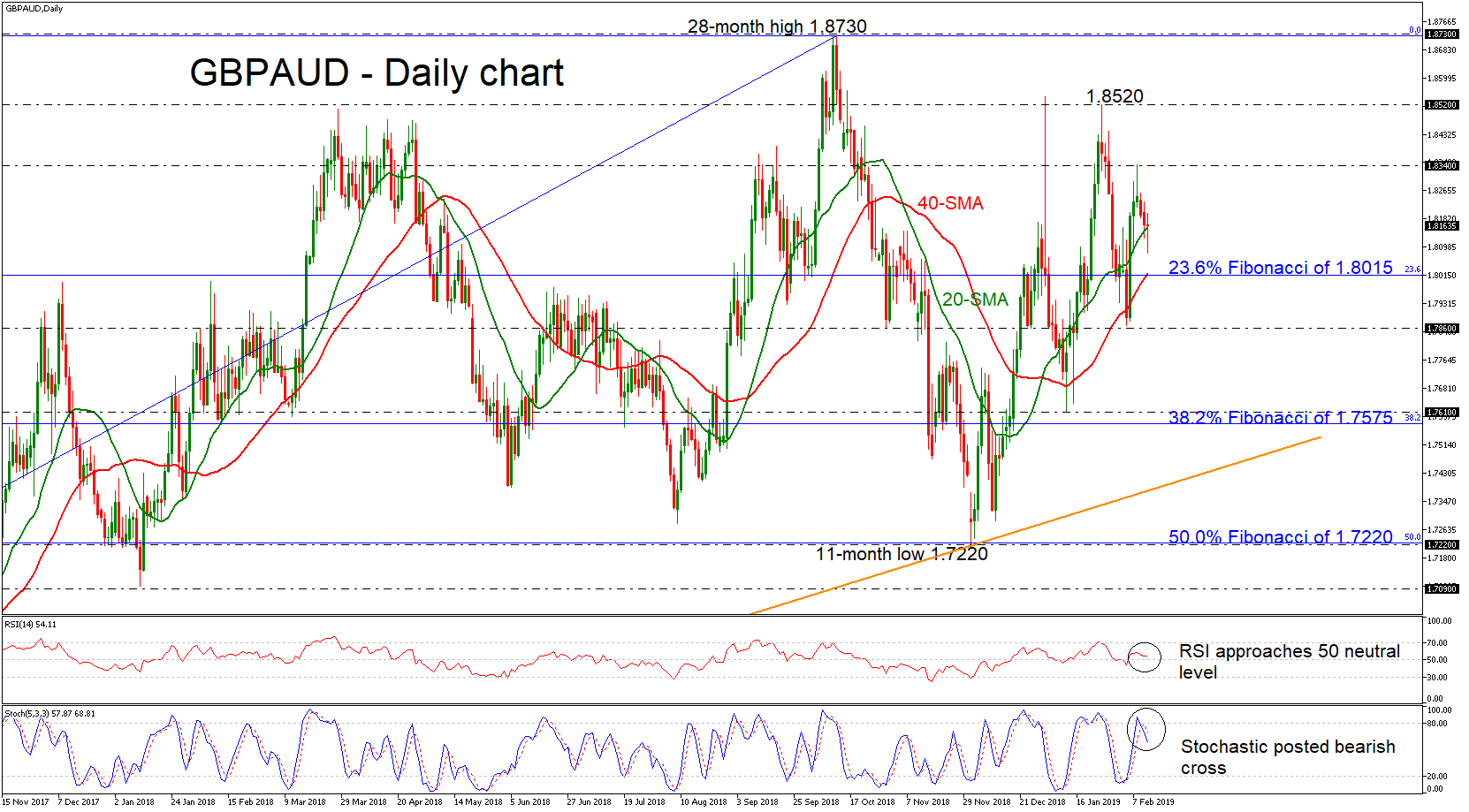
GBPAUD is recording the third day of losses after a failed attempt to break significantly above the 1.8340 resistance level last Friday. Chances for a short-term reversal are increasing as the price is dropping below the 20-day simple moving average (SMA), while the technical indicators have a steeper negative slope now. The RSI is heading towards the neutral threshold of 50, while the stochastic is moving down after the bearish cross within %K and %D lines.
Should the price retreat further, the 23.6% Fibonacci retracement level of the upward movement from 1.5725 to 1.8730 near 1.8015, which coincides with the 40-day SMA. Moving lower, the focus would shift to the 1.7860 support area, while lower still, a violation of this barrier would increase speculation that the near-term bullish phase has ended.
To the upside, the price could turn attention to the 1.8340 latest high. Further up, the area around 1.8520 comes into view before pushing prices until the 28-month high of 1.8730.
Overall, GBPAUD has been trading within an upside rally since October 2016, creating higher highs and higher lows during this period.
US: January Inflation Data Just Right
Consumer prices were flat on a month-on-month basis in January, slightly softer than markets were expecting. Energy prices fell for the third consecutive month (-3.1% m/m), and are 4.8% lower than a year ago. Headline inflation now sits at a modest 1.6% on a year-on-year basis, down from 1.9% in December.
Core CPI prices (excluding food and energy) rose 0.2% in January for the fourth consecutive month. Similarly, core inflation remained at 2.2% (y/y), where it has sat for five of the past six months. However, there appears to be a bit more price pressures coming through on core inflation recently. On a three-month annualized basis, core prices are up 2.7%, up from a low of 1.6% back in October.
A key part of the recent heating up in core inflation has been core goods prices, which jumped up 0.4% in January. Core goods inflation has now been in positive territory for four months, the hottest it has been since 2011. Much of January's jump up will likely reverse, as a 1.1% spike in apparel prices in January is likely to be at least partly reversed. Apparel prices have become quite volatile over the past year or so, but on net are up 0.1% year-on-year.
On the other hand, core services inflation was a bit more staid in January, rising 0.2% on the month. Core services inflation was up 2.8% versus a year ago, down from 2.9% the prior month, continuing a mild deceleration from a 3.1% peak back in the summer.
Key Implications
January's inflation data had a little something for everyone. Continued strength in core goods prices provides reassurance that core inflation, which had softened somewhat through the middle of 2018, seems unlikely to weaken further. Meanwhile, steady to softening inflation for core services helps to alleviate concerns that we are about to see a break higher in inflation momentum. Core inflation is running right in line with our December forecast.
Inflation seems to be having a goldilocks moment – essentially right on the Fed's target, with little indication it will shift in either direction soon. This should make the FOMC comfortable with its recent decision to be patient on monetary policy, and await clearer signs on how slower global growth and weaker confidence shows up in domestic data in the months ahead. We expect the U.S. economy to remain resilient, and that the next Fed hike is likely to come in the latter half of this year.
U.S. January CPI Holds Steady
Highlights:
- The all items CPI remained unchanged in January which represented the third consecutive month of steady prices. The level of the CPI over all three months was restrained by gasoline prices steadily declining 5% to 6% in each of the three months.
- Food prices rose a trend like 0.2% in January following a 0.3% gain in December. Core prices, which eliminates the impact of both food and energy prices, rose 0.2% for the fifth consecutive month.
- The overall CPI year-over-year rate dropped to 1.6% from December’s 1.9% while the annual increase in core prices held steady at 2.2%.
Our Take:
January consumer prices held steady matching unchanged prices in December. Both months saw downward pressure from falling gasoline prices with this component in January dropping 5.5% after December’s decline of 5.8%. Food prices and core prices, which eliminate the impact of energy and food prices, both rose 0.2% in the month. The decline in gasoline prices is in contrast to a sizeable monthly increase a year ago resulting in the overall CPI year-over-year rate dropping to 1.6% from 1.9% in December. The annual increase in core prices held steady at December’s rate of 2.2%. The annual increase in core prices holding steady tempers somewhat concern about the economy operating beyond capacity. Such provides further reason for the Fed to opt for ‘patience’ in the setting of near-term monetary policy. However, the increase is still slightly above the Fed’s inflation objective of 2.0%. As well, the upward drift in wage inflation remains intact with the most recent increase in January at 3.2% implying an ongoing inflation risk going forward. Our forecast assumes that GDP growth will remain sufficiently strong to keep the U.S. economy in excess demand and put greater upward pressure on core inflation going forward. This is expected to result in the Fed eventually raising fed funds a further 50 basis points sending the upper end of the fed funds range to 3.0% by the end of 2019.
USD/JPY Outlook: Close above 55SMA to Signal Further Advance But Headwinds May Come from Psychological 111.00 Barrier and 200SMA
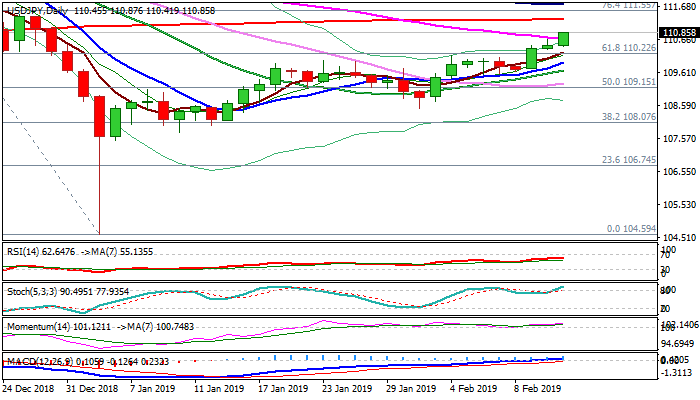
The pair maintains positive tone on Wednesday and eyes psychological / option 111.00 barrier after fresh acceleration in early US trading broke above important barrier at 111.66 (55SMA). Close above here is needed to generate bullish signal for extension of recovery leg from 104.59 (3 Jan spike low) and test of 200SMA (111.27). Renewed risk appetite keeps safe-haven yen in defense and boosts the greenback. Rising bullish momentum supports the advance, but overbought stochastic warns of stronger hesitation on approach to 111.00/27 pivots. Broken Fibo 61.8% barrier (110.22) is reinforced by rising 5SMA and expected to ideally contain dips and guard pivotal 10/20SMA's (109.93/69 respectively).
Res: 111.00; 111.27; 111.55; 111.72
Sup: 110.66; 110.22; 109.93; 109.69
USD/JPY Mid-Day Outlook
Daily Pivots: (S1) 110.34; (P) 110.49; (R1) 110.65; More...
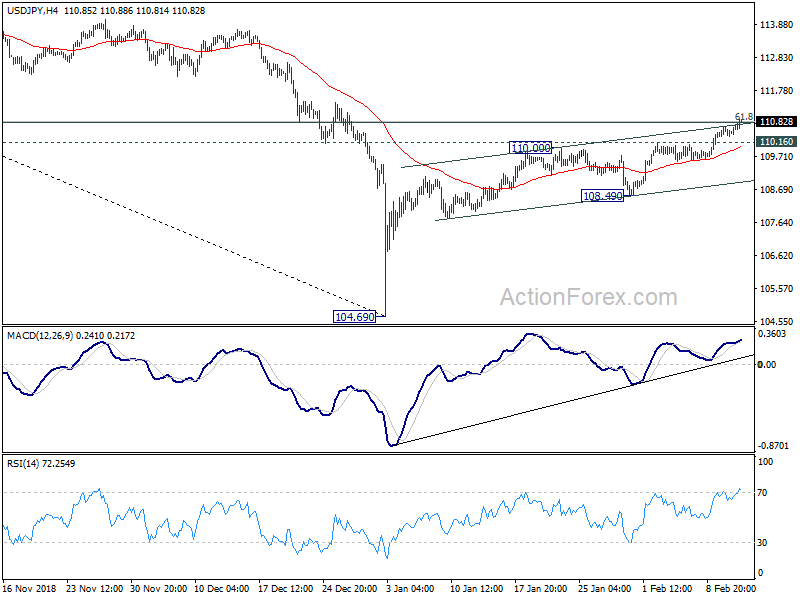
Intraday bias in USD/JPY remains on the upside at this point. Sustained trading above 61.8% retracement of 114.54 to 104.69 at 110.77 will dampen our original bearish view. Next target will be 114.54 resistance. On the downside, break of 110.16 minor support will indicate rejection by 110.77 and turn bias to the downside for 108.49 support next.
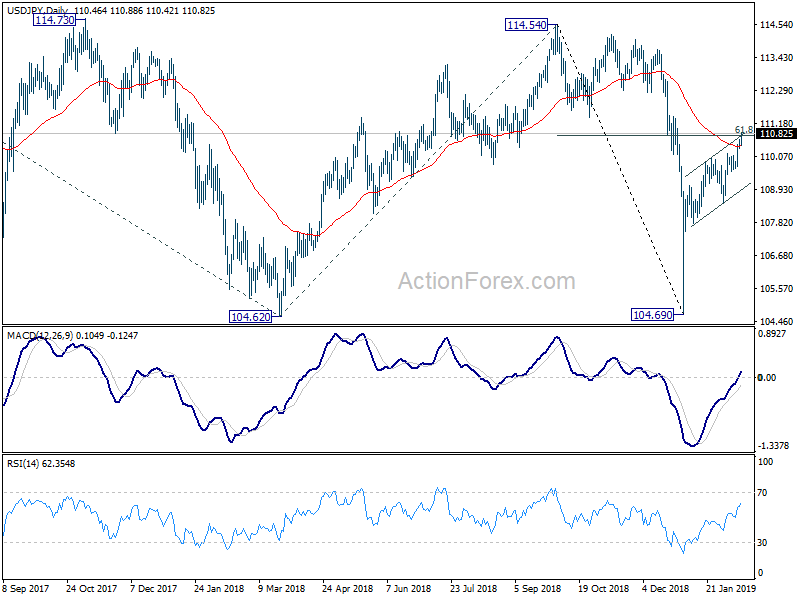
In the bigger picture, while the rebound from 104.69 is strong, there is no change in the view that it's a corrective move. That is, fall from 114.54, as part of the decline from 118.65 (2016 high), is not completed yet. Break of 104.62 will target 100% projection of 118.65 to 104.62 from 114.54 at 100.51, which is close to 100 psychological level. Nevertheless, sustained trading above 55 day EMA (now at 110.41) will dampen this bearish view and turn focus back to 114.54 resistance instead.
USD/CHF Mid-Day Outlook
Daily Pivots: (S1) 1.0034; (P) 1.0063; (R1) 1.0093; More....
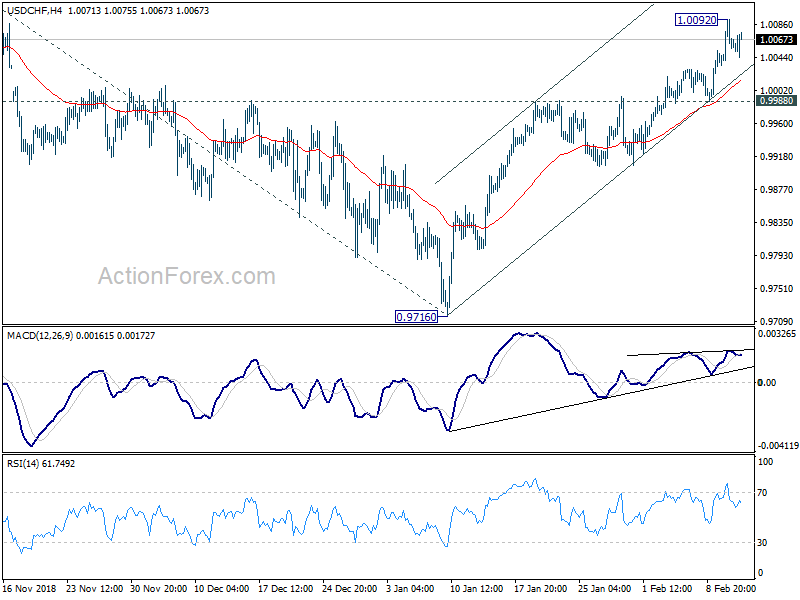
Intraday bias in USD/CHF remains neutral for consolidation below 1.0092 temporary top. Downside should be contained by 0.9988 support to bring another rally. On the upside, above 1.0092 will extend the rise from 0.9716 to 1.0128 resistance. Decisive break there will confirm resumption of up trend from 0.9186. Next target will be 100% projection of 0.9541 to 1.0128 from 0.9716 at 1.0303. Though, break of 0.9988 will indicate short term topping and bring deeper pull back.
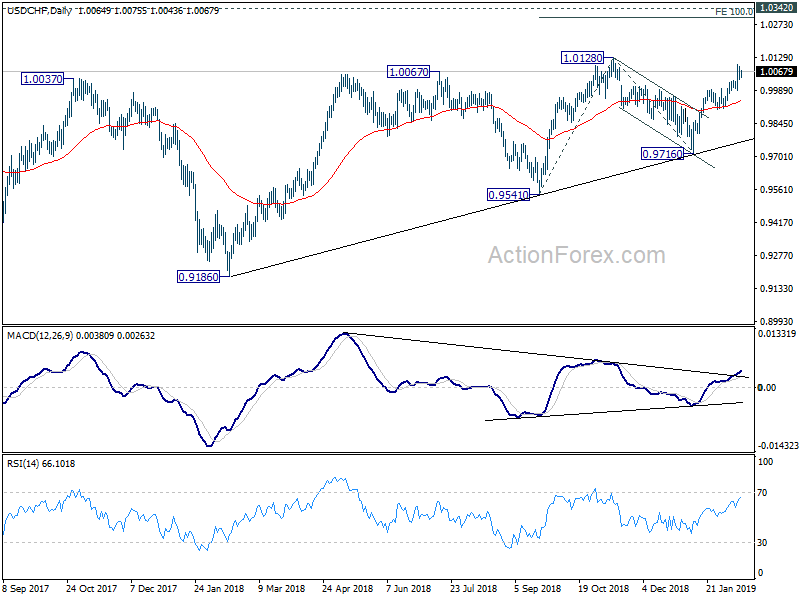
In the bigger picture, USD/CHF drew strong support from medium term trend line and rebounded. That suggests rise from 0.9186 is still in progress. Further break of 1.0128 will confirm up trend resumption and target 1.0342 key resistance. Nevertheless, break of 0.9716 will dampen this bullish view and at least bring deeper fall to 0.9541 key support.
GBP/USD Mid-Day Outlook
Daily Pivots: (S1) 1.2849; (P) 1.2879; (R1) 1.2926; More....
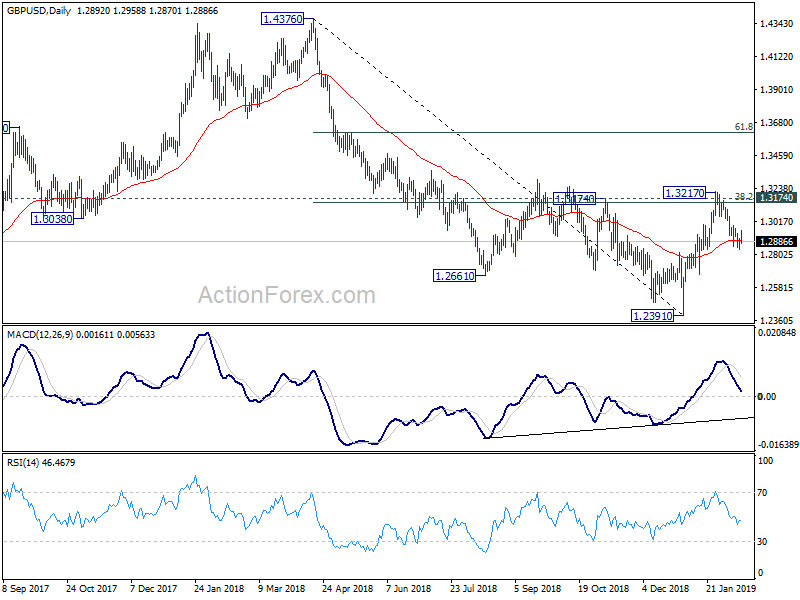
Intraday bias in GBP/USD remains neutral as consolidation from 1.2832 temporary low might extend. But upside should be limited by 1.3043 resistance to bring another decline. We're holding on to the view that rebound from 1.2391 has completed at 1.3217 already, after rejection by 1.3174 key resistance. On the downside, below 1.2832 will extend the fall from 1.3217 to retest 1.2391 low. However, break of 1.3043 will turn focus back to 1.3217 high instead.
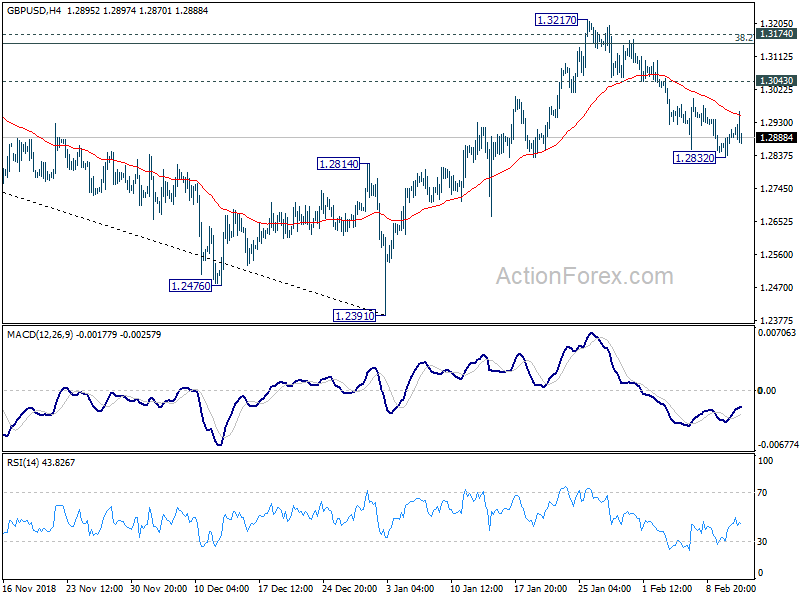
In the bigger picture, the rejection by 1.3174 key resistance revived the original view on GBP/USD. That is, decline from 1.4376 is possibly resuming long term down trend from 2.1161 (2007 high). Firm break of 1.2391 will solidify this bearish case and target 1.1946 (2016 low). However, decisive break of 1.3174 will invalidate this bearish case again and turn outlook bullish.