Sample Category Title
AUD/USD Outlook: Fresh Risk Appetite And Rally Of Kiwi Dollar Boost Aussie
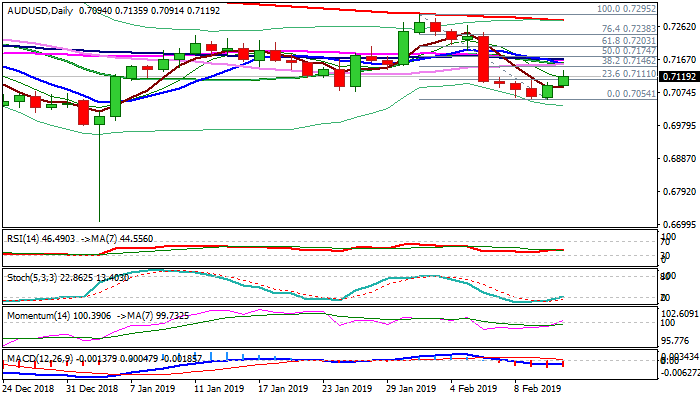
The Aussie dollar extends recovery from 0.7054 lows, underpinned by surge of kiwi dollar on less dovish RBNZ earlier today and fresh risk appetite on renewed optimism over US/China trade talks.
Double rejection at 0.7054 signals basing, with Tuesday’s bullish outside day adding to bullish signals.
Technical studies support recovery action as momentum is entering positive territory and stochastic emerges from oversold zone.
Bulls face strong barriers at 0.7146 (Fibo 38.2% of 0.7295/0.7054) and a cluster of converged daily MA’s (10, 20, 30, 55SMA’s) at 0.7156/66 zone.
Firm break here is needed to confirm reversal and open way for further retracement of 0.7295/0.7054 bear-leg.
The downside is expected to remain vulnerable if recovery fails to clear these barriers.
Res: 0.7146, 0.7156, 0.7166, 0.7203
Sup: 0.7110, 0.7094, 0.7054, 0.7000
Kiwi Roars Back As RBNZ Disappoints The Bears
- Kiwi skyrockets after RBNZ refrains from signaling rate cuts, but downside risks linger
- Trump’s trade comments reinvigorate risk appetite
- UK and US inflation data highlight the agenda today
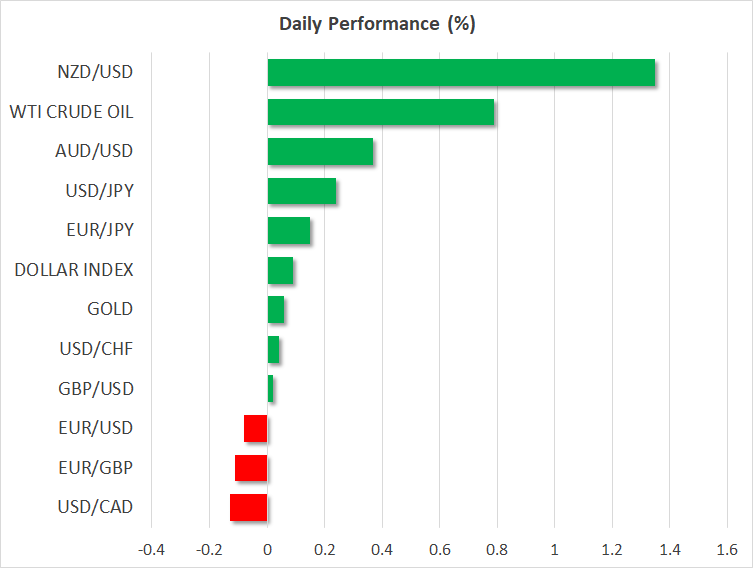
RBNZ fails to live up to market’s dovish expectations, kiwi explodes up
As expected, the Reserve Bank of New Zealand (RBNZ) kept its policy unchanged overnight, maintaining a relatively balanced tone overall. It acknowledged that downside risks have heightened, particularly on a global level, but retained some optimism on the outlook. Most importantly, policymakers did not provide any clear signal that the likelihood for a rate cut has risen. Considering that traders viewed a rate cut this year as a done deal, with the market-implied probability for one resting at 85% ahead of the decision, these relatively neutral signals likely came as a ‘reality check’, sending the kiwi soaring.
While it was somewhat predictable that the RBNZ would refrain from outright signaling a rate cut this early, that doesn’t mean one won’t materialize later this year. Indeed, the nation’s data pulse is weakening, slowing population growth amplifies risks around consumption, and foreign developments – particularly in China – threaten the domestic outlook. Therefore, the scale seems to be tipped more towards a rate cut further down the road, which implies that the overall risks surrounding the kiwi may be skewed to the downside, though a lot will also depend on how the trade saga plays out.
Dollar pulls back alongside safe-havens, stocks advance on trade hopes
In the broader market, the overarching theme was “risk on”, with equity markets in all major regions being a sea of green and defensive currencies such as the dollar, yen, and Swiss franc surrendering ground to their G10 peers. US President Trump was the driving force behind most of these moves, with some remarks that he may extend the March 1 tariff deadline against China if a deal seems close by that point reinvigorating risk appetite. In the eyes of investors, this likely confirmed that both sides are thirsty for an accord, and simultaneously diminished the risk of a further escalation. He also noted he doesn’t expect another government shutdown, further amplifying the positive sentiment.
Coming up: UK and US inflation data, slew of Fed speakers
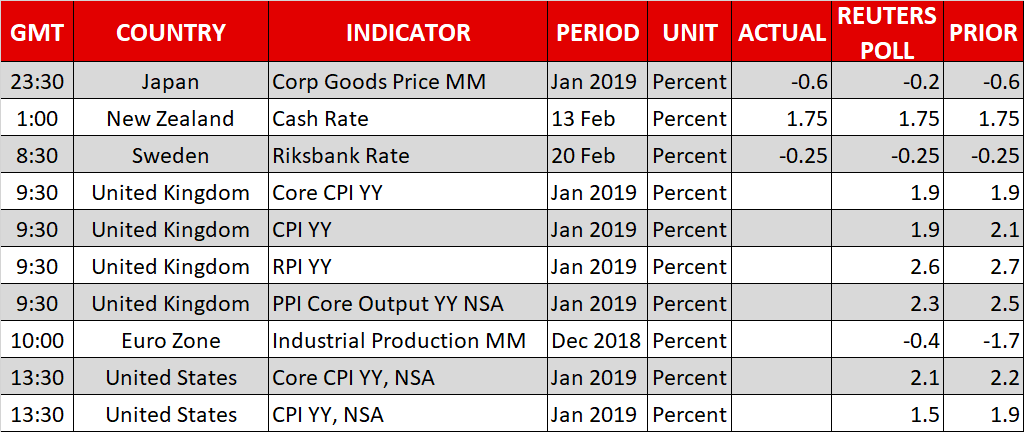
It’s inflation day in both the UK and the US. Kicking off with Britain, the headline CPI rate for January is expected to have dipped to 1.9% in yearly terms from 2.1% previously, though that seems owed to energy effects as the core rate is forecast to have held steady at 1.9%. As for where risks may lie, the nation’s services PMI for the month implies a downside surprise may be more likely than an upside one, indicating that prices charged by service firms rose at the slowest pace since September. While a disappointment could weigh on the pound on the news, economic data will likely continue to play second fiddle to political developments in driving the British currency over the next weeks.
In the US, the headline CPI is expected to have slowed to 1.5% on a yearly basis in January, from 1.9% in December. Underlying inflation is also expected to have cooled, with the core rate projected to tick down to 2.1%, from 2.2% previously. Investors will keep a close eye on these figures, as the Fed’s preferred inflation gauge – the core PCE index – will only be released in early March due to the government shutdown, which implies the CPI prints are the only inflation data in town for now.
In energy markets, the weekly EIA inventory data are due at 15:30 GMT.
We have three regional Fed Presidents on the schedule: Mester and Bostic will both speak at 13:50 GMT, while Harker will deliver remarks at 17:00 GMT.
Why European Markets Are Not As Strong As US Markets
Central bank support matters a lot and the ECB is still not paying any attention to the weakness in the economic data
The equity markets in Europe and in the U.S. are robust. The S&P 500 is up 9.49% year-to-date, the NASDAQ index is up 11.75% YTD and the Dow Jones is up 8.99% YTD. Similarly, the Euro Stoxx 600, DAX, CAC 40 and IBEX are also up 7.74%, 7.23%, 7.21% and 5.10% YTD respectively.
So what is behind this rally?
Central Banks and Economic Data
There is no doubt that the European central bank is more hawkish than the Federal Reserve and the reason that I am saying this is because the ECB is in denial of the fact that there is any meaningful weakness in the economy over in the Eurozone. The president of the European central bank, Mario Draghi, maintains his view that the sailing path for the monetary policy is in the correct direction and there is no significant reason why the bank should be changing its course. The Fed also had the same message last year, and this resulted in the weakness in the economic data.
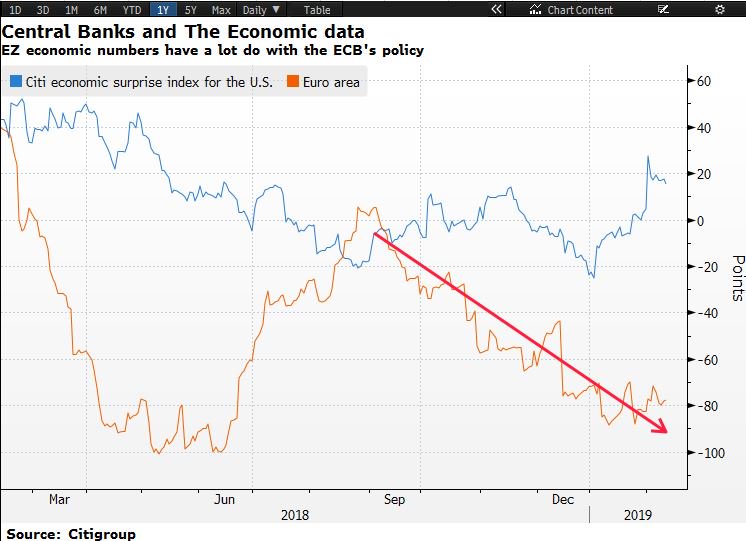
The below chart shows the Citi economic surprise indices for the Eurozone and the US. One thing is evidently clear, the Eurozone's economic data has started to roll over, and the chief reason for this is: the ECB has become a lot more hawkish than the Fed. Jerome Powell, the Fed Chairman, had a similar mind frame, but recently, he has adopted a different tone in relation to the monetary policy. One can see from the chart below that the economic data has started to perform well as a result of this. Sadly, for the eurozone economic data, we have not seen any change in the current trend. Hence, I do believe that the current weakness in the economic numbers will make the ECB rekindle its monetary policy message in the near future.
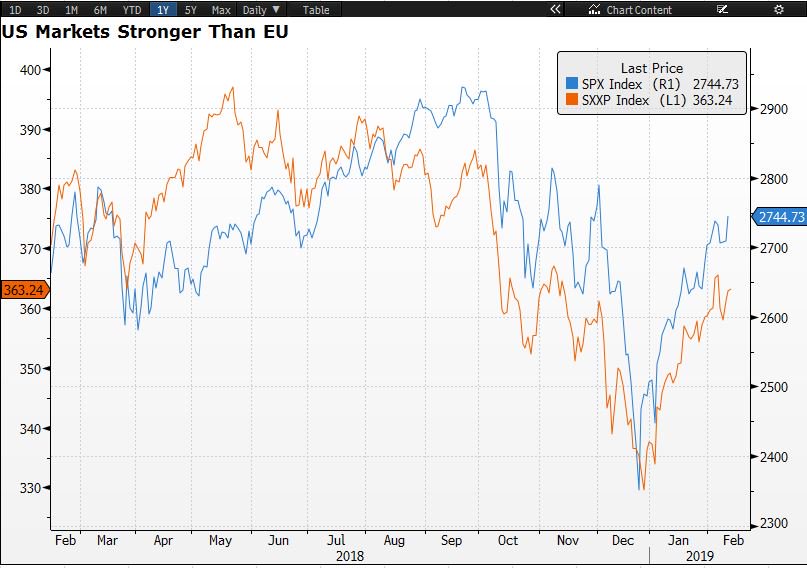
U.S. Markets Stronger Than European Markets
The equity markets (usually) accurately factor in the weakness of the economic numbers. However, this argument doesn’t hold too much strength if we look at the below chart. The chart shows the comparison of the S&P500 index and the Euro Stoxx 600; one can see that both indices are moving in the same direction and there is a very strong correlation. This leads me to think why the ECB isn’t that concerned about the economic data; we have not seen any meltdown in the European markets. If we focus purely on the fundamentals, the U.S. markets are a lot stronger because they have the support of the Fed and economic data. Unfortunately, one cannot say the same for the European markets: the economic data is feeble and the ECB is looking for an opportunity to start the interest rate hike cycle.
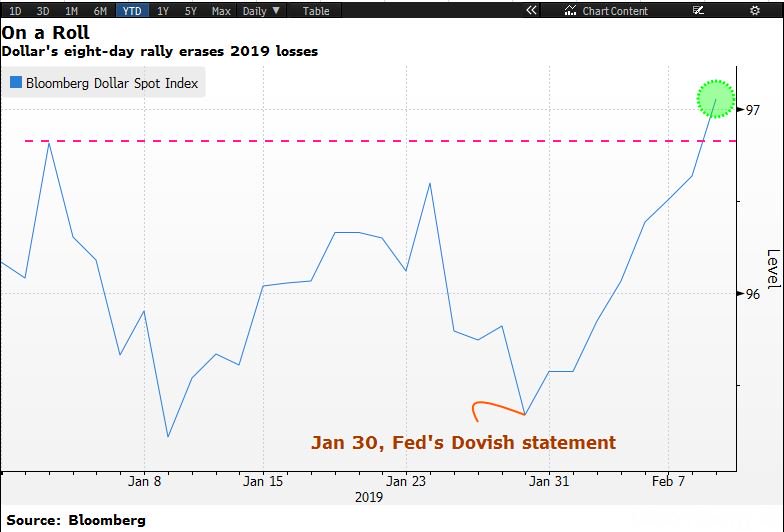
Dollar Index strengths Its Position While Equity Markets Roar
Time over time, we have seen investors becoming nervous when the dollar index starts to rise. Generally speaking, higher dollar eats the US corporate profit because a higher dollar makes the export less attractive for the country. However, one strong trend that I am witnessing for this year is that the equity markets moving higher while the dollar index maintaining its strength. To put things in perspective, the dollar index is experiencing its eight-day rally—its longest rally going all the way back to 2016. The dollar index is on the run since the Federal Reserve Chairman, Jerome Powell said that the bank “will be patient”; this is a dovish tone and it should move bulls away. However, we have not seen this. The concern is if the US investors are no longer worried about the dollar strength or the alternative is that this trade is not going to last longer. I really do not see a compelling reason why the dollar should be moving higher when the Fed is dovish unless of course, the market participants do not believe that the Fed is going to remain dovish and they will be forced to adopt the hawkish stance.
To conclude, I believe there is strong evidence that the Fed’s recent dovish stance has helped the U.S. economic data and this also provided the helping hand for the U.S. equity markets. However, I am concerned about the rise in the dollar index and the U.S. equity markets. Finally, the European markets may see some retracement if the economic data doesn’t support it.
XAUUSD Intraday Analysis
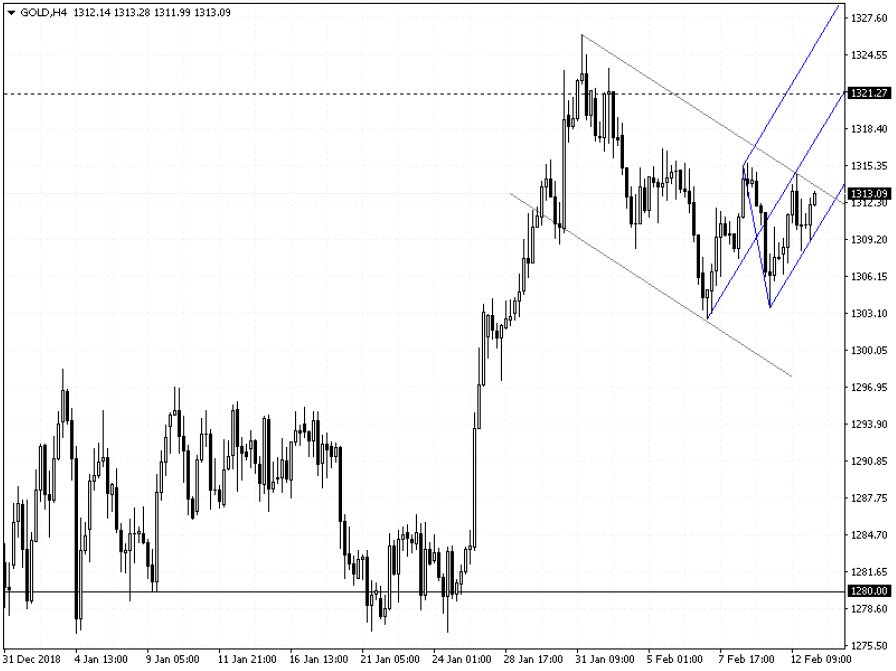
XAUUSD (1313.09): Gold prices attempted to reverse the losses from Monday. Price action tested intraday highs of 1313.28 before easing back but closing on a bullish note. A bullish follow through today which could close above Monday's open of 1314.07 will potentially set the upside bias in motion.
On the daily chart, gold prices have been consolidating, and the gradual decline has formed a bullish flag pattern. Price will need to break past the highs of 1321.58 to confirm the upside. The minimum upside target at 1347.23 is a successful breakout of the bullish flag pattern.
USDJPY Intraday Analysis
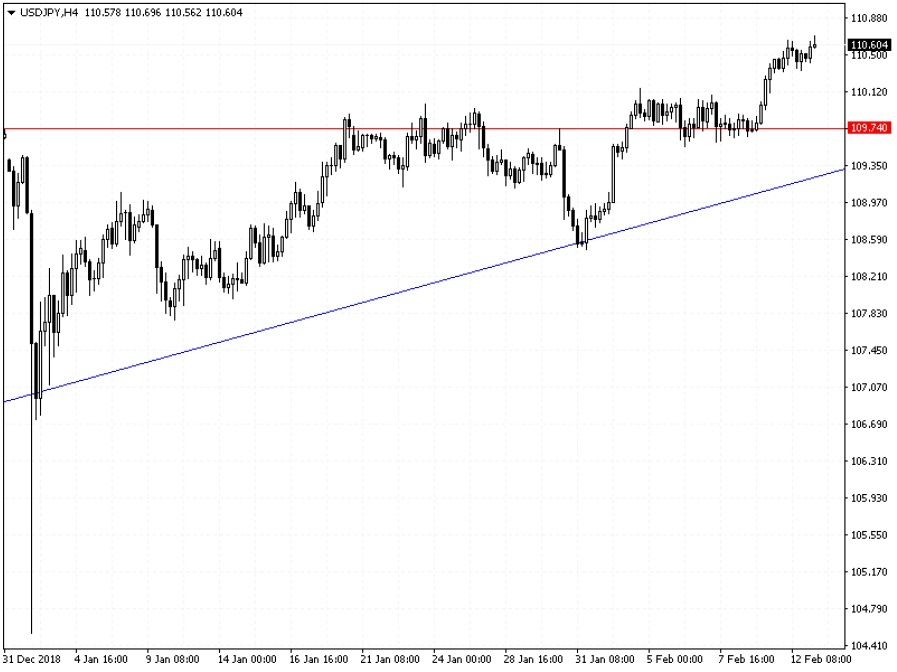
USDJPY (110.60): The USDJPY currency pair has been maintaining a solid bullish momentum since the past two trading sessions.
Last Friday's strong bullish close above 109.78 has triggered the move that is likely to see prices testing the main resistance level of 111.21. This also comes with price action breaking out to the upside from the ascending triangle pattern. The support at 109.78 could be tested in the near term.
EURUSD Intraday Analysis
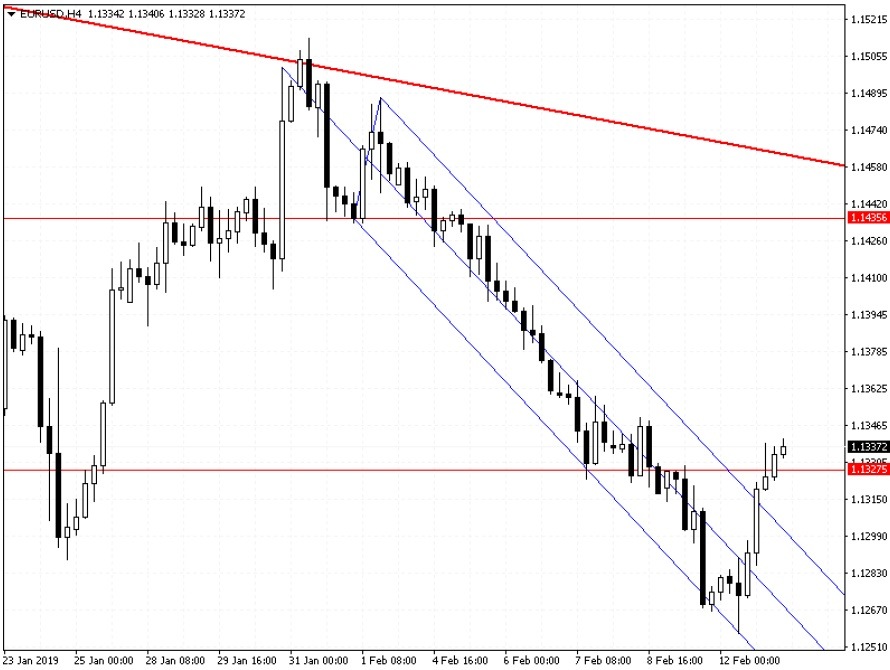
EURUSD (1.1337): The EURUSD currency pair closed on Tuesday with a bullish engulfing pattern. This comes after prices fell to a 3-month low of 1.1256 before prices recovered. On the 4-hour char time frame, the EURUSD currency pair attempts to close above 1.1327. This marks a minor support level that was breached.
Failure to hold the gains and the higher close above this level could potentially trigger a correction to the upside. The EURUSD could test the next main resistance level of 1.1435 if the bullish bias keeps in place.
RBNZ Leaves OCR Unchanged At 1.75%. Kiwi Gains Over 1.6%
The USD eased back on Tuesday as investors grew cautious about the U.S. and China trade talks which entered the second day. The parties are focusing on producing an outline for the agreement which could be then signed off by the respective leaders. Failure to reach a deal by March 1st could potentially mean that either a new deadline must be set or the new tariffs will hit the tariffs on $200 billion worth of goods from China.
The British Prime Minister, Theresa May said that there was no breakthrough on the Brexit negotiations with the EU. However, she ruled out a no-Brexit deal and said that talks would continue.
Economic data on the was relatively quiet. New Zealand's inflation expectations for the quarter remained unchanged at 2.0%. Japan's tertiary industry activity declined by 0.3% against forecasts of a 0.1% decline. The declines were slower compared to the previous month's fall of 0.4%.
The European trading session was quiet.
The Brexit Situation
Bank of England Governor, Mark Carney gave a scheduled speech where he highlighted that trade uncertainty and the slowdown from China as the most significant risks. However, Carney said that the global economy would most likely avoid a recession. The British pound did not record any significant movement on the day.
The NY trading session which saw no significant economic releases was seen highlighted by the speech of the Fed Chair, Jerome Powell. Powell delivered a speech titled Economic Developments in High Poverty Rural Communities in Mississippi.
Answering questions during the speech, Powell said that the U.S. economy looked strong. He did not make any further references to the Fed's rate hike plans or on monetary policy.
The overnight session saw the Reserve Bank of New Zealand holding its monetary policy meeting. As widely expected, the central bank left the official cash rate unchanged at 1.75%. The RBNZ's policy statement suggested a dovish tone as the Governor said that while the chance of a rate cut is not in the books, a rate cut could happen if growth did not pick up.
The NZDUSD managed to post strong gains after the RBNZ's meeting. The Kiwi is currently up over 1.68% against the USD.
Looking ahead, the UK's inflation figures will be coming out today. Economists forecast that inflation fell to 1.9% on the year ending January 2019. The core inflation rate of 1.9%, matching forecasts.
Industrial production data from the Eurozone should fall by 0.4% on the month following a 1.7% decline from the month before.
The NY trading session will see the release of the monthly consumer price index data. Reports should show that the headline inflation rate rose by 0.1% reversing the 0.1% decline from the month before. The core inflation rate should remain steady, rising at a pace of 0.2% during the month.
Later in the evening, the RBNZ Governor, Adrian Orr will speak.
Forex Technical Analysis: EUR/USD, USD/JPY, GBP/USD
EUR/USD
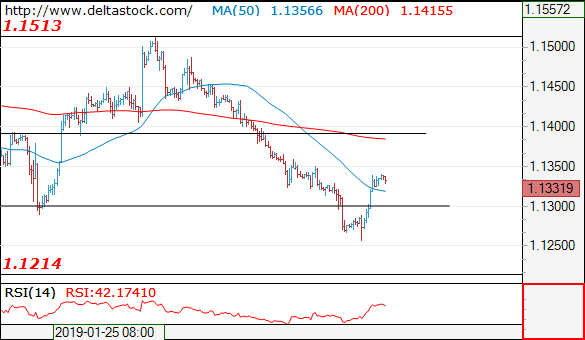
Current level - 1.1331
The rebound after 1.1255 low clearly states, that the downtrend since 1.1513 high is over and my outlook here is already positive above 1.1300, for a rise towards 1.1400 area.
| Resistance | Support | ||
| intraday | intraweek | intraday | intraweek |
| 1.1350 | 1.1630 | 1.1300 | 1.1214 |
| 1.1400 | 1.1820 | 1.1255 | 1.1100 |
USD/JPY
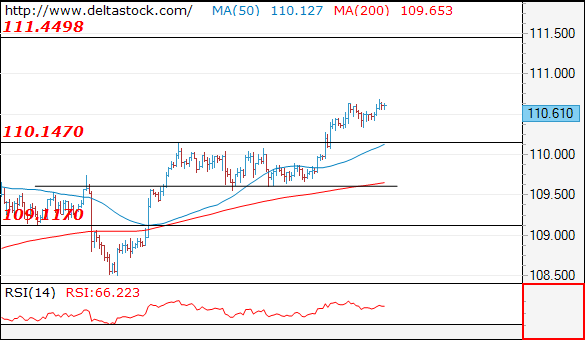
Current level - 110.61
The uptrend is intact, heading towards 111.45 resistance. Major support is projected at 110.20.
| Resistance | Support | ||
| intraday | intraweek | intraday | intraweek |
| 111.45 | 111.45 | 110.20 | 106.70 |
| 112.10 | 114.50 | 109.60 | 104.60 |
GBP/USD
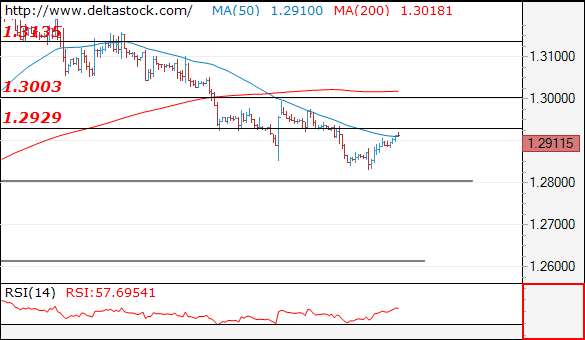
Current level - 1.2911
The reversal at 1.2830 has neutralized the bearish bias and my outlook here is neutral below 1.2930 resistance.
| Resistance | Support | ||
| intraday | intraweek | intraday | intraweek |
| 1.2930 | 1.3290 | 1.2800 | 1.2800 |
| 1.3000 | 1.3480 | 1.2700 | 1.2610 |
GBP/USD Outlook: Pound Extends Recovery Ahead Of Key UK Inflation Data, Overall Picture Remains Bearish
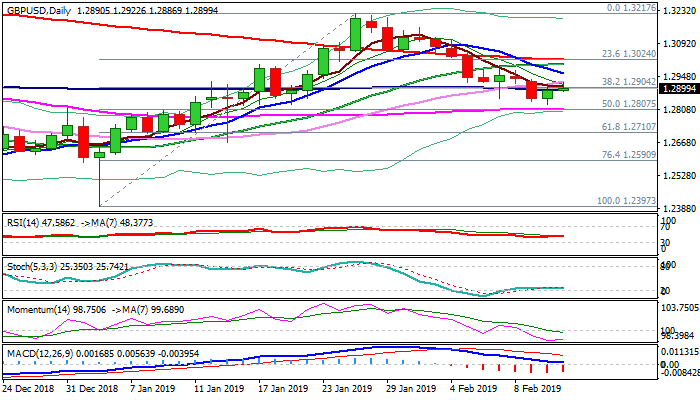
Cable holds in green in early Wednesday’s trading and probes above 1.29 zone, following Tuesday’s bullish close which signaled bears may stay on hold.
The pair extends recovery despite previous day’s close below 100SMA (1.2889), with upticks so far seen as positioning for fresh weakness as situation over Brexit – pounds key driver – remains unclear and so far signaling that divorce without deal could be likely scenario.
Slight turn in momentum and stochastic supports corrective action but overall picture remains bearish as 20SMA turned sideways, while falling 10SMA made double-cross (10/200SMA death cross and 10/20SMA bear-cross), maintaining pressure.
Investors focus UK inflation data today, to get fresh signals.
Weaker than expected forecast (Jan CPI y/y 1.9% f/c vs 2.1% prev / Jan m/m -0.7% f/c vs 0.2% prev) adds to negative outlook, with downbeat release to bring sterling under fresh pressure.
Broken 200SMA marks pivotal barrier at 1.3020 and only firm break here would neutralize bears.
Res: 1.2922, 1.2963, 1.3000, 1.3020
Sup: 1.2889, 1.2832, 1.2807, 1.2786
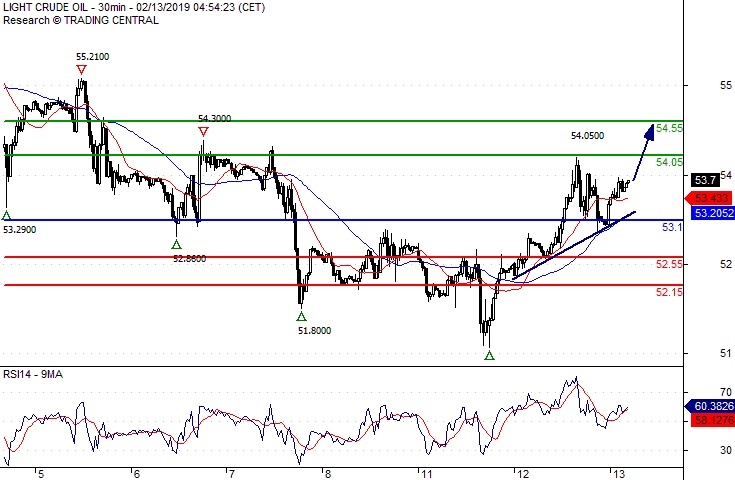
Crude Oil Further Advance
Pivot (invalidation): 53.10
Our preference Long positions above 53.10 with targets at 54.05 & 54.55 in extension.
Alternative scenario Below 53.10 look for further downside with 52.55 & 52.15 as targets.
Comment The RSI advocates for further upside.