

Sample Category Title
(RBNZ) Official Cash Rate Unchanged at 1.75 Percent
Tena koutou katoa, welcome all.
The Official Cash Rate (OCR) remains at 1.75 percent. We expect to keep the OCR at this level through 2019 and 2020. The direction of our next OCR move could be up or down.
Employment is near its maximum sustainable level. However, core consumer price inflation remains below our 2 percent target mid-point, necessitating continued supportive monetary policy.
Trading-partner growth is expected to further moderate in 2019 and global commodity prices have already softened, reducing the tailwind that New Zealand economic activity has benefited from. The risk of a sharper downturn in trading-partner growth has also heightened over recent months.
Despite the weaker global impetus, we expect low interest rates and government spending to support a pick-up in New Zealand's GDP growth over 2019. Low interest rates, and continued employment growth, should support household spending and business investment. Government spending on infrastructure and housing also supports domestic demand.
As capacity pressures build, consumer price inflation is expected to rise to around the mid-point of our target range at 2 percent.
There are upside and downside risks to this outlook. A more pronounced global downturn could weigh on domestic demand, but inflation could rise faster if firms pass on cost increases to prices to a greater extent.
We will keep the OCR at an expansionary level for a considerable period to contribute to maximising sustainable employment, and maintaining low and stable inflation.
Meitaki, thanks.
Fed George: Let’s step back and see what happens
Kansas City Fed President Esther George expressed her support for pausing rate hikes yesterday. She said inflation pressures did not appear very strong. At the same time, there were concerns on global slowdown. Thus, "let's step back and see what happens."
Cleveland Fed President Loretta Mester said at the coming meetings, Fed "will be finalizing our plans for ending the balance-sheet runoff and completing balance-sheet normalization." And, Fed will "make these plans and the rationale for them known to the public in a timely way because transparency and accountability are basic tenets of appropriate monetary policymaking."
Fed Chair Jerome Powell delivered a speech on bank consolidations and rural communities. But he didn't talk about monetary policy. On the economy, he just said "We don't feel that the probability of recession is at all elevated."
Trump may let trade truce deadline slide for a little while
US Treasury Secretary Steven Mnuchin is now in Beijing with Trade Representative Robert Lighthizer for trade negotiations. The high-level meeting with Chinese Vice Premier Liu He will start tomorrow. Ahead of that, Mnuchin said he hoped to have "productive meetings", without any elaborations.
Trump, on the other hand, said yesterday that he could let the March 1 trade truce deadline "slide for a little while" if "we're close to a deal". But he added that "generally speaking, I'm not inclined to do that."
Separately, it's reported that Chinese President Xi Jinping may meet Mnuchin and Lighthizer on Friday.
Another US government shutdown unlikely even though Trump doesn’t like the deal
Trump was briefed overnight about the Congressional deal to avert another government shutdown, with only USD 1.37B for border fencing. He apparently dislike it as he told reporters "I have to study it. I'm not happy about it." Though, he added that "I don't think you're going to see another shutdown."
He also kept on pressing for the border wall and signaled unilateral actions. He said "The bottom is on the wall: We're building the wall". And, "We're supplementing things, and moving things around, and we're doing things that are fantastic and taking, really, from far-less-important areas."
EUR/USD And USD/JPY Primed For More Gains
EUR/USD started a decent recovery and moved above the 1.1320 resistance area. USD/JPY is gaining bullish momentum and it might break the 110.80 resistance.
Important Takeaways for EUR/USD and USD/JPY
- The Euro found support near the 1.1260 level and later recovered above 1.1300.
- There was a break above a crucial bearish trend line with resistance at 1.1295 on the hourly chart of EUR/USD.
- USD/JPY broke a key contracting triangle with resistance at 110.55 on the hourly chart.
- The pair is gaining momentum and it could climb towards the 111.00 resistance in the near term.
EUR/USD Technical Analysis
There was a strong downtrend recently in the Euro from the 1.1480 swing high against the US Dollar. The EUR/USD pair broke many support levels such as 1.1450, 1.1400, 1.1320 and 1.1300.
The pair even broke the 1.1280 support and formed a low at 1.1257 on FXOpen. Later, the pair started a decent upside correction and traded above the 1.1280 and 1.1300 resistance levels. There was even a close above the 1.1300 level and the 50 hourly simple moving average.
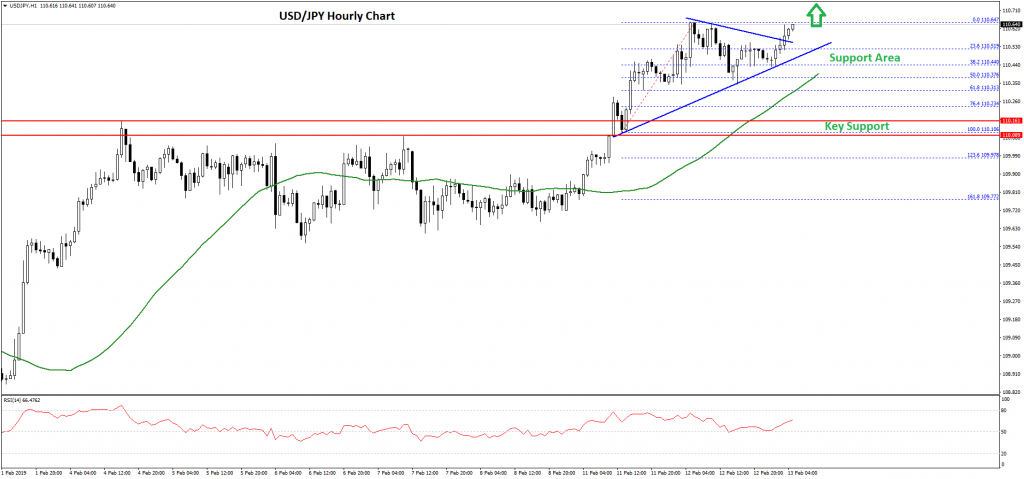
During the recovery, there was a break above a crucial bearish trend line with resistance at 1.1295 on the hourly chart of EUR/USD. The pair even surpassed the 61.8% Fib retracement level of the recent decline from the 1.1359 high to 1.1257 low.
The pair is currently trading nicely above 1.1320 and it may continue to move towards the 1.1350 or 1.1360 resistance levels. If there are more gains, the pair could trade towards the 1.1380 resistance area.
The 1.236 Fib extension level of the recent decline from the 1.1359 high to 1.1257 low is also near the 1.1380 level to act as a resistance.
If there is a downside correction, the pair might find support near the 1.1310 level. However, the main support is near the 1.1300 level and the 50 hourly simple moving average.
USD/JPY Technical Analysis
The US Dollar consolidated for a few sessions below the 110.00 and 110.10 resistance levels against the Japanese Yen. However, the USD/JPY pair finally gained traction and broke the 110.10 resistance to start a solid upward move.
Buyers pushed the price above the 110.30 resistance and the 50 hourly simple moving average. It traded as high as 110.64 and later there was a short term downside correction. The pair dipped below the 23.6% Fib retracement level of the last wave from the 110.10 low to 110.64 high.
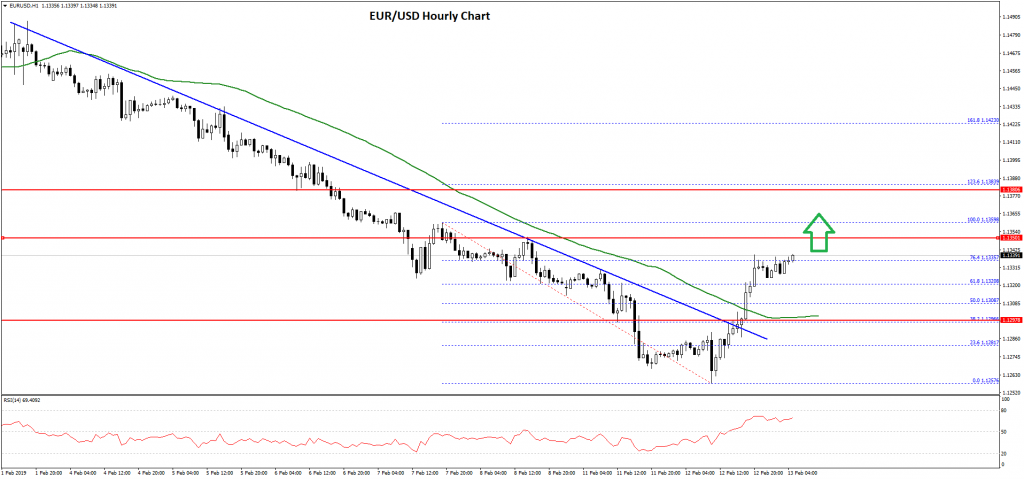
However, the decline was protected by the 110.35 level and the 50% Fib retracement level of the last wave from the 110.10 low to 110.64 high.
Finally, the USD/JPY pair broke a key contracting triangle with resistance at 110.55 on the hourly chart. It seems like the pair is gaining pace above 110.50 and it may continue to rise towards the 110.80 and 111.00 resistance levels.
On the other hand, if there is a downside correction, an initial support is seen near the 110.50 level. A break below the 110.50 support could push the pair back towards the 110.35 support and the 50 hourly SMA in the near term.
AUD/USD Remains At Risk Of More Declines
Key Highlights
- The Aussie Dollar declined heavily after it failed to surpass the 0.7300 resistance against the US Dollar.
- There was a break below a crucial triangle support at 0.7210 on the 4-hours chart of AUD/USD.
- The NFIB Business Optimism Index in Jan 2019 declined from 104.4 to 101.2.
- Today in the US, the CPI figure for Jan 2019 will be released, which could increase 1.5% (YoY).
AUDUSD Technical Analysis
After a solid rally, the Aussie Dollar found resistance near the 0.7300 area against the US Dollar. The AUD/USD pair declined heavily and traded below the 0.7200 and 0.7120 support levels.
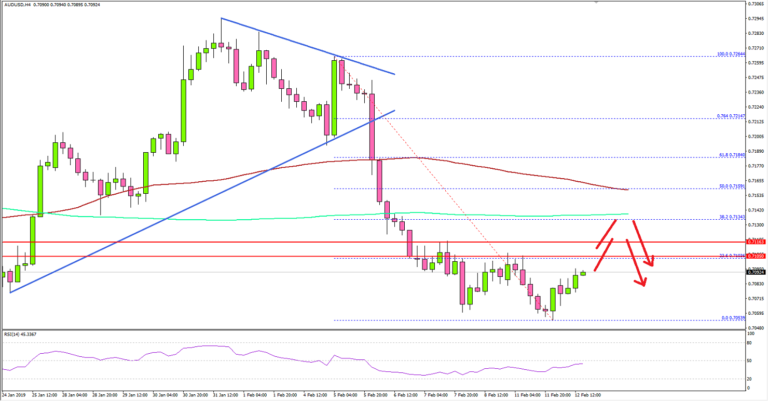
Looking at the 4-hours chart, the pair even broke the 0.7100 support and settled well below the 100 (red) simple moving average (4-hours). A new monthly low was formed at 0.7053 and later the pair started a short-term upside correction.
It traded towards the 0.7120 resistance and the 23.6% Fib retracement level of the recent decline from the 0.7264 high to 0.7053 low. If buyers succeed in gaining strength above 0.7120, the pair could correct higher towards the 0.7150 resistance zone.
The main resistance is near 0.7160 and the 50% Fib retracement level of the recent decline from the 0.7264 high to 0.7053 low. On the downside, the key support is at 0.7050, below which the pair could revisit the 0.7000 support area.
Recently in the US, the NFIB Business Optimism Index for Jan 2019 was released. The market was looking for a minor decline in the index from 104.4 to 103.2.
However, the result was disappointing as the NFIB Business Optimism Index declined to 101.2 in Jan 2019, which is the lowest since the weeks leading up to the 2016 elections.
There were corrective upward moves in EUR/USD, GBP/USD and AUD/USD, but all these pairs are still trading in a bearish zone and facing crucial resistances.
Economic Releases to Watch Today
- UK Consumer Price Index Jan 2019 (YoY) – Forecast +1.9%, versus +2.1% previous.
- UK Core Consumer Price Index Jan 2019 (YoY) – Forecast +1.9%, versus +1.9% previous.
- US Consumer Price Index Jan 2019 (MoM) – Forecast +0.1%, versus -0.1% previous.
- US Consumer Price Index Jan 2019 (YoY) – Forecast +1.5%, versus +1.9% previous.
- US Consumer Price Index Ex Food & Energy Jan 2019 (YoY) – Forecast +2.1%, versus +2.2% previous.
Market Morning Briefing: Pound Bounced From 1.2832
STOCKS
Strong surge in the global equities on hopes for some positive development on the US-China trade talk and from the tentative deal to avoid another shutdown in the US. The Indian equities which is underperfroming its peers may get some breather today on the back of the rally in the global market
Dow Jones (25,425.76, +372.65, +1.49%) has held well above 25,000 and can extend the rally towards 25,700 and 25,800 on a strong break above 25,450.
DAX (11,126.08, +111.49, +1.01%) can test 11,300 while it remains above 11,100.
Nikkei (21,185.59, +321.38, +1.54%) risen sharply recovering all the loss made over the last few days.While a strong close above 21,000 is seen, it opens a test of 21,500 and 21,750 in the coming days.
Shanghai (2,686.16, +14.27, +0.53%) keeps the bullish view intact for a test of 2,700. While a corrective fall to 2,650 cannot be ruled out from 2,700, a rise past 2,700 will pave way for the next target of 2,750.
Sensex (36,153.62, -241.41, -0.66%) and the Nifty 50 (10,831.40, -57.40, -0.53%) has failed to take the bullish cues from the Asian markets yesterday and continued to fall. The broader view remains negative for the Sensex to fall to 36,000-35,985 or even 35,800 and the Nifty 50 to test 10,700 on a break below 10,800. However, given the positive sentiment in the global equities, an intermediate bounce to 10,900-10,950 on the Nifty and 36,500 on the Sensex cannot be ruled out before this fall.
COMMODITIES
Gold and Silver remains stable and can be range bound for some time with the broader bias continuing to remain bullish. Copper, though holding above its support, may see further dip before bouncing back. Oil is getting support from Saudi Arabia's production cut and can see some uptick in the near term.
Gold (1,310) and Silver (15.71) remains stable above their respective supports at 1300 and 15.60. As mentioned yesterday, gold can remains range bound between 1300 and 1325 before we see a fresh rally to 1350-1360. Silver on the other hand can see a bounce to 16.2 in the near-term while it remains above the support level of 16.6.
Copper (2.78) sustains above 2.78 but is still vulnerable to test 2.76 and 2.75 while it trades below 2.82.
Brent (63) has resistances at 63.5 and 64. A strong break above 64 will trigger a fresh rally towards 66. While 64 holds, a pull-back move to 62 and 61 can be seen again.
WTI (53.60) can test its immediate resistance at 54.5, a break above which can take the prices further higher to 55.4 nad 55.7.
FOREX
Dollar-Index could not sustain a rise above 97, bringing back hope of some positive movements in the major currencies. Pound, Aussie, Euro and Rupee saw strength against the US Dollar over yesterday and today. While the US Dollar could see some more weakness in the near term, currencies could continue to see a short rise.
Dollar Index (96.67) is trading lower after coming off from 97.20. While the fall sustains, the index could come off towards 96.30/25 in the near term which is also the 21-day MA on the daily charts. Near term looks bearish while below resistance near 97.20-97.00.
Euro (1.1335) bounced back from 1.1257 and has turned out to be a temporary break below 1.13 as suspected. This negates an immediate fall to 1.11 re-affirming the upside chances of moving back towards 1.14.
Euro-Yen (125.38) has risen as expected but could face rejection from resistance near 126. Only on a break above 126, we may expect further upmove towards 127. While 126 holds, another dip to 124 could be a possibility. Watch price action near 126.
Dollar Yen (110.61) is trading above our expected resistance near 110.50. Unless it comes down immediately, we could see a rise towards 111.50 in the near term. On the longer term charts (see weekly candles), there is room for a rise towards 113.
Pound (1.2896) bounced from 1.2832, a little lower than our expected 1.2850. A rise to 1.30 is possible in the next few sessions.
Aussie (0.7121) is also trading higher today. A rise towards 0.72 is on the cards in the next few sessions. Near term view is bullish.
USDCNY (6.7606) came off from 6.7941 instead of testing the 21-day MA near 6.8040 mentioned yesterday. However, the current fall could extend to 6.7350 in the near term.
Dollar Rupee (70.71) came off sharply breaching 71 on the downside. While the falling momentum remains strong there is room for a fall towards 70. An interim bounce from 70.60/40 is possible before Dollar-Rupee heads lower.
INTEREST RATES
The US yields are trading higher. The 2Yr (2.52%), 5Yr (2.51%), 10Yr (2.70%) and 30Yr (3.03%) have risen from 2.51%, 2.50%, 2.68% and 3.02% respectively. The 5Yr has bounced from 2.46% and could rise towards 2.54% while the 10Yr and 30Yr could also move up to 2.73% and 3.06% respectively.
The German-US 2Yr differential (-3.08%) is stable just now. While it holds below -3.05%, chances of a fall towards -3.10% remains on the cards for the near term. This could indicate that the Euro could possibly see a limited rise in the near term. The German-US 10Yr (-2.57%) is also trading lower and could fall towards -2.625 before pausing.
The 10Yr GOI (7.5339%) is trading lower and has scope of falling towards 7.50/45% in the near term. While below 7.60%, bias is tilted to the downside for the next couple of weeks.
Daily Markets Broadcast
Wall Street rallies as another shutdown avoided
Wall Street cheered news that a tentative deal on border security funding may have been reached thus avoiding a possible government shutdown again. Other positives came from President Trump’s comments that he may let the March 1 deadline for trade tariffs slide. Fed’s Powell described the US economy as “strong”.
US30USD Daily Chart
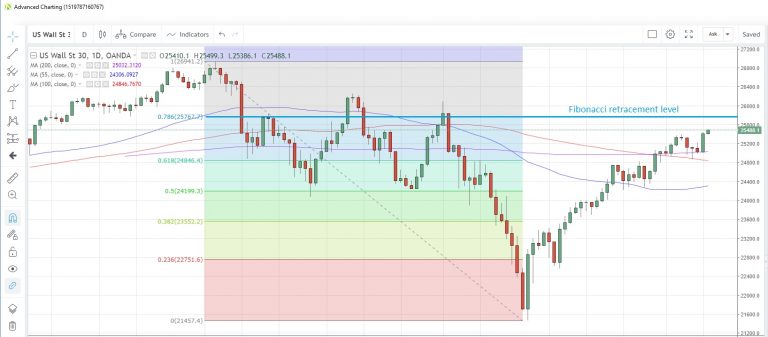
The US30 index snapped a four-day losing streak yesterday, advancing the most since January 18. The index has extended yesterday’s rally in early trading this morning to reach the highest since December 4
The index is rising toward the 78.6% Fibonacci retracement of the October-December drop at 25,768
US CPI is seen easing to +1.5% y/y in January from +1.9% the previous month, latest polls of economists suggest. Speeches from Fed’s Bostic and Mester are also due.
DE30EUR Daily Chart
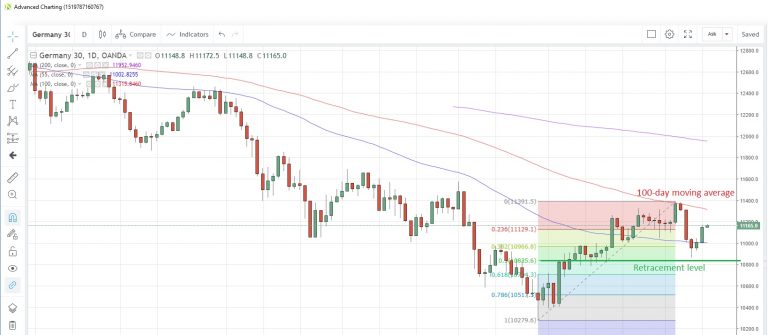
The Germany30 index rose for a second day yesterday and looks poised to extend gains into today as Wall Street sentiment buoys prices
Support at 10,836, the 50% retracement level of the run-up which lasted from December 27 to February 5, has held and the index is now pushing toward the 100-day moving average at 11,316
Euro-zone industrial production is expected to show contraction for the second straight month in December, adding to the list of weak data that has come out of the area recently.
AU200AUD Daily Chart
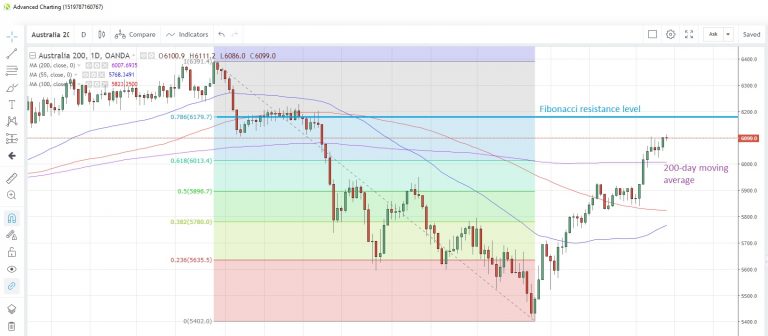
The Australia200 index touched the highest in four months earlier this morning, buoyed by hopes that progress is being made in US-China trade negotiations, with the March 1 deadline possibly being pushed back
The index is rising toward the 78.6% Fibonacci retracement of the August-December drop at 6,180. The index has traded above the 200-day moving average for seven days now
Tomorrow we get to see consumer inflation expectations for February. January’s reading was +3.5%.
Markets Surge As Traders Choose Hope Over Reality
Markets surge as traders choose hope over reality
With a tentative deal averting a US government shutdown reached and positive noise from the ongoing US-China trade talks, Wall Street surged more than 1.5% higher overnight. The US JOLTS job opening also posted much higher-than-expected gain to USD 7.335 million, adding fuel to the fire.
The positive backdrop saw investors rotating out of the USD bringing its eight-day rally to an end. We also saw gold and oil rise, buying a respite from the sell-off in G7 currencies as traders moved to more risk-seeking positions.
We would expect this theme to flow through to Asia's markets today with regional currencies rallying and a positive tone for the local stock markets. One note of caution is that President Trump has not indicated whether he will accept the Republican/Democrat compromise. Experience should teach us predictability is not often associated with the President and should he say no, the global rally could come to an abrupt halt.
Locally, today's data highlight will be the Reserve Bank of New Zealand (RBNZ) rate decision. Markets universally expect rates to remain unchanged at 1.75% (record lows), but the subsequent press conference will draw much attention. The street will be looking for signs of dovishness and this could put pressure on the New Zealand dollar.
This evening we have Euro-zone Industrial Production where we expect the poor run of data to continue, followed by the US CPI, with the street forecasting 2.1%. US Crude Inventory data finishes the night and will be closely monitored following Saudi Arabia's announced of further production cuts overnight.
FX
The USD sold across the board overnight and we expect this to continue with regional currencies benefiting from the more risk-seeking environment.
The euro regained the 1.1300 level, rising to 1.1340 just below resistance at 1.1350. The GBP rose 50 points to 1.2895 but failed to recapture the 1.2900 level, which suggests the Brexit overhang will rightly crimp gains.
USD/JPY rose to 110.50 and – assuming no surprises on the trade front – its technical picture leaves it well placed in marching on to 111.50, its next significant resistance.
The NZD continues to tread water at the bottom of its range at 0.6740 following last week's sell-off. A dovish RBNZ this morning could present a high-risk factor for the flightless bird.
Stocks
The Nikkei has risen 0.50% this morning following on from Wall Street's gains. Regional markets should enjoy a positive day, but investors should beware of headlines coming out of the trade talks that could spark short-term direction volatility. The rally in stocks has been based on hope rather than any concrete agreements overnight.
Gold
Gold regained the 1,310.00 level overnight as the dollar fell. Trading remains muted with attention elsewhere in the markets, and gold continues to consolidate above 1,300.00 in the medium term.
Oil
Both Brent and WTI spiked higher overnight before settling up 1.70% on the day. Oil was boosted initially by a lower dollar and positive vibes from Beijing before Saudi Arabia announced it was cutting daily production and exports by a further 500,000 barrels per day on top of its agreed OPEC quota cut.
As refiners scramble to find heavy crude stocks to replace sanctions-hit Venezuelan oil, Saudi Arabia's announcement sound very tactical by further squeezing supplies in the short term to push prices higher. For now, it seems to be working very nicely.
Eco Data 2/13/19
[php_everywhere instance="1"]