Sample Category Title
Australia’s Westpac Consumer Confidence Index Rebounded In February
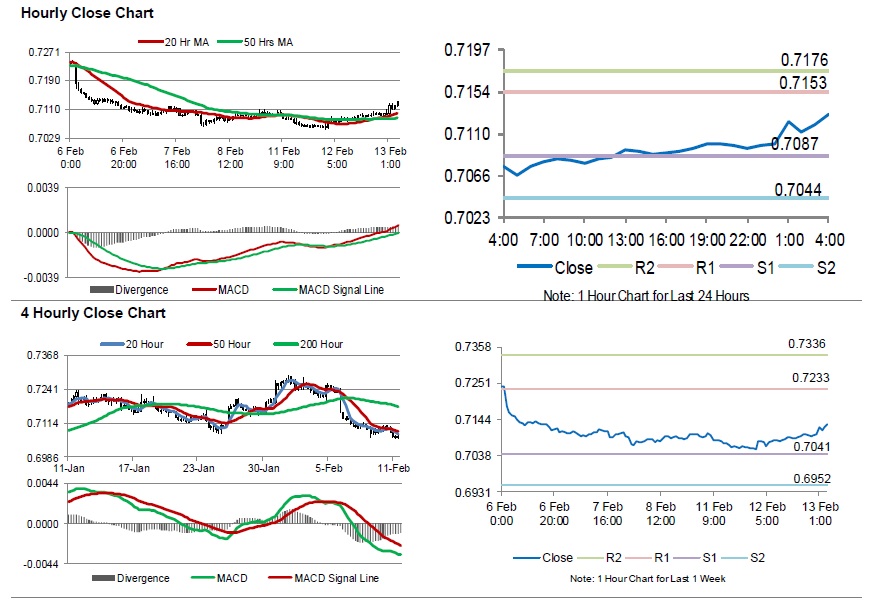
For the 24 hours to 23:00 GMT, the AUD rose 0.54% against the USD and closed at 0.7098.
LME Copper prices declined 0.8% or $46.0/MT to $6102.0/MT. Aluminium prices declined 0.4% or $7.5/MT to $1840.5/MT.
In the Asian session, at GMT0400, the pair is trading at 0.7131, with the AUD trading 0.46% higher against the USD from yesterday's close.
Overnight data indicated that Australia's Westpac consumer confidence index advanced 4.3% to a level of 103.8 in February, compared to a reading of 99.6 in the previous month.
The pair is expected to find support at 0.7087, and a fall through could take it to the next support level of 0.7044. The pair is expected to find its first resistance at 0.7153, and a rise through could take it to the next resistance level of 0.7176.
Going ahead, traders would await Australia's consumer inflation expectations for February, slated to release overnight.
The currency pair is trading above its 20 Hr and 50 Hr moving averages.
Gold: Yellow Metal Extends Its Gains In The Asian Session
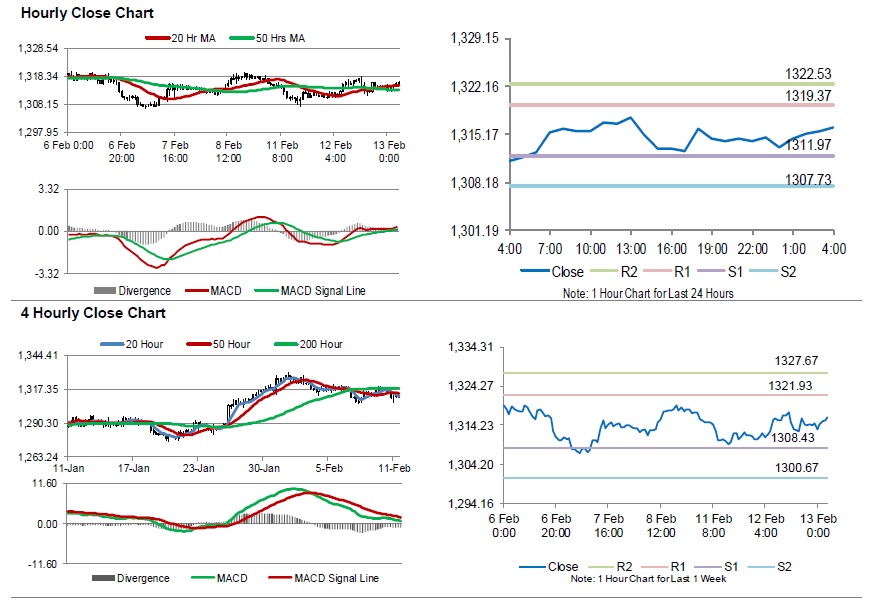
For the 24 hours to 23:00 GMT, Gold rose 0.21% against the USD and closed at USD1314.20 per ounce, amid weakness in the greenback.
In the Asian session, at GMT0400, the pair is trading at 1316.20, with gold trading 0.15% higher against the USD from yesterday’s close.
The pair is expected to find support at 1311.97, and a fall through could take it to the next support level of 1307.73. The pair is expected to find its first resistance at 1319.37, and a rise through could take it to the next resistance level of 1322.53.
The yellow metal is showing convergence with its 20 Hr moving average and trading above its 50 Hr moving average.
Silver: White Metal Trading On A Positive Footing This Morning
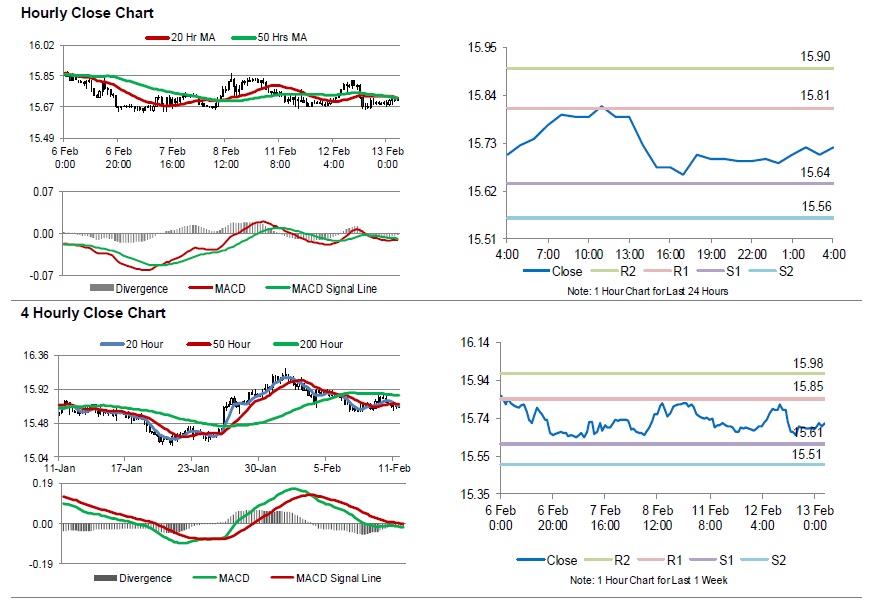
For the 24 hours to 23:00 GMT, Silver marginally rose against the USD and closed at USD15.70 per ounce, tracking gains in gold prices.
In the Asian session, at GMT0400, the pair is trading at 15.72, with silver trading 0.16% higher against the USD from yesterday’s close.
The pair is expected to find support at 15.64, and a fall through could take it to the next support level of 15.56. The pair is expected to find its first resistance at 15.81, and a rise through could take it to the next resistance level of 15.90.
The white metal is showing convergence with its 20 Hr and 50 Hr moving averages.
Crude Oil: Oil Trading Higher, Ahead Of EIA’s Weekly Crude Oil Inventories Data
For the 24 hours to 23:00 GMT, Crude Oil rose 1.83% against the USD and closed at USD53.37 per barrel, after the American Petroleum Institute (API) reported that US crude oil inventories fell 1.0 million barrels to 449.0 million barrels in the week ended 08 February 2019.
Meanwhile, the Energy Information Administration upgraded its oil production outlook by 2.8% to 12.41 million barrels per day for 2019 and 2.6% to 13.2 million barrels per day for 2020 respectively, while trimmed its 2020 projection by 4.3%.
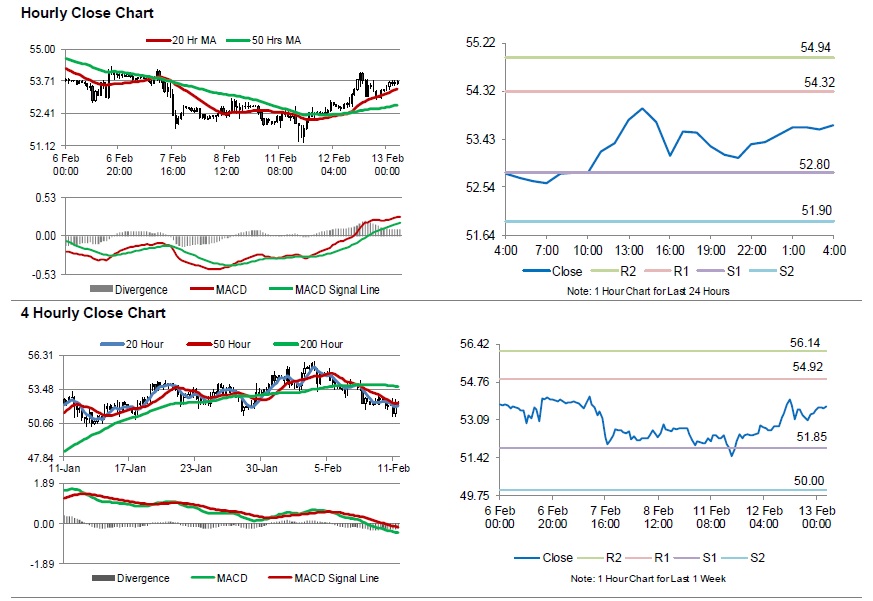
In the Asian session, at GMT0400, the pair is trading at 53.69, with oil trading 0.60% higher against the USD from yesterday's close.
The pair is expected to find support at 52.79, and a fall through could take it to the next support level of 51.90. The pair is expected to find its first resistance at 54.32, and a rise through could take it to the next resistance level of 54.94.
Crude oil is trading above its 20 Hr and 50 Hr moving averages.
AUD/USD Daily Outlook
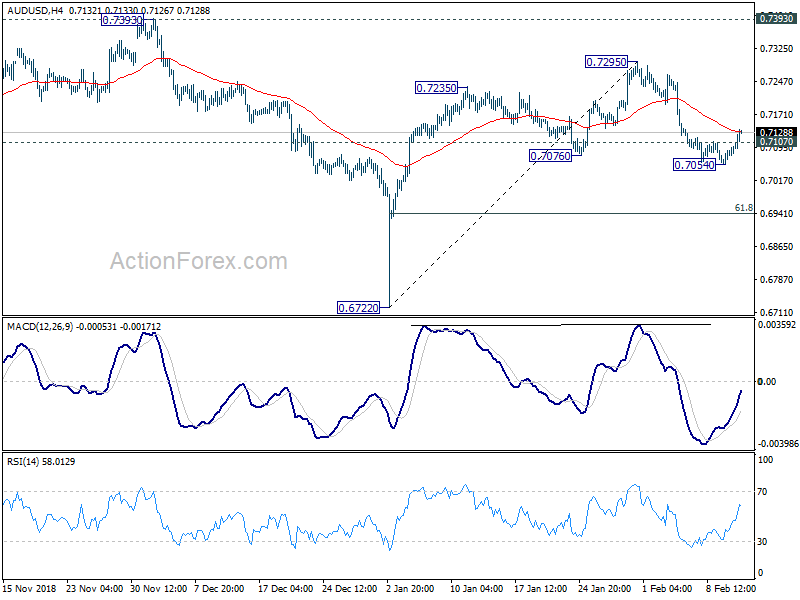
Daily Pivots: (S1) 0.7065; (P) 0.7084; (R1) 0.7115; More...
AUD/USD's strong recovery and break of 0.7107 minor resistance suggests temporary bottoming at 0.7054. Intraday bias is turned neutral for consolidations. Stronger rise might be seen, but upside should be limited by 0.7295 resistance to bring another fall. We're holding on to the view that rebound from 0.6722 has completed at 0.7295 already. On the downside, break of 0.7054 will turn bias to the downside for 61.8% retracement of 0.6722 to 0.7295 at 0.6941 next.
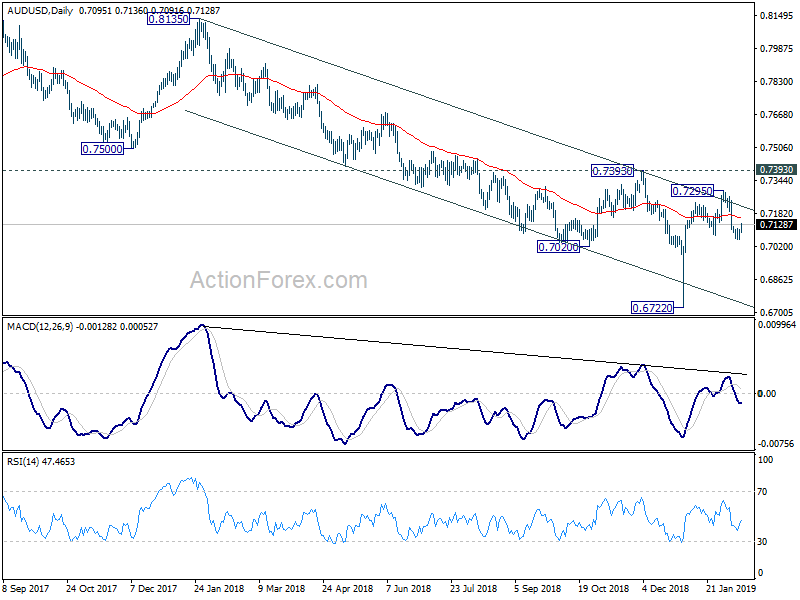
In the bigger picture, as long as 0.7393 resistance holds, we'd treat fall from 0.8135 as resuming long term down trend from 1.1079 (2011 high). Decisive break of 0.6826 (2016 low) will confirm this bearish view and resume the down trend to 0.6008 (2008 low). However, firm break of 0.7393 will argue that fall from 0.8135 has completed. And corrective pattern from 0.6826 has started the third leg, targeting 0.8135 again.
Yen & Dollar Tumbles on US-China Trade Optimism, Kiwi Surges on RBNZ
Strong risk appetite dominates the financial markets today. Investors are getting more optimistic on US-China trade negotiations, with another round of talks happening in Beijing now. Both sides seem to express more desire to make a deal. Trump hinted that he's willing to let the March 1 trade truce deadline slip, even though he doesn't prefer it. Xi will also meet US delegation later this week. Such optimism boosts Asian stocks broadly higher.
In the currency markets, Yen and Dollar are the weakest ones as a result. At the time of writing, Euro is the third weakest, but Swiss Franc is not far away. Australian Dollar strengthens across the board naturally. But it's overwhelmed by New Zealand Dollar, which was boosted by less dovish than expected RBNZ statement. For now, at least RBNZ doesn't hint at a rate cut. Market focuses will now turn to UK and US consumer inflation data.
Technically, Dollar has at least topped temporarily against European majors and Aussie. USD/JPY is also losing momentum and could also top close to 110.77 fibonacci level. With current development, some Yen crosses are now eyeing last week's high as resistance level. NZD/JPY is looking at 75.91 and break will resume the rebound from 69.18 towards 78.86 resistance. CAD/JPY is also looking at 83.98. Break will resume the rebound from 76.61 to 85.17 resistance next.
In Asia, Nikkei closed up 1.34%. Hong Kong HSI is up 1.20%. China Shanghai SSE is up 1.56%, back above 2700 handle. Singapore Strait Times is also up 1.21%. Japan 10-year JGB yield is up 0.0083 at -0.002, still negative. Overnight, DOW rose 1.49%. S&P 500 rose 1.29%. NASDQ rose 1.46%. 10-year yield rose 0.023 to 2.684. 30-year yield rose 0.023 to 3.022, back above 3% handle.
Trump may let trade truce deadline slide for a little while
US Treasury Secretary Steven Mnuchin is now in Beijing with Trade Representative Robert Lighthizer for trade negotiations. The high-level meeting with Chinese Vice Premier Liu He will start tomorrow. Ahead of that, Mnuchin said he hoped to have "productive meetings", without any elaborations.
Trump, on the other hand, said yesterday that he could let the March 1 trade truce deadline "slide for a little while" if "we're close to a deal". But he added that "generally speaking, I'm not inclined to do that."
Separately, it's reported that Chinese President Xi Jinping may meet Mnuchin and Lighthizer on Friday.
Another US government shutdown unlikely even though Trump doesn't like the deal
Trump was briefed overnight about the Congressional deal to avert another government shutdown, with only USD 1.37B for border fencing. He apparently dislike it as he told reporters "I have to study it. I'm not happy about it." Though, he added that "I don't think you're going to see another shutdown."
He also kept on pressing for the border wall and signaled unilateral actions. He said "The bottom is on the wall: We're building the wall". And, "We're supplementing things, and moving things around, and we're doing things that are fantastic and taking, really, from far-less-important areas."
Fed George: Let's step back and see what happens
Kansas City Fed President Esther George expressed her support for pausing rate hikes yesterday. She said inflation pressures did not appear very strong. At the same time, there were concerns on global slowdown. Thus, "let's step back and see what happens."
Cleveland Fed President Loretta Mester said at the coming meetings, Fed "will be finalizing our plans for ending the balance-sheet runoff and completing balance-sheet normalization." And, Fed will "make these plans and the rationale for them known to the public in a timely way because transparency and accountability are basic tenets of appropriate monetary policymaking."
Fed Chair Jerome Powell delivered a speech on bank consolidations and rural communities. But he didn't talk about monetary policy. On the economy, he just said "We don't feel that the probability of recession is at all elevated."
NZD jumps on less dovish than expected RBNZ
New Zealand Dollar jumps sharply after RBNZ turned out to be less dovish than expected. OCR was kept at 1.75% as widely expected. And, the central bank restored the language that "the direction of our next OCR move could be up or down" in the statement. However, there was no more dovish tweak.
In short, RBNZ expected interest rate to be unchanged at current level "through 2019 and 2020". It maintained the view that "As capacity pressures build, consumer price inflation is expected to rise to around the mid-point of our target range at 2 percent."
And, there were upside and downside risks to the outlook. RBNZ noted "there are upside and downside risks to this outlook. A more pronounced global downturn could weigh on domestic demand, but inflation could rise faster if firms pass on cost increases to prices to a greater extent."
The overall statement was pretty balanced and did nothing to endorse market speculation of a rate cut by year end.
Suggested readings:
- NZD Jumped although RBNZ Postponed Timing of Rate Hike (At Least Not Expecting a Cut)
- First Impressions: RBNZ Leaves OCR at 1.75%
On the data front
Australia Westpac consumer confidence rose 4.3% in February. Japan domestic CGPI rose 0.6% yoy in January versus expectation of 1.0% yoy. Inflation data will be the major focuses of today. UK will release CPI, PPI and house price index. Eurozone will release industrial production. US will release CPI too. In particular, headline CPI in US is expected to slow sharply from 1.9% yoy to 1.5% yoy in January.
AUD/USD Daily Outlook
Daily Pivots: (S1) 0.7065; (P) 0.7084; (R1) 0.7115; More...
AUD/USD's strong recovery and break of 0.7107 minor resistance suggests temporary bottoming at 0.7054. Intraday bias is turned neutral for consolidations. Stronger rise might be seen, but upside should be limited by 0.7295 resistance to bring another fall. We're holding on to the view that rebound from 0.6722 has completed at 0.7295 already. On the downside, break of 0.7054 will turn bias to the downside for 61.8% retracement of 0.6722 to 0.7295 at 0.6941 next.
In the bigger picture, as long as 0.7393 resistance holds, we'd treat fall from 0.8135 as resuming long term down trend from 1.1079 (2011 high). Decisive break of 0.6826 (2016 low) will confirm this bearish view and resume the down trend to 0.6008 (2008 low). However, firm break of 0.7393 will argue that fall from 0.8135 has completed. And corrective pattern from 0.6826 has started the third leg, targeting 0.8135 again.
Economic Indicators Update
| GMT | Ccy | Events | Actual | Forecast | Previous | Revised |
|---|---|---|---|---|---|---|
| 23:30 | AUD | Westpac Consumer Confidence Feb | 4.30% | -4.70% | ||
| 23:50 | JPY | Domestic CGPI Y/Y Jan | 0.60% | 1.00% | 1.50% | |
| 1:00 | NZD | RBNZ Official Cash Rate | 1.75% | 1.75% | 1.75% | |
| 9:30 | GBP | CPI M/M Jan | -0.70% | 0.20% | ||
| 9:30 | GBP | CPI Y/Y Jan | 2.00% | 2.10% | ||
| 9:30 | GBP | Core CPI Y/Y Jan | 1.90% | 1.90% | ||
| 9:30 | GBP | RPI M/M Jan | -0.80% | 0.40% | ||
| 9:30 | GBP | RPI Y/Y Jan | 2.60% | 2.70% | ||
| 9:30 | GBP | PPI Input M/M Jan | 0.30% | -1.00% | ||
| 9:30 | GBP | PPI Input Y/Y Jan | 3.80% | 3.70% | ||
| 9:30 | GBP | PPI Output M/M Jan | 0.00% | -0.30% | ||
| 9:30 | GBP | PPI Output Y/Y Jan | 2.20% | 2.50% | ||
| 9:30 | GBP | PPI Output Core M/M Jan | 0.20% | 0.20% | ||
| 9:30 | GBP | PPI Output Core Y/Y Jan | 2.30% | 2.50% | ||
| 9:30 | GBP | House Price Index Y/Y Jan | 2.50% | 2.80% | ||
| 10:00 | EUR | Eurozone Industrial Production M/M Dec | -0.40% | -1.70% | ||
| 13:30 | USD | CPI M/M Jan | 0.10% | -0.10% | ||
| 13:30 | USD | CPI Y/Y Jan | 1.50% | 1.90% | ||
| 13:30 | USD | CPI Core M/M Jan | 0.20% | 0.20% | ||
| 13:30 | USD | CPI Core Y/Y Jan | 2.10% | 2.20% | ||
| 15:30 | USD | Crude Oil Inventories | 1.3M | |||
| 19:00 | USD | Monthly Budget Statement Dec | -10.0B | -204.9B |
Into European session: Kiwi powers on RBNZ, Yen dives on strong stocks
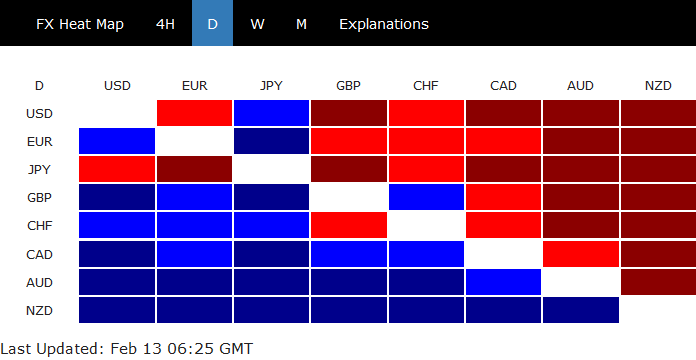
Asian stocks staged a strong rally today on optimism over US-China trade talks. In particular, Trump hinted that he's willing to let the March 1 trade truce deadline slip, even though he doesn't prefer it. Yen and Dollar are trading as the weakest ones for today because of that. Euro follows as third weakest. Australian Dollar rises across the board naturally on risk appetite. But it's overwhelmed by New Zealand Dollar, which was boosted by less dovish than expected RBNZ statement. For now, at least RBNZ doesn't hint at a rate cut. Focus will now turn to CPI from UK and then US.
In Asia:
- Nikkei closed up 1.34%.
- Hong Kong HSI is up 1.20%.
- China Shanghai SSE is up 1.56%, back above 2700 handle.
- Singapore Strait Times is also up 1.21%.
- Japan 10-year JGB yield is up 0.0083 at -0.002, still negative.
Overnight:
- DOW rose 1.49%.
- S&P 500 rose 1.29%.
- NASDQ rose 1.46%.
- 10-year yield rose 0.023 to 2.684.
- 30-year yield rose 0.023 to 3.022, back above 3% handle.
NZD Jumped although RBNZ Postponed Timing of Rate Hike (At Least Not Expecting a Cut)
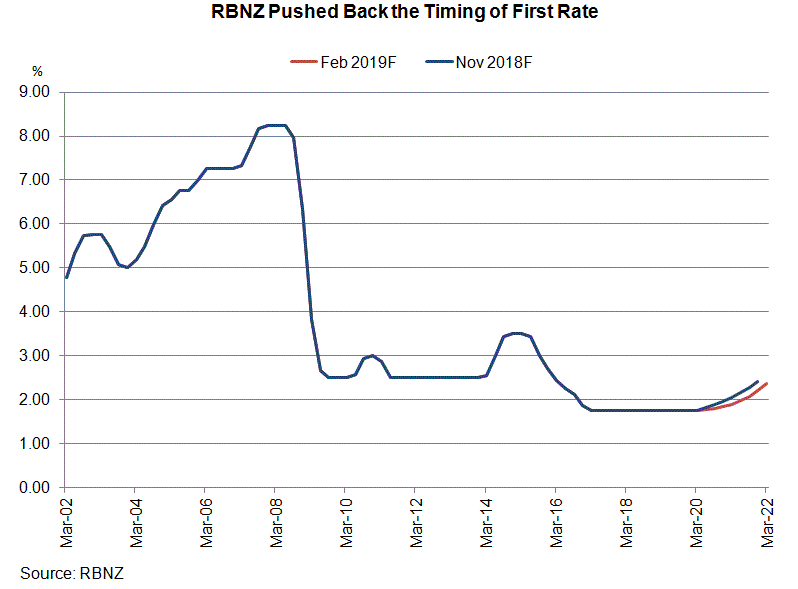
Kiwi rallied although RBNZ left the OCR unchanged at 1.75% as anticipated. The central bank did turn slightly more dovish than in November but the market had expected more. The central bank indicated that “the tailwinds to growth have eased” while “trading-partner growth is starting to slow”. It also pushed the timing of the first rate hike. It also retained the stance that the next move could be “up or down”. At the press conference, Governor Adrian Orr signaled that the risk of a rate hike has NOT increased, this is interpreted positively by the market as a sign that the chance of a rate cut is diminished.
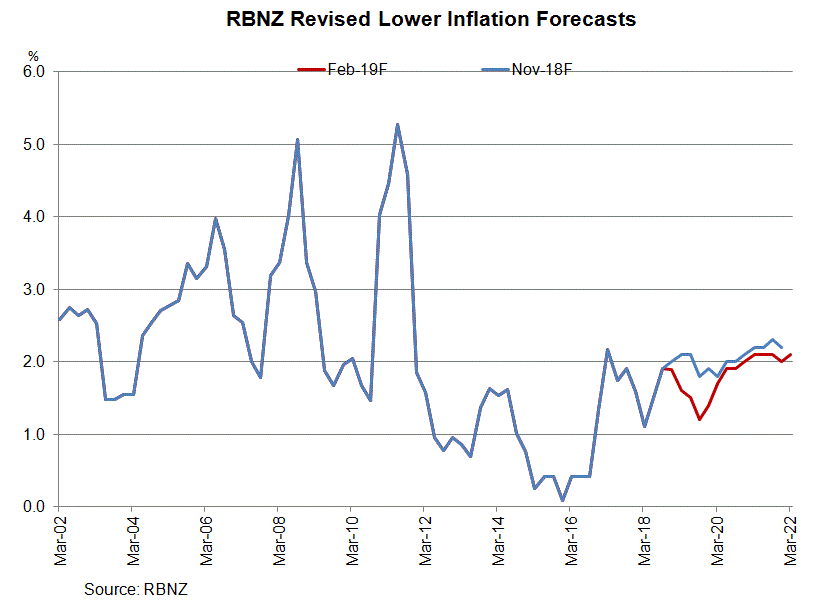
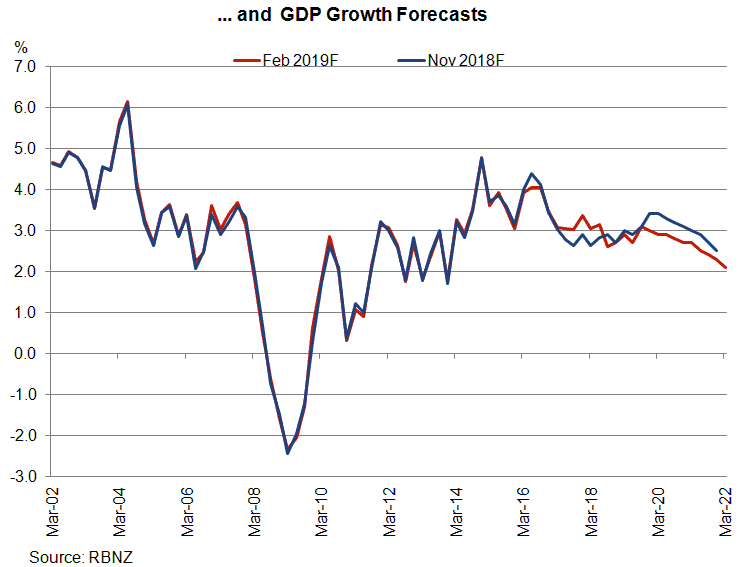
 Domestically, RBNZ acknowledged that employment is “near its maximum sustainable level”. Yet, the also noted that core inflation has stayed below the midpoint of the +2% target, thus requiring “continued supportive monetary policy. With exports of commodity the key revenue source of the country, weakening in global commodity prices have reduced “the tailwind that New Zealand economic activity has benefited from”. Globally, growth in New Zealand’s trading partner should “further moderate” this year while “the risk of a sharper downturn in trading-partner growth has also heightened”. The members affirmed that there are “upside and downside risks” to the above economic outlook. As noted in the Monetary Policy Statement, RBNZ has downgraded the GDP growth and inflation forecasts for this year.
On the monetary stance, RBNZ reiterated that “low interest rates” would be needed to support an improvement the country’s economy growth over 2019. As such, it reiterated that stance to keep the policy rate at an “expansionary” level for “a considerable period”, while reinforcing that “the direction of our next OCR move could be up or down”. The central bank noted that the policy rate is expected to stay at the current level “through 2019 and 2020”, a slight tweak from November’s “through 2019 and into 2020”. Looking at the Monetary Policy Statement, RBNZ now sees a rate hike to come in at March 2021, compared with November’s forecast of 3Q2020. Interestingly, this is an upside surprise for the market, which had almost nearly fully priced for a rate cut by the end of this year.
First Impressions: RBNZ Leaves OCR at 1.75%
First impressions of the RBNZ's February Monetary Policy Statement.
In its first review of 2019, the Reserve Bank left the OCR at 1.75% as expected. The tone of the statement was more dovish compared to November, but it didn’t go quite as far in that direction as we or markets were expecting.
The projected OCR track was around 20 basis points lower, with the RBNZ noting that it expects to keep the OCR at its current level over the next two years. The comment that “the next OCR move could be up or down” was returned to the statement, having been removed from the November statement after a run of strong data.
These headlines were all very much in line with our expectations, but some of the details were less dovish than we might have expected. Overall, the RBNZ has stuck to its view that inflation pressures in New Zealand are slowly building.
The RBNZ’s downside concerns centred around the global economy and were couched as risks. In contrast, the RBNZ remains upbeat on domestic conditions, with growth expected to be supported by low interest rates, government spending and investment, and growth in employment.
The tight labour market in particular featured strongly in the RBNZ’s analysis. The RBNZ noted that while it estimates the current output gap to be zero, its conversations with businesses point to difficulties in finding workers and pressure to pass on cost increases.
Inflation was forecast to slow to 1.4% in 2019, with the recent plunge in fuel prices acting as a drag. Inflation is expected to rise to around 2% over the medium term, a bit lower than their previous forecast.
There was no mention in the media release of the higher exchange rate since November, which is a little surprising given that it was trading significantly higher than their previous forecast.
Finally, we note that some of the details of this statement seem out of date. Export commodity prices are described as having “already softened”, but in fact they have seen some significant gains recently. The RBNZ expects GDP growth to rebound to 0.8% in the December quarter, but recent indicators point to something much weaker. And the recent revisions to the net migration data have yet to be incorporated into the RBNZ’s forecasts. Altogether, this suggests that some downside revisions to the RBNZ’s views may be already in the pipeline.
Financial markets have been moving towards pricing in the possibility of an OCR cut by the end of this year. Today’s statement didn’t do much to endorse that view. Consequently, the New Zealand dollar rose by 0.7 cents to 0.6800 and swap rates rose by 4 basis points.
More details to follow in our Bulletin later today.n.
NZD jumps on less dovish than expected RBNZ
New Zealand Dollar jumps sharply after RBNZ turned out to be less dovish than expected. OCR was kept at 1.75% as widely expected. And, the central bank restored the language that "the direction of our next OCR move could be up or down" in the statement. However, there was no more dovish tweak.
In short, RBNZ expected interest rate to be unchanged at current level "through 2019 and 2020". It maintained the view that "As capacity pressures build, consumer price inflation is expected to rise to around the mid-point of our target range at 2 percent."
And, there were upside and downside risks to the outlook. RBNZ noted "there are upside and downside risks to this outlook. A more pronounced global downturn could weigh on domestic demand, but inflation could rise faster if firms pass on cost increases to prices to a greater extent."
The overall statement was pretty balanced and did nothing to endorse market speculation of a rate cut by year end.
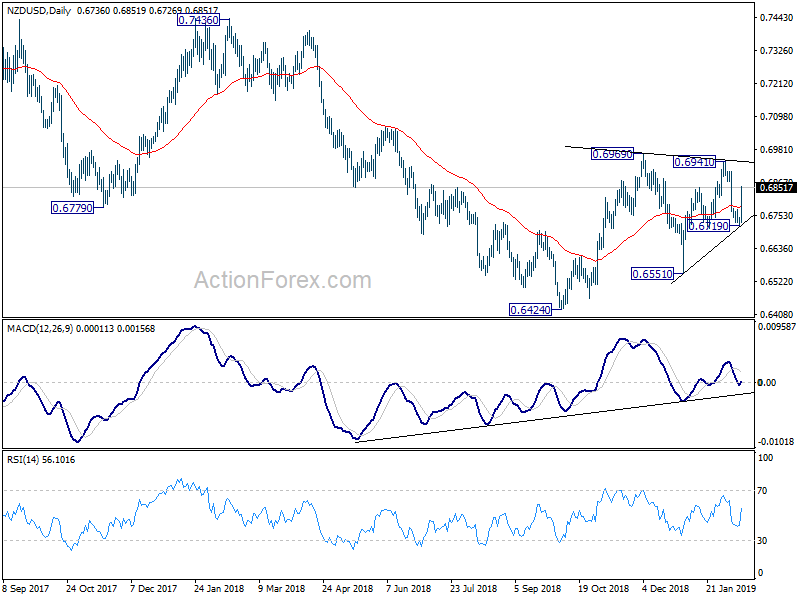
With today's strong rebound in NZD/USD, focus is back on 0.6941 resistance. Firm break there will complete the corrective pattern from 0.6969 and resume the whole rise from 0.6424. That will be a rather bullish development, but only until it happens.