

Sample Category Title
US update: AUD/CHF the top mover as risk appetite returns
Risk appetite appears to be rather strong today. It's reported that Trump is undecided on the congressional deal to avert another shutdown. But investors couldn't care less and they seem optimistic that Trump will eventually find an excuse to bow down, like claiming that the 90km border fence is a first step. But anyway, S&P 500 has already broken recent high to extend rally. DOW and NASDAQ might follow soon.
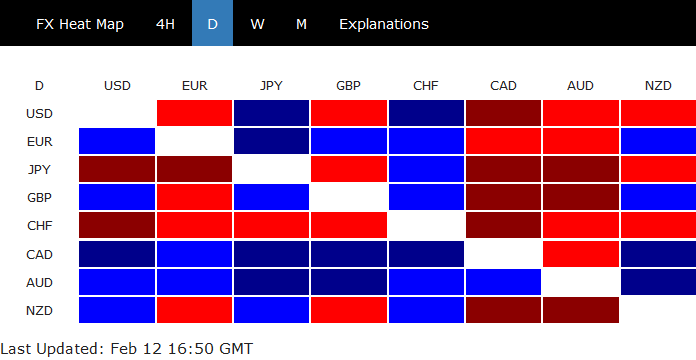
In the currency markets, Swiss Franc is the worst performing one, followed by Yen and then Dollar. Australian Dollar is the strongest one, followed by Canadian and then Euro. Sterling is mixed after little reactions to UK Prime Minister Theresa May's Brexit statement in Commons. Kiwi is also mixed ahead of tomorrow's RBNZ rate decision.
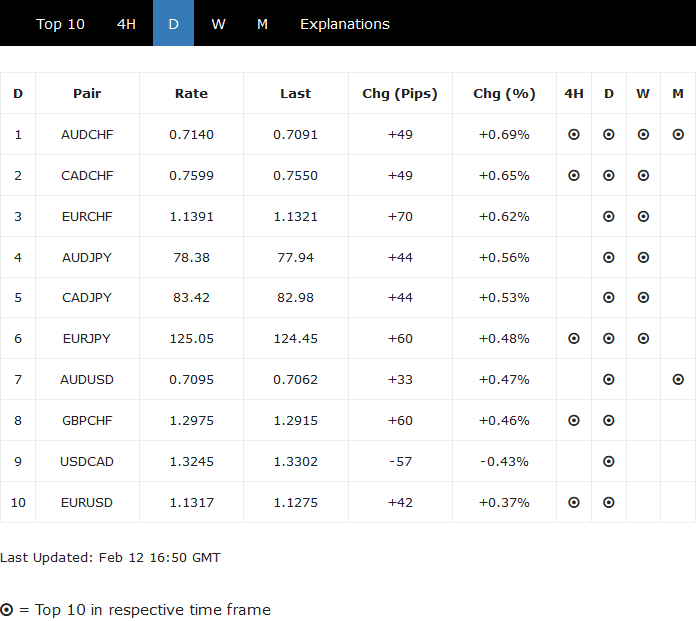
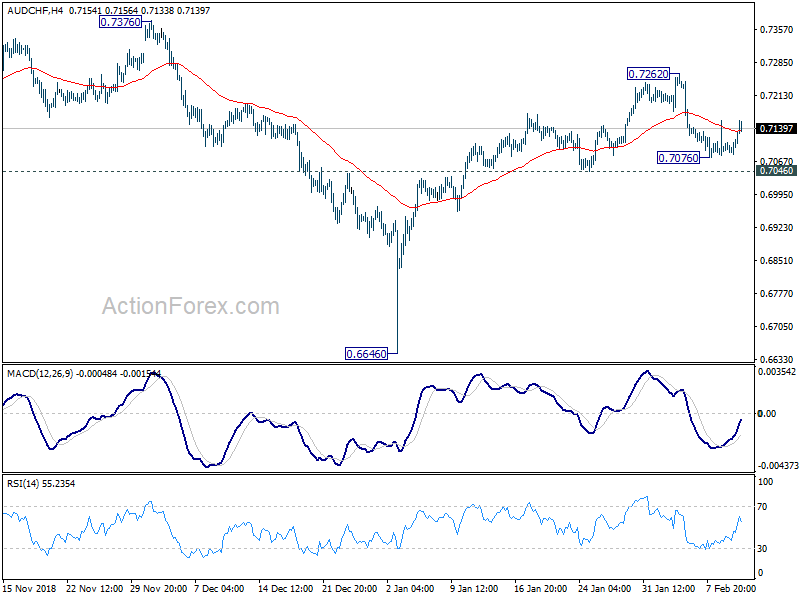
AUD/CHF is currently the top mover today, up 0.69%. The recovery ahead of 0.7046 support argues that rebound from 0.6646 low might not be completed yet. Intraday bias stays neutral first. Break of 0.7262 will target 0.7376 resistance next. Though, firm break of 0.7046 should confirm near term reversal and target a retest on 0.6646 low.
In other markets:
- DOW is up 1.39%.
- S&P 500 is up 1.14%.
- NASDAQ is up 1.27%.
- 10-year yield is up 0.025 at 2.686.
- 30-year yield is up 0.028 at 3.027, back above 3% handle.
In Europe:
- FTSE rose 0.06%.
- DAX rose 1.01%.
- CAC rose 0.84%.
- German 10-year yield rose 0.0102 to 0.132.
RBNZ May Appear Dovish, But Not Enough to Satisfy the Bears
The Reserve Bank of New Zealand (RBNZ) will conclude its policy meeting on Wednesday, at 0100 GMT. Governor Orr will hold a press conference an hour later. In the wake of some disappointing employment data, traders have sharply ramped up their bets for a rate cut this year. While the central bank may indeed cut rates later in 2019, it’s unlikely to clearly signal such a move this early, which generates an upside risk for the kiwi on the decision.
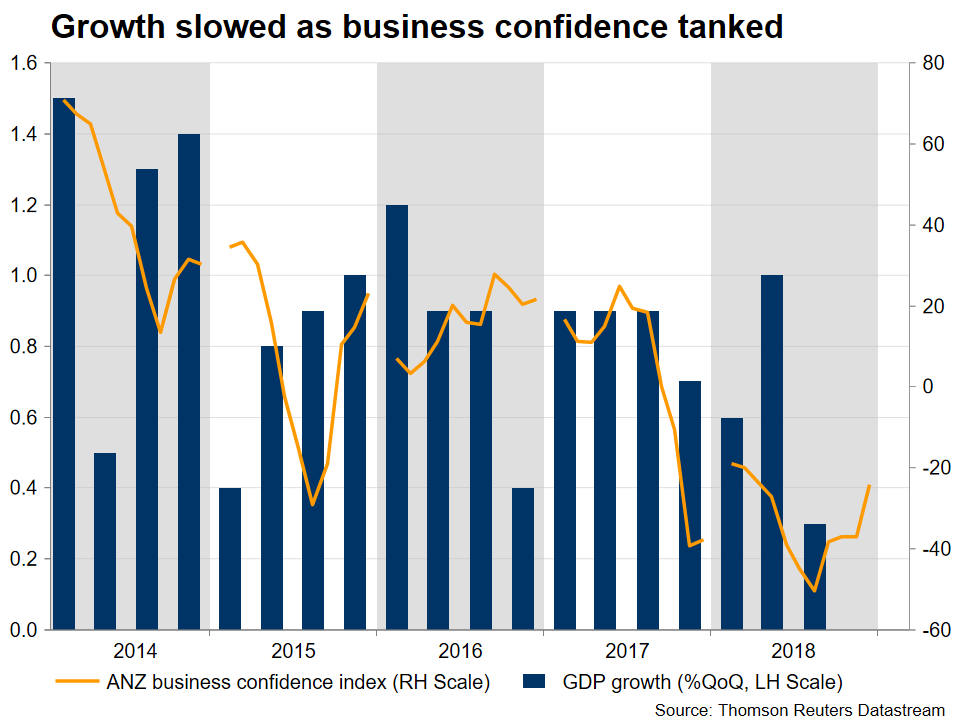
Undeniably, New Zealand’s economy is going through a soft patch, with growth disappointing in recent quarters as tanking business confidence held back investment. Meanwhile, net migration has started to slow massively, which is worrisome as this had been a major driving force behind gains in the housing and labor markets in recent years, thereby fueling consumption and broader growth. Accordingly, some “cracks” are starting to show in the labor market, with the latest employment report being on the soft side. Of course, there’s an array of external risks as well, with trade tensions and slowing growth in China being the most prominent.
All the above suggest that a rate cut by the RBNZ may be on the cards further down the road to help stabilize the situation, though a lot will also depend on how the trade picture and China evolve. Indeed, this shouldn’t be all too surprising, considering that the central bank has repeatedly stressed that rates can move in both directions for almost a year now.
Hence, the RBNZ could very well strike a more cautious tone at this policy meeting, highlighting that downside risks have intensified and keeping the door wide open for a future rate cut. Having said that though, a quarter-point rate cut this year is already priced in with an 85% probability, which implies markets believe this is practically a done deal. Even though this may well happen later on, it’s probably much too early for the RBNZ to commit to such a move, suggesting that the Bank will likely find it difficult to live up to the market’s overly dovish expectations.
In other words, given just how dovish market pricing is, anything short of a clear-cut signal that rates will be cut soon could come as a hawkish surprise, and may therefore elicit a positive reaction in the kiwi as investors start second-guessing whether a cut will indeed materialize. A parallel could be drawn with a “sell the rumor, buy the fact” move, considering that the kiwi has recently been under selling pressure as rate-cut expectations grew.
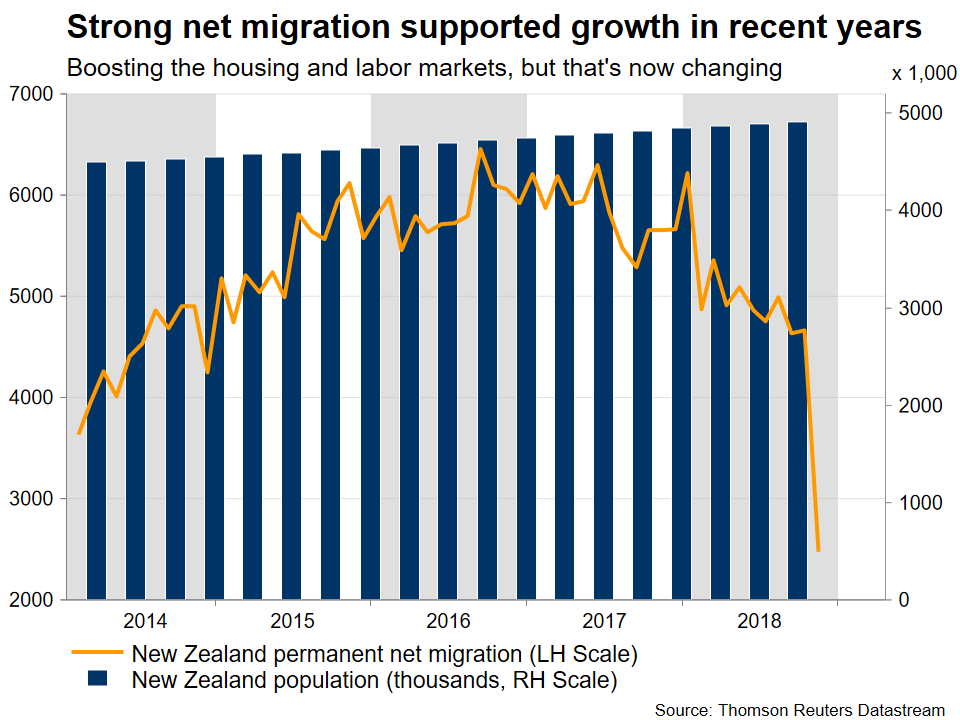
Looking beyond this meeting, though, the broader outlook for the kiwi remains bleak. The nation’s data pulse is weakening, slowing population growth amplifies the downside risks around consumption, and foreign developments – particularly in China – threaten the domestic outlook. To be sure, the currency has been kept afloat by surging dairy prices lately, despite these risks. However, dairy auctions tend to be highly volatile and since we’ve already seen robust gains in recent months, a correction may well be due going forward, which could erode one of the kiwi’s biggest sources of support.
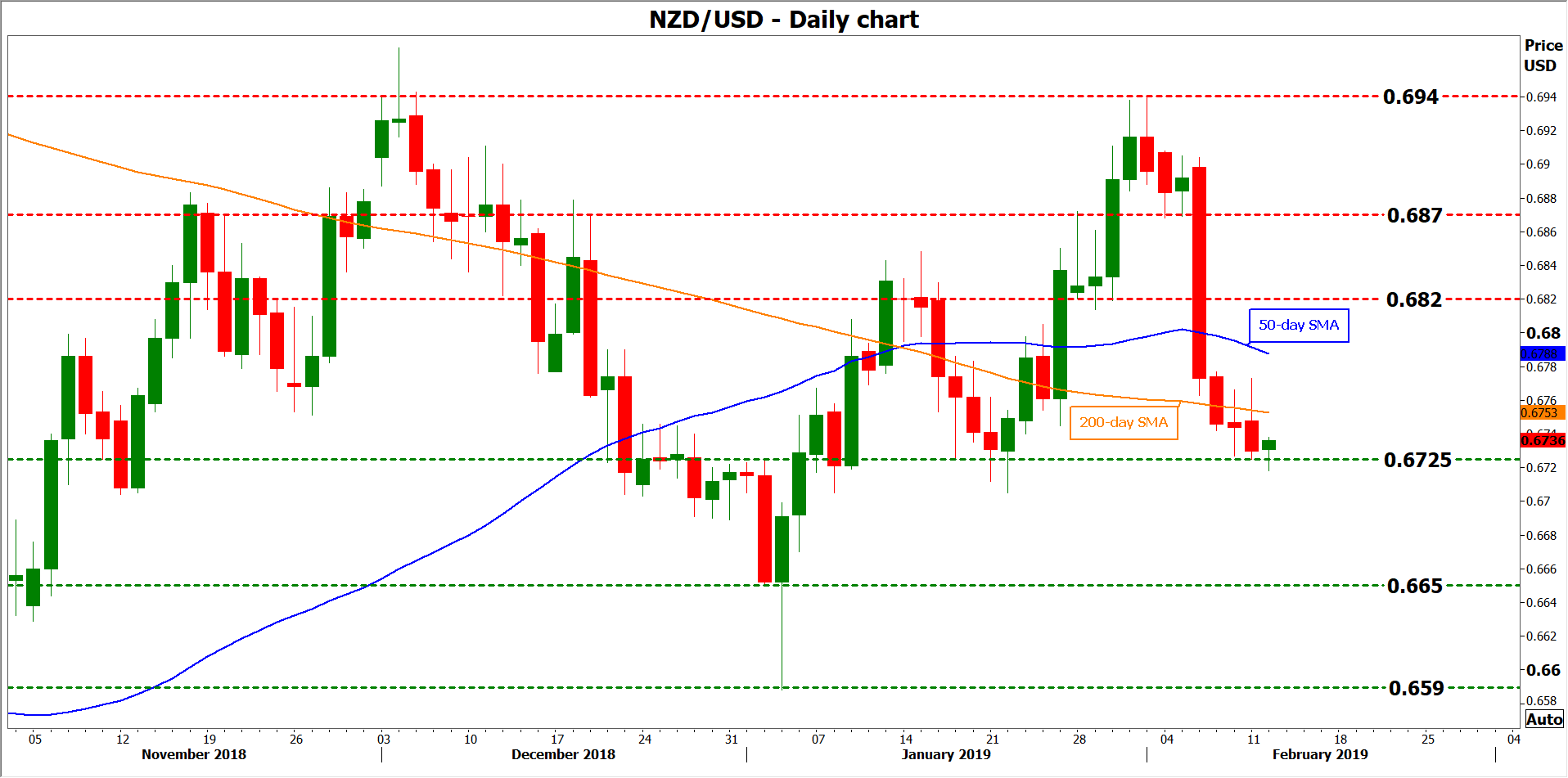
Technically, initial resistance to advances in kiwi/dollar may be found near the 200-day simple moving average (SMA), currently at 0.6753. An upside break could open the way for the 50-day SMA at 0.6788, with even steeper advances aiming for a test of 0.6820, the swing low on January 30.
On the other hand, immediate support to declines may be met near 0.6725, the low of February 11. Should the bears pierce below that, they could challenge the 0.6650 zone next.
Reserve Bank of New Zealand (RBNZ) – What to Expect
The Reserve Bank of New Zealand is expected to keep its benchmark interest rate at +1.75% this evening (08:00 pm ET).
Many expect Governor Orr to join the RBA with a more “dovish” statement this go around, and in contrast to the November release. The statement should reflect the increased global risks over the past three-months.
Currently, the market is pricing close to a +40% chance of an RBNZ rate cut by May, and with that in mind, investors should expect the accompanying policy statement to trigger a rates market reaction.
Kiwi inflation is just below target, but unemployment has risen recently.
Rate differentials support U.S dollar:
Many of the commonwealth central banks (BoC, BoE, RBA) have assumed the Fed’s cautious outlook on monetary policy, which suggests that a gap in yields – U.S vs. the rest – will remain for the foreseeable future.
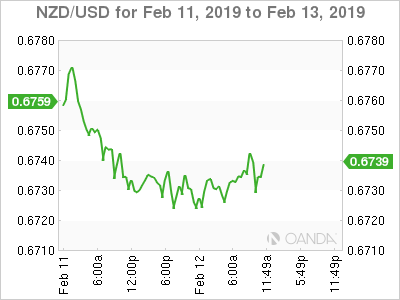
Higher U.S yields does support owning dollar dominated assets. The New Zealand dollar is down by -0.2% at NZ$0.672, having dropped to a three-week low of NZ$0.6719 during today’s European session.
Reserve Bank of Australia (RBA)
The RBA has adopted a “neutral” policy bias, stating that the Australian economy “could be weaker than it thinks and that the risks to the economic outlook are more balanced.”
Nevertheless, Governor Lowe remains upbeat on the Aussie job market, but has given the RBA the latitude to cut interest rates should growth fall short of expectations and the unemployment rate start to rise.
MARKET WRAP: Indices & Dollar Moved Higher, Crude Price Surged
Investors pushed the equity markets higher on the back of a possibility that the US government may not shut after all. Crude prices moved higher on oil production cut hopes.
Stocks
- The S&P 500 Index jumped 0.9 percent on the back of the trade hopes as of 15:31 London time.
- The Nasdaq 100 soared 0.97 percent and the Dow Jones Industrial Average also added to its yearly gains by 0.98 percent.
- The Stoxx Europe 600 Index moved higher by 0.52 percent.
- Germany’s DAX Index jumped 1.1 percent.
- The MSCI Emerging Market Index followed other market and moved up by 0.1 percent.
Currencies
- The Dollar spot Index still moving higher, as traders turn towards risk-off assets ahead of the possibility of the US government shutdown. It touched its peak in almost six weeks.
- The Euro recovered some of its losses and added 0.2 percent to $1.1293.
- The British pound is still under the selling pressure becuase Theresa May asked for more time from the parliament. The currency dropped by 0.25 percent to $1.2898- the lowest level in three weeks.
- The Japanese Yen lost more momentum and dropped by 0.3 percent to 110.36 per dollar.
Bonds
- The yield on 10-year Treasuries jumped two basis points to 2.66 percent, broke its consecutive days of losses in a week.
- Germany’s 10-year didn’t move much today and consolidated mostly.
- Britain’s 10-year yield is highly sensitive to Brexit news and moved up by two basis points to 1.18 percent.
Commodities
- West Texas Intermediate crude moved higher on the hopes of oil production cut and jumped up by 2.61 percent to $53.78 a barrel, recovered its losses from yesterday.
- Gold moved between gains and losses today, investors are not sure about the prospects of any positive outcome from US-China trade deal. At 15:30 London time it was up by 0.3 percent to $1,309 an ounce.
GBPUSD – Risk of Fresh Weakness Rises after 100SMA Capped Recovery Attempts
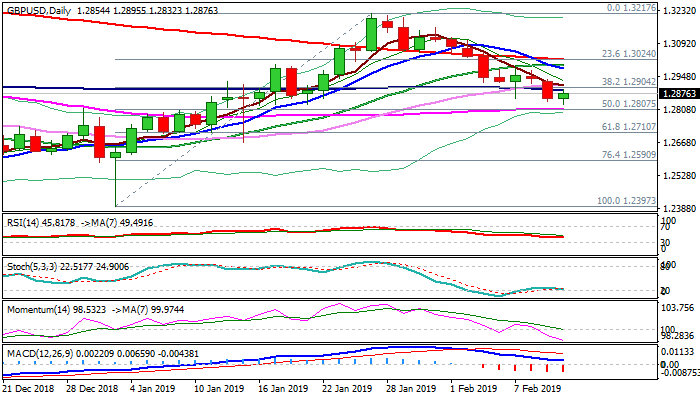
Recovery rally from new three-week low at 1.2832 that commenced in early European trading on Tuesday, showed signs of stall in early hours of American session, as broken 100SMA (1.2890) managed to cap corrective action.
In my morning forecast I pointed at 100SMA as ideal cap for positioning ahead of fresh weakness, after strong bearish signal was generated on Monday’s close below significant 1.29 support zone.
Repeated close below would re-confirm bearish stance for extension of bear-leg from 1.3217 (25 Jan high).
Bears would look for test of solid supports at 1.2807 (55SMA / 50% of 1.2397/1.3217) and 1.2786 (daily cloud top).
Momentum continues to trend lower in the negative territory, while stochastic turns south after brief recovery attempt from oversold territory, adding to negative signals.
BoE’s governor Carney, in his speech today said that global economic growth is likely to stabilize, but at slower pace and pointed to negative consequences of no-deal Brexit, which could be likely scenario of divorce between the UK and EU, if solution won’t be found in coming weeks until the 29 Mar deadline.
Res: 1.2890; 1.2915; 1.2942; 1.2996
Sup: 1.2832; 1.2807; 1.2786; 1.2710
Risk Rally Drives Stocks and High-Beta Currencies Higher
- USD – Risk rally caps on as hopes improve on trade and shutdown fronts
- Stocks – Still unable to take out last week’s high
- Oil – Saudi Arabia to overdeliver on pledge cuts
- Shutdown- Will Trump squash this deal?
- Gold – Refuses to break despite surging markets
USD
The market reaction was very clear on optimism from both the trade front and an apparent deal among American lawmakers to avoid a second government shutdown, stocks rose sharply and safe-haven currencies declined sharply. The dollar is down for the first time in nine days and we could finally see a sustained pullback here if progress does not digress on the trade front.
Stocks
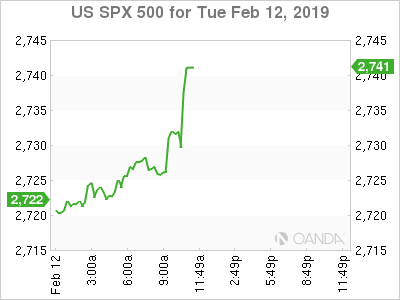
What is somewhat concerning for stock bulls is that today’s rally has struggled to break above last week’s high. The Trump factor could see one or both positive developments fall apart and markets will remain cautious until something concrete is outlined. Going into the week, expectations were fairly positive we would not see a second government shutdown and that the trade talks would be the key catalyst for the next major move.
Oil
Oil prices received a double dose of positive news, Saudi Arabia said they would over deliver on their crude production cuts by more than half a million barrels and risk appetite improved, sinking the dollar on positive developments on the political and trade fronts. Oil may see further gains if the dollar sees a significant pullback here, but not necessarily on continued compliance from the OPEC led production cuts as US production continues to thrive.

Shutdown
The proposed deal to avoid a second government shutdown saw both sides of the aisle take concessions. The Republicans will accept $1.375 billion for 55 miles of physical barriers, much less than President Trump’s initial demand of $5.7 billion and 220 miles. While the Democrats removed their demand to cut beds for detention within the US. If the President signs off on the agreement, it would fund the government through September 19th. The market’s reaction to the tentative deal to avoid a second shutdown is risk positive as it could remove a big political headache and opens the door for the US Congressional leaders to focus on the debt ceiling and possibly an infrastructure deal. The President did squash an earlier deal reached by Congress last time and we will not for sure if he will do it this time. The political damage from a Trump refusal however would be much worse this go around as it would complicate debt ceiling talks.
Gold
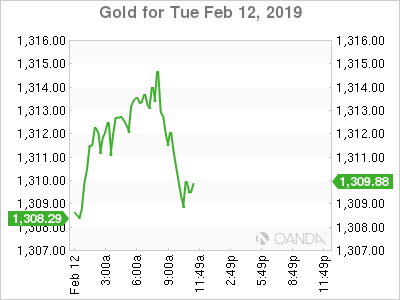
Gold is flat in early trade and the price movement in the precious metal signals that despite all the optimism on today’s developments on trade talks and government funding, growth risks remain. Gold could remain bid as financial markets appear not to be completely sold we will see a substantial trade deal finalized next month and that global growth may remain sluggish.
Yen Falls to Lowest Level in 2019 as Japanese Manufacturing Report Slides
USD/JPY has paused in Tuesday trade, after posting strong gains on Wednesday. In the North American session, the pair is trading at 110.51, up 0.11% on the day. On the release front, Japanese services and manufacturing reports indicated contraction. In the U.S., JOLTS Jobs Openings sparkled, climbing to 7.33 million.
Japan’s economy is struggling, as underscored by Tuesday’s releases. Tertiary Industry Activity, which measures the value of services purchased by businesses, fell 0.3%, its third decline in four months. There was no relief from Preliminary Machine Tool Orders, which plunged 18.8% in January, marking a fourth successive decline. With Japan continuing to post soft data and the BoJ continuing its easy monetary policy, the yen will be hard pressed to attract investors, unless risk apprehension shoots higher.
Japan is heavily reliant on trade with the U.S. and China, so the U.S-China trade war remains a significant concern for policymakers. Although the sides are talking, markets slipped after President Trump that he would not hold a meeting with President Xi prior to the March 2 deadline, when the U.S. is set to impose further tariffs if the sides fail to reach a deal. A third round of negotiations starts this week, with Treasury Secretary Mnuchin joining the talks later in the week. Still, with no signs of progress, there is growing alarm that the sides will not be able to reach a deal by March 2.
The Federal Reserve pressed the rate trigger four times in 2018, as the Fed responded aggressively to a red-hot U.S. economy. However, the global trade war and slower U.S. growth has resulted in the Fed lowering its forecast to two hikes in 2019. This could be overly optimistic, as the rate futures market has forecast no rate hikes until 2020. On Monday, Fed President Michelle Bowman said that she was satisfied with current monetary policy, and that the labor market and inflation levels had put the economy in a “good place”.
What is Bull and Bear in Forex Market
Bulls and bears are the main participants in the forex market. They differ in market behavior. These terms appeared on the stock exchanges but quickly came into common use in most financial markets, including Forex.
On Forex, both categories of traders expect a rise or fall in the exchange rate, buying or selling the base currency against the quoted one. Market participants are trying to obtain profit due to the ever-changing dynamics of the exchange rate. Let's take a closer look at who the bulls and bears are.
Bulls on Forex
Bulls are traders who expect that price will go up. A bull trader opens long positions, thus increasing demand and raising the price of a trading instrument. In the bullish market, the economy is doing well, the unemployment is declining, GDP is rising, and prices are also growing. This market is characterized by optimism, high expectations, and investor’s confidence.
The origin of the name is inspired by an analogy: the bulls thrust its horns up into the air, just as the bull trader "raises" the prices by aggressive purchases.
Bulls are aimed at increasing capital due to market growth. They buy to resell in the future at a higher price. Therefore, when quotes are growing, the market and the trend itself are called bullish. There is a gradual increase in prices over a certain period of time in the bullish market. In other words, the price moves only upwards during the entire time period.
Bears on Forex
Bears are trying to lower the price, ie they are pessimistic about the rise in prices. These market participants expect that prices will fall. Bears sell their assets to buy them cheaper in the future. The bears swipe its paws downward, similarly, the bear trader seeks to reduce prices.
The bearish market is opposite to bullish: the unemployment is rising, GDP is declining, and the prices are also decreasing. Here the prices are constantly falling under the pressure of negative news and the ever-increasing number of positions to sell. The bearish market is characterized by a pessimistic approach and low expectations.
When quotes are falling, the market and the trend itself are called bearish. A steady downtrend is being formed in the market.
When the market changes
The bearish market may become the bullish one at any time. The reversal usually occurs after the market has moved into the oversold zone and the current price does not suit the sellers. Positive news on the base currency may also lead to the trend change. In this case, the bears will not be able to hold the market and will start closing existing deals.
The bullish market may exist until negative news is released or before moving into an overbought zone.
How to identify the market trend
To recognize which sentiment prevails in the market traders use technical analysis tools.
Price chart
First of all, trends can be determined using the price chart. If we are talking about an uptrend in the market, then each subsequent maximum should be higher than the previous one, and each subsequent minimum should also be higher than the previous one. Then we can speak about the current trend as upward in the market.
Moving Averages
Another common way to determine whether the market is bullish or bearish is trend indicator, Moving Averages. It has a form of a curve, which changes depending on the direction of the trend. A combination of two moving averages is usually used. The 50-day and 200-day MAs are widely followed by traders.
When the price moves above the curve, a bullish signal is formed. If the price moves below the MA, a bearish signal occurs. When the price crosses the curve, the trend is likely to reverse. Taking into account angle of slope, one may determine the potential direction and the strength of price movements in the market.
Also, such indicators as Bulls/Bears Power and ADX display the confrontation between bulls and bears quite clearly.
If you are a novice trader, test the strategy and indicator on a practice account. Open a demo account and try your hand at trading without risks.
To sum up, the sentiment of the market participants strongly depends on the exchange rate dynamics. When the bearish trend is observed, traders start selling actively, and prices fall. When the bull trend changes the bearish one, traders start buying to resell at a higher price.
NZD/USD decline slows, some RBNZ previews
RBNZ rate decision will be a major focus in the coming Asian session. There is no chance of a shift in OCR, which is currently at 1.75%. While the economy appeared to have picked up momentum in Q3, Q4 data proved that was only a false dawn. RBNZ's today in the upcoming statement should at least switch to the absolute neutral stance. That is, the language that next move could be up or down would be reintroduced. And there is prospect for the central to even tilt more to the dovish side.
Here are some suggested readings:
- RBNZ Preview – Turning More Dovish while Affirming Next Move Can be Up or Down
- Australia & New Zealand Weekly: RBA Shifts to a More Balanced View
- RBNZ May Appear Dovish, But Not Enough to Satisfy the Bears
- Reserve Bank of New Zealand (RBNZ) – What to Expect
- Aussie and Kiwi Outlook: Storm Clouds Gathering?
- Dollar Hit by Profit-Taking; RBNZ and US CPI in Focus
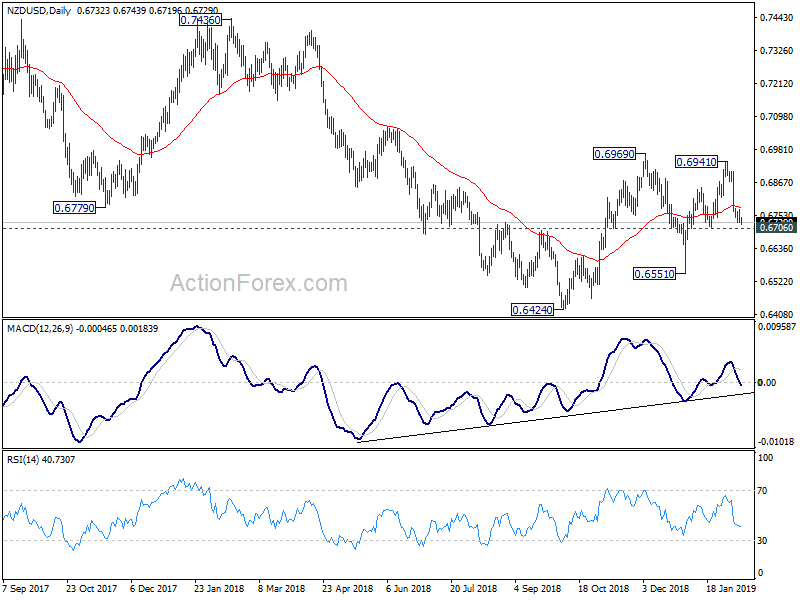
NZD/USD dived sharply last week after weaker than expected job data. But the decline slowed this week, with 4 hour MACD crossed above signal line. Intraday bias is turned neutral for now. As long as 0.6773 minor resistance holds, we'd expect further decline ahead. Break of 0.6706 will pave the way to 0.6551 low.
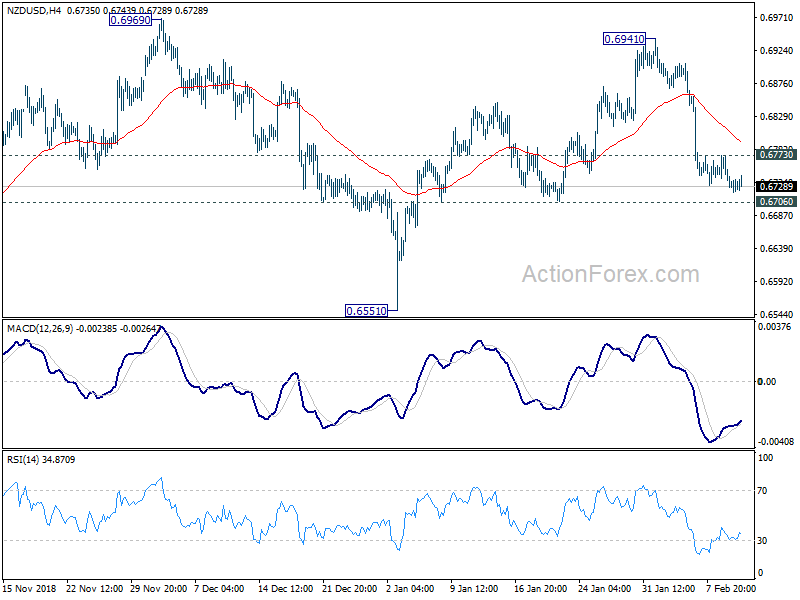
Nevertheless, break of 0.6773 will indicate shorty term bottoming and bring stronger recovery. But even in that case, we don't expect a break of 0.6941 resistance in near term.
Sunset Market Commentary
Markets
Global core bonds lost ground today with US Treasuries underperforming German Bunds. Yesterday’s risk-rebound received a push in the back overnight as US Congress reached a tentative border security deal that, if approved later this week, might avoid another government shutdown. Both US Treasuries and German Bunds took a step back on the news. ECB’s Philip Lane warned against overreacting to individual data points but said the domestic euro-area economy remains “pretty strong”. The Bund temporarily rebounded on a headline from Germany’s Weidmann, but the move didn’t last. ECB member Knot said that recession fears for the euro zone are “clearly premature” and that the current wait-and-see approach is the right attitude for the ECB. The German yield curve moves higher with changes up to +1.2 bps (30-yr). The preliminary US Congress deal on border security and positive signals from the White House on the US-Sino trade talks pushed US Treasuries down with a rebound ahead of the US bell. The US yield curve edges higher with changes ranging from +1.6 bps (2-yr) to +2.7 bps (10-yr). Peripheral spreads over the German 10-yr yield tighten with Greece (-7 bps) and Italy (-5 bps) outperforming.
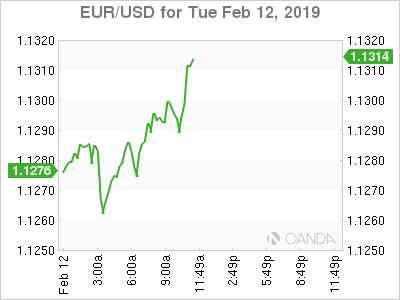
The EUR/USD slide (rise of the dollar) slowed temporary this morning even as US Congress reached a (tentative) budget deal overnight. A positive risk sentiment prevented further EUR/USD losses. Euro selling resumed early in European dealings on headlines from ECB’s Weidmann. Markets made a dovish reading of his assessment that the euro zone hasn’t yet reached the stage of being ‘crisis proof’. EUR/USD set a minor short-term correction low in the 1.1260 area. However, the overall message from Weidmann wasn’t that dovish. The euro (and EMU yields) gradually rebounded. Comments from ECB members Knot and Nowotny also weren’t overly dovish. A further improvement in global risk sentiment also provided a good reason for short-term investors to take some profit on the recent USD rally. Interest rate differentials between the US and Germany/EMU widened slightly, but this time it didn’t help the dollar. EUR/USD is heading back up to the high 1.12 area. Even USD/JPY (110.45 area) pairs part of recent gains, despite the broader risk rally. The USD rally took a breather, but the overall picture remains USD constructive.
Sterling trading remained mostly technical in nature today. EUR/GBP trended slightly higher this morning as markets were looking forward to PM’s Brexit update in Parliament. As expected, the UK PM asked more time to reach a solution with the EU on the Irish border backstop (in one way or another, preferably in by changing the withdrawal agreement). BoE’s Carney in a speech warned on the risk of trade tensions (incl. Brexit) for global growth but kept a balanced approach on the BoE’s intentions on monetary policy. EUR/GBP reversed this morning’s gain and is currently again trading in the 0.8765 area.
News Headlines
Hungarian headline inflation stabilized at 2.7% YoY (0.3% MoM) in January. Core measures however, rallied to 3.2%, (vs. 2.8% in December). Core inflation as measured by the country’s central bank (MNB) quickened to 3% vs. 2.9% in December. MNB deputy governor Nagy recently said a reading of 3% would be a “very strong indicator for monetary policy that normalization can start”. The forint rallied on such prospects.
France’s finance minister Le Maire seeks to overhaul EU competition laws with support of Germany. Le Maire says the bloc’s industrial policy needs to be “much more ambitious” and aimed at creating global champions to face US and Chinese competition. Le Maire’s comments come after the EU vetoed a German-French rail merger.
ECB’s Weidmann said in a speech the EMU is going through a “soft patch” but sees “good reasons” to believe inflation is still on track toward the 2%-target. Nowotny spoke later and suggested the ECB will revise its plans for interest rates “in the summer”. Dutch governor Knot thinks the ECB’s wait-and-see approach is “probably the optimal attitude” but dismissed EMU recession talks. He added the ECB has to be patient and is “not yet there” when it comes to new stimulating measures.