

Sample Category Title
EU Verhofstadt warns UK: Getting rid of Irish border backstop is irresponsible
UK Prime Minister Theresa May is due to meet European Commissioner Jean Claude-Juncker tomorrow, to seek agreement on alternative arrangements on Irish border backstop. Ahead of that, European Parliament's Brexit coordinator Guy Verhofstadt warned that it's irresponsible to ditch the backstop.
Verhofstadt tweeted, "Today I see Taoiseach Leo Varadkar and tomorrow Prime Minister May. My message to the UK will be that it is not very responsible to try to get rid of a backstop that is meant as an ultimate safeguard to avoid a hard border and the return of violence on the Island of Ireland."
https://twitter.com/guyverhofstadt/status/1093077110225285123
AUD/USD Analysis: Breakout Occurs
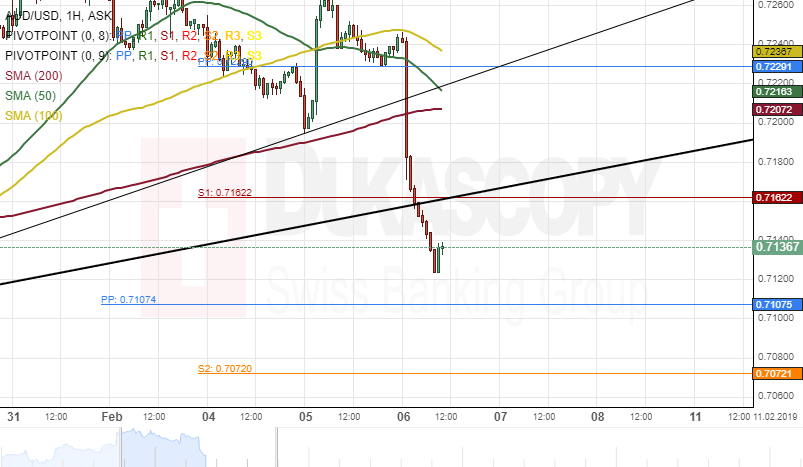
The Australian Dollar has depreciated about 143 base points against the US Dollar during the last 24hrs. The currency pair broke a medium-term ascending channel pattern during the Asian session on Wednesday.
Given that a breakout had occurred, most likely, the exchange rate will continue its decline within this session.
The potential downside target will be near a support level formed by the weekly S2 at 0.7072.
However, the monthly pivot point at 0.7107 could hinder bears from pushing the currency exchange rate down.
NZD/USD Analysis: Target At 0.6826
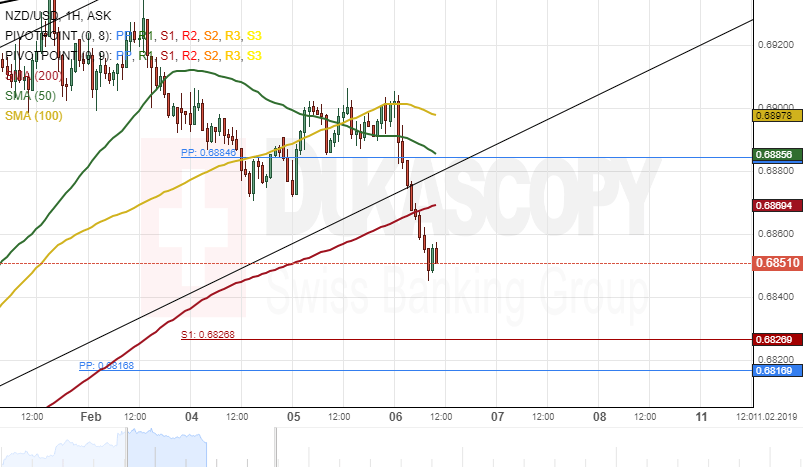
Today's trading session began with a strong bearish sentiment. The New Zealand Dollar has depreciated about 59 base points during the morning hours of Wednesday's session.
A breakout through the lower boundary of an ascending channel occurred during the European trading session on Wednesday.
Given that a breakout had occurred, it is likely that bears could push the currency exchange rate towards a support level at 0.6826 during the following trading session.
Although, the market sentiment could changes within the following hours, as technical indicators suggest bullish signals on the daily time frame.
USD/CAD Analysis: Bullish Sentiment
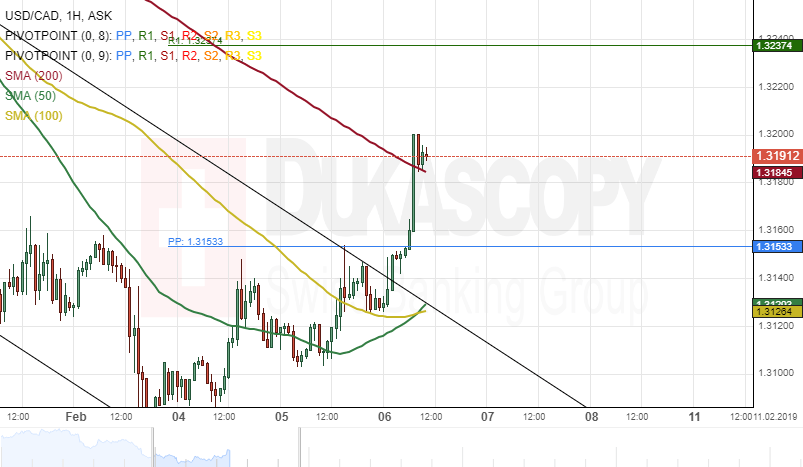
A breakout through the upper boundary of a descending channel pattern occurred during the Asian trading session on Wednesday. The US Dollar has since appreciated about 95 base points against the Canadian Dollar during the last 24hrs.
The exchange rate broke a strong resistance level at 1.3153 and breached the 200-hour simple moving average near 1.3186 during the first half of Wednesday's trading session.
Everything being equal, it is likely that the currency exchange rate will continue moving up towards the weekly R1 at 1.3238 today.
Although, the rate could aim for a resistance of the weekly pivot point at 1.3153 in the short term.
EUR/JPY Analysis: Moving Towards Swing Low At 124.40
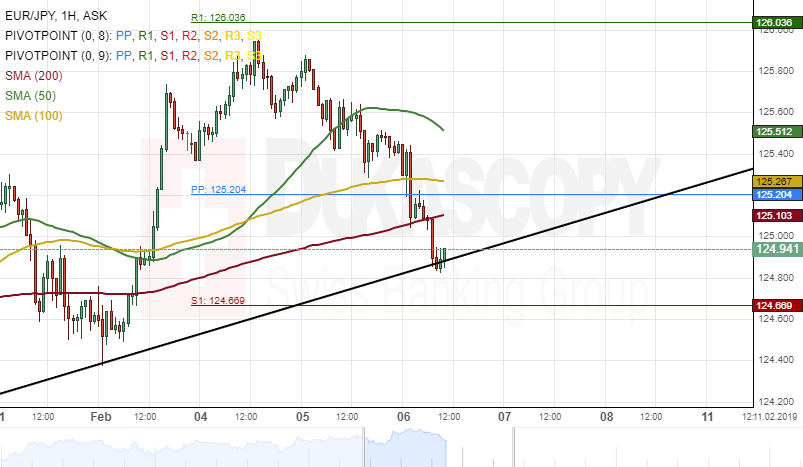
During the last 24hrs, the common European currency has depreciated about 102 base points against the Japanese Yen. The currency pair breached the lower boundary of an ascending channel pattern at 124.87 during the Asian trading session on Wednesday.
Given that a breakout had occurred, it is likely that the exchange rate decline towards a swing low of 124.60 within this session.
The currency exchange rate could make a possible reversal from the swing low as mentioned above during the following trading session.
Traders are advised to look for opportunities to trade if the situation occurs.
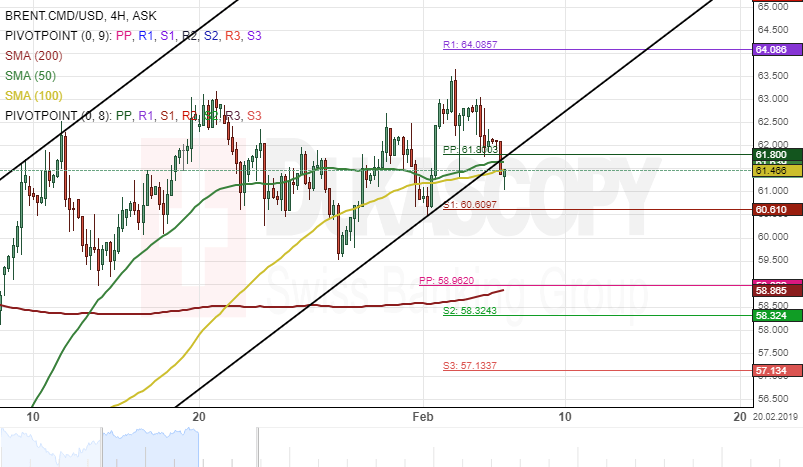
Brent.CMD/USD 4H Chart: Facing Support Cluster At 61.80
The BRENT.CMD/USD pair has appreciated about 4.92% of its values during the past week. The commodity tested a swing high of 63.61 during this time period.
The Brent crude oil is currently facing a strong support level formed by the weekly pivot point and the combination of the 50– and 100-hour SMAs at the 61.80 area.
If this support cluster as mentioned above holds, the oil prices could edge higher towards a resistance level at the 66.00 mark in the nearest future.
However, if the UKOIL passes the SMAs, a decline towards a support level set by the monthly PP at 58.96 could be expected.
Light.CMD/USD 4H Chart: Likely To Decline
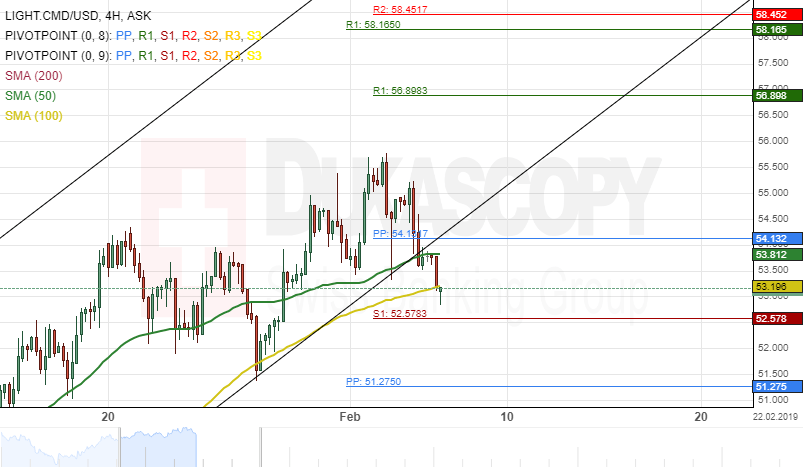
During the past week, the Light crude oil has gained about 5.07% of its values against the US Dollar. The commodity breached a swing high of 54.33 during this time period.
The LIGHT.CMD/USD pair tested the lower boundary of an ascending channel pattern and the 50-hour simple moving average at 53.82 during the Asian session on Wednesday.
The crude oil prices could decline towards a support level formed by the monthly pivot point at 51.27 in the shorter term.
However, a support cluster formed by the 100-hour SMA and the 63.61 during this time period weekly S1 at 52.57 could hinder such movement.
EURUSD Vulnerable To Further Losses
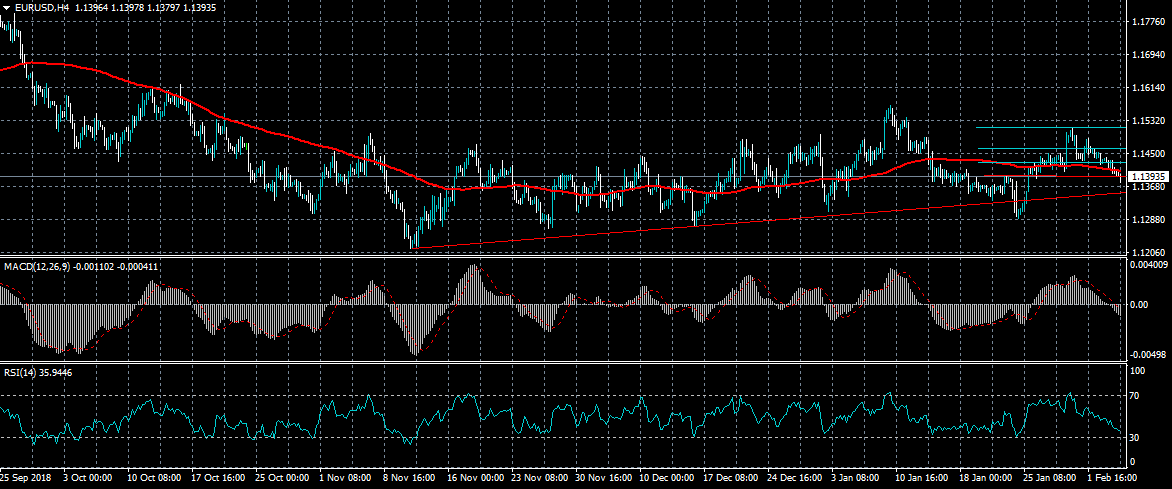
The euro currency has continued to decline against the greenback during the European trading session, with the pair so far finding support from the 1.1378 level. Overall sentiment toward the EURUSD pair remains weak after the German economy posted worsening economic data this morning. The Relative Strength Index on the four-hour time frame is signalling that the EURUSD pair has yet to reach oversold conditions.
The EURUSD pair is intraday bearish while trading below the 1.1410 level, key technical support is found at the 1.1378 and 1.1360 levels.
If the EURUSD pair trades above the 1.1410 level, buyers may test towards the 1.1430 and 1.1460 resistance levels.
USDJPY Testing Key Weekly Pivot
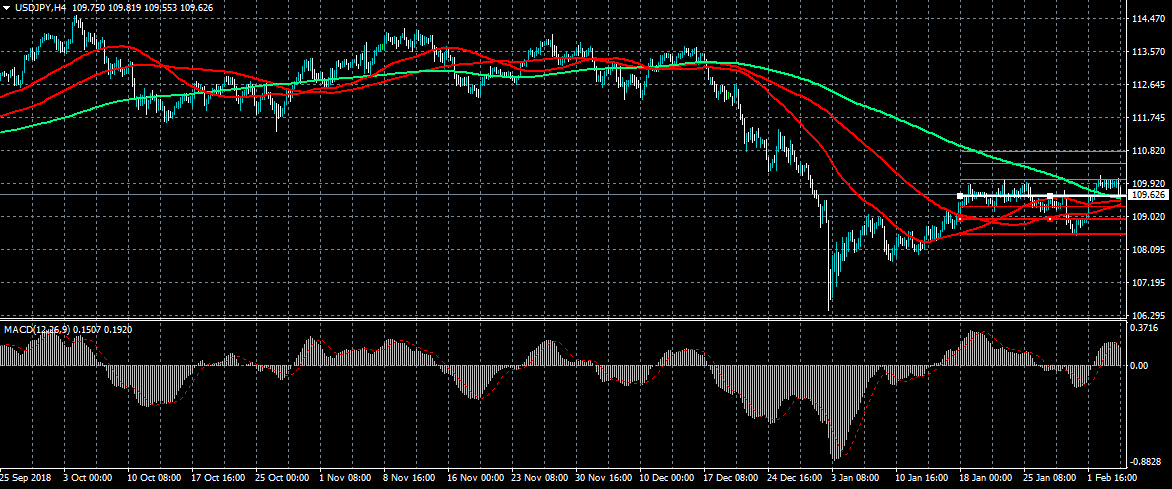
The US dollar is testing the pivotal 109.60 level against the Japanese yen currency after buyers failed to rally the pair above the 110.00 level on Tuesday. A sustained break below the 109.60 level may provoke further technical selling towards the 109.14 support level. The MACD indicator on the four-hour time frame is also correcting lower, signalling that further downside in the USDJPY pair seems likely.
The USDJPY pair is only bullish while trading above the 109.60 level, key technical resistance is found at the 110.00 and 110.40 levels.
If the USDJPY pair moves below the 109.60 level, sellers may test towards the 109.30 and 109.14 support levels.
Softness Back In Vogue For Central Bankers
The head of the Reserve Bank of Australia provoked the Australian currency selloff on Wednesday morning. AUDUSD loses 1.6% after Philip Low's comments on the Central Bank readiness to consider rate cuts. These 180 degrees turn compare to the previous rhetoric came as a surprise to the markets. Earlier the RBA noted that it was choosing the right moment to raise rates from a historical low.
However, such softening of rhetoric is not the exception, but the rule at the moment. From the beginning of the year, in official comments, the Fed made it clear that they were not sure about further rate increases, the ECB noted the need to monitor the situation and indicated that they did not want to rush to increase rates and were generally concerned about the economic slowdown.
The central banks of developing countries altogether moved to active steps in their policy. The National Bank of China reduced reserve requirements, which is another form of policy easing. In Armenia and Georgia, central banks cut rates in January. Most economists expect rate cuts in the near future in Thailand, Philippines, and India. In Indonesia, the Central Bank also sharply softened the rhetoric, despite strong economic data.
Thus, most central banks either try to defuse the situation or in fact resort to stimulating the economy through policy easing. This is positive news for the stock markets of these countries and contributes to a positive attitude in global indices.
It is worth recalling that there is no smoke without fire. Central Banks soften the rhetoric, as the risks of the economy overheating are gone from the agenda. Due to trade wars and global economy cyclical slowing, it is no longer necessary to restrain growth, now it needs to be stimulated.
In the short term, it supports emerging markets rally and contributes to the stability of their currencies. However, the big question is whether these measures are enough to rid the world of a new recession.
Analogies come to mind that the 2019 year can be compared to 2006 or 2007 when markets grew on soft rhetoric, but this was not enough to prevent the global financial crisis in 2008.