

Sample Category Title
Fed Powell: It’s important to earn and deserve trust that Fed is non-political
Speaking at a town hall to a group of educators, Fed Chair Jerome Powell repeated the assessment that the US economy is "now in a good place". While there were some "big events" like Brexit, "the system has been strong". He also emphasized that the essence of his job is to "earn and deserve trust" of American people to Fed that, it's "working on their behalf in a non-political way" to support the economy.
Looking forward, Powell said income inequality and sluggish productivity are the biggest challenges of the next decade. He noted "We want prosperity to be widely shared. We need policies to make that happen." And, "There are policies that we need to do that everyone should be able to agree on that will change mobility, improve people's chances and enable people to better take part in the workforce of the future."
Separately, Fed Governor Randal Quarles warned that "right now China is a downdraft as we think about what the potential impact for that is on our economy." Though, the U.S. outlook "is still very solid" given the labor market in particular.
UK PM May to work urgently with EU on Brexit deal changes
UK Prime Minister Theresa May is travelling to Brussels to meet EU leaders to convince them to tweak the Irish backstop arrangement. And as the March 29 formal Brexit date is approaching, May is expected to ask European Commission President Jean-Claude Juncker, European Council President Donald Tusk and the European parliament's Antonio Tajani to work "urgently".
According to her office, May is expected to tell the parliament that the "The government now wants urgently to work with the EU to secure such changes ... We must show determination and do what it takes to now get the deal over the line." While the expectation on the meeting is low, May would describe today's meeting as "part of a process leading to the government bringing back" a new vote on a Brexit agreement as soon as possible.
Eco Data 2/7/19
[php_everywhere instance="1"]
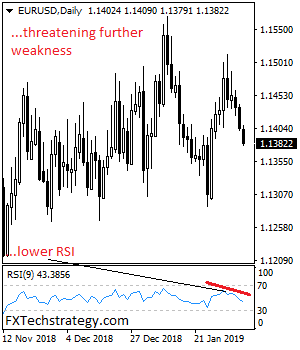
EURUSD Bear Pressure Remains Intact
EURUSD bear pressure remains intact as it looks for price extension. Support stands at the 1.1350 where a break will aim at the 1.1300 level. A break below here will target the 1.1250 level. Further down, support lies at the 1.1200. On the upside, resistance resides at 1.1400 level with a break through there opening the door for further upside towards the 1.1450 level. Further up, resistance comes in at the 1.1500 level where a violation will expose the 1.1550 level. All in all, EURUSD continues to threaten further downside pressure.
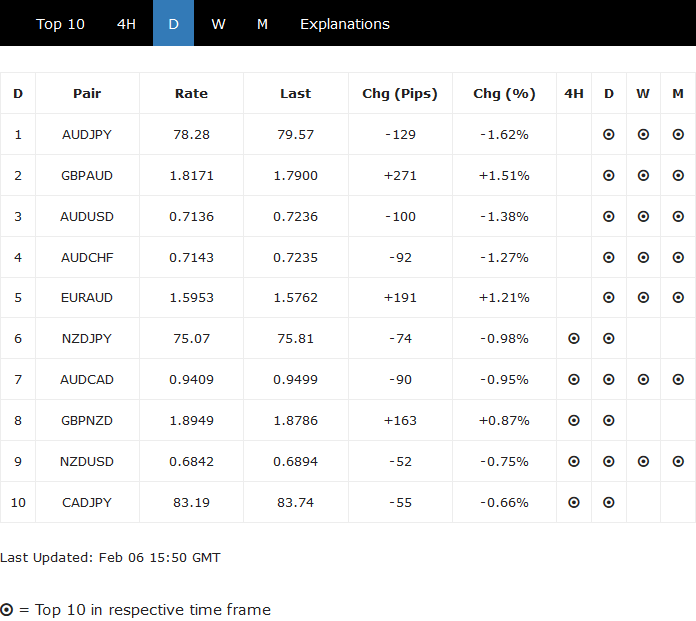
Today’s top mover: AUD/JPY completed post flash crash rebound
AUD/JPY is currently the top mover for today, down over -1.6%. Australian Dollar is knocked down by comments from RBA Governor Philip Lowe. Meanwhile, Yen is lifted by falling global treasury yields. Yen crosses also generally display signs of bearish reversal.
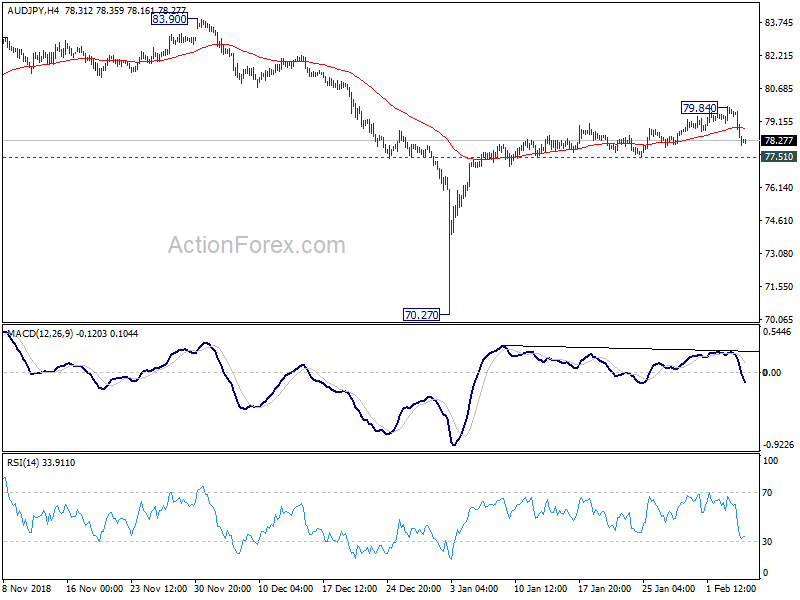
Back to AUD/JPY, current development argues that corrective rebound from 70.27 flash crash low has completed at 79.84 already. This is supported by mild bearish divergence condition in 4 hour MACD, as well as rejection by 55 day EMA. Focus is now on 77.51 support. Break there will confirm this bearish case.
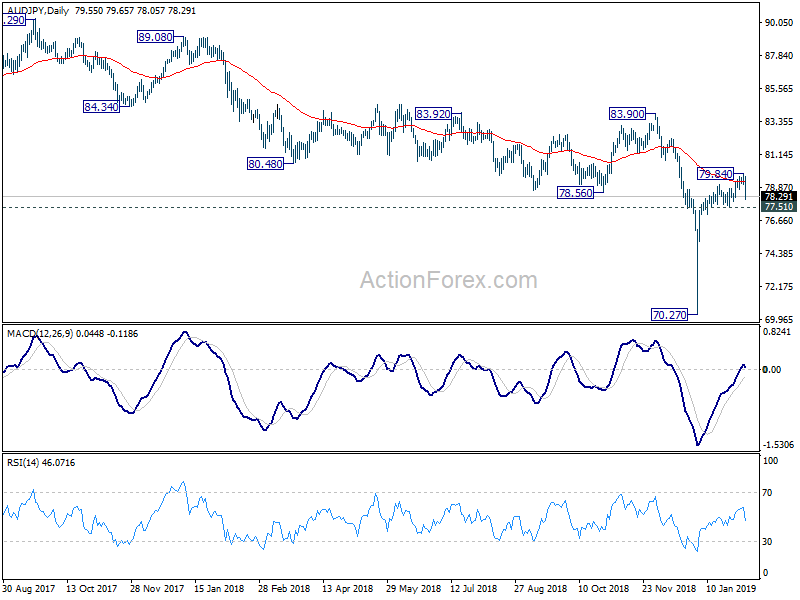
As the 70.27 is an abnormal spike low, it's hard to judge whether it would be taken out in near term at this point. The momentum through 77.51 should be watched to assess the chance. But in any case, risk will now stay on the downside as long as 79.84 holds, even in case of strong recovery.
BoC Lane: US trade policies, lower oil prices, softened housing resulted in temporary slowing on Canadian economy
In a speech in Washington, BoC Deputy Governor Timothy Lane outlined the challenges the Canada is facing. Firstly, uncertainty on US trade policies held back Canadian business investments. Secondly, lower oil prices caused deterioration of Canada's terms of trade. Thirdly, housing investment and consumption softened. Together, they resulted in "temporary slowing of Canada's economic growth.".
On the other hand, the US economy "has been powering ahead with the effects of the fiscal stimulus". Fed also raised interest rates a couple of times last yet. The combined effects put downward press on the Canadian. And, "the lower Canadian dollar, in turn, will help support the economy through this period."
BoE to Strike Cautious Tone as Brexit Uncertainty Reigns
The BoE is widely expected to keep policy unchanged via a unanimous 9-0 vote on Thursday, at 1200 GMT. Focus will be on the updated economic forecasts, the likelihood for rate hikes – or cuts – this year, and Governor’s Carney’s remarks. The heightened uncertainty around Brexit coupled with a slowdown in UK growth suggest little scope for any hawkish bits, with Carney & Co. instead likely to adopt a more cautious tone. With money markets still assigning a 60% probability for a hike this year, that could weigh on sterling.
It’s “Super Thursday” in the UK, meaning that besides the rate decision and the meeting minutes, the Bank of England (BoE) will also release its quarterly Inflation Report with updated economic forecasts, which Governor Carney will present in a press conference. The UK economy has continued to lose growth momentum as evidenced by the recent dip in the nation’s PMIs, slowing in tandem with the global economy. In the UK’s case, much of this weakness is the result of Brexit uncertainties holding back business investment, as the BoE itself pointed out at the latest meeting.
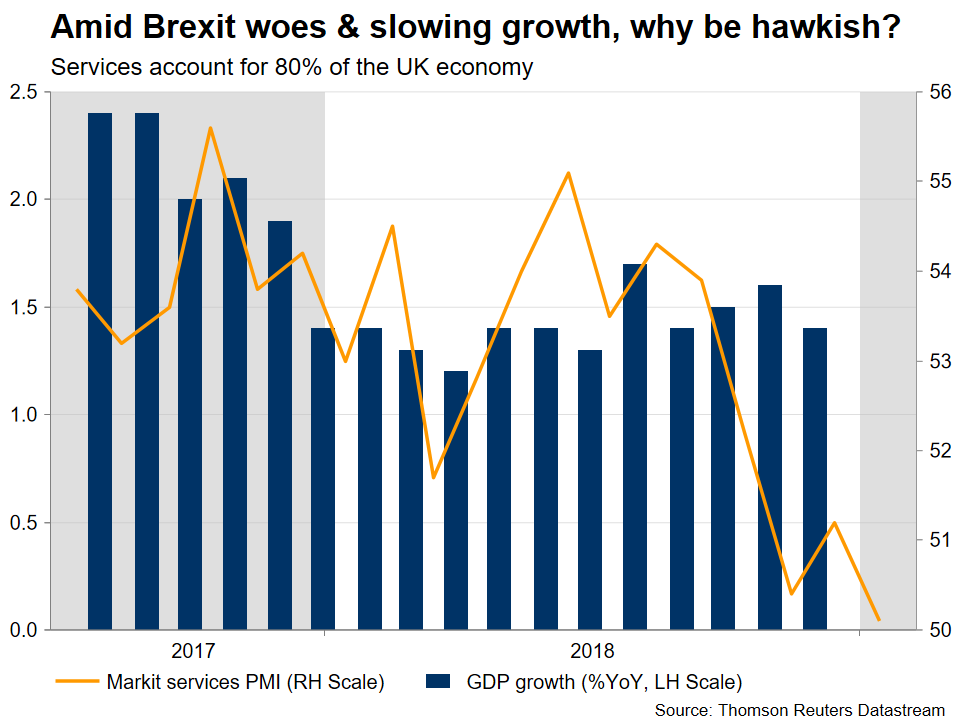
Considering that Brexit anxieties have dragged on since then, and that there are now less than two months before the UK exits the EU without an agreement in place yet, it’s safe to say that the BoE will refrain from making any hawkish remarks. If anything, the Bank is more likely to revise down its inflation and growth forecasts, given lower oil prices and the global slowdown respectively, while at the same time highlight that rates could even be cut this year in case of a disruptive, no-deal Brexit.
Remember that the BoE bases all its forecasts and expectations on the assumption that there will, eventually, be a Brexit deal. So, while the Bank will continue to reiterate – under its written communication – that further rate hikes are still on the table given this assumption, the verbal guidance by Governor Carney may take a different turn, where he stresses the adverse scenario as well.
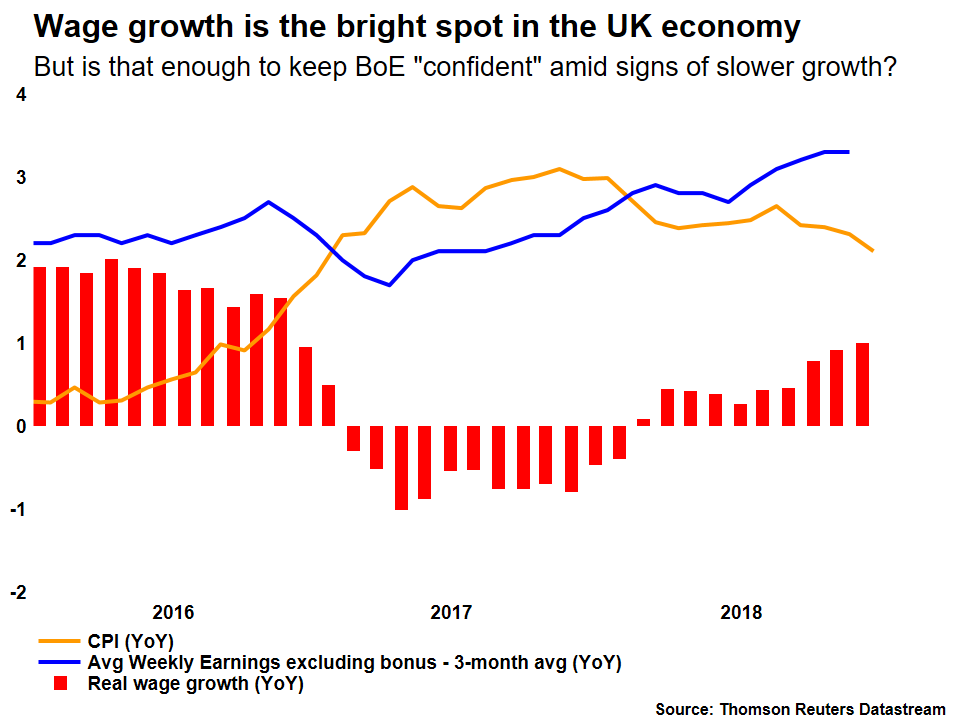
Even though markets have recently taken the view that a no-deal outcome has become less likely with Parliament taking some control of Brexit, the absence of any clear way forward in the face of a ticking clock suggests this is still a real danger. In the context of a slowing economy as well, the BoE seems to have no incentive to amplify expectations for a future hike, only to risk having to walk back on that a few weeks later in case of an unfavorable Brexit outcome.
Investors currently assign a 60% probability for a quarter-point rate increase this year, according to the UK overnight index swaps. If the BoE indeed assumes a risk-management approach and downplays the prospect of a hike or emphasizes that a cut has become a higher-probability outcome, then the pound could slide as some tightening expectations are priced out. In such a case, sterling/dollar could encounter immediate support at 1.2920, with a break lower opening the dollar for a test of the 1.2825 area.
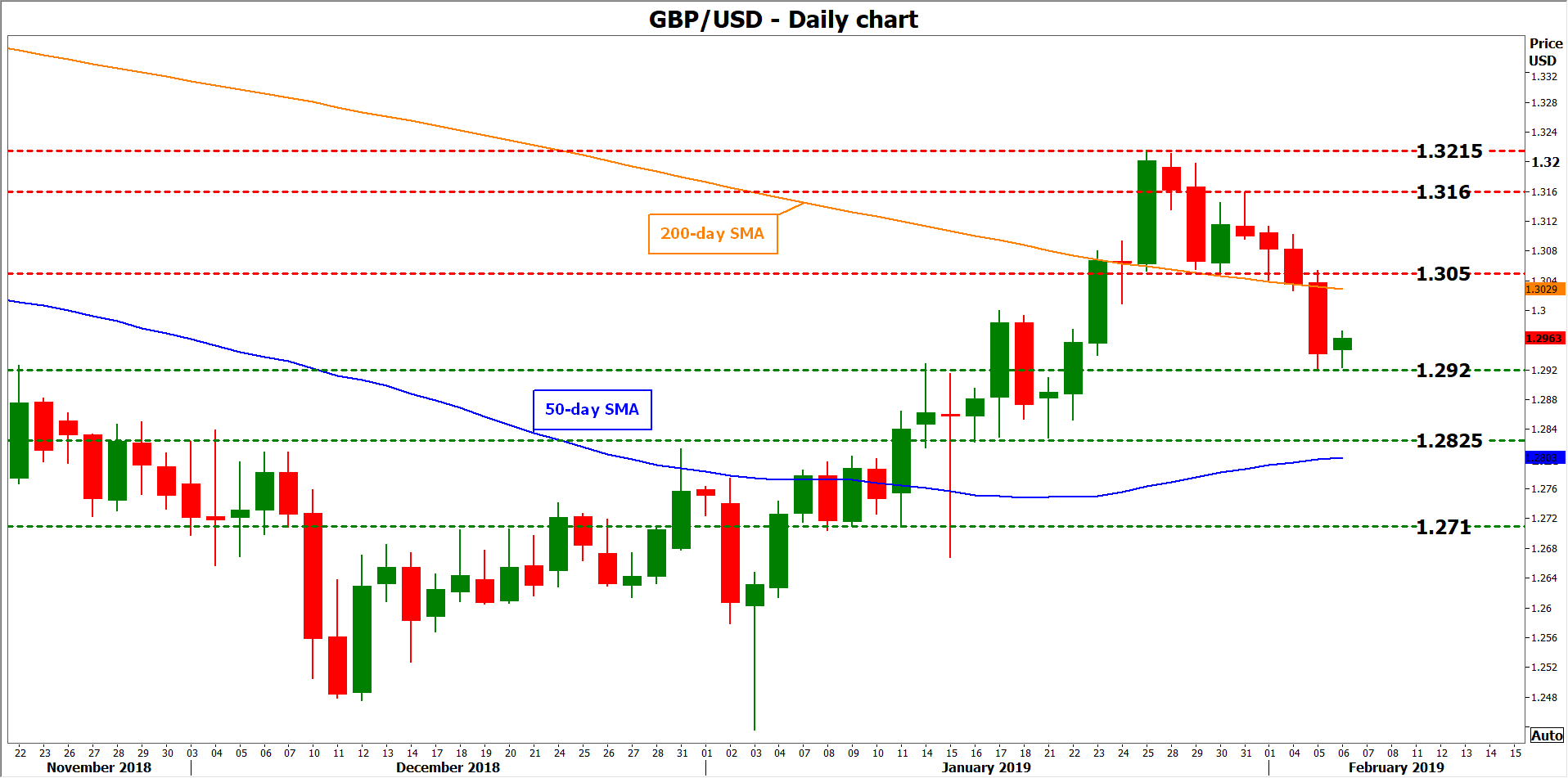
On the other hand, if policymakers choose to focus on encouraging developments like the pickup in wage growth lately, or if one of the 9 members surprises and votes for an immediate rate increase, that could see the UK currency gain. The bulls could challenge 1.3050, marked by the inside swing low on January 30, with even steeper advances aiming for the January 31 highs at 1.3160.
Beyond what the BoE says, the bigger driver for sterling’s direction will be how the Brexit saga unfolds. After Parliament signaled it would support PM May’s deal if the Irish backstop is replaced, May is now attempting to renegotiate this controversial arrangement – something the EU has repeatedly rejected. The PM has a week to do so, as she has promised lawmakers another vote on what happens next by February 14. Since the EU is unlikely to make any real concessions, uncertainty is set to remain elevated until then, with a correction lower in sterling not to be ruled out in the interim. After that date though, it will either be an explosion higher for the pound as Parliament either i) accepts the deal ii) extends the leave date iii) calls for a second referendum – or a massive drop lower as none of these happens and the probability of a no-deal exit soars.
Canada to Add Fewer Jobs Numbers in January
Canada is delivering its first employment report for this year on Friday at 1330 GMT but according to analysts the results may appear dull once again, likely leading to the conclusion that rate hike plans should remain on hold for now until further notice.
In December, employment growth was muted at 9.3k, marking an average yearly increase of 163,000 for 2018, the lowest expansion recorded in three years, while the unemployment rate remained at the multi-decade low of 5.6%. In January, the economy is said to have added fewer job positions, with the increase estimated to come in even lower at 8k. The jobless rate is expected to be a soft point as well, as forecasts are for the measure to inch up to 5.7%.
Depending on the economic circumstances, the Bank of Canada would have no incentive to drive interest rates higher in the wake of an unimpressive outcome unless wage growth heats up to a greater degree and consumption picks up steam such that inflation could hit the Bank’s 2.0% midpoint target. But as in other economies, Canada has not seen wage pressures gather steam either, with Senior Deputy Governor, Carolyn Wilkins, saying last week that skills shortages, low prices in the vital oil industry and digitalization are potential reasons why firms don’t simply offer more money to their workers. Consequently, households who also struggle with debt stress prefer to keep their expenses under control, limiting inflationary pressures. Recall that the latest retail sales stats showed that receipts dropped by 0.9%, the largest decline in five months. Also of importance, the decline in home and auto sales provided a piece of evidence that elevated interest rates might have already started to constrain spending.
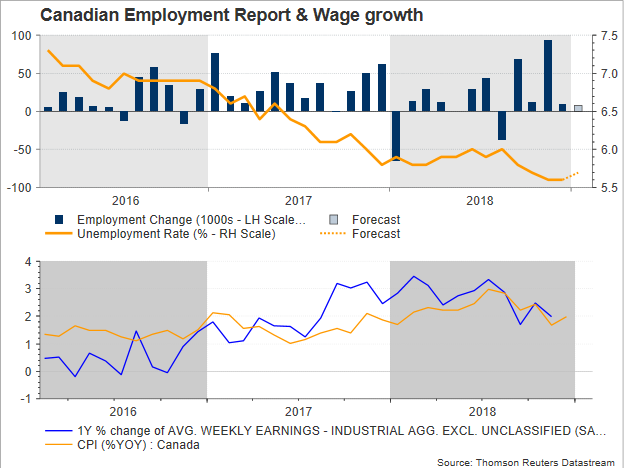
The last time the BoC raised borrowing costs was in July. Since then, the bank’s thinking was that, given the healthy picture of the economy, rates would need to continue rising. However, following the aggressive sell-off in oil and stock markets in the fourth quarter and the GDP contraction in November, policymakers feel now more doubtful about the timing of the next rate hike as the boiling US-Sino trade war and the cloudy economic environment in Europe could give little chance for improvement in Canada in the coming months – the odds for more tightening by the end of the year are around 35% according to the overnight indexed swaps. A worse-than-expected employment report, would likely throw more caution to the air, making investors more sensitive to any subsequent data releases ahead of the BoC policy meeting on March 6.
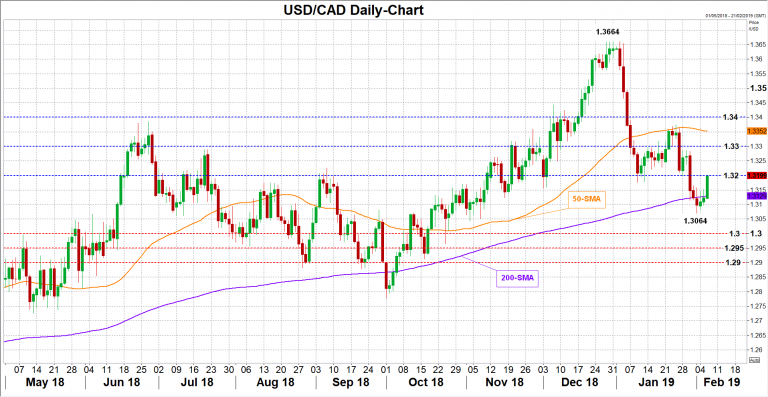
Turning to the market reaction, the loonie would bear the negative consequences of a surprisingly weaker jobs growth in the absence of any oil volatility. In this case, USDCAD could retest the 200-day simple moving average which currently stands at 1.3129 ahead of the previous low of 1.3064. if the latter fails to hold, the downfall could next pause within the 1.30-1.2950 area, while lower traders could eye the 1.29 round level as well.
Alternatively, upbeat numbers could push the price above 1.32 and towards 1.33. A steeper rally may target the 50-day MA currently at 1.3352, while a cross above the 1.34 resistance could bring more buyers into the market.
Elliott Wave Analysis: USDJPY Unfolding a Temporary Pullback
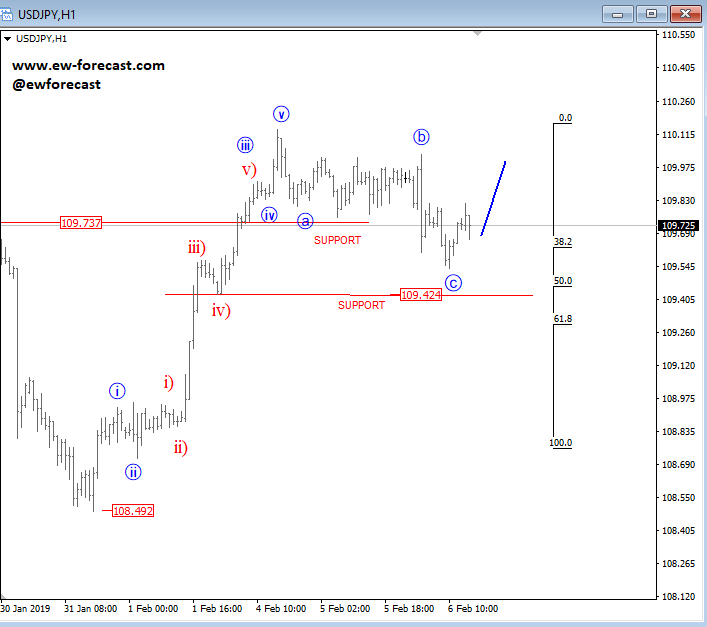
USDJPY made a nice structure, up from 108.49 level, a five-wave move which is now being retraced by a temporary pullback. We see this pullback as an a-b-c, which is now trading at interesting support regions, here at 109.73/109.42 area. A rally in impulsive fashion would suggest a completed correction and more upside.
USDJPY, 1h
Sunset Market Commentary
Markets
Global core bonds moved higher today with US Treasuries outperforming German Bunds. With an almost empty economic calendar, investors were left with nothing but risk sentiment to guide position taking. Before EU openings, disappointing German factory orders soured sentiment. In December, factory orders declined 1.6% A modest rise of 0.3% was expected. The German Bund jumped higher on the release but moved downwards throughout the day. Once again, core bonds moved higher as US investors joined the debates. The German yield curve was mixed with changes between -1.5 bps (30-yr) to +1.2 bps (2-yr). US Treasuries were little inspired as well. The US trade deficit narrowed more than expected in November, but had little impact. Still, UST’s moved higher in the run-up to the WS bell. The US yield curve is moving lower with changes up to -1.8 bps (10-yr). Italy’s 30-yr bond syndication was well bid with a record €41bn for its second syndicated sovereign bond of the year. The final deal size is said to be 8 billion euros. The Italian BTP’s traded in a choppy sideways pattern to currently hover near opening levels. Peripheral spreads over the German 10-yr yield are steady.
The way of least resistance for EUR/USD trading this week is south. This morning, it looked that this trend would simply continue. At the start of European dealings, December German factory orders (-1.6% M/M, and ‑7.0% Y/Y) disappointed again, flashing a new warning sign on the EMU economy. EUR/USD dropped to the 1.1380 area, but at least for now, there were no follow-through losses. Further out, there was hardly any market relevant eco news. The Italian 30-y bond auction attracted ample investor interest. This successful sale didn’t help the euro, but at least one perceived risk factor for the euro didn’t materialize. On the other hand, comments from EU policy makers, including from EU’s Tusk, suggested that Brexit uncertainty probably won’t disappear anytime soon. EUR/USD (currently 1.1380 area) continued this morning’s trading near this week’s low. An, albeit marginal, decline in US yields and a less buoyant risk sentiment also aborted the USD/JPY attempt to regain the 110 barrier. The pair (currently 109.80 area) hovered in the upper half of the 109 big figure.
Sterling entered calmer waters today. Both last week on Friday and yesterday, the UK currency came under pressure as the PMI’s indicated that UK economic growth might be heading for a standstill as its remains highly uncertain whether and, if so, on what conditions, the country will leave the EU on March 29. There were quite some harsh headlines from EU’s Tusk vis-à-vis UK Brexiteers. He also admitted that attempts to stop the Brexit process will probably prove idle. For now, the comments had no negative impact on sterling. EUR/GBP is trading in the 0.8780 area. Tomorrow, UK PM May and EU’s Juncker are scheduled to meet and try to unlock the Brexit stalemate.
News Headlines
The Polish central bank left its main rate unchanged at a record low of 1.50%. The status quo comes amid a dovish shift of other major central banks (Fed, ECB) and was widely expected as the bank’s governor Glapinski suggested at the previous meeting that rates might even remain stable until the end of his term in 2022, instead of 2019 or 2020 indicated earlier. The Polish zloty is trading slightly lower ahead of the bank’s press conference.
Bank of Canada deputy governor Timothy Lane said US trade uncertainty, lower oil prices and weaker housing and consumer spending has been driving the latest deceleration in growth. But the underperformance relative to the US’s has put downward pressure on the loonie against the USD which should help the economy through this temporary slowdown, Lane said.