

Sample Category Title
USD/JPY Mid-Day Outlook
Daily Pivots: (S1) 109.82; (P) 109.93; (R1) 110.08; More...
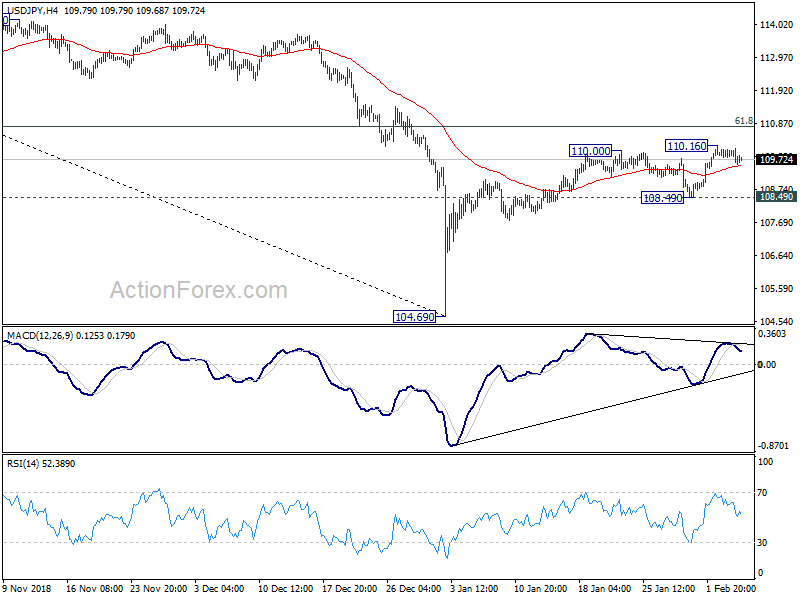
Intraday bias in USD/JPY remains neutral at this point. In case of another rise, we'd expect strong resistance from 61.8% retracement of 114.54 to 104.69 at 110.77 to limit upside to bring reversal. On the downside, break of 108.49 support will now confirm completion of the rebound and bring retest of 104.69 low. However, sustained trading above 110.77 will dampen our bearish view and target a test on 114.54 resistance instead.
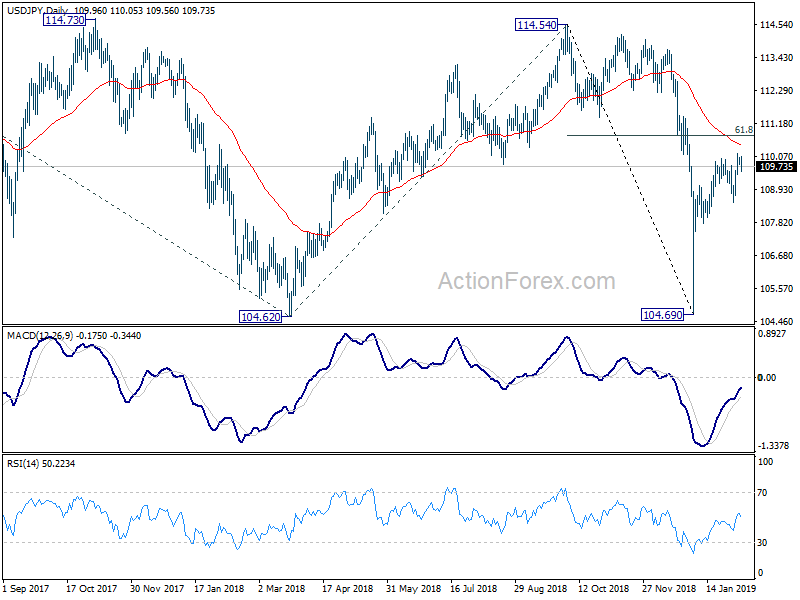
In the bigger picture, while the rebound from 104.69 is strong, there is no change in the view that it's a corrective move. That is, fall from 114.54, as part of the decline from 118.65 (2016 high), is not completed yet. Break of 104.62 will target 100% projection of 118.65 to 104.62 from 114.54 at 100.51, which is close to 100 psychological level. Nevertheless, sustained trading above 55 day EMA (now at 110.55) will dampen this bearish view and turn focus back to 114.54 resistance instead.
USD/CAD Mid-Day Outlook
Daily Pivots: (S1) 1.3101; (P) 1.3127; (R1) 1.3153; More...
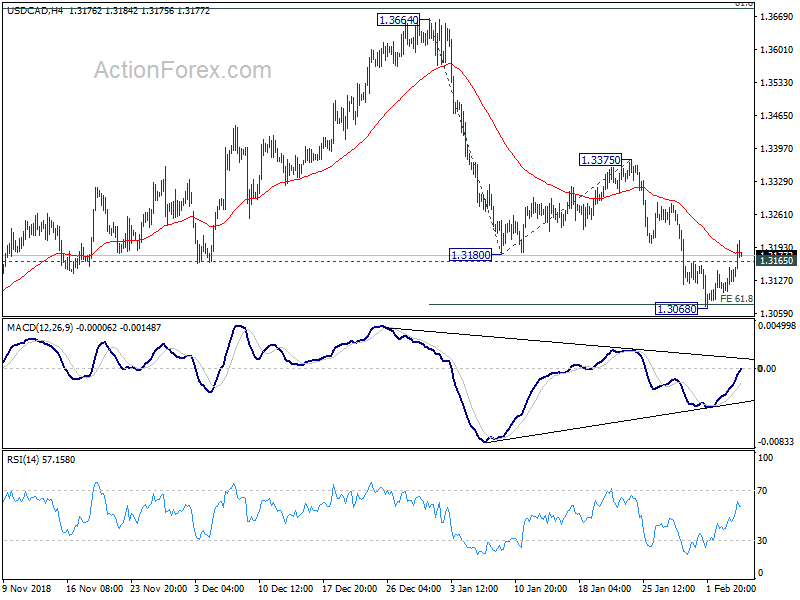
USD/CAD's rebound and break of 1.3165 minor resistance suggests short term bottoming at 1.3068, on bullish convergence condition in 4 hour MACD. Intraday bias is turned back to the upside for 1.3375 resistance first. Break should indicate completion of whole fall from 1.3664. In that case, further rise should be seen back to retest 1.3664. On the downside, in case of another fall, we'd stay cautious on bottoming as USD/CAD is close to channel support (now at 1.3061). But sustained break of the channel support will pave the way to 100% projection of 1.3664 to 1.3180 from 1.3375 at 1.2891.
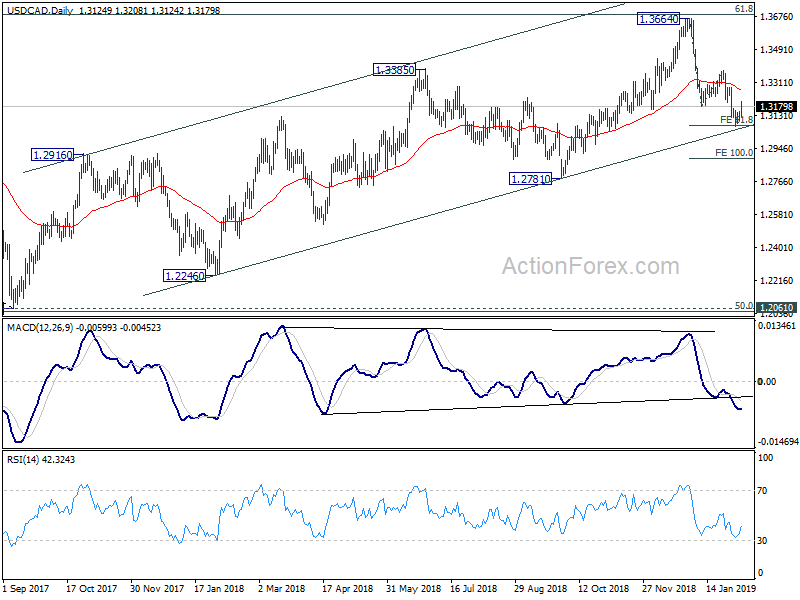
In the bigger picture, structure of the medium term rise from 1.2061 (2017 low) to 1.3664 is not clearly impulsive. Hence, we'd stay cautious on strong resistance from 61.8% retracement of 1.4689 (2016 high) to 1.2061 at 1.3685 and 1.3793 resistance to limit upside, and bring medium term topping. But in any case, medium term outlook will stay bullish as long as channel support (now at 1.3049) holds. Sustained break of 1.3793 will pave the way to retest 1.4689 (2015 high). Firm break of the channel support should confirm reversal target 1.2061 low again.
Dollar Takes a Breather, Sterling Recovers Despite Brexit Spats
Dollar is taking a breather for in early US session but remains the strongest one for the week. Positive development on trade talk with China is providing some support to the greenback, except versus Yen, which is the strongest for today. Sterling is also trying to recover after this week's selloff. There is no clear solution on Irish backstop, just spats between EU and the UK. Meanwhile, Australian Dollar remains the weakest as selloff is extending,
Technically, USD/CAD's break of 1.1365 minor resistance suggests short term bottoming at 1.3068. The outlook of EUR/USD, GBP/USD, USD/CHF, AUD/USD and USD/CAD are now aligned. That is, more upside is now in favor in Dollar in general. The only expectation is Yen. EUR/JPY and GBP/JPY are gyrating lower and focus could now be on 124.36 and 140.62 minor support levels respectively.
On the data front, US trade deficit narrowed to USD -49.3B in November, versus expectation of -54.0B. Canada building permits rose 6.0% mom in December versus expectation of -0.4% mom. Germany factory orders dropped -1.6% mom in December, versus expectation of 0.3%.
In other markets, currently, FTSE is down -0.06%, DAX is down -0.34%, CAC is down -0.10%. German 10-year yield is down -0.009 at 0.164. Earlier in Asia, Nikkei closed up 0.15% at 20875.63. Japan 10-year JGB yield is down -0.0062 at -0.015, staying negative. China, Hong Kong and Singapore were still on lunar new year holiday.
US Mnuchin putting enormous amount of effort to meet China trade talk deadline
US Treasury Secretary confirmed that he and US Trade Representative Robert Lighthizer will travel to Beijing next week for trade negotiations. Mnuchin said prior meetings with Chinese Vice Premier Liu He in Washington were "very productive".
He added that he and Lighthizer are "committed to continue these talks". And, "We're putting in an enormous amount of effort to try to hit this deadline and get a deal. So that's our objective."
Mnuchin also said "we are also very focused on free and fair trade for U.S. companies to have access there and to having a more level playing field which will bring down the trade deficit."
His comments echoed Trump's remark in the State of Union Address that the trade deal "must include real, structural change to end unfair trade practices, reduce our chronic trade deficit and protect American jobs."
EU Tusk: Won't gamble with peace and no time limit of Irish backstop
In a joint press conference with Irish Prime Minister Leo Varadkar, European Council President Donald Tusk reiterated that the EU won't re-open Brexit withdrawal agreement negotiation. Though he hoped that UK Prime Minister Theresa May would bring "realistic suggestions" to Brussels tomorrow. Tusk also emphasized that EU won't "gamble with peace" by accepting a time limit on the Irish border. He admitted that Brexit will clearly happen as there no "leadership for remain. The priority now is to avoid no-deal, and safeguard an open Irish border.
Tusk also said "I've been wondering what the special place in hell looks like for those who promoted Brexit without even a sketch of a plan on how to carry it out safely." Brexiteer Nigel Farage responded: "After Brexit we will be free of unelected, arrogant bullies like you - sounds like heaven to me."
Verhofstadt tweeted, "Today I see Taoiseach Leo Varadkar and tomorrow Prime Minister May. My message to the UK will be that it is not very responsible to try to get rid of a backstop that is meant as an ultimate safeguard to avoid a hard border and the return of violence on the Island of Ireland."
Separately, UK Trade Minister Liam Fox said a no-deal Brexit could force the government to drop all import tariffs in key sectors. The government have to consider the options to keep prices down for consumers and balance the impact on the job markets. For example, Fox said "in the agricultural sector it's very clear what the impact would be were we to move to zero tariffs."
Cabinet Office Minister David Lidington said that extending Article 50 would "simply defer the need for this house ... to face up to some difficult decisions".
Japan PM Abe and BoJ Kuroda defend monetary policy in parliament
Japan Prime Minister Shinzo Abe told the parliament today that the government accepted BoJ's explanation on failing to meet the 2% inflation target. Abe went further and hailed that "what's most important is what is happening to the economy as a result of the BOJ's target, which is that more jobs were created."
BoJ Governor Haruhiko Kuroda defended the central bank's monetary policy to the parliament. He said "expanding base money alone won't immediately have an effect on the economy". And, "with huge expansion of base money, central banks can push down real interest rates and bank lending rates, which in turn would stimulate the economy." He emphasized "this is what happened in the past six years."
RBA Lowe: Evenly balanced chance of hike or cut in next move
Australian Dollar drops sharply after RBA Governor Philip Lowe dropped the rhetoric that the next move in interest rate is more likely a hike than a cut. Instead, he said the probabilities of hike and cut are now more "evenly balanced". That is, rate cut is now back on the table.
Lowe delivered a speech "The Year Ahead" to the National Press Club of Australia today. Lowe maintained the view that " tighter labour market and reduced spare capacity will see underlying inflation rise further towards the midpoint of the target range." And given that, RBA "maintained a steady setting of monetary policy" yesterday.
However, he also noted given the uncertainties "it is possible that the economy is softer than we expect, and that income and consumption growth disappoint." In particular, "in the event of a sustained increased in the unemployment rate and a lack of further progress towards the inflation objective, lower interest rates might be appropriate at some point.
Thus, on the scenarios of next-move-is-up and next-move-is-down, "the probabilities appear to be more evenly balanced." Though Lowe also maintained that RBA "does not see a strong case for a near-term change in the cash rate".
USD/CAD Mid-Day Outlook
Daily Pivots: (S1) 1.3101; (P) 1.3127; (R1) 1.3153; More...
USD/CAD's rebound and break of 1.3165 minor resistance suggests short term bottoming at 1.3068, on bullish convergence condition in 4 hour MACD. Intraday bias is turned back to the upside for 1.3375 resistance first. Break should indicate completion of whole fall from 1.3664. In that case, further rise should be seen back to retest 1.3664. On the downside, in case of another fall, we'd stay cautious on bottoming as USD/CAD is close to channel support (now at 1.3061). But sustained break of the channel support will pave the way to 100% projection of 1.3664 to 1.3180 from 1.3375 at 1.2891.
In the bigger picture, structure of the medium term rise from 1.2061 (2017 low) to 1.3664 is not clearly impulsive. Hence, we'd stay cautious on strong resistance from 61.8% retracement of 1.4689 (2016 high) to 1.2061 at 1.3685 and 1.3793 resistance to limit upside, and bring medium term topping. But in any case, medium term outlook will stay bullish as long as channel support (now at 1.3049) holds. Sustained break of 1.3793 will pave the way to retest 1.4689 (2015 high). Firm break of the channel support should confirm reversal target 1.2061 low again.
Economic Indicators Update
| GMT | Ccy | Events | Actual | Forecast | Previous | Revised |
|---|---|---|---|---|---|---|
| 07:00 | EUR | German Factory Orders M/M Dec | -1.60% | 0.30% | -1.00% | -0.20% |
| 13:30 | CAD | Building Permits M/M Dec | 6.00% | -0.40% | 2.60% | 2.10% |
| 13:30 | USD | Trade Balance (USD) Nov | -49.3B | -54.0B | -55.5B | |
| 15:00 | CAD | Ivey PMI Jan | 60.2 | 59.7 | ||
| 15:30 | USD | Crude Oil Inventories | 1.3M | 0.9M |
US Mnuchin putting enormous amount of effort to meet China trade talk deadline
US Treasury Secretary confirmed that he and US Trade Representative Robert Lighthizer will travel to Beijing next week for trade negotiations. Mnuchin said prior meetings with Chinese Vice Premier Liu He in Washington were "very productive".
He added that he and Lighthizer are "committed to continue these talks". And, "We're putting in an enormous amount of effort to try to hit this deadline and get a deal. So that's our objective."
Mnuchin also said "we are also very focused on free and fair trade for U.S. companies to have access there and to having a more level playing field which will bring down the trade deficit."
His comments echoed Trump's remark in the State of Union Address that the trade deal "must include real, structural change to end unfair trade practices, reduce our chronic trade deficit and protect American jobs."
Canadian Dollar Lower, Investors Braced for Weak Canadian Data
USD/CAD continues to move higher this week, and has posted considerable gains on Wednesday. Currently, the pair is trading at 1.3180, up 0.41% on the day. On the release front, Canada releases data for the first time this week. Building Permits is expected to slip 0.9%, while Ivey PMI is projected to slow to 56.4 points. With no major events out of the U.S., the markets will be focusing on Federal Reserve Chair Powell, who will speak at an event in Washington. On Thursday, the key event is U.S. unemployment claims.
The markets didn’t show much reaction to President Trump’s State of the Union address on Tuesday. The speech was almost cancelled to the recent government shutdown, and the President spoke of the possibility of another shutdown if his demands for funding for a border wall were not met. Trump spoke of the U.S-China trade war, reiterating that the U.S. would demand “real structural change” from China before a trade deal could be reached. American policymakers have long demanded that China desist from intellectual theft against U.S. companies, and with China experiencing a slowdown, the Chinese may have to make concessions or face further tariffs in March.
With the Canadian economy showing signs of a slowdown, the mood of consumers remains fragile. Low oil prices and a weaker global economy have lowered demand for Canadian exports and weighed on inflation and wage levels. Consumer confidence is a strong barometer of the economy’s health, and if weaker consumer sentiment translates into decreased consumer spending, the economy could falter and drag down the Canadian dollar. Meanwhile, the Bank of Canada appears to have taken page out of the Federal Reserve’s playbook, and is expected to ease monetary policy this year after aggressively raising rates in 2018.
Are Equity Bulls Running Out of Ammunition?
It is shaping up to be a dull day for financial markets with equities across the world struggling for direction due to a lack of fresh catalysts.
Stocks in Asia witnessed another muted session today as many markets in the region remain closed for the Lunar New Year holiday. In Europe, shares got out of the wrong side of the bed thanks to weak earnings from French banking group BNP Paribas and disappointing data from Germany. While Wall Street has the potential to extend gains this afternoon on strong corporate earnings and cautious optimism over US-China trade talks, the medium- to longer-term outlook for equity markets tilts to the downside. Concerns over slowing global growth remains a dominant theme while the unpredictable nature of trade negotiations has certainly left investors on edge. With other geopolitical risks such as Brexit, China’s slowdown, Eurozone growth concerns and political turbulence in Washington seen stimulating risk aversion, the ingredients are in place for a stock market sell-off.
Investors who were expecting fireworks and action from US President Donald Trump’s State of the Union address were left empty handed after nothing new was brought to the table. While Trump discussed trade relations with China, border security and the budget, this was of no real interest to markets and such was reflected in the muted reaction. With Trump failing to provide fresh insight into the progress over US-China trade talks and the March deadline looming, sensitivity to trade developments is poised to heighten moving forward.
Brexit uncertainty and growing pessimism over Theresa May’s ability to secure further concessions from the EU continues to weigh on the Pound. With the European Union already stating that the Withdrawal Agreement is “not open for re-negotiations” it will be interesting to see what the prime minister achieves from her trip to Brussels. While negativity over Brexit is likely to continue punishing the Pound in the short term, the currency could receive a boost if expectations mount over the government delaying Brexit by extending Article 50. Although the Bank of England policy meeting is on Thursday, we expect the Pound to offer a muted reaction to this risk event as Brexit continues to overshadow economic fundamentals.
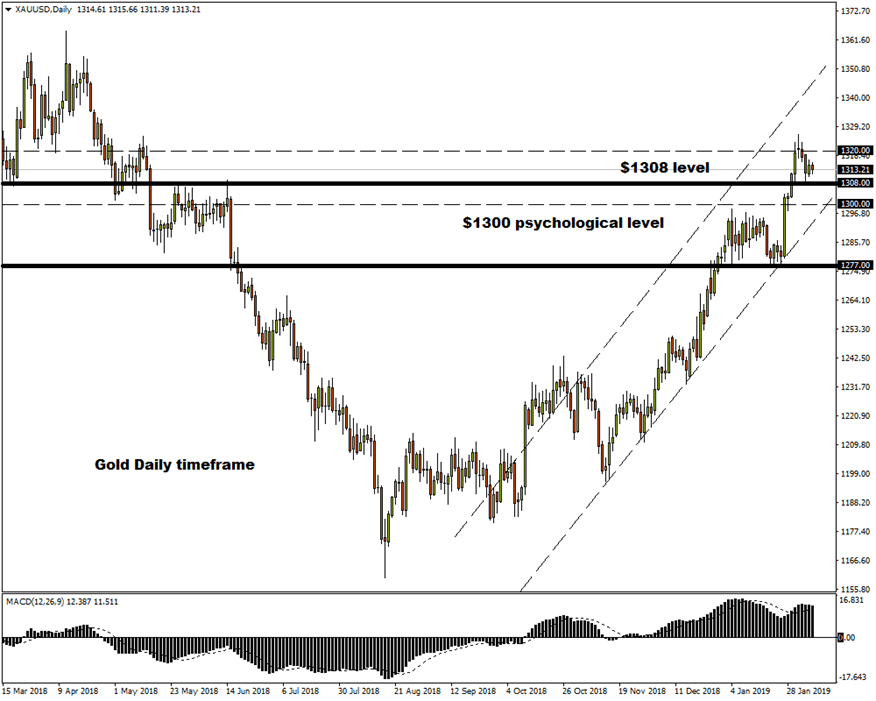
In the commodity markets, Gold is trading lower today thanks to an appreciating Dollar. While the precious metal is seen extending losses in the near term, bulls still remain in control in the medium to longer term. For as long as global growth fears weigh on market sentiment and expectations mount over the Fed taking a break on rate hikes this year, Gold will continue shining. Focusing on the technical picture, the precious metal has the potential to rebound towards $1,320 if $1,308 proves to be reliable support. A breakdown below $1,308 is likely to invite a decline back towards the psychological $1,300 level.
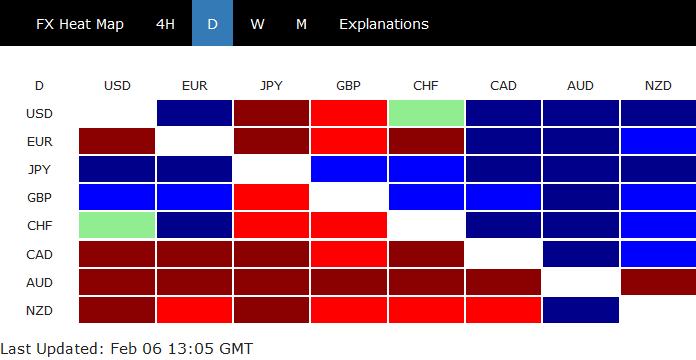
Into US session: AUD weakest, GBP recovers despite Brexit deadlock
Entering into US session, Australian Dollar remains overwhelmingly the weakest one today, followed by New Zealand and then Canadian Dollar. The Aussie was sold off after RBA Governor Philip Lowe put a rate cut back onto the table.
Yen is the strongest one on mild risk aversion, as also helped by selloff in AUD/JPY. Sterling is the second strongest but it's just in corrective recovery. The Pound is overall weak on Brexit uncertainty. UK Prime Minister Theresa is visiting Brussels tomorrow. So far, EU officials sound very firm that they won't back down on Irish backstop.
In European markets, currently:
- FTSE is down -0.02%.
- DAX is down -0.48%.
- CAC is down -0.23%.
- German 10-year yield is flat at 0.173.
Earlier in Asia:
- Nikkei closed up 0.15% at 20875.63. 3
- Japan 10-year JGB yield is down -0.0062 at -0.015, staying negative.
- China, Hong Kong and Singapore are still on lunar new year holiday.
EU Tusk: Won’t gamble with peace and no time limit of Irish backstop
In a joint press conference with Irish Prime Minister Leo Varadkar, European Council President Donald Tusk reiterated that the EU won't re-open Brexit withdrawal agreement negotiation. Though he hoped that UK Prime Minister Theresa May would bring "realistic suggestions" to Brussels tomorrow. Tusk also emphasized that EU won't "gamble with peace" by accepting a time limit on the Irish border. He admitted that Brexit will clearly happen as there no "leadership for remain. The priority now is to avoid no-deal, and safeguard an open Irish border.
Tusk also said "I've been wondering what the special place in hell looks like for those who promoted Brexit without even a sketch of a plan on how to carry it out safely." Brexiteer Nigel Farage responded: "After Brexit we will be free of unelected, arrogant bullies like you - sounds like heaven to me."
Separately, UK Trade Minister Liam Fox said a no-deal Brexit could force the government to drop all import tariffs in key sectors. The government have to consider the options to keep prices down for consumers and balance the impact on the job markets. For example, Fox said "in the agricultural sector it's very clear what the impact would be were we to move to zero tariffs."
Cabinet Office Minister David Lidington said that extending Article 50 would " simply defer the need for this house ... to face up to some difficult decisions".
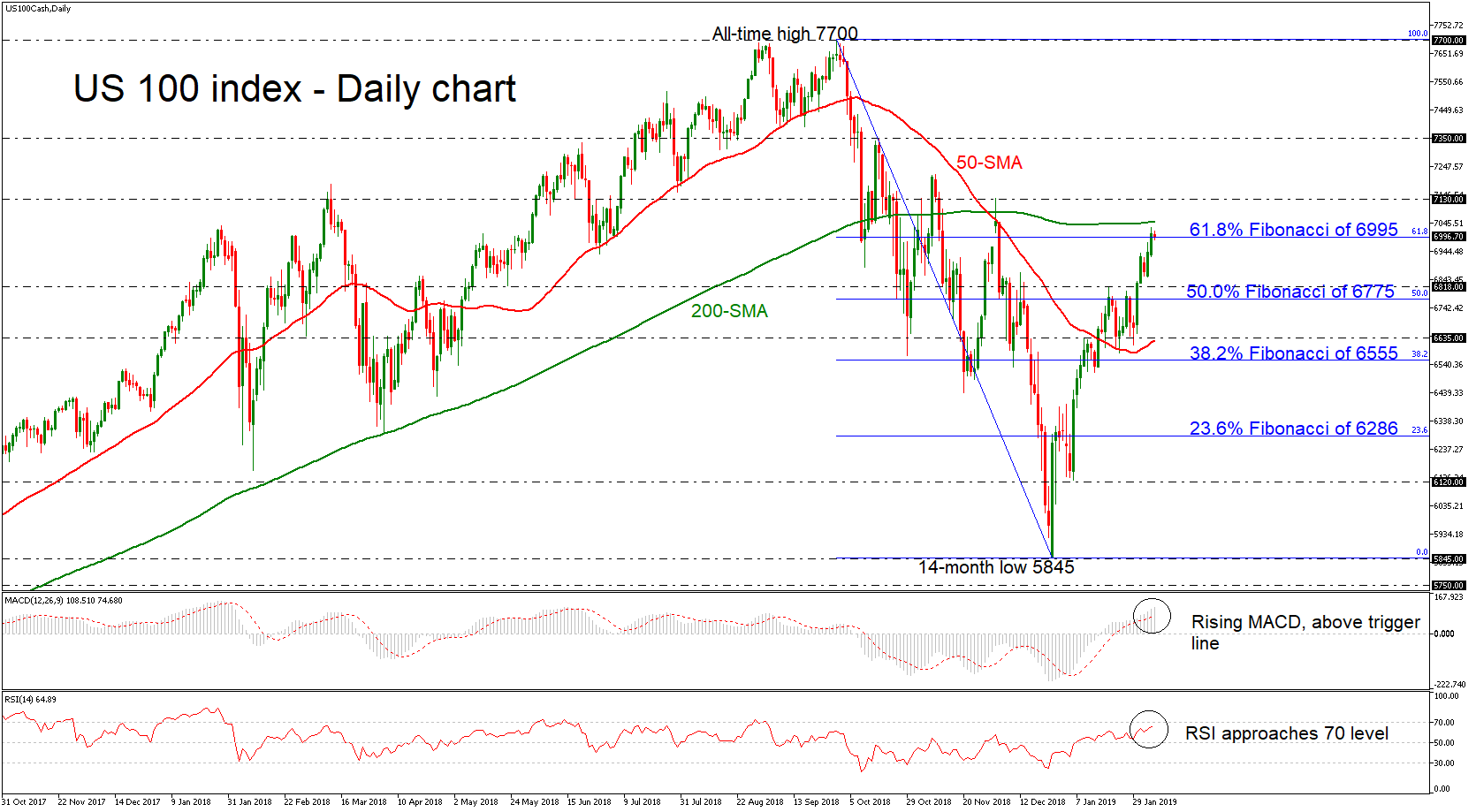
US 100 Index May Challenge 200-SMA Roof; Bullish in Near Term
The US 100 index (NASDAQ 100) has been in a positive tendency after the jump above the 61.8% Fibonacci retracement level of the downleg from the all-time high of 7700 to the 14-month low of 5845, around 6995. Currently, the price remains below the 200-day simple moving average (SMA), which is acting as a strong resistance level for the bulls.
Momentum indicators in the daily chart, though, are currently supporting that positive momentum is likely to strengthen in the short-term. Specifically, the RSI is holding above 50 and the MACD continues to distance itself above its red signal line.
Should the price decisively close above the roof of 200-SMA, traders could extend the bullish movement towards the 7130 resistance barrier. Further advances above this level, could then target the area around the 7350 hurdle.
On the other side, a decline could meet the 6818 – 6775 support area, near the 50.0% Fibonacci region, before moving even lower towards the next significant obstacle of 6635, which stands around the 50-day SMA.
The recent bullish action turned the very short-term picture more positive, however, in the bigger view the index entered neutral mode.
DAX Loses Ground On Soft German Manufacturing Report
The DAX index has retracted in the Wednesday session, after sharp gains on Tuesday. The DAX is currently trading at 11,309, down 0.50%. On the release front, German Factory Orders declined 1.6%, compared to an estimate of a 0.3% gain. On Thursday, Germany releases industrial production and the EU publishes its economic forecasts.
Investors remain concerned about the strength of the eurozone economy, as the locomotive of the eurozone has been struggling. Retail sales ended the year on a low, as the December score plummeted 4.3% last week, its sharpest decline in more than 12 years. On the manufacturing front, German manufacturing PMI for January dipped to 49.7, below the 50-point level which separates contraction and expansion. This was the weakest score since October 2014. The dismal news continued on Wednesday, as factory orders fell 1.6%, after a decline of 1.0% in the previous release. Global trade tensions and weakness in the German auto sector continue to weigh on the manufacturing sector. Weakness in manufacturing can be seen across the eurozone, as France and Italy both posted manufacturing PMIs in contraction territory in January.
The eurozone may be experiencing a slowdown, but that hasn’t changed the ECB’s guidance on interest rates. The bank continues to forecast a rate hike in December, but this stance has become increasingly out of sync with market sentiment, which has ruled out a rate hike before mid-2020. With ECB President Mario Draghi due to leave the job in October, policymakers are reluctant to alter current guidance and ‘tie the hands’ of Draghi’s successor. This means that the ECB will cling to its guidance unless economic conditions significantly deteriorate.