Sample Category Title
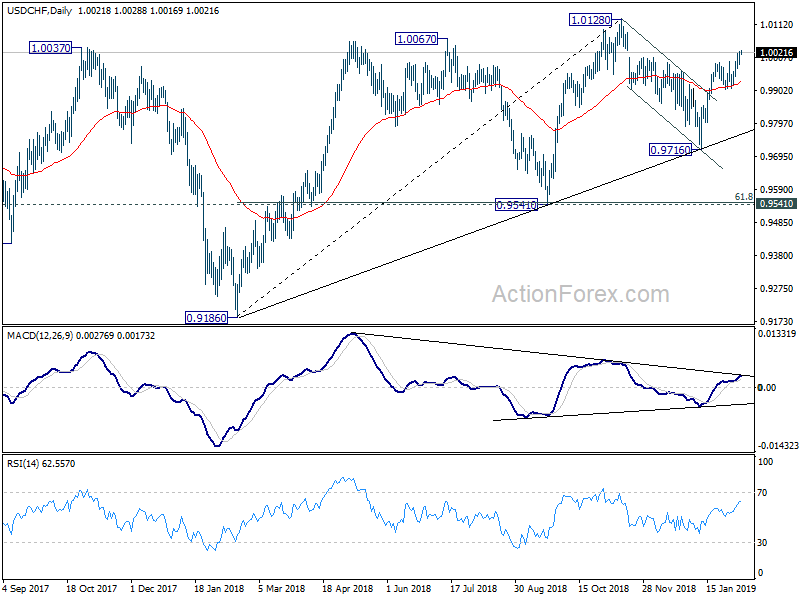
USD/JPY Aim @ 110.35
Pivot (invalidation): 109.70
Our preference Long positions above 109.70 with targets at 110.05 & 110.35 in extension.
Alternative scenario Below 109.70 look for further downside with 109.55 & 109.40 as targets.
Comment The RSI is bullish and calls for further upside.
GBP/USD Under Pressure
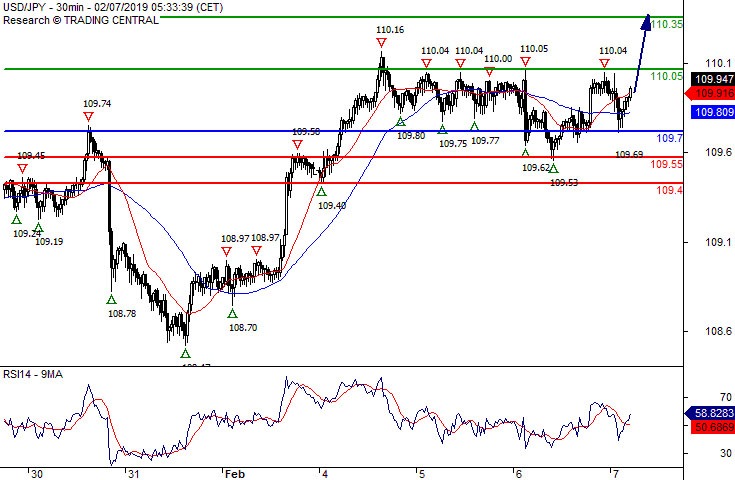
Pivot (invalidation): 1.2960
Our preference Short positions below 1.2960 with targets at 1.2890 & 1.2855 in extension.
Alternative scenario Above 1.2960 look for further upside with 1.2980 & 1.3000 as targets.
Comment Technically the RSI is below its neutrality area at 50.
EUR/USD 1.1315 Expected
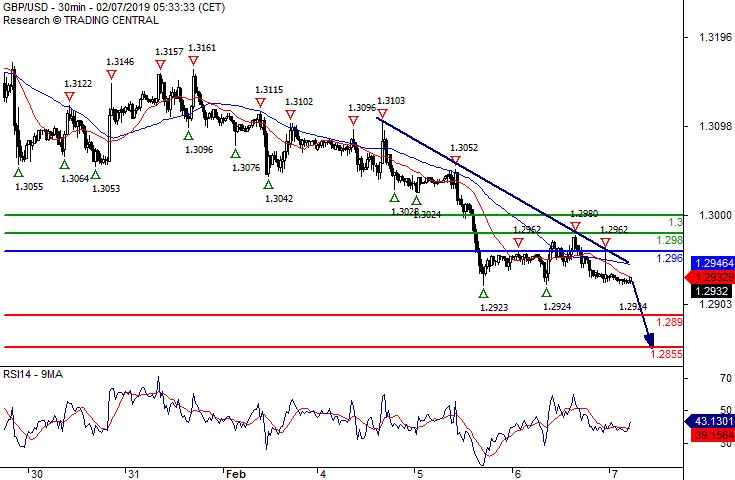
Pivot (invalidation): 1.1380
Our preference Short positions below 1.1380 with targets at 1.1340 & 1.1315 in extension.
Alternative scenario Above 1.1380 look for further upside with 1.1400 & 1.1420 as targets.
Comment The RSI is bearish and calls for further decline.
USDJPY Finds Wall Near 110.00, 40-SMA Seems To Be Strong Obstacle
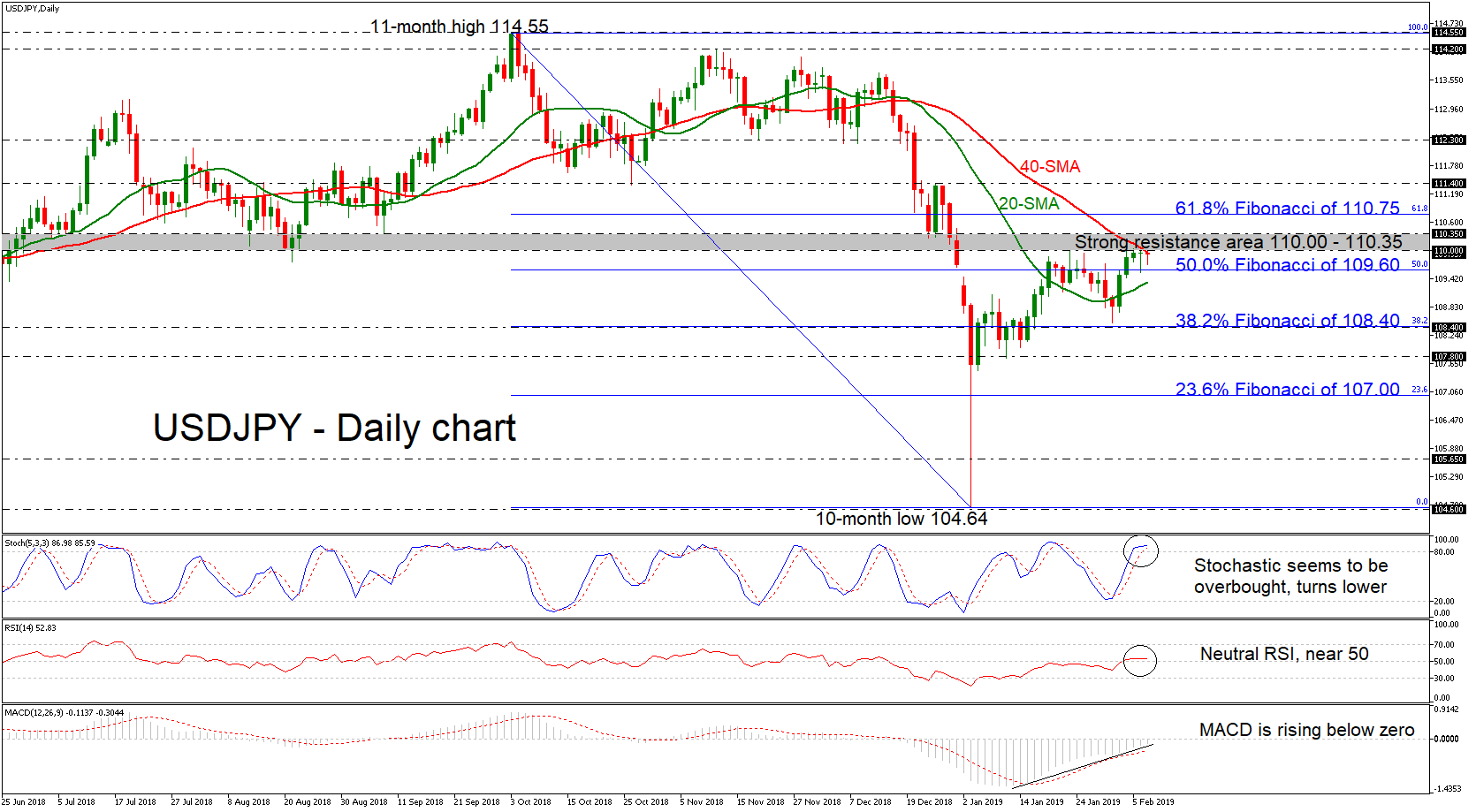
USDJPY has found a strong resistance obstacle around the 40-day simple moving average (SMA) over the last couple of days after the jump above the 50.0% Fibonacci retracement level of the downleg from the 11-month high of 114.55 and the 10-month low of 104.64, around 109.60. Currently, the pair is in a bullish correction mode following the rebound on the 104.64 support level on January 3, but the technical indicators seem to be in confusion.
Looking at the momentum indicators, the stochastic oscillator is turning lower and is in progress to post a bearish crossover within the %K and %D lines, while the RSI indicator is flattening near the neutral threshold of 50. However, the MACD oscillator is rising in the negative territory around the zero line. According to the SMAs, the 20-SMA is moving higher, approaching the 40-SMA for a bullish crossover in the near term.
The price is currently knocking on the door for the 110.00 handle and if there is a successful attempt above this barrier it would open the door for the 110.35 resistance level. More advances could turn the focus on the 61.8% Fibonacci mark of 110.75, before extending bullish pressures until the next resistance of 111.40.
A reversal to the downside below the 50.0% Fibonacci and the 20-day SMA could find support at the 38.2% Fibonacci region, which overlaps with the 108.40 hurdle. If the latter fails to halt bearish movements, the next target could be at the 107.80 low, identified by the bottom on January 10.
Turning to the long-term picture, the outlook is neutral over the past year and only a decisive close above 114.55 could resume the bullish picture. On the other hand, a significant decline below January’s trough of 108.10 could shift the outlook to bearish.
U.S. Dollar On Six-Day Rally Streak
After a robust performance in 2018, the Dollar's rally was expected to come under significant pressure going into 2019. Well, that may not be so true.
Factors that supported the U.S. currency last year were numerous, including robust economic expansion, fiscal stimulus which boosted yields in treasury markets, a hawkish Federal Reserve and fund repatriation by U.S. firms. None of these factors remain in play, and the Fed's U-turn last week almost confirmed that monetary policy would no longer contribute to the Dollar's strength.
The belief that global monetary policy wouldbegin to converge with that of the U.S. was a key ingredient to the Dollar's expected weakness. Surprisingly though, the U.S. Dollar has risen 0.70% against its major peers since the Fed turned extremely dovish on the 30th of January.
The Dollar's strength over the past couple of days may not be justified by the Fed's actions. However, when analyzing a currency's exchange rate, it should be relative to a peer. So far it seems none of these peers have a competitive advantage, making the Dollar the less unloved currency.
Almost all central banks are admitting difficult times lie ahead. The latest was the Reserve Bank of Australia which surprised the markets yesterday when its Governor Philip Lowe opened the door for a rate cut. His comments crushed the Australian Dollar, sending it 1.8% lower against the USD, in its worst performance day since June 2016. Global risks were amongthe major factors that led to the shift in policy guidance.
Europe isn't in a better place. Italy has already fallen into a technical recession. Germany may follow suit with its suffering auto industry, and France's Yellow Vest demonstrations have dealt a significant blow to the country's economy which hadalready been slowing. Thus, it shouldn't be surprising to see investor sentiment in the Eurozone falling to itslowest level in more than four years.
The focus today will shift to the Bank of England meeting and the UK Quarterly Inflation report. With 50 days remaining until the UK is due to leave EU, and President of the European Council Donald Tusk saying that Brexiters deserve “a special place in hell”, it doesn't seem there're signs the European Union is willing to compromise on a deal. This is probably the most challenging time for Bank of England Governor Mark Carney who is faced witha slowing economy, and risk of a disorderly Brexit. Given that policy won't be expected to change anytime soon, it's Carney's tone and the outcome of UK Prime Minister May's visit to Brussels today that will determine Sterling's next move. At this stage, it seems the risks remain to the downside.
Nikkei Declines As Toyota And Fast Retailing Drop, Gains In Softbank Limit Downside
General Trend:
- Softbank rises over 16% after recent buyback announcement
- Gains in resources, energy and financial shares support Australian equities
- South Korea Kospi rises upon return from holiday break
- Kiwi (NZD) declines as unemployment rose more than expected, next week’s RBNZ meeting (Feb 13th) in focus after recent RBA guidance shift
- Japan sells 30-yr JGBs at highest bid to cover since July 2018
- RBA due to release quarterly statement on monetary policy on Friday
- Reserve Bank of India (RBI) decision expected later today, no changes expected (focus expected to be on comments)
- Bank of England (BOE) expected to leave policy unchanged at upcoming meeting
- Hong Kong markets due to resume trading on Friday, after Lunar New Year break
- US companies expected to report earnings on Thursday include Expedia, Grubhub, Kellogg, Mattel, Philip Morris, S&P Global, T-Mobile, Tapestry, Twitter, Tyson Foods, Verisign, Virtu Financial, WWE, Western Union and Yum Brands (includes afterhours)
Headlines/Economic Data
Japan
- Nikkei 225 opened -0.3%
- (JP) Japan Jan Official Reserve Assets: $1.28T v $1.26T prior
- 9984.JP Reports 9M Net ¥1.54T v ¥1.0T y/y, Op ¥1.86T v ¥1.15T y/y, Rev ¥7.17T v ¥6.81T y/y; to buyback 10.3% of shares for ¥600B [+17% in the session]
- (JP) Japan MoF sells ¥700B v ¥700B indicated in 0.70% (prior 0.70%) 30-yr JGBs, avg yield: 0.587% v 0.715% prior, bid to cover 4.72x v 4.03x prior
- (JP) Japan Dec Preliminary Leading Index: 97.9 v 97.9e (lowest since 2016); Coincident Index:102.3 v 102.2e
Korea
- Kospi opens +0.3%
- (KR) US Sec State Pompeo: See every opportunity for North Korea to de-nuclearize – Yonhap
- 030200.KR Will expand overseas network to handle Netflix traffic, no specifics provided
- (KR) some speculation that the Kaesong Industrial Zone will re-open ahead of next US/North Korea summit – Yonhap
- (KR) South Korea Lawmaker: Have agreed to a ~8% increase in defense cost sharing with US, Korea contribution ~KRW1.0T (~$890M) - Korean Press
- (KR) According to Bank of Korea (BOK) report Digital currency authorized by the central bank may have a negative impact on the South Korean financial system, causing a liquidity shortage and pushing up interest rates
China/Hong Kong
- Hang Seng and Shanghai Composite closed all week
- (CN) China Jan wholesale pork prices -15.3% y/y due to Swine flu - Chinese press
- (CN) China MOFCOM: we have made trade policies more transparent; US trade report does not match facts
- (CN) China railway trips +8.6% y/y in the first 15 days of Lunar New Year travel rush - Chinese press
Australia/New Zealand
- ASX 200 opened flat
- (AU) Australia Q4 NAB Business Confidence: 1 v 3 prior (lowest since 2015); Conditions: 8 v 13 prior
- (NZ) NEW ZEALAND Q4 UNEMPLOYMENT RATE: 4.3% V 4.1%E
- RIO Moodys raises rating one notch to A2 from A3; outlook stable
- AGL.AU Reports H1 underlying (A$) Net 537M v 487M y/y; EBIT 862M v 814M y/y; Rev 6.3B v 6.5B y/y; affirms FY19
- SPO.AU Reports H1 (A$) Net 39.0M v -39.6M y/y; EBITDA 121.6M v 13.7M y/y; Rev 1.46B v 1.50B y/y, issues positive outlook
- DOW.AU Reports H1 (A$) Net 163.4M v 5.7M y/y; EBIT 236.6M v 52.3M y/y; Rev 6.30B v 5.80B y/y; raises FY19 guidance
- (NZ) New Zealand sells NZ$100M v NZ$100M indicated in 2.50% inflation indexed Sept 2040 bonds, avg yield 1.4902% v 1.7244% prior, bid to cover 2.17x v 2.90x prior
- (AU) UBS expects the Reserve Bank of Australia (RBA) to cut rates in Nov 2019 and H1 of 2020 - US financial press
North America
- (US) Fed's Quarles (hawk, voter): 2019 is an interim year as Fed moves to longer stress testing cycles; we have better tools than monetary policy to address financial stability concerns
- (US) Democrats in the Senate are seeking an FCC probe related to net neutrality violations, companies mentioned included AT&T, T-Mobile, Sprint and Verizon - US financial press
- (US) Fed Chair Powell: Does not comment on monetary policy or economy
Europe
- (UK) Reportedly PM May now planning the second Brexit vote for the week of Feb 25th; ministers believe this means extending Article 50 is now inevitable - Telegraph
Levels as of 12:50ET
- Hang Seng closed; Shanghai Composite closed; Kospi +0.1%; Nikkei225 -0.8%; ASX 200 +1.1%
- Equity Futures: S&P500 -0.2%; Nasdaq100 -0.3%, Dax -0.2%; FTSE100 +0.0%
- EUR 1.1354-1.1376; JPY 109.72-110.03; AUD 0.7095-0.7114; NZD 0.6744-0.6778
- Commodity Futures: Gold -0.5% at $1,307/oz; Crude Oil -0.3% at $53.86/brl; Copper +0.1% at $2.83/lb
USD/CAD Daily Outlook
Daily Pivots: (S1) 1.3152; (P) 1.3184; (R1) 1.3246; More...
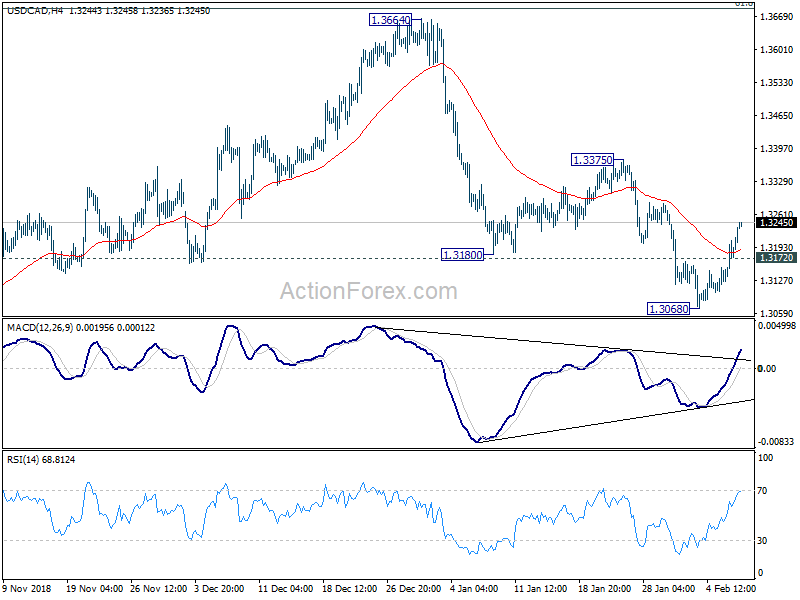
Intraday bias in USD/CAD remains on the upside at this point. Rebound from 1.3068 short term bottom is in progress for 1.3375 resistance. Decisive break there will indicate completion of whole fall from 1.3664. In that case, further rise should be seen back to retest 1.3664. On the downside, below 1.3172 minor support will turn bias back to the downside for 1.3068. But we'd stay cautious on bottoming near to channel support (now at 1.3061).
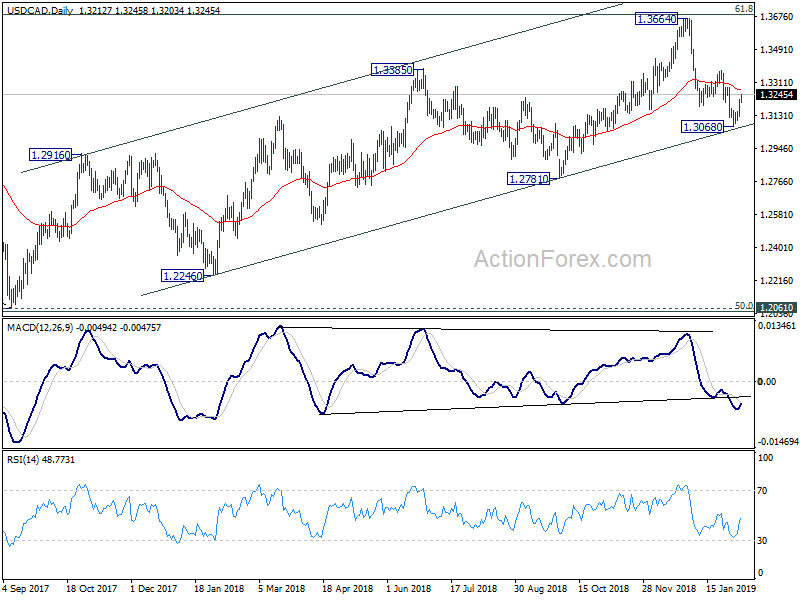
In the bigger picture, structure of the medium term rise from 1.2061 (2017 low) to 1.3664 is not clearly impulsive. Hence, we'd stay cautious on strong resistance from 61.8% retracement of 1.4689 (2016 high) to 1.2061 at 1.3685 and 1.3793 resistance to limit upside, and bring medium term topping. But in any case, medium term outlook will stay bullish as long as channel support (now at 1.3049) holds. Sustained break of 1.3793 will pave the way to retest 1.4689 (2015 high). Firm break of the channel support should confirm reversal target 1.2061 low again.
AUD/USD Daily Outlook
Daily Pivots: (S1) 0.7059; (P) 0.7152; (R1) 0.7201; More...
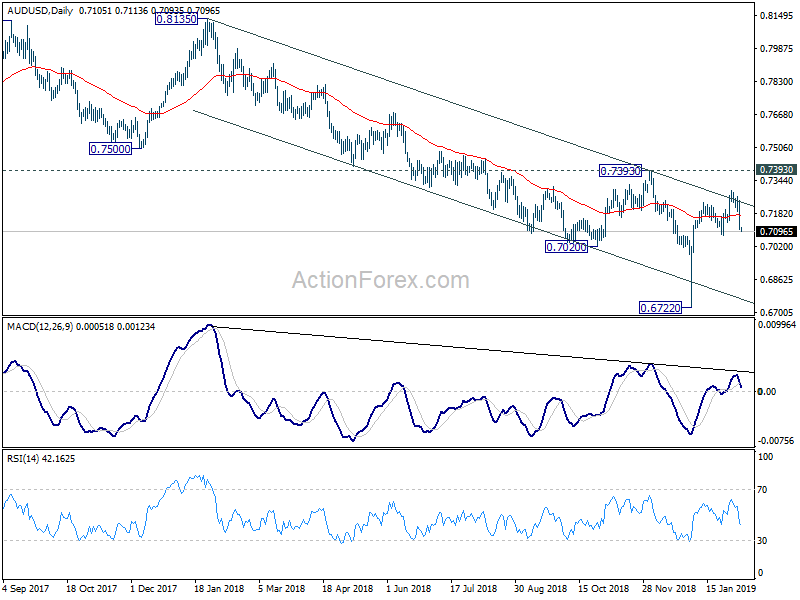
Intraday bias in AUD/USD remains on the downside for 0.7076 cluster support (38.2% retracement of 0.6722 to 0.7295 at 0.7076). Decisive break there will confirm completion of rebound from 0.6722 at 0.7295. In that case, further decline would be seen to 61.8% retracement at 0.6941 next. On the upside, above 0.7139 minor resistance will turn intraday bias neutral first. But risk will remain on the downside as long as 0.7295 resistance holds.
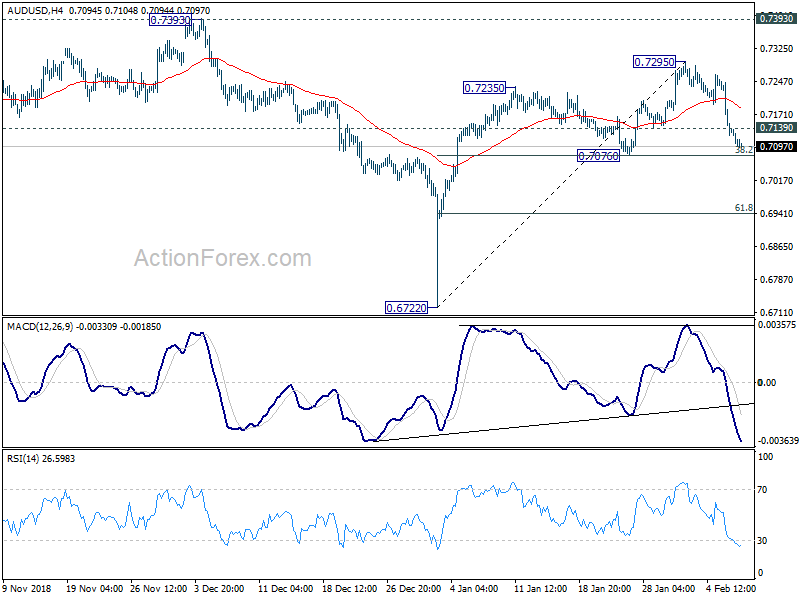
In the bigger picture, as long as 0.7393 resistance holds, we'd treat fall from 0.8135 as resuming long term down trend from 1.1079 (2011 high). Decisive break of 0.6826 (2016 low) will confirm this bearish view and resume the down trend to 0.6008 (2008 low). However, firm break of 0.7393 will argue that fall from 0.8135 has completed. And corrective pattern from 0.6826 has started the third leg, targeting 0.8135 again.
USD/JPY Daily Outlook
Daily Pivots: (S1) 109.68; (P) 109.86; (R1) 110.17; More...
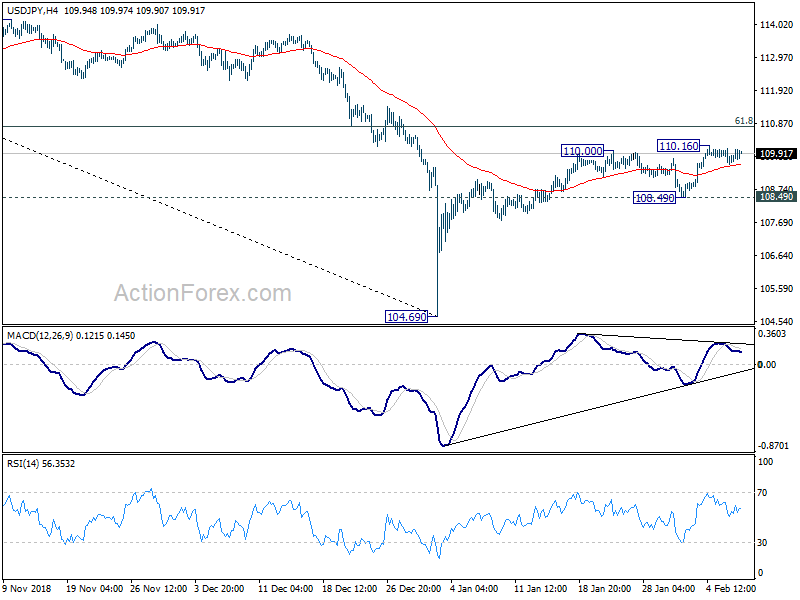
No change in USD/JPY's outlook and intraday bias remains neutral for the moment. In case of another rise, we'd expect strong resistance from 61.8% retracement of 114.54 to 104.69 at 110.77 to limit upside to bring reversal. On the downside, break of 108.49 support will now confirm completion of the rebound and bring retest of 104.69 low. However, sustained trading above 110.77 will dampen our bearish view and target a test on 114.54 resistance instead.
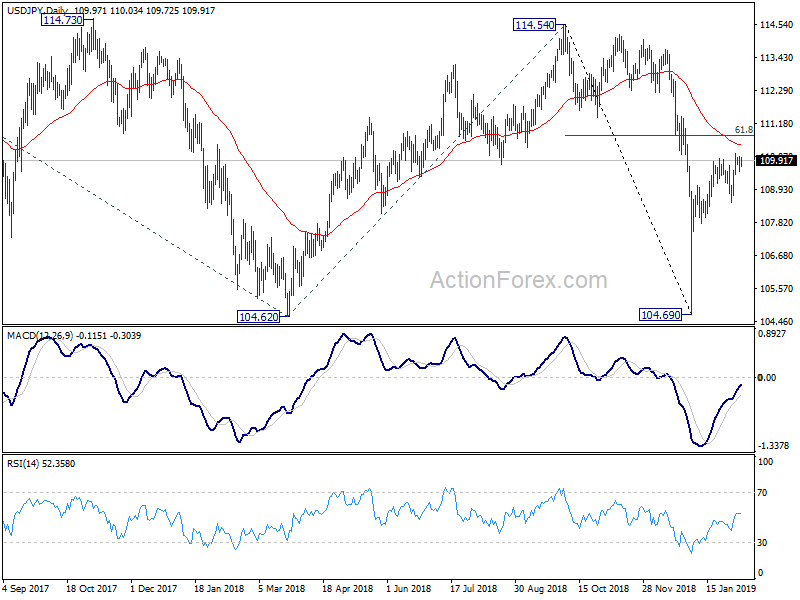
In the bigger picture, while the rebound from 104.69 is strong, there is no change in the view that it's a corrective move. That is, fall from 114.54, as part of the decline from 118.65 (2016 high), is not completed yet. Break of 104.62 will target 100% projection of 118.65 to 104.62 from 114.54 at 100.51, which is close to 100 psychological level. Nevertheless, sustained trading above 55 day EMA (now at 110.55) will dampen this bearish view and turn focus back to 114.54 resistance instead.
USD/CHF Daily Outlook
Daily Pivots: (S1) 0.9999; (P) 1.0013; (R1) 1.0040; More....
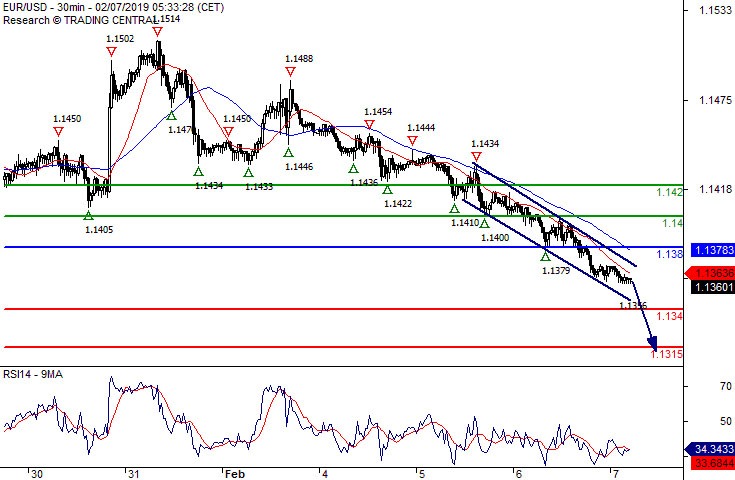
Intraday bias in USD/CHF remains on the upside for the moment. Rise from 0.9716 is in progress for retesting 1.0128 high. As noted before, corrective decline from 1.0128 should have completed at 0.9716 already, after hitting trend line support. Break of 1.0128 will resume larger up trend from 0.9186. On the downside, break of 0.9908 is needed to indicate completion of the rebound. Otherwise, outlook will stay cautiously bullish in case of retreat.
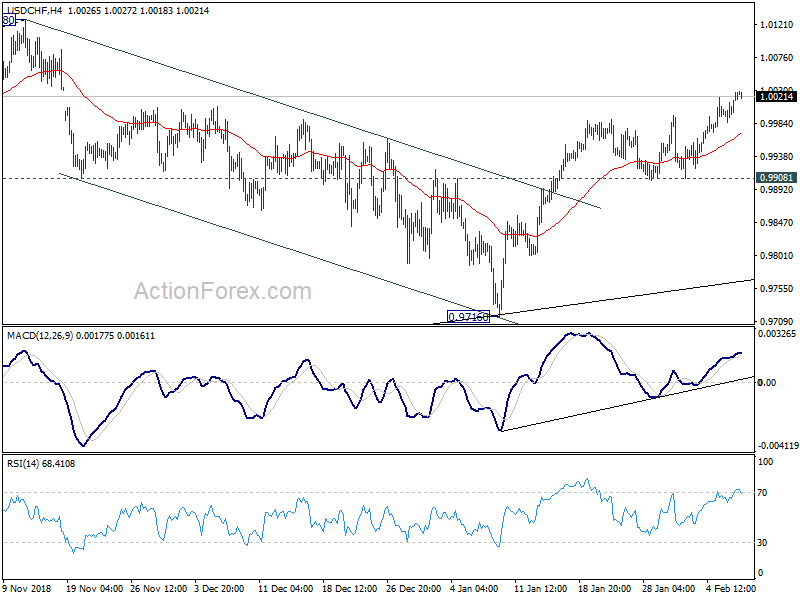
In the bigger picture, USD/CHF drew strong support from medium term trend line and rebounded. That suggests rise from 0.9186 is still in progress. Further break of 1.0128 will confirm up trend resumption and target 1.0342 key resistance. Nevertheless, break of 0.9716 will dampen this bullish view and at least bring deeper fall to 0.9541 key support.