Sample Category Title
AUD/USD Outlook: Aussie Advances On Less Dovish Than Expected RBA, But The Downside Remains Vulnerable
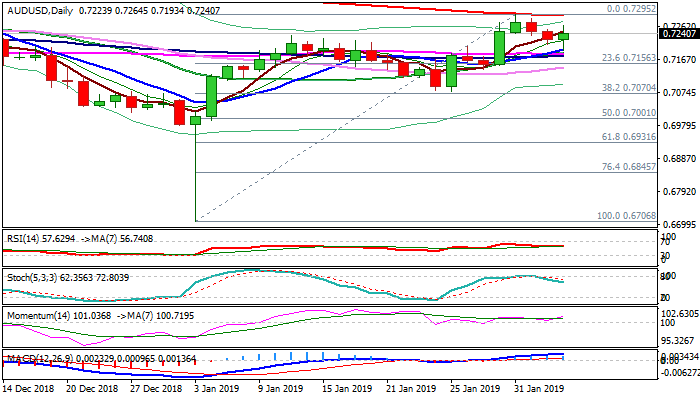
The Aussie dollar bounced after brief test of strong support provided by daily cloud top (0.7205) boosted by less dovish than expected RBA.
The central bank left interest rates unchanged as expected in the first meeting 2019, but sounded optimistic despite strong signals of global growth slowdown, decline in house prices in the biggest Australian cities and lower Q3 GDP that made a number of traders expecting a rate cut this year.
Immediate downside risk is sidelined for now, as fresh recovery is boosted by rising bullish momentum and improved post-RBA sentiment, however, a lot of work is required at the upside to neutralize bearish threats and attack again key 200SMA barrier (0.7291).
South-heading stochastic conflicts bullishly aligned momentum and daily MA’s, keeping the downside vulnerable.
The pair would look for firmer direction signal on break of either side, with plethora of supports between 0.7205 and 0.7175 (cloud top / 100/55/20/10SMA’s) marking the lower pivot and 200SMA acting as upper trigger.
Weak fundamentals could keep the Aussie under pressure and unable to clear important 0.7300 resistance zone and increase risk of eventual break below 0.7205/0.7175 pivots that would spark stronger bearish acceleration and expose next pivotal supports at 0.7070/00 (Fibo 38.2% of 0.6706/0.7295 / psychological support / Fibo 50%).
Res: 0.7264, 0.7291, 0.7355, 0.7393
Sup: 0.7205, 0.7195, 0.7175, 0.7144
Dollar Steady…But For How Long?
The US Dollar held steady near a one-week high against a basket of major currencies this morning as bulls remained inspired by last Friday’s strong U.S. payroll figures.
While the Greenback is seen extending gains in the near term as renewed trade optimism supports risk sentiment and elevates U.S. Treasury yields, the medium- to longer-term outlook still remains in favour of bears. It is worth noting that expectations remain elevated over the Federal Reserve taking a pause on rate hikes this year while the final effects of the 35-day government shutdown remain unknown. With the United States tackling headwinds in the form of trade tensions, global growth fears, fading fiscal stimulus at home and political uncertainty in Washington, the Dollar is certainly vulnerable to downside shocks. Any signs of the U.S. economy experiencing a slowdown will most likely accelerate Dollar depreciation as its safe-haven status is questioned.
Focusing on the technical picture, the Dollar held onto gains this morning with prices trading around 95.90 as of writing. The upside momentum is likely to send the Dollar Index towards 96.00 in the short term. A solid breakout and daily close above this level is seen opening a path towards 96.30 and 96.45, respectively. For bears to jump back into the game, prices need to trade back below 95.20.
GBPUSD Approaches 1.3000
The endless uncertainty over Brexit is poised to heavily influence the Pound’s trajectory this week.
Although the UK services PMI will be published this morning and the Bank of England meets on Thursday, investors are likely to be much more concerned with Theresa May’s trip to Brussels later this week. With the European Union not open for Brexit re-negotiations, is May’s trip doomed to fail with the PM returning home empty-handed? With the Pound already spiking higher yesterday on Brexit noise and likely to remain extremely sensitive to headlines, market players should brace for another volatile trading week for Sterling.
In regards to the technical perspective, the GBPUSD seems to be edging lower on the daily charts with the 1.3000 psychological level acting as the first point of interest. A solid breakdown below this point has the potential to instil bears with enough inspiration to challenge 1.2940. If 1.3000 proves to be reliable support, the GBPUSD is seen rebounding back towards 1.3150.
Commodity Spotlight – WTI Oil
The outlook on Oil remains heavily influenced by a combination of fundamental themes.
Dollar weakness, OPEC-led supply cuts and U.S. sanctions against Venezuela are factors that have supported Oil bulls. However, bears remain inspired by ongoing trade developments, record production from U.S. Shale and fears over plateauing global economic growth. Oil markets are poised to transform into a battleground for bulls and bears this quarter thanks to conflicting supply and demand dynamics. Focusing on the technical perspective, WTI Crude could challenge $58 if bulls are able to secure control above $54. Sustained weakness under the $54 level may open the gates back towards $52 and $50, respectively.
AUDUSD Maintains A Neutral To Positive Short-Term Outlook
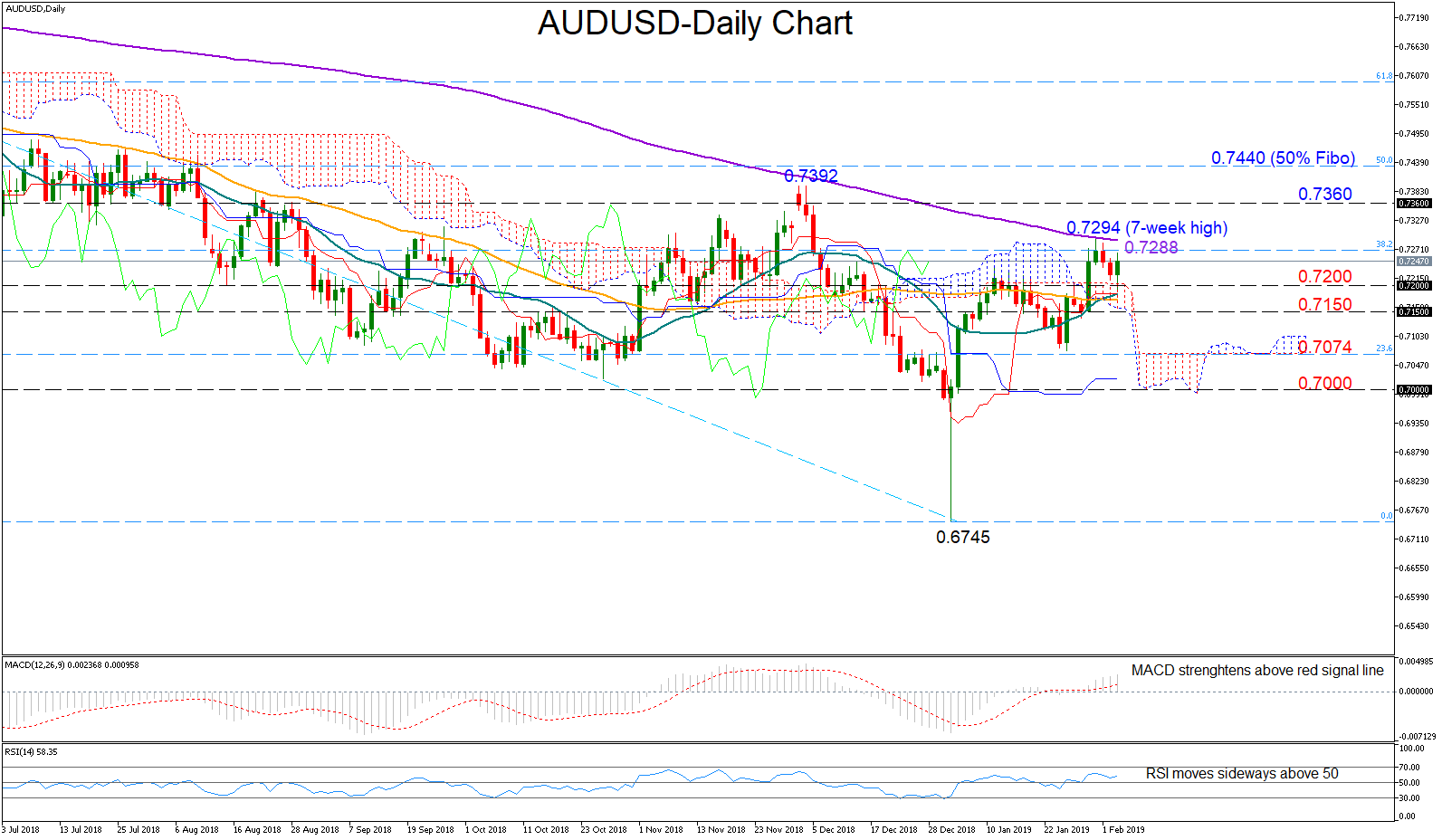
AUDUSD erased some gains after it touched the 200-day simple moving average (MA) last week, but the uptrend started in early January is still intact, with the 20-day MA suggesting that the positive tendency may hold in place as the line managed to jump back above the 50-day MA early this month.
In momentum indicators, the MACD is gaining strength above its red signal line, while the RSI is moving sideways since the start of the month together with the red Tenkan-sen line. Hence the bias is seen as neutral-to-positive.
On the upside, the 200-day MA currently at 0.7288 could halt bullish action once again. Should the bulls prove stronger this time, with the pair closing above that line, long positions may increase towards the 0.7360 barrier. Breaking that obstacle too and surpassing the December peak of 0.7392, resistance may run up to 0.7440, where the 50% Fibonacci of the upleg from 0.8135 to 0.6745 is located.
Heading lower, the 0.72 round level could provide immediate support ahead of the 0.7150 mark. Under the latter, attention may shift to the 23.6% Fibonacci of 0.7074, while decreases below 0.70 may foresee the end of the neutral cycle in the medium-term and the start of a bearish one.
Summarizing AUDUSD looks neutral-to-positive in short term, while in the medium-term picture the market is still neutral.
UK PMI services dropped to 50.1, Brexit uncertainty coincides with wider global slowdown
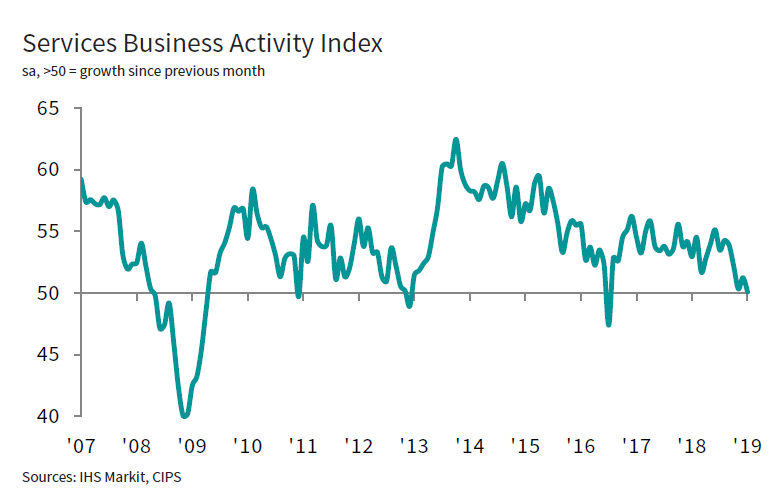
UK PMI Services dropped to 50.1 in January, down from 51.2 and missed expectation of 51.1. That's the lowest level for two-and-a-half year and the second-weakest since December 2012. Markit also noted that business activity stagnates amid modest drop in new
work. Staffing levels decline for the first time since December 2012. And, strong input cost inflation persists at start of 2019.
Chris Williamson, Chief Business Economist at IHS Markit, which compiles the survey:
"The latest PMI survey results indicate that the UK economy is at risk of stalling or worse as escalating Brexit uncertainty coincides with a wider slower slowdown in the global economy.
"Service sector growth ground almost to a halt in January, matching similar disappointing news in the manufacturing and construction sectors. The last three months have seen the economy slip into its weakest growth spell for six years, and indicate that GDP likely stagnated at the start of 2019 after eking out modest growth of just 0.1% in the fourth quarter.
"With the exception of July 2016, when demand contracted briefly following the surprise Brexit vote, service providers suffered the largest drop in new business since April 2009 as customers tightened their belts.
"Service sector employment fell for the first time in the past six years in a sign that the slowdown is feeding through to the labour market.
"The survey results indicate that companies are becoming increasingly risk averse and eager to reduce overheads in the face of weakened customer demand and rising political uncertainty. Such worries were in turn most commonly linked to heightened Brexit anxiety, though wider global political and economic factors were also seen to have been taking their toll on demand."
Eurozone PMI composite finalized at 5.5 year low, Q1 to be worst quarter since 2013
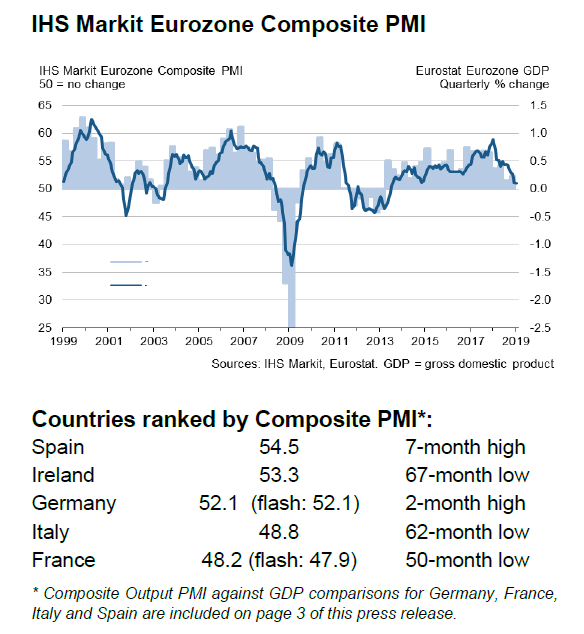
Eurozone PMI Services was finalized at 51.2, revised up from 50.8. That's unchanged from the 49-month low recorded in December. PMI Composite was finalized at 51.0, lowest in five-and-a-half years. Among the countries, France PMI composite dropped to 48.2, 50-month low. Italy was at 48.8, 52-month low. Germany recovered to 52.1, a 2-month high. But Ireland dropped to 53.3, 67-month low.
Chris Williamson, Chief Business Economist at IHS Markit said:
"The eurozone has started 2019 on flat note, with growth close to stagnation amid falling demand for goods and services. The PMI indicates that GDP is growing at a quarterly rate of just 0.1%, setting the scene for the region's worst quarter since 2013. Such a weak start to the year would mean the current consensus forecast for 1.5% GDP growth in 2019 is likely to be revised lower, and hence lead to more dovish signals from the ECB.
"What started as a manufacturing and export-led slowdown has shown increasing signs of infecting the service sector. The manufacturing PMI numbers are indicative of the goods-producing sector slipping into recession, while growth in services is now running at its lowest for four years. Worst may be yet to come: new orders received by factories are declining at the steepest rate for nearly six years and new business inflows into the service sector have stalled. Demand is consequently falling to an extent not seen since mid-2013.
"Employment growth is now also being affected by a growing reticence to expand capacity, with jobs being created at the slowest rate for over two years.
"The deteriorating picture looks broad-based. Italy is in its steepest downturn for over five years and France has sunk into its sharpest decline for over four years. Faster growth in Germany and Spain meanwhile looks tenuous, as order book trends deteriorated in both cases.
"The survey indicates that political uncertainty, both global and local, is increasingly taking a toll on growth, dampening demand and driving increased risk aversion. Add in rising global trade tensions, Brexit uncertainty, the 'yellow vest' protests in France and a spluttering auto sector, it's clear that the business environment is at its most challenging since the height of the region's debt crisis."
RBA Remains On Hold And The Aussie Jumps For Joy
As was widely expected RBA kept interest rates unchanged at +1.50%, yet sounded less dovish than what the market expected, causing the AUD to jump. The bank recognized the global risks and expects inflation to rise gradually, while at the same expects GDP growth to average 3.0% and employment market to remain strong. Analysts note that the key message from the RBA is clear as the bank has noted the weaker outlook and the steep drops of the housing prices and the Q3 GDP growth was higher than expected. We see the case for the Aussie to be in a bullish mode over the next few days, maintain some reserves for a possibly overoptimistic vies by the bank and expect volatility for the AUD to continue until the end of the week. Despite AUD/USD's bearish pathway yesterday, RBA's interest rate decision gave the pair a boost during today's Asian session, breaking the 0.7230 (S1) resistance line, now turned to support. Given the contents of RBA's accompanying statement and the forecasts for the US ISM non-manufacturing PMI for January later today we could see the pair rising even further. Should the pair find fresh buying orders along its path, we could see the pair rising and aiming or even breaking the 0.7330 (R1) resistance line. Should the pair come under the selling interest of the market, we could see it breaking the 0.7230 (S1) support line and aim for the 0.7150 (S2) support barrier.
GBP drops as difficulties mount for Theresa May
The pound weakened against the USD yesterday as difficulties regarding Brexit, seem to mount for UK's PM and another PMI came in lower than expected. UK business secretary Clark, stated that there is damaging uncertainty about the terms of the UK departure from the EU, as Nissan abandoned plans for a new factory in Sunderland. On the political front Theresa May is about to start a two day visit to Northern Ireland to gather support for Brexit plan. UK's PM has until next week to secure changes that will satisfy conservative hard Brexiteers and the UK parliament. On the other hand the EU seems to be digging in to their positions and recent media reports stating that the bloc might offer legally binding assurance to the UK about the Irish backstop were denied by EU officials. Currently we could see the pound maintaining a bearish momentum as Brexit uncertainty rises and financial releases seem to weaken the pound. As uncertainty about Brexit grows, IronFX plans to hold a live Webinar on the 12th of the month about Brexit. Cable dropped yesterday, breaking the 1.3070 (R1) support line, now turned to resistance. We could see the pair remaining under pressure, yet we expect it to be sensitive to any further Brexit headlines and today's financial releases. Should the bears continue to dictate the pair's direction we could see it aiming if not breaking the 1.2960 (S1) support line, while if the bulls take over, we could see cable breaking the 1.3070 (R1) resistance line and aim for higher grounds.
Today's other economic highlights
In today's European session, we get Eurozone's final Composite PMI for January, UK's services PMI for January and Eurozone's retail sales growth rate for December. In the American session, we get form the US the ISM non-manufacturing PMI for January and the API weekly crude oil inventories figure.
AUD/USD H4
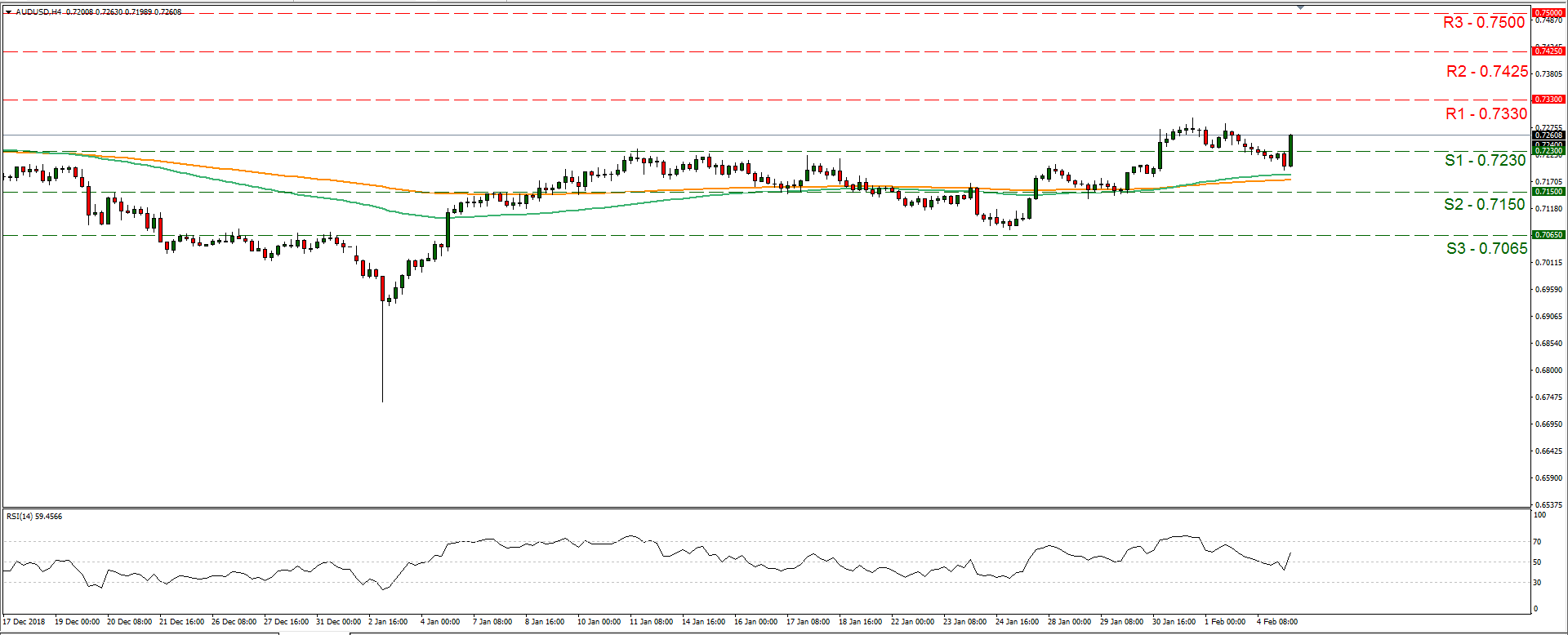
Support: 0.7230 (S1), 0.7150 (S2), 0.7065 (S3)
Resistance: 0.7330 (R1), 0.7425 (R2), 0.7500 (R3)
GBP/USD H4
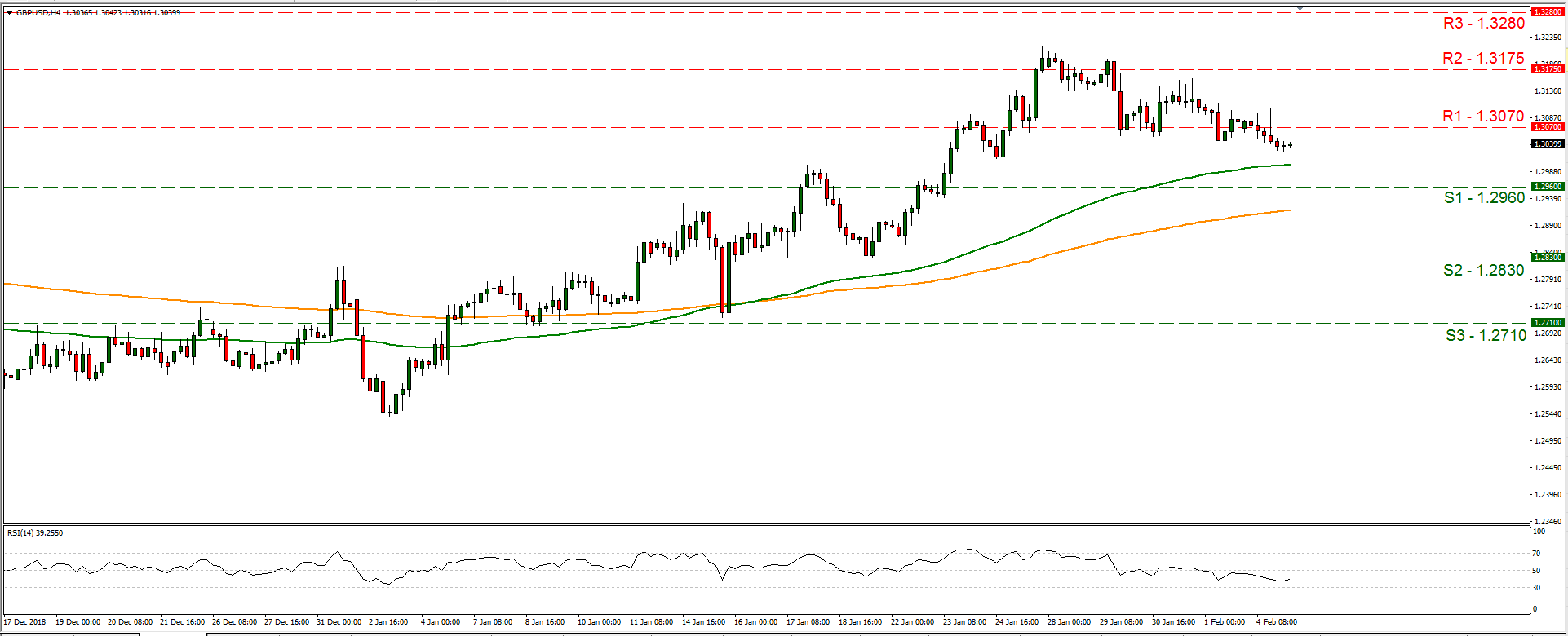
Support: 1.2960 (S1), 1.2830 (S2), 1.2710 (S3)
Resistance: 1.3070 (R1), 1.3175 (R2), 1.3280 (R3)
Neutral RBA Lifts Aussie, Wall Street Advances
- Stocks climb while haven assets tumble, without any fresh catalyst
- Aussie outperforms after RBA wasn't as dovish as markets expected
- Today, services PMIs from both the UK and US will dictate the action
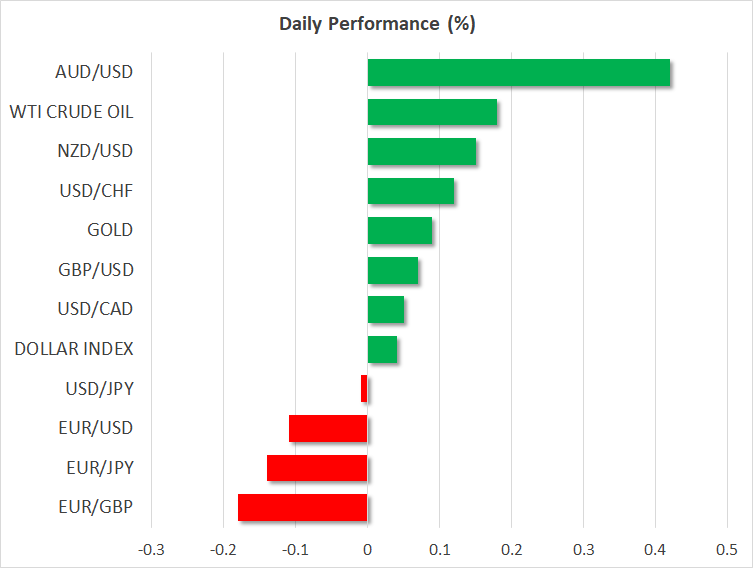
Stocks advance, yen crumbles as “no news is good news”
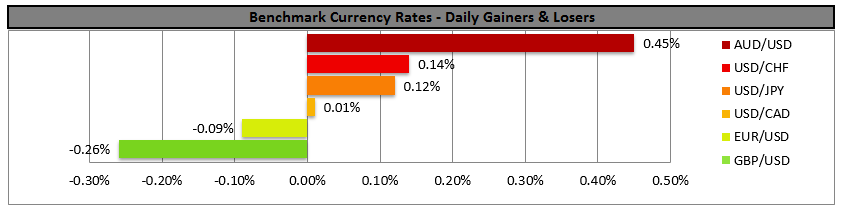
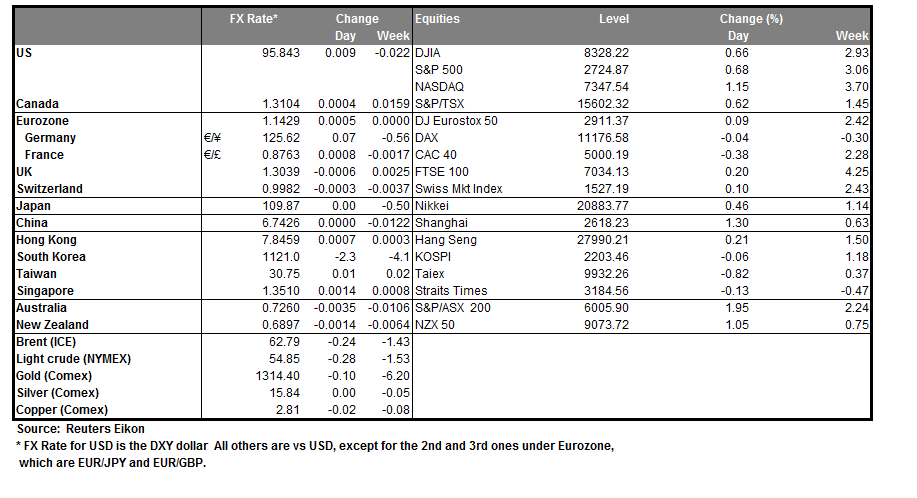
Global risk appetite returned on Monday, in the absence of any material news or fresh fundamental catalysts to speak of. US stock markets recorded decent gains, with the benchmark S&P 500 (+0.68%) closing at a two-month high, while haven currencies like the Japanese yen surrendered ground across the board. Meanwhile, the dollar climbed alongside US Treasury yields, as the risk-on sentiment led to a rotation away from bonds, which are also considered a safe asset.
It's worth mentioning that all these moves occurred in the midst of thinner-than-usual liquidity, as China and most of Asia are on holiday celebrating the Lunar New Year. Overall, the outlook for riskier assets like equities appears constructive in the near term following the Fed's latest decision to hit the “pause” button, and amid elevated expectations that the US-China trade negotiations may bear fruit as early as this month.
Aussie celebrates after RBA stays neutral, doesn't hint at rate cuts
The Australian dollar is outperforming early on Tuesday after the nation's central bank kept its policy unchanged earlier, as was widely expected, and maintained a relatively neutral tone. Policymakers noted that downside risks have increased, but reiterated that growth will remain above-trend and wages will pick up eventually. Most importantly, the statement contained no hints whatsoever that officials discussed the prospect of cutting rates if the outlook deteriorates, which likely disappointed the bears.
Accordingly, investors unwound some of their rate-cut bets, pushing the aussie higher. Note though, that a quarter-point rate cut by October is still priced in with a 35% probability, so that action remains very much on the table according to markets.
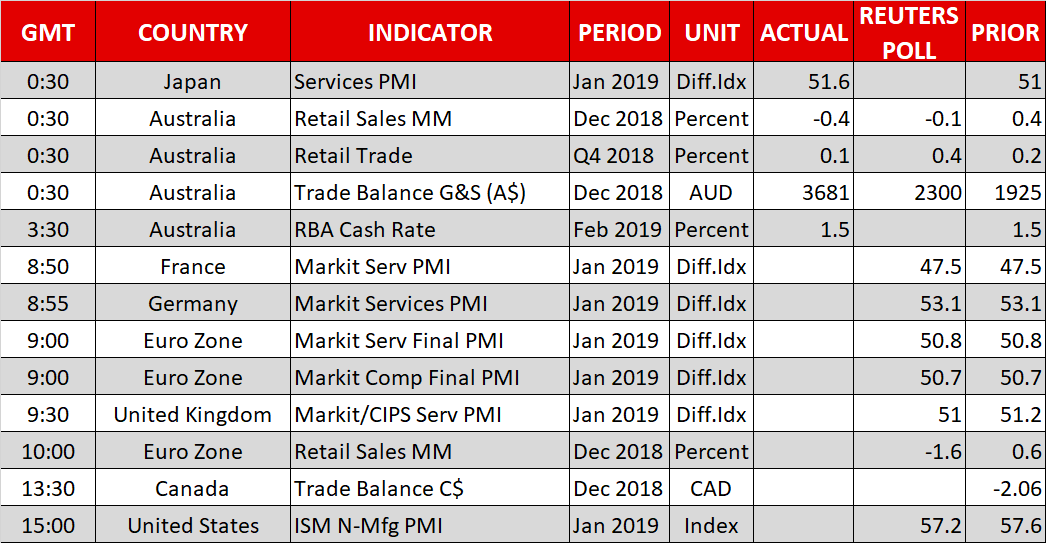
British and American services PMIs coming up
The economic calendar is relatively busy on Tuesday. The UK will kick things off with the release of its all-important services PMI for January. The service sector accounts for 80% of British GDP, so this is a good bellwether for overall economic growth. The forecast is for a downtick, though if the disappointments in the manufacturing and construction indices for the month are anything to go by, the risks surrounding that projection may be tilted to the downside. It seems the UK economy started the year on the back foot as Brexit uncertainties curtailed business investment, and if today's PMI confirms as much, that could ignite speculation for a dovish tilt by the BoE when it meets on Thursday, hurting the pound.
In the US, the ISM non-manufacturing PMI for January is due out. Expectations are for the index to decline, but to still remain at a very healthy level. The manufacturing index surprised to the upside last week, and if something similar occurs today, that could allay some recession fears, potentially providing a boost to both the dollar and US equities.
As for the speakers, US President Trump will deliver his State of the Union address during the Asian session on Wednesday (0200 GMT). While this is typically a non-market moving event, any hints on whether the government will shut down again soon or whether he will declare a national emergency could make for some interesting headlines
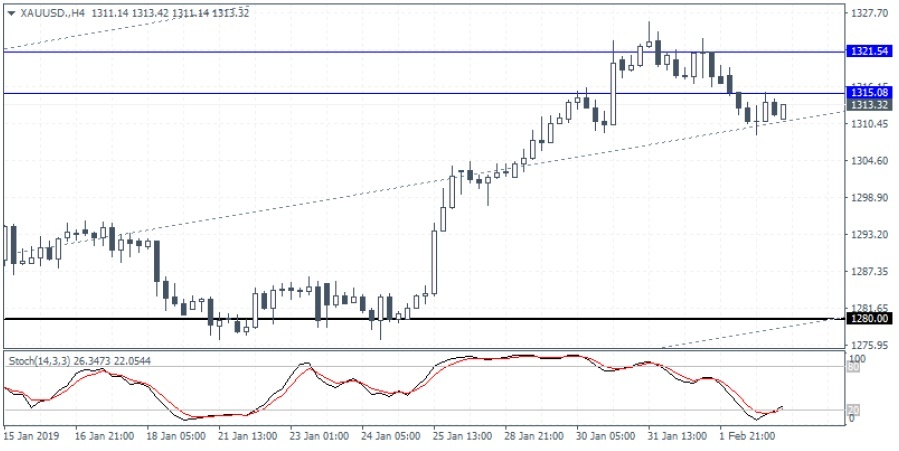
XAUUSD Intraday Analysis
XAUUSD (1313.32): Gold prices extended declines for the second consecutive day, but price action managed to recover some of the losses towards Monday's close. The modest retracement is likely to push gold prices briefly higher toward the 1318 level before the bearish momentum is likely to resume. If gold prices rally above the 1319 level, we could expect to see a move back to the previous highs near 1321.
AUDUSD Intraday Analysis
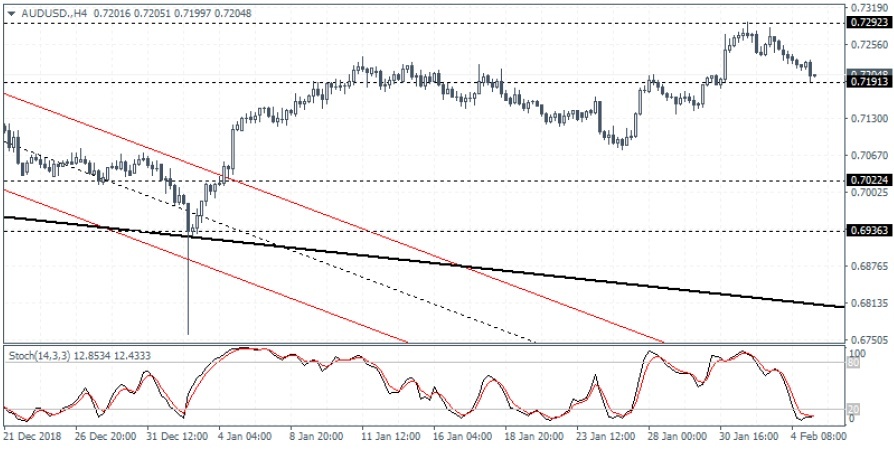
AUDUSD (0.7204): The Australian dollar dropped to the lower end of the range at 0.7191. The declines came after AUDUSD failed to post a breakout above 0.7292 level of resistance. The drops are likely to stall at the current level leaving AUDUSD to trade sideways. However, in the event of a decline below 0.7191, we could expect the currency pair to test the lower support at 0.7022
EURUSD Intraday Analysis
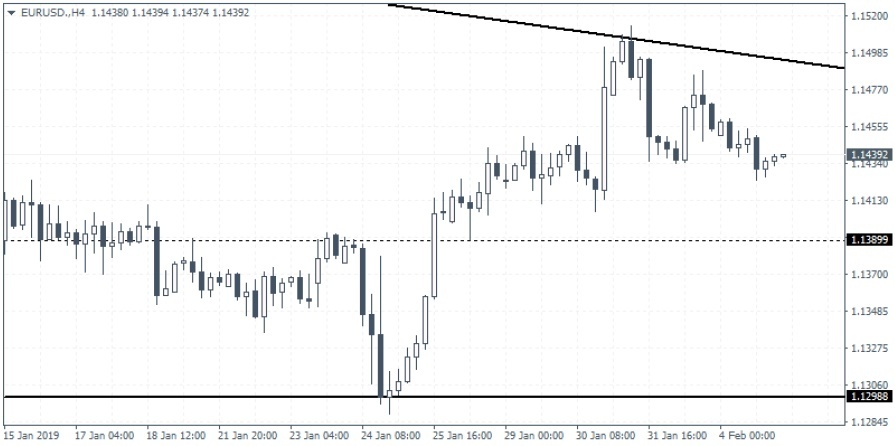
EURUSD (1.1439): The EURUSD currency pair closed bearish with price action seen drifting modestly lower. The support at 1.1400 is likely to be tested to the downside in case of any bullish momentum. Price action remains caught with the resistance from the falling trend line. A breakout from this level is the way forward for further gains. The next main resistance should be at 1.1575.