Sample Category Title
EUR/USD Mid-Day Outlook
Daily Pivots: (S1) 1.1420; (P) 1.1440; (R1) 1.1457; More.....
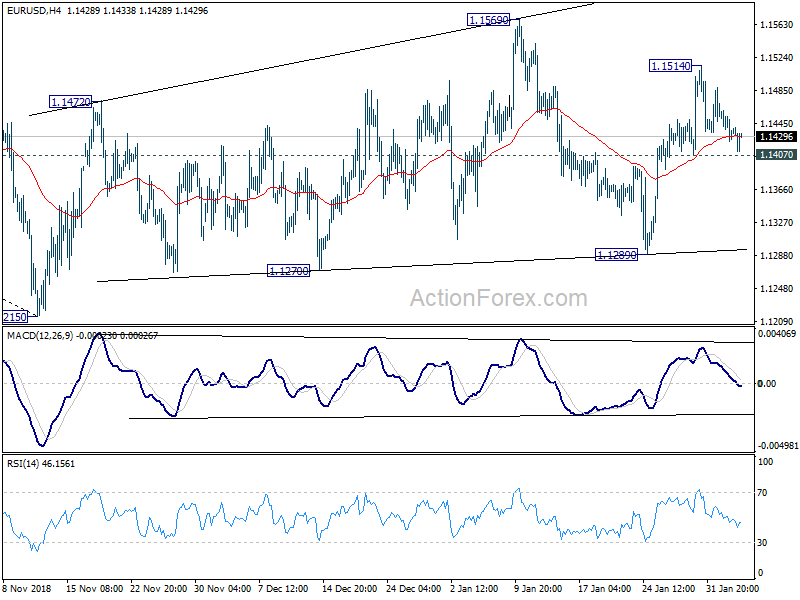
EUR/USD is still bounded in range of 1.1407/1514. Intraday bias stays neutral for the moment. Another rise is mildly in favor with 1.1407 minor support intact. Rise from 1.1289 is seen as another rising leg in the correction pattern from 1.1215. Above 1.1514 will target 1.1569 resistance and above. On the downside, break of 1.1407 minor support will turn bias back to the downside for 1.1289 support instead.
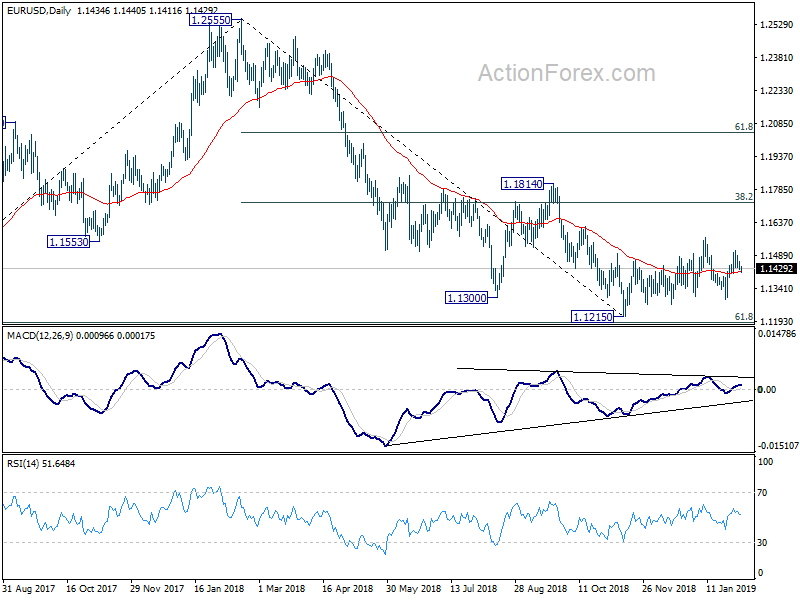
In the bigger picture, as long as 1.1814 resistance holds, down trend down trend from 1.2555 medium term top is still in progress and should target 61.8% retracement of 1.0339 (2017 low) to 1.2555 at 1.1186 next. Sustained break there will pave the way to retest 1.0339. However, break of 1.1814 will confirm completion of such down trend and turn medium term outlook bullish.
GBP/USD Mid-Day Outlook
Daily Pivots: (S1) 1.3010; (P) 1.3057; (R1) 1.3083; More....
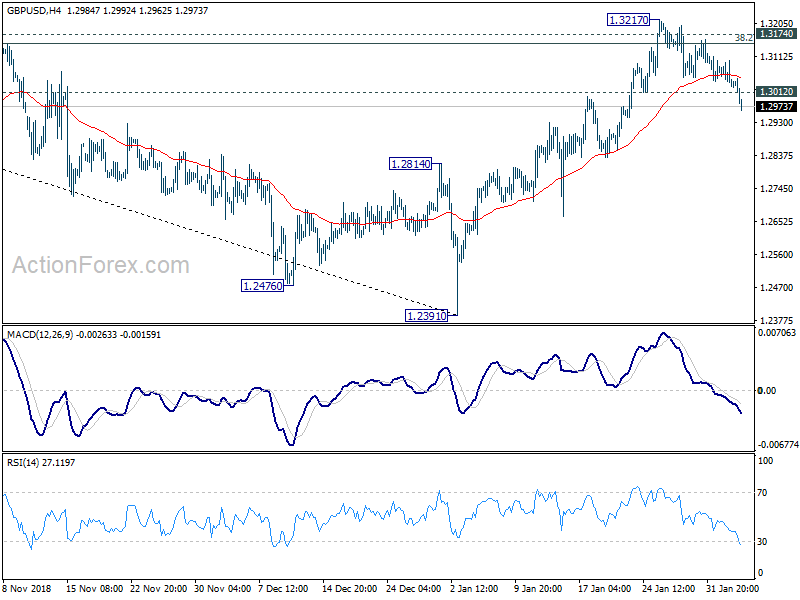
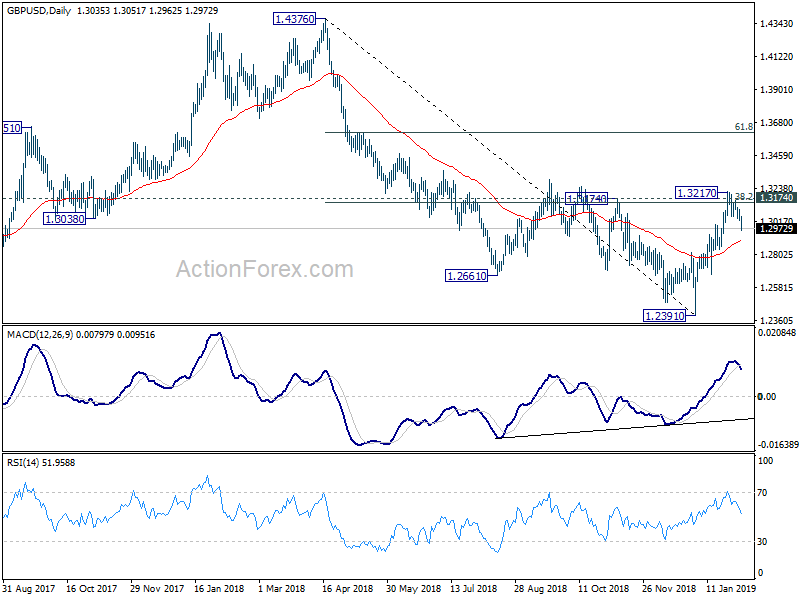
GBP/USD's break of 1.3012 support suggests that rebound from 1.2391 has completed at 1.3217, after rejection by 1.3174 key resistance. Intraday bias is turned back to the downside for 1.2814 resistance turned support first. Break will bring retest on 1.2391 low. On the upside, break of 1.3217 resistance is needed to confirm resumption of the rebound. Otherwise, risk will now stay on the downside in case of recovery.
In the bigger picture, the rejection by 1.3174 key resistance revived the original view on GBP/USD. That is, decline from 1.4376 is possibly resuming long term down trend from 2.1161 (2007 high). Firm break of 1.2391 will solidify this bearish case and target 1.1946 (2016 low). However, decisive break of 1.3174 will invalidate this bearish case again and turn outlook bullish.
USD/JPY Mid-Day Outlook
Daily Pivots: (S1) 109.51; (P) 109.83; (R1) 110.24; More...
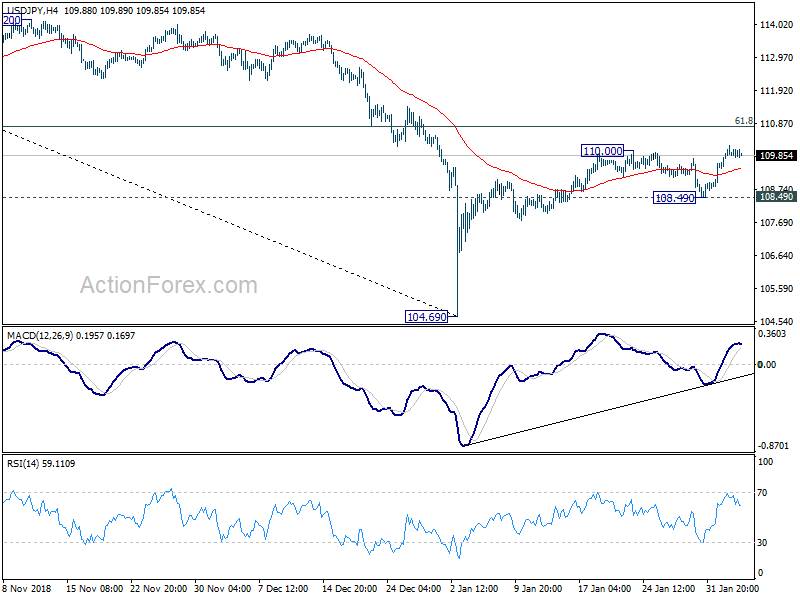
Intraday bias in USD/JPY remains on the upside at this point and further rise could be seen to 61.8% retracement of 114.54 to 104.69 at 110.77. We'd expect strong resistance from there to limit upside. On the downside, break of 108.49 support will now confirm completion of the rebound and bring retest of 104.69 low. However, sustained trading above 110.77 will dampen our bearish view and target a test on 114.54 resistance instead.
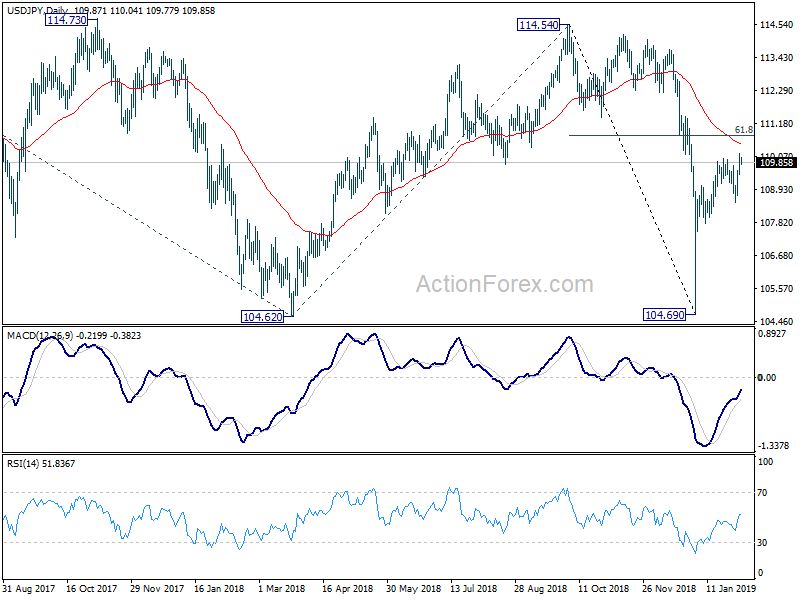
In the bigger picture, while the rebound from 104.69 is strong, there is no change in the view that it's a corrective move. That is, fall from 114.54, as part of the decline from 118.65 (2016 high), is not completed yet. Break of 104.62 will target 100% projection of 118.65 to 104.62 from 114.54 at 100.51, which is close to 100 psychological level. Nevertheless, sustained trading above 55 day EMA (now at 110.55) will dampen this bearish view and turn focus back to 114.54 resistance instead.
USD/CHF Mid-Day Outlook
Daily Pivots: (S1) 0.9948; (P) 0.9971; (R1) 1.0003; More....
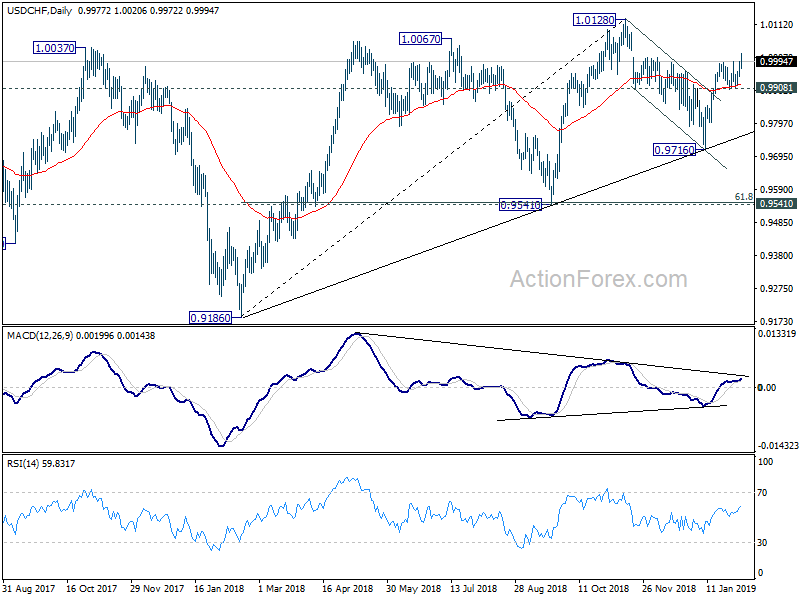
USD/CHF's rise break of 0.9994 resistance suggests that rise from 0.9716 has resumed. Intraday bias is back on the upside. Outlook is unchanged that corrective decline from 1.0128 should have completed at 0.9716 already, after hitting trend line support. Further rally should now be seen back to retest 1.0128. On the downside, break of 0.9908 is needed to indicate completion of the rebound. Otherwise, outlook will stay cautiously bullish in case of retreat.
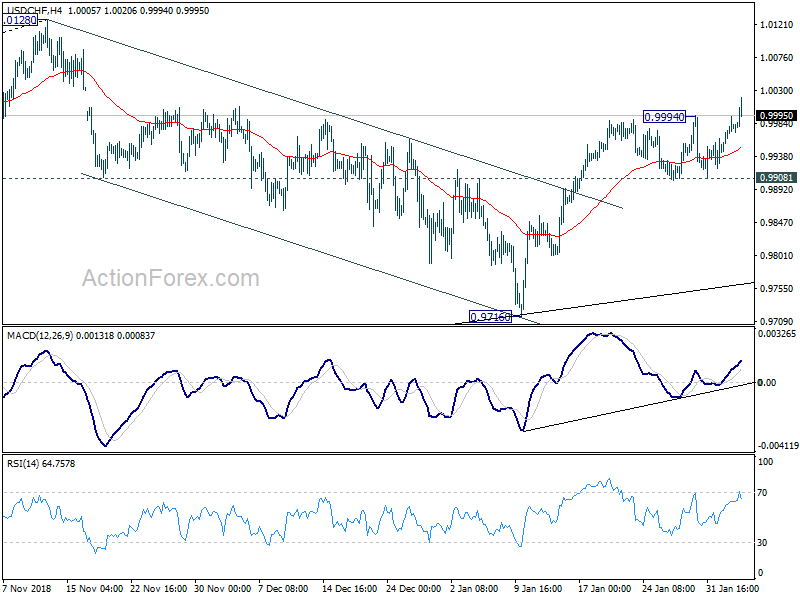
In the bigger picture, USD/CHF drew strong support from medium term trend line and rebounded. That suggests rise from 0.9186 is still in progress. Further break of 1.0128 will confirm up trend resumption and target 1.0342 key resistance. Nevertheless, break of 0.9716 will dampen this bullish view and at least bring deeper fall to 0.9541 key support.
Swiss Franc Leads European Majors Lower, Dollar Fighting Back
European majors are generally under pressure today. Weak economic data from Eurozone and UK is one of the factors. Stocks are indifferent to the data though, and rise broadly probably on expectation that loose monetary policy will stay longer. Selloff in Swiss Franc is also apparent, in particular with USD/CHF and EUR/CHF taking out near term resistance. On the other hand, Australian Dollar maintains post RBA gains and is trading as the strongest ones for today with New Zealand Dollar. Greenback is also trying to extend recent rebound.
Technically, USD/CHF has taken out 0.9994 resistance to resume rise from 0.9716 already. EUR/CHF also broke 1.1429 to resume rise from 1.1181. GBP/USD's break of 1.3012 minor support is the first sign of bearish reversal on rejection by 1.3174 key resistance. Focus will turn to 1.1407 minor support in EUR/USD to confirm Dollar's underlying strength. Despite today's rebound, AUD/USD is help below 0.7295 resistance and EUR/AUD is kept above 1.5721 support. Aussie bulls are not that committed.
In other markets, FTSE is currently up 1.23%. DAX is up 1.05%. CAC is up 1.00%. German 10-year yield is up 0.0101 at 0.189, but stays below 0.2 handle. Earlier in Asia, Nikkei closed down -0.19%. Japan 10-year JGB yield rose 0.0036 to -0.008, staying negative. China, Hong Kong and Singapore are on lunar new year holiday.
UK PM May to meet EU Juncker on Thursday, Irish backstop plan awaited
UK Prime Minister Theresa May will travel to Brussels on Thursday to meet European Commission Jean-Claude Juncker. Obviously Brexit withdrawal agreement and Irish backstop will be the purpose.
Ahead of that, European Commission spokesman Margaritis Schinas said "the European Union's position is clear." And, "we are expecting, waiting once again to hear what the prime minister has to tell us."
German Merkel: It's humanly possible to solve a precise problem of Brexit Irish backstop
German Chancellor Angela Merkel indicated that there is still time to find a solution for Brexit before the March 29 deadline. She said in a conference in Tokyo that "from a political point of view, there is still time." But she added "it would be very important to know what exactly the British side envisages in terms of its relationship with the EU."
Also, on the specific problem of Irish backstop, Merkel said "It should be humanly possible to find a solution to such a precise problem. But this depends … on the kind of trade deal that we forge with each other."
UK PMI services dropped to 50.1, Brexit uncertainty coincides with wider global slowdown
UK PMI Services dropped to 50.1 in January, down from 51.2 and missed expectation of 51.1. That's the lowest level for two-and-a-half year and the second-weakest since December 2012. Markit also noted that business activity stagnates amid modest drop in new work. Staffing levels decline for the first time since December 2012. And, strong input cost inflation persists at start of 2019.
Chris Williamson, Chief Business Economist at IHS Markit, said "he UK economy is at risk of stalling or worse as escalating Brexit uncertainty coincides with a wider slower slowdown in the global economy." And, GDP has likely "stagnated at the start of 2019 after eking out modest growth of just 0.1% in the fourth quarter."
Also, "companies are becoming increasingly risk averse and eager to reduce overheads in the face of weakened customer demand and rising political uncertainty. Such worries were in turn most commonly linked to heightened Brexit anxiety, though wider global political and economic factors were also seen to have been taking their toll on demand."
Eurozone PMI composite finalized at 5.5 year low, Q1 to be worst quarter since 2013
Eurozone PMI Services was finalized at 51.2, revised up from 50.8. That's unchanged from the 49-month low recorded in December. PMI Composite was finalized at 51.0, lowest in five-and-a-half years. Among the countries, France PMI composite dropped to 48.2, 50-month low. Italy was at 48.8, 52-month low. Germany recovered to 52.1, a 2-month high. But Ireland dropped to 53.3, 67-month low.
Chris Williamson, Chief Business Economist at IHS Markit said, "the eurozone has started 2019 on flat note, with growth close to stagnation amid falling demand for goods and services." And, "GDP is growing at a quarterly rate of just 0.1%, setting the scene for the region's worst quarter since 2013." And that would also mean ECB's projection of 1.5% GDP growth in 2019 is "likely to be revised lower" and "lead to more dovish signals from the ECB".
Also, "The survey indicates that political uncertainty, both global and local, is increasingly taking a toll on growth, dampening demand and driving increased risk aversion. Add in rising global trade tensions, Brexit uncertainty, the 'yellow vest' protests in France and a spluttering auto sector, it's clear that the business environment is at its most challenging since the height of the region's debt crisis."
Also from Eurozone, retail sales dropped -1.6% mom in December, matched expectations.
RBA downgrades growth and inflation forecast, cites increased risks
Australian Dollar jumps after RBA left cash rate unchanged at 1.50% as widely expected. The conclusion of the statement was kept totally unchanged. And most importantly, RBA maintained "further progress in reducing unemployment and having inflation return to target is expected, although this progress is likely to be gradual."
There are some dovish tweaks in the statement, including mentioning of increased risks, downgrade of growth and inflation forecasts. But for now, the statement still suggests the next move is a hike rather than a cut. Just that it may take longer to happen.
Globally, RBA said growth "remains reasonable" but "downside risks have increased". In particular "trade tensions are affecting global trade and some investment decisions". Headline inflation also "moved lower" due to fall in oil prices. Regarding financial markets, RBA also noted government bond yields have declined in most countries including Australia. Australia's terms of trade are "expected to decline over time"
Domestically, RBA expects Australian economy to growth by around 3% in 2019 and a little less in 2020. That's a downward revision from prior expectation of growth at 3.5% in 2019. Further than that, RBA acknowledged weaker than expected growth in Q3 and said "some downside risks have increased". And, "the main domestic uncertainty remains around the outlook for household spending and the effect of falling housing prices in some cities."
On inflation, RBA now expects underlying inflation to hit 2% in 2019 and 2.25% in 2020. Headline inflation is also expected to decline in the near term due to petrol prices. That's also a downgrade as in previously, RBA expected inflation to hit 2.25% in 2019 and a bit higher in 2020.
Also from Australia, AiG performance of services dropped sharply from 52.1 to 44.3 in January. Retail sales dropped -0.4% mom in December versus expectation of 0.0%. Trade surplus widened to AUD 3.68B in December versus expectation of AUD 2.25B.
USD/CHF Mid-Day Outlook
Daily Pivots: (S1) 0.9948; (P) 0.9971; (R1) 1.0003; More....
USD/CHF's rise break of 0.9994 resistance suggests that rise from 0.9716 has resumed. Intraday bias is back on the upside. Outlook is unchanged that corrective decline from 1.0128 should have completed at 0.9716 already, after hitting trend line support. Further rally should now be seen back to retest 1.0128. On the downside, break of 0.9908 is needed to indicate completion of the rebound. Otherwise, outlook will stay cautiously bullish in case of retreat.
In the bigger picture, USD/CHF drew strong support from medium term trend line and rebounded. That suggests rise from 0.9186 is still in progress. Further break of 1.0128 will confirm up trend resumption and target 1.0342 key resistance. Nevertheless, break of 0.9716 will dampen this bullish view and at least bring deeper fall to 0.9541 key support.
Economic Indicators Update
| GMT | Ccy | Events | Actual | Forecast | Previous | Revised |
|---|---|---|---|---|---|---|
| 21:30 | AUD | AiG Performance of Service Index Jan | 44.3 | 52.1 | ||
| 0:01 | GBP | BRC Retail Sales Monitor Y/Y Jan | 2.10% | -0.20% | -0.70% | |
| 0:30 | AUD | Trade Balance (AUD) Dec | 3.68B | 2.25B | 1.93B | 2.26B |
| 0:30 | AUD | Retail Sales M/M Dec | -0.40% | 0.00% | 0.40% | 0.50% |
| 3:30 | AUD | RBA Rate Decision | 1.50% | 1.50% | 1.50% | |
| 8:45 | EUR | Italy Services PMI Jan | 49.7 | 50 | 50.5 | |
| 8:50 | EUR | France Services PMI Jan F | 47.8 | 47.5 | 47.5 | |
| 8:55 | EUR | Germany Services PMI Jan F | 53 | 53.1 | 53.1 | |
| 9:00 | EUR | Eurozone Services PMI Jan F | 51.2 | 50.8 | 50.8 | |
| 9:30 | GBP | Services PMI Jan | 50.1 | 51.1 | 51.2 | |
| 10:00 | EUR | Eurozone Retail Sales M/M Dec | -1.60% | -1.60% | 0.60% | 0.80% |
| 14:45 | USD | US Services PMI Jan F | 54.2 | 54.2 | ||
| 15:00 | USD | ISM Non-Manufacturing/Services Composite Jan | 57 | 57.6 |
Into US session: Swiss Franc sold off on risk appetite, USD/CHF breaks parity
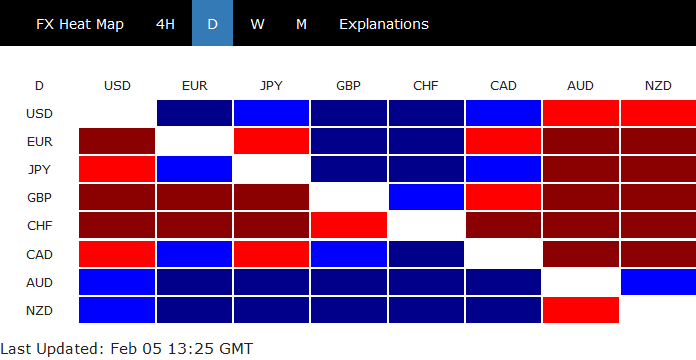
Entering into US session, Australian Dollar remains the strongest one for today, followed by New Zealand Dollar. The Aussie was boosted by RBA statement earlier today. In short, while RBA downgraded growth and inflation forecast for 2019, it remained confident that inflation will gradually return to target. This is consistent with the rhetoric that next move is a hike rather than a cut. Dollar is the third strongest one as it's trying to rebound again.
On the other hand, Swiss Franc is the weakest one for today as European stocks rise. . In particular, USD/CHF has taken out 0.9994 resistance to resume rise from 0.9716 already. EUR/CHF also broke 1.1429 to resume rise from 1.1181. Sterling is the weakest one for today so far. Markets shrug off UK PM May's plan to visit EU Juncker on Thursday. Euro follows as the third weakest. Both Euro and Sterling are also weighed down by weak PMI data.
In Europe:
- FTSE is up 1.23%.
- DAX is up 1.05%.
- CAC is up 1.00%.
- German 10-year yield is up 0.0101 at 0.189, but stays below 0.2 handle.
Earlier in Asia:
- Nikkei closed down -0.19%.
- Japan 10-year JGB yield rose 0.0036 to -0.008, staying negative.
- China, Hong Kong and Singapore are on lunar new year holiday.
Banking Sectors Boost European Blue-Chip Indices
European stock blue-chip indices have registered strong gains in the Tuesday session. The DAX and CAC have climbed about 1.0%, while the FTSE has gained 1.38%. On the release front, German Services PMI improved to 53.1, while eurozone Services PMI remained steady at 51.2 points. Eurozone retail sales plunged 1.6%, its worst showing since December 2013. On Wednesday, President Trump delivers the State of Union address before Congress and Germany releases factory orders.
Bank shares have boosted blue-chip indices on Tuesday. In France, Credite Agricole and BNP Paribas have gained over 2.0%, while Standard Chartered has climbed 1.9%. With European bank sectors rebounding, European stock markets could continue to gain ground this week.
Eurozone data was mixed on Tuesday. German Services PMI improved to 53.1, but the eurozone reading of 51.2 pointed to stagnation in the eurozone services sector. Retail sales ended the year with a whimper, as December releases headed south. Eurozone retail sales dropped 1.6%, and German retail sales plunged 4.3% last week, its sharpest decline in more than 12 years. On the manufacturing front, German manufacturing PMI for January dipped to 49.7, below the 50-point level which separates contraction and expansion. This was the weakest score since October 2014. Trade tensions and weakness in the German auto sector continue to weigh on the manufacturing sector. Weakness in manufacturing can be seen across the eurozone, as France and Italy both posted PMIs in contraction territory. With the U.S-China trade war still in full gear, manufacturing indicators could continue to head south.
UK PM May to meet EU Juncker on Thursday, Irish backstop plan awaited
UK Prime Minister Theresa May will travel to Brussels on Thursday to meet European Commission Jean-Claude Juncker. Obviously Brexit withdrawal agreement and Irish backstop will be the purpose.
Ahead of that, European Commission spokesman Margaritis Schinas said "the European Union's position is clear." And, "we are expecting, waiting once again to hear what the prime minister has to tell us."
Dollar Position Taking Requires Conviction
Tuesday January 5: Five things the markets are talking about
Capital markets remain relatively listless, especially during this week in which much of Asia is on holiday. Interested parties are desperately seeking out any market momentum to apply to their convictions.
Perhaps the ‘big’ dollar may have to wait to react to this evenings State of the Union address from President Trump (09:00 pm EDT) – market focus is likely to be on any indications on how Sino-U.S trade negotiations are going, anything positive on the trade news front should provide support for the greenback.
Until then, it’s about picking your poison – despite volatile U.S and Euro equity and bond markets, the forex market remains confined to its recent tight trading ranges outright.
Ongoing trade tensions between the U.S and China, rising populism, budgetary issues in Italy, French protests, monetary policy divergence, and Brexit have all being taking their toll on financial markets, except the forex space – that remains in a ‘wait and see mode.’
On tap: Corporate earnings season continues. On Wednesday, Fed Chair Powell will deliver his first public comments following last months FOMC meeting and rate decision (07:00 pm EDT).
1. Stocks driven by trade talk and earnings
Asian markets closed Tuesday: China, Hong Kong, Indonesia, Korea, Malaysia, Philippines, Singapore, Taiwan, Pakistan
In Japan, the Nikkei ended lower overnight, breaking its three-day rally as the market digested a slew of corporate earnings. The index ended -0.19% lower, while the broader Topix edged up +0.1%.
Down-under, financial equities pushed Aussie stocks to record one of their best day in years as the market saw plans of a high-powered banking inquiry as “less severe” than expected, and not posing a serious threat to one of Australia’s most profitable sector. The S&P/ASX 200 index surged +1.95% to trade atop its four-month high – the benchmark rallied +0.5% on Monday.
Note: The RBA remains in focus this week – Governor Lowe is expected to speak on Feb 6th, while the RBA quarterly statement on monetary policy seen on Feb 8th.
In Europe, regional indices trade higher across the board, maintaining their upward momentum of late following a stronger session stateside yesterday and mixed Asian session following mixed European PMI data.
U.S stocks are set to open in the ‘black’ (+0.12%).
Indices: Stoxx600 +0.76% at 326.66, FTSE +1.16% at 7,115.75, DAX +0.93% at 11,280.14, CAC-40 +0.80% at 5,040.26, IBEX-35 +0.66% at 9,034.25, FTSE MIB +0.99% at 19,800.50, SMI +0.82% at 9,092.50, S&P 500 Futures +0.12%
2. Oil prices rise on tighter supply, but data caps gains, gold higher
Oil prices are better bid as the market expects U.S sanctions on Venezuela and production cuts led by OPEC+ to trump any glut. However, U.S data showing a decline in factory orders is providing a cap to the market.
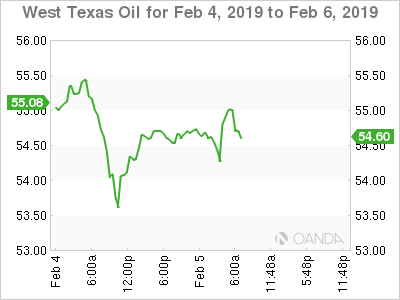
Brent crude futures are up +33c, or +0.53%, at +$62.84 a barrel, down from a high of +$63.63, while WTI futures are up +46c, or +0.84%, at +$55.02 per barrel – they touched their highest level in more than two-months at +$55.75 Monday.
Analysts note that there are currently little signs of any overhang in the market now that the U.S has imposed sanctions on Venezuela, on top of the reduced supply from Saudi Arabia.
Note: Last week, the U.S administration announced export sanctions against state-owned oil firm Petroleos de Venezuela SA (approx. +500k bpd) – this has led to some disruption for oil refineries on the Gulf coast. They have had to seek alternative heavy crude supplies from Canada.
OPEC supply fell this month by the largest amount in two-years, which has helped to offset limited compliance so far by non-OPEC Russia.
While OPEC cuts, the U.S continues willing to expand its supply. However, data on Friday showed a drop in the number of U.S oil rigs on line to their lowest in eight-months, lending temporary prices some support.
But weighing on markets, U.S government data yesterday showed that new orders for U.S made goods unexpectedly fell in November, with sharp declines in demand for machinery and electrical equipment. The prospects for growth in fuel demand have been clouded by poor economic data in China and U.S-China trade tensions.
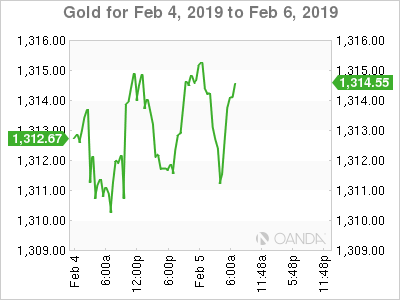
Ahead of the U.S open, gold has inched a tad higher in the Euro session in thin trading as investors made purchases after prices touched a one-week low in yesterday’s session. However, gold ‘bulls’ can expect that improved market risk appetite to cap the yellow metal’s gains. Spot gold has rallied +0.2% to +$1,314.10 per ounce, after having printed its weakest price since January at +$1,308.20 in yesterday’s session. U.S gold futures are firm at +$1,318.10 an ounce.
3. Reserve Bank of Australia (RBA) sticks to the script
The RBA in its first policy meeting for 2019 overnight stuck with its upbeat narrative on the Aussie economy. The official cash rate remained at +1.5% with the RBA forecasting a “gradual” lift in inflation in 2019 and 2020, and +3% GDP growth in 2019.
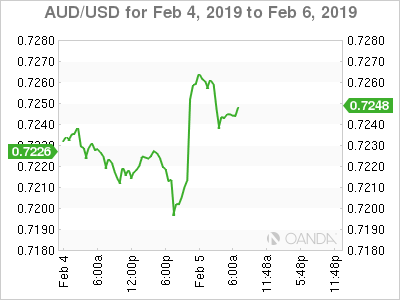
Governor Lowe said that the growth forecast is enough for unemployment to continue falling. He reiterated that the low level of interest rates was continuing to support the Australian economy and that inflation remains “low and stable.” He viewed that the AUD (A$0.7245) has remained within a narrow range.
Note: AUD rallied on the report which has disappointed a lot of the policy doves in the market. Futures traders have already priced in a +50% likelihood of a rate cut before the end of this year. The RBA shows no sign yet of delivering that.
Elsewhere, the yield on U.S 10-year Treasuries has gained +1 bps to +2.73%, the highest in more than a week. In Germany, the 10-year Bund yield has rallied +1 bps to +0.19%, while in the U.K, the 10-year Gilt yield has increased less than +1 bps to +1.279%, the highest in more than a week.
4. ‘Big’ dollar looking for guidance
The ‘mighty’ USD is maintaining a slightly firmer tone outright against G10 pairs in quiet trading with the dollar supported by slightly higher U.S Treasury yields.
EUR/USD (€1.1420) is a tad softer as this morning’s PMI Services data print hovered around the contraction level for the key countries and highlighted the growth concerns for the region.
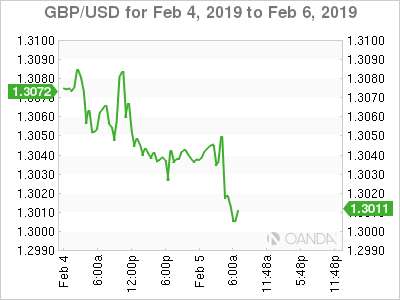
GBP/USD (£1.3007) saw any of its Euro session gains evaporate in the aftermath of weak PMI Services data (50.1). The overall the reading was the lowest print since the Brexit vote back in 2016.
AUD/USD (A$0.7242) is a tad firmer in the aftermath of the RBA decision to keep its policy steady and was less optimistic on both the growth and inflation front. Ahead of the RBA statement, the futures market was implying a +50% chance of RBA rate cut by the end of the year amid weaker than expected December and Q4 retail sales earlier data this week.
5. Weak U.K PMI services sends pound lower
Data this morning from the world’s fifth-biggest economy showed that the IHS Markit/CIPS UK Services Purchasing Managers’ Index (PMI) fell to 50.1 in January from 51.2 in December – the 50 mark separates growth from contraction. Today’s print was the lowest in nearly three-years and suggests that the British economy is flat-lining after losing momentum in H2 2018.
With Brexit nearing (March 29), the U.K’s dominant services sector is reporting job cuts for the first time in six-years and falling new orders. Sterling has slipped to trade atop of its two-week low outright on the news.
Note: Today’s print will likely worry BoE ahead of their latest interest rate decision announcement and new forecasts for the economy on Thursday.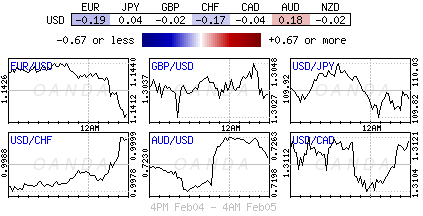
USD/JPY Outlook: Pivotal 110 Barrier Continues To Resist
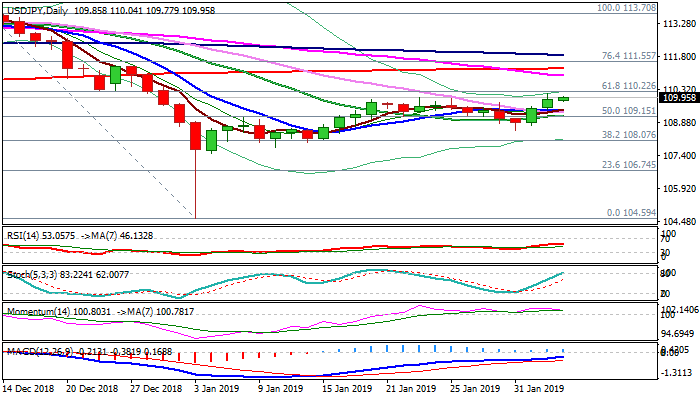
The pair maintains positive tone on Tuesday and holds near strong 110.00 barrier, but so far without clear break higher, despite Monday's spike to 110.16 (new 2019 high). Lower volumes in Asia due to holidays slowed the activity, with lack of bullish momentum and overbought slow stochastic, contributing to the pair's hesitation at 110 pivot. Despite strong rally in past two days and probes above 110 barrier, risk of another rejection here remains in play, as recently formed 55/200 SMA bear-cross weighs. Pivotal supports lay at 109.45/18 zone (10/30/20SMA) and break here would generate stronger bearish signal. Bullish scenario requires sustained break above 110.00/22 barriers (psychological/Fibo 61.8% of 113.70/104.59) to generate continuation signal and expose 55/200SMA's (110.96/111.24 respectively).
Res: 110.16, 110.22, 110.96, 111.24
Sup: 109.77, 109.45, 109.18, 108.72