

Sample Category Title
Eco Data 2/6/19
[php_everywhere instance="1"]
New Zealand Jobs Growth Likely Slowed in Q4; May Put Kiwi Rebound at Risk
Employment data out of New Zealand will be watched on Thursday (Wednesday, 21:45 GMT) as investors try to gauge the Reserve Bank of New Zealand’s next move ahead of the central bank’s policy meeting the following week. Recent economic indicators from the country have been showing an improving trend, lessening the need for a rate cut. However, with a clouded outlook over world growth, any signs of renewed weakness in parts of the economy, such as the labour market, could revive speculation of an RBNZ rate cut.
New Zealand’s unemployment rate fell sharply in the third quarter to a 10-year low of 3.9%, defying expectations that it would stay unchanged at 4.5%. It is forecast to have ticked higher to 4.1% in the final three months of 2018, with jobs growth anticipated to have slowed to 0.3% quarter-on-quarter from 1.1% in the prior period.
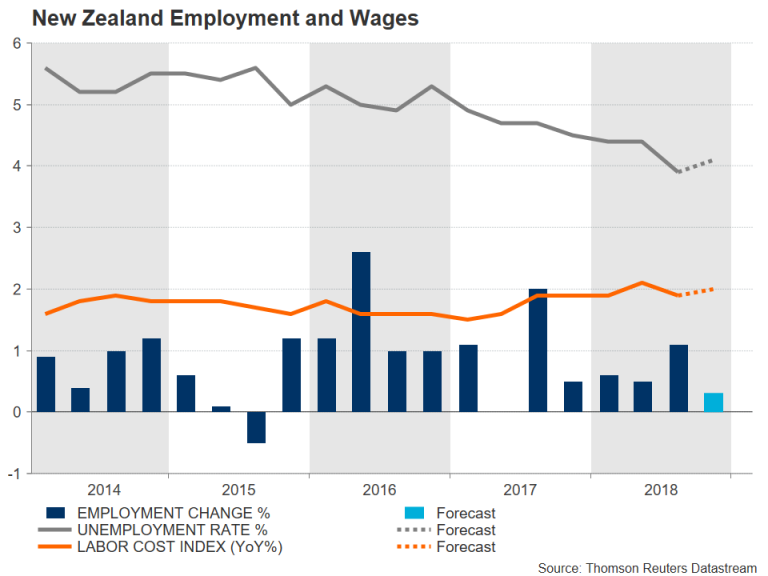
A small rise in the jobless rate is unlikely to alarm policymakers as a figure around 4% would still be historically consistent with a tight labour market. A bigger worry would be if wage growth was to moderate, as even with a decade-low unemployment rate, labour costs rose by just 1.9% year-on-year in the three months to September. Although they are forecast to have inched higher to 2.0% y/y in the fourth quarter, the RBNZ will not want to take a rate cut off the table until wage pressures have started to build up more substantially.
The RBNZ will next meet on February 13 and is widely expected to hold rates at 1.75% as it waits for growth and inflation to pick up some momentum. While, in addition to the strong jobs market, there have been a few other positives in the economy in recent months, such as rising dairy prices (dairy products are New Zealand’s biggest export earner) and inflation sticking close to the middle of the RBNZ’s 1-3% target band, business confidence remains weak and Q3 GDP growth came in at half the expected rate of 0.6% q/q.
The closely-watched ANZ business outlook index rose notably in December, but at -24.1, it remains deep in negative territory where it’s been stuck since October 2017. The RBNZ fears the subdued business confidence is a sign of softer growth to come and therefore will likely maintain its cautious outlook until there’s a convincing recovery in business sentiment.
The New Zealand dollar, which has rebounded to around the 0.69 level against the US dollar after slumping to a 32-month low of 0.6422 in October 2018, will probably struggle to advance much higher unless the RBNZ drops its easing bias. Another solid employment report on Thursday could prompt the central bank to signal a somewhat less dovish stance. However, with the deteriorating outlook for the global economy and inflation running in the lower half of the target band, it’s hard to see the RBNZ turning more optimistic just yet.
Any advances in the kiwi from a data beat will therefore probably be kept in check. Kiwi/dollar could re-challenge last week’s 2-month high of 0.6941 if there is a fresh upside push. Clearing this top would turn attention on the December peak of 0.6969 before the bulls aim for the June 2018 highs around 0.7050.
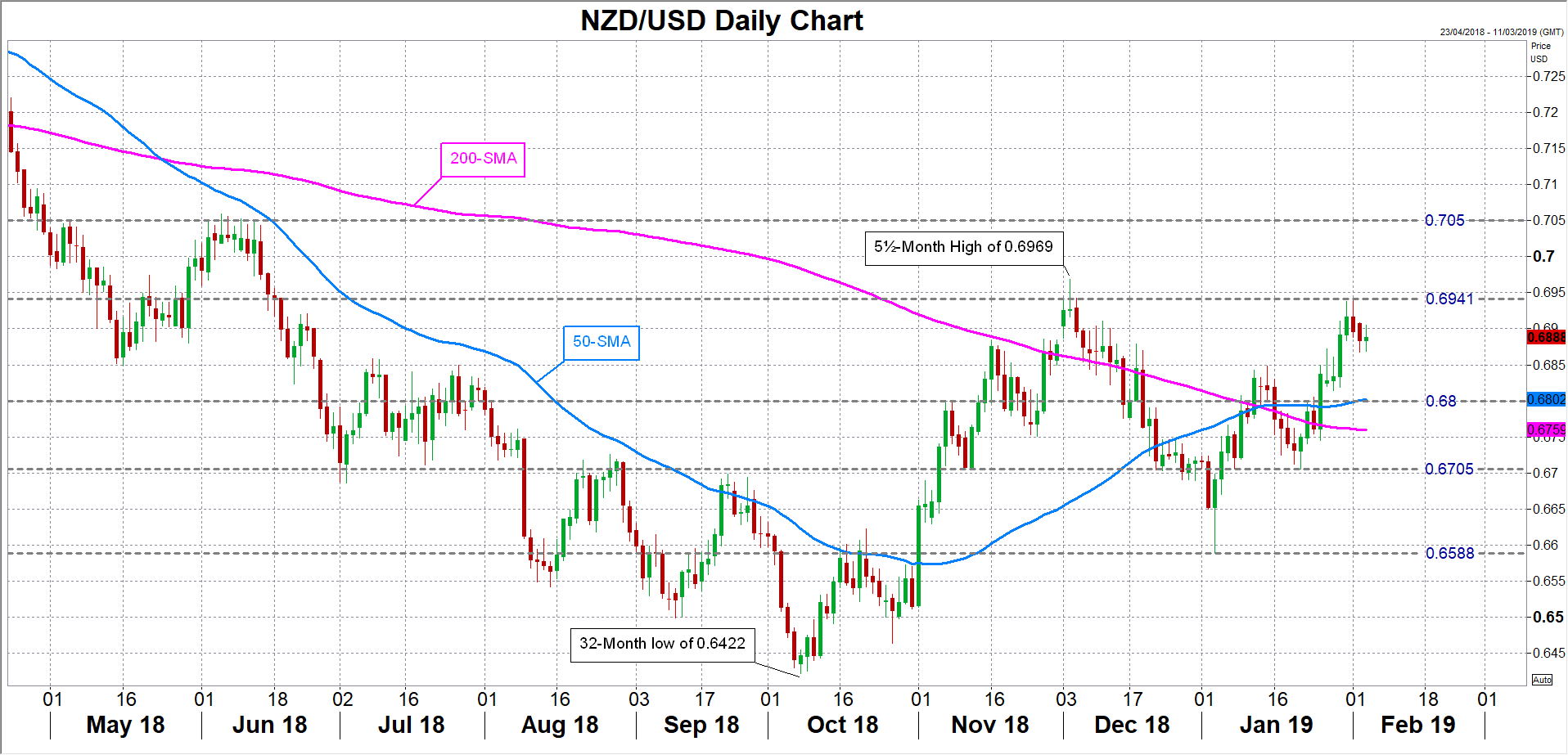
However, in the event that the jobs numbers disappoint, kiwi/dollar could seek support from the 50-day moving average, which currently stands at the 0.68 handle. A drop below this level could pull the pair towards the recent swing low of 0.6705, while steeper declines would bring the January trough of 0.6588 back within range.
Position trading: USD/CHF running away, buy order cancelled
This is an update to our position trading strategy as mentioned here. In short, we tried to buy USD/CHF at 0.9880, stop at 0.9810 and target 1.0300. USD/CHF's break of 0.9994 indicates that rise from 0.9716 has resumed. The pull back from 0.9994 was shallower than expected and ended at 0.9908. Thus our order was not filled. We'll cancel the order for now and look for other opportunities later.
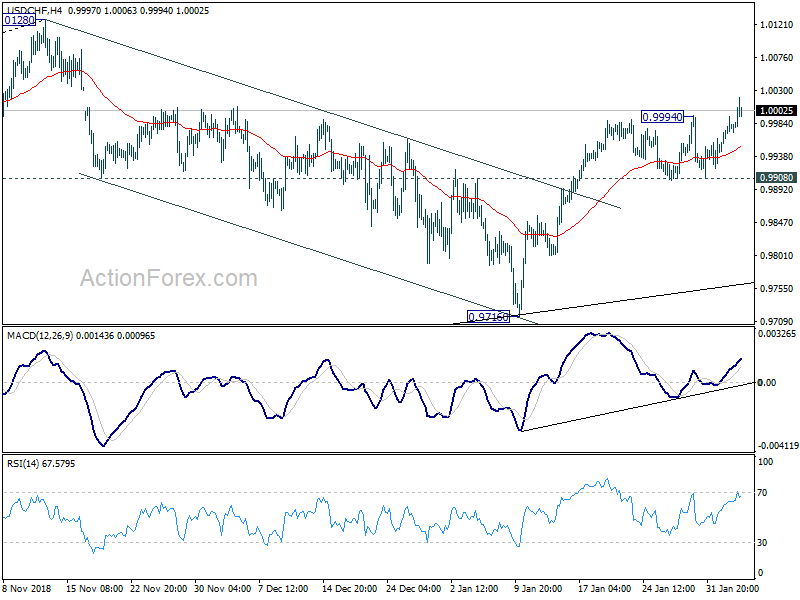
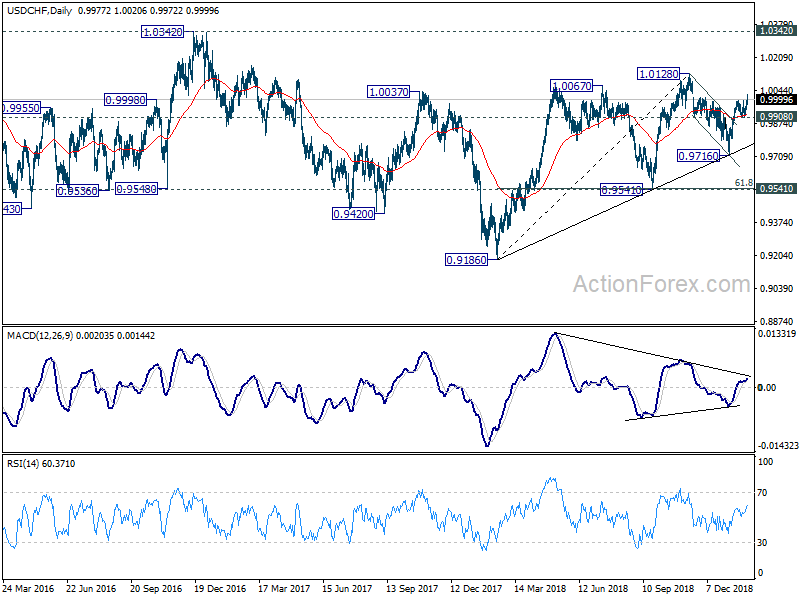
The overall bullish outlook in USD/CHF is unchanged. Correction from 1.0128 has completed at 0.9716 after drawing support from medium term trend line. Rise from 0.9716 will likely resume the whole up trend from 0.9186 to 1.0342 key resistance 2016 high.
Dollar suffered some broad based selling two weeks ago on talks that Fed was going to cut short the balance sheet reduction plan. Last week's FOMC statement was also dovish as the tightening bias was removed. However, we over-estimated the impact on Dollar. Or we have actually under-estimated Dollar's resilience. Thus, USD/CHF long now looks like a missed opportunity. Anyway, we'll come back to position trading strategy in the weekly report again. USD/CHF could still be a candidate.
MARKET WRAP: Bond Yields Dropped And Stocks Moved Higher
Risk on trade was the most popular trade once again and this pushed the equity markets higher. However, we also saw the gold price and Japanese yen moving higher as well.
Stocks
- The S&P 500 index jumped 0.2 percent as of 15:31 London time hitting the highest level in two months.
- The Stoxx Europe 600 Index picked its momentum from yesterday and gained 1.1 percent, touching the highest point in 12 weeks on its sixth consecutive advance.
- The MSCI Asia Pacific Index followed on its uptrend and gained 0.4 percent to the highest in almost four months.
- The MSCI Emerging Market Index also jumped up by 0.2 percent.
Currencies
- The Dollar Spot Index eased off from its previous level and dropped 0.05 percent.
- The Euro dropped after poor economic data and fell 0.1 percent to $1.143, the lowest point in more than a week.
- The British pound also dropped after treh Services PMI data and $1.2987, the weakest in two weeks.
- The Japanese yen jumped as little by 0.1 percent to 109.82 per dollar.
Bonds
- The yield on 10-year Treasuries went down by less than one basis point to 2.72 percent.
- Germany’s 10-year yield started to rise by one basis point to 0.19 percent.
- Britain’s 10-year yield dropped by one basis point to 1.269 percent.
Commodities
- Gold picked its momentum again and jumped 0.3 percent to $1,316.69 an ounce.
- West Texas Intermediate crude dropped by 1.1 percent to $53.97 a barrel
German Industrial Indicators to Turn Positive in December; Unlikely to Change Dim Outlook
Key indicators out of Germany will be in focus this week as investors assess the health of the Eurozone’s industrial powerhouse for the month of December. Industrial orders will be watched first on Wednesday, followed by industrial production numbers on Thursday and trade figures on Friday, all due at 0700 GMT. After a dismal second half for industrial activity, 2018 is expected to have ended somewhat more positively. However, traders might treat any rebound with caution given recent downgrades to growth forecasts by both the government and the Bundesbank.
Germany’s economy has been decelerating since the start of 2018, with a variety of factors such as Brexit, trade tensions and bouts of political uncertainty on the continent weighing on business sentiment and investment. The slowdown has become much more persistent and severe than what most analysts and policymakers had anticipated, and Germany is now flirting with recession, threatening to derail a fragile Eurozone recovery.
Should there be are any encouraging components in this week’s data, they could provide some glimmer of hope for the markets that the worst is over and growth is steadying, even if an actual rebound may be some time away. Looking first at industrial orders, they are forecast to have increased by 0.3% month-on-month in December after tumbling by 1% in November. New manufacturing orders have been on a down path for much of the year and it’s been a similar trend for industrial production.
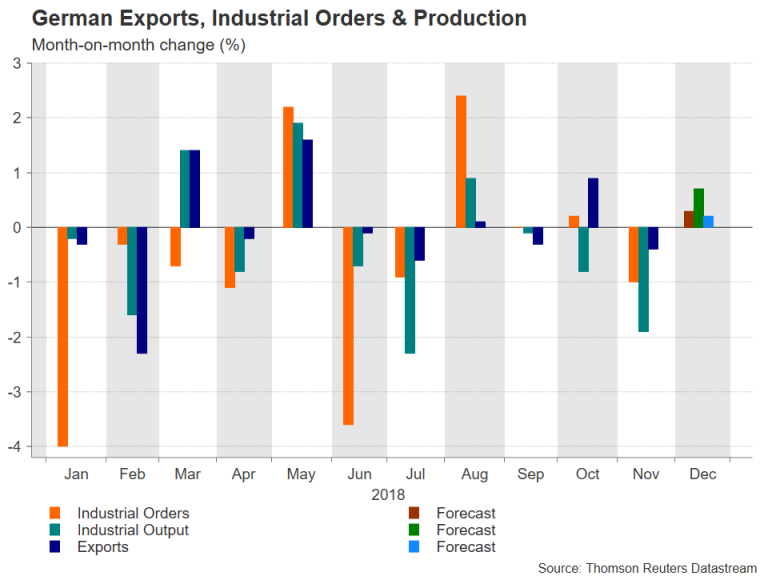
German industrial output fell for the third consecutive month in November, by 1.9% m/m. It is expected to have recovered slightly by 0.7% m/m in December. Exports, meanwhile, have performed similarly poorly since last summer as weakening overseas demand has hurt German manufacturers, which rely heavily on international trade. Exports are forecast to have risen by 0.2% m/m in December, reversing half of the prior month’s drop.
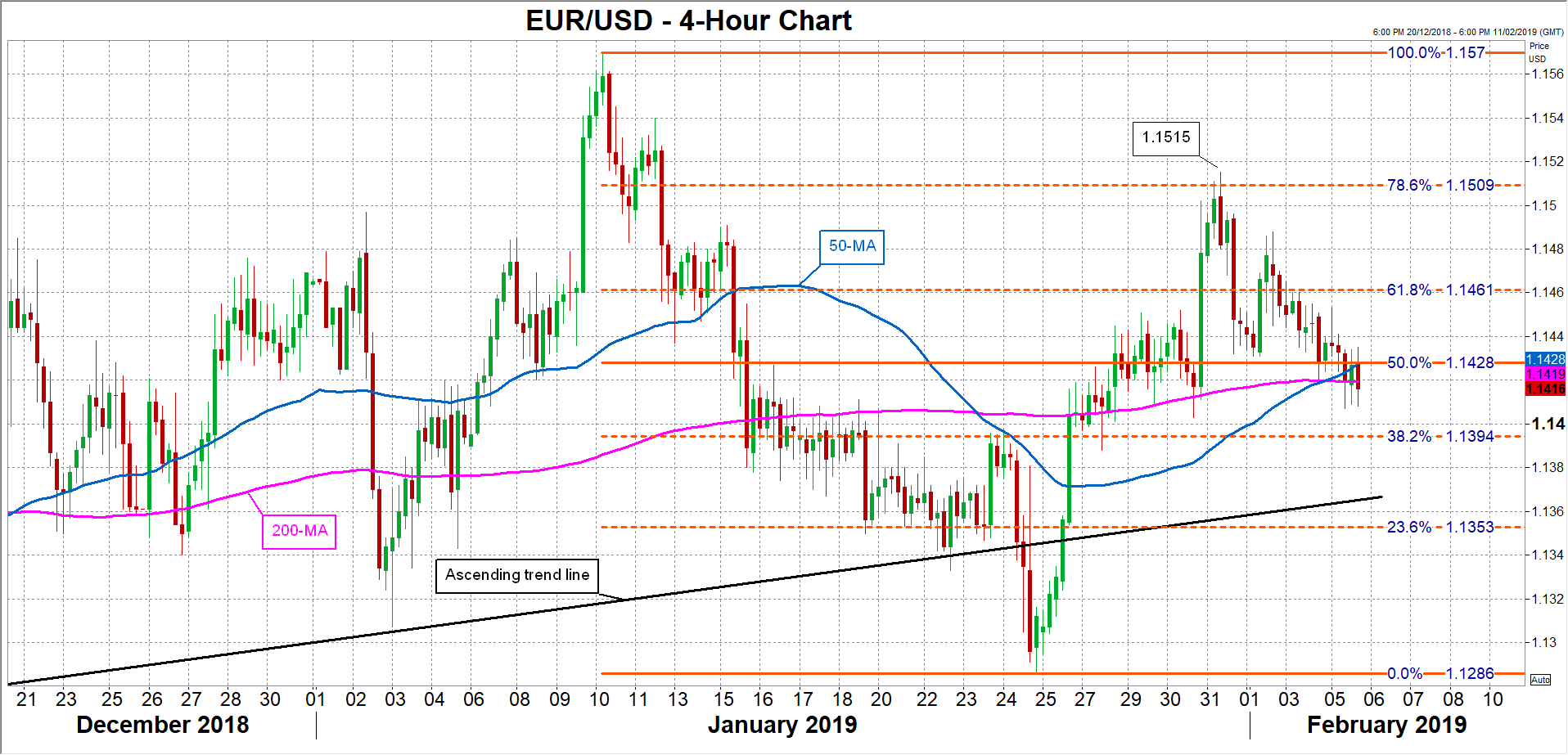
If the above releases surprise mostly to the upside, euro/dollar might be able to overcome immediate resistance at the 50% Fibonacci retracement level of the downleg from 1.1570 to 1.1286, which is around the 1.1430 level. A break above it would clear the way for the 61.8% Fibonacci at 1.1461, while higher up, the January top of 1.1515, which lies near the 78.6% Fibonacci, could be the next target for the bulls.
On the other hand, a negative set of numbers could drag euro/dollar down to the 38.2% Fibonacci at 1.1394. Failing this support, the pair would be at risk once again of crossing below the medium-term ascending trend line, which would then turn the focus on the 23.6% Fibonacci at 1.1353. A steeper sell-off would increase the prospect of breaching January’s 6-week low of 1.1286.
The latest IHS Markit PMI data suggest the manufacturing slump continued in January so any boost to the euro from unexpectedly strong numbers would likely be limited as they would not necessarily point to a turnaround in growth. The German government is also becoming gloomier. Last week, the country’s Economy Ministry sharply revised down Germany’s growth forecast for 2019 from 1.8% to just 1.0%. The Bundesbank looks set to follow suit. Its President, Jens Weidmann, speaking one day later said the economy “will probably grow well below the potential rate of 1.5 percent in 2019”. Only in December, the central bank had projected growth of 1.6%.
Sunset Market Commentary
Markets
Global core bonds are mixed today as risk sentiment flourished in Europe, causing German Bunds to underperform US Treasuries. EU equities moved north after the bell and a positive revision of the Eurozone PMI’s boosted sentiment further, weighing core bonds down. The German Bund edged lower throughout the day and set an intraday low as some ECB officials are said to be reluctant to change the forward guidance on interest rates. There was no follow-through action though and Bunds paired losses as US Treasuries found a bid at the start of US dealings. The German yield curve moves limited higher with changes up to 0.5 bps (5-yr). US Treasuries moved sideways today with a slightly upward tendency even as US (risk) sentiment remained positive in the run up to the ISM Non-Manufacturing Index (January). Apart from that, there was nothing on the US economic calendar to guide traders. Investors await President Trump’s State of the Union address, later today after US markets have called it a day. The US yield curve edges lower with changes varying between -0.5 bps (2-yr) to -1.4 bps (10-yr).
There was again no unequivocal deriver for EUR/USD trading today. Early this morning, the dollar maintained the benefit of the doubt. EUR/USD slipped to the 1.1415 area even as EMU PMI’s were slightly better (less weak) than expected. Poor Italian PMI’s probably prevented the euro to profit from a stronger overall PMI and lightly higher yields at that time. The EUR/USD started an intraday bottoming out process. Later, the euro regained some ground after a press article/rumours that the ECB was unlikely to change its forward guidance on interest rates at the March policy meeting. Interest rates differentials are slightly narrowing in favour of the euro. FX traders are now looking forward to the non-manufacturing ISM and President Trump’s State of the Union. EUR/USD is trading in the 1.1425/30 area. USD/JPY (108.85 area) again failed to sustain the move north of the 110 handle.
Contrary to what was mostly the case of late, the UK eco data rather than Brexit set the tone for sterling trading today. EUR/GBP lost a few ticks early in European dealings, tracking the intraday downward bias in the EUR/USD headline pair. However, the UK PMI’s turned the focus again to sterling side of the story. The UK services PMI (50.1) and the composite measure (50.3) declined more than expected, suggesting that UK economic growth is moving close to stagnation as the country is nearing the March 29 Brexit deadline. A decline in the eco dynamics also suggest a cautious BoE assessment at Thursday’s policy meeting. At the same time there was no indication that the UK and EU are making progress on a Brexit deal. EUR/GBP rebounded off the intraday lows and currently regains the 0.88 big figure. Cable is testing the 1.30 big figure.
News Headlines
Reuters cites sources close to the ECB who are reluctant to alter the central bank’s forward guidance on policy rates – unchanged at least through the Summer – in order not to tie the next chair’s governor who takes over from ECB President Draghi on November 1. This stance suggests a preference to use other weapons in the CB’s toolkit first if needed to restore confidence. A new set of targeted long term refinancing operations is often rumoured.
The Swedish services PMI declined from 55.8 to 54.1 in January, the weakest reading since April 2016. All components of the report, apart from suppliers’ input prices, suffered a setback. The manufacturing PMI last week eased from 51.8 to 51.5. EUR/SEK tested this year’s high around 10.43, but failed to creep higher.
Under the National Industry Strategy 2030, the German government could (temporarily) buy stakes in important domestic companies to prevent foreign takeovers and key technologies leaving Germany, the country’s Minister of Economy said. Sectors under consideration include steel and aluminum, chemicals and defense.
GBP/USD Outlook: Bears Crack 1.30 Level, Eye Pivotal Support at 1.2904
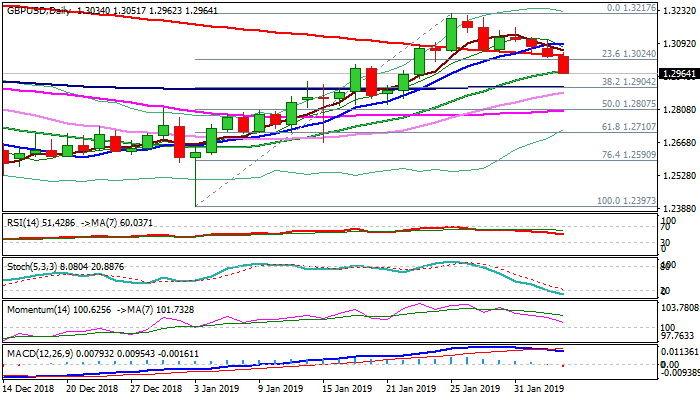
Cable cracked 1.30 support in extension of weakness after lower than expected UK service sector PMI in Jan, released earlier today. Downside pressure increased after Monday's close below 200SMA and sustained break below 1.30 and rising 20SMA (1.2977) would spark fresh bearish acceleration towards next pivotal support at 1.2904 (100SMA/Fibo 38.2% of 1.2397/1.3217), violation of which would generate reversal signal and open way for further decline. Bearish studies on lower timeframes and weakening daily techs work in favor of fresh bears. US non-manufacturing PMI is next key event (Jan 57.0 f/c vs upward-revised Dec figure at 58), with downside surprise expected to weaken dollar and slow pound's bears. Conversely, stronger than expected Jan figure would further boost current bears.
Res: 1.3000; 1.3024; 1.3041; 1.3085
Sup: 1.2942; 1.2904; 1.2879; 1.2807
US ISM services dropped to 56.7, growth cooled off by business mostly optimistic
US ISM Non-Manufacturing Composite dropped to 56.7 in January, down from 57.6 and missed expectation of 57.0. Business Activity Index dropped -1.5 to 59.7. New Orders dropped -5 to 57.7. Employment Index rose 1.2 to 57.8. 11 non-manufacturing industries reported growth.
ISM noted that "The non-manufacturing sector's growth rate cooled off in January. Respondents are concerned about the impacts of the government shutdown but remain mostly optimistic about overall business conditions."
Some quotes from respondents:
- "Business has slowed well below expectations as our customers deal with the effects of economic situations exacerbated by the government shutdown." (Construction)
- "Apprehension regarding overall economic conditions due to uncertainly of the partial government shutdown, its effect on business climate and lack of national strategic direction. Economic activity remains strong locally; however, there is concern that this may change quickly due to uncertainty and reports of slowing economic indicators." (Public Administration)
- "Things are steady. We're trying to mitigate any impact of the tariffs." (Retail Trade)
- "The shutdown and potential delay in tax refunds will hurt our business." (Wholesale Trade)
EUR/CHF Mid-Day Outlook
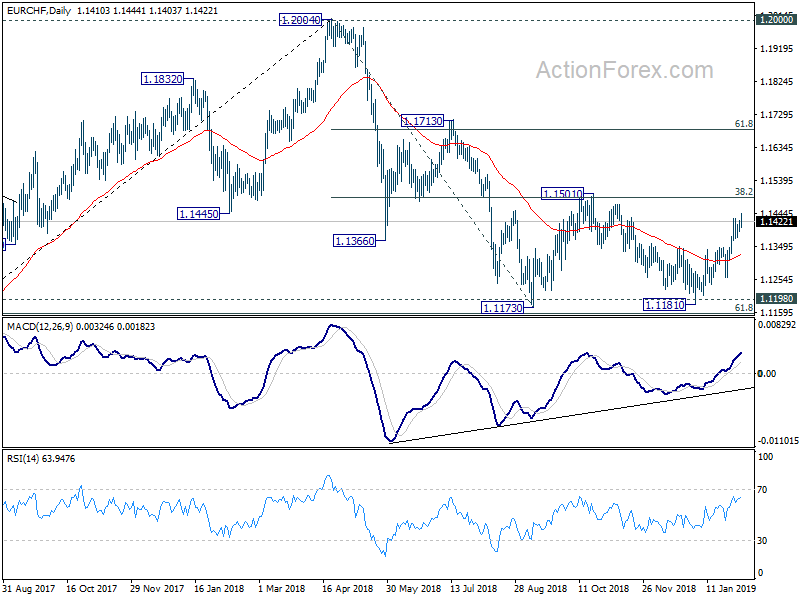
Daily Pivots: (S1) 1.1391; (P) 1.1407; (R1) 1.1428; More...
EUR/CHF's break of 1.1429 resistance suggests resumption of rally from 1.1181. Intraday bias is turned back to the upside for retesting 1.1501 key resistance. On the downside, break of 1.1372 support is now needed to indicate completion of the rebound. Otherwise, near term outlook will stay cautiously bullish in case of retreat.
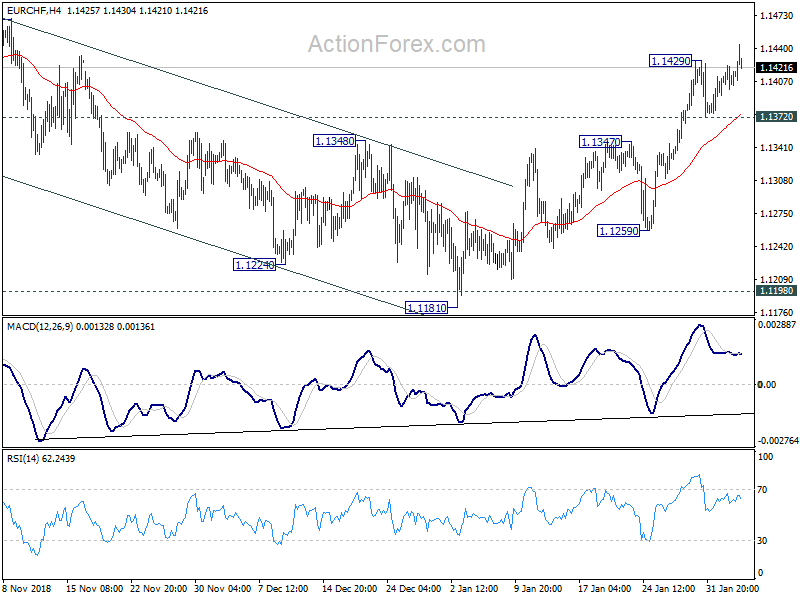
In the bigger picture, price actions from 1.2004 medium term top is seen as a correction only. Downside should be contained by 1.1154/98 support zone to complete it and bring rebound. Decisive break of 1.1501 (38.2% retracement of 1.2004 to 1.1173 at 1.1490) will confirm completion of the correction, on bullish convergence condition in daily MACD, with double bottom pattern (1.1173, 1.1181) Further rise should be seen to 61.8% retracement at 1.1687 and above next.
Lack of Canadian Events Leaves Loonie Listless
USD/CAD has posted small gains for a second successive day. Currently, the pair is trading at 1.3125, up 0.11% on the day. On the release front, there are no Canadian events for a second straight day. On Wednesday, Canada releases Building Permits and Ivey PMI. In the U.S, the key event is ISM Non-manufacturing PMI, which is expected to dip to 57.2 points. Later on Tuesday, President Trump delivers the State of Union address before Congress.
It’s been a quiet week for the Canadian dollar, after strong gains a week earlier. The absence of Canadian releases has contributed to the lack of movement of the currency. With Canada releasing Ivey PMI on Wednesday and key employment data on Friday, traders should be prepared for stronger movement from USD/CAD. The markets will also be keeping a close eye on the Federal Reserve, as Fed Chair Jerome Powell speaks at an event in Washington. At last week’s monetary policy update, Powell said that the central bank would be “patient” regarding future rate hikes. It was an aggressive 2018 for the Fed, which raised rates four times last year, in response to a hot U.S. economy. However, with a global trade war in full force and U.S. growth slightly lower, the Fed has trimmed its forecast to two interest rates in 2019. Many analysts have gone further, predicting no rate hikes this year.